
5 Best Solar Powered Pumps for Irrigation Systems
Watering your garden, farm, or landscape doesn’t need to rely on electricity or gas.
A solar powered irrigation pump offers a reliable, energy efficient solution for watering, especially in off-grid or remote areas.
By harnessing the sun’s energy, a solar irrigation pump system reduces your utility costs, helps conserve the environment, and keeps water flowing wherever you need it.
Whether you’re managing a small vegetable garden, a greenhouse, or an entire field, solar water pumps for irrigation come in various sizes and styles to suit different needs.
From submersible pumps that draw water from deep wells, to surface pumps ideal for ponds or rainwater collection barrels, there’s a solar solution for nearly every setup.
In this guide, we’ve reviewed five of the best solar water pumps for gardens, fountains, and irrigation, judged on performance, build quality, ease of installation, and overall value.
A quick note before you buy: two of the pumps below (the fountain kits) are true solar-direct pumps, while the other three are AC or pressure pumps that can be paired with a solar panel, controller, and battery, or run from a generator or grid power. We label each one clearly so you know exactly what you’re getting.
Quick Comparison: Best Solar Water Pumps for Irrigation
| Pump | Best For | Power Source | Key Spec |
|---|---|---|---|
| ECO-WORTHY Solar Fountain Pump Kit | Birdbaths, small ponds | Solar panel (no battery) | 410 GPH, ~7 ft lift |
| VEVOR Deep Well Submersible Pump | Deep wells, field irrigation, tank filling | AC (generator or solar inverter system) | 37 GPM, 200+ ft depth |
| POPOSOAP Solar Bird Bath Fountain Pump | Patio fountains, hydroponics | 6W glass solar panel (no battery) | 5 nozzles, auto shut-off |
| ECO-WORTHY 33-Series Pressure Pump | Sprinklers, pools, RVs | 110V AC | 4.0 GPM, up to 70 PSI |
| WASSERMANN Water Pressure Booster Pump | Rain barrel to garden, booster use | 115V AC (works with solar setup) | 5.0 GPM, 55 PSI |
ECO-WORTHY Solar Fountain Water Pump Kit Review
I picked up the ECO-WORTHY 25W Solar Fountain Pump to bring some life to my birdbath and small backyard pond. Right out of the box, the setup was simple.
I connected the panel, placed the pump in the water, and it started running as soon as the sun came out.
The flow is strong at 410 GPH, and the lift height is just under 7 feet. It keeps the water circulating nicely and adds a pleasant visual effect.
The long power cord gave me flexibility with where I positioned the solar panel, which was helpful.
The upgraded monocrystalline panel is efficient, but it absolutely needs direct sunlight. Even a little shade drops the performance or shuts it off entirely.
I ended up buying their extension cable so I could move the panel to a fully sunny area, which made a big difference in how well the pump worked throughout the day.
Keep in mind, this pump doesn’t have a battery, so it only runs when the sun is shining. No operation at night or on very cloudy days.
I’m considering getting their battery upgrade to get a more consistent run time.
What really impressed me was the customer service. I missed a discount when I bought it, but after contacting the seller, they refunded me the cost of the extension cable, no questions asked. That level of support adds real value.
Best for: small ponds, birdbaths, and decorative water features where daytime-only operation is fine.
Pros: 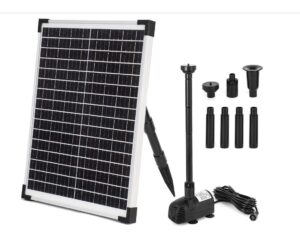
- Strong water flow and lift
- Easy to set up and use
- Efficient solar panel
- Excellent customer support
Cons:
- Very sensitive to shade
- No power storage for night use
VEVOR Deep Well Submersible Pump Review
I bought the VEVOR 1HP Deep Well Pump to replace a failing unit on our farm well. Honestly, I’m impressed by its solid performance and construction.
It’s been running nonstop for over 60 hours without a hiccup.
The water pressure is strong. It easily pushes water from over 200 feet deep. The 37 GPM flow rate is perfect for watering the fields and keeping the garden green.
I also use it to fill storage tanks fast. No more waiting around for hours.
Build quality is excellent. The stainless steel body gives me peace of mind it won’t rust or wear out quickly like cheaper models.
Plus, it’s ETL certified and fully waterproof with an IP68 rating. I can see this pump lasting many seasons.
Installing it was straightforward. The included 33-foot cord gave me the flexibility to position it just right.
I do recommend using a generator with solid output, though. The startup power draw is high, around 2500W. It’s manageable, but worth noting.
Running it on solar: this is an AC pump, so a solar setup needs a properly sized inverter and enough panel and battery capacity to handle that startup surge. For a true solar-direct deep well setup, look for a DC or solar-specific submersible pump with its own controller.
What I like most is the built-in check valve and filter system. It keeps debris out and prevents backflow, so the pump runs smooth. For newly drilled wells, just wrap some gauze on the intake to be safe.
Best for: deep wells and larger irrigation jobs where you need high flow and lift.
Pros: 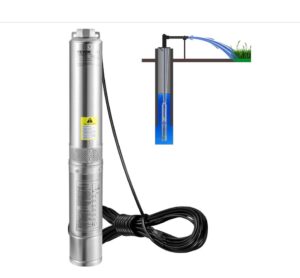
- High flow and deep lift performance
- All stainless steel design
- Reliable copper motor with safety features
- Built-in check valve and filtration
Cons:
- High startup power draw
- Needs clean water; add gauze for new wells
POPOSOAP Solar Bird Bath Fountain Pump Review
I got the POPOSOAP Solar Fountain Pump to give my patio birdbath a little charm, and it didn’t disappoint.
The water starts flowing almost instantly in full sun, and the spray is lively and eye-catching.
The upgraded 6W glass solar panel is a huge plus. It feels durable and looks sleek. Unlike cheap plastic panels, this one doesn’t warp or fade in the sun.
Just point it toward the light and let it do the rest.
What I love most is how customizable it is. It comes with five different nozzles, so you can switch between spray patterns depending on your mood or setup.
The 4-foot tubing is perfect for creating a small waterfall or stream. DIY projects just got more fun.
Installation was quick. I dropped the pump in the water and mounted the panel on a nearby fence post. It includes an adjustable bracket, so finding the best sun angle is easy.
Now for the catch: this fountain only works while the sun is shining directly on the panel. It doesn’t store energy. So if a cloud rolls in, the water stops.
It’s best for sunny patios or daytime enjoyment, not nighttime ambiance.
The built-in filter and water shortage sensor are great touches. It shuts off automatically when the water is low, so the pump doesn’t burn out. Plus, it comes with extra filter sponges.
Best for: birdbaths, patio fountains, small hydroponic setups, and ponds.
Pros: 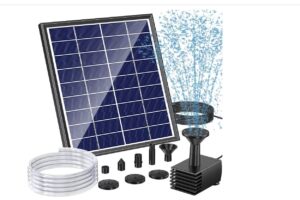
- Strong and steady water spray in full sun
- Durable and high-efficiency glass solar panel
- Easy to install with adjustable mounting bracket
- Includes 5 spray nozzles and 4-ft tubing for custom setups
- Automatic shut-off when water is low
- Great for birdbaths, fountains, hydroponics, or ponds
Cons:
- Only works in direct sunlight (no battery backup)
- Stops immediately when shaded or cloudy
- Not suitable for nighttime use
ECO-WORTHY 33-Series Industrial Water Pressure Pump Review
We bought the ECO-WORTHY 33-Series pump to create some backyard fun for the grandkids. The goal?
Push pool water up their slide without adding more water to the pool. And it works like a charm.
Setup was easy. Everything needed to hook up hoses or tubing came in the box. It even includes garden hose adapters and a roll of Teflon tape.
Just a heads-up: all the fittings have rubber seals, so you won’t need the tape, but it’s still nice to have on hand.
The power is impressive. This little diaphragm pump runs at 4.0 GPM and holds pressure steady at 50 PSI.
It automatically shuts off when no water is flowing, so you’re not wasting energy. No loud startup noises. It’s on-demand and super quiet.
We’ve run it for hours in 90-degree weather without a hitch. The motor stayed cool, and we didn’t run into any pressure loss.
The thermal protection feature gives peace of mind, especially when using it for long stretches.
It’s also self-priming and can lift water nearly 150 feet, which is great for irrigation or marine uses too. The pressure is adjustable (45–70 PSI), so you can fine-tune it for your setup.
Solar note: this is a 110V AC pump, so pair it with a solar power station or an inverter-based solar system if you want to run it off-grid. It makes a good solar powered irrigation pressure booster pump for sprinklers and drip lines once your power supply is sorted.
Honestly, this pump exceeded our expectations. Whether for gardening, marine, or backyard projects, it’s a powerful little workhorse.
Pros: 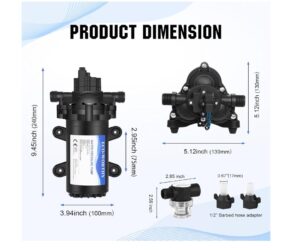
- Strong 4.0 GPM flow with up to 70 PSI
- Auto on/off with smart pressure switch
- Quiet operation and thermal overload protection
- Comes with garden hose adapters and seals
- Works for pools, RVs, irrigation, and more
- Easy to install and adjust
Cons:
- No pipe threads (all rubber-sealed fittings)
- Not battery-powered (110V AC only)
WASSERMANN Water Pressure Booster Pump Review
Getting this pump up and running was a bit of a puzzle at first, but once I figured it out, it turned out to be a solid performer. I set it up with a solar controller, a battery, and a solar panel. At first, nothing happened. No sound, no pressure, no flow.
Turns out, the issue was simple: the pump needed more power than my 10A controller could provide. Swapped in a 20A controller and boom, it fired right up.
Still, no water came through. Then I realized I’d missed two red plugs hidden inside the inlet and outlet ports. Once those were out, everything worked perfectly.
This pump is impressively strong. I use it to move water from a rain barrel across my garden, and it shoots more than halfway across the yard with ease.
It’s rated at 5 GPM and 55 PSI, and I believe it. Plenty of pressure to run sprinklers or a hose nozzle with no problem.
It’s plug-and-play with a standard 115V outlet, and the built-in pressure switch works just right. It starts automatically when I open a tap and shuts off when I close it.
If you need to boost water pressure in an RV, garden, or even on a boat, this pump gets the job done. Just don’t forget to check those hidden caps!
Best for: rain barrel irrigation, sprinklers, and small off-grid garden setups with a battery and solar controller.
Pros: 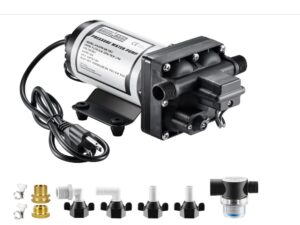
- Strong 5.0 GPM output with 55 PSI pressure
- Easy 115V plug-in, no special wiring needed
- Automatic start/stop with pressure switch
- Compact, reliable, and good for RVs or gardens
- Includes filter and hose adapters
Cons:
- Setup can be tricky if you miss the red caps
- Needs a 20A controller if used with solar
What is a Solar Powered Water Pump?
A solar powered water pump is a water pumping system that runs on electricity generated by solar panels, instead of relying on grid electricity or fuel-based generators.
It uses solar energy to power a motor, which then moves water from a well, river, pond, or storage tank to your desired location, like a garden, field, or household system.
These pumps are ideal for remote or off-grid areas, farms, gardens, and sustainable homes where traditional power access is limited or costly.
They help reduce electricity bills and carbon emissions, making them eco-friendly and cost-effective in the long run.
How Does a Solar Powered Water Pump Work?
- Solar Panel Absorbs Sunlight
Photovoltaic (PV) solar panels capture sunlight and convert it into direct current (DC) electricity. - Controller Regulates Power
The system includes a pump controller that manages voltage and current to protect the pump and optimize its performance. It can also include features like dry-run protection or adjustable flow settings. - Electricity Powers the Motor
The DC electricity (or converted AC via an inverter) runs the electric motor in the pump. - Water is Pumped to Target Location
The motor drives the pump mechanism (either submersible, surface, or centrifugal) to draw water and deliver it to a designated area like a tank, irrigation line, or garden bed.
Some systems also include battery storage, allowing them to store solar energy for use during cloudy days or at night.
Uses of a Solar Water Pump
Solar water pumps are far more versatile than most people expect. Common uses include:
- Garden and crop irrigation: watering vegetable beds, orchards, and open fields, including drip and sprinkler systems.
- Livestock watering: filling troughs and tanks in pastures with no grid power.
- Household water supply: moving well or tank water to a home in remote locations.
- Ponds, birdbaths, and fountains: circulating and aerating water for decoration and wildlife.
- Greenhouses and hydroponics: supplying water to plants and nutrient systems.
- Rain barrel and tank transfer: moving stored rainwater to where it’s needed.
Types of Solar Irrigation Pumps
Choosing the right type of solar pump for irrigation depends on where your water comes from and how far it needs to travel.
- Submersible solar pumps: sit inside the well or borehole and push water up. Best for deep wells and large irrigation needs.
- Surface solar pumps: sit above ground and pull water from ponds, tanks, streams, or shallow sources. A solar surface pump for irrigation is easier to install and service.
- Solar fountain and floating pumps: low-power, panel-direct pumps for ponds, birdbaths, and decorative features.
- Pressure booster pumps: add pressure for sprinklers, drip lines, and hose nozzles. Solar powered irrigation booster pumps are usually paired with a battery or power station.
DC vs. AC Solar Pumps
DC pumps connect directly to solar panels through a controller. They are highly energy efficient and simple, which makes them a good fit for most off-grid and remote irrigation systems.
AC pumps need an inverter to run from solar. They are usually cheaper to buy and easier to find, but the inverter adds cost and some energy loss, and their startup surge means you need a larger solar system.
How to Choose the Best Solar Water Pump
If you’re wondering which is the best solar pump for your property, check these factors first:
- Water source and depth: a deep well needs a submersible pump; a pond or tank works with a surface pump.
- Total dynamic head: this is the vertical lift plus friction loss in your pipes. Make sure the pump’s rated head is higher than your real requirement.
- Flow rate (GPM or GPH): add up how much water your plants or animals need per day, then divide by your peak sun hours.
- Panel size: choose panels with a wattage a little above the pump’s rating to cover cloudy conditions and system losses.
- Battery or no battery: a direct-to-panel system is cheaper and simpler; batteries add night and cloudy-day operation but raise cost and maintenance.
- Controller quality: look for dry-run protection, overload protection, and an MPPT controller for better efficiency.
- Scale of the job: large schemes covering many acres usually need higher-capacity DC systems and professional design rather than small DIY kits.
Best Location for a Solar Water Pump and Panel
Placement makes a big difference in how well a solar irrigation pump performs.
- Put the panel in full sun: choose a spot with no shade from trees, buildings, or fences between roughly mid-morning and mid-afternoon.
- Face the panel toward the equator: south-facing in the Northern Hemisphere, and north-facing in the Southern Hemisphere. Tilt it close to your latitude for year-round output.
- Keep the pump close to the water source: shorter pipe runs mean less friction loss and less power needed.
- Protect the controller and battery: mount them in a dry, ventilated, shaded enclosure away from flooding.
- Keep panels clean and secure: dust and debris cut output, and panels should be mounted where they are safe from theft or damage.
Solar Water Pump Maintenance Tips
- Wipe panels regularly to remove dust, bird droppings, and leaves.
- Clean or replace the pump’s intake filter to prevent clogs and overheating.
- Check wiring, connectors, and the controller for corrosion or loose connections.
- Never let the pump run dry; use a model with dry-run protection or a float switch.
- Inspect batteries (if used) and keep them within their recommended temperature range.
FAQs: Solar Powered Pumps for Irrigation
1. Do solar water pumps work at night?
Only if connected to a battery system. Without a battery, the pump will only work when the sun is shining.
2. Can solar pumps lift water from deep wells?
Yes. Submersible solar pumps are designed for deep wells and can lift water from depths of 100 feet or more, depending on the model.
3. How much sunlight is needed for a solar pump to work efficiently?
Most pumps need 4–6 hours of direct sunlight per day for optimal performance.
4. Are solar irrigation pumps hard to install?
Most DIY kits are easy to install, especially surface pumps. Submersible systems may require a bit more effort or professional help.
5. Can I use a solar pump for drip irrigation?
Absolutely. Many solar water pumps pair well with drip irrigation systems, delivering water slowly and efficiently. Just make sure your pump can deliver the pressure your drip emitters need, or add a filter and pressure regulator.
6. Do I need a battery with a solar pump?
It depends. If you want the pump to run when it’s cloudy or at night, a solar battery is recommended. Many farms skip batteries and simply store water in an elevated tank instead, using gravity to water crops when the sun is down.
7. What size solar panel do I need for a water pump?
Match the panel wattage to your pump’s power rating, then add a margin of roughly 20–30% for losses and cloudy conditions. AC pumps also need extra capacity to handle startup surges.
8. What is the difference between a solar surface pump and a submersible pump?
A surface pump sits above the water and pulls it in, so it suits ponds, tanks, and shallow sources. A submersible pump sits in the water and pushes it up, which makes it better for deep wells.
9. Can solar pumps irrigate large farms?
Yes. Larger DC solar pumping systems are used for large irrigation schemes. These are usually sized and installed by a solar pumping specialist based on your acreage, crop water needs, and well data.
10. Can I run a regular electric pump on solar?
Yes, if you add an inverter (and usually a battery or power station) that can handle the pump’s startup power. A purpose-built DC solar pump is generally more efficient.
Conclusion
If you’re looking for a sustainable and cost-effective way to irrigate your garden, field, or greenhouse, a solar powered water pump is a smart investment.
These pumps offer the freedom to water plants anywhere without worrying about electricity or fuel costs.
From compact units for small gardens to high-capacity systems for large farms, there’s a solar pump to match every irrigation need.
Plus, with fewer moving parts and lower operating costs, solar pumps require less maintenance and are built to last.
Choose one of the top-rated options reviewed in this guide, and start enjoying the benefits of solar-powered irrigation today: clean, quiet, and completely off-grid.

- Top 10 Best Easy Install Smart Doorbell 2026 - October 11, 2026
- Top 10 Best Smart Doorbell Compatible With Google Home 2026 - October 11, 2026
- Top 10 Best Outdoor Smart Doorbell 2026 - October 11, 2026


One Comment