17 Full Sun Perennials That Come Back Bigger and Better Every Year
Imagine planting a garden once and watching it transform into a richer, denser, more spectacular floral showcase every single spring. Unlike annuals that flare out and die at the first touch of frost, true perennial powerhouses invest their energy underground. Each year, they develop stronger roots, broader crowns, and more extensive networks of shoots, returning with greater vigor, more blooms, and improved pest resistance.
If you have a backyard baked by the midday sun, you don’t have to settle for scorched leaves or high-maintenance annual replacements.
This comprehensive, expert-vetted guide covers 17 exceptional full-sun perennials that thrive in intense light. We will explore the science of how they grow, detail their specific environmental preferences, and provide actionable tips to help you build a self-sustaining, pollinator-friendly landscape that matures beautifully over time.
Quick Answer for Voice & AI Search (AEO)
What are the best full sun perennials that come back every year?
The most reliable, long-lived perennials for full sun include Purple Coneflower (Echinacea purpurea), Black-Eyed Susan (Rudbeckia fulgida), Russian Sage (Salvia yangii), Woodland Sage (Salvia nemorosa), Daylilies (Hemerocallis), and Peonies (Paeonia). These plants thrive in 6 to 8+ hours of direct daily sunlight, are highly drought-tolerant once established, and naturally expand their root crowns to return larger and more floriferous each spring.
Why do some perennials grow larger and produce more blooms each year?
Perennials return bigger and better because of root architecture and metabolic storage. Over the growing season, their leaves photosynthesize sunlight into starches, which they store deep within underground structures like rhizomes, tubers, woody crowns, or deep taproots. During winter dormancy, the above-ground foliage dies, but the root system remains alive. Each spring, this larger, more mature root network supports a greater volume of stems, leaf tissue, and flower buds.
The Botany of “Bigger and Better”: How Perennials Expand
To design a low-maintenance, long-lived garden, it helps to understand the subterranean mechanics that drive perennial growth. Plants use three primary root strategies to expand:
                  ┌──────────────────────────────┐
                  │   PERENNIAL ROOT SYSTEMS     │
                  └──────────────┬───────────────┘
         ┌───────────────────────┼───────────────────────┐
         ▼                       ▼                       ▼
   [ Rhizomatous ]          [ Taproot ]           [ Crown Expanding ]
  Underground runners      Deep vertical anchor    Widening central hub
   Forms dense mats        Drought-resistant      Forms distinct clumps
  Ex: Russian Sage         Ex: Coneflower         Ex: Peonies, Daylilies
- Rhizomatous Spreaders: These plants send out horizontal underground stems called rhizomes. As they travel, they push up new clonal shoots. This makes them excellent natural weed-suppressing groundcovers.
- Deep Taproot Anchors: Plants with thick, vertical taproots drill deep into the soil profile. While they do not spread rapidly across the surface, they access moisture and minerals deep underground, making them incredibly drought-hardy and long-lived.
- Crown Expanders: These species grow outward from a central hub called a crown. Each year, the crown develops more eyes (buds) just beneath the soil surface, resulting in a wider, denser clump of stems and flowers.
17 Premium Full-Sun Perennials
1. Purple Coneflower (Echinacea purpurea)
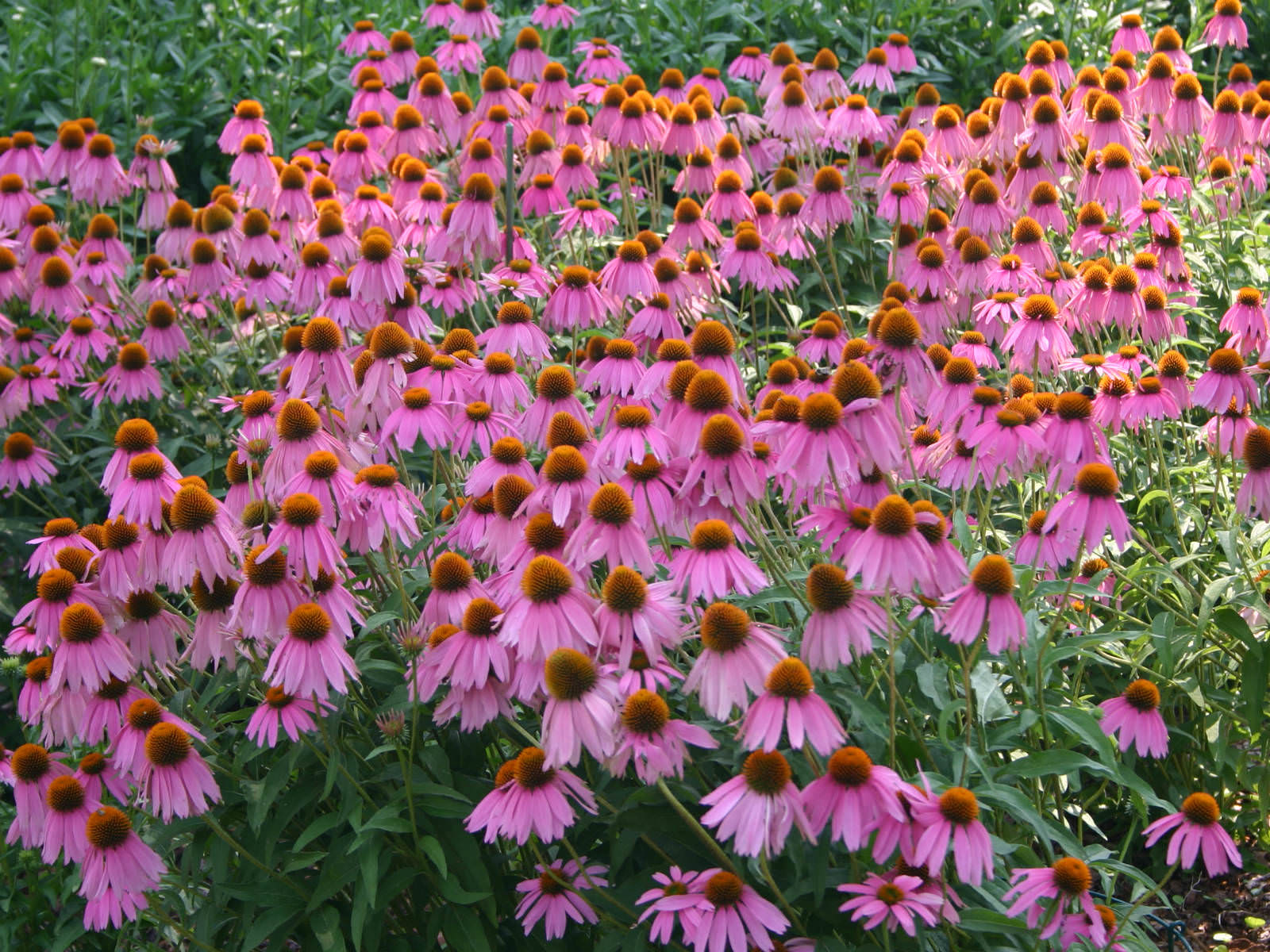
The Purple Coneflower is a quintessential American prairie classic, sporting large, daisy-like blossoms with reflexed, magenta-pink petals surrounding a prominent, orange-gold metallic central cone. It looks particularly striking when planted in naturalized drifts, where the heavy-headed flowers sway gracefully in the summer breeze against a bright blue sky.
- USDA Hardiness Zones: 3 – 9
- Mature Height & Spread: 2 – 5 feet tall | 1.5 – 2 feet wide
- Soil & Moisture: Average, dry to medium, well-drained soil; highly drought-tolerant once established.
- Bloom Period: Early summer to mid-autumn.
Why It Comes Back Bigger & Better:
Echinacea develops a thick, woody taproot system. In its first year, it may look modest as it directs its energy downward. By years three and four, that deep taproot efficiently draws up minerals and deep-ground moisture, allowing the plant to push up dozens of sturdy, self-supporting flower stalks. It also self-seeds gently, creating a beautiful, naturalized drift over time.
2. Goldsturm Black-Eyed Susan (Rudbeckia fulgida ‘Goldsturm’)
Nothing says late summer like a sweeping carpet of ‘Goldsturm’ Black-Eyed Susans. Each flower boasts brilliant, daisy-like golden-yellow petals radiating outward from a dense, chocolate-brown central button. The rough, deep green foliage provides a beautiful contrast, making the fiery yellow blooms practically pop under the warm rays of the afternoon sun.
- USDA Hardiness Zones: 3 – 9
- Mature Height & Spread: 2 – 3 feet tall | 1.5 – 2 feet wide
- Soil & Moisture: Adaptable to clay, loam, or sandy soils; prefers consistent moisture but tolerates dry spells.
- Bloom Period: Mid-summer to first frost.
Why It Comes Back Bigger & Better:
Unlike its short-lived cousin Rudbeckia hirta, ‘Goldsturm’ is a true perennial that spreads via creeping underground rhizomes. It forms a dense, weed-suppressing carpet of deep green foliage that widens reliably every year, offering a reliable, high-impact block of gold.
3. Russian Sage (Salvia yangii / Perovskia atriplicifolia)
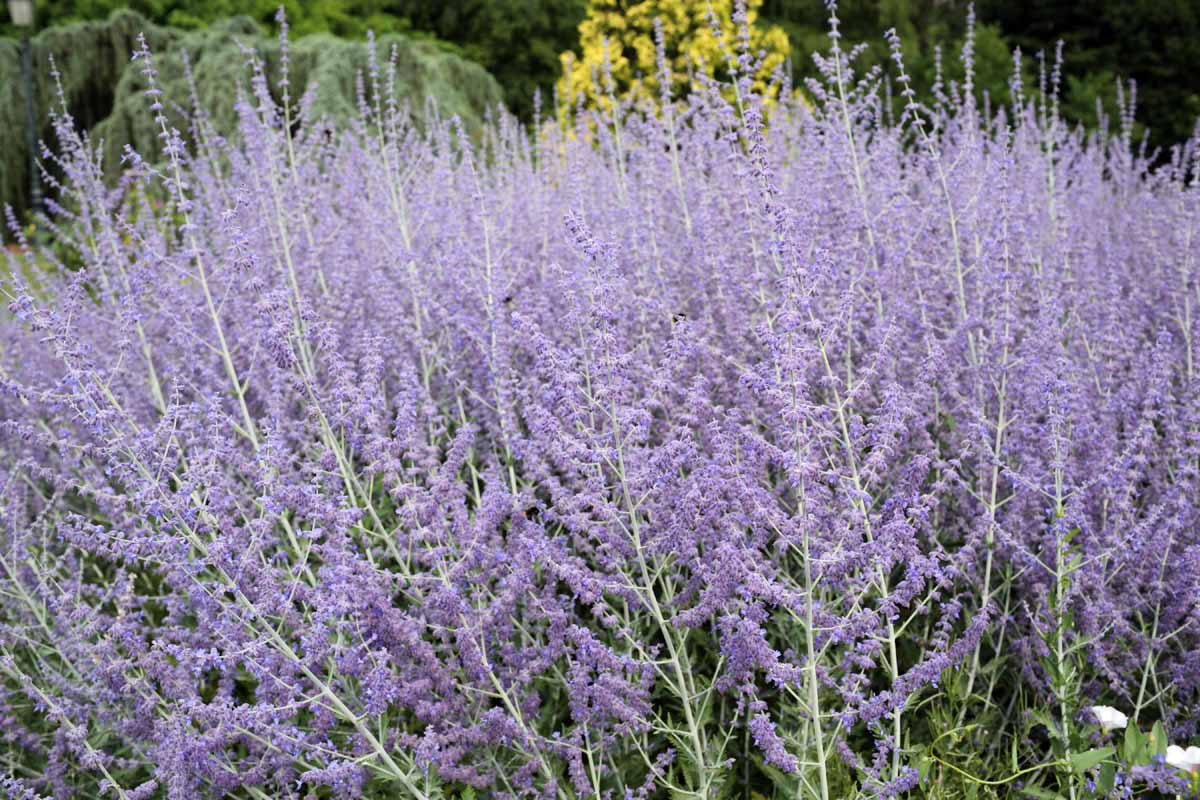
Russian Sage brings a soft, airy texture to the garden with its hazy clouds of tiny lavender-blue flowers held on long, silvery-white stems. Its finely-cut, aromatic, grey-green leaves release a pleasant herbal scent when brushed against. It creates a beautiful, mist-like cooling effect when planted next to hot-colored companions.
- USDA Hardiness Zones: 5 – 9
- Mature Height & Spread: 3 – 4 feet tall | 3 – 4 feet wide
- Soil & Moisture: Poor, rocky, dry, highly alkaline soils; requires sharp drainage.
- Bloom Period: Mid-summer to late autumn.
Why It Comes Back Bigger & Better:
Russian Sage is a woody perennial with a robust, expansive root system. It thrives on neglect, heat, and poor soil. Each spring, after being cut back to the ground, it returns with woodier, sturdier base stems, creating a massive, cloud-like display of blue-purple flowers that stands strong against late-summer storms.
4. May Night Woodland Sage (Salvia nemorosa ‘May Night’)
‘May Night’ is one of the most reliable and intense perennial salvias, producing dense, upright spikes of deep indigo-violet flowers. The spikes rise above compact mounds of aromatic, rugose green foliage. The sheer density of the flower spikes creates clean, architectural lines that look spectacular bordering garden paths or gravel walkways.
- USDA Hardiness Zones: 4 – 9
- Mature Height & Spread: 1.5 – 2 feet tall | 1.5 – 2 feet wide
- Soil & Moisture: Average, moist but well-drained soil; highly drought-tolerant once established.
- Bloom Period: Late spring to late summer (if deadheaded).
Why It Comes Back Bigger & Better:
This award-winning salvia expands outward from a dense central crown. With every winter that passes, the crown develops more growing points. By spring, it produces a thicker cluster of deep indigo spikes. If you cut the first round of flowers back after they fade, it will reward you with a second, equally impressive flush of blooms.
5. Stella de Oro Daylily (Hemerocallis ‘Stella de Oro’)
The cheerful ‘Stella de Oro’ Daylily is a staple of sunny borders, featuring bright golden-yellow, trumpet-shaped flowers that open fresh each morning. The blossoms sit just above lush, fountain-like mounds of narrow, arching, grass-like green leaves that remain attractive throughout the entire season.
- USDA Hardiness Zones: 3 – 9
- Mature Height & Spread: 1 – 1.5 feet tall | 1 – 1.5 feet wide
- Soil & Moisture: Highly adaptable; thrives in clay, sand, compacted urban soils, and dry conditions.
- Bloom Period: Early summer to mid-autumn (reblooming).
Why It Comes Back Bigger & Better:
Daylilies grow from thick, tuberous roots that store large amounts of moisture and nutrients. This underground storage makes them virtually indestructible. A single plant soon grows into a dense clump that can be easily divided in early spring to start new patches around your yard.
6. Sarah Bernhardt Peony (Paeonia lactiflora ‘Sarah Bernhardt’)
The ‘Sarah Bernhardt’ Peony is the epitome of classic garden romance, producing massive, heavily-ruffled, fully-double blossoms of soft apple-blossom pink. The inner petals are sometimes delicately flecked with crimson, and their sweet, vintage fragrance fills the late-spring air, making them the crown jewel of any cottage garden.
- USDA Hardiness Zones: 3 – 8
- Mature Height & Spread: 3 feet tall | 3 feet wide
- Soil & Moisture: Rich, fertile, moist, exceptionally well-drained soil; neutral to slightly acidic pH.
- Bloom Period: Late spring to early summer.
Why It Comes Back Bigger & Better:
Peonies are legendary for their longevity, often thriving in the same spot for fifty years or more. Their massive, fleshy root tubers store immense energy. While they may take a year or two to settle in and bloom after planting, their root system grows stronger and deeper each year, eventually producing dozens of fragrant, double-pink blooms on a single, bushy plant.
7. Arizona Sun Blanket Flower (Gaillardia x grandiflora ‘Arizona Sun’)
‘Arizona Sun’ produces a dazzling, low-growing carpet of fiery bi-color daisies. Each bloom features a central, dark reddish-brown button surrounded by brick-red petals tipped in bright, sunny yellow. It has a wild, rustic aesthetic that looks incredible spilling over rocky walls, bordering pathways, or planted in dry gravel beds.
- USDA Hardiness Zones: 3 – 10
- Mature Height & Spread: 1 foot tall | 1 foot wide
- Soil & Moisture: Poor, sandy, sharply drained soils; highly heat and drought-tolerant.
- Bloom Period: Early summer to late autumn.
Why It Comes Back Bigger & Better:
Blanket Flower thrives in hot, sunny conditions where other plants struggle. Its compact crown widens into a neat mound, and it seeds itself freely in sunny, open spaces. This creates a continuous, expanding carpet of fiery red-and-yellow blooms year after year.
8. Jacob Cline Beebalm (Monarda didyma ‘Jacob Cline’)
‘Jacob Cline’ is a showstopper for native plant gardens, sporting large, shaggy, crown-like heads of intense, tube-shaped scarlet flowers. The blooms sit on sturdy, square stems lined with aromatic, mint-scented, deep-green foliage. It is a magnet for hummingbirds and swallowtail butterflies, which constantly visit the nectar-rich flowers.
- USDA Hardiness Zones: 3 – 9
- Mature Height & Spread: 3 – 4 feet tall | 2 – 3 feet wide
- Soil & Moisture: Rich, organic, moist soils; prefers consistent moisture but tolerates wet feet.
- Bloom Period: Mid to late summer.
Why It Comes Back Bigger & Better:
A proud member of the mint family, Monarda spreads via active underground runners. ‘Jacob Cline’ is particularly prized not only for its striking red flowers but also for its natural resistance to powdery mildew. It quickly fills in bare spaces to form a lush, aromatic hedge.
9. Coronation Gold Yarrow (Achillea ‘Coronation Gold’)
This yarrow is loved for its highly architectural, large, flat-headed flower plates of rich, mustard-gold. The bright flower heads stand proudly on stiff, unyielding stems above a dense mound of deeply cut, feathery, silvery-grey foliage. It adds a wonderful vertical and horizontal contrast to garden borders.
- USDA Hardiness Zones: 3 – 9
- Mature Height & Spread: 2.5 – 3 feet tall | 1.5 – 2 feet wide
- Soil & Moisture: Poor, dry, sandy, or gravelly soils; highly drought-resistant.
- Bloom Period: Early to late summer.
Why It Comes Back Bigger & Better:
Achillea features a dense, creeping root system that thrives in lean soils. ‘Coronation Gold’ is a tough, long-lived cultivar with sturdy stems that won’t flop. It spreads steadily to form a beautiful, silvery-green groundcover topped with flat-headed yellow blooms that dry beautifully on the stem.
10. Autumn Joy Stonecrop (Hylotelephium spectabile ‘Autumn Joy’)
‘Autumn Joy’ is the ultimate late-season transitional plant. It starts the summer as a neat, light-green succulent mound with flower heads resembling heads of broccoli. In late summer, these heads open into soft pink clusters, which gradually deepen to a rich rosy-rust, and finally mature to a warm, coppery-bronze by winter.
- USDA Hardiness Zones: 3 – 9
- Mature Height & Spread: 2 feet tall | 2 feet wide
- Soil & Moisture: Poor, rocky, sandy, sharply drained soils; extremely drought-tolerant.
- Bloom Period: Late summer to winter (seed heads provide winter interest).
Why It Comes Back Bigger & Better:
This classic succulent stores water in its thick, fleshy leaves and sturdy stems. Its crown widens each year, producing a larger, dome-shaped mound of foliage. In autumn, the blooms turn a beautiful rust-red, and the dried seed heads hold their shape through the winter, providing food for birds and structure in the snow.
11. Caesar’s Brother Siberian Iris (Iris sibirica ‘Caesar’s Brother’)
‘Caesar’s Brother’ brings regal elegance with its rich, deep pansy-violet blooms that feature intricate gold and white brushstrokes on the throat of each petal fall. The delicate, orchid-like flowers bloom on slender, graceful stems above a dense, architectural fan of grass-like, upright green leaves that remain neat all summer.
- USDA Hardiness Zones: 3 – 9
- Mature Height & Spread: 3 – 4 feet tall | 2 – 3 feet wide
- Soil & Moisture: Moist, rich, slightly acidic soils; can grow in wet clay or near water features.
- Bloom Period: Late spring to early summer.
Why It Comes Back Bigger & Better:
Unlike German Irises, which can be prone to rot, Siberian Irises grow from incredibly tough, fibrous rhizomes. They form dense, grassy clumps that expand steadily over time. The root system is so robust that mature clumps can help stabilize soil on slopes and prevent erosion.
12. Walker’s Low Catmint (Nepeta x faassenii ‘Walker’s Low’)
‘Walker’s Low’ is a soft, sprawling, billowy perennial covered in a profusion of small, lavender-blue flowers. Its tiny, crinkled, grey-green leaves are highly aromatic, releasing a clean, spicy-mint scent when brushed. It acts as a wonderful, softening groundcover along stone walls, gravel paths, and sunny garden edges.
- USDA Hardiness Zones: 3 – 8
- Mature Height & Spread: 2 – 2.5 feet tall | 2.5 – 3 feet wide
- Soil & Moisture: Average, dry to medium, well-drained soil; very drought-tolerant.
- Bloom Period: Mid-spring to mid-autumn (if cut back after the first flush).
Why It Comes Back Bigger & Better:
‘Walker’s Low’ is a tough, sterile hybrid that won’t spread aggressively by seed, but it does grow into a lush, wider mound each year. Its aromatic foliage is naturally pest-resistant, and it handles hard shearing beautifully, bouncing back with fresh, clean growth and more blue flowers within weeks.
13. Lord Baltimore Hardy Hibiscus (Hibiscus moscheutos ‘Lord Baltimore’)
‘Lord Baltimore’ brings an undeniable tropical feel to temperate gardens with its immense, dinner-plate-sized, deep crimson-red blooms. Each flower features heavily ruffled, overlapping petals and a prominent red center. Planted as a backyard centerpiece, its bold size and saturated color make it an instant focal point.
- USDA Hardiness Zones: 4 – 9
- Mature Height & Spread: 4 – 5 feet tall | 3 – 4 feet wide
- Soil & Moisture: Wet, marshy, organic soils; thrives in damp areas but adapts well to average garden beds.
- Bloom Period: Mid-summer to early autumn.
Why It Comes Back Bigger & Better:
While it is slow to emerge in the spring—often waiting until the soil warms up in late May—Hardy Hibiscus grows rapidly once it starts. It develops a large, woody root crown that supports a greater number of thick, cane-like stems each summer, culminating in a spectacular, tropical-looking floral display.
14. David Garden Phlox (Phlox paniculata ‘David’)
‘David’ produces magnificent, dense, pyramidal clusters of pure, snow-white flowers that release a wonderfully sweet, old-fashioned fragrance. The clean white flower domes are held aloft on tall, sturdy stems clothed in deep green, lance-shaped leaves, bringing a crisp, clean aesthetic to the late-summer cottage border.
- USDA Hardiness Zones: 4 – 8
- Mature Height & Spread: 3 – 4 feet tall | 2 – 3 feet wide
- Soil & Moisture: Rich, moist, organic, exceptionally well-drained soil.
- Bloom Period: Mid-summer to late summer.
Why It Comes Back Bigger & Better:
‘David’ is highly prized for its exceptional resistance to powdery mildew, a common issue for other phlox varieties. It grows into a dense, upright clump that produces larger flower heads each year, filling the late-summer garden with a sweet, delicate fragrance.
15. Early Sunrise Coreopsis (Coreopsis grandiflora ‘Early Sunrise’)
This coreopsis is a sun-drenched delight, featuring fluffy, semi-double, bright golden-yellow daisies with fringed, thread-like petals. It forms a compact, bushy mound of narrow green leaves that is completely covered in glowing gold blooms from late spring deep into the summer months.
- USDA Hardiness Zones: 4 – 9
- Mature Height & Spread: 1.5 – 2 feet tall | 1.5 – 2 feet wide
- Soil & Moisture: Poor, sandy, gravelly, dry soils; highly drought-resistant.
- Bloom Period: Late spring to late summer.
Why It Comes Back Bigger & Better:
Also known as Tickseed, this native cultivar produces a wealth of bright yellow blooms. It spreads steadily through both root crown expansion and gentle self-seeding, quickly turning dry, sunny borders into a sea of brilliant yellow.
16. Becky Shasta Daisy (Leucanthemum x superbum ‘Becky’)
‘Becky’ is the classic, timeless daisy of our childhood, sporting clean, crisp white ray petals radiating from a sunny, golden-yellow central eye. The heavy flower heads are supported by exceptionally thick, strong stems that stand tall against the elements, making them a perfect, reliable choice for cutting and structural borders.
- USDA Hardiness Zones: 5 – 9
- Mature Height & Spread: 3 – 4 feet tall | 2 – 3 feet wide
- Soil & Moisture: Average, moist but well-drained soil; does not tolerate winter wetness.
- Bloom Period: Early to late summer.
Why It Comes Back Bigger & Better:
‘Becky’ is one of the sturdiest, most heat-tolerant Shasta Daisies available, featuring thick stems that don’t need staking. It spreads via underground rhizomes to form a robust, dense clump that returns larger and more floriferous each year.
17. Gateway Joe-Pye Weed (Eutrochium purpureum ‘Gateway’)
‘Gateway’ is a magnificent, statuesque plant topped with massive, fluffy, cloud-like dome clusters of soft dusty-rose flowers. The giant flower heads sit on thick, architectural, wine-purple stems with whorled, deep-green leaves. It makes a highly impressive, structural backdrop that hums with pollinator activity in the autumn.
- USDA Hardiness Zones: 4 – 9
- Mature Height & Spread: 5 – 6 feet tall | 3 – 4 feet wide
- Soil & Moisture: Moist, rich, organic soils; thrives in damp areas but adapts well to average gardens.
- Bloom Period: Late summer to early autumn.
Why It Comes Back Bigger & Better:
‘Gateway’ is a compact cultivar of our native wetland giant. It develops a massive, deep fibrous root system that helps it grow rapidly into a stately, structural clump of wine-red stems topped with huge, vanilla-scented flower heads each summer.
Regional Management & Care Guidelines
To ensure your full-sun perennials thrive and return with maximum vigor, tailor your care to your specific regional climate:
1. The Humid East & South (Zones 7–10)
- The Challenge: High humidity and warm nights can promote fungal diseases like powdery mildew and leaf spot.
- Key Care Tip: Space plants generously to maximize airflow, and always water at the base of the plant in the morning so the foliage dries quickly in the sun.
- Top Perennials for the South: Salvia yangii, Echinacea, Monarda ‘Jacob Cline’, and Hibiscus moscheutos.
2. The Great Plains & Midwest (Zones 3–6)
- The Challenge: Extreme winter freezes with dry winds can cause frost-heaving, which can push plant crowns out of the ground.
- Key Care Tip: Apply a 2-to-3-inch layer of organic mulch around the plants in late autumn after the ground freezes to help stabilize soil temperatures and prevent freeze-thaw damage.
- Top Perennials for the Midwest: Rudbeckia fulgida, Salvia nemorosa, Iris sibirica, and Paeonia.
3. The Arid Mountain West & Southwest (Zones 4–9)
- The Challenge: Intense sunlight, dry air, and rocky, alkaline soils can stress young plants.
- Key Care Tip: Prioritize deep, infrequent watering to encourage roots to grow deep into the soil. Group plants with similar water needs together to conserve moisture.
- Top Perennials for the West: Achillea, Gaillardia, Salvia yangii, and Sedum ‘Autumn Joy’.
Frequently Asked Questions (FAQ)
What is the best time of year to plant perennial flowers?
The best times to plant perennials are early spring or early autumn. Planting in spring allows the roots to grow throughout the warm season, while fall planting lets the roots establish in cool, damp soil before winter dormancy, giving them a head start for the following spring.
How often should I fertilize full-sun perennials?
Most native full-sun perennials prefer lean, average soil and can flop over if given too much nitrogen. A simple top-dressing of organic compost in the spring is usually all they need. Avoid heavy applications of synthetic fertilizers.
Why are my perennials flopping over instead of standing tall?
Flopping stems are usually caused by two common issues:
- Too much shade: The plants will stretch towards the sun, resulting in weak, spindly stems.
- Over-fertilizing: Excess nitrogen encourages rapid, tender top growth before the stems can thicken and support the weight.
When should I divide my mature perennials?
As a general rule, divide spring-blooming perennials in early autumn and summer-to-fall-blooming perennials in early spring just as new growth begins to show. Division helps keep the plants healthy, encourages better blooming, and gives you free plants to grow your garden.

- 10 Best Aquarium Light For Deep Tank 2026 - September 20, 2026
- 10 Best External Filter For 300 Litre Aquarium 2026 - September 20, 2026
- 10 Best Aquarium Light For 20/40/55/75 Gallon Tanks 2026 - September 19, 2026