
Disclosure: This post contains affiliate links. As an Amazon Associate I earn from qualifying purchases, at no extra cost to you. Learn more
Specs are compiled from manufacturer listings and verified buyer reviews and can change over time — please confirm the key details on the product page before buying.
If you are staring down half an acre of unbroken ground, the thing that actually decides whether you finish the job is not brand loyalty — it is tine direction, engine size, and how wide the machine cuts each pass. A rear tine tiller with counter-rotating tines chops into sod and clay instead of bouncing over it, which is the difference between finishing in an afternoon and quitting by noon. Below are eight gas tillers that are genuinely sized for large gardens, sorted by what each one is best at.
This guide is built by comparing the manufacturers’ published specifications and the patterns across verified customer reviews, so you get each pick’s real strengths and trade-offs instead of marketing spin.
Big plots expose an undersized tiller fast, so the picks below are ranked by engine displacement, tilling width, and tine type rather than sticker appeal. That is the whole logic behind this shortlist of the best rototillers for large gardens.
Top Picks


How To Choose The Best Rototillers For Large Gardens
On a big plot, an undersized tiller costs you weekends and your back. Here is what actually matters before you commit.
Rear tine or front tine
Rear tine machines put the engine weight over the tines, so the tines dig while the wheels pull — you steer rather than wrestle. Front tine tillers are lighter and cheaper but demand far more muscle on virgin ground. If your garden is measured in fractions of an acre rather than square feet, rear tine is the honest starting point.
Engine displacement in cc
Displacement is the size of the engine’s combustion chamber, and on a tiller it is your best proxy for how much stubborn soil the machine can bite through. Small engines in the 79cc range suit light, already-worked ground. Once you are breaking sod or packed clay across a large area, the 200cc-and-up class is where the work actually gets done.
Tilling width and depth
Width decides how many passes your plot takes. A 33.5-inch swath covers ground far faster than a 16-inch one, but it also needs more engine to keep the tines turning under load. Depth is a separate dial — some machines reach 13 inches for deep root beds, others stop around 10. Match depth to what you intend to grow, not to the biggest number on the box.
Side-by-Side Comparison
| Model | Best For | Engine | Tilling Width | Tilling Depth | Amazon |
|---|---|---|---|---|---|
| NOVUS 18-Inch Dual Direction Rear Tine Tiller★ Best Overall | All-round large garden work | 212cc | 18 in | 10 in | Amazon |
| SPLENDOR Gas Powered Tiller 212CCWidest Cut | Widest single-pass coverage | 212cc | 13, 22 or 33.5 in | 13 in | Amazon |
| SuperHandy RotoTiller Cultivator 27”Fastest Digger | Ripping compacted ground fast | 209cc | 21–27 in | 11–14 in | Amazon |
| EARTHQUAKE Victory Rear Tine Tiller | Serious counter-rotating power | 209cc | 16 in | 10 in | Amazon |
| SuperHandy Tiller Cultivator 7HP 209cc | Value-priced rear tine option | 209cc | Adjustable | Adjustable | Amazon |
| Pulsar 212cc 20-Inch Gas Powered Rear Tine Tiller | Long runs on a single tank | 212cc | 20 in | 6.5 in | Amazon |
| EARTHQUAKE Pioneer Dual Direction Rear Tine Tiller | Quiet, light one-hand operation | 99cc | 17 in | 11 in | Amazon |
Detailed Reviews
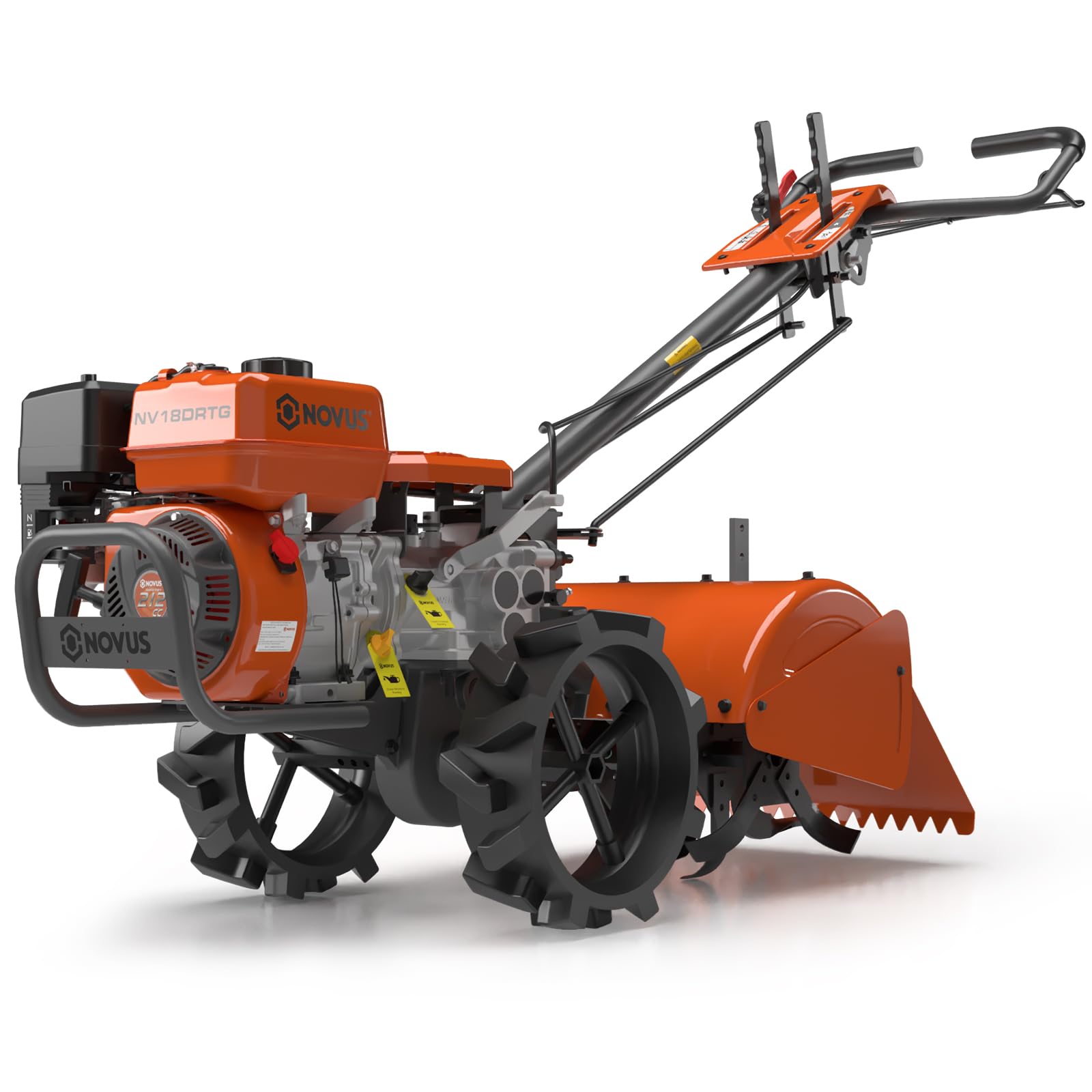
1. NOVUS 18-Inch Dual Direction Rear Tine Tiller
Our pick — 4.5+★ from 50+ verified ratings; the strongest balance of quality and price.
A gear-driven 212cc workhorse that turns over hard ground without a belt to slip.
Here is the number that settles the argument: a 212cc engine driving 16 steel tines through an 18-inch swath. That is a big engine for the cut width, which is why this NOVUS has the torque to keep turning when it hits packed clay instead of stalling or smoking a belt. The full gear transmission is the second half of the story — there is no belt drive to stretch or slip, so what you get is a direct mechanical link from engine to tines and far less to maintain over the years.
Then there is the dual-direction tine setup. Flip to counter-rotating and the tines spin against the wheels, which is how you bust sod and break new ground. Switch to standard rotation and you are turning already-worked soil into a fine, level seedbed. The reach goes to 10 inches deep with an 8-position depth adjustment, and there are 2 forward speeds plus 1 reverse so you can move the machine without tilling.
The honest caveats. This is a heavy machine, and buyers report needing a hand lifting it onto its wheels, so plan for a second person on setup day. In soft, loose soil the tires can spin while digging — a front weight is a common fix. A few owners also note the gearbox feels stiff for the first few uses before it settles in.
What earns it the top slot
- 212cc engine paired with a full gear transmission — no belt to slip or replace
- Dual-direction tines cover both sod-busting and fine seedbed finishing
- 18-inch width and 10-inch depth with an 8-position depth adjustment
- Airless tires mean no flats and no pumping before a session
- 2 forward speeds plus 1 reverse for maneuvering without tilling
Where it asks for help
- Heavy enough that getting it onto its wheels takes some muscle
- Tires can spin while digging in loose or sandy ground
- Gearbox feels notchy until the first few uses wear it in
Where it lands: the strongest all-round pick for someone breaking real ground across a large plot.
Think twice if: you need a machine light enough to move around solo and you are only refreshing soil that is already tilled.
2. SPLENDOR Gas Powered Tiller 4 Cycle 212CC
A 33.5-inch cut means fewer passes over a big plot — and the engine to match.
If your garden is measured in rows rather than beds, width is the spec you feel every single pass. This SPLENDOR cuts a maximum of 33.5 inches and dials down through 22 and 13 inches when you need tighter work. That 33.5-inch swath is the widest in this group, and it runs on 24 tines driven by a 212cc engine. Depth reaches 13 inches — the deepest here, and relevant if you are chasing deep-rooted crops or breaking a hardpan layer rather than just turning the top few inches.
Owners mention running it hard: 50 feet by 50 feet of un-tilled soil in about 30 minutes. That is the whole case for buying wide: a 33.5-inch cut finishes the plot in one afternoon instead of one pass every weekend. Its 7HP engine handles clay and roots without complaint, and a chain-type gearbox is on duty for simpler maintenance. There is a safety lock on the clutch handle so the machine will not creep when you step away.
Where it asks for patience: assembly instructions get mixed feedback, and a machine this size takes real effort to wrestle around tight corners. The clutch action and general ease of use also draw a range of opinions. None of that is unusual for a wide-cut tiller, but budget the setup time and the physical effort before you commit.
Why large-plot owners reach for it
- 33.5-inch maximum width clears a big garden fast, with 22-inch and 13-inch settings for finer work
- 13-inch maximum depth is the deepest in this lineup
- 24 tines and a 212cc engine take on clay and lawn roots
- Chain-type gearbox keeps maintenance straightforward
- Clutch safety lock stops the machine creeping when idle
What to plan around
- Assembly instructions get mixed feedback — allow extra time
- Wide and heavy, so steering in tight beds takes effort
- Clutch feel and ease of use draw a spread of opinions
Choose it if: raw coverage speed is your priority and you have room for a wide machine to swing.
Not ideal if: your beds are narrow or you want a tiller you can nudge around by hand easily.
3. SuperHandy RotoTiller Cultivator 27” 7HP 209cc 4 Stroke
A 30:1 gear reduction turns engine RPM into slow, unstoppable tine torque.
This SuperHandy runs its 7HP 209cc OHV engine at up to 3600 RPM and reduces that down to a 100 RPM tine speed through a 30:1 reduction ratio. What that means in practice is simple: the tines turn slowly but with enormous force behind them, which is exactly the recipe for ripping through compacted ground. Six replaceable steel tines work a width from 21 to 27 inches and reach 11 to 14 inches deep. A tine shield skirts the cutting edge for protection, and a centrifugal friction clutch smooths the engagement.
Two practical numbers matter here. The fuel tank holds up to 0.5 gallons, and you feed it 87 octane gas with 10% or less ethanol. That is a machine you can run for a real session before refueling. There is no separate forward and reverse setting on this unit — it is built around forward-rotating tines, so plan your passes accordingly.
The honest note is that this is a heavier, simpler machine that rewards soil you have already worked. It is not the pick for precision bed shaping, and one reviewer noted a gearbox oil leak on arrival. A few note assembly takes some time and that bolts arrive unlabeled. Those are the exception rather than the rule, but in a compacted-ground tiller you want to inspect the gearbox on arrival, so factor that into day one.
Who this is built for: a large garden in heavy, compacted, or clay soil where raw breaking force beats finesse.
The friction clutch: makes engagement smooth instead of a lurch, which matters when you are holding a machine this size under load.
Best suited to: people breaking and refreshing tough, dense soil on a big plot who value permanent tine speed over a wide feature set.
Skip if: you want a machine with dedicated reverse or you are buying for light, sandy soil where slower tines add nothing.
4. EARTHQUAKE Victory Rear Tine Tiller

Counter-rotating tines and a cast-iron bronze gear transmission built for the long haul.
The design that earns this Earthquake Victory its place is the counter-rotating tine setup. The tines spin opposite the wheels, so they chop into tough clay and compacted soil instead of skipping across it. Backing that up is a heavy-duty cast-iron transmission with engineered bronze gears — a build aimed at lasting years, not seasons. It tills a 16-inch row up to 10 inches deep and holds tilling speed with an adjustable drag stake that sets how hard the machine bites.
The ergonomics deserve a mention. A 3-position adjustable handlebar pairs with 2- or 1-handed control, so you can walk beside the machine and keep your footprints out of the seedbed. Side tine shields keep dirt from flying onto nearby plants, and a trailing rear shield smooths the surface behind you. Instant Reverse is a handle rather than a gear change — pull it to back up and turn in tight corners without stopping to shift. A 209cc 4-cycle Viper engine supplies the muscle.
Two honest limits. There is no neutral for the tines, so when the machine is running you are managing it. And this is a genuinely heavy machine — moving it between beds involves real effort. One owner also reported damaged transmission components after hitting large rocks, worth knowing if your ground is littered with stone. This is an excellent tiller for clean, large plots and a patient experience for rocky ones.
The strongest arguments for it
- Counter-rotating tines break tough clay and compacted soil more effectively
- Cast-iron transmission with engineered bronze gears for long service
- Instant Reverse handle for backing up without shifting gears
- 3-position handlebar with 2- or 1-handed control keeps footprints out of beds
- 16-inch width, 10-inch depth, and adjustable drag stake
Where it can frustrate
- No neutral for the tines while running
- Heavy, so moving it around the plot takes effort
- Rocky ground risks transmission damage if you push it
Built for: large gardens of clay, compacted, or new ground where counter-rotating bite is the whole point.
Consider lighter options if: your soil is rocky or you need a machine you can reposition solo without effort.
5. SuperHandy Tiller Cultivator 7HP 209cc Engine

A rear tine tiller with a 7HP 209cc engine and adjustable width and depth.
Step into rear tine territory without stepping into the top of the market. This SuperHandy pairs a 7HP 209cc OHV 4-stroke engine with heavyweight steel tines and a centrifugal friction clutch for smooth starts. It is built for soil preparation, aeration, and weed removal, and it handles both new ground and existing beds. Width and depth adjust to cover large plots and tighter spaces, and the machine runs on 87 octane gasoline with 10% or less ethanol.
What buyers like most is the power — through clay-heavy home soil it starts easily and works cleanly, and cleanup is as simple as hosing it down. Assembly is straightforward. Owner suggestions point to the obvious next-move upgrades: taller tires for softer ground, an electric start, and a reverse gear would round it out, with the recognition that each would add cost.
The candid part. A couple of customers note quality slips — one describes a breakdown after only three uses with fuel leaking from the carburetor and a slipping belt drive, and another mentions a pull-start that locks up intermittently. For budget-tier rear tine power, this is the honest risk: you are paying less, and a small share of units need attention. Inspect it carefully on arrival and lean on the warranty if anything is off.
The value read: a genuine rear tine, 7HP, 209cc machine at the more accessible end of the category.
The quality caveat: most units run well, but a minority arrive with issues worth catching early.
Right for: budget-minded large-garden buyers who want rear tine capacity and are comfortable checking the machine thoroughly on delivery.
Better to look up-market if: you want a lower chance of out-of-box trouble and are willing to trade fewer features for that.
6. Pulsar 212cc 20-Inch Gas Powered Rear Tine Tiller

Tractor-style wheels and a 212cc engine that runs a long time between refuels.
Four 13-inch counter-rotating tines give this Pulsar a 20-inch tilling width, backed by large 13.5-inch tractor-style wheels that grip and roll over uneven ground. Those wheels have neutral and drive cotter pin settings, so you can move the machine without tilling. A built-in depth regulator holds a consistent depth on each pass, and the 212cc OHV engine supplies the torque. It tops out at 6.5 inches in depth — shallower than the deepest machines here, so it is a tiller for turning and refreshing soil rather than deep-breaking.
The range is the standout for big plots. Owners describe it running long on a single tank — enough for a 6000 sq ft garden without stopping to refuel — and starting reliably every time. The frame is steel and arrives boxed with foam protection, which buyers notice. It comes with 85W140 gear oil prefilled in a 1-quart quantity, but you supply your own 10W-30 engine oil, a detail worth catching before your first run.
Two things owners raise. Gear shifting can feel difficult, and it wants scarified ground before tilling — at full depth it will not bite soil that has not been worked first. And a smattering of buyers find small parts missing from the box, like bumper nuts or a thumb handle. Neither is a dealbreaker, but budget the time to check the parts kit.
On the plus side
- 20-inch width from four 13-inch counter-rotating tines
- Large 13.5-inch tractor-style wheels for grip on uneven ground
- Runs a long time on a single tank, enough for a 6000 sq ft garden
- Includes 1 qt of prefilled 85W140 gear oil
- Forward and reverse controls with a built-in depth regulator
Worth checking before you buy
- Shallower than most here at 6.5 inches maximum depth
- Gear shifting can feel difficult
- Wants pre-tilled or scarified soil before it will bite at full depth
- Occasional units arrive with small parts missing from the kit
Pick this if: you need a big-plot tiller that keeps running for a long session without refueling, with sturdy wheels and a solid frame.
Keep looking if: you need deep tilling or rock-solid shifting from day one.
7. EARTHQUAKE Pioneer Dual Direction Rear Tine Tiller
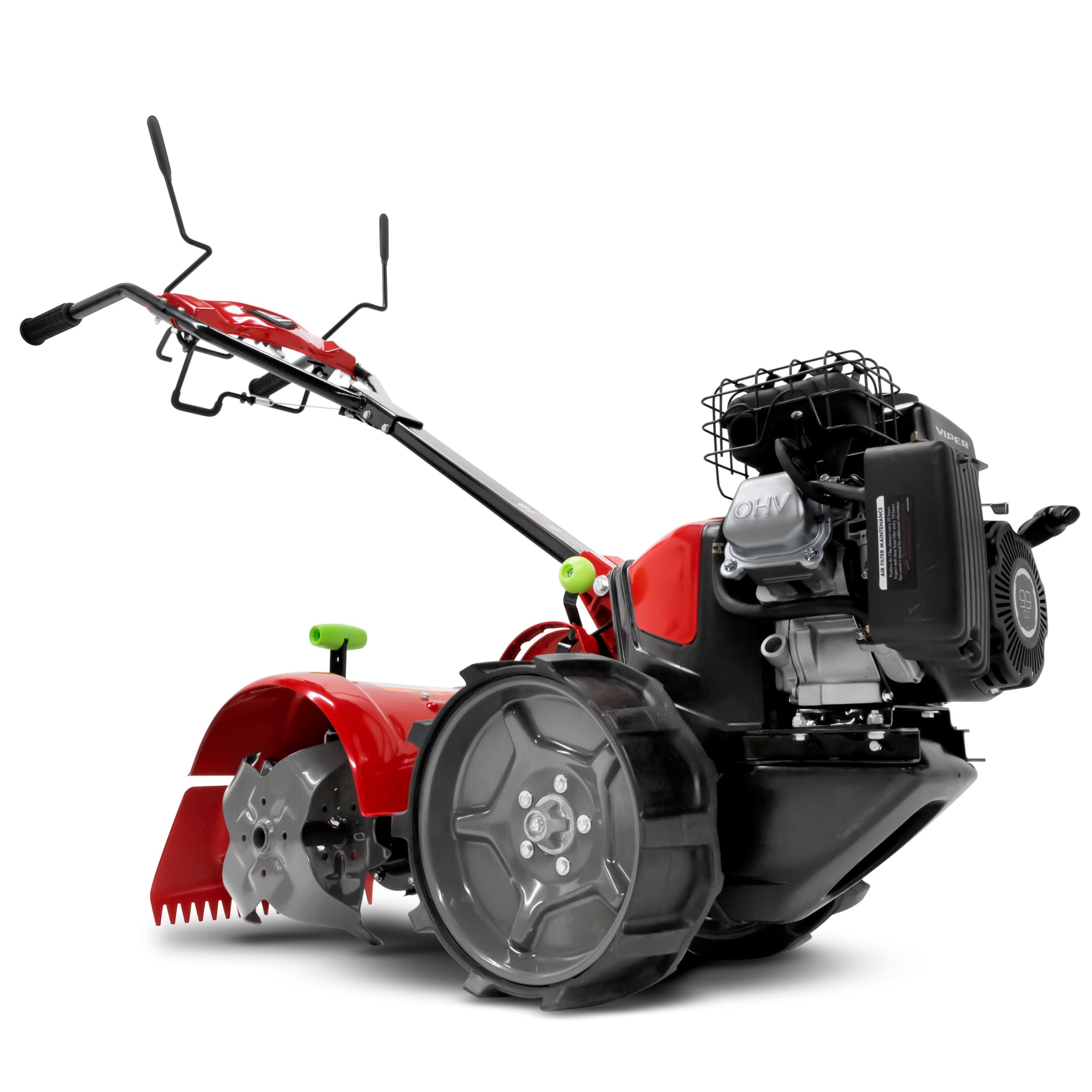
A lighter, quieter tiller that lets a 67-year-old run it one-handed.
Not everyone breaking a large garden wants a 154-pound machine to wrestle. The Pioneer swaps raw displacement for smart design, using a 99cc 4-cycle Viper engine that is lighter, quieter, and more balanced to run. It cuts a 17-inch width to 11 inches deep, and the dual-direction tines rotate both ways — counter-rotating to bust sod, standard rotating to smooth out a seedbed. A shift locator plate slides into your preferred mode, and Instant Reverse is a pull of a handle, no gear hunting.
Then there is the one-hand operation. The super-wide airless wheels never go flat and carry aggressive lugs for grip, so owners describe running the machine single-handed and pivoting cleanly at the end of rows. On a large garden, that one-hand control is the difference between an hour of work and an afternoon of fatigue. Setup is straightforward with metric tools, and it starts easily from cold, even after sitting.
Be honest about its ceiling. A 99cc engine is light duty by design — reviewers point out that on hard packed soil it takes several passes to break ground, and this is a machine for normal to heavy garden use, not for commercial-scale churning. If your ground has never been turned, expect to be patient. If it is in regular cultivation, this is the least tiring machine in the group.
The standout: airless wheels with aggressive lugs plus one-hand control make this the most manageable machine here for a large plot.
The limit: 99cc means fewer, slower passes on virgin or packed soil.
Ideal for: gardeners with established beds who want a lighter, quieter tiller they can control with one hand.
Not for: anyone breaking untouched, hard-packed ground who needs it done in one pass.
Know the Specs
Engine displacement in cc
This is the volume of the engine’s cylinder, and it tracks how much muscle the machine brings to heavy soil. Smaller engines in the 79cc and 99cc ranges are lighter and quieter but take more passes on virgin ground. The 200cc-and-up class — 209cc and 212cc engines in this lineup — generates the torque to bite into clay and compacted soil without stalling. Match displacement to your soil type, not to the biggest number on the spec sheet.
Tilling width and depth
Width is the swath of soil the tines turn per pass, so a wider cut finishes a large garden in fewer laps. Depth is how deep the tines reach, letting you target shallow turning or deeper breaking. Many machines let you adjust both — this lineup runs from an 11-inch narrow setting up to 33.5 inches at maximum width. Deeper settings demand more engine power, so treat width, depth, and displacement as one combined decision.
Common Questions
Should I buy a rear tine or front tine tiller for a large garden?
What does counter-rotating tines actually do?
How wide should a tiller be for a garden of roughly half an acre?
How deep can a gas tiller realistically go?
Do I need to mix oil with the gas on these tillers?
How much does a large-garden tiller weigh and does it matter?
Are airless wheels better than pneumatic tires on a tiller?
Can these tillers handle clay and compacted soil?
What maintenance does a gas rototiller need between seasons?
Is a gear transmission better than a belt drive on a tiller?
The Bottom Line
For most large-garden owners, the best rototillers for large gardens winner is the NOVUS 18-Inch Dual Direction Rear Tine Tiller, because its 212cc engine and full gear transmission give it the torque and durability to break tough ground without a belt to slip. If raw coverage speed is what you want, the SPLENDOR 212CC cuts the widest swath at 33.5 inches and digs 13 inches deep. And for a lighter machine you can run one-handed across established beds, the Earthquake Pioneer is the one to reach for.
If you are starting from bare ground and value long-term reliability, the NOVUS is the safe bet: its gear-driven design has no belt to slip or replace, so it is a machine you buy once and run for seasons. Whichever you choose, match engine displacement to your soil type and tilling width to your plot, and the work gets a lot easier.
How we choose
We do not accept paid placement. Every pick is matched to a real buyer and a real use-case; we do not hands-on test units.
Sources
Specifications: manufacturer listings and product documentation. Review insights: verified customer reviews, as of October 2026. Pricing: not shown on this page (it changes often); check the current price via the retailer link.
As an Amazon Associate, Home Digitized earns from qualifying purchases. This does not affect which products we feature.