5 Best irrigation for vegetable garden: Expert Reviews & Tips
Getting the watering right in your vegetable garden is the difference between a thriving harvest and a disappointing season.
Too little water and your plants wilt. Too much and you invite root rot and disease. The best irrigation for vegetable garden setups solves that problem completely delivering the right amount of water, to the right place, at exactly the right time.
Whether you are growing tomatoes, peppers, cucumbers, lettuce, or a full raised bed garden, the right irrigation system saves you time, reduces water waste, and noticeably improves your yields.
We tested and researched dozens of options so you do not have to.
Here are the 5 best irrigation systems for vegetable gardens in 2026 reviewed honestly, with pros, cons, pricing, and everything you need to make the right call.
1 Best Overall: Rain Bird DRIP1000 Drip Irrigation Kit

If you are serious about your vegetable garden, the Rain Bird DRIP1000 is the irrigation system to get.
Rain Bird has been one of the most trusted names in irrigation for decades, and this kit delivers everything a home gardener needs right out of the box no plumber, no complicated installation, no fuss.
The DRIP1000 kit includes 250 feet of drip tubing, 25 adjustable drip emitters, 6 adjustable quarter-turn drip emitters, stakes, couplings, and everything needed to set up a complete drip system for a medium to large vegetable garden.
The emitters are adjustable from 0 to 2 gallons per hour, giving you precise control over how much water each plant receives.
This matters enormously in a vegetable garden where tomatoes, zucchini, and peppers have very different water needs.
The tubing is UV-resistant and built to last multiple seasons. Setup takes about 30 to 60 minutes for most gardens.
Because drip irrigation delivers water directly to the root zone and keeps foliage dry, it significantly reduces fungal diseases one of the biggest problems in vegetable gardens during humid summers.
What We Love:
- Complete kit — everything included, nothing extra to buy
- Adjustable emitters work for all vegetable types
- Drip delivery reduces disease and water waste
- UV-resistant tubing handles all weather conditions
- Rain Bird’s reliability and customer support are industry-leading
What Could Be Better:
- Takes some planning to lay out efficiently for irregular garden shapes
- Not compatible with a smart timer out of the box (needs adapter)
Specs at a Glance
| Feature | Detail |
|---|---|
| Kit Includes | 250 ft tubing, 25+ emitters, fittings |
| Emitter Output | 0–2 GPH adjustable |
| Coverage | Up to 250 linear feet |
| Connection | Standard 3/4″ hose thread |
| Material | UV-resistant polyethylene |
| Ideal Garden Size | Medium to Large |
💡 Pro Tip: Pair this kit with the Orbit B-hyve Smart Timer (our #2 pick) for a fully automated, app-controlled vegetable garden watering system that waters your garden even when you are away.
2 Best Smart Irrigation: Orbit B-hyve Smart Hose Faucet Timer

If you want your vegetable garden watered automatically and controlled from your phone the Orbit B-hyve Smart Hose Faucet Timer is the smartest investment you can make.
This Wi-Fi-enabled timer connects directly to your outdoor faucet and pairs with the free B-hyve app on iOS or Android, letting you set custom watering schedules, adjust run times remotely, and monitor your garden’s water usage from anywhere.
What sets the B-hyve apart from basic timers is its Smart Watering feature, which uses local weather data and soil evapotranspiration calculations to automatically skip or adjust watering when rain is in the forecast.
Over a growing season, this feature alone can reduce water usage by 30 to 50 percent compared to a fixed schedule timer — saving money on your water bill and preventing overwatering.
Setup is extremely simple. It attaches to a standard outdoor faucet in seconds, connects to your home Wi-Fi through the app, and you can be running your first scheduled watering within 15 minutes. It also works manually with a push-button override if you do not have your phone handy.
The B-hyve works with any drip system, soaker hose, or sprinkler attached to your faucet — making it the perfect companion to any of the other products on this list.
What We Love:
- Wi-Fi app control from anywhere in the world
- Smart weather-based watering adjustments
- Easy 15-minute setup on any standard faucet
- Manual override button for quick use without the app
- Works with drip, soaker, or sprinkler systems
- Battery-powered — no wiring required
What Could Be Better:
- Requires Wi-Fi to use smart features (basic timer works without)
- App can occasionally be slow to sync on older phones
- Single zone only — need multiple units for separate garden zones
Specs at a Glance
| Feature | Detail |
|---|---|
| Connectivity | Wi-Fi (2.4 GHz) + Bluetooth |
| Power Source | 4x AA batteries (not included) |
| App | B-hyve (iOS & Android, free) |
| Smart Features | Weather skip, ET watering, remote control |
| Connection | Standard 3/4″ hose thread |
| Zones | Single zone |
💡 Pro Tip: Use two B-hyve timers on a Y-splitter at your faucet to independently control two separate drip zones in your garden — perfect if you have a raised bed section and an in-ground row section with different water needs.
3 Best for Beginners: Raindrip R560DP Automatic Container & Hanging Basket Kit

Not everyone wants to spend an hour laying out tubing and planning drip zones. If you are new to garden irrigation and want something simple, reliable, and genuinely affordable, the Raindrip R560DP is designed exactly for you. This kit comes with a built-in programmable timer already attached — you open the box, connect it to your faucet, run the tubing to your plants, and you are done.
The timer is programmable with watering frequency (from multiple times per day to every 7 days) and duration (from 1 to 240 minutes). No app, no Wi-Fi, no learning curve — just simple dial settings that a first-time gardener can master in about five minutes.
The kit is designed primarily for containers, raised beds, and small to medium vegetable gardens. It includes 50 feet of distribution tubing, emitters, stakes, and all necessary fittings. The emitters are pre-set at a gentle 1 GPH output, which works well for most vegetables without any adjustment needed.
While it lacks the smart features of the Orbit B-hyve and the coverage scale of the Rain Bird DRIP1000, the Raindrip R560DP wins on simplicity and value. For a first-time drip irrigation user or someone with a smaller vegetable garden, it is genuinely one of the best purchases you can make.
What We Love:
- Timer included right in the box — ready to use immediately
- Extremely simple dial programming — no app needed
- Affordable price point — under $40 in most listings
- Works great for raised beds, containers, and small gardens
- Gentle 1 GPH emitters are perfect for most vegetables
What Could Be Better:
- 50 feet of tubing limits coverage to smaller gardens
- No weather-based smart adjustments
- Timer battery life could be better (check before each season)
- Emitters are pre-set and not adjustable on basic models
Specs at a Glance
| Feature | Detail |
|---|---|
| Kit Includes | Timer, 50 ft tubing, emitters, fittings |
| Emitter Output | 1 GPH (pre-set) |
| Timer Frequency | Multiple per day to every 7 days |
| Timer Duration | 1–240 minutes |
| Ideal Garden Size | Small to Medium |
| Power | 9V battery |
💡 Pro Tip: Buy two Raindrip R560DP kits and use a Y-splitter at your faucet to cover twice the garden area. Each kit runs independently on its own timer schedule — great for separating your tomatoes from your leafy greens, which need different watering frequencies.
4. Best Budget Pick: Gilmour Flat Soaker Hose (1/2 inch, 50 ft)
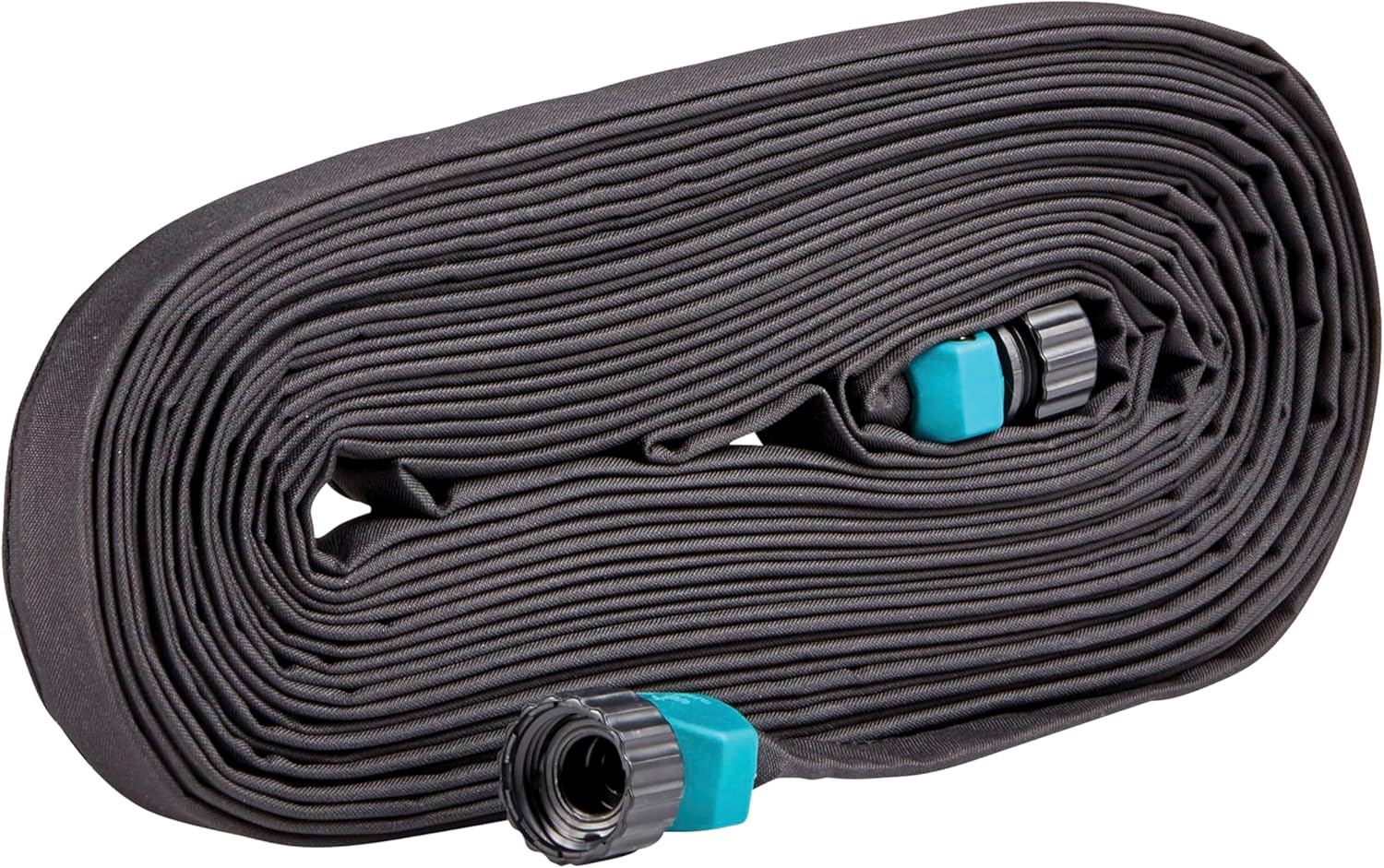
If you grow vegetables in traditional row gardens and want the most straightforward, affordable irrigation solution available, a quality soaker hose is hard to beat.
The Gilmour Flat Soaker Hose is our top pick in this category made from 65% recycled rubber and vinyl, it delivers a steady, gentle seep of water along its entire length directly into the soil at root level.
Soaker hoses work by allowing water to slowly weep through thousands of tiny pores along the hose wall, soaking directly into the ground without any runoff, evaporation, or wet foliage. For vegetable row gardens — rows of beans, carrots, beets, lettuce, or any densely planted vegetables — a soaker hose laid down the center of each row delivers near-perfect, even moisture across the entire root zone.
The Gilmour soaker hose is flat when not in use, making it easy to store over winter, and it expands slightly when pressurized. The 50-foot length covers most standard home vegetable garden rows, and multiple hoses can be connected end-to-end (up to 150 feet total recommended). For best results, run it at low pressure (8–12 PSI) with a pressure regulator — many city water systems run at 40–80 PSI, which is too high for a soaker hose.
What We Love:
- Extremely affordable — usually under $20
- Eco-friendly recycled rubber construction
- Delivers water directly to roots with zero evaporation
- Flat design makes off-season storage simple
- Connects easily to standard hose fittings
What Could Be Better:
- Needs a pressure regulator (sold separately) for best performance
- Not ideal for raised beds or irregularly planted gardens
- Can degrade faster than drip systems in direct UV exposure
- No timer included — needs to be managed manually or with a separate timer
Specs at a Glance
| Feature | Detail |
|---|---|
| Length | 50 feet |
| Diameter | 1/2 inch |
| Material | 65% recycled rubber + vinyl |
| Recommended Pressure | 8–12 PSI |
| Connection | Standard 3/4″ garden hose |
| UV Resistance | Moderate |
💡 Pro Tip: Add an inexpensive Orbit Single-Outlet Hose Timer (under $15 on Amazon) to automate your soaker hose watering schedule. Set it to run for 30–45 minutes every morning and you will have a fully automated system for under $35 total.
5 Best Sprinkler: Melnor XT Turbo Oscillating Sprinkler

Not every vegetable garden needs drip irrigation. If you have a large open garden with densely planted rows of corn, beans, squash, or other large-leafed vegetables — or if you are watering seedlings that need gentle overhead moisture — an oscillating sprinkler gives you broad, even coverage that drip systems simply cannot match.
The Melnor XT Turbo Oscillating Sprinkler covers up to 4,500 square feet with adjustable width and range controls. Its 20-nozzle turbo drive design delivers a gentle, consistent fan of water that mimics natural rainfall. The range control lets you adjust coverage from a narrow strip to a wide sweep, and the width control lets you limit one side of the spray — useful for watering right up to a fence or path without soaking beyond your garden.
The stainless steel frame is noticeably sturdier than typical plastic oscillating sprinklers, and the turbo motor runs smoothly without the stuttering and jamming that plagues cheaper oscillating sprinklers in this price range. It connects to any standard garden hose.
This is our recommended pick for gardeners with large open plots, seedling beds, or anyone who prefers overhead watering over drip systems for their particular crops.
What We Love:
- Covers up to 4,500 sq ft — great for large gardens
- Adjustable width and range for precise coverage control
- Stainless steel frame — significantly more durable than plastic models
- 20-nozzle design delivers gentle, even water distribution
- Easy hose connection — setup takes 30 seconds
What Could Be Better:
- Overhead watering wets foliage — not ideal for tomatoes, peppers, or squash prone to fungal disease
- Wastes more water to evaporation than drip systems
- Coverage can be affected by wind
- No timer included
Specs at a Glance
| Feature | Detail |
|---|---|
| Coverage Area | Up to 4,500 sq ft |
| Nozzles | 20 |
| Adjustment | Width + Range controls |
| Frame | Stainless steel |
| Connection | Standard 3/4″ garden hose |
| Ideal Garden Size | Large open plots |
💡 Pro Tip: Use the Melnor XT for large open garden sections and pair it with the Orbit B-hyve timer for automated scheduling. This combo gives you set-it-and-forget-it coverage for beds where overhead watering is appropriate — like corn, beans, and leafy greens.
Buyer’s Guide: How to Choose the Best Irrigation for Your Vegetable Garden
What Type of Irrigation Is Best for Vegetable Gardens?
The short answer is: drip irrigation is the gold standard for most vegetable gardens. Here is why drip systems deliver water directly to the root zone, keep foliage dry (which dramatically reduces fungal diseases like blight and powdery mildew), and use 30 to 50 percent less water than overhead sprinklers. For tomatoes, peppers, eggplant, cucumbers, and squash specifically, drip irrigation is almost always the best choice.
Soaker hoses are an excellent and affordable alternative to drip systems, especially for row-planted vegetables like beans, carrots, beets, and lettuce. They work on the same principle — root-zone water delivery, dry foliage — but are simpler and less expensive to set up.
Sprinklers work best for large open beds of corn, seedling areas, or dense plantings of greens and herbs where broad overhead coverage is more efficient than laying individual drip lines.
Drip Irrigation vs. Soaker Hose vs. Sprinkler: Which Should You Choose?
| Feature | Drip Irrigation | Soaker Hose | Sprinkler |
|---|---|---|---|
| Water efficiency | ⭐⭐⭐⭐⭐ | ⭐⭐⭐⭐ | ⭐⭐⭐ |
| Disease prevention | ⭐⭐⭐⭐⭐ | ⭐⭐⭐⭐ | ⭐⭐ |
| Ease of setup | ⭐⭐⭐ | ⭐⭐⭐⭐⭐ | ⭐⭐⭐⭐⭐ |
| Coverage flexibility | ⭐⭐⭐⭐⭐ | ⭐⭐⭐ | ⭐⭐⭐⭐ |
| Cost | $$ | $ | $ |
| Best for | Raised beds, mixed plantings | Row gardens | Large open plots |
How Often Should You Water a Vegetable Garden?
Most vegetables need 1 to 1.5 inches of water per week during the growing season. How you split that across the week depends on your climate and soil type. Sandy soils drain quickly and may need watering 3 to 4 times per week. Clay-heavy soils retain moisture longer and may only need watering twice a week. The best approach is to check soil moisture 2 to 3 inches below the surface — if it feels dry, it is time to water.
With a drip system or soaker hose and an automated timer, the best default schedule for most vegetable gardens is 30 to 45 minutes every 1 to 2 days in the early morning. Early morning watering minimizes evaporation, gives foliage time to dry before nightfall, and delivers moisture before peak daytime heat.
What Features Should I Look For?
Timer compatibility: An irrigation system without a timer requires you to be present every time the garden needs water. A quality timer — especially a smart Wi-Fi timer — is the feature that transforms a manual watering chore into a fully automated system.
Adjustable emitters: Vegetables have very different water needs. Tomatoes and squash are heavy drinkers. Herbs and root vegetables prefer drier conditions. Adjustable drip emitters let you dial in the right flow rate for each plant individually.
Pressure regulation: Most home water systems run at 40 to 80 PSI — far too high for drip systems and soaker hoses (which work best at 15 to 25 PSI). A pressure regulator (usually $10 to $15 on Amazon) protects your system and ensures even, consistent water delivery.
Coverage area: Match your kit’s coverage capacity to your garden size. Buying a kit designed for 50 feet when your garden needs 200 feet means buying accessories or a larger kit. Read the specs carefully before purchasing.
Durability and UV resistance: Cheap plastic components degrade quickly under direct sunlight and seasonal temperature swings. Look for UV-resistant tubing and metal or heavy-duty plastic fittings, especially if you plan to leave the system in place year-round.
Essential Accessories to Buy With Your Irrigation System
| Accessory | Why You Need It | Approx. Price |
|---|---|---|
| Pressure Regulator | Protects drip/soaker systems from high water pressure | $10–$15 |
| Filter Screen | Prevents debris from clogging drip emitters | $8–$12 |
| Y-Splitter | Run two zones from one faucet independently | $12–$20 |
| Hose Timer | Automate any irrigation system | $15–$50 |
| End Caps | Seal the end of drip tubing | $5–$8 |
| Goof Plugs | Seal unwanted holes in drip tubing | $5–$8 |
| Moisture Meter | Check soil moisture before watering | $10–$20 |
| Hose Repair Kit | Fix leaks and breaks in tubing | $8–$15 |
Common Irrigation Mistakes to Avoid in the Vegetable Garden
Watering at the wrong time of day: Evening watering leaves foliage wet overnight, creating ideal conditions for fungal diseases. Always water in the early morning when possible. With an automated timer, this is easy to set and forget.
Overwatering: More plants die from overwatering than underwatering. Soggy soil deprives roots of oxygen and creates root rot. Check soil moisture at 2 to 3 inches deep before each watering cycle to calibrate your schedule.
Ignoring water pressure: Running drip or soaker systems at full tap pressure (40–80 PSI) causes uneven distribution and premature wear. Always use a pressure regulator set to 15 to 25 PSI for drip and soaker hose systems.
Not filtering the water: Drip emitters are tiny and clog easily with sediment, mineral deposits, and organic debris from garden hoses. A simple inline filter at the faucet connection prevents 90 percent of clogging problems.
Skipping the timer: Manual watering is inconsistent — you miss days, you overwater to compensate, and your plants suffer the up-and-down moisture stress. An automated timer delivers water on a consistent schedule that your vegetables will visibly respond to.
FAQs About Vegetable Garden Irrigation
What is the best type of irrigation for a raised bed vegetable garden?
Drip irrigation is the best choice for raised bed vegetable gardens. It delivers water precisely to the root zone of each plant, keeps foliage dry, and works perfectly within the defined edges of a raised bed. The Rain Bird DRIP1000 is our top recommendation for raised bed setups.
Can I use a soaker hose in a raised bed?
Yes, soaker hoses work well in raised beds, especially if your bed has straight, parallel rows of plants. Lay the soaker hose in a serpentine pattern across the bed and connect it to a timer for best results. For beds with mixed, irregularly spaced plantings, a drip system with individual emitters gives better control.
How long should I run drip irrigation in a vegetable garden?
Most drip systems with 1 GPH emitters should run for 30 to 60 minutes per session to deliver adequate moisture to vegetable roots. This varies with your soil type, local climate, and the specific crops you are growing. Sandy soils may need longer, more frequent sessions. Clay soils need shorter, less frequent runs. Start with 45 minutes every other day and adjust based on how your plants respond.
Do I need a pressure regulator for drip irrigation?
Yes, absolutely. Standard residential water pressure (40–80 PSI) is too high for drip systems and soaker hoses, which are designed to operate at 15–25 PSI. Without a pressure regulator, emitters will mist instead of drip, connections will pop loose, and tubing will deteriorate much faster. Pressure regulators cost $10 to $15 and are one of the best investments you can make in your irrigation setup.
Is drip irrigation or sprinkler better for tomatoes?
Drip irrigation is strongly preferred for tomatoes. Tomatoes are highly susceptible to early blight, late blight, and septoria leaf spot — all fungal diseases triggered by wet foliage. Drip systems keep the leaves dry and deliver water consistently to the root zone, producing healthier plants and dramatically higher yields compared to overhead sprinkler watering.
What is the most water-efficient irrigation system for vegetables?
Drip irrigation is consistently the most water-efficient option, using 30 to 50 percent less water than sprinkler systems. Paired with a smart timer like the Orbit B-hyve that adjusts watering based on local weather data, you can reduce water consumption by up to 50 percent compared to a fixed schedule — saving money on your water bill while keeping plants perfectly hydrated.
Final Verdict: Which Irrigation System Should You Buy?
| Your Situation | Best Pick |
|---|---|
| Best overall vegetable garden system | Rain Bird DRIP1000 |
| Want app control + smart watering | Orbit B-hyve Smart Timer |
| First-time irrigation user | Raindrip R560DP |
| Row garden on a tight budget | Gilmour Flat Soaker Hose |
| Large open garden, broad coverage | Melnor XT Oscillating Sprinkler |
For most home vegetable gardeners, we recommend starting with the Rain Bird DRIP1000 kit combined with the Orbit B-hyve Smart Timer. Together, these two products give you a professional-grade, fully automated drip irrigation system that delivers perfectly calibrated water to every plant in your garden — without you having to lift a finger after the initial setup.
Your vegetables will reward you with stronger growth, less disease, and a noticeably better harvest.