Different Types of Spoons in Kitchen Complete Guide
I used to think a spoon was just a spoon. I kept a few random ones in my kitchen drawer and used them for everything. Over time, I noticed small problems. My metal spoon scratched my nonstick pan. My thin serving spoon bent when I stirred thick chili. I realized I did not choose the right tool for the job.
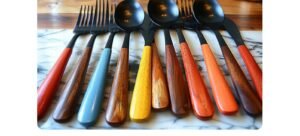
When I started paying attention to different types of kitchen spoons, my cooking improved. Sauces turned out smoother. Pasta drained faster. Serving meals felt easier and cleaner. Each spoon has a specific purpose, and once I understood that, my kitchen routine became more efficient.
In this guide, I share the most important types of spoons every kitchen should have. I explain what each spoon does, when to use it, and how to choose the right material for your cookware in the USA. If you want to cook with more control and less frustration, understanding your kitchen spoons is a simple but powerful step.
If you have your own favorite spoon or a cooking challenge you face in the kitchen, I invite you to share your experience and join the discussion.
2. Cooking Spoons
These are your primary “engines” on the stovetop. Each material offers a specific mechanical advantage depending on the temperature and the type of pan you are using.
Wooden Spoon
-
Gentle on Cookware: The soft fibers of the wood will never scratch or compromise the integrity of your pans.
-
Ideal For: Simmering sauces, stirring hearty soups, and sautéing onions or garlic.
-
Heat Resistance: Wood is a natural insulator; the handle stays cool to the touch even when left in a boiling pot. Its durability is legendary—many heirloom wooden spoons last for decades with proper oiling.
Stainless Steel Spoon
-
Strong & Long Lasting: Resistant to rust, corrosion, and physical warping. It can handle the heaviest stews without flexing.
-
Best For High Heat: Ideal for stovetop tasks where temperatures exceed the safety limits of plastic or silicone.
-
Browning & Deglazing: Because of its rigid edge, it is the best tool for scraping up the caramelized bits (the fond) from the bottom of a stainless steel or cast iron pan.
Silicone Spoon
-
Flexible & Heat Resistant: Typically safe up to 315°C. The flexible edges act like a squeegee against the pan.
-
Safe for Nonstick: The “Gold Standard” for modern nonstick and ceramic-coated cookware.
-
Scraping & Folding: Excellent for getting every last drop of sauce out of a pan or gently folding air into batters without deflating them.
3. Serving Spoons
While cooking spoons are built for the heat of the stove, serving spoons are designed for the ergonomics of the plate and the aesthetics of the table.
Solid Serving Spoon
-
Large Bowl Design: Specifically oversized to move a “standard portion” in a single scoop.
-
Uses: Perfectly suited for dense or granular sides like rice, roasted vegetables, and heavy casseroles.
-
Table Presence: Often made of polished steel or ceramic to complement dinnerware.
Slotted Serving Spoon
-
Liquid Drainage: The precision-cut slots or holes allow excess water, oil, or broth to fall back into the serving dish rather than onto the diner’s plate.
-
Useful For: * Vegetables: Serving broccoli or corn that has been sitting in its own cooking liquid.
-
Poached Foods: Safely lifting delicate poached eggs or fish fillets while leaving the poaching liquid behind.
-
Fried Items: Moving meatballs or fritters from a tray to a plate without transferring excess grease.
-
4. Specialty Spoons
Specialty spoons are engineered for “separation.” Whether you are separating solids from liquids, foam from broth, or specific portions from a large pot, these designs prioritize functionality over simple stirring.
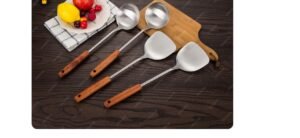
Slotted Spoon: The Precision Drainer
The slotted spoon is the essential bridge between boiling and plating.
-
Designed for Lifting: Featuring long vertical slots or circular perforations, it allows liquid to fall away instantly due to gravity while the solid food remains securely in the bowl.
-
Common in Frying and Boiling: It is the safest tool for retrieving blanched broccoli from boiling water or lifting a poached egg. In frying, it allows hot oil to drain back into the pot, preventing soggy, greasy results.
Ladle: The Volume Master
The ladle is less of a spoon and more of a “handled cup.“
-
Deep Bowl for Soups and Stews: The spherical or hemispherical bowl is designed to hold a significant volume of liquid without spilling, which is impossible with a standard flat spoon.
-
Portion Control & Mess Reduction: Many professional ladles are “volumetric,” meaning a single scoop equals exactly 4oz or 6oz. This is vital for consistent plating. The hooked handle on many ladles also prevents the tool from sliding into a deep stockpot, keeping your kitchen cleaner.
Pasta Spoon (The Pasta Fork)
Arguably the most oddly shaped tool in the drawer, the pasta spoon is a masterpiece of specialized geometry.
-
Pronged Edges: The “teeth” are designed to snag long, slippery strands like spaghetti, fettuccine, or angel hair. Because these noodles have a low surface area and are coated in slippery starch, a regular spoon would let them slide right off.
-
The Center Hole: This serves a dual purpose. First, it allows the pasta-cooking water (which is heavy and hot) to drain away as you lift. Second, in many models, the diameter of the hole is exactly the size of one dry serving of spaghetti, acting as a built-in measuring tool.
Skimmer Spoon (The Spider)
Often confused with the slotted spoon, the skimmer is flatter, wider, and much more delicate.
-
Flat and Wide Design: Often made of a wire mesh or a very thin piece of perforated steel.
-
Removing Foam and Fried Items: Its primary job is “skimming” the surface. When boiling meat or making stocks, a grey foam (denatured protein) often rises to the top; the skimmer lifts this off without taking the precious broth with it. It is also the preferred tool in Asian cuisine for “fishing” delicate dumplings or tempura out of hot oil.
Basting Spoon
The basting spoon is the secret to succulent roasts and restaurant-quality steaks.
-
Shallow Bowl: Unlike a deep ladle, a basting spoon is relatively flat and wide. This allows the cook to reach the very shallow layer of fat and juices at the bottom of a roasting pan.
-
Flavor Distribution: By repeatedly pouring these hot juices back over the meat, you ensure the exterior doesn’t dry out in the oven’s dry heat. In pan-searing, it is used to shower a steak in hot, herb-infused butter, creating a deep crust and moist interior.
5. Measuring Spoons
In the world of cooking, you can often “eyeball” ingredients. In the world of baking, you are performing chemistry, and chemistry requires precision.
Accurate Ingredient Measurement
Measuring spoons are standardized vessels. Unlike “table” spoons, which vary in shape and depth by brand, a measuring spoon is a calibrated instrument. They are used for both dry ingredients (leavening agents like baking soda) and liquid ingredients (extracts and oils).
Common Sizes in US Kitchens
In the United States, measuring spoons almost always come in a nested set of four to six. The standard “North American” set includes:
-
1 Tablespoon (tbsp): Approximately 15ml.
-
1 Teaspoon (tsp): Approximately 5ml. (Note: 3 teaspoons = 1 tablespoon).
-
1/2 Teaspoon.
-
1/4 Teaspoon.
-
Bonus sizes often include 1/8 teaspoon (a “pinch”) or 1/2 tablespoon.
Measuring vs. Regular Spoons: The Great Divide
Many novice cooks make the mistake of using a “soup spoon” from their silverware drawer to measure out baking powder. This is a recipe for disaster.
-
Volume Consistency: A decorative tablespoon from a silverware set can hold anywhere from 10ml to 20ml depending on its design. A measuring spoon is strictly 15ml. Using a regular spoon in baking can result in a cake that doesn’t rise or a cookie that is far too salty.
-
The “Leveling” Edge: Measuring spoons are designed with a flat, horizontal rim. This allows the cook to use the back of a knife to “level off” the ingredient, ensuring a perfectly flat top. A curved “eating” spoon has no such edge, making accurate dry measurement impossible.
-
Reach: Measuring spoons often have long, narrow handles and small, rounded heads designed to fit inside narrow spice jars—something a wide dining spoon cannot do.
6. Material Comparison
Choosing a material is a trade-off between durability and protection.
Wood vs. Stainless Steel
-
Wood: The “gentle giant.” It won’t scratch nonstick, it won’t conduct heat (the handle stays cool), and it’s traditionally beautiful. However, it can’t go in the dishwasher and can harbor odors from garlic or onions.
-
Stainless Steel: The “indestructible workhorse.” It is hygienic, dishwasher-safe, and perfect for heavy-duty scraping. Its downside is that it will ruin nonstick coatings and the handle can become dangerously hot if left in a pan.
Silicone vs. Plastic (Nylon)
-
Silicone: Generally superior. It has a much higher heat ceiling (up to 315°C), is chemically inert, and stays flexible over time. It won’t melt if it accidentally touches a hot burner.
-
Plastic/Nylon: Often the most budget-friendly option. However, it has a lower melting point (around 200°C) and can leach chemicals or “curl” at the edges over time. If a plastic spoon melts slightly, it can leave microscopic plastic residue in your food.
Heat Resistance and Durability
7. How to Choose the Right Kitchen Spoon
Before you buy, ask yourself these four questions to ensure you aren’t just cluttering your drawers.
1. What is your Cookware Type?
This is the most important factor.
-
If you use Nonstick or Ceramic, you must use Wood or Silicone.
-
If you use Stainless Steel or Cast Iron, you can use anything, but a metal spoon is best for getting the most flavor out of the pan.
2. What is the Heat Level?
For high-heat tasks like searing meat or making candy, avoid plastic at all costs. Stick to stainless steel or high-grade silicone. For low-and-slow simmering (like a 4-hour ragu), a wooden spoon is the most comfortable to hold for long periods.
3. Cleaning and Maintenance
Be honest about your habits. If you put everything in the dishwasher, skip the wood and bamboo. If you prefer hand-washing and appreciate natural materials, wood is a rewarding choice.
4. Budget and Long-Term Value
-
Budget: A $5 nylon set will get you through a year of college.
-
Value: A $15–$20 high-carbon stainless steel spoon or a solid olive wood spoon is a “one-time” purchase that will likely outlive your current stove.
8. Frequently Asked Questions
What spoon is most versatile in a kitchen?
The Wooden Spoon (specifically a “flat-edged” wooden turner) is the undisputed champion. It is safe for every pan type, handles high heat, doesn’t conduct electricity or heat to your hand, and is strong enough to stir the thickest doughs.
How many spoons should every kitchen have?
For a fully functional kitchen, aim for a “Core Six”:
-
1 Wooden Spoon (General purpose)
-
1 Silicone Spoon (Nonstick/Scraping)
-
1 Stainless Steel Spoon (Heavy browning)
-
1 Slotted Spoon (Lifting/Draining)
-
1 Ladle (Soups/Sauces)
-
1 Set of Measuring Spoons (Precision)
Are wooden spoons better than metal?
They aren’t “better,” just different. Wood is better for protecting your equipment and comfort. Metal is better for sanitation (it’s non-porous) and performance when you need to scrape the bottom of a pan to deglaze it. Professional chefs usually keep both within arm’s reach.
Conclusion: Mastering the Art of the Spoon
Throughout this guide, we have traversed the landscape of the modern kitchen—from the molecular stability of 18/10 stainless steel to the ergonomic grace of a hand-carved wooden spoon. While these tools may seem like simple instruments, they are the vital link between the cook’s intent and the final dish.
The Synergy of Material and Method
Choosing the right spoon is an act of preservation. By matching a silicone or wooden spoon to your nonstick pans, you protect your investment. By utilizing the rigid edge of a stainless steel spoon on a cast iron skillet, you unlock the deep, complex flavors of the Maillard reaction through deglazing.
Health, Safety, and Longevity
We have debunked common myths surrounding stainless steel, confirming that it remains one of the most stable, non-reactive, and hygienic materials available to the home cook. While minor leaching is a reality for those with extreme nickel sensitivities, for the vast majority, stainless steel represents a “buy-it-for-life” choice that avoids the chemical risks associated with degrading nonstick coatings.
Final Takeaways
-
Invest in Quality: A single high-grade 304 stainless steel or solid hardwood spoon will outlast a dozen cheap plastic alternatives.
-
Respect the Physics: Use the Leidenfrost effect to make steel non-stick and the pronged design of a pasta spoon to master long noodles.
-
Maintenance Matters: Hand-wash your wood and dry your steel promptly to ensure these tools serve you for decades, not just seasons.
Whether you are portioning a delicate consommé with a ladle or scraping the final bits of batter with a silicone spoon, you now possess the technical knowledge to choose the perfect partner for every culinary task.

- 10 Best iPhone 13 Pro Camera Protectors for Reliable Lens Safety 2026 - March 2, 2026
- 10 Best iPhone 14 Pro Cases with Camera Protection 2026 - March 2, 2026
- 10 Best iPhone 14 Pro Max Cases for Camera Protection 2026 - March 2, 2026