
Disclosure: This post contains affiliate links. As an Amazon Associate I earn from qualifying purchases, at no extra cost to you. Learn more
Specs are compiled from manufacturer listings and verified buyer reviews and can change over time — please confirm the key details on the product page before buying.
Your sprinklers can stop watering in the rain, stop soaking the sidewalk, and stop forcing you into the garage to twist a dial — a wireless sprinkler controller you drive from your phone does all three. The hard part is that these boxes all look alike and all promise “smart” watering. So what actually matters is how many zones it runs, how it decides when to skip a cycle, and whether its Wi-Fi holds up in a garage full of metal.
This guide is built by comparing the manufacturers’ published specifications and the patterns across verified customer reviews, so you get each pick’s real strengths and trade-offs instead of marketing spin.
This list runs from the crowd favorite that owners rate 4.5+ stars across 8,000+ ratings to smaller-batch controllers that beat it on niche features, so you can match one to your own yard and wiring.
Top Picks


How To Choose The Best Wireless Irrigation Pump Controllers for Smart Pump Systems
Start with the wires, not the app. Every controller on this list replaces a traditional timer the same way: you cut power, unscrew the old box, and move each zone wire onto the matching numbered terminal. If you can match colors and numbers, you can do this yourself — most owners finish in under half an hour.
Count your zones before you count features
A zone is one set of sprinkler heads that runs together on its own valve. Count the valves in your existing box, or count the numbered terminals on your old controller. Buy one with at least that many zones, because a controller with fewer terminals than you have valves will leave something unwatered — or worse, force you to double up two zones onto one terminal.
If your valve count falls between two sizes, buy the larger controller. Spare zones sit unused until you need them, and they save you from buying a second controller when you add a drip line later.
How auto-skip and weather adjustment really work
The “smart” part of a smart controller is a weather feed. The controller pulls local forecast and weather data, then decides whether your lawn needs water today. Rain skip and freeze skip are the two you will notice most — nobody wants sprinklers running in a downpour or on frozen turf.
Once you understand that, comparing models gets easy. Check whether the weather service is free forever or attached to a subscription. Then check whether the app shows the skip decisions on a calendar you can actually read.
The Wi-Fi detail that trips up most buyers
These controllers almost universally want the 2.4GHz band — the slower, longer-range Wi-Fi channel your router broadcasts alongside the faster 5GHz one. A garage or outdoor cabinet is exactly where 2.4GHz reaches best, and it is also where homeowners forget they need signal at all.
Before you buy, check whether your phone sees your home network from the spot where the controller will hang. If it does, setup is usually a two-minute job in the app.
Side-by-Side Comparison
| Model | Best For | Zones | Control | Outdoor Placement | Amazon |
|---|---|---|---|---|---|
| Rachio 3 8-Zone★ Best Overall | Most yards, easiest app | 8 | App, Alexa | Indoor (outdoor enclosure available) | Amazon |
| Rachio 3 8 Zone Outdoor EnclosureHighest Rated | Double the Rachio, enclosure included | 8 | App, Alexa, HomeKit | Outdoor enclosure included | Amazon |
| Rain-Bird ESP-TM2 with LNK WiFi Module (8 Zone)Trusted Nameplate | Old Rain Bird owners going smart | 8 | App, Alexa, iPhone | Indoor or outdoor | Amazon |
| Hunter PRO-HC PHC-600 Outdoor Wi-Fi Controller, 6 Station | Outdoor mounts with pro features | 6 | Touchscreen, Hydrawise app | Outdoor | Amazon |
| Yardian Pro 8-Zone Smart Sprinkler Controller | Apple HomeKit homes, wired Ethernet | 8 | App, Siri, Alexa, Google Home | Indoor (IP56 enclosure available) | Amazon |
| Orbit B-hyve XR 16-Zone Indoor/Outdoor Smart Sprinkler Timer | Very large multi-zone properties | 16 | App, Alexa | Indoor or outdoor | Amazon |
| ImoLaza 12 Zone WiFi Smart Sprinkler Controller, ET Master | Free-forever app, many programs | 12 | App, Alexa, Google Assistant | Indoor | Amazon |
| ImoLaza Outdoor Sprinkler Controller, 8-Zone Ultra | Hot climates and light commercial use | 8 | App, Alexa, Google Assistant | Outdoor, weatherproof | Amazon |
| Hunter Industries Hydrawise Pro-HC 6-Station Indoor Wi-Fi Controller | Indoor cabinets, maximum programming | 6 | Touchscreen, Hydrawise app | Indoor only | Amazon |
Detailed Reviews
1. Rachio 3 8-Zone
Our pick — 4.5+★ from 8,000+ verified ratings; the strongest balance of quality and price.
The controller most yards should start with: eight zones, a 30-minute install, and weather logic that pays attention.
You get eight zones on a white box that measures 9.1 inches long by 5.6 inches high and weighs 16 ounces — small enough to mount on a garage wall or tuck into an existing irrigation cabinet. Setup is the part owners talk about most. Wiring is the same move-your-wires-over job as any replacement, and the in-app tutorial walks you through it, which is why the app itself keeps getting praised as intuitive.
The real work happens after setup. Weather Intelligence (Rachio’s forecast-based skip system) watches rain, wind, and freeze conditions and cancels a cycle when your lawn does not need it. Buyers report it skipping full cycles within the first two weeks of use. If you want the simplest version of “it waters when it should and stops when it shouldn’t,” this is the box that does it.
The honest catch is Wi-Fi. This controller wants the 2.4GHz band, and several owners found their drops disappeared only after giving it a dedicated 2.4GHz network rather than a combined 2.4/5GHz name. It also is not a HomeKit device — Apple users should look at the Yardian Pro below. Note too that the Rachio 3 stays indoor-rated on its own; if it lives outside, you want the bundle version with the enclosure.
Where it earns its keep
- Weather Intelligence skips rain, wind, and freeze cycles and tracks estimated water usage in the app
- Wiring is plug-and-go rather than twisted copper, which is why install time runs 10-30 minutes
- Supports scheduled zone runs from the app, so you can shut off a zone at the repair site instead of flooding the yard
- Works with Alexa, with the item spec listing a 2-Year Warranty
What to plan around
- Wants its own 2.4GHz network; a combined 2.4/5GHz name can cause dropouts
- No HomeKit support
- Indoor-rated by itself — pair it with the enclosure bundle for outdoor mounting
Best for: the eight-zone yard that wants the least amount of fiddling for the most automatic watering.
Look elsewhere if: your whole smart home runs on Apple HomeKit, or your controller has to live outdoors without a separate enclosure.
2. Rachio 3 8 Zone Outdoor Enclosure
The same eight-zone watering brain, only this time it arrives with the box that lets it live outside.
Two pieces ship here: the Rachio 3 controller and a custom Rachio enclosure built to keep rain off it. That solves the one limit of the standard model above — you mount the controller on a wall in the garage, or you put it outdoors in its own weatherproofed housing. If your old timer sat on the side of the house, this is the version that slots straight into that spot.
The watering behavior is unchanged. Weather Intelligence still handles rain skip, wind skip, and freeze skip, and the app still builds tailored schedules from your plant type, soil type, and sun exposure. It also adds Apple HomeKit support to the picture alongside Alexa, which the plain Rachio 3 does not carry. Owners consistently describe the automation as reliable and efficient, with the AI-style schedule handling the day-to-day so they stop editing programs by hand.
The thing to weigh is that you are paying for the enclosure as a second item — two pieces in the box, not one. If your controller already lives indoors, the non-bundle version does the identical watering job for less. And like every Rachio here, it lives on the 2.4GHz band, so give it a stable network before you mount it outside.
Why it tops the ratings: this is the pick for anyone who wants the Rachio app without a separate trip to buy a housing — the enclosure arrives in the box, already designed to fit.
The trade-off: you are buying two items to do one job, so an indoor install makes the bundle redundant.
Reach for this if: your controller has to sit outdoors and you want it protected from day one.
Skip the bundle if: the box is going in a garage — the standalone Rachio 3 gets you the same schedules.
3. Rain-Bird ESP-TM2 8 Zone
The upgrade path for anyone whose yard already speaks Rain Bird — swap the box, keep the wiring.
This is two products working as one: the eight-zone ESP-TM2 timer with the LNK WiFi module that turns it into a phone-controlled system. The WiFi module acts like a wireless remote for your irrigation — it works onsite when you are standing at the box, and it becomes an internet-based monitoring and control setup when you are away from home.
Where it wins is familiarity. First-time installers report wiring it up without reading the instructions, simply reconnecting the wires in the same order they came off the old unit. Owners replacing an older Rain Bird say the dial feels similar, which flattens the learning curve to almost nothing. Programming runs in three steps on a big back-lit LCD (a screen with its own light, so you can read it in the dim garage or in direct sun).
There are two conveniences worth knowing. Contractor Default lets you save and restore your custom schedule, so an accidental reset is not a disaster. And you can Delay Watering for up to 14 days and let it resume automatically — useful for a vacation or a reseeding project. The honest limit is range: with no router booster in the garage, owners sometimes see a brief connection loss. It also has no flow-sensor port, so leak monitoring is not part of this box’s job.
What buyers keep coming back to
- Three-step programming on a back-lit LCD readable in low light and direct sun
- Automatic weather adjustments trim daily run times, and the maker claims up to 50% water savings
- Works with iPhone and Alexa for remote schedule control
- Factory-installed 6-foot outdoor-rated power cord
Worth knowing before you buy
- Connection can briefly drop without a router booster nearby
- No flow-sensor or leak-monitoring input
- The WiFi module is a separate item that has to be installed alongside the timer
The right box for: Rain Bird households that want phone control, weather adjustments, and zero relearning.
Think twice if: you need leak detection or flow alerts — there is no sensor port here.
4. Hunter PRO-HC PHC-600 6 Station

A landscaper-grade outdoor box that hands the schedule to a web dashboard instead of a dial.
Six stations, a touchscreen on the front, and Hydrawise — Hunter’s web-based watering software — running the smart side. Add the internal transformer and a factory power cord, and the unit arrives plug-and-play for an outdoor wall.
Hydrawise earns its spot by doing the heavy lifting remotely. It makes predictive watering adjustments, detects wiring faults and alerts you, and gives you zone-by-zone control from the app, so you never walk the yard just to check whether a head is spraying. The interface also carries the EPA WaterSense label for smart watering. Owners call the switch-over quick — one finished in 15 minutes — and single out phone-based zone testing as the real quality-of-life gain.
Two things to note. Like every smart controller in this group, it prefers a steady network signal at the mounting spot, so a garage far from your router is worth checking first. And it is an outdoor-rated box by design — if your setup calls for an indoor unit with deeper programming options, the Pro-HC indoor version below covers that instead.
What the backyard crowd says: the box is water-saving in practice, with owners in dry climates reporting that the smart mode stops the soggy-grass-then-dry-shrub cycle by adjusting to temperature, rainfall, and wind on its own.
Where it fits: best for a six-zone yard where the controller lives outside and someone in the house likes having a screen to fall back on.
Best for: outdoor six-zone installs that want pro-grade weather logic and a touchscreen backup.
Look past it if: you have more than six zones, or you want the richest programming depth — the indoor Pro-HC covers both.
5. Yardian Pro 8-Zone

The wired-instead-of-wireless option: a controller that plugs into Ethernet when your garage Wi-Fi is the problem.
Two things set the Yardian Pro apart from the rest of this list. First, that RJ45 Ethernet port (a standard network cable jack) gives you a hard-wired connection instead of relying on Wi-Fi at all — a genuine fix for the dropouts that plague garage-mounted controllers. Second, it carries native Apple HomeKit support, so it surfaces in the Apple Home app and can be run by Siri, alongside Alexa, Google Home, and Home Assistant.
There is also a physical fail-safe that few competitors bother with: buttons on the device itself let you run a zone or test sprinklers with no phone and no internet. That is what you want mid-install or during an outage. Watering is handled by an ET-based system (evapotranspiration — it estimates how much moisture your lawn lost and adjusts to match) fed by hyperlocal weather data, and it takes both wireless and wired flow sensors for real-time leak and burst-pipe alerts. The maker claims that ET scheduling can cut up to 50% off your water bill.
Physically this is a 6-by-6-inch white box, 16 ounces, with LED zone indicators, sized to fit into existing irrigation cabinets. HomeKit owners describe the pairing as strikingly easy and the multi-program scheduling as genuinely capable. The catch is that it is indoor-rated from the start. An IP56 weatherproof outdoor enclosure is available separately, and some owners found a couple of the interior wiring clips stiff to press, but neither held anyone back from a working install.
Where it pulls ahead
- RJ45 Ethernet port for a wired connection, plus enhanced Wi-Fi when you need it
- Physical zone buttons so you can run or test sprinklers with no phone and no internet
- Native Apple HomeKit support, plus Alexa, Google Home, and Home Assistant
- Two sensor inputs for rainfall and water flow, with leak and burst-pipe alerts
Set your expectations here
- Indoor-rated as sold — the IP56 outdoor enclosure is a separate purchase
- Some interior wire clips need a firm press during install
- App skips the step-by-step quick-start helper some rival apps include
The pick for: Apple-powered homes that want sprinklers in the Home app and a network cable as a backup to Wi-Fi.
Pass if: you need an out-of-the-box outdoor unit — add the enclosure or choose an outdoor-rated model instead.
6. Orbit B-hyve XR 16-Zone
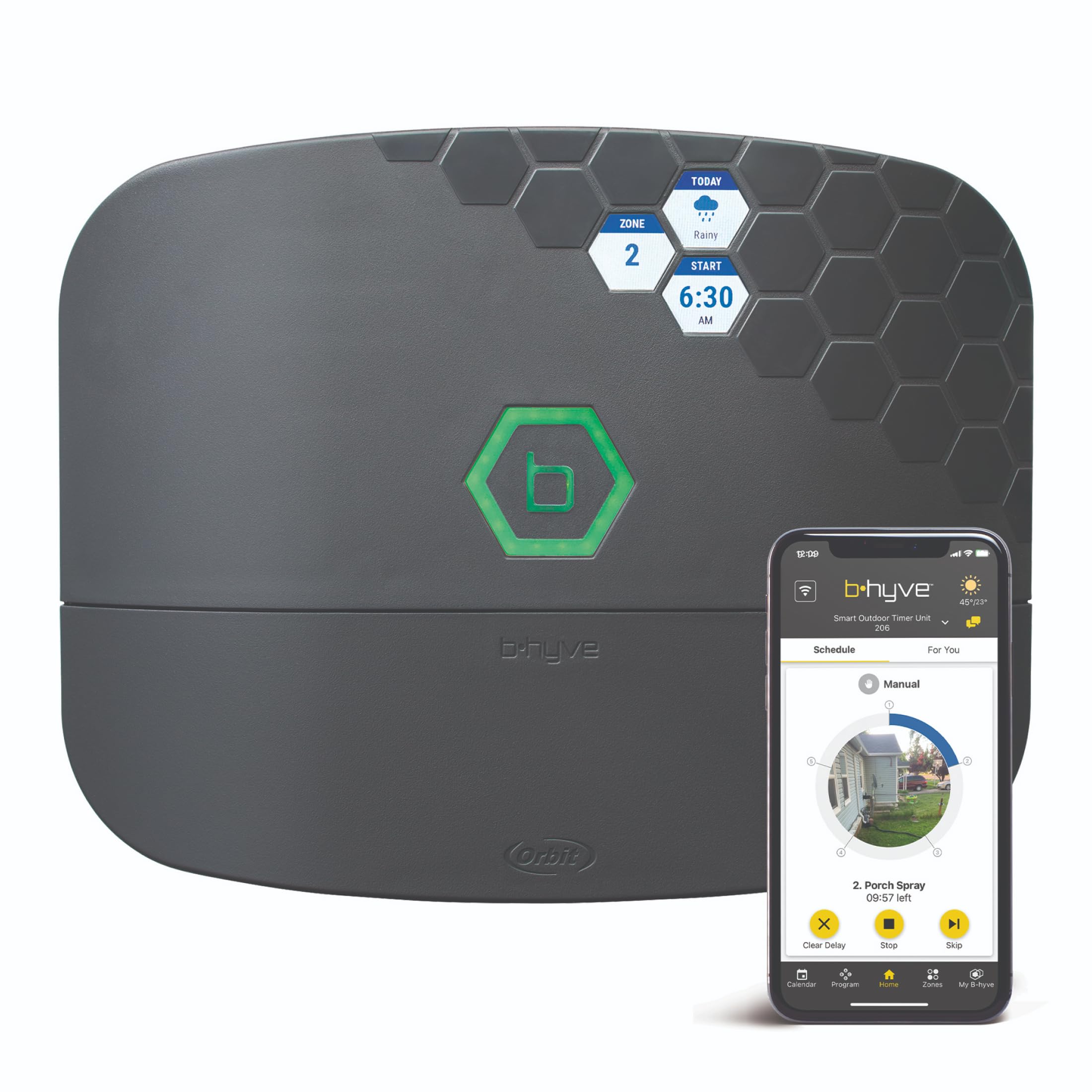
Sixteen stations in one box — roughly double the eight-zone ImoLaza Ultra, and the only 16-zone pick here.
If your property has a lot of separate watering sections — front, back, beds, side yard, drip lines — this is the one that runs them all without doubling up valves. It takes 16 zones against the 8 Zone of the ImoLaza Outdoor Ultra, and it ships indoor/outdoor rated so you can mount it in the garage or on an exterior wall. The housing is a 11-by-9-by-4-inch gray plastic box, three pounds, and it works with Alexa.
The app side is the part owners genuinely like: intuitive interface, station naming with photos, and the ability to fire a manual run from the phone in a matter of seconds for zone checks and repairs. Weather-aware scheduling pulls in forecasts and adjusts cycles to conserve water, and it carries a two-year limited warranty against material or workmanship defects.
The trade-offs are real and worth reading. Program capacity is tight — only four programs (A through D) split across all 16 stations, which owners of large properties call their biggest limitation. The smart watering settings occasionally skip days in hot weather when you want them to run. And Wi-Fi is the recurring complaint: the radio gets confused by combined 2.4/5GHz networks and can disconnect even on a dedicated 2.4GHz band. If you can give it a clean, strong signal and you are not fussy about program slots, its zone count is class-leading here.
Why 16 zones matters: one box covers the whole property, so no valve gets stacked onto a terminal meant for another.
The recurring gripe: treat the wireless link as the weak point — a messy dual-band router is where this thing stumbles, so plan your network before you mount it.
Choose it when: you need more than eight zones and one controller panel to run them.
Reconsider if: four programs across 16 stations will cramp how you schedule, or your Wi-Fi is a patchy dual-band setup.
7. ImoLaza 12 Zone
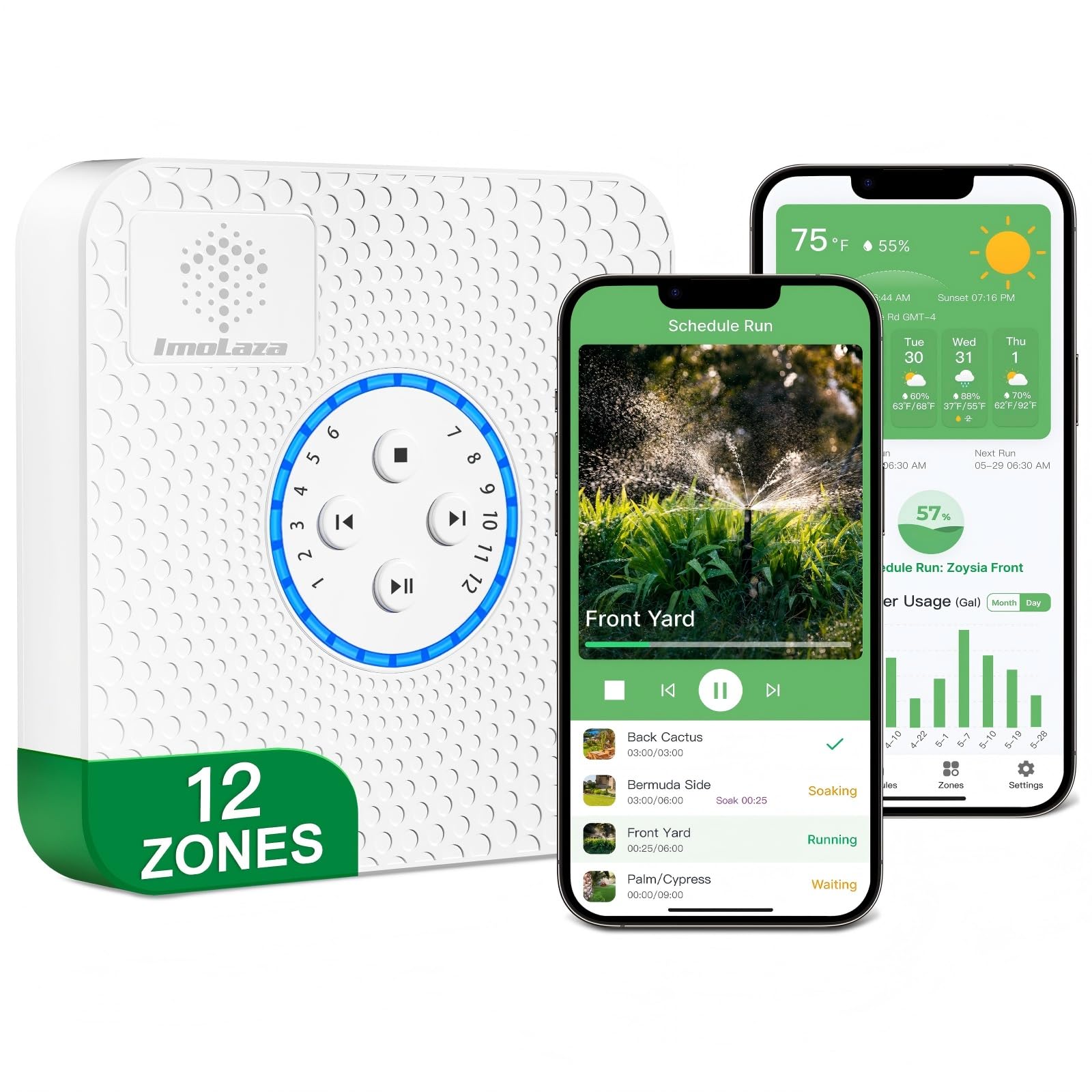
Twelve zones, a self-updating brain, and not a cent of subscription — the value play for serious lawns.
Twelve zones lands between the eight-zone Ultra and Orbit’s 16-zone panel, and the app carries no subscription at all — every premium feature is free forever. That is the headline for anyone who has been burned by controllers that hide watering features behind a monthly fee.
The scheduling freedom here is the standout. You get up to 24 start times for high-frequency watering through a New Grass Schedule, versus the traditional controllers that cap you at four fixed schedules or a single start time. It calculates watering duration from plant type, soil type, and sunlight, then updates daily against real-time evapotranspiration data. Rain skip, wind skip, and freeze skip all come standard, and Over-the-Air (OTA) updates mean the controller downloads new algorithms remotely and improves itself over time.
Physically it is a white ABS box, 6.3 inches square by 1.18 inches thick and 12.16 ounces, with a sleek look owners single out and an indoor design. Voice control runs through Amazon Alexa and Google Assistant. The consistent complaint is app sync lag — the occasional delay between a change you make and the controller catching up. Just as with the other ImoLaza here, you want it on a 2.4GHz network to avoid setup headaches.
What earns it a spot
- Up to 24 start times via the New Grass Schedule, well beyond the four-program ceiling of many rivals
- No subscription on any feature — the app is free
- OTA updates let the controller pull new watering algorithms remotely
- Works with Alexa and Google Assistant, and supports rain, wind, and freeze skips
Where it asks patience
- Occasional app sync lag between making a change and the controller reacting
- Indoor-rated, so plan a sheltered mount
- Initial 2.4GHz setup can be fussy if your router blends both bands
The value leader for: mid-size yards with 12 or fewer zones that want maximum schedule control without a subscription.
Skip if: you need outdoor mounting or you want a controller that reacts instantly to every app tap.
8. ImoLaza 8-Zone Ultra
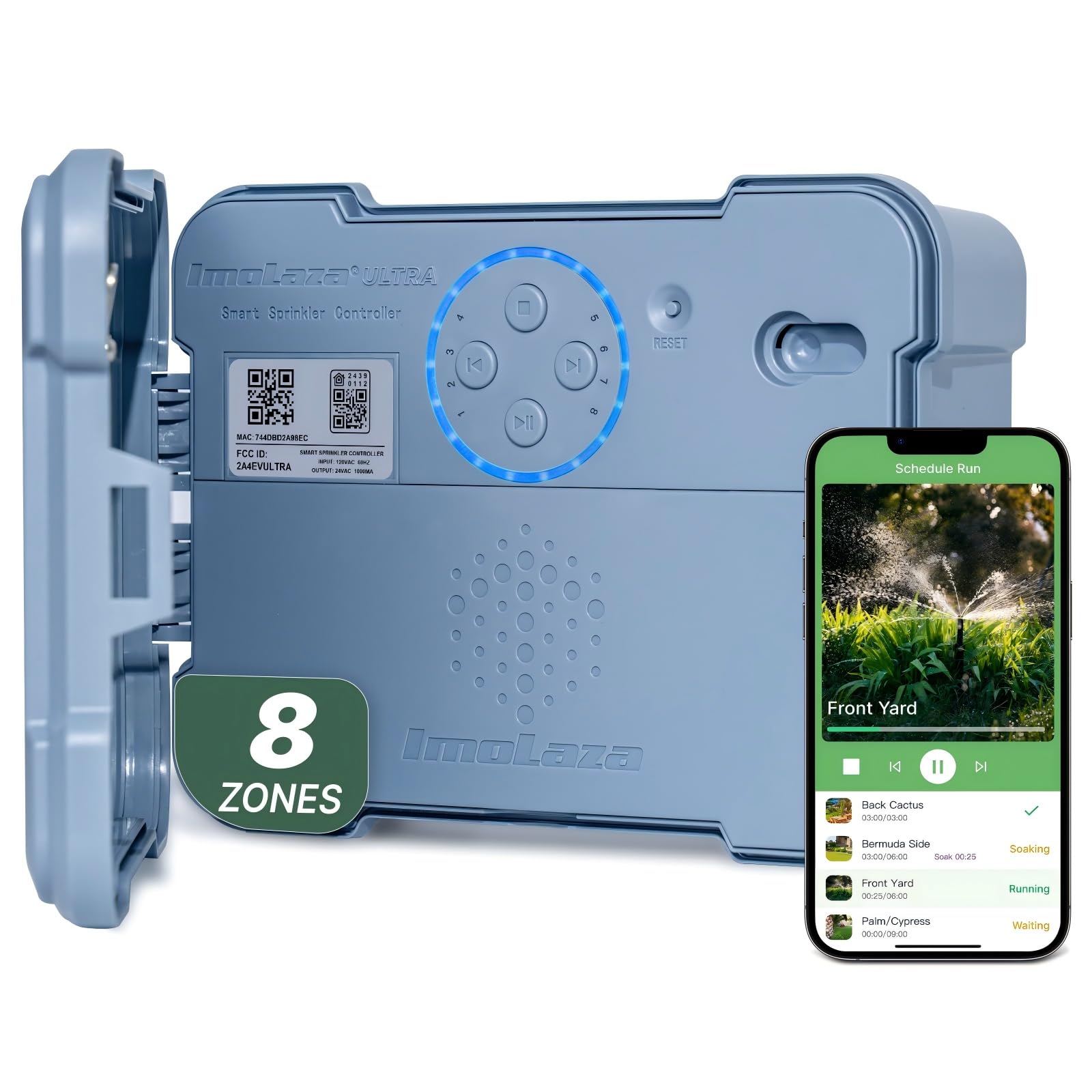
Built for the heat: this one is rated to keep watering long after most controllers would call it a day.
The number that matters most here is the operating range. This ImoLaza is rated to 140 °F, while the Rachio 3 carries a 4 °F low-end figure — so if your controller lives on a sun-blasted exterior wall, this is the more forgiving pick of the two on high heat.
It is built for outdoor duty, with a weatherproof housing, hardwiring capability, and a real-time clock (RTC) that keeps time through power and network outages — a small piece of hardware that stops your schedules from drifting when the internet blinks. It runs eight zones and weighs 3.2 pounds in an ABS housing measuring 9.53 by 6.97 by 3.23 inches.
The smart side is thorough: it sets schedules from plant type, soil type, nozzle type, and sun exposure, then adjusts against real-time weather and evapotranspiration data. A Smart Fault Detection system watches for problems and sends alerts, surge protection shields the electronics from lightning and over-voltage, and the app — with all premium features — is free forever. It works with Alexa and Google Assistant. The catch is simply that some units arrived needing support intervention before they worked, though those owners mention they were made whole. Setup itself is a 15-to-30-minute DIY job, and it is one of the few controllers here aimed at light commercial use as well as home lawns.
Built for the worst of the calendar: surge protection plus a real-time clock means storms and outages are handled without you re-programming anything.
One honest caveat: a small share of units arrive faulty and need a support swap — the flip side of a newer, less common model.
Pick it if: your controller sits outdoors in a hot climate and you want fault alerts, surge protection, and a free app.
Consider a proven standby if: you would rather not risk a support call — the Rachio and Rain Bird boxes above have longer track records.
9. Hunter Hydrawise Pro-HC 6-Station

The indoor Pro-HC: six stations, six programs, and enough terminals to keep a master valve off your zone count.
This is the desk-mount sibling of the outdoor Hunter above, and the programming depth is the reason to pick it. It supports six independent irrigation programs with six start times per program, plus an advanced station-based option topping out at six total start times. Compare that to a fixed four-program ceiling and you can see why big, complicated yards gravitate here.
It also carries hardware the outdoor model this list already covered does not list: a P/MV output (a terminal for a pump start relay or master valve, so that valve does not eat one of your six zones) and a built-in milliamp sensor (a current-reading sensor that detects a broken or shorted wire and alerts you). Two sensor inputs accept any Clik sensor and an HC Flow Meter. The 2.75-inch full-color touchscreen handles on-panel programming for anyone who would rather set it up standing at the unit.
Owners describe the setup and schedule revisions as easy, and the reliability as solid — weather-based rain skip works, Wi-Fi reaches into the garage, and the Hydrawise app manages everything from an iPhone. Physically it is a compact gray indoor unit at 1.95 kg, so it wants a sheltered indoor spot, not an exterior wall. The one recurring gripe is menu navigation, where a few settings sit deeper than they should, but nobody reported it stopping them from getting the schedule they wanted.
Why the extra terminals matter: a dedicated pump/master-valve output keeps all six zones free for actual watering, which the simpler six-zone boxes cannot claim.
The honest note: it is indoor-only, so outdoor installs should step up to the Pro-HC outdoor version above.
Right for: complex indoor installs with pumps, master valves, and flow meters that need serious program depth.
Wrong for: anyone mounting outdoors, or anyone who just wants zones run on a simple schedule.
Know the Specs
Zones and stations
A zone is one set of sprinkler heads fed by one valve; a station is the terminal the controller uses to fire that valve. Counting your existing valves is the fastest way to size a controller. Go one or two over your current count and you leave room for a drip line later without buying again. The boxes here span from 6 stations to 16 zones.
Weather-based skip and ET watering
Weather skip means the controller reads a local forecast and cancels a scheduled run when rain, wind, or freezing conditions make it pointless. ET (evapotranspiration) goes a step further: it estimates how much moisture your lawn lost to sun and heat, then adjusts run times to replace just that. Some apps charge for this; others, like ImoLaza’s, are free forever.
2.4GHz Wi-Fi and Ethernet
Nearly every controller on this list connects on the 2.4GHz band, the slower but longer-reaching Wi-Fi channel that holds up better through garage walls. A few — like the Yardian Pro — also offer an RJ45 Ethernet jack for a wired connection that sidesteps Wi-Fi entirely. Check your signal at the mounting spot before you buy.
Flow and rain sensors
A flow sensor measures water moving through your lines and flags leaks, burst pipes, or clogged valves; a rain sensor detects actual rainfall at the property. Both are often optional add-ons rather than included hardware. If leak alerts matter to you, check whether the controller lists sensor inputs and whether the accessory comes in the box.
Common Questions
How many zones do I actually need?
Will a smart sprinkler controller work with my existing sprinkler system?
Why does the controller need a 2.4GHz Wi-Fi band?
Do these controllers charge a monthly fee to use the app?
Can I control the sprinklers when I am away from home?
What is the difference between weather skip and ET watering?
Are flow sensors and rain sensors included or extra?
How do I know if a controller can be mounted outdoors?
What happens to my watering schedule during a power or internet outage?
The Bottom Line
For most yards, the wireless irrigation pump controllers for smart pump systems winner is the Rachio 3 8-Zone because it pairs the simplest install with weather intelligence that actually skips cycles, and it wears a 4.5+ star rating backed by more than eight thousand owners. The Rachio 3 Bundle is the same brain with the outdoor enclosure already in the box if your controller lives outside. And if your property needs sixteen stations, the Orbit B-hyve XR is the one to reach for. Whatever your zone count, the honest nudge is this: match the terminal count to your valves first, then let the app decide the rest — that single decision is what keeps a wireless controller from becoming a wiring headache.
How we choose
We do not accept paid placement. Every pick is matched to a real buyer and a real use-case; we do not hands-on test units.
Sources
Specifications: manufacturer listings and product documentation. Review insights: verified customer reviews, as of October 2026. Pricing: not shown on this page (it changes often); check the current price via the retailer link.
As an Amazon Associate, Home Digitized earns from qualifying purchases. This does not affect which products we feature.