
Disclosure: This post contains affiliate links. As an Amazon Associate I earn from qualifying purchases, at no extra cost to you. Learn more
Specs are compiled from manufacturer listings and verified buyer reviews and can change over time — please confirm the key details on the product page before buying.
You do not need a walk-behind monster for a backyard plot. What you actually need is a machine that fits between your raised beds, starts without a fight, and chews packed soil without stalling halfway down the row. That is the whole game with compact tillers, and this guide sorts the nine strongest options for exactly that job.
This guide is built by comparing the manufacturers’ published specifications and the patterns across verified customer reviews, so you get each pick’s real strengths and trade-offs instead of marketing spin.
If you’re deciding between a cordless cultivator and a corded machine, the real differences come down to tilling width, depth, and how much you want to fight a power cord. Below you’ll find the exact specs that decide whether a tool suits a 4-by-8 raised bed or a full kitchen plot, so you can pick the best rototillers for small gardens without guessing.
Top Picks


How To Choose The Best Rototillers For Small Gardens
Start with the size of the ground you are breaking. A small garden means narrow rows, tight corners, and often a shed with no spare floor space. That rules out full-size walk-behind machines before you even look at a motor.
Tilling width sets your real working pace
A wider cut covers more ground per pass but needs more muscle to hold steady. A narrower cut squeezes between plants and into raised beds without chewing the stems you meant to keep.
Twelve inches is the tight-row number. Seventeen or eighteen inches is the straight-line, open-bed number. Pick based on your widest clear path, not your total plot size.
Depth tells you what soil you can actually break
Depth is how far the tines sink, and it decides whether you are scratching the surface or turning over new ground. An eight-inch bite handles established beds and compost mixing. Nine inches and beyond is for compacted or previously untouched soil.
If your ground has never been worked, deeper is the safer bet. If you are refreshing a bed you till every spring, shallower is plenty.
Corded or cordless changes your whole routine
A cordless unit frees you from finding an outlet and dragging a line across the yard. The trade-off is runtime, and how far one charge carries you depends on how hard the soil fights back.
A corded machine runs as long as you do. But you need a heavy-gauge outdoor extension cord long enough to reach the far corner, and you will spend part of the job managing that cord instead of the soil.
Side-by-Side Comparison
| Model | Best For | Tilling Width | Power Source | Tilling Depth | Amazon |
|---|---|---|---|---|---|
| Sun Joe TJ603E★ Best Overall | Established beds and mixed soil | 16 inches | 12-amp corded electric | 8 inches | Amazon |
| OFISPEED Cordless TillerBest Battery Freedom | Raised beds and tight rows | 12 inches | 2×4.0Ah battery | 8 inches | Amazon |
| Goplus 17-Inch TillerClay Crusher | Clay and rocky ground | 17 inches | 13.5-amp corded electric | 9 inches | Amazon |
| BILT HARD 18-Inch Electric | Hard ground with grass cover | 18 inches | 15-amp corded electric | 8.7 inches | Amazon |
| Westinghouse W18TCAC | Compacted beds with rocks | 18 inches | 15-amp corded electric | 9 inches | Amazon |
| BILT HARD 46cc Gas Tiller | No-outlet gardens and remote plots | 16 inches | 46cc 4-cycle gas | — | Amazon |
| SENIX TL4QL-L1 | Hobby gardens and seasonal tilling | 15 inches | 46cc 4-cycle gas | 8 inches | Amazon |
| NOVUS 2-in-1 Gas Tiller | Breaking brand-new ground | 9–17 inches adjustable | 79CC 4-cycle gas | 6 inches | Amazon |
| Ryobi RY18CVA-0 | Ryobi 18V ONE+ owners | — | 18V ONE+ battery | — | Amazon |
Detailed Reviews
1. Sun Joe TJ603E Electric Garden Tiller Cultivator
Our pick — 4.5+★ from 12,500+ verified ratings; the strongest balance of quality and price.
The backyard standard: a 12-amp corded tiller that turns established beds without a wrestling match
You get a 12-amp motor (a measure of electrical power) driving six rust-proof steel tines (the spinning prongs that dig into soil). Together they bite up to 16 inches wide and 8 inches deep. That’s the balance for a bed you already work each spring, because you’re refreshing soil rather than quarrying it.
The 3-position wheel adjustment is the part owners lean on hardest. Wheels up means a deeper bite; wheels down means shallower passes to level things off. Set it once for your soil type and you stop thinking about it.
That weight helps the tines dig, but it also means lifting it into a truck bed is a two-hand job.
What wins people over is how little fuss it makes of the work. Sandy ground, grass cover, weeds — it grinds through all three, and assembly runs about 15 to 20 minutes with the folding handle folding flat for storage afterward. The cord is the honest catch: you need an outdoor-rated extension line reaching your plot, and on long runs the voltage drop softens the bite.
Where It Earns Its Keep
- Tills up to 16 inches wide and 8 inches deep on a 12-amp motor
- Six rust-proof steel tines rated for long-term repeated use
- 3-position wheel adjustment for depth control across soil types
- Folding handle and 2-year warranty for easy off-season storage
What To Plan Around
- At 27.1 pounds it is the heaviest unit in this comparison
- Cord length and gauge limit how far you can work from an outlet
- Not built for virgin ground with heavy rock or thick roots
Reach for it if: you have established beds, an outdoor outlet within cord reach, and want the most proven corded tiller for the money.
Look elsewhere if: your plot sits far from power or you need to break ground that has never been turned.
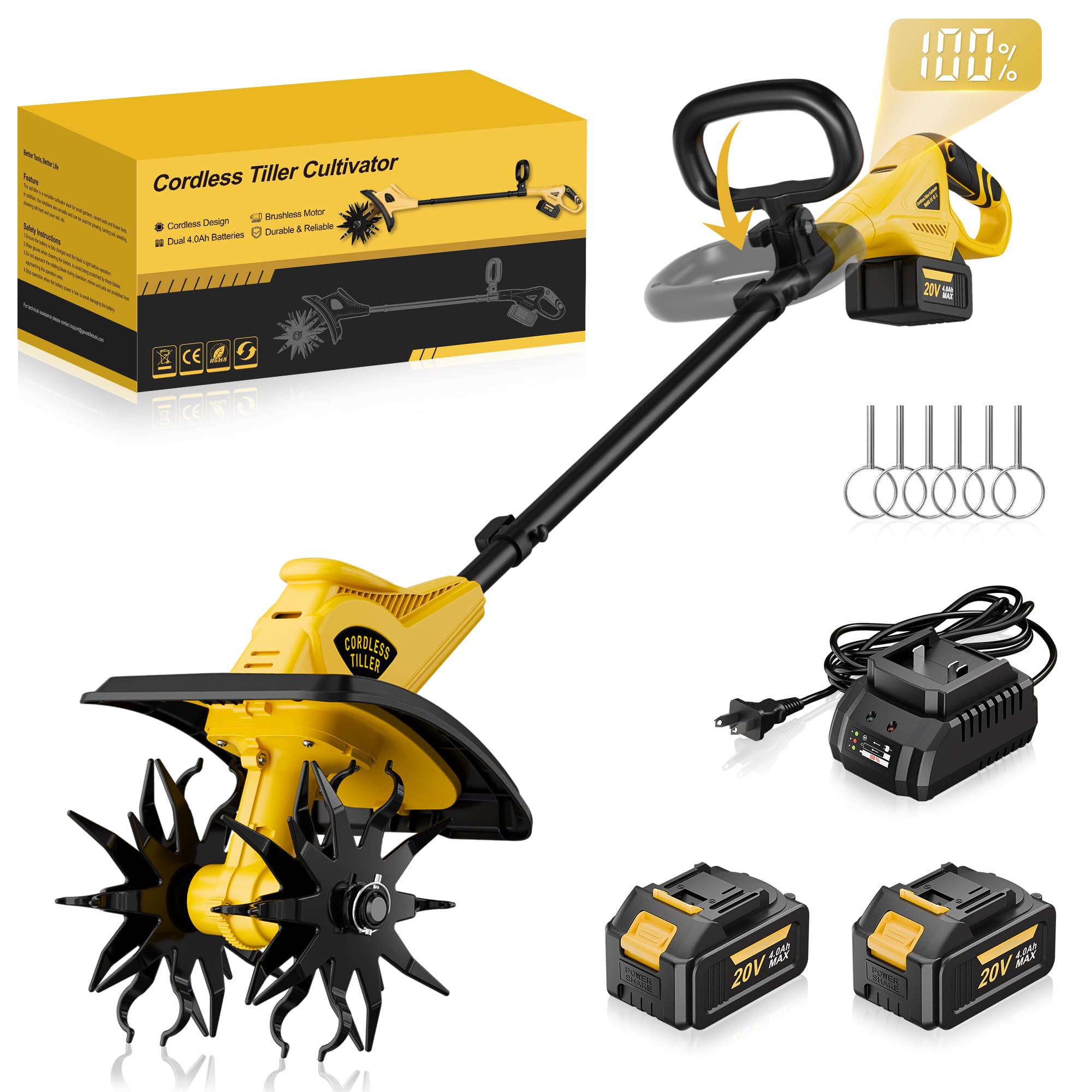
2. OFISPEED Cordless Tiller Cultivator
Ten pounds of cordless muscle with two batteries, so you swap and keep going instead of hunting an outlet
At 10.6 pounds this is the lightest machine on the list — and that number matters most in raised beds, where you are lifting the tool over the sides rather than dragging it along a path. Four steel tines cut 12 inches wide and 8 inches deep, so it handles a narrow row without clipping the plants on either side.
The brushless motor (a motor without carbon brushes, so it runs cooler and lasts longer) spins the tines at 360 RPM (revolutions per minute, or how fast they turn). It’s built to outlast ordinary motors, running quieter and without sparking. Two 4.0Ah batteries (amp-hour rating, a measure of battery capacity) charge fully in 2 to 3 hours, and you run one while the spare tops up. Buyers report the battery outlasts the stated runtime, with one buyer logging “almost 2 hours on/off with 70% remaining on first charge.”
Between passes you will notice the gap. The 12-inch cut needs a second run to cover a full bed cleanly, and the 4-tine head leaves strips between passes that a wider machine would swallow in one go. For a 12-inch raised bed that is a non-issue. For a 20-foot open row it means more walking.
The detachable handle and pole break down for a shed shelf, and the safety switch needs two deliberate presses before the tines turn — sensible when a grandchild wanders into the garden. Durability draws mixed notes in the review pages, so treat the 24-month warranty as the safety net and rinse the gear head after every session to keep root fibers from tangling.
The compact advantage: 12-inch cutting width in 10.6 pounds is a pairing no corded machine here can match — the Goplus at 24 pounds and the BILT HARD at 25 pounds both weigh more than double.
The honest limit: the same narrow cut that makes it nimble in raised beds means extra passes in open ground, and you cannot buy a third battery for a marathon session.
Best fit: raised-bed gardeners and anyone tilling far from a wall outlet who wants the job done this afternoon, not next weekend.
Think twice if: you are covering a long open row and want one pass to do it, or you need a deeper bite than 8 inches.
3. Goplus 17-Inch Corded Electric Tiller and Cultivator
For heavy clay and rocky patches, the 13.5-amp motor and 9-inch bite do the arguing for you
Six high-hardness blades and a 13.5-amp pure-copper motor turning at up to 400 RPM make this the deepest-cutting corded unit in the mid-range tier. It reaches 17 inches wide and 9 inches down, which puts it a full inch deeper than the Sun Joe TJ603E and 1.5 amps stronger. In soil that has never been turned, that extra inch is the difference between scratching the crust and actually opening the bed.
It weighs 24 pounds and folds down on rotary knobs at two frame positions, so it tucks into a utility-room corner between seasons. The wheels flip downward for rolling it out to the plot, then up for a deeper dig. An ergonomic open handle sits to the right side, and the start switch lives on the handle so you are not reaching back to the housing to kill the motor.
What owners talk about is raw effectiveness. It carves through clay and rocky soil, cuts new beds without overheating, and assembles in about five minutes with four bolts. Reviewers working heavy clay and stone report it “tills heavy clay/rocky soil, creates new beds, no overheating.” The recurring limitation is the middle gap between tine clusters: tangled big weeds and pine needles jam there, and clearing them mid-job runs slower than the tilling itself.
Two more practical notes. It wants a proper heavy-gauge cord — owners reach for 150-foot outdoor lines — and cord placement takes some thought so you are not tilling over your own lead. And it is built for soil, not for roots and rocks the size of your fist.
Why it stands out: a 17-inch width paired with 9-inch depth puts the deepest reach of any corded tiller here into clay without stalling.
What to know: those same aggressive tines can grab and pull forward on first contact, so brace your stance and let the machine walk at its own pace rather than fighting it.
Pick this one if: you are opening new beds in clay or rocky ground and have a stout cord reaching the plot.
Pass if: your garden is loamy and already worked — the extra depth adds weight you will not need.
4. BILT HARD 18 Inch Electric Tiller Cultivator

A 15-amp corded workhorse that turns a grass-covered lawn into seedbed in an afternoon
Here is the headline: an 18-inch working width and 8.7-inch depth driven by a 15-amp motor reaching 19,000 RPM. Six rust-resistant blades spin at 380 RPM, with four angled tines doing the actual soil breaking. For small-to-medium gardens and courtyards, that footprint covers a bed in noticeably fewer passes than the narrower machines above.
Weight sits at 25 pounds, and four quick knobs plus an H-handle design let the whole thing fold for storage. The 6-inch wheels flip down through four adjustable positions to set your working depth — wheels up for deep turning, wheels down for shallow leveling passes.
Owners consistently say it out-powers the gas tillers they have owned. One buyer put the workflow plainly: run the wheels up, make one fast forward pass then a slow reverse pass, then drop the wheels to level everything off. That reverse technique is what keeps the tines from bouncing on hard ground.
Two things to know before you commit. At full speed the machine pulls forward hard and can fling dirt beyond the bed edges, so slower throttle control and a firm grip are your friends. And root matter wraps around the tines, as it does on any tiller without quick-release blades — expect to stop and unwind them when working heavy root ground. The corded setup also means you need a real outdoor extension cord or you may miss the coupon value entirely.
The performance case: 18 inches of cutting width on a motor owners describe as stronger than their old gas units is the biggest corded bite in this lineup.
The fine print: that same power pulls forward aggressively at top speed, so working a tighter bed at lower throttle gives you more control than pushing the machine to its limit.
Built for: lawns you are converting to garden, small-to-medium plots, and older gardeners who want something light enough to assemble and handle alone.
Not for: precision work right beside delicate plants, where 18 inches of tine swing has nowhere to go.
5. Westinghouse W18TCAC Corded Electric Tiller Cultivator
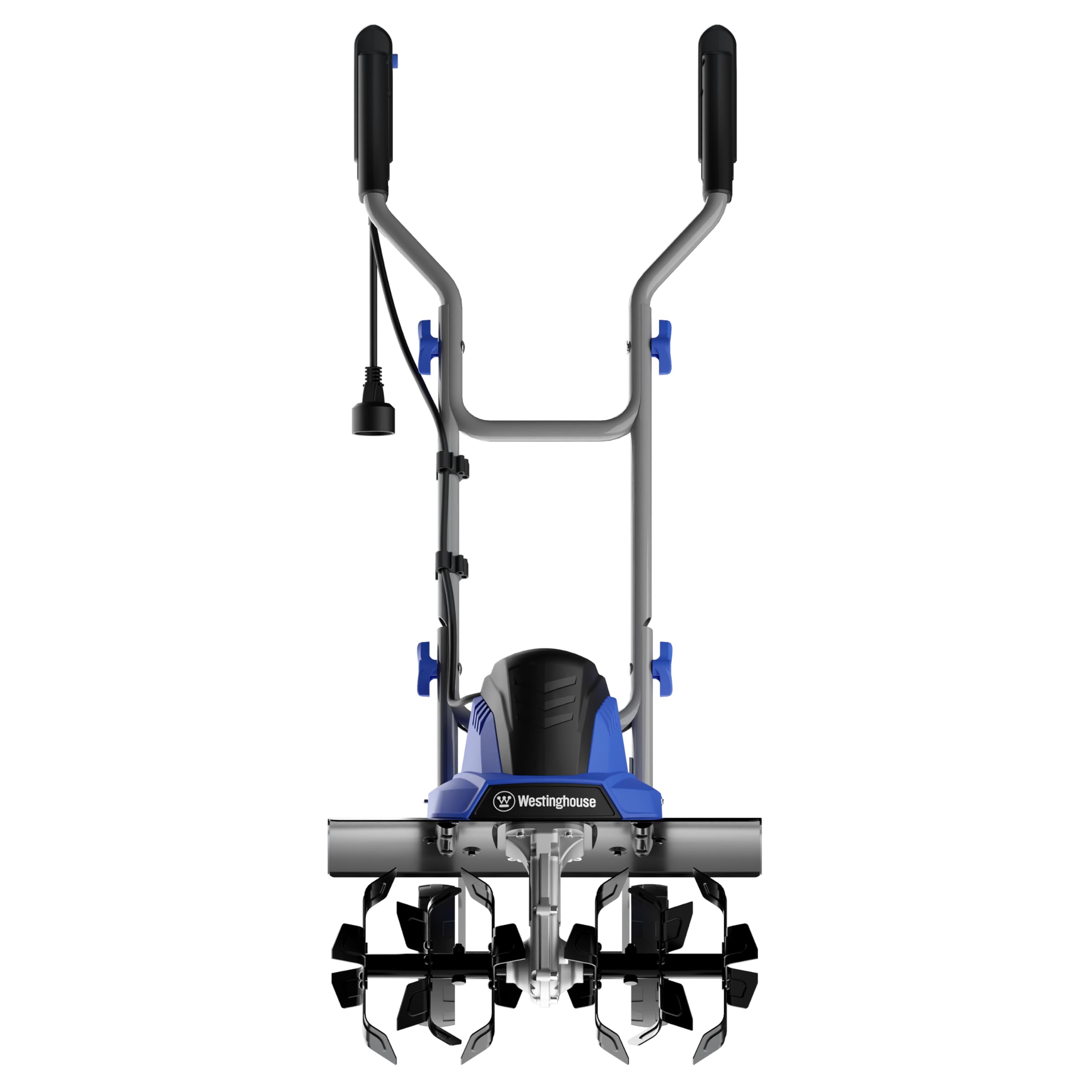
A 23.9-pound corded tiller with a 9-inch reach that shrugs off rocks and compacted ground
The W18TCAC covers 18 inches of working width with a 15-amp motor turning up to 400 RPM, and it will cultivate 9 inches deep. That depth matches the Goplus and beats the Sun Joe’s 8 inches by a full inch — useful when you are working a bed that has been walked on all winter and packed solid.
Six integrated steel blades with a 8-inch blade diameter do the cutting. What people keep coming back to is how well it handles debris: rocks, hard crust, the odd buried root. That short 6-tine cutting performance note keeps showing up in the review pages, and it is backed by an adequate size that stays small enough to maneuver around plants without uprooting them.
Build quality is Westinghouse’s strongest card here. Owners describe it as solid and well-assembled — about a quarter of reviews touch on quality directly — and the machine carries a 2-year limited warranty with lifetime technical support through a nationwide service network. Assembly runs straightforward, with buyers largely agreeing the setup was quick even for first-time tiller owners.
The honest catch: dry ground makes it hop. Multiple owners flag that the tines bounce in hard, dusty soil rather than biting in, and bouncing slows your passes. Watering the bed a day before you till largely solves it. It also sits on the heavier end at 23.9 pounds, though the foldable H-type handle helps with storage.
The strength: 15-amp power with a 9-inch bite and rock-clearing tine design is a well-rounded package for genuinely tough ground.
What to expect: dry soil makes it bounce, so plan to water the plot a day ahead if you want smooth passes.
Suits: rocky or compacted garden beds, flower patches, and anyone who wants a trusted brand with local service support behind it.
Think again if: your soil is bone-dry and you cannot wet it down beforehand — the bounce will slow you more than the machine’s power will help.
6. BILT HARD 46cc Gas Powered Tiller Cultivator
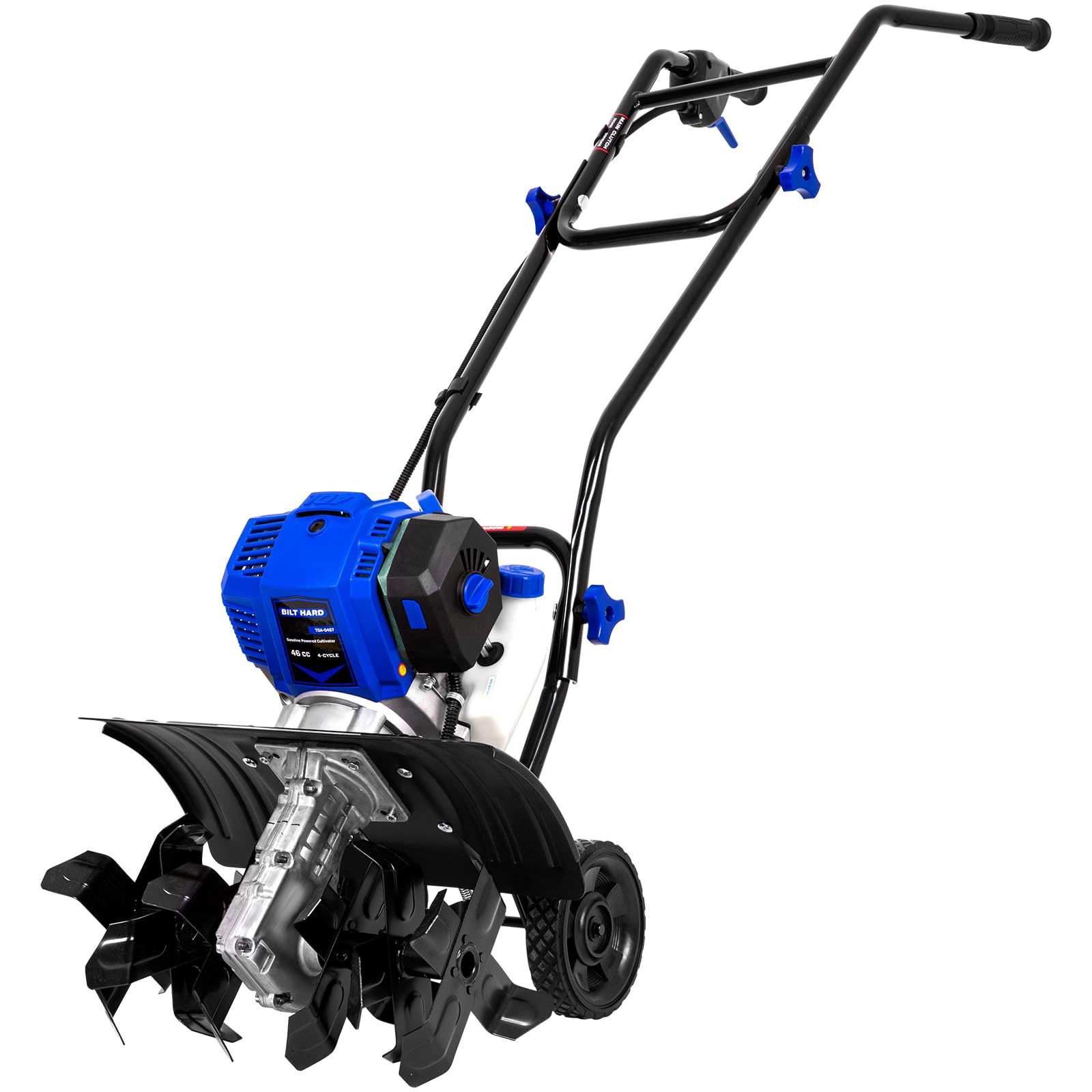
Gas power without gas fuss — a 46cc engine you fuel separately from the oil
This is the pick for gardens with no outdoor outlet within reach. The 46cc 4-stroke engine delivers 1,400W peak power and 250 RPM at the blade, and it works 16 inches wide. A no-mix fuel system keeps gas and oil in separate reservoirs, so you skip the pre-mix ritual entirely and just fill and go.
That 4-cycle design is the practical draw. Precision-balanced engineering keeps vibration low, noise down, and emissions clean, which means a long row does not leave your hands numb afterwards. For a hobby garden where you till a few times a season, that difference is what separates a tool you enjoy using from one you dread.
Owners say it chews through hard ground, and one tester tilled a 120-square-foot patch of packed soil and plant roots in 20 to 30 minutes without the engine flinching. Assembly is a solo job right from the start, and the size suits a small garden plot where a wide walk-behind would not fit.
Two notes worth weighing honestly. One buyer reports their unit ran rough on its second session, so log a support request early if anything feels off in the first few uses. The other is lubrication: the turbine/gearbox wants SAE 80W-90 EP gear oil, and that spec does not appear in the maintenance section of the included manual — write it down before you need it.
Where it wins: gas power with the convenience of no-mix fuel and reduced vibration at a weight light enough to manage without help.
Where you should plan: engines of any kind need maintenance, and this one calls for SAE 80W-90 EP gear oil in the gearbox — not a detail the manual hands you.
Go for it if: your garden has no outlet nearby, you want 16 inches of gas-powered cutting, and you would rather fuel a 4-cycle engine than mix a 2-cycle can.
skip it if: you garden only a handful of times a year and would rather not deal with fuel storage at all.
7. SENIX 4QL Gas Powered Tiller Cultivator

A 46cc gas tiller that starts on one pull and keeps running whatever direction you turn it
Six premium steel forward-rotating tines on a 46cc full crank engine cut 15 inches wide and 8 inches deep. That widths sits right between the OFISPEED cordless at 12 inches and the BILT HARD gas unit at 16, giving you a compact working footprint that still covers a full bed in reasonable passes.
The patented 4QL technology is the differentiator — no mixing gas and oil, and all-directional use without stalling or oil leakage. That means you can tip the machine, roll it on its side for cleaning, or maneuver it at odd angles without worrying about oil sloshing the wrong way and flooding the combustion chamber. That is the failure mode on ordinary 4-cycle small engines.
Starting is genuinely easy here. An auto choke and compression release mean a light pull fires the engine, and once running the full crank design keeps vibration low enough that longer sessions do not become a hand-numbing chore. Foldable handles break down for tight shed storage, and the package includes engine oil so you are not hunting for a specific weight before your first session.
It carries a 3-year limited warranty, the longest coverage in this lineup. The item listing notes a 2-year limited warranty description, and owners mention the 3-year term was honored, so confirm coverage at purchase. And unlike corded machines, this one brings fuel, exhaust, and seasonal storage prep into your routine.
The gas advantage: 4QL technology means no fuel mixing and no oil-leak stalls regardless of how you hold or tip the machine mid-job.
The gas trade-off: you are now responsible for fuel, spark plug, and air filter maintenance — a corded unit has none of those moving parts to keep up with.
Great choice for: small to medium lots where owners want one-pull starts and compact foldable storage without fuel-mixing fuss.
Consider alternatives if: you want zero engine upkeep — a corded or battery model takes that entire category of maintenance off your plate.
8. NOVUS 2-in-1 Gas Tiller
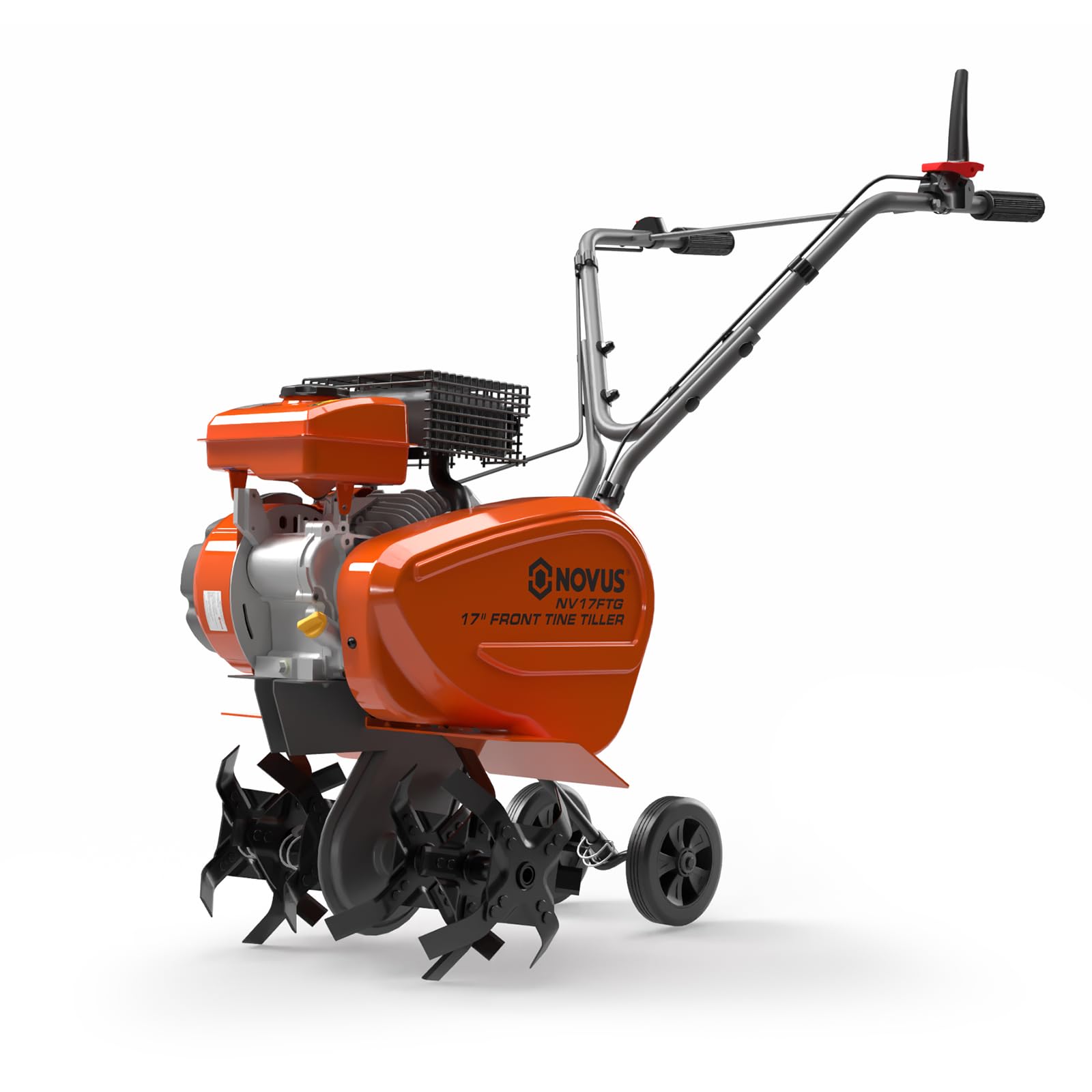
One machine that shrinks to 9 inches for tight rows and expands to 17 for open ground
The trick here is the tool-free outer tine removal. Pop the outer pair off and you have a 9-inch cultivator for precision work between rows; bolt them back on and you are at 17 inches with all 24 hardened steel tines cutting. The working depth sits at 6 inches, which is shallower than the corded machines above, but this machine wins on width flexibility instead.
The 79CC 4-cycle engine is the biggest in this lineup, and customers note it handles hard ground without complaint — even stony Kentucky soil that has never been broken. That is a front-tine machine doing genuinely heavy work. A reverse gear makes backing out of a jam simple, and the low center of gravity keeps the unit planted through turns at the row ends.
Two build features stand out for small-garden use. The 6-inch airless never-flat wheels mean you are not topping up tires before every session, and the smooth-rolling design keeps it easy to move across loose soil. And the compact footprint at 75 pounds keeps it manageable despite the engine size — much of that weight is down low.
The trade-offs to know going in. This is a 6-inch working depth, so if you need to go 9 inches deep, look to the Westinghouse or Goplus instead. Assembly takes a bit of time, and the manual does not always match the machine shipped — reportedly missing a fuel shutoff and throttle lever — so a little patience and a call to NOVUS’s US-based support helps sort it out. Owners also note the gas and oil caps cross-thread easily, so turn them in gently.
What it does best: switching from 9 inches to 17 inches without tools is the kind of flexibility no fixed-width tiller here can offer.
The reality check: that flexibility comes at 75 pounds and a 6-inch depth, so the machine is at its best breaking new ground rather than digging deep in established beds.
Ideal for: gardeners expanding into brand-new ground who also want a narrower cultivator for the rows once the beds are built.
Skip if: you need a deep 9-inch bite, or you already know your soil is rock-free and a lighter corded machine will handle the job.
9. Ryobi RY18CVA-0 Motor Hoe 18V ONE+ Battery (Body Only)

If you already own Ryobi 18V ONE+ batteries, this tool plugs straight into the pack you have
This is the cultivator that rewards loyalty to an existing battery platform. Body only, so if you already own 18V ONE+ packs, you are adding a tool to your collection rather than starting a new battery ecosystem. With a RYOBI 18V ONE+ 4.0Ah Battery RB1840X you get over an hour of runtime per charge, which covers most small-garden sessions in a single go.
Three speed settings let you dial back for delicate work between plants or open up for tougher passes. The tool-free adjustment takes the machine from four tines down to two for narrower cultivating between tight rows. An adjustable auxiliary handle mounts where you want it for longer sessions, and the whole unit weighs about 10.6 pounds, which makes long working stretches far less tiring.
Where this tool shines is fine refinement work rather than deep digging. Reviewers point out it breaks up hard, crusty topsoil and clears grass and moss with little effort. One buyer tilled around 80 square meters of garden without stopping. The biggest advantage owners cite is quick blade removal — pull the four tines off, clear roots, and get back to work without breaking out tools.
The honest picture: this machine does not till deep, and Ryobi’s own materials position it as a cultivator rather than a full rototiller. The 4-to-2 tine conversion is your narrow-row tool; for deep breaking you want a corded or gas machine instead. And the retaining pins holding the discs can loosen over time — a simple wire wrap fixes it, but check them before each session so you do not lose a pin mid-job.
The platform play: for existing ONE+ owners, this is a low-friction add-on that reuses the batteries already in your garage.
Not for everyone: body-only means no battery or charger included, and it tops out as a cultivator rather than a deep tiller.
Right for: current Ryobi 18V ONE+ owners who want a light, quiet, cordless cultivator for cleanup passes and tight areas.
Wrong for: anyone starting from scratch without ONE+ batteries in the drawer, or gardeners who need to break virgin ground at real depth.
Know the Specs
Amperage (corded tillers)
Amperage is the measure of electrical current a corded motor draws — think of it as the raw muscle available at the tines. Higher amperage generally means more torque to push through tough soil without stalling. The corded machines here run from 12 to 15 amps, and in general, the higher the amperage, the larger the working width the motor can sustain without bogging down.
Tine count and tine design
Tines are the curved steel blades that actually break the soil. More tines usually means a wider cut and finer soil breakdown, but the design of the tine — how aggressively it is angled — matters as much as the count. Angled tines slice into the soil; flat or forward-rotating tines churn and throw it. Match the tine style to your goal: fine seedbed or rough break-up.
Tilling width and depth
Width is how much ground you cover in a single pass; depth is how far the tines reach down. A wider cut moves faster across open ground. A deeper bite opens compacted or unworked soil. Pick the depth that matches your soil condition first, then choose the width that fits your garden layout.
Brushless vs standard motors
A brushless motor skips the carbon brushes that wear down on traditional motors. The result in cordless tools is quieter operation, no electrical sparking, and generally longer service life. It also tends to deliver more torque per watt of battery draw, which is why cordless tillers with brushless motors can handle harder soil than their weight might suggest.
Common Questions
How wide should a tiller be for a small garden?
Is a corded or cordless tiller better for a small garden?
Can an electric tiller break through clay soil?
How deep does a small garden tiller actually till?
Do I need to mix gas and oil for a 4-cycle gas tiller?
How much does a rototiller weigh and why does it matter for a small garden?
Can I use a cordless tiller with my existing battery platform?
How long does it take to assemble a small garden tiller?
Do small garden tillers work on rocky or root-filled soil?
Should I buy a tiller with wheels?
The Bottom Line
For most small-garden owners, the rototillers for small gardens winner is the Sun Joe TJ603E because a 12-amp motor, 16-inch width, and 8-inch depth cover the widest range of established beds, and the folding handle keeps it easy to tuck away between seasons. If you want cordless freedom and narrow-row agility, grab the OFISPEED Cordless Tiller — 10.6 pounds and 12 inches of cutting width go where a cord will not. For breaking new clay or rocky ground, the deeper 9-inch bite of the Goplus 17-Inch Tiller is the one to reach for. And for gardens far from any outlet, the BILT HARD 46cc Gas Tiller brings 16 inches of gas-powered cutting without mixing fuel.
Whichever way you go, match the width to your narrowest path and the depth to your soil condition — that pairing decides whether a tiller turns a spring choreinto a five-minute job or a weekend fight.
How we choose
We do not accept paid placement. Every pick is matched to a real buyer and a real use-case; we do not hands-on test units.
Sources
Specifications: manufacturer listings and product documentation. Review insights: verified customer reviews, as of October 2026. Pricing: not shown on this page (it changes often); check the current price via the retailer link.
As an Amazon Associate, Home Digitized earns from qualifying purchases. This does not affect which products we feature.