
Disclosure: This post contains affiliate links. As an Amazon Associate I earn from qualifying purchases, at no extra cost to you. Learn more
Specs are compiled from manufacturer listings and verified buyer reviews and can change over time — please confirm the key details on the product page before buying.
If the spot you need to watch has no outlet and no router, the answer is a camera that makes its own power and carries its own signal. That means a solar panel on top and a cellular SIM inside, so the thing keeps recording at a barn, a gate, a jobsite, or a cabin where the grid simply stops. The picks below are sorted by how well each one actually survives that reality — not by how many fancy features the box promises.
This guide is built by comparing the manufacturers’ published specifications and the patterns across verified customer reviews, so you get each pick’s real strengths and trade-offs instead of marketing spin.
A camera in the middle of nowhere lives or dies on two things: whether its panel keeps the battery fed through grey weeks, and whether its signal holds when the nearest tower is far away. This breakdown of the best off grid security cameras covers both, plus the data-plan traps that catch people after they install.
Top Picks

How To Choose The Best Off Grid Security Cameras
Off-grid changes the rules completely. Without a wall outlet, the camera has to harvest its own electricity. Without a router, it has to carry its own data connection. Get either of those wrong and you have an expensive plastic box bolted to a fence post.
Match the solar panel to the camera’s appetite
A solar panel only helps if it out-produces what the camera drains each day. A camera in constant “always-on” recording mode burns far more than one that wakes only when motion trips its sensor. Check the panel wattage and the battery capacity side by side, then think about your winter sun. A panel that keeps up in July can fall behind in December, which is why a bigger battery in milliamp-hours (mAh — a measure of stored electrical charge) buys you slack for the dark months.
Cellular signal, not WiFi, is the lifeline
These cameras connect through a 4G LTE cellular network (the same signal your phone uses for calls and data), not your home internet. That means the installation spot must have usable cell coverage from a carrier the camera supports. Some units lock you to their own data plan; others let you pick a carrier. Before you buy, confirm the exact coverage at your gate or barn, because a camera with one bar of signal will drop clips no matter how good the lens is.
Local storage keeps the monthly bill at zero
Cloud plans recur forever, so a camera that can record to a microSD card lets you keep footage without a subscription. Look at both the included card size and the maximum the camera accepts, because loop recording overwrites the oldest clips once the card fills. If you want the cheapest long-term setup, prioritize a camera with a generous max card capacity over one that leans hard on cloud storage.
Side-by-Side Comparison
| Model | Best For | Power Source | Max Card Storage | Night Vision Range | Amazon |
|---|---|---|---|---|---|
| ELYSOO 4-Cam Kit★ Best Overall | Whole-property coverage | Solar + built-in battery | 256 GB | 25 ft | Amazon |
| Hiseeu 4G LTEBest for Barns | Barns & remote outbuildings | Solar + battery | 128 GB | 48 ft | Amazon |
| SEHMUA 2-PackMost Popular | Large acreage on a budget | Solar + 6W panel | — | Color night vision | Amazon |
| REOLINK Go PT S Lite | Auto-tracking coverage | Solar + battery | 512 GB | Color + infrared | Amazon |
| ELYSOO Dual Mode Solar Cam | Spotty WiFi or cellular | Solar + built-in panel | — | Color night vision | Amazon |
| TACTACAM Defend 360 | Remote cabins & docks | Solar + 10000 mAh battery | — | 1080p video | Amazon |
| Vosker V150 2-Pack | Construction sites | Solar + 10000 mAh battery | 16 GB | 80 ft | Amazon |
| AUKIN Lifetime Free Data | Zero-fee monitoring | Solar + 7200 mAh battery | 32 GB | 2K color night vision | Amazon |
Detailed Reviews
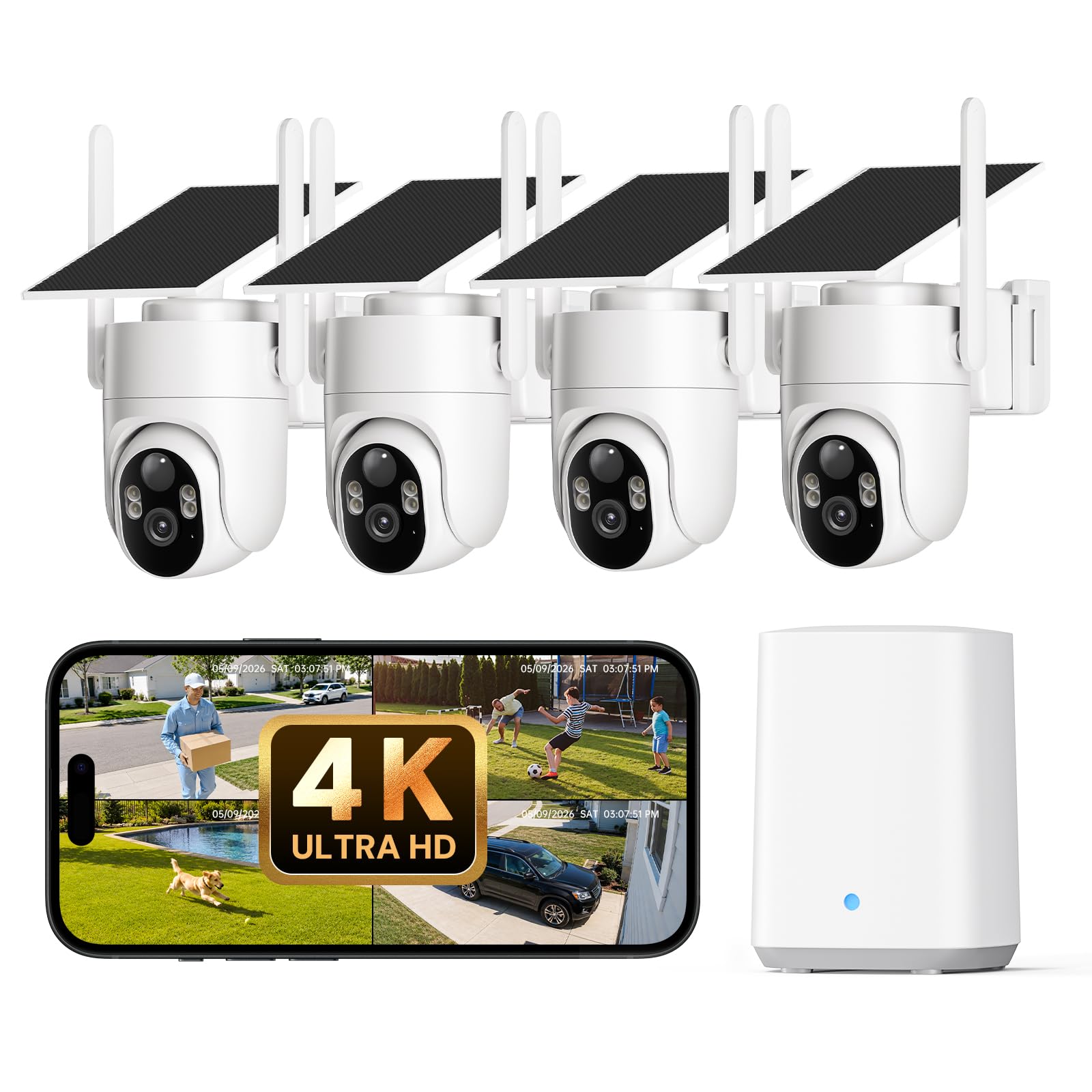
1. ELYSOO 4K Solar Security Cameras 4-Cam Kit
Our pick — 4.5+★ from 300+ verified ratings; the strongest balance of quality and price.
Four solar eyes that stitch one event into a single story across every angle.
If you are covering a whole property rather than one gate, this is the kit to build around. You get four cameras plus a homebase that stores everything on a pre-installed 32GB card, and that card slot climbs to 256GB. Nothing leaves the house, so there is no fee hanging over you and no footage sitting on someone else’s server. The base also ties clips from the same moment together, so a person walking from the driveway to the back door shows up as linked multi-angle footage instead of four separate videos.
The lens work is where the kit separates from cheaper single cams. Each unit records at 8MP for 4K-level detail, which is enough to make out faces, license plates, and package labels. Night vision reaches 25 ft in full color thanks to four LED lights plus smart IR, and that 25 ft figure is where the Hiseeu unit outpaces it, reaching 48 ft in the dark. The ELYSOO pulls ahead on storage instead: its 256GB ceiling doubles the Hiseeu’s 128GB max. If your priority is detail on the walkway outside your door, this wins; if your priority is seeing deep into a dark field, the Hiseeu reaches farther.
Power is genuinely set-and-ignore. Two hours of sunlight a day keeps each camera alive, and the built-in battery carries it through cloudy stretches. IP65 sealing handles -4°F to 122°F, so winter in the north and summer in the south are both fine. Installation is a screw-in job with no electrician and no wiring. The cameras also do 360° pan-tilt with cross-camera tracking, and they run on dual-band 2.4GHz and 5GHz WiFi once they reach the base station. That means the base still needs a network — this is a locally-stored system, so the radios handle the link home and the cellular hardware handles nothing here.
What earns its keep
- Four cameras plus a homebase for full-perimeter coverage in one purchase
- 32GB card pre-installed and expandable to 256GB with zero subscription
- 8MP lens reaching 4K-level detail for spotting faces and plates
- Linked multi-angle clips so you watch one event, not four screens
- Solar keeps charging on just 2 hours of daily sun; IP65 rated
The honest trade-offs
- Night vision tops out at 25 ft, shorter than the Hiseeu’s 48 ft reach
- No true desktop app — the workaround runs an Android emulator
- Notifications arrive too often by default until you tune the sensitivity
- The base station needs WiFi, so this suits a property with a router nearby
Reach for it if: you want a complete four-camera perimeter with local-only storage and no recurring bill, and your house already has a network for the base.
Look elsewhere if: you need night detail far down a dark driveway, since color coverage stops at 25 ft.
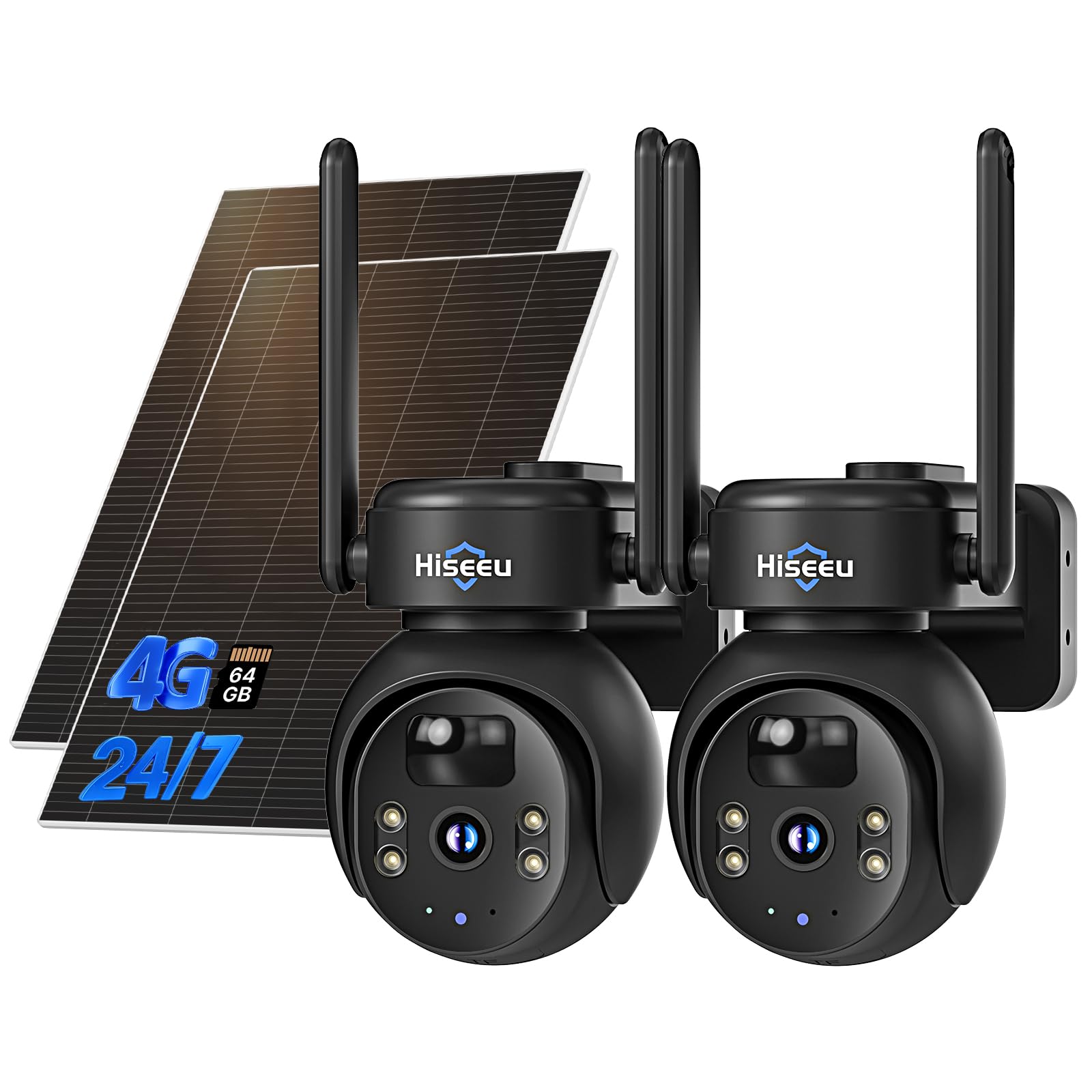
2. Hiseeu 4G LTE Cellular Security Camera Solar Powered
An always-recording watchman for the spots where no router has ever reached.
This is a pure cellular camera — it does not support WiFi at all, and it is built for the places that fact suits: a barn, a farm, a ranch, a construction site, a vacation home. It carries a 64GB card and takes up to 128GB, which is half what the ELYSOO kit accepts, but it counters with reach. Color night vision stretches to 48 ft, nearly double the ELYSOO’s 25 ft, so on a dark lot or a long drive this is the one that keeps seeing when the other gives up.
Its headline trick is always-on video, which records continuously and assembles the frames into a smooth timeline rather than waiting for motion to start. Motion-triggered cameras can miss the first second of an event; this one is already rolling. When the PIR sensor (a passive infrared sensor that notices body heat moving) picks up a person, it switches to standard recording for full detail, then drops back. The onboard AI analysis trims the junk alerts, and you can dial sensitivity in the app. Weather sealing is IP66, rated from -4°F to 122°F, so a barn wall in February is not a problem.
The single biggest thing to understand before you buy: this camera runs only on Hiseeu’s own 4G data plan, priced at USD19.90 per month or USD169.90 per year per camera after the trial data runs out. There is no carrier choice here, and a buyer who struggled to keep the data topped up found the cameras unusable once the plan lapsed. That is the trade-off of a locked ecosystem. On the plus side, setup takes three steps — power on, scan the QR code, done — and the pan-tilt sweep covers 355° horizontally and 90° vertically.
What owners value most: the install is the part that wins people over — the app walks you through it and the solar panel means no cable run and no battery-swap routine.
Signal check first: because the camera is cellular-only, the installation spot must have live 4G coverage or the feed simply drops — verify that before mounting anything.
Pick this one when: the site has no WiFi and no power but does have cellular bars, and you want continuous recording rather than motion-triggered clips.
Consider a different model if: you refuse to be locked into one brand’s data plan, since the camera only connects through Hiseeu’s own service.
3. SEHMUA 2 Pack 4G LTE Cellular Solar Security Camera
Two 4G cameras with their own SIM cards and a long-running reputation behind them.
The first thing to know about this pair is that they ship with an EIOTCLUB 4G LTE SIM card already inside each camera, and that SIM plays nicely with AT&T, T-Mobile, and Verizon. You get a 7-day unlimited data trial plus a 30-day cloud storage trial, after which continuing service costs.9 per month or.9 per year. Unlike the Hiseeu, which locks you to one provider’s plan, these let you work with the major carriers. The catch is that the built-in SIM is the only one that works, so plan switching means working through the included card rather than popping in your own.
Each camera carries a 6W solar panel that keeps it alive on sunlight alone, and the first charge must come from the bundled cable before the panel takes over. Video is 2K with 4X digital zoom and full-color night vision, and the wide-angle lens rotates both horizontally and vertically for a full sweep. You can see your whole yard after dark, and one owner’s note about that night coverage is exactly the appeal. The real durability proof is in the long-haul owners — one has run them over a year and reports the solar panel still holds the battery near full through cloud and heat.
This 2-pack is the most widely owned set on the list by a wide margin, so you get the full range of buyer experiences. Most buyers report the picture and the setup as excellent. A small handful hit the classic cellular-camera frustrations: motion alerts that trip on rain and wind, and footage that saves to the cloud by default until you switch it to the card. No memory card is included, so budget for one if you want local recording without a cloud bill. Turn the motion sensitivity down on day one and most of the false alerts go away.
Where it wins
- SIM included and works across AT&T, T-Mobile, and Verizon
- 2K resolution with 4X zoom and full-color night vision
- 6W solar panel per camera for true cordless power
- Two cameras for the price of roughly a single premium unit
- One owner has run the pair over a year with the panel still holding a near-full charge
Before you mount it
- No microSD card bundled — local recording needs one added
- First charge must come from the cable, not the panel
- Motion detection runs hot from the start and trips on weather and bugs
- The default cloud path must be manually swapped to card storage
Best fit: anyone watching a large property who wants two carrier-flexible cameras and does not mind adding memory cards and dialing down sensitivity.
Pass on it if: you want a plug-and-record setup with storage included and zero tuning, since this pair expects a little hands-on configuration.
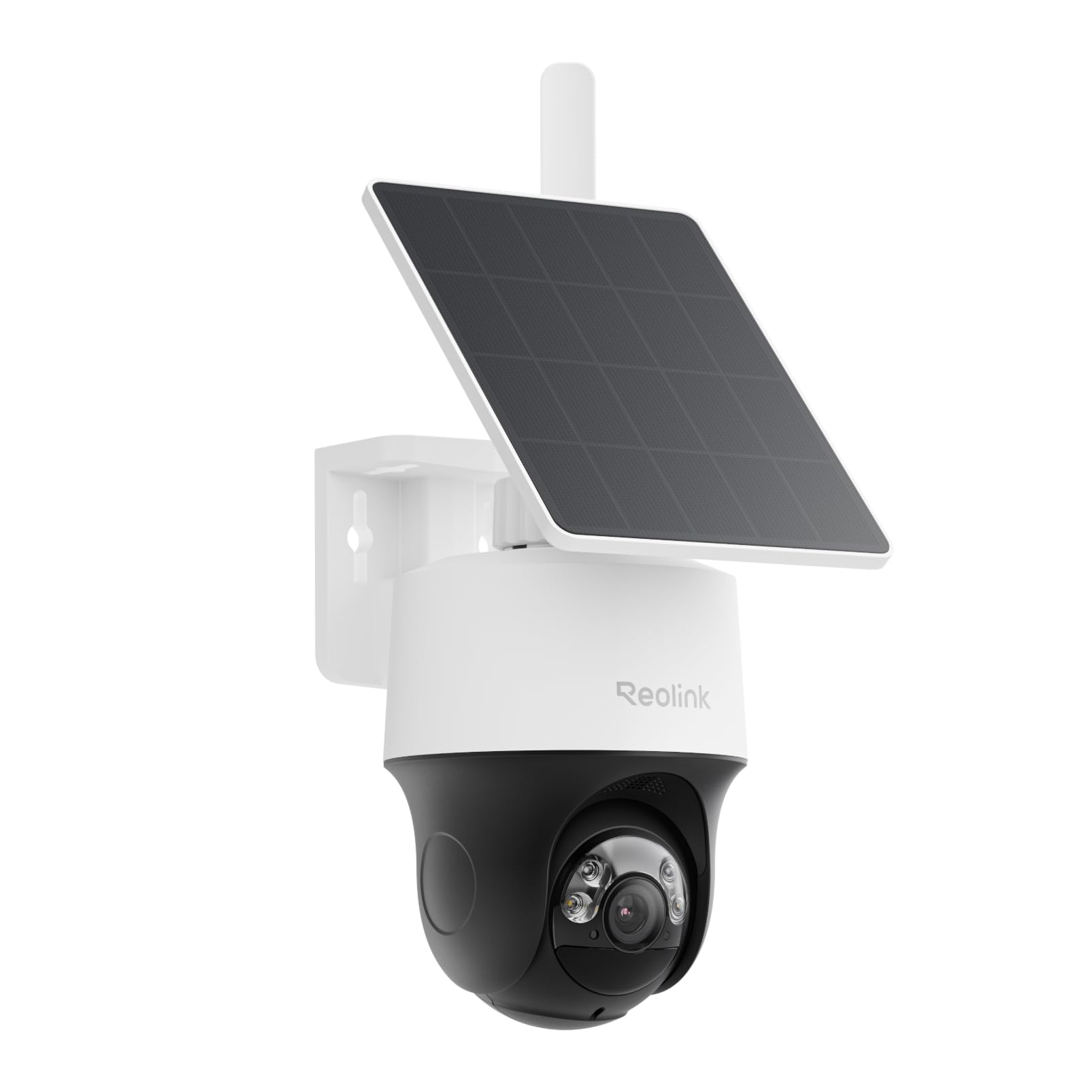
4. REOLINK 2K 4G LTE Cellular Security Camera
A solar camera that follows the action instead of waiting for it to walk into frame.
Most cameras on this list cover a fixed slice of ground. This one pans 355° and tilts 140°, then uses auto tracking to keep following a moving subject as it crosses the property. Storage is the most generous here too: it takes a microSD card up to 512GB, four times what the SEHMUA stores and twice the Hiseeu’s max, so months of clips fit without a subscription. The frame rate runs at 15 frames per second, and 4MP Super HD resolution keeps faces and vehicles legible in both color and black-and-white infrared night mode.
You get power that holds up through rough weather. The 3W solar panel (a small panel that trickles charge into the battery) keeps it topped up on as little as 10 minutes of daily sun. When the sky goes fully grey, the battery runs up to 3 months on a single charge — the longest no-sun buffer here, enough to ride out a cloudy winter month. IP65 sealing (dust-tight and protected against water jets) and a 3m power cable make the install straightforward. The integrated SIM (the built-in cellular chip that connects it to the network) is not removable, and the free 100MB trial is small, so you will move to a paid plan quickly through the Reolink app. The app also handles plan purchase and usage monitoring in one place.
Here is where you need to weigh honestly. The built-in SIM makes activation simple, and when signal is good this camera is talked about as dependable with solid tracking and pictures. But connectivity is the recurring weak point in the owner feedback — some units settle in fine, while others struggle to hold a connection, and data usage can climb faster than expected on some plans. If your location sits in a strong cellular pocket and you value the 512GB storage ceiling and auto tracking, this is a strong pick. If your coverage is marginal, that risk deserves real weight before you commit.
Storage and reach: the 512GB card ceiling and 3-month battery reserve let it keep recording through weeks without sun.
The connectivity question: cellular stability varies by location, so test signal strength at the exact mounting spot before you trust it with a gate or driveway.
Great for: a property with strong cell coverage where you want a tracking camera and enough local storage to skip the cloud entirely.
Think twice if: your install site sits in a weak-signal pocket, since connectivity is the one thing owners flag as inconsistent.
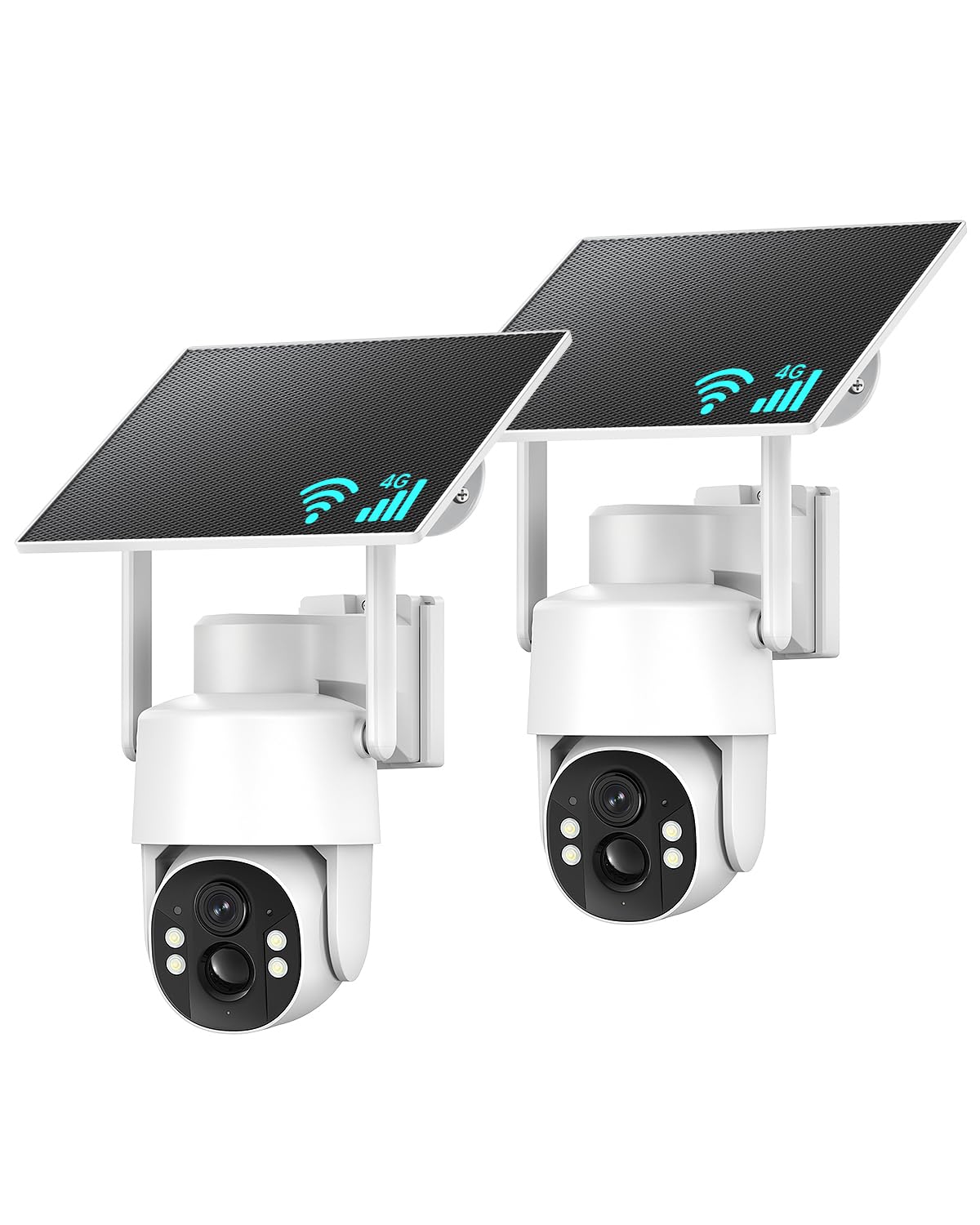
5. ELYSOO Cellular Security Camera 4G LTE&WiFi Dual Mode
The rare camera that flips between WiFi and cellular when your signal gets flaky.
Most off-grid cameras force a choice: cellular only, or WiFi only. This one carries both radios and an integrated SIM card, so when your home WiFi turns unreliable you switch to 4G with a tap in the app, and it auto-connects to AT&T, Verizon, or T-Mobile. That flexibility is the entire reason it earns a slot. You get a 7-day unlimited data trial after activation, then a plan is required — but at least you are not stranded when the router drops.
Coverage runs 350° horizontally and 90° vertically on a 4MP sensor, capturing clear day and night video of people and vehicles. Two layers of night vision handle the dark: infrared black-and-white, plus a spotlight that kicks on automatically for color footage. AI detection separates humans from vehicles and fires instant push alerts, and you can draw custom detection zones to cut the false notifications that plague sensitive cameras. The built-in solar panel removes the need for frequent recharges or a hardwired line, and IP65 sealing keeps it running through rain.
Buyer feedback on this one leans strongly positive, with the recurring theme being how easy the app makes the whole setup. The measurements come in at a compact footprint that screws into a wall or post without fuss. The one storage detail to plan for: there is no built-in memory, so you need a card, with one owner noting a 64GB microSD card as the target. The SIM trial is small at 300MB, so account for a data plan once it runs dry. It also leaves the choice of cloud or card storage open, and the keeper is that it removes the single-point failure of a WiFi-only design.
Suits you if: your location sits on the edge between good WiFi and good cellular, and you want a camera that can lean on whichever one is working.
skip it if: you want storage built in, since this one needs a microSD card added before it records locally.
6. TACTACAM Defend 360 Cellular Security Camera

A 10000 mAh battery runner built for boats, cabins, and gates far from any outlet.
Where the ELYSOO and SEHMUA lean on solar alone to top up small batteries, this one packs a 10000 mAh internal battery — the largest battery on the list — and pairs it with solar charging. That combination is what lets it run through long stretches with no direct sun. It connects over LTE cellular only, so a remote gate, a barn, or a cabin with zero WiFi is exactly the environment it was made for. Livestream resolution is 1080p video with 4K still photos, and motion alerts hit your phone the moment something moves.
The 360° pan-tilt-zoom lets you sweep the whole property from your phone instead of bolting up three fixed cameras to cover the same ground. Weather resistance lets it stay outside through heat, cold, and rain, and the whole unit weighs 1.4 pounds. When it works, the location independence is the point: one owner keeps theirs on a boat in a marina where it sends activity notifications reliably and the reasonable subscription keeps the feed alive.
The honest caution here is the paywall. There is also a delay between motion and the captured shot on some plans. If you want continuous video without a subscription, this is not the model for you. If you want a rugged, high-capacity camera for a genuinely remote spot and you accept the ongoing plan, it delivers a battery reserve the smaller cameras simply cannot match.
Why it earns its price
- 10000 mAh battery outlasts every other battery here
- Solar plus battery means long unsupported runtimes
- 360° pan, tilt, and zoom covers ground a fixed camera cannot
- 4K still photos and 1080p livestream for detail on demand
- LTE-only connection suits truly remote sites with no router
Understand before buying
- Key functions sit behind a monthly subscription
- The free tier sends only limited photos per day
- Motion-to-photo delay exists on cheaper plans
- No built-in storage is listed, so remote footage leans on cloud
The right call when: you need a high-capacity camera running solo at a boat, cabin, or remote gate and are comfortable with an ongoing data and service plan.
Not the one if: you want one-time purchase with no recurring charges — this model is built around a subscription.
7. Vosker V150 Construction Pack 4G LTE Solar Cellular Security Cameras, 2-Pack

Rugged 4G sentinels built for trailers, tool containers, and unfenced lots.
This two-pack is aimed straight at contractors and remote-property owners. Each camera carries a 10000 mAh lithium battery (matching the TACTACAM’s 10000 mAh) and a built-in solar panel, so autonomy comes without any on-site power. The pre-activated SIM and 4G LTE connection mean it works where there is no wiring and no WiFi at all, and a 16GB microSD card is included for local backup. GPS tracking rounds it out, so you know exactly where each unit is mounted — useful when a trailer moves between sites.
Detection distances here are the standout spec. The camera picks up activity out to 90 ft and sends real-time photo alerts to the Vosker app, while infrared night vision reaches 80 ft. That 80 ft infrared range is the deepest night vision here — far beyond the ELYSOO kit’s 25 ft — which is exactly what you want when a dark lot is the thing you are guarding. The HD day vision uses a 43° wide angle, and the rugged IP65 housing shrugs off rain, dust, snow, and temperature swings.
The story from owners is calm confidence: they describe the V150 as reliable and low-maintenance, with a straightforward app setup that starts by charging the unit, sliding in the pre-activated SIM, and scanning the QR code. Two cameras cover a wide area better than one, and several note that linking a second set expands coverage even further. The repeated caveat is the subscription — even though WiFi is not needed, cellular service is, and that is a recurring cost. Plan for that before you buy, and this becomes one of the toughest, longest-range kits in the group.
Range and ruggedness: the 90 ft detection and 80 ft infrared night vision are the longest ranges here, and the 10000 mAh battery keeps both cameras running through bad weather.
The plan factor: cellular service is mandatory, so factor the ongoing subscription into your decision — the hardware itself is built to last.
Ideal for: contractors and remote landowners who need two long-range, weatherproof cameras watching trailers, tools, or unfenced equipment.
Reconsider if: you want a fully subscription-free system — cellular service is required to keep these online.
8. AUKIN 4G LTE Cellular Solar Security Camera
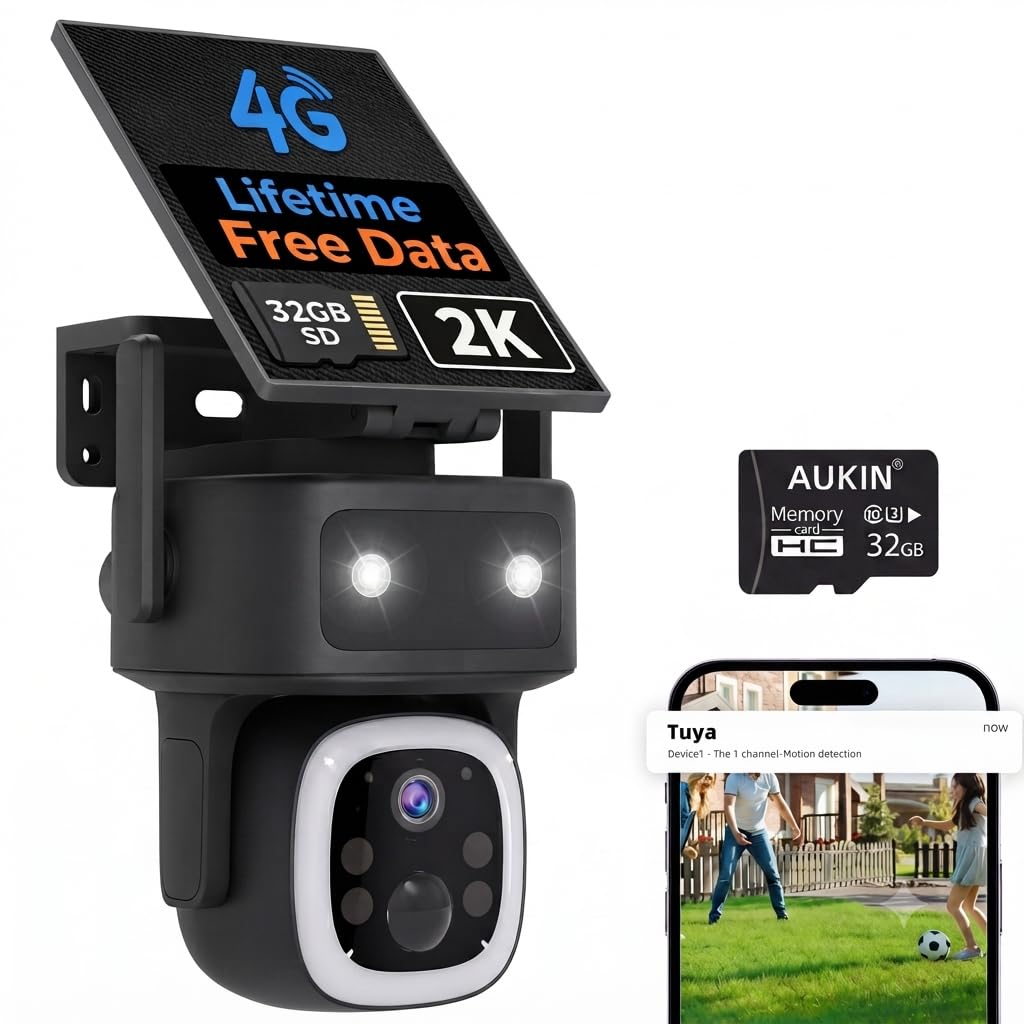
The one camera here that claims no monthly bill, ever, in a classic black shell.
Where every other camera on this list eventually asks for a data plan, this one leans on a built-in VSIM card that the manufacturer calls lifetime free, with no monthly fees or contracts. It still runs on AT&T, T-Mobile, and Verizon for nationwide coverage, and it needs no WiFi, so barns, farms, ranches, and construction sites are all fair game. The catch is that the VSIM is dedicated to this camera alone — you cannot pop it into any other device. If the free-data promise holds for you, this is the lowest ongoing cost on the page.
The solar math is spelled out clearly here, which is rare. Under full sunlight the panel generates roughly 2400–3000 mAh per day, while the camera’s normal daily drain runs only 800–1200 mAh, so the panel out-produces the camera and keeps the battery topped off. That 7200 mAh battery is the reserve backing the panel. It records 2K color night vision with 360° pan-tilt and human tracking, so it follows a person rather than just watching a fixed cone. Two-way audio lets you speak through the camera, and a free 32GB TF card handles local recording without any cloud subscription.
On the storage and sharing side, this one is generous: up to five people can pull the live view at once through the Tuya app, which suits a family or a small crew. The PIR sensor is tuned to cut false alerts, and IP66 sealing covers rain, snow, and strong sun. Buyer feedback centers on the picture — owners describe the day and night image as clear. Treat the free-data claim as the thing to verify against your own coverage area, since a cellular camera still lives and dies on the local signal. Get that right and this is the most economical long-term setup here.
The money angle: a 32GB card is included and data is billed as free, so this pick is built to avoid both a storage fee and a cellular plan.
Verify your signal: like every cellular camera here, its performance depends entirely on the strength of coverage at the mounting spot, so confirm that first.
Made for: buyers who want to avoid monthly bills entirely, watching a family property or small farm with a strong local cellular signal.
Not ideal if: you need to move the SIM between devices, since the free-data card is locked to this camera.
Know the Specs
Solar panel output vs. battery capacity
A solar panel’s daily charge has to beat what the camera drains each day. The AUKIN unit lists this plainly: its panel makes roughly 2400–3000 mAh per day while the camera uses only 800–1200 mAh, so the battery gains ground over time. Battery capacity in mAh (milliamp-hours, a measure of how much charge a battery holds) is your buffer for grey weeks. A camera with a 10000 mAh battery, like the TACTACAM and Vosker, can ride out long cloudy stretches that would drain a smaller cell.
Night vision distance and detection range
These are two separate specs and both matter. Night vision range is how far the camera can see once the sun is down — the SEHMUA uses color night vision, while the Vosker reaches 80 ft with infrared. Detection range is how far the sensor can notice motion, and the Vosker’s reaches 90 ft. A camera can detect movement farther than it can see, so check both figures against the depth of the area you are guarding. A 25 ft color range suits a doorway; an 80 ft night range suits a long driveway.
Common Questions
Do off grid security cameras work without WiFi?
How much do the data plans cost for a cellular camera?
How long does the battery last when there is no sun?
Do I need a microSD card or is cloud storage enough?
Will a 4G security camera work in an area with weak cell signal?
How is motion detection different from always-on recording?
Can these cameras see in complete darkness?
Do these cameras need a power outlet to charge?
Which is better, a 2-camera pack or a single 360 camera?
Are cellular security cameras hard to install?
The Bottom Line
For most people setting up the best off grid security cameras system, the ELYSOO 4-Cam Kit is the one to build around. Four solar cameras with a 256GB-capable local homebase (a base station that stores footage on a card instead of the cloud) and no subscription cover a full property in one move. If your priority is seeing deep into a dark field or lot, grab the Vosker V150 2-Pack, whose 80 ft night range reaches farther than anything else here. And for a barn or gate with no router at all, the always-recording Hiseeu pairs an IP66 shell (dust-tight and protected against strong water jets) with 48 ft color night vision. Whichever you pick, confirm your cellular signal at the exact mounting spot first — it is the one factor no spec sheet can guarantee for you.
How we choose
We do not accept paid placement. Every pick is matched to a real buyer and a real use-case; we do not hands-on test units.
Sources
Specifications: manufacturer listings and product documentation. Review insights: verified customer reviews, as of October 2026. Pricing: not shown on this page (it changes often); check the current price via the retailer link.
As an Amazon Associate, Home Digitized earns from qualifying purchases. This does not affect which products we feature.