
Disclosure: This post contains affiliate links. As an Amazon Associate I earn from qualifying purchases, at no extra cost to you. Learn more
Specs are compiled from manufacturer listings and verified buyer reviews and can change over time — please confirm the key details on the product page before buying.
If you inspect houses for a living, the tool that saves you the most time is the one that finds the problem without opening a wall. A thermal camera reads surface temperature and turns heat differences into a picture, so a missing patch of insulation, a leaking pipe, or an overheating breaker shows up as a bright or dark spot on screen. A borescope does the opposite job: it slips a tiny camera into a cavity you cannot see into. This guide matches the right tool to the way you actually work.
This guide is built by comparing the manufacturers’ published specifications and the patterns across verified customer reviews, so you get each pick’s real strengths and trade-offs instead of marketing spin.
You will see which handheld units store the most images, which ones clip straight onto your phone, and which probe reaches into a drain line. Every pick here earns its place for the best cameras for home inspections.
Top Picks

How To Choose The Best Cameras for Home Inspections
Two buyers walk into the same category and need opposite things. One is a full-time inspector who needs a rugged handheld that logs hundreds of images a day. The other is a homeowner chasing a draft or a damp patch twice a year. The full-time inspector’s rugged handheld is overkill for the homeowner, and the homeowner’s occasional-use camera will frustrate the inspector within a week. Decide which buyer you are before you spend, because that answer eliminates half the field.
Infrared resolution decides what you can actually see
Infrared resolution is the number of heat-detecting pixels in the sensor, written as two numbers like 256×192. More pixels means a small cold spot, such as a gap around a window frame, still reads as a distinct shape instead of a smear. Super resolution technology then upscales that base number to a larger one for a sharper on-screen picture. If your inspections are mostly whole-room sweeps, a lower base resolution copes fine. If you need to pinpoint the exact edge of a leak, the higher base number pays off.
Thermal sensitivity and frame rate shape how fast you scan
Thermal sensitivity is the smallest temperature difference the sensor can notice, written in millikelvin (mK) — a lower number is better. Frame rate is how many times per second the picture refreshes, written in hertz (Hz). A 25Hz refresh keeps the image smooth as you pan across a ceiling, so you never mistake lag for a real temperature shift. Cold sensitivity paired with a slow refresh is the combination that makes a cheap camera feel tiring on a long route.
Where a borescope fits into the kit
A thermal camera shows you that something is wrong behind a surface. A borescope shows you what it is. The probe is a thin, flexible cable with a camera and lights on the tip, and it slides through a vent, a drain, or a wall cavity so you can look inside without cutting an access hole. A probe around 0.25 inches across reaches places a standard scope cannot, which is the difference between confirming a leak and guessing at it.
Battery, storage, and toughness on a real route
On a working day you want a battery that outlasts the route and storage that holds every image without you stopping to clear space. Built-in memory measured in gigabytes fills up slower than you would expect, but the number matters when you record video as well as stills. Drop ratings and IP ratings tell you how much abuse the housing survives. An IP54 rating means it shrugs off dust and splashes, which is the realistic floor for crawlspaces and unfinished basements.
Side-by-Side Comparison
| Model | Best For | Infrared Resolution | Temperature Range | Storage | Amazon |
|---|---|---|---|---|---|
| TOPDON TC004★ Best Overall | Full inspection routes | 256×192, up to 512×384 with TISR | -4°F to 1022°F | 64GB built-in | Amazon |
| FOXWELL RT280Best Value | Value-focused thermal work | 120×90, up to 240×180 with TISR | -4°F to 1022°F | 8GB eMMC | Amazon |
| HSFTOOLS HF96Smart Detection | Fast fault spotting | Enhanced to 240×240 live | -4°F to 1022°F | 4GB built-in | Amazon |
| FOXWELL Y406D Borescope | Looking inside cavities | 1080p visible light | Not applicable | 32GB built-in | Amazon |
| HSFTOOLS HP96 | Screen-first control | 96×96, up to 240×240 live | -4°F to 1022°F | Built-in, approx. 30,000 images | Amazon |
| TOPDON TC002C Duo | Phone-based inspections | 256×192, up to 512×384 with TISR | -4°F to 1022°F | Via connected phone | Amazon |
| FLIR One | iPhone 15 and newer owners | 80×60 native, 240×180 upscaled | Within 5°C to 120°C scene range | Via connected phone | Amazon |
| Thermal Master Thor002 | Detailed professional surveys | 256×192, up to 512×384 with X³ | -4°F to 1022°F | 32GB plus 8GB RAM | Amazon |
| FLIR TG165-X | Spot temperature checks | 4,800 pixel IR camera | -13°F to 572°F | Not specified | Amazon |
Detailed Reviews
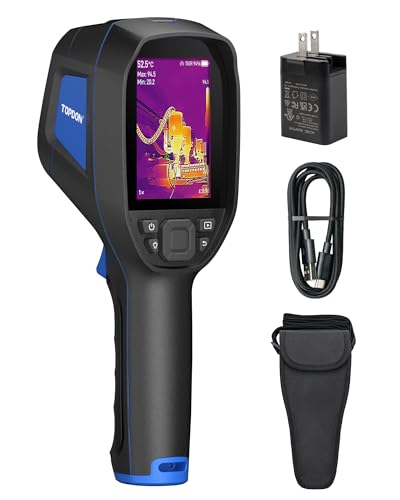
1. TOPDON TC004 Thermal Imaging Camera
Our pick — 4.5+★ from 850+ verified ratings; the strongest balance of quality and price.
A big-screen thermal workhorse that documents an entire inspection day without running out of room.
You will spend all day looking at the screen, so start there. The TC004 gives you a 3.5-inch screen, and against the 2.8-inch panel on the FOXWELL RT280 that extra space means you spend less time squinting at a hot spot and more time reading it. The infrared sensor underneath runs at 256×192 (256 pixels wide by 192 tall), and TISR upscaling (software that sharpens the image) pushes the effective picture to 512×384. Compare that 256×192 base to the RT280’s 120×90, and the TC004 holds more than double the raw heat pixels — which is why the edges of a water stain or a cold gap stay crisp instead of blending together.
Storage is the sleeper feature here. With 64GB built in, you can shoot stills and video all week without ever clearing the card, and against the HF96’s 4GB that is a 16-times difference in room to work. A red laser pointer marks exactly where on the wall the camera is measuring, so when you photograph a suspicious patch you can match the image to the physical spot later in your report. Wi-Fi moves those files straight to the TopInfrared app for write-up, which means no cable hunt at the end of the route.
The housing is built for real field conditions: IP54 dust and splash protection, 2-meter drop resistance, and an integrated LED light for crawlspaces and dark mechanical rooms. Its rechargeable battery is built to last a full day of multi-property inspections. Owners consistently praise its temperature accuracy, which is why field inspectors reach for it.
What earns it the top spot
- Largest screen of the handhelds here, at 3.5 inches
- 256×192 base infrared resolution with upscaling to 512×384
- 64GB of storage so a week of documentation never fills the drive
- Laser pointer, Wi-Fi app transfer, IP54 body, 2-meter drop rating
Worth knowing before you buy
- At 2.11 pounds it is the heaviest unit on this list to hold one-handed
- It reads surface temperature only — it will not measure moisture directly
Land it on your shoulder strap if: you run multi-property routes and need one camera to cover the whole day with room to spare.
Weigh the trade first: that big screen and long storage come with real heft, so a full shift of one-handed ceiling pans will tire your wrist faster than a lighter phone-tethered unit.
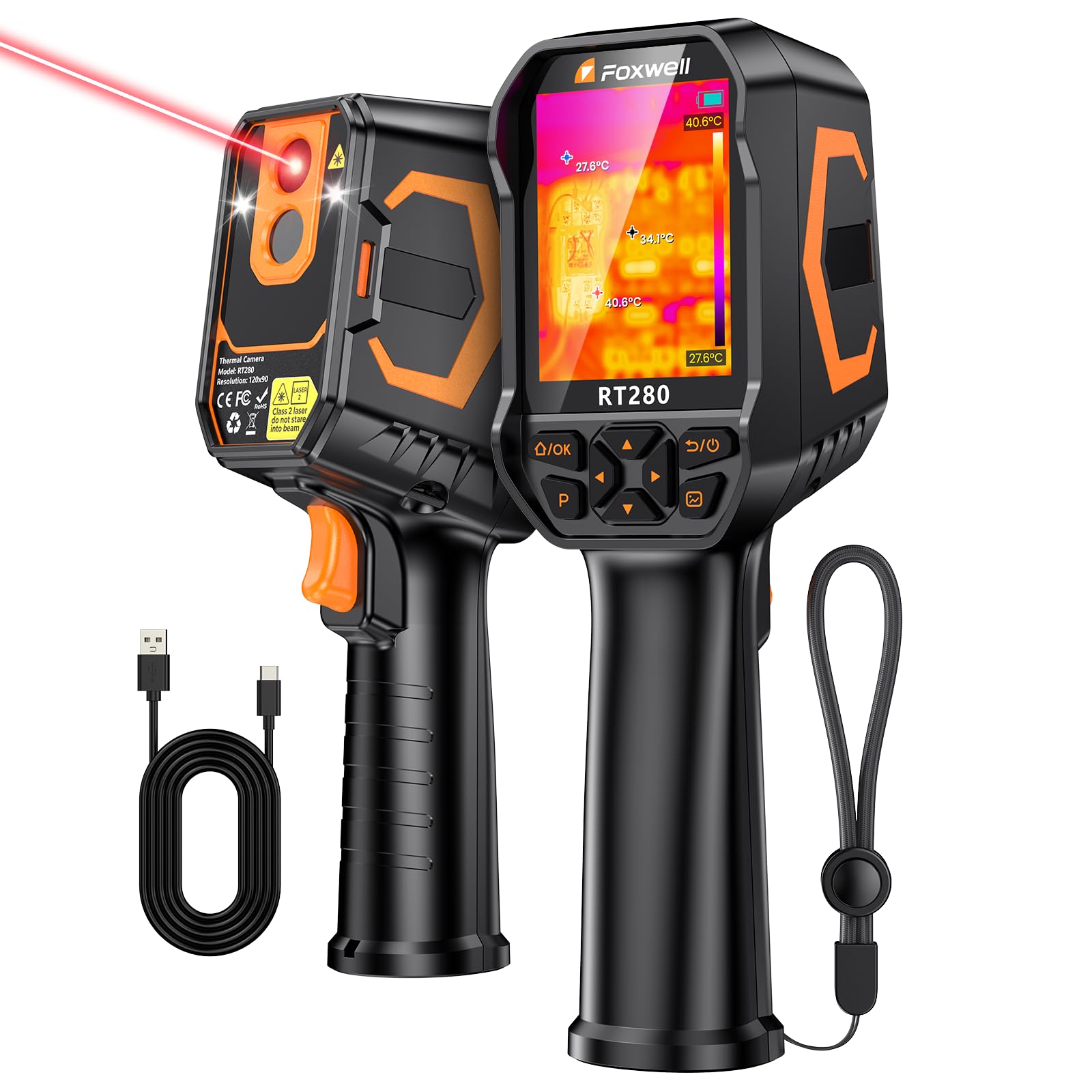
2. FOXWELL RT280 Thermal Imaging Camera
The entry point that does the core job of showing you where the heat is different.
If you are new to thermal work, this is the camera that gets you scanning without a big outlay. The RT280 reads from -4°F to 1022°F with ±3.6°F or ±2% accuracy, and it automatically flags the hottest, coldest, and center points for you. A 25Hz frame rate (25 image updates per second) keeps the picture moving smoothly as you sweep, and a 50° × 38° field of view covers a wide slice of wall in one pass, which speeds up whole-room scans in electrical panels and HVAC cabinets.
The 2.8-inch 320×240 LCD is the practical compromise here. Its base infrared sensor runs at 120×90, upscaled to 240×180 with TISR (software that sharpens the image) — so it sees the shape of a leak but not every fine edge, which is the honest trade against the larger base sensor on the TC004. For home DIY work that is rarely a problem. Locating a water leak, spotting heat loss around a door, or chasing an exhaust leak all show up clearly, and the built-in laser pointer plus LED light let you target in dim basements and confined cavities.
Ruggedness is where this punches above its class. It survives 6.6-foot drops and carries an IP54 rating for dust and splash, so unfinished basements and dusty attics are not a concern. The included Windows software handles point, line, and area temperature analysis plus 2D and 3D plotting, though note it is not compatible with Mac. The one genuine flaw buyers hit is the battery: it drains faster than expected for longer sessions, so a backup plan for a full day is sensible.
Where the money goes: the accuracy and the 9 color palettes (display color schemes) let you switch the display to make a subtle temperature difference stand out, which is genuinely useful when a faint cold trail is all you have to go on.
The honest catch: the 120×90 base sensor resolves less fine detail than a 256×192 unit, so hairline leaks at the edge of a beam may read as a soft blur rather than a sharp line.
The smart buy for: DIY homeowners and part-time inspectors who want proven thermal readings without committing to a pro-tier body.
Step up instead if: you need to resolve fine detail on every scan — the RT280 shows you the problem, not its exact border.
3. HF96 Thermal Camera
A battery that outlasts your route and scene detection that flags the leak for you.
Runtime is the headline. The HF96 carries a built-in rechargeable battery rated for up to 11 hours of continuous operation, which is the kind of number that means you charge it once and stop thinking about it. That is a far cry from the short sessions you plan around on some pocket units. The same goes for documenting the job: 4GB of built-in storage holds over 30,000 images and 14 hours of video, so the record of a full inspection week stays on the device.
What sharpens the work is IntellFault scene detection, powered by deep learning (AI that learns from examples), which flags likely water leaks and insulation gaps automatically rather than leaving you to interpret every smudge of color. Live super resolution lifts the thermal image to 240×240 in both live view and captured photos, and thermal sensitivity below 50mK (millikelvin, a tiny temperature unit) lets it pick up temperature differences as small as 0.05°C — the fine margin that separates a real cold bridge from background noise in a wall. The 25Hz refresh (25 image updates per second) keeps the scan smooth at the same time.
The measuring side is genuinely adjustable. It holds ±3.6°F accuracy across the -4°F to 1022°F range, and you can fine-tune distance and emissivity for different surfaces like cement and brick so readings stay honest on material that normally throws a camera off. A 50° field of view, seven color palettes, laser pointer, and a tripod thread round out the toolset. The durability side is equally settled: a 6.6-foot drop test and IP54 protection cover the rough handling a jobsite delivers. Be aware the runtime claim has not held up perfectly for every owner — a few find the battery drains faster than the spec suggests on prolonged professional jobs.
Why pros like it: scene detection plus automatic hot and cold spot tracking takes guesswork out of a fast walkthrough — you capture the anomaly and move on.
One caution: the automatic detection is a guide, not a verdict, so confirm anything surprising before you write it into a report.
Point it at: energy audits, HVAC service calls, and electrical diagnostics where a full day of scanning needs one charge.
Look elsewhere if: you need the camera to measure moisture directly — this one reads temperature only.
4. FOXWELL Dual Lens Borescope
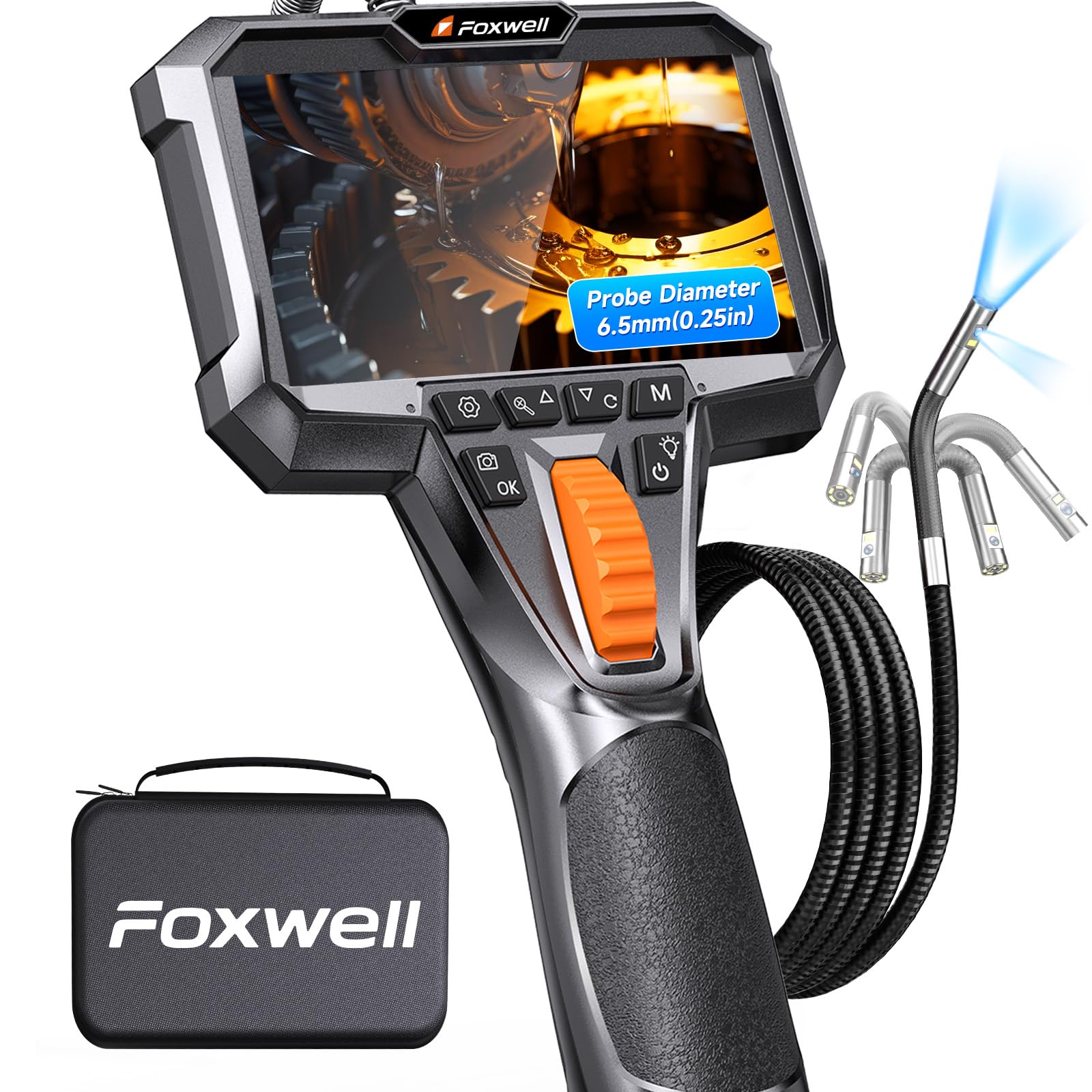
The probe that gets inside a wall cavity so you can see the leak, not just suspect it.
Where a thermal camera tells you something is wrong behind a surface, this one shows you what it is. The Y406D runs a 0.25-inch (6.5mm) probe with a 220° dual-lens articulating tip (a bendable head with two cameras), so you steer the head inside a tight space and switch between front and side views to check valves, cylinders, or pipes without tearing anything apart. That slim 0.25-inch diameter slides through spark plug holes, HVAC vents, and narrow pipes that a bulkier scope simply cannot enter.
The imaging core is built for clarity in bad conditions. A CMOS sensor with a large-aperture lens feeds an IPS HD display, and adjustable LEDs light the dark, oily, or reflective surfaces you meet inside a cavity where cracks and carbon buildup would otherwise be invisible. Dual zoom at 4x and 2x magnifies a hairline crack or a loose fitting on screen so you can confirm a defect rather than just spot a smudge. One touch captures photos and video with no Wi-Fi or app involved — everything saves to the built-in 32GB storage, enough for 50-plus videos or 10,000 photos.
Durability is the other half of the story. The probe carries an IP67 waterproof rating (sealed against water, dust, and oil), and a smart heat-protection system automatically shuts the unit down above 70°C to protect the sensor from hot engine work. A symmetrical control knob keeps your hand steady during long sessions. Buyers praise the build quality, which feels better than its price suggests, though a few owners found the on-screen menu navigation fiddly until they adjusted.
The field payoff: reaching a water leak inside a wall without opening it up keeps the damage — and the description in your report — small and precise.
Plan for this: it needs a steady hand and slow movement; rushing the probe tip produces disorienting, unusable footage.
Reach for it when: you need to look inside a cavity, an engine, or a drain line that no external camera can access.
Know the learning curve: it is not a point-and-shoot, so budget a little practice time on the controls before your first real job.
5. HP96 Thermal Imaging Camera

A phone-style touchscreen camera for inspectors who would rather tap than hunt for buttons.
The control scheme is what sets this one apart. Instead of a button maze, the HP96 puts an intuitive phone-type interface on a 3.5-inch touchscreen, so you slide or tap to change brightness, switch image modes, cycle color palettes, or adjust temperature range. When you are up a ladder with one hand free, that fingertip control is faster than memorizing button combos. A swipe down turns on the LED flashlight for low-light work in crawlspaces and mechanical rooms.
Under the glass it pairs a 96×96 infrared sensor with a 640×480 visible-light camera across five imaging modes — Thermal, Visual, Fusion, PIP, and Blending — plus eight color palettes. That fusion is what makes an inspection image readable to a client: the visible detail sits on top of the heat map so you can tell exactly which wall stud or pipe is running warm. Live super resolution boosts the infrared clarity from 96×96 to 240×240 in real time, and a 25Hz frame rate keeps the on-screen movement smooth.
Measuring is handled by an advanced VOx detector, which picks up temperature differences as small as 0.05°C within ±2%, and you can adjust emissivity and object distance for accurate reads on wood, brick, and other surfaces. It tracks the maximum, minimum, and center temperatures in real time and lets you set custom alarms that trip a visual or audible warning. Storage holds roughly 30,000 standard images plus 20 hours of video, and the rechargeable lithium-ion battery delivers up to 4 hours of continuous operation. That runtime is on the shorter side, and some owners find the battery and accuracy less consistent than the specs suggest, so plan to recharge between long days.
Why it stands out
- Touchscreen of 3.5 inches with a familiar phone-style interface
- Five imaging modes including Fusion and PIP for client-friendly images
- Live super resolution to 240×240 and 25Hz smooth scanning
- 30,000 images and 20 hours of video storage built in
Know before you commit
- Up to 4 hours of runtime is the shortest here, so long routes need a recharge stop
- A 96×96 base sensor resolves less fine detail than higher-resolution rivals
Made for: inspectors who want client-ready fusion images and the simplest possible on-camera controls.
Think twice if: you cover huge properties — four hours of runtime will not carry a full shift without a top-up.
6. TOPDON TC002C Duo Thermal Imaging Camera

A pocket-size thermal lens that turns the phone already in your hand into the inspection camera.
If you already carry a capable phone, this is the least gear you can add. The TC002C Duo plugs straight into any USB-C smartphone or tablet — iOS, Android, or Windows — and draws its power from the device, so there is no battery to charge and no screen to read. At 2.8 by 1.7 by 0.55 inches and just 1.1 ounces, it disappears into a pocket. That portability is why it fits the way a full-time inspector works: the phone is already out for photos and reports, so the camera just slips on.
Inside, a 256×192 sensor is sharpened to an effective 512×384 with TISR super resolution, paired with a 25Hz refresh rate and a fine 40mK heat sensitivity. That 256×192 base is the same raw resolution as the handheld TC004, but this one avoids the weight and the separate screen. It measures -4°F to 1022°F with a maximum of ±2°C or 2% error, and from up to 16.4ft (5m) away — useful when you want a temperature read on something you would rather not get close to. The TopInfrared app handles control, real-time waveform viewing, and adjustable temperature limits.
Owners repeatedly praise its accuracy: it pinpoints the exact spot a heat source or leak is coming from rather than flagging the general area, and it works on both iPhone 16 and Android handsets. Two real considerations stand out. The USB-C connector is short and can struggle to seat through a thick phone case, and some owners see connection drops if the phone is bumped. Compatibility is broad but not universal: it is not compatible with Mac devices, nor with Android 16 for now. Neither issue is a dealbreaker for careful use, but both are worth knowing before you rely on it mid-inspection.
Standout for the money: nothing else on this list gives you 256×192 thermal at this weight and with zero charging routine.
The fine print: the short USB-C plug may force you to remove a bulky case, and the phone connection is the one weak point against accidental knocks.
Slip it in your pocket if: you want pro-grade thermal resolution on the phone you already carry, without another charged device to manage.
Check your setup first: a thick case or a Mac-only workflow will get in the way of this one.
7. Flir One Thermal Imaging Camera
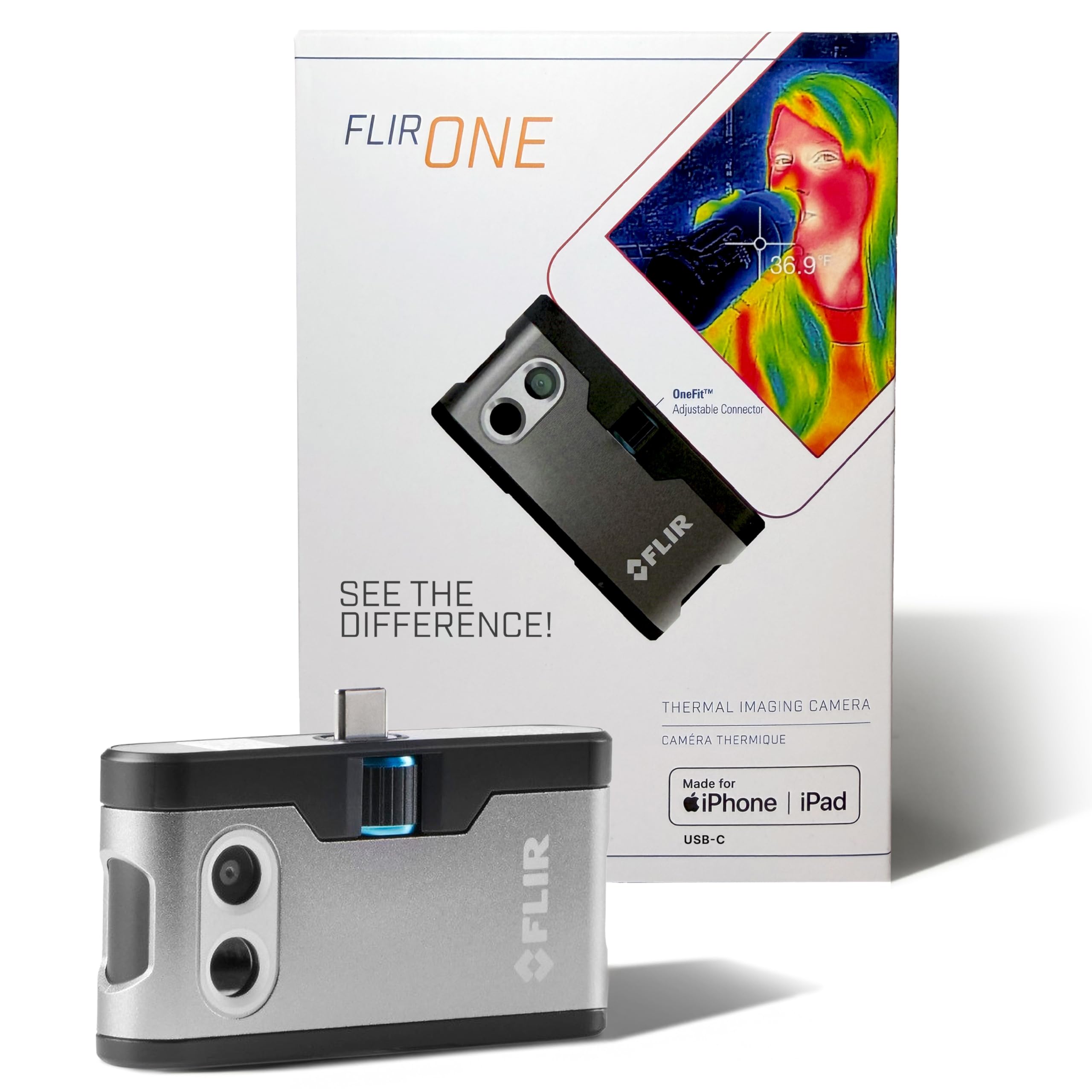
A guided iPhone accessory built around step-by-step home inspection walkthroughs.
For an iPhone 15 or newer owner, this is the simplest way to get thermal on the phone you carry. It plugs directly into the USB-C charging port — no cable, no pairing fuss — and pairs with the Flir One app, which includes a step-by-step inspection guide that walks you through finding the typical faults in a house, from air leaks to moisture buildup. If you are newer to thermal work, that built-in structure is a genuine teaching tool rather than just a viewer.
The imaging is a familiar FLIR approach rather than the highest raw resolution. An 80×60 native infrared sensor is upscaled to 240×180 through Vivid IR, and MSX technology layers the visible-light details from the scene onto the heat image so edges become readable instead of blurry. Accuracy is quoted at ±3°C or ±5% when the unit sits within 15°C to 35°C and the scene is within 5°C to 120°C. For homeowner-level checks — a winter heat-loss trail around a door frame, a cool patch over a missed insulation bay — it delivers exactly what you need. The catch is that on a raw-resolution basis, that 80×60 native sensor resolves less fine detail than the higher-resolution units on this list, so hairline leaks can read soft.
The build is rated to survive a 1.5-meter drop, keeping it usable on a site. The most common gripes concern the physical attachment: the point where the unit meets the phone is a known weak spot, and it can loosen over time with repeated plug-ins. The included battery also drains quickly, though for occasional homeowner use that is manageable. For a first thermal camera, it remains one of the easiest introductions to thermal work.
Great for a first camera: the guided inspection walkthroughs mean you are not left guessing what to point it at.
Budget for longevity: the phone attachment is the soft spot — treat the connection gently and expect the plastic housing to need care.
The right fit for: iPhone 15-and-newer owners who want guided, app-led inspections without a separate handheld unit.
Skip if: you need high-resolution detail or a rugged, drop-proof housing that shrugs off daily commutes.
8. Thermal Master Thor002 Handheld Thermal Camera
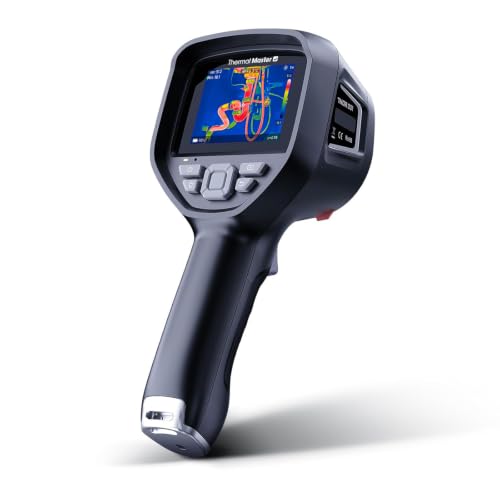
A big-battery handheld built to resolve fine detail and keep recording for a full day.
Runtime and screen quality are the two numbers that define this camera. A 5000mAh lithium battery runs up to 10.5 hours and supports 18W fast charging, so a long route ends without a panic charge. The display is a 3.5-inch 640×480 IPS panel backed by a 2MP visible-light camera, and X³ infrared technology lifts the thermal resolution from 256×192 to 512×384. On a scan, that translates to faster, more detailed images — you spend less time triangulating a small hot spot and more time measuring it. A 25Hz refresh and 40mK sensitivity keep the picture smooth and sensitive to small temperature differences.
Where it pulls ahead of the pack is data handling. With 8GB of RAM and 32GB of storage, it records video and captures photos without hesitation, and voice notes plus QR-code file management make on-site documentation quick to sort afterward. It measures six points at once — center, hottest, coldest, and three user-defined spots — which lets you compare several surfaces in a single frame instead of measuring one at a time. The -4°F to 1022°F range with ±3.6°F accuracy handles most surfaces, and adjustable emissivity keeps readings honest on different materials.
Connectivity and toughness round it out: USB to a PC for real-time analysis on a bigger screen, and Wi-Fi pairing with phones and iPads for flexible work. A 4.3mm lens extends detection range, 4X digital zoom gets you closer without moving, and the body meets IP54 and survives 2-meter drops. The honest caveat is accuracy consistency — most owners trust the readings, but a minority do not, so verify against a known reference on critical jobs before you commit to a number.
The strong points
- Up to 10.5 hours from a 5000mAh battery with 18W charging
- 256×192 sensor upscaled to 512×384 with a 3.5-inch 640×480 IPS screen
- 32GB storage plus 8GB RAM for heavy still and video capture
- Six-point measurement, USB and Wi-Fi transfer, IP54 and 2-meter drop rating
The trade-offs to know
- Heaviest body here at 3.12 pounds, so one-handed scanning takes some effort
- Temperature accuracy is confident for most owners but not universal
Best for: professionals who survey large properties and want high detail, long runtime, and serious storage in one unit.
Go lighter if: you mostly work one-handed overhead — the weight will make itself known on long ceiling scans.
9. Flir TG165-X Thermal Imaging Camera
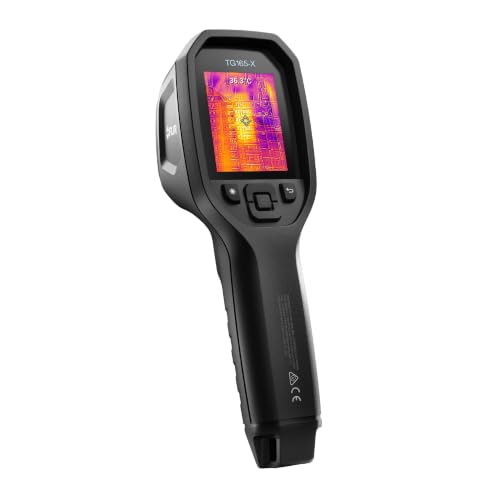
A rugged spot-temperature camera with a bullseye laser built around quick point-and-read checks.
This is a different tool from the scanning units. The TG165-X uses a 4,800-pixel IR camera to measure temperatures from -25°C to 300°C (-13°F to 572°F), and it targets with a bullseye laser that outlines the measurement area before you read. For a fast check — is this breaker running hot, is this register blowing warm, is this wall surface cool for no reason — that outline-first approach is what makes the reading reliable. Patented MSX embossing layers the visual details onto the thermal image so the picture is easy to interpret at a glance.
The temperature ceiling of 572°F is lower than the other handhelds here, which reach 1022°F, so it is not the tool for high-heat industrial work. It is built for the surfaces you meet in a house. The body carries an IP54 enclosure that protects against dirt, dust, and oil, and it has a drop-tested design for the everyday knocks a service call brings. It runs on rechargeable batteries and charges over USB Type-C.
Where it earns its keep is support and durability. FLIR backs it with a 2-10 warranty — two years on parts and labor for the camera, and ten years covering the detector, the core sensing part of the unit. That long coverage on the detector is the strongest reason to pick this one if you want a camera you can rely on for years. Be aware this is a spot tool rather than a wide-field scanner: it is best at confirming and measuring specific points rather than sweeping an entire building, and you will want a scanning camera alongside it for wide-area work.
The long-game value: a decade of detector coverage plus IP54 protection makes it a low-stress tool to keep in the truck.
What it is not: it is a point-and-measure device, so it will not replace a scanning camera for whole-downstairs sweeps.
Pick it for: quick confirmed readings on specific hot or cold points and a tool you can count on for years.
Not the tool if: your job is wide-area scanning — pair it with a resolution-forward camera instead.
Know the Specs
Infrared resolution and super resolution
Infrared resolution is the number of heat-sensing pixels the camera reads at once, written like 256×192. The higher that base number, the more clearly a small temperature difference keeps its shape on screen — a cold trail from a gap stays as a trail instead of a blur. Super resolution is a processing step that upscales that base image to a higher effective number, such as 256×192 to 512×384, sharpening edges for a cleaner picture. Super resolution is a helpful polish, but it cannot invent detail the base sensor never saw, so the base number is still what matters most for fine diagnosis.
Thermal sensitivity, frame rate, and accuracy
Thermal sensitivity is the smallest temperature difference the sensor can detect, measured in millikelvin (mK) — a lower number means it notices smaller variations, which matters for spotting an early leak. Frame rate is how many times per second the screen refreshes, shown in hertz (Hz); a 25Hz camera pans smoothly, so you do not mistake lag for a real temperature shift. Accuracy is how close the reading is to the true temperature, usually written as a tolerance such as ±2°C or ±2%. Pairing fine sensitivity with a smooth frame rate and a tight accuracy tolerance is what turns a camera from a toy into a diagnostic tool.
Common Questions
Do I need a thermal camera or a borescope for home inspections?
Will the TOPDON TC002C Duo work with my iPhone or Android phone?
Which FLIR One model should I choose for an older iPhone?
How long do these thermal cameras run on a single charge?
What does the IP rating on an inspection camera actually mean?
How much storage do I need for a full inspection route?
Is the FLIR TG165-X good for home inspections?
<
How do I measure a hot spot several feet away without getting close to it?
Can these cameras measure moisture directly or only temperature?
Why do some cameras show temperature as mixed colors and others as grayscale?
Do I need Windows software to analyze the images later?
The Bottom Line
The strongest all-rounder for the cameras for home inspections job is the TOPDON TC004, because it pairs a 256×192 sensor with a large 3.5-inch screen and 64GB of storage, so you can scan a whole property and document it without ever clearing the drive. If detail is your priority, the Thermal Master Thor002 resolves more with its 512×384 X³ output and runs up to 10.5 hours on a 5000mAh battery. And if your problem is behind the surface rather than on it, the FOXWELL Y406D borescope is the one to reach for, with a 0.25-inch IP67 probe (sealed against water and dust) that slips into a wall cavity and shows you the leak itself.
One honest nudge: the TC004 holds the highest rating alongside its full feature set, with a large display and more built-in storage than anything else on this list, so it is the safe first purchase if you would rather buy once than upgrade twice.
How we choose
We do not accept paid placement. Every pick is matched to a real buyer and a real use-case; we do not hands-on test units.
Sources
Specifications: manufacturer listings and product documentation. Review insights: verified customer reviews, as of October 2026. Pricing: not shown on this page (it changes often); check the current price via the retailer link.
As an Amazon Associate, Home Digitized earns from qualifying purchases. This does not affect which products we feature.