
Disclosure: This post contains affiliate links. As an Amazon Associate I earn from qualifying purchases, at no extra cost to you. Learn more
Specs are compiled from manufacturer listings and verified buyer reviews and can change over time — please confirm the key details on the product page before buying.
If you work behind a chair all day, you already know the real problem in a salon is not the haircut — it is the cloud hanging in the room. Bleach fumes, acrylic dust, permanent solution, burnt hair from a flat iron, and airborne clippings all build up while you and your clients breathe them in. The right air purifier pulls those particles and chemical smells out of the air instead of letting them settle on your mirror, your tools, and your lungs. This guide lines up nine genuinely capable machines — commercial scrubbers built for restoration crews and high-capacity home units — so you can match one to the size of your floor and the type of work you actually do.
This guide is built by comparing the manufacturers’ published specifications and the patterns across verified customer reviews, so you get each pick’s real strengths and trade-offs instead of marketing spin.
Before you spend anything, know one thing: these picks were matched by what they can actually clean — commercial-grade or large-room coverage — not by an exact search string, so a few are sized differently than the phrase you typed but serve the same job. Ongoing filter cost is what separates a machine that survives years in a salon from one that gets shoved in a closet. The result is a shortlist of air purifiers for hair salon work that holds up to real chemical and particle loads.
Top Picks

How To Choose The Best Air Purifiers for Hair Salon
A salon is not a bedroom, and shopping for one like it is the most common and most expensive mistake. You are dealing with two different problems at once: physical debris (hair, acrylic dust, lint) that clogs filters fast, and airborne chemistry (bleach, perm solution, ammonia, burnt protein) that a particle filter alone does nothing to fix. Get both, and you stop noticing the smell when you walk in the next morning.
Start with airflow, not square footage
CFM stands for cubic feet per minute — the actual volume of air the machine pushes through its filters every minute. That number matters more than the coverage claim on the box, because a room can be small and still be constantly polluted by two stylists working back to back. Higher CFM means the room’s entire air volume turns over more often, so fumes get cycled through the filter instead of drifting to the front desk. If your station count is high, airflow is the spec you shop by first.
Look for layered filtration with real carbon
A pre-filter catches the big stuff — hair, dust clumps, lint — and protects the finer filter behind it. The HEPA layer handles particles, and the carbon layer handles gases and odors. For a salon, that carbon layer is not a bonus, it is the reason you buy the machine. Permanent and bleach work releases chemical vapors that no particle filter can trap, so you want a purifier with activated carbon substantial enough to actually work on fumes, not a thin dusting of it.
Plan for daily debris
Hair clippings and acrylic dust will shorten the life of any filter you install. A washable or reusable pre-filter lets you rinse the worst of it away instead of buying a new cartridge every few weeks. Remember that a purifier removes what is floating in the air — it does not sweep hair off the floor, so pair it with normal salon cleanup.
Side-by-Side Comparison
| Model | Best For | Airflow / CADR | Coverage | Filtration Stages | Amazon |
|---|---|---|---|---|---|
| BlueDri Air Shield 550★ Best Overall | Heavy dust and renovation-level cleanup | 550 CFM | 1,400 Sq. Ft | Pre-filter + HEPA + optional carbon | Amazon |
| Honeywell Allergen Plus 4-in-1Quietest Pick | Quiet overnight use in a small shop | — | 1,718 Sq. Ft | 4-layer HEPA system | Amazon |
| FreAire HAP611WFBest Smart Pick | App control and pet-hair-style debris | 450 CFM CADR | 3,850 Sq. Ft | Washable pre-filter + HEPA | Amazon |
| PuroAir 400 | Fume and odor control in a mid-size studio | — | 2,000 Sq. Ft | 3-layer filtration | Amazon |
| ALORAIR Clean Shield HEPA 550 | Stacking multiple units in one open floor | 270–550 CFM | 5,500 cubic feet | 3-stage (MERV-10 + carbon + HEPA) | Amazon |
| Sans HEPA Air Purifier | Open-plan salons with pets on site | — | 1,854 Sq. Ft | 3-in-1 HEPA + UV-C | Amazon |
| AIRDOCTOR AD4000 | Large salons wanting fast room turnover | 694 ft² in 15 minutes | 2,776 Sq. Ft | 3-stage (pre + carbon + UltraHEPA) | Amazon |
| Austin Air HealthMate Standard | Low-maintenance odor removal | — | 1,500 Sq. Ft | 4-stage (carbon + zeolite) | Amazon |
| Air Oasis iAdapt 2.0 | Big salons that need maximum coverage | 706 CFM | 5,474 Sq. Ft | 5-stage (HEPA + carbon + silver ion + ionization + UV) | Amazon |
Detailed Reviews
1. BlueDri Air Shield 550 HEPA Air Scrubber
Our pick — 4.5+★ from 750+ verified ratings; the strongest balance of quality and price.
Built for demolition crews, and that is exactly why it shrugs off a busy salon floor.
BlueDri’s Air Shield 550 is the pick here that was designed from the ground up for jobsites rather than living rooms — and restoration crews are not gentle on equipment. It moves 550 CFM and covers 1,400 square feet. For a working salon that means the room’s air gets pushed through the filter often enough that fumes from permanent solution and dust from a fresh blow-dry do not just hang at eye level. The housing is built as a single piece, and the brand backs it with a 1-year warranty plus a 5-year housing warranty.
The filter setup is the practical part. A pre-filter catches the big debris — hair, dust, lint — so the HEPA layer behind it can do the fine work, and the HEPA rating is stated at 99.97% of particles down to 0.3 microns. That is the layer that actually removes airborne dust and hair clippings before they land on your station. The optional carbon filter, sold separately by the maker, is the piece you want if chemical fumes are your main complaint — the brand specifically names salons and print shops as the use case for it.
What wins people over is how much air quality it delivers against the money spent, along with the sheer build quality; the recurring gripe is noise. It is genuinely loud on the highest setting, though several owners note it is still quieter than a table saw or a shop vac. A few owners mention the filter seal could be better, and one notes it only removes dust that is airborne, not dust already settled on surfaces. It weighs 39 pounds, which is heavier than the Honeywell by a wide margin, so plan a permanent spot rather than hauling it between chairs. At 4.5+ stars from 750+ ratings, this is the crowd favorite in this lineup for good reason.
What it gets right
- 550 CFM moves serious air volume for a 1,400 sq ft space
- Standard 16x16x1 filters, easy to source
- Washable and reusable HEPA filter per owner reports
- Optional carbon filter is the salon-specific option for fumes
Where it asks more of you
- Loud on max setting — white-noise loud, not conversation loud
- 39 pounds means it stays where you put it
- Carbon filter is not included, so add it separately for odor work
Made for: high-turnover salons with constant acrylic dust, hair clippings, and heavy chemical use who want a machine built for abuse rather than looks.
Think twice if: your shop is small, your clients are sensitive to fan noise, or you want a unit you can carry from station to station.
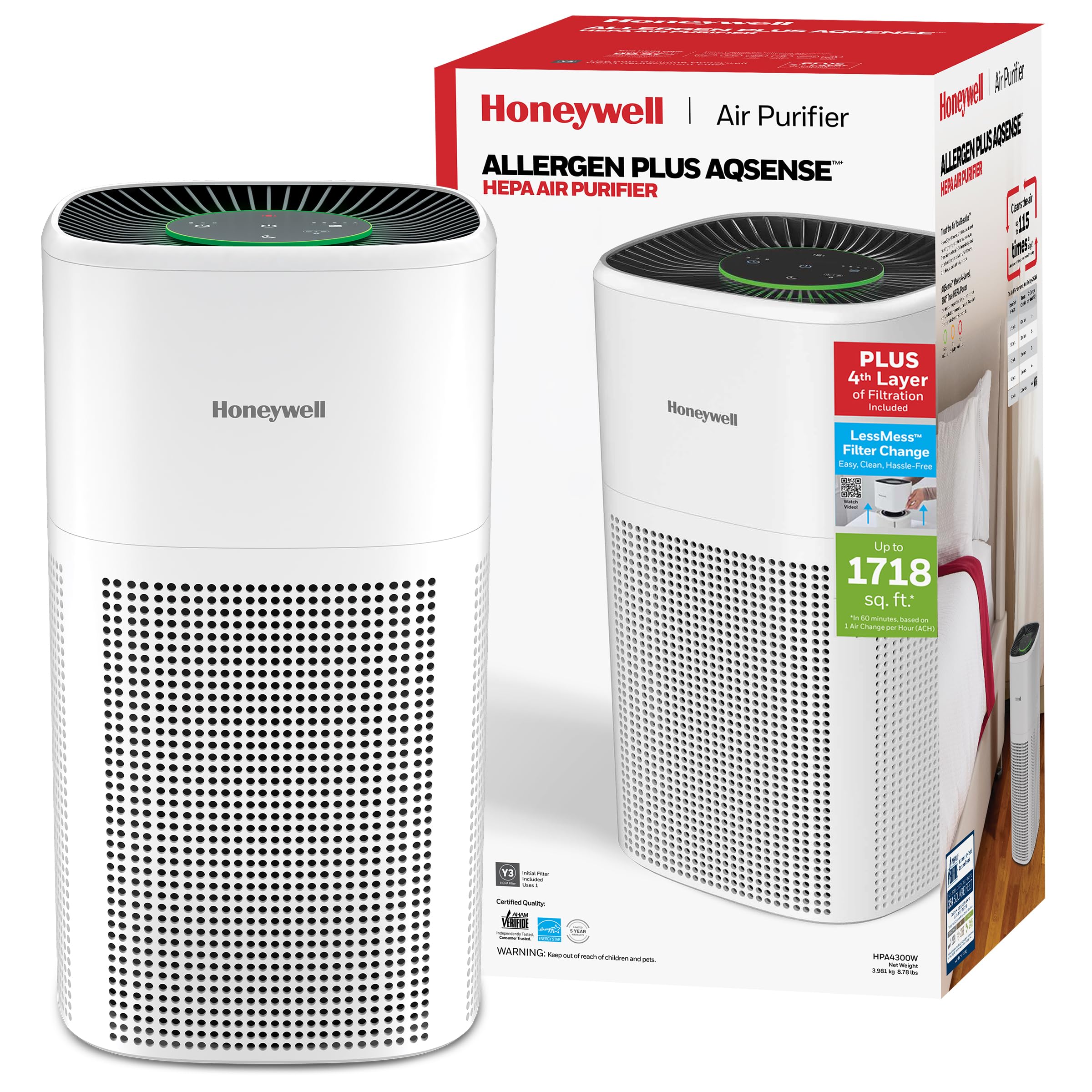
2. Honeywell Allergen Plus 4-in-1 HEPA Air Purifier
The one your receptionist will forget is even running until the bleach comes out.
If your salon sits inside a building with other tenants, or you run a small studio where clients chat while you work, the loudest machine in the room becomes the problem. This Honeywell is the quiet counterweight — it runs four cleaning levels plus an auto mode, and the manufacturer-designed sleep mode and low-speed settings are the ones owners describe as near-silent. It weighs 12.1 pounds and stands about knee-height on the floor, so moving it from the color bar to the shampoo area is a one-hand job. That is a long way from the 39-pound BlueDri above; you trade raw airflow for portability.
The filtration is a 4-layer HEPA system with 360-degree cleaning: a pre-filter for pet hair, a True HEPA layer rated at 99.98% of allergens, an activated carbon layer for odors and VOCs, plus a fourth layer for extra protection. The carbon layer is the salon-relevant part — that is what pulls ammonia from permanent solution and the sweet chemical edge from color work out of the air. The AQSense Auto Mode watches your air in real time and adjusts fan speed on its own, with green, yellow, and red indicators showing the current quality. Four speeds, a timer, sleep mode, a child lock, and a filter change indicator round it out.
Coverage is where buyers need to read carefully, and the honest answer is in the AHAM Verifide rating itself — it circulates the air 4.8 times per hour in a 354 sq ft room and once per hour in rooms up to 1,718 sq ft. Translation: it is at its best in a standard single-station room and gets stretched thin in an open floor plan. A buyer sums it up bluntly, saying it is not suited to whole-room use at that top figure or to quiet high-speed running. Plan for one unit per enclosed room rather than one for the entire salon.
Where it earns its spot: overnight and low-traffic hours. Set it to auto, let the sensor handle the speed changes, and the noise floor stays low enough to talk over. Odor work on a small scale — a litter area, a client’s smoke smell in a cramped room — is exactly the workload it handles without drama.
The catch worth knowing: high-speed operation is genuinely loud, described as white-noise territory, so if your air quality spikes mid-service you will hear it. Its upward airflow also limits how much it stirs the lower part of the room, so a floor-level dust problem while you are cutting is not its strength.
Reach for this if: you want a light, movable purifier for one enclosed room and noise bothers your clients more than max airflow does.
Look elsewhere if: your salon is one big open floor and you need a single unit to cover all of it at once.
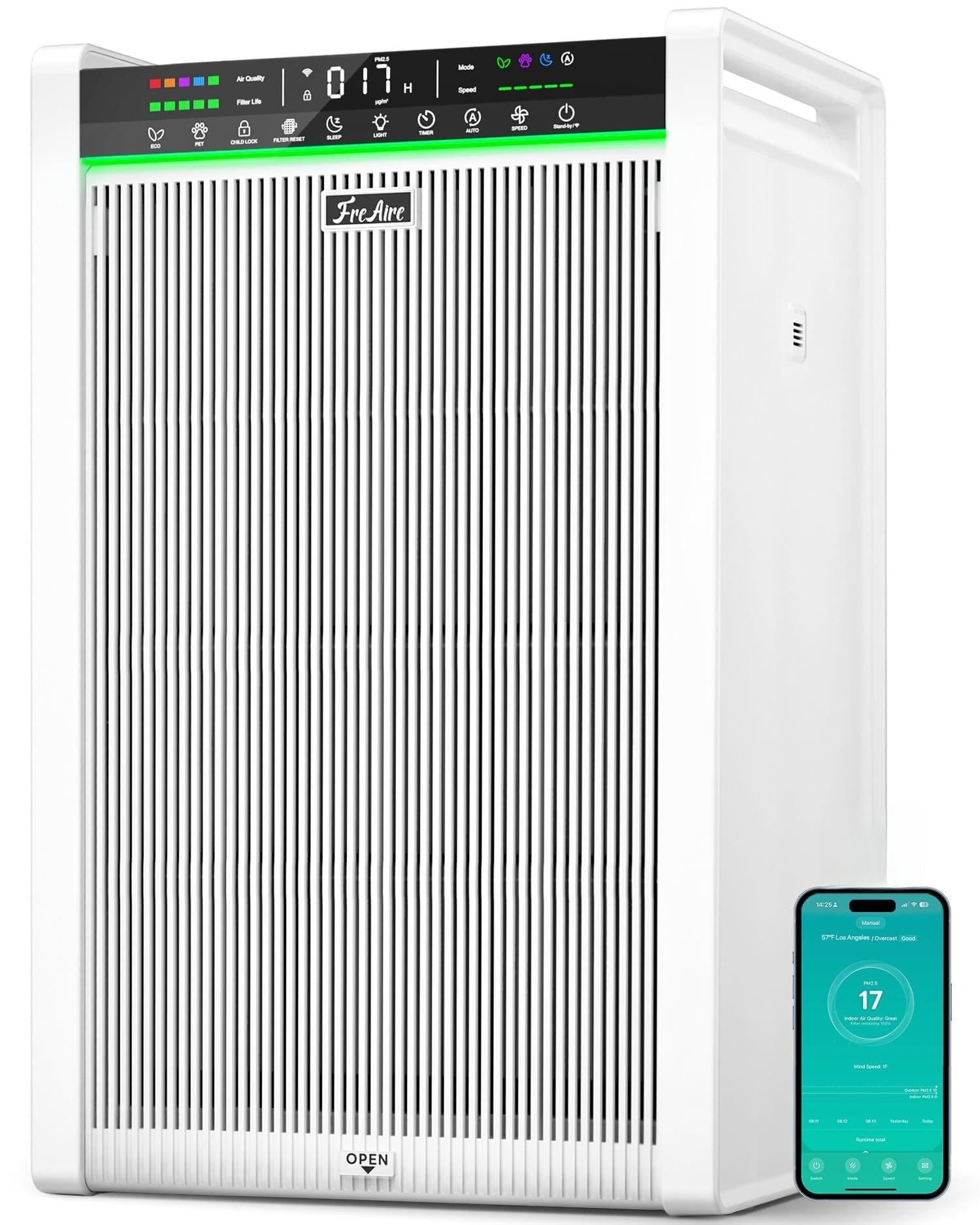
3. FreAire Air Purifiers HAP611WF
Start the air before you open up the door — this one obeys your phone.
Opening the salon for the day and walking into yesterday’s stale air is a small thing that wears on you. This FreAire solves it directly: it runs on an app, so you can start purification from the parking lot, check the PM2.5 reading on your way in, and set a daily schedule so the unit is already cycling air when the first client sits down. PM2.5 is the fine particle size — the dust and fume droplets small enough to stay suspended and reach deep into the room — and watching that number fall in real time is genuinely useful when you are judging whether your ventilation is keeping up.
On paper it is the biggest home-format unit here. It is rated at 450 CFM CADR and covers up to 3,850 square feet, which is notably more coverage than the Honeywell’s 1,718 square feet. The design pulls air in through a full-front intake and pushes clean air out the top, so it circulates instead of blowing straight at the client in the chair. The control panel is a wide touch surface with PM2.5 readings and five color-coded air quality lights, sized so you are less likely to hit the wrong button with wet hands. For a salon dealing with hair and lint, the washable pre-filter is the everyday money-saver — rinse and reuse rather than replace.
There is a Pet Mode, which sounds irrelevant until you realize what it is really doing: it runs 15 minutes at Speed 5, then 60 minutes at Speed 3 to keep air moving through a heavily-trafficked area. That cycle pattern is close to ideal for a busy cutting zone. Sleep mode drops the display lights out and the noise down to 20 dB — a whisper, roughly the level of a quiet room — which makes it viable for a treatment or lash room in the back. It meets ETL, FCC, EPA, CARB, CA65, and DOE requirements, and comes with a 1-year-plus warranty and lifetime technical support.
The maintenance rule: the brand says replace the filter every 3 to 6 months and then hold the Filter Reset button. It also warns that non-genuine filters may damage the unit and may not qualify for warranty support, so budget for the real cartridges rather than aftermarket lookalikes.
One practical note: this is a new listing with a small review base, so you are buying partly on the spec sheet and the certification list rather than on a long track record. The washable pre-filter and the app scheduling are the two features that do the most work in a salon.
Suit yourself to this one if: you want app scheduling, a washable first layer, and the largest stated coverage among the home-style units here.
Steer past it if: you want a model with years of owner history behind it instead of a fresh launch.
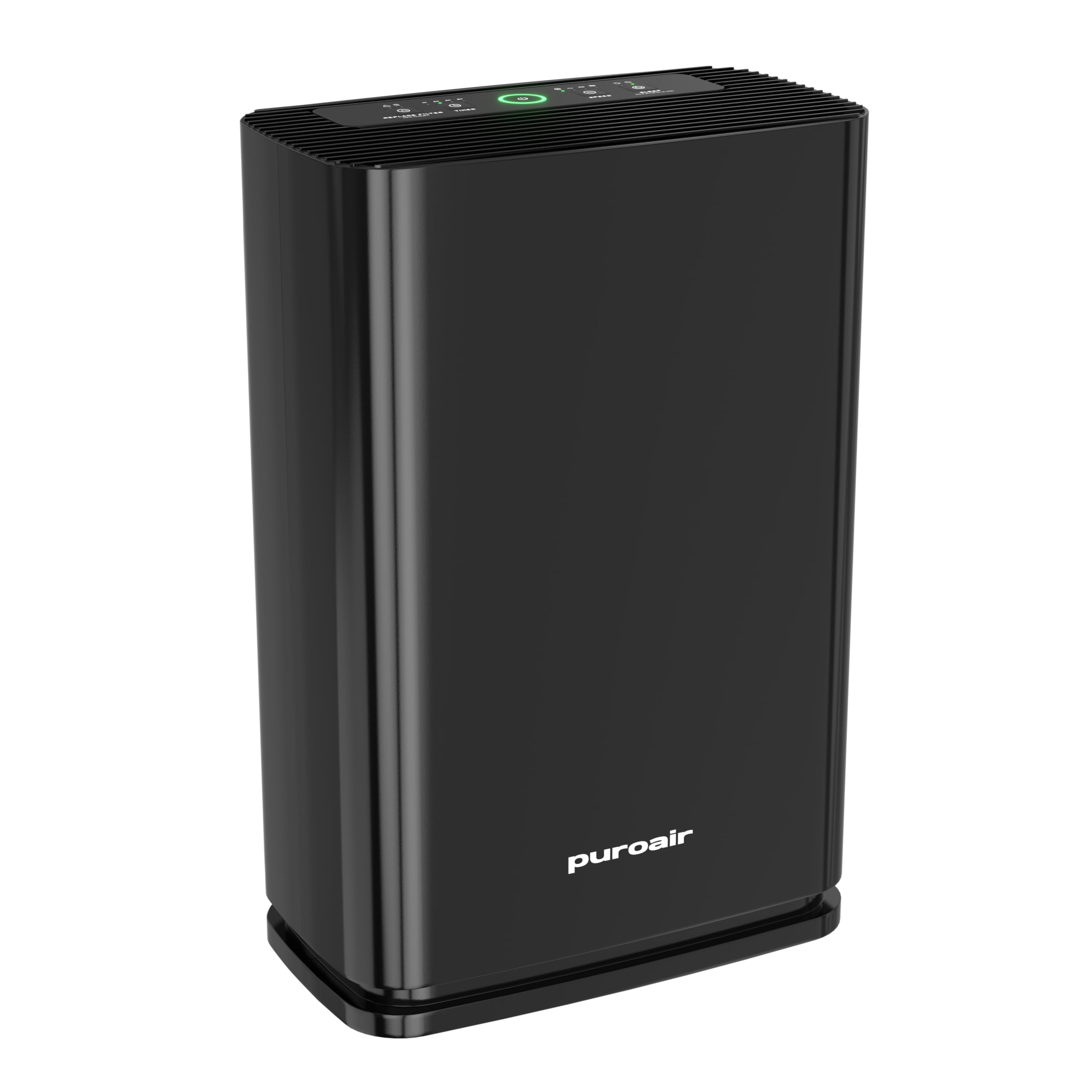
4. PuroAir 400 HEPA Air Purifiers
The odor workhorse that clears a bacon haze — imagine what it does to perm solution.
PuroAir’s 400 is the mid-size option for a two-to-four-station studio where the complaint you hear most is smell rather than dust. It cleans rooms up to 2,000 square feet in one hour, and the maker states the figure comes from independent testing in an ISO 17025 certified lab using typical residential ventilation rates. The filtration is three layers — pre-filter, HEPA, activated carbon — and it filters 99.9% of dust, pollen, smoke, pet dander, and VOCs. VOCs are the volatile organic compounds that carry chemical odor — the exact family of fumes that permanent solution and nail-adjacent work release into a salon, and the reason the carbon layer matters here.
The behavior is what makes it work on a busy floor. A smart particle sensor watches the air and ramps power up automatically when pollution rises, so a sudden burst of hairspray or a fresh perm does not sit in the room while you finish a blowout. There is a built-in sleep mode for quieter operation, and the unit is designed to run continuously rather than in short bursts, which suits a salon day better than a timer. It stands 17.5 by 10.6 by 12.5 inches and weighs 14.73 pounds, so it tucks under a station shelf or beside the color bar without eating floor space. It is certified by CARB, ETL, ISO, and UL.
What buyers notice is speed. The recurring theme across reviews is a difference felt within hours of switching it on — cleaner-feeling air, quieter operation than expected, and easier breathing in the space. Among the small gripes that come up, the most practical one is bright indicator lights on the front panel; a few people have taped over them because they do not want the glow in a dark room overnight. It is a fair point for a treatment room, less so for a work floor. With nearly twenty thousand ratings and a 4.5+ star score, this is among the most established machines in this lineup — though it has not been on the market as long as the Austin Air, so I would treat its lifespan as less proven over a decade-plus horizon.
Strong points for salon use
- Auto-ramping sensor reacts to fume spikes without you touching a dial
- Carbon layer aimed at VOCs and odors, not just particles
- 14.73 pounds and compact enough for a station shelf
- Certified by CARB, ETL, ISO, and UL
Honest trade-offs
- Indicator lights are bright enough that some owners cover them at night
- No listed CFM figure, so airflow is harder to compare directly to the scrubbers here
- Short track record compared to the older brands in this guide
Built for: a mid-size studio where chemical odor is the thing your clients comment on, and you want the machine to react on its own.
Not the one if: you need a hard CFM number to size the unit against a large open floor, or you work in a darkened treatment room.
5. ALORAIR Air Scrubber Clean Shield Hepa 550

Three of these chained together will change a room’s air faster than any single unit here.
For a large open salon — six chairs, a color station, and a shampoo bar all under one ceiling — a single domestic purifier will always be fighting a losing battle. The ALORAIR is built for exactly that problem. It daisy-chains up to three units together for a combined 1,650 CFM of airflow, and its own range is adjustable between 270 and 550 CFM. That stacking ability is the defining feature: you add capacity as your floor grows rather than replacing one machine with a bigger one. The three-stage filtration runs a MERV-10 layer for large particles, a carbon layer aimed at smoke and pet odor, and a HEPA layer rated at 99.97% of particles larger than 0.3 microns.
The numbers tell you where it belongs. Its filtration area is stated at 5,500 cubic feet, which is genuinely industrial territory — the kind of number that covers an entire salon floor with room to spare. It runs on 16-inch inlet and 8-inch outlet ducts if you want to route the exhaust, and both are optional rather than included. The shell is rotomolded polyethylene, which is the same tough plastic used for hard-wearing equipment cases, so it will survive being knocked around a shop. It also has auxiliary GFCI outlets on the panel — that means you can plug tools into the unit itself — plus an indicator light that reminds you when a filter change is due. ETL-certified and backed by a 10-year limited warranty.
The honest trade-off is weight and noise. At 39.6 pounds it is not portable in any practical sense — you move it once or twice and then leave it alone. It can be stacked horizontally and vertically, which helps in storage, but it is still a big unit at roughly two feet on each side. Noise gets mixed verdicts from owners: some find it quieter than similar machines, some find it very loud on full. The recurring mechanical gripe is about the durability category rather than the filtration — a reminder that even heavy-duty equipment needs a little respect. Rated 4.0+ stars across 400+ ratings, with effectiveness the aspect people praise most.
How to buy it right: the listing includes a 2-pack of MERV-10 filters as a bonus, and there is a promo where the filters come free if you add both the scrubber and the filter to your cart — the discount applies at checkout.
The practical limit: you are buying a commercial-grade machine for a commercial-grade space. In a single bench studio it is more machine than the room needs and you will pay for that in noise and floor space.
Choose this when: you run a large floor, want to expand capacity by chaining units together, and value a 10-year warranty over a lighter footprint.
Skip it when: your space is small enough that a lighter unit like the Honeywell would do the same job with far less bother.
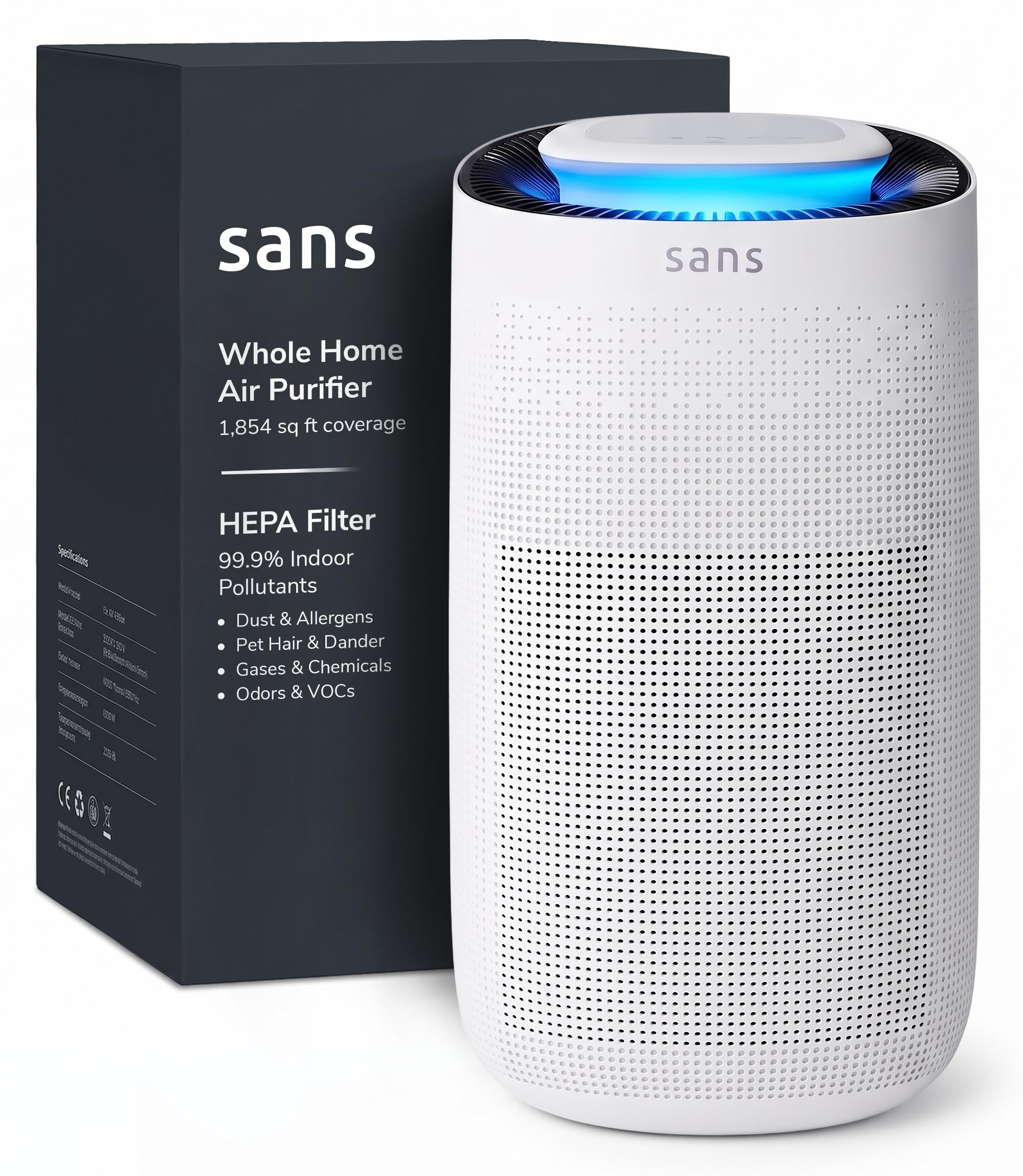
6. Sans HEPA Air Purifier
A full pound of carbon is the spec that separates this from every thin-filter machine.
Sans puts a number on the part most brands stay vague about: a full pound of activated carbon. In salon terms that is the difference between a purifier that masks a chemical smell for twenty minutes and one that actually pulls the odor out of the room. Most units in this class use a token carbon layer to check a box; the substantial carbon bed here is built for real-world workloads like cooking smells and pet odors, and it works the same way on permanent solution and bleach. Activated carbon adsorbs gas molecules onto its surface, which is why quantity matters — more carbon surface means more fume-removal capacity before it stops working.
The rest of the filtration is a true 3-in-1 system: HEPA capturing 99.9% of particles down to 0.3 micron, a dedicated filter to trap pet hair and airborne dander before it settles, and an internal UV-C light added to the purification chain. It covers up to 1,854 square feet every hour. Its noise floor is listed at 25 dB, which is about as quiet as a purifier gets while still doing meaningful work — the brand calls it meditation quiet, and it is quiet enough to leave running in a treatment room. Output is monitored by SmartPure sensors with a color-coded display and a filter replacement indicator, and the entire system is CARB-certified and ozone-free.
The one thing buyers should plan around is the filter cycle. The brand recommends replacing every 3 months depending on usage and air quality, which is shorter than several machines here — the trade-off for running a large carbon bed in a dirty environment. It weighs 12 pounds and stands 20 inches tall, easy to move when the floor plan changes. One review cuts against the grain and is worth knowing: an unhappy owner describes it as moving air without filtering it effectively, and reports the air quality reading never budged across multiple locations. That is a single account set against a large body of positive ones, but it is honest to flag that a rare unit does not perform as expected, and the sensor-dependent design means you are trusting the display.
Where it shines: odor control. The combination of a generous carbon layer plus the third-stage design gives it more fume-handling muscle than most consumers expect from a slim unit, and it runs at 25 dB while doing it.
What to budget for: a filter change roughly every three months. That is a real cost of ownership in a daily-use salon, so factor it into your decision before you commit to the carbon-heavy design.
Pick it for: strong fume and odor removal in a mid-size space where a quiet 25 dB unit can sit in the treatment area without disturbing anyone.
Reconsider if: you want a longer stretch between filter changes, or you prefer a machine without a sensor display driving its behavior.
7. AIRDOCTOR AD4000 Air Purifier
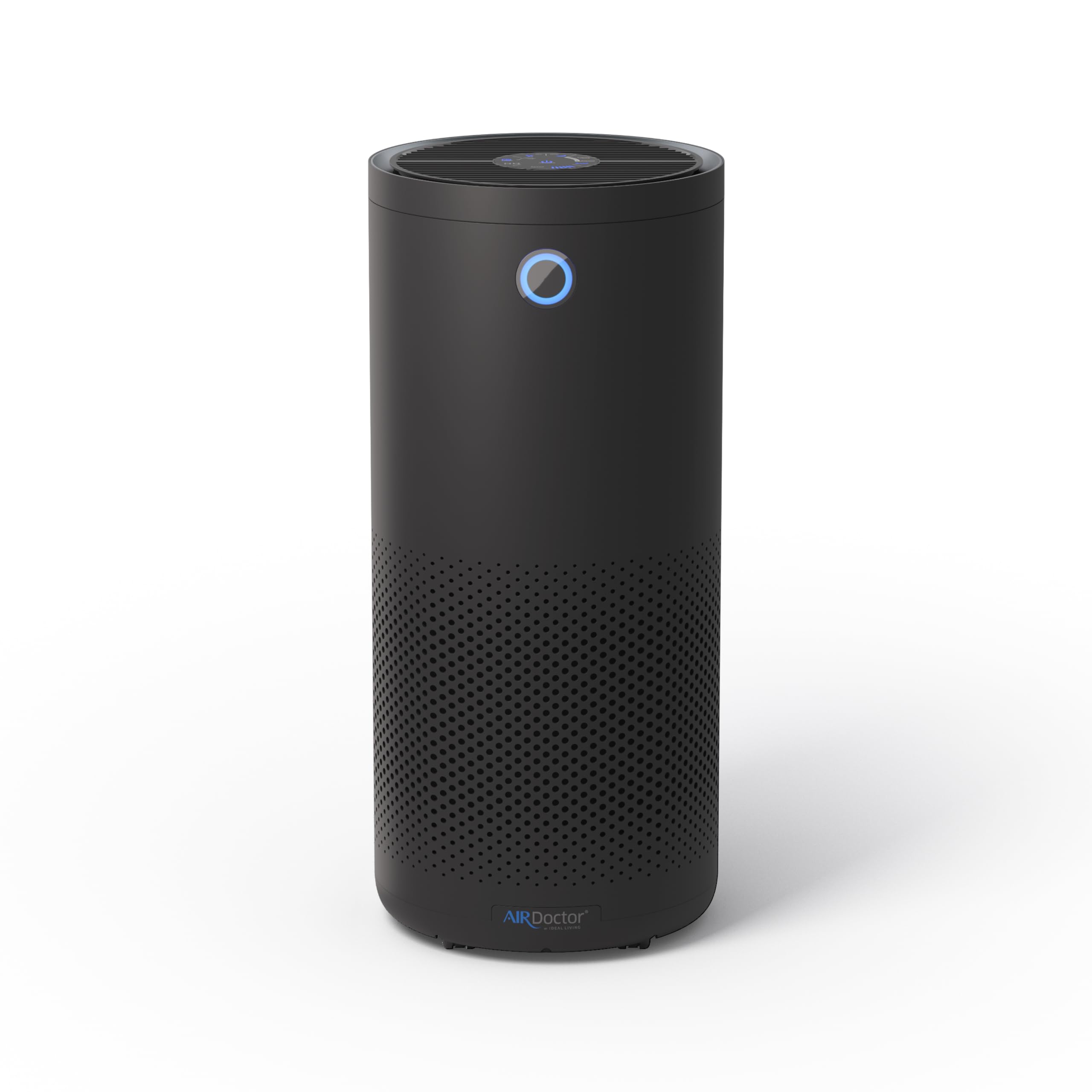
Fifteen minutes is all it claims to need to reset a 694 square foot room.
The single most useful number on this machine is its speed: AirDoctor says the AD4000 cleans 694 square feet in 15 minutes and up to 2,776 square feet in one hour. For a salon that means you can blast a room clean between clients instead of waiting an hour for the air to recover — the practical difference between a lunch-return rush and a smooth afternoon. Six fan speeds plus an auto mode give you fine control over how hard it works. The PM2.5 sensors watch air quality continuously and the Halo display shows it in color-coded levels, with Auto Mode raising fan speed and switching on Boost when it detects a problem without you touching anything.
The filtration spec is where this one stands apart from the pack. Its UltraHEPA layer captures 99.99% of airborne particles at 0.003 microns — far finer than the 0.3-micron HEPA standard. Fine particles are also the ones that linger longest — the smallest smoke and fume droplets are exactly the ones a standard filter can miss, which is why the UltraHEPA rating matters in a space where you use heat tools. The carbon layer is premium grade, made with activated carbon and potassium permanganate, and it targets toxic gases, odors, pet smells, cooking fumes, gas emissions, wildfire smoke, and VOCs. Potassium permanganate is a compound carbon filters use specifically to break down gases rather than just hold them.
The machine is 20.05 pounds with 3-stage filtration and it is built for continuous duty — filter changes every six months per the maker, and the UltraHEPA filters are made in Japan. It is also FSA and HSA eligible, which is worth checking if you have a pre-tax spending account. Noise gets positive notes from owners, who describe it as quiet on lower settings; at the same time the size is best suited to a large room rather than a single station, so place it in the biggest open area you have. At 4.5+ stars across 80+ ratings, this is one of the higher-scoring machines in the premium tier, though it has a shorter review history than the older models here.
The upgrade over standard HEPA: a 0.003-micron rating is a meaningful step finer than a standard HEPA filter, and combined with the potassium permanganate carbon layer, it handles both fume particles and the gases behind them.
What to weigh: this is a premium-tier machine with a six-month filter cycle, so the upkeep is a real budget line, not an afterthought. Buy it because the speed and filtration depth suit your space, not because you want the cheapest running cost.
Your match if: you need a large room reset fast between appointments and want the finest particle filtration on this list.
Pass on it if: your shop is a single small booth where its rapid-clean capability would be mostly wasted.
8. Austin Air HealthMate Standard Air Purifier
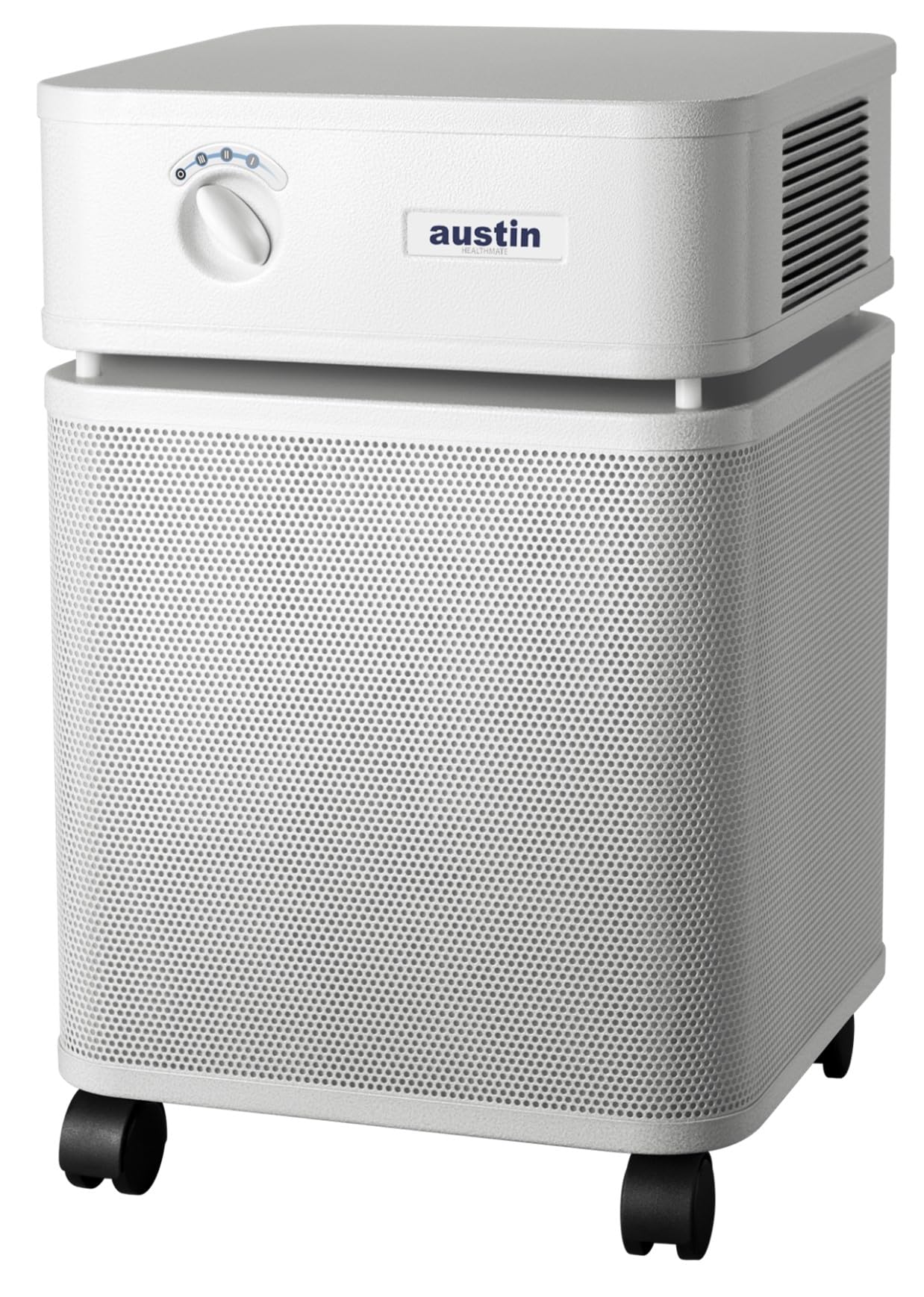
Buy it once, change the filter rarely, and stop thinking about filters entirely.
The Austin Air HealthMate is the answer to a specific frustration: constantly replacing cartridges. Its filter life is stated at up to 5 years, which is far longer than the three-to-six-month cycles on most machines in this guide. For a salon, that flips the cost math — the upfront spend is higher, but the running cost drops dramatically because you are not buying cartridges several times a year. The 4-stage filtration uses a single integrated filter with activated carbon and zeolite, and it captures dust, pollen, pet dander, mold, smoke, and VOCs. Zeolite is a mineral that traps gas molecules the carbon alone can miss, which is why the two are combined here — the pairing is aimed squarely at odors, smoke, and chemical vapors rather than particles only.
The design is deliberately simple: three speeds, no smart features, no app, no display, no LEDs. Coverage is stated at up to 1,500 square feet, suitable for a living space or a mid-size salon floor. Air is drawn in 360 degrees around the unit and pushed out one side, so placement is flexible and it circulates from every direction rather than blasting one spot. It weighs 45 pounds, which makes it the heaviest unit here, and the manufacturer says it is designed to run quietly at full power while minimizing noise. The lack of electronics is a feature in a humid salon environment — nothing to fail on a display board or a sensor.
What owners praise most is effectiveness, and the pattern across reviews is consistent: it eliminates smoke, odor, and VOCs and helps people sleep better. One long-time user has been running Austin filters since 1997 and reports their air stays clean and allergen-free. On noise, verdicts split — very quiet on low, genuinely loud on the top setting, and the noise becomes tiring with prolonged exposure. Value for money draws mixed views, largely because the unit itself is a premium purchase and the replacement filters are not cheap. Filter life is also more mixed in practice than on paper: one owner got 2.5 years out of a filter, another reports the carbon exhausting after about a year in a smoky home. A couple of owners mention quality-control issues on arrival — debris rattling in the fan box, a misinstalled pre-filter — both easy fixes but an unwelcome surprise on a premium unit.
Why salons keep buying it
- Up to 5 years of filter life cuts the annual running cost sharply
- Carbon and zeolite combination targets gases, smoke, and odors directly
- 360-degree intake means flexible placement on the salon floor
- No smart electronics to fail in a humid environment
What to go in expecting
- Heaviest unit in this guide at 45 pounds
- Loud on the top speed, tiring over long shifts
- No app, timer, or air quality display
- An occasional unit arrives with a loose part inside the fan box
Made for: salons that want to set a purifier down and forget about it for years, and value odor removal over app control or display features.
The trade-off to accept: you give up smart controls and pay more up front in return for a filter that outlasts nearly everything else in this lineup.
9. Air Oasis iAdapt 2.0 H13 HEPA Filter Air Purifier

706 CFM of airflow — this is the machine for a salon with no patience left for stale air.
The iAdapt 2.0 sits at the top of the airflow ladder here: 706 CFM, which one of the highest clean air delivery rates on the market. Its coverage claim is 5,474 square feet in one hour, or 1,059 square feet with five air exchanges per hour — the second figure is the more useful one, because five full air changes per hour in a space that size is what actually keeps fumes from building up during a busy shift. For a large multi-station salon, that headroom means one unit can genuinely handle the whole floor. The filtration is a 5-stage system: H13 true HEPA, carbon, silver ion, ionization, and UV light. H13 is the near-medical HEPA grade, and it is rated for particles as small as 0.05 microns, with the carbon and UV stages aimed at gases and biological contaminants.
The maintenance picture is favorable. Filter changes can go up to 2 years apart according to the brand, which it positions as a low cost of ownership against comparable machines. That long cycle combined with the huge coverage area is the core case for the premium spend — you buy a lot of capability and stretch the replacement cost across two years rather than replacing cartridges every season. The unit stands 45.28 inches tall and weighs 38 pounds, so this is a floor-standing tower rather than a tabletop appliance. It delivers air from a 360-degree pattern, so it does not need to face a specific direction to work.
Owner notes lean heavily toward quiet operation — the common observation is that it runs so quietly you can forget the fans are spinning, and dust and mold smells clear within an hour on low. Build quality also draws praise. The one consistent complaint is about the smart side: the WiFi standard is older 802.11n behavior and the accompanying app is described as poor, which is frustrating on a premium unit. If app control is a priority for you, that is the weak link — plan to run the iAdapt manually rather than through the phone. At 4.5+ stars across 250+ ratings, it holds a high score, and the machine is best understood as a big-room platform rather than a plug-and-forget gadget.
The reason it tops the coverage charts: 706 CFM of airflow and a 2-year filter cycle make it the lowest long-term maintenance burden of the high-capacity group, and the 5-stage filtration covers particles, gases, and biological contaminants in one unit.
Where it asks you to compromise: the app and WiFi stack are its weakest link by owner accounts, and the 45-inch tower needs floor space that a countertop-style unit does not.
Suits you if: you run a large salon and want one tower to cover the whole floor with minimal filter shopping.
Cross it off if: you want a slick phone app to control the unit, or you lack the floor footprint for a 45-inch tower.
Know the Specs
CFM and CADR
CFM means cubic feet per minute — the volume of air the machine moves through its filters each minute. CADR is the clean air delivery rate, a related measure of how much filtered air the unit puts back into the room. In a salon, high CFM is how you keep up with two stylists working simultaneously; a machine with low airflow simply gets overwhelmed and lets fumes accumulate. When comparing units, treat CFM as the single most important airflow number on the spec sheet.
HEPA rating and micron size
A HEPA filter is a dense mat of fibers that traps particles by forcing air through tight gaps. The micron number on the box is the smallest particle size the filter is rated to catch — smaller microns mean it can grab finer particles. Standard HEPA is rated at 0.3 microns; the higher-spec H13 HEPA and UltraHEPA layers go finer than that. For salon fumes, the finest particles matter most because they stay airborne longest, so a tighter micron rating means more of what you cannot see gets removed.
Carbon and the gases HEPA misses
A HEPA filter catches particles and nothing else. The chemical smells in a salon — ammonia, perm solution, bleach — are gas molecules, and they pass straight through a particle filter. Activated carbon adsorbs those gas molecules onto its surface, and quantity matters more than presence: a substantial carbon bed keeps working longer than a thin one. Some filters pair carbon with zeolite, a mineral that traps a wider range of gases. If odor is your main complaint, the carbon layer is the spec to compare.
Coverage ratings and air exchanges
A coverage rating tells you the floor area the unit can clean in one hour, but it does not tell you how often the air turns over. Air exchanges per hour — how many times the unit cycles the full room volume — is the more practical figure. A rating that gives a large area at one exchange per hour is much weaker than the same machine cleaning a smaller area at four or five exchanges per hour. For a working salon, aim for a unit that turns the air over several times an hour in your actual room size.
Common Questions
What size air purifier does a hair salon actually need?
Can an air purifier remove the smell of bleach and perm solution?
Will a home air purifier work in a commercial salon?
How often do I need to change the filter in a salon purifier?
Is a HEPA filter enough for hair dust and clippings?
How loud are these purifiers at the highest setting?
Do I need a carbon filter as well as HEPA in a salon?
Does a purifier remove the chemical smell from nail services too?
Is it safe to run a purifier all day while the salon is open?
The Bottom Line
For most salons, the air purifiers for hair salon winner is the BlueDri Air Shield 550 because it is the one machine here built for a job site rather than a living room, and that toughness translates directly into handling a working salon. Its 550 CFM, standard 16x16x1 filters, and huge owners’ following give it the confidence of a machine that gets used hard and keeps running. If chemical odor is your chief complaint, the PuroAir 400 with its auto-sensing carbon filtration will quietly erase the smell that lingers behind your bleach station. And for those running a large multi-chair floor who want to stop thinking about filters for two years at a stretch, the Air Oasis iAdapt 2.0 is the floor-standing tower to reach for. If you only have one small enclosed booth, start with the Honeywell Allergen Plus instead — that is the model that makes the least fuss in a tight space. Whatever you choose, the machine matters less than running it consistently: keep it on a schedule, keep the filters clean, and the air in your salon will stop being the thing nobody mentions.
How we choose
We do not accept paid placement. Every pick is matched to a real buyer and a real use-case; we do not hands-on test units.
Sources
Specifications: manufacturer listings and product documentation. Review insights: verified customer reviews, as of October 2026. Pricing: not shown on this page (it changes often); check the current price via the retailer link.
As an Amazon Associate, Home Digitized earns from qualifying purchases. This does not affect which products we feature.