
Disclosure: This post contains affiliate links. As an Amazon Associate I earn from qualifying purchases, at no extra cost to you. Learn more
Specs are compiled from manufacturer listings and verified buyer reviews and can change over time — please confirm the key details on the product page before buying.
If your cuts wander, burn, or need three passes you did not plan for, the problem is usually the router, not your technique. The right machine holds its depth setting, keeps RPM steady under load, and stays balanced enough to steer one-handed. The eleven picks below cover every job from trimming cabinet doors to flattening slabs, and each one is matched to a specific kind of woodworker.
This guide is built by comparing the manufacturers’ published specifications and the patterns across verified customer reviews, so you get each pick’s real strengths and trade-offs instead of marketing spin.
The quick version: a combo kit with both a fixed base and a plunge base covers the most ground per dollar. Read on to see which of these wood routers for precision cuts actually holds its depth setting run after run.
Top Picks


How To Choose The Best Wood Routers for Precision Cuts
Precision routing is a three-part problem: can the machine hold a depth setting, can it hold motor speed when the bit bites, and can you physically keep it flat on the workpiece. Every spec that matters here answers one of those three questions.
Plunge base, fixed base, or both
A fixed base drops the bit to one locked height — perfect for running an edge profile or a groove at a set depth. A plunge base lets you lower the spinning bit into the middle of a board, which is what you need for stopped grooves, inlays, and hinge mortises. If you want to buy once, a combo kit with both bases is the widest-coverage choice. Kits with a fixed, plunge, and D-handle base go a step further and let you match the base to how you are holding the tool.
Depth adjustment is where precision is won or lost
Look for micro-fine adjustment rings or knobs that move the bit in tiny, repeatable steps. A turret stop with preset depth positions lets you sneak up on a deep cut in equal passes instead of guessing. Cheaper machines skip micro-adjustment entirely, and that is the single biggest difference you feel in daily use.
Motors, amperage, and collets
Amperage tells you how much sustained work the motor can do before it bogs down. Big raised-panel bits and slab-flattening jigs demand more of it, and electronic feedback keeps RPM steady when the load rises. The collet is the chuck that grips the bit shank — a 1/2-inch collet gives you a stiffer, more accurate grip on large bits, while 1/4-inch handles the small stuff. Many routers ship with both.
Side-by-Side Comparison
| Model | Best For | Motor | Base Type | Speed Range | Amazon |
|---|---|---|---|---|---|
| SKIL RT1322-00★ Best Overall | All-around combo value | 14 A / 2.42 hp | Fixed, Plunge | Variable w/ LCD | Amazon |
| DEWALT DW616Router Table Workhorse | Router table duty | 11 A / 1.75 hp | Fixed | Single speed | Amazon |
| BOSCH GOF13-25Widest Speed Range | Sign making and larger work | 1-3/4 hp | Plunge | 11,000 to 28,000 RPM | Amazon |
| Makita RF1101 | Table-mounted work | 11 A / 2.25 hp | Fixed | Variable speed dial | Amazon |
| BOSCH MRC23EVSK | Kit collectors | 15 A / 2.3 hp | Fixed, Plunge | 10,000-25,000 RPM | Amazon |
| Makita RP1800 | Heavy plunge work | 15 A | Plunge | 22,000 RPM | Amazon |
| DEWALT DW618B3 | Three-base workshop | 12 A / 2.25 hp | Fixed, Plunge, D-Handle | 8,000-24,000 RPM | Amazon |
| Triton TRA001 | Dedicated router tables | 15 A / 3.25 hp | Plunge (dual mode) | 21,000 RPM | Amazon |
| Festool OF 1400 | Finish-quality handheld | 11.7 A / 2.25 hp | Plunge | Variable speed | Amazon |
Detailed Reviews
1. SKIL 14 Amp Plunge and Fixed Base Router Combo — RT1322-00
Our pick — 4.5+★ from 1,500+ verified ratings; the strongest balance of quality and price.
Two bases, an LCD that picks your speed, and enough motor to bury a big bit.
Start with the motor, because it is the number most routers in this group cannot touch. The SKIL runs a 14-amp, 2.42-horsepower motor — and for scale, the DEWALT DW616 further down this list runs 11 amps and 1.75 horsepower. That extra grunt is what lets you take a deeper pass in hardwood instead of nibbling at it. At 14.3 pounds it is also 6.6 pounds heavier than the Bosch GOF13-25, which is the trade you make for the bigger motor.
The feature that actually earns its place is the speed-control LCD. You dial in the bit type and the material you are cutting, and it suggests a speed setting for that combination. Electronic feedback then holds the RPM steady as the bit moves through the wood, so a deep cut in maple stops sounding like the motor is straining. Soft start ramps the bit up gently instead of kicking the whole machine sideways, and a live tool indicator lights when the router is on power.
What ships in the box matters as much as the specs. There is a fixed base, a plunge base, a parallel guide, a collet wrench, dust-extraction adaptors for both bases, and both a 1/4-inch and a 1/2-inch collet. The 1/2-inch collet is the one that grips large bits firmly, and having it included means you are not buying it separately. The plunge base handles stopped grooves and mortises, while the fixed base stays stable for edge work.
What wins people over is simply how much kit arrives for the money — a combo this complete usually costs noticeably more. One buyer went so far as to say it “does a nice job and its easy to use,” adding “no complaints after a year of use.” As owners put it, this one “works better than other routers I have purchased.” The recurring gripe is narrower: the sub-base center hole is too small to fit some large template bushings without a workaround plate, so if you rely on Porter-Cable-style guides, check that fit before you commit.
Where it pulls ahead
- 14 A and 2.42 hp out-muscles every entry-level option here
- Both fixed and plunge bases plus 1/4-inch and 1/2-inch collets in one box
- Programmable LCD takes the guesswork out of speed selection
- Electronic feedback holds RPM through deep cuts
What to plan around
- At 14.3 pounds it is heavy for long one-handed edge work
- Sub-base center hole is tight for oversized template bushings
Reach for this if: you want one box that covers edge work, stopped grooves, and table mounting without buying a second machine.
Look elsewhere if: your workflow leans on big aftermarket template guides, or you want a light router to hold overhead for hours.
2. DEWALT Router, Fixed Base, 1-3/4-HP, 11.0 Amp Motor (DW616)
A fixed base built to disappear under a table and never move again.
Most people buying this router are not holding it in their hands. They are bolting it under a router table plate and leaving it there, which is exactly the job a fixed base is good at. The 1-3/4-horsepower, 11-amp motor has enough sustained power for running profiles through hardwood, and it runs considerably lighter and more compact than a full combo kit.
Depth control is the headline here. The micro-fine adjustment ring moves the bit in 1/64-inch increments, which is the difference between a groove that lines up with your layout line and one that is a hair deep. A sub-base concentricity gauge ships in the box too — that is a small tool that helps you center the bit in the base opening, so the cut lands where the scale says it will. The steel motor cam lock is tool-free, so base changes and depth locks tighten without hunting for a wrench.
Here is the honest catch, and it is a real one: there is no variable speed. One owner put it plainly — the router is “great” but “doesn’t have variable speed.” That limits you on large-diameter bits, which want to spin slower. The height adjustment divides opinion as well, with some finding it intuitive and others fiddly to dial in. There is also a recurring report of the box arriving without the 1/4-inch collet that the listing describes, so verify what is in the packaging when it lands.
Longevity is where this series has a reputation worth noting. As buyers report, switching to this model from a router that had finally given out after three decades was an easy call — one owner wrote plainly, “My old Dewalt router failed after 30 years.” Swapping the motor pack between bases in the wider DEWALT 618 series is a well-liked feature too, and this base accepts that same motor. If the table is your home base and you want to set a depth and forget it, the steady, tool-free adjustability is the reward.
Table-first logic: fixed bases win under a table because there is nothing to plunge — you adjust depth from above and route. The concentricity gauge and the 1/64-inch ring are exactly the tools you want for repeatable grooves.
The honest trade: single speed. If your bit collection leans on large panel raisers, this is not the base for them.
Reach for this if: your router lives under a table and you want a rock-solid base with precise, repeatable depth numbers.
skip it if: you need to spin large bits at reduced speed, or you work entirely freehand.
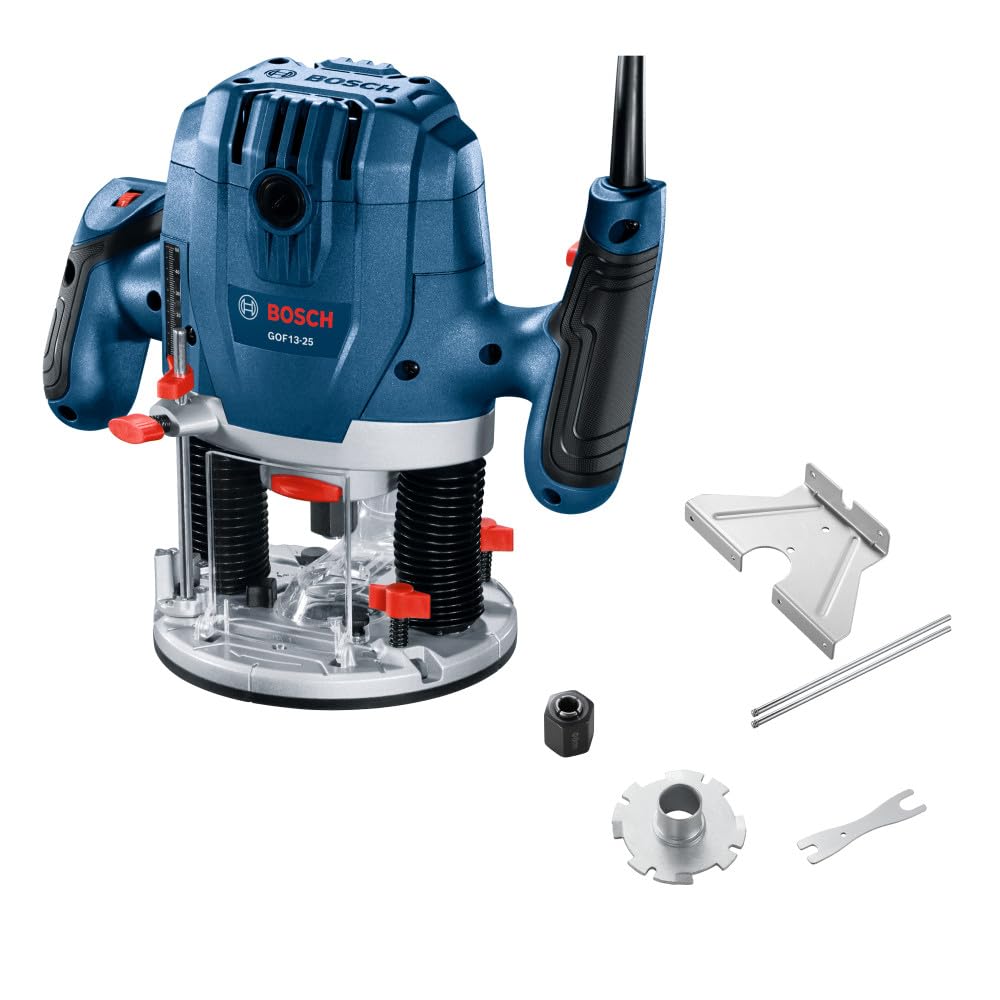
3. BOSCH GOF13-25 1-3/4 HP Mid-Size Plunge Router
The dial that runs from 11,000 to 28,000 RPM covers bits no other router here will spin.
If you route signs, acrylic, or anything with a small cutter that needs to scream, this is the pick. The speed range stretches from 11,000 to 28,000 RPM — a wider window than most of the fixed-speed and narrower-range machines on this page. A handle-mounted dial lets you change speed without letting go of the tool, and that range lets you match RPM to the bit diameter and material instead of forcing one speed onto everything.
At 7.7 pounds it is among the lighter plunge routers here, and the slim grip plus two ergonomic handles are built for longer sessions. The integrated depth stop and depth scale run eight-stop increments — that is eight preset depths you can step through when a single pass would be too aggressive. A detachable parallel guide keeps the base aligned along a board edge for straight grooves.
The kit is generous for a mid-size plunge: a 1/4-inch collet, a parallel guide, a roller guide, a surface routing dust hood, a wrench, and a centering pin. The dust hood earns its keep when you are surfacing a wide panel and want to see where the bit is going. Soft start is included too, so the bit eases into the cut rather than snapping the machine to life.
The main limitation is the single 1/4-inch collet. Large bits with 1/2-inch shanks are out, and the plunge mechanism has a firm spring that some find stiff, especially when trying to hold an intermediate depth mid-cut. Setup expectations for larger guided work should account for wanting the stiffer collet, so this suits the woodworker who does fine detail and guided profiling rather than heavy panel raising.
The spec that sells it
- 11,000 to 28,000 RPM range is the widest on this list
- 7.7 pounds with slim grip and two handles for extended use
- Eight-stop depth increments simplify multi-pass work
- Detachable parallel guide and dust hood included
Fit notes before you buy
- 1/4-inch collet only, so no 1/2-inch shank bits
- Plunge spring runs stiff for some users
Reach for this if: your work lives in fine cutters and guided edges, and you want the ability to slow or speed the bit to suit the material.
Look elsewhere if: you plan to run large 1/2-inch shank bits.
4. DEWALT Router, Fixed/Plunge Base Combo Kit (DW616PK)

A 2-1/4-horsepower fixed base that runs noticeably quieter than the rest of the bench.
Makita built this one around a rugged aluminum motor housing that measures just 3-1/4 inches across. That small diameter matters because your hand wraps around the body — a slimmer housing means more control and less wrist strain over a long cut. Electronic speed control holds a steady RPM under load, and the variable speed dial lets you slow the bit down for larger cutters. Soft start eases the bit into the work instead of snapping it on.
The sub-base accepts industry-standard template guides, so if you already own a set of guide bushings from another brand, they drop straight in. That compatibility is a big deal for anyone doing hinge mortises, inlays, or pattern work with a template. The fixed base itself is a solid choice for table-mounted duty, where you want a locked depth and no plunge mechanism to drift.
What buyers notice most is how quietly it runs compared to the rest of the shelf, and how much power it packs when it meets dense wood. It is a stout, well-built machine that feels substantial in the hand. The friction point is the depth adjustment and the bit-change routine — some find the depth setting fiddly, and the two-wrench collet change is a step slower than the single-wrench spindle locks on newer designs. The locking mechanism can also shift settings if you do not seat it firmly. For anyone who mostly routes in a table and changes bits rarely, neither issue is significant.
Where it shines: that 3-1/4-inch housing diameter and the quiet, steady motor make it a comfortable router to run for long stretches, especially in a table.
Worth knowing: the depth mechanism and the two-wrench collet take some getting used to, so budget a little practice time.
Reach for this if: you want a quiet, powerful fixed base for table work and standard template guides.
Look elsewhere if: you need a plunge base, or you want single-wrench bit changes.
5. BOSCH MRC23EVSK Combination Router, 15 Amp, 2.3 Horsepower
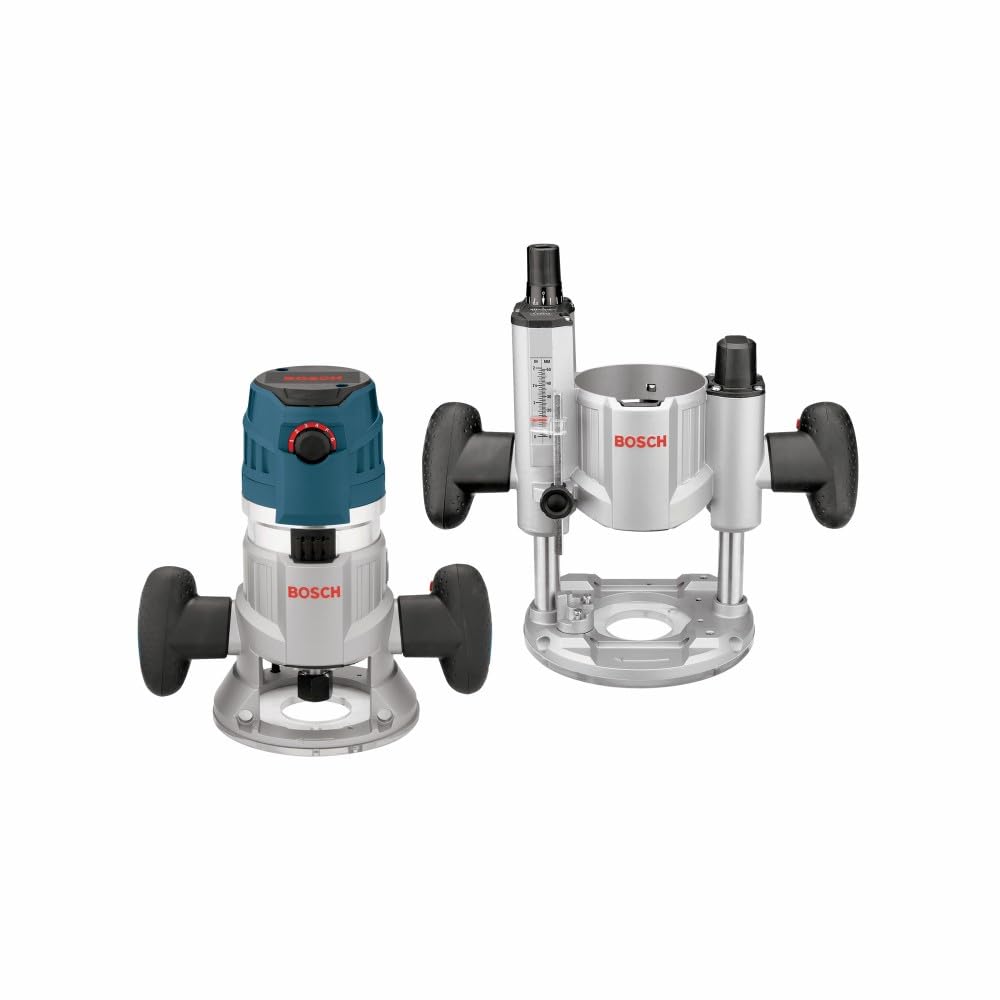
A 15-amp, 2.3-horsepower combo kit with the trigger in the handle where your finger already is.
This is a combination kit with both a fixed and a plunge base, and the motor is the reason it earns a spot here. A 15-amp, 2.3-horsepower motor runs from 10,000 to 25,000 RPM, and that range lets you slow a large bit down or speed a small one up. The fixed base adds a 1-5/8-inch continuous microfine adjustment range — one long, smooth window of height change rather than a short threaded ring.
The standout control feature is the trigger in the handle. Because the power switch sits where your hand naturally grips, you can power the router on and off without letting go or fumbling for a body-mounted switch. The precision-center design keeps the bit lined up on the cut line, which is the whole game when you are following a pencil mark. The fixed base is also set up for table mounting with pre-drilled threaded holes, so it drops into a router table plate when you want it there.
The kit itself is thorough: the motor, both bases, self-releasing 1/4-inch and 1/2-inch collet chucks, a 16mm and a 24mm wrench, a T-handle hex height adjustment wrench, three M4 table-mounting screws, and a carrying case. That is everything you need to go from freehand edge work to a table setup without buying anything extra.
The trade to keep in mind is that some buyers of this model have run into units that would not power on or quit early, which is a known risk with this particular design. When it works, it works well — owners describe it as high quality and stable. If you buy it, test it thoroughly within the return window and lean on the one-year limited warranty if anything is off.
Control innovation: putting the trigger in the handle means you never have to release the tool to switch it on or off mid-cut — a small change that improves safety and control in equal measure.
Do this first: burn-in the unit as soon as it arrives and confirm what’s in the box before the return window closes, since some examples have arrived dead on arrival.
Reach for this if: you want a big 15-amp combo kit with a hard case and a handle-mounted trigger.
Look elsewhere if: you want the lowest possible risk of a DOA unit and would rather pay for a brand with a longer track record at this size.
6. Makita RP1800 3-1/4 HP Plunge Router

A 3-1/4-horsepower plunge router built to bury a 2-inch bit in oak and keep going.
When a job calls for hogging out material in one pass, the RP1800 is the machine that will not blink. The 15-amp motor spins to 22,000 RPM, and the plunge depth capacity runs from zero to 2-3/4 inches — enough to drop a large bit deep into a thick panel. Linear ball bearings guide the plunge action so the stroke stays smooth and true rather than grinding or binding.
Precision features are all in service of repeatable depth. A quick-release plunge depth adjustment works alongside a micro control, and there are three preset depth stops so you can step through a deep cut in controlled stages. Oversized ball bearing construction is built for a long service life. Owners who push hard tools describe this as a machine that stands up where off-the-shelf routers will not, and the plunge action itself draws steady praise.
Two caveats worth knowing before you commit. There is no soft start and no variable speed, so the motor kicks on at full tilt and stays there — you control the cut with feed rate rather than dialing the RPM down. That is fine for the aggressive work this router is built for, less ideal if you want to slow a large bit. The other caveat is weight: this is a heavy machine, and long freehand edge work will wear you out. It is happiest in a plunge jig or guided setup.
Built for the hard stuff
- 15 amps and 22,000 RPM spin large bits without bogging
- 0 to 2-3/4-inch plunge depth opens deep mortises and hollows
- Linear ball bearings keep the plunge smooth
- Three preset depth stops for staged cuts
Who this is not for
- No soft start or variable speed control
- Heavy for extended freehand edge work
Reach for this if: your routing involves deep plunge cuts and heavy stock, and you want the motor to keep pace.
it’s not for you if: you want a light handheld router with a soft-start trigger and dialed-down speeds.
7. DEWALT Router DW618B3

Three bases, full electronic speed control, and a spindle lock for one-wrench bit changes.
This is the kit for the woodworker who keeps finding that one base is always the wrong shape. You get a fixed base, a plunge base, and a D-handle base in the same box, all driven by a 12-amp, 2-1/4-horsepower electronic variable speed motor. Speed runs from 8,000 to 24,000 RPM with full feedback control, which means the motor holds its RPM even when the bit bites hard. Soft start takes the kick out of powering up.
Each base earns its place. The fixed base runs edge profiles and grooves and sits well in a table. The plunge base handles stopped cuts and mortises with brass bushings and case-hardened steel guide rods for a smooth, accurate stroke. The D-handle base puts a trigger switch with a lock-on feature right under your finger, which is a real help when you are running long dados one-handed. The micro-fine depth ring adjusts in 1/64-inch increments and moves vertically to keep the switch and cord in a constant spot.
Making a strong showing here is the depth control and the bit-change setup. There is a spindle lock button that lets you change bits with a single wrench, and the through-the-column dust collection pulls away chips and keeps the bit line visible. The kit also includes both 1/4-inch and 1/2-inch collets, a vacuum adapter, a large-hole sub-base, and a kit box that stores everything.
The honest limitation is that this is the most complex setup in this group, and some owners note the motor latch requires a careful touch — get the base seated properly or depth can shift. There is also occasional dust leakage around the collection system. Neither is a dealbreaker, and the three-base flexibility is what most buyers are paying for.
The three-base advantage: owning a fixed, a plunge, and a D-handle base means you stop compromising on how you hold the tool — the right base for the cut is always in the kit.
Small habit worth building: the motor latch asks you to seat the base firmly every time. A second of care prevents a depth shift mid-project.
Reach for this if: you want maximum base versatility with electronic speed control and a single-wrench spindle lock.
Consider a simpler kit if: you mostly work in one position and do not want to manage three bases.
8. Triton TRA001 3-1/4 HP Dual Mode Precision Plunge Router

A 3-1/4-horsepower router that switches from plunge to rack-and-pinion with one button.
Most routers claim to be table-ready. This one is actually designed around the table. A single button switches the machine from conventional plunge mode to a fixed-base rack-and-pinion mode, and a micro winder crank lets you make continuous fine depth adjustments through the full plunge range. In practice, that means you can tune bit height from above the table using the crank instead of reaching underneath and fighting a lift mechanism.
The motor is a serious one: 15 amps and 3.25 horsepower turning to 21,000 RPM, with soft start and variable speed. Bit changes are handled through the base with an automatic spindle lock — you crank the bit up, the collet grabs itself, and you use one wrench. It ships with a multi-function fence, a collet wrench, and both a 1/2-inch and 1/4-inch collet. The dual-mode design is what earns it a place for anyone building a router table setup where the router stays mounted.
The honest picture: quality and power are the two things buyers praise most. It is a heavy-router that handles large raised-panel bits and thick flattening passes without bogging down. The trade to size is durability and price-for-what-you-get. Owners occasionally report reliability issues — one unit described as failing after being set up in a table, and others note the unit is not the ideal match for those who want a router they can also comfortably handhold. It is also heavier and clumsier than a fixed-base router for freehand work.
What earns the praise
- Switches between plunge and fixed rack-and-pinion mode with a button
- Micro winder crank for fine depth adjustment through the full plunge range
- 15 amps and 3.25 horsepower turn through heavy bits
- Single-wrench bit changes with an automatic spindle lock
Plan for the trade-offs
- Heavy and awkward freehand — this is a table router
- Durability complaints exist; test it under load within the return window
Reach for this if: you are building a dedicated router table and want above-table adjustment and monster power in one unit.
look elsewhere if: you need a light handheld router for edge work, or you want the lowest risk of a unit that fails under hard use.
9. Festool 578951 OF 1400 EQ-F-Plus Plunge Router

Twin guide columns, a 1400W motor, and a ratcheting lock that makes bit changes fast.
If your work depends on the cut being exactly where you planned it, this is the one. Dual-sided guide column clamping locks the plunge columns from both sides at once, which holds the base perfectly aligned through the whole cut — that is where flimsy plunge mechanisms introduce the slop and chatter that ruin a good piece. A 1400W motor covers edge profiling, rabbeting, chamfering, groove cutting, and solid-surface work without straining.
The details are what separate it. An integrated LED dust hood illuminates the work area while pulling dust away, so you can actually see the cut line as the bit moves. A ratcheting spindle lock makes bit changes quick, cuttingdown timebetween setups. The LED dust hood lights the cut line while pulling chips away.
The system play matters as much as the router itself. This model integrates with Festool templates, guide systems, and routing accessories, so it works as one piece of a larger kit rather than a stand-alone tool. The bit centerline is marked on all four sides of the base, which trims the time it takes to line a cut up with a mark. Owners describe it as very good and worth the outlay when the engineering is what they are paying for.
Two things to weigh honestly. The first is support: some owners mention long wait times for Festool support and a requirement to ship the whole unit for warranty repairs rather than receiving a replacement part. The second is the base itself — the plunge stop has drawn reports of being defective from the start, and a simple fix that owners could do themselves was not covered. Neither is universal, but if downtime matters to you, plan around it.
The engineering story: dual-sided column clamping is why this plunge stays dead-true under load — the base cannot shift side to side the way a single-clamp mechanism can.
Where it costs you: the price is high and the warranty service requires shipping the whole tool. Buy it for the function, as the owners do, not for the support experience.
Reach for this if: you are a finish-focused woodworker who wants the cleanest plunge stroke and the system to match.
Consider the Bosch or Makita above if: you want comparable power and precision at a fraction of the cost and without the service-shipping requirement.
Know the Specs
Amperage And Horsepower
Amperage measures how much electrical current the motor draws from the wall, and it is the best single gauge of how much sustained work a router can do before it bogs down. Horsepower is a related figure the maker publishes to describe the motor’s peak output. When you are running large bits or taking deep passes in dense material like oak, both numbers matter. A higher-amp motor keeps the bit spinning at full speed for longer, which means a cleaner cut and less chatter. If you plan to flatten slabs or rout raised-panel doors, higher amperage is the spec to prioritize.
Speed Range And Variable Speed
RPM is revolutions per minute — how fast the bit spins. Different bit diameters want different speeds: large bits want slower RPM to prevent burning and kickback, while small bits cut cleaner at higher RPM. A router with variable speed and electronic feedback control lets you set the right speed for the bit and hold it there even when the load changes. A fixed-speed router spins at one rate, which works for many simple cuts but limits the bits you can safely run.
Depth Adjustment And Turret Stops
Depth adjustment is how you control how deep the bit cuts into the wood. Micro-fine adjusters move the bit in small increments, and turret stops let you preset multiple depths so you can cut a deep groove in equal passes. The finer the adjustment, the more repeatable your cuts — a 1/64-inch increment is a real advantage when you need consistency.
Collet Size And Bit Compatibility
The collet is the sleeve that grips the bit shank. A 1/2-inch collet allows larger bits with greater accuracy and a stiffer cut, while a 1/4-inch collet handles small bits. Many routers ship with both, which lets you run whichever bit the job calls for. Before buying any bit for your router, check the collet size on your machine and match the bit shank accordingly.
Common Questions
What is the difference between a plunge router and a fixed-base router?
Can I use 1/4-inch and 1/2-inch bits in the same router?
How do I get a cleaner cut and stop the bit from burning the wood?
Is a heavier router better for precision work?
Do I really need variable speed on a router?
How long does a wood router motor usually last?
Can I mount any of these routers in a router table?
What does soft start do on a router?
Is a cordless router as powerful as a corded one?
What accessories should I buy with a router?
The Bottom Line
For the widest range of precision work in one box, the SKIL RT1322-00 is the one to get — a 14-amp motor, both fixed and plunge bases, and an LCD that takes the guesswork out of speed selection, all in one box. If you are building a router table and want above-table adjustment with serious power, the Triton TRA001 earns its keep. And for the woodworker who wants the smoothest handheld plunge stroke with a dust hood and system support to match, the Festool OF 1400 is the one to reach for. Most of these routers will outlast their warranty by years — but if you want the safest bet on getting it right the first time, the SKIL’s combination of a 14-amp motor, both bases, and a 1/2-inch collet from the start is hard to argue with.
How we choose
We do not accept paid placement. Every pick is matched to a real buyer and a real use-case; we do not hands-on test units.
Sources
Specifications: manufacturer listings and product documentation. Review insights: verified customer reviews, as of October 2026. Pricing: not shown on this page (it changes often); check the current price via the retailer link.
As an Amazon Associate, Home Digitized earns from qualifying purchases. This does not affect which products we feature.