
Disclosure: This post contains affiliate links. As an Amazon Associate I earn from qualifying purchases, at no extra cost to you. Learn more
Specs are compiled from manufacturer listings and verified buyer reviews and can change over time — please confirm the key details on the product page before buying.
Your raised beds are six feet long, the soil is compacted clay, and every spring you spend two weekends swinging a hoe instead of planting. An electric rototiller for a small garden is built to take that job off your hands. The catch is telling apart the machines that actually bite into new ground from the ones that only fluff soil you already broke last season. A light cordless cultivator and a true corded tiller are very different tools, even though their names sound almost the same.
This guide is built by comparing the manufacturers’ published specifications and the patterns across verified customer reviews, so you get each pick’s real strengths and trade-offs instead of marketing spin.
Below you will find the tilling width, depth, motor power, and battery or cord setup for each machine explained in plain language, so you can match one to the size of your bed. Whether your plot needs a narrow cordless unit for between rows or a wider corded tiller for a full vegetable patch, this breakdown of the electric rototillers for small gardens covers it.
Top Picks
How To Choose The Best Electric Rototillers for Small Gardens
On a small plot, the biggest mistake is buying more machine than your soil needs — or less than your soil demands. A four-foot raised bed of loose, screened compost is a different job than a ten-foot patch of untouched clay with roots woven through it. Three things decide the right tool for you: how wide a path you need, how deep the tines (the spinning metal prongs that dig into the dirt) reach, and whether power comes from a cord or a battery pack.
Tilling width sets how many passes you make
A tilling width, or cultivating width, is how wide a strip the tines churn in one sweep. A narrow path like nine inches is easy to steer between plants but means more overlapping passes across a wide bed. A wider path near eighteen inches covers ground faster but is harder to control around delicate stems. For a bed you rebuild every spring, the wider path usually saves you the most time.
Depth is what actually breaks hard ground
Depth is how far the tines dig down. Shallow machines loosen only the top layer, which is fine for mixing in compost but useless for opening virgin soil. If your ground has never been turned, look for a deeper reach and plan to make several passes rather than one heroic plunge. Wet soil clings to tines and packed soil makes the machine bounce, so working dry soil in stages is normal.
Corded amps versus battery runtime
A corded tiller runs on constant wall power, so the amp rating tells you the muscle on tap — more amps generally mean more grunt through clay. The trade-off is a cord that limits your reach and needs a heavy-duty extension lead. A battery tiller frees you from the outlet entirely, which matters for a plot far from the house, but runtime is capped and you will want to check how many battery packs come in the box.
Side-by-Side Comparison
| Model | Best For | Tilling Width | Tilling Depth | Power | Amazon |
|---|---|---|---|---|---|
| Sun Joe TJ602E★ Best Overall | All-round small garden tilling | 12″ | 8″ | 8-amp corded | Amazon |
| SOARFLY Cordless TC-01Best Value | Cord-free beds with two packs | 9″ | 6.6″ | Battery, 2×4.0Ah | Amazon |
| Saker SK-TC18AMost Versatile | Variable speed on established beds | 9″ | 6.3″ | 22V battery, 3-speed | Amazon |
| Steelite AZDG550 | Wide corded coverage | 18″ | 8.7″ | 13.5-amp corded | Amazon |
| Earthwise TC70090 | Low-maintenance corded value | 12″ | 8″ | 9-amp corded | Amazon |
| Westinghouse W18TCAC | Fast coverage of medium gardens | 18″ | 9″ | 15-amp corded | Amazon |
| Sun Joe TJ605E | Large plots close to an outlet | 15.7″ | 7.7″ | 15-amp corded | Amazon |
| RYOBI P2750 | Weeding and light tilling | 8″ | — | 18V battery, 4.0Ah | Amazon |
| Ryobi RY18CVA-0 | Between rows with 4-to-2 tine change | — | — | 18V battery, 3-speed | Amazon |
Detailed Reviews
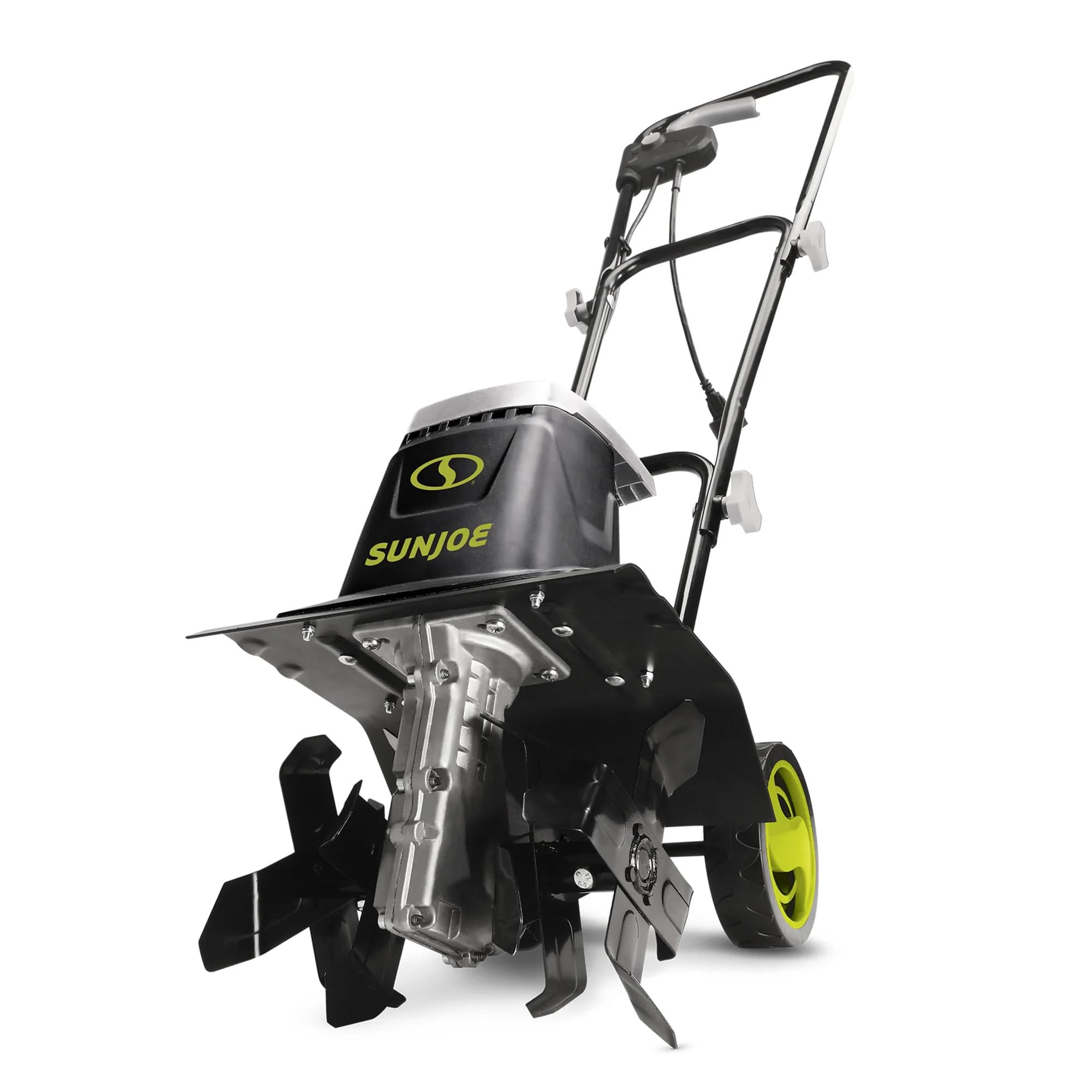
1. Sun Joe TJ602E
Our pick — 4.5+★ from 850+ verified ratings; the strongest balance of quality and price.
The 8-amp corded tiller that turns a weekend of hand-digging into a two-hour job.
If your beds are already in place and you just want them turned, fed, and ready for seedlings, this is the machine to buy first. Its 8-amp motor spins the tines at 300 RPM — that’s rotations per minute, a measure of how fast the blades churn the earth — and it cuts a 12-inch-wide, 8-inch-deep path through soil. That depth is the number that matters, because it is deep enough for most vegetable roots rather than just scratching the surface.
The four heavy-duty angled steel tines are built to slice roots and weeds, and a 3-position height-adjustable rear wheel set lets you steer the cut across uneven ground. The handle collapses for storage, so it tucks into a shed corner. It runs on a plain extension cord with no gas, no oil, and no tune-ups. Owners describe tilling four-by-twelve-foot raised beds and blending in organic matter in about two hours instead of days by hand.
Be honest about its limits before you buy. This is a light machine, and on deep, compacted soil it bounces, so the trick is multiple shallow passes rather than forcing a single deep one. Wet soil sticks to the blades and needs to dry out first. There is also a gap between the center blades that leaves a strip untouched, which you fix by running the same bed from a couple of directions. The trade-off is worth it: for refresh work on established beds, nothing here does more per dollar.
What earns it the top spot
- 8-amp motor at 300 RPM cuts a 12-inch-by-8-inch path — deep enough for real vegetable roots
- Four angled steel tines handle roots and weeds on already-worked soil
- 3-position height wheels plus a collapsible handle for tight storage
- Corded power means no battery to charge and no runtime clock
Where it needs patience
- Light build bounces on deep, compacted ground — work in several shallow passes
- A center-blade gap leaves an untouched strip you clear by crossing passes
- Wet soil clings to the tines and needs to dry before it releases cleanly
Reach for this if: you have existing beds or flower borders and want them turned deep and fast without a battery clock running.
Think twice if: your plot is virgin sod or hard clay and you expect one pass to do the whole job — plan on several.
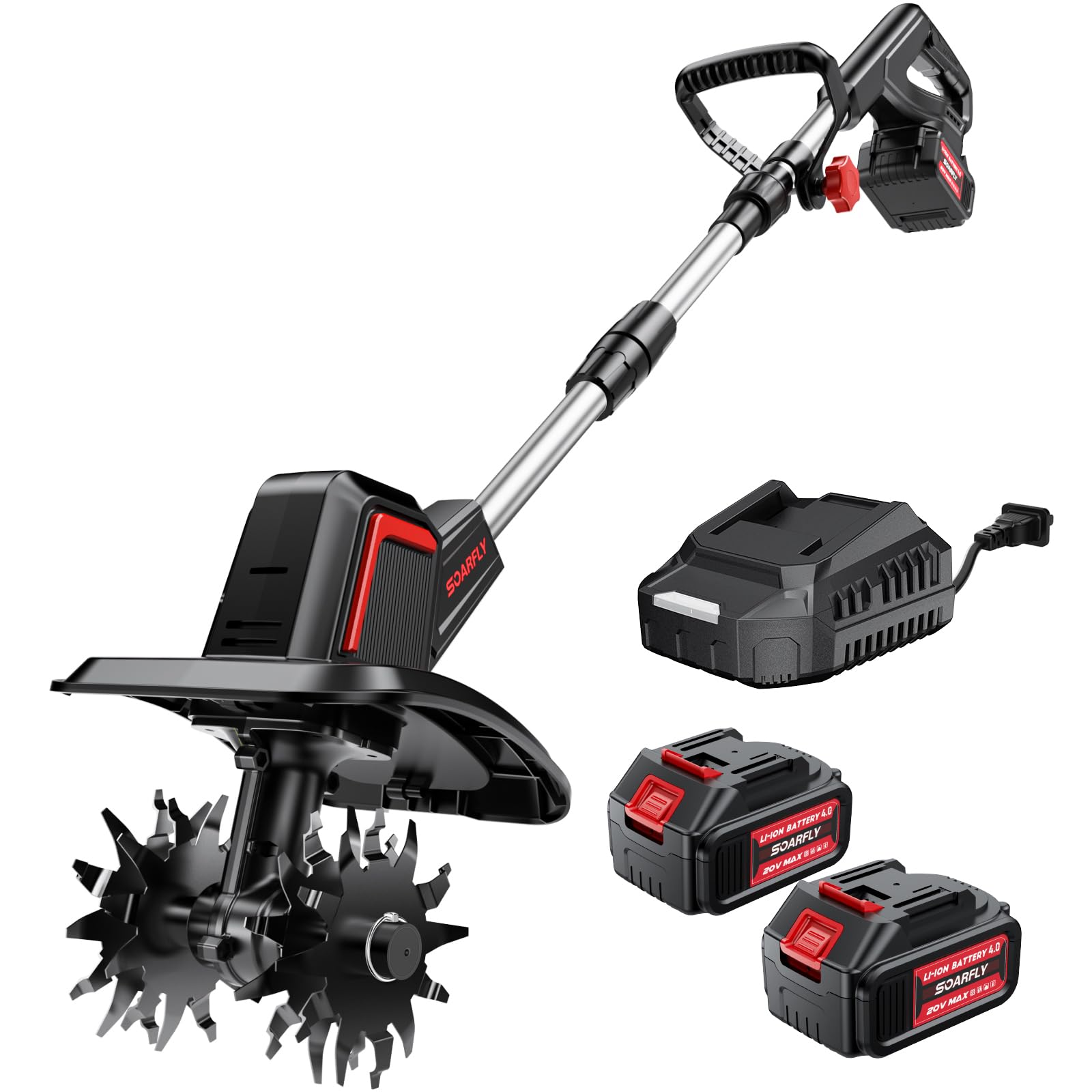
2. SOARFLY Cordless Tiller Cultivator
Two battery packs in the box and no cord to drag across the lawn.
This is the one to pick when your beds sit far from any outlet. It ships with two 4.0Ah lithium-ion battery packs, double the capacity of the common 2.0Ah packs, giving you a spare to swap in mid-job. That 4.0Ah rating is twice the 2.0Ah of the Saker below, so you get longer running stretches between changes. A single charge runs about 45 minutes, so the two-pack setup is what makes a full bed rebuild practical.
The upgraded motor holds 360 RPM for steady churning, and 48 steel tines let it work normal garden soil, lightly to moderately compacted ground, and properly moistened clay. It weighs 6.9 kg — about 15 pounds — so one person can carry it to the far end of the yard. The height-adjustable system and auxiliary handle help taller and shorter gardeners alike, and a dual safety system means you press a button before the trigger will engage.
What wins people over is the overall build quality, and the battery endurance is a close second. Pair that with a 9-inch-wide, 6.6-inch-deep cut and you have a compact machine that still does honest work. The honest catch is durability: most owners find it strong, though a few report a unit loosening after a short run, so treat the tines gently in rocky soil and clear jammed roots before restarting. One more thing tall users notice — the handle runs short, which can mean a bit of hunching.
Cord-free freedom: 360 RPM motor with 48 steel tines handles flower beds, raised beds, and moistened clay — no outlet required.
Watch the handle height: shorter users get an easy fit, but taller gardeners report the grip sits low enough to cause back strain on long sessions.
Buy it for: remote plots, tight spaces, and anyone who wants two batteries to keep going without a cord.
Pass if: you need to tear up thick sod or deeply rooted ground in one pass — this works best in staged, shallow sweeps.
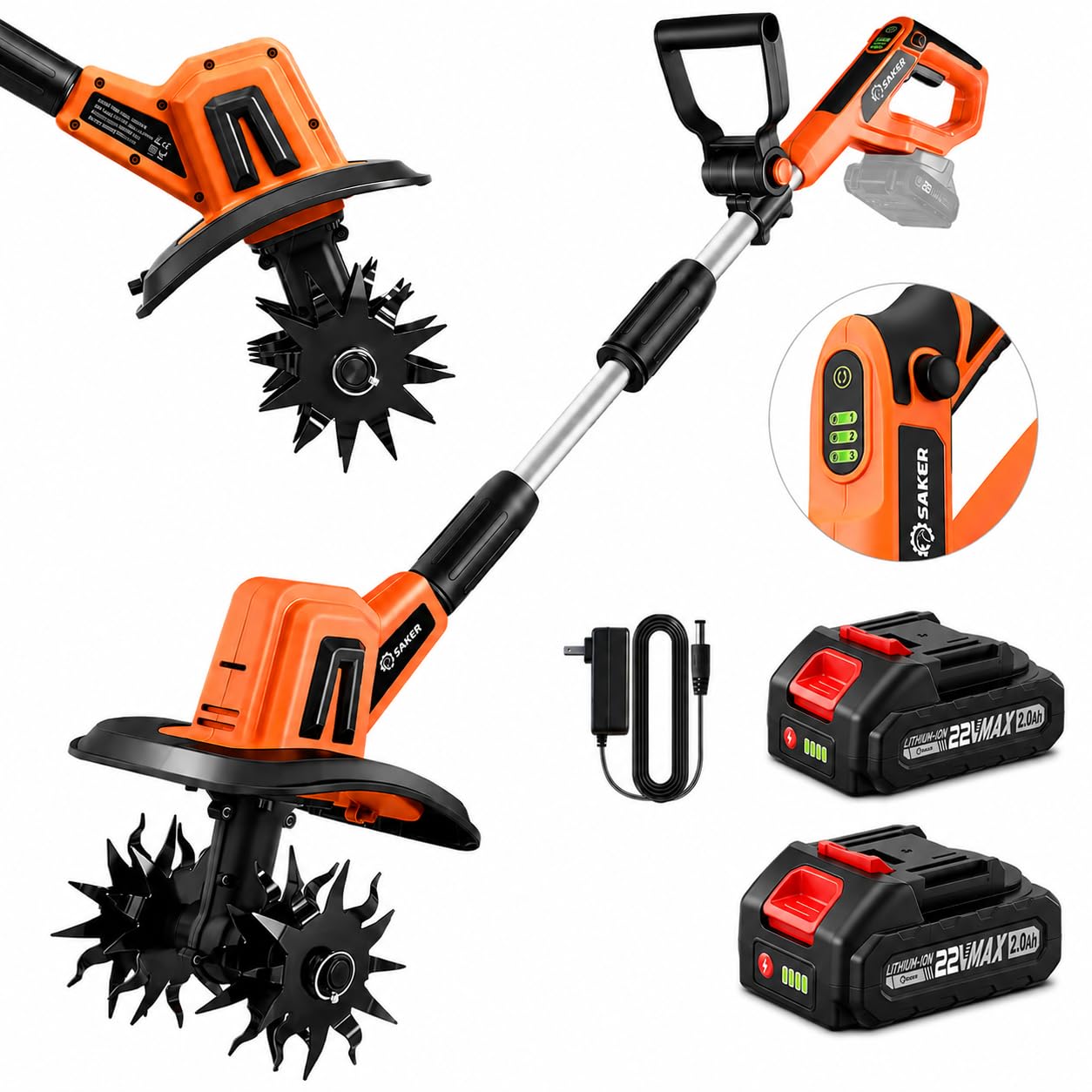
3. Saker 22V Cordless Garden Tiller
Three speeds let you finesse a seedbed one minute and chew clay the next.
Dial things down to 200 RPM for delicate weeding between young plants, or open it up to 360 RPM for deeper tilling — this is the machine for a gardener who wants control rather than one fixed gear. It cuts a 9-inch-wide, 6.3-inch-deep path with four steel tines, which keeps you nimble in raised beds and tight corners. Two 22V 2.0Ah batteries run about 30 minutes each, so a swap doubles your session.
Comfort was clearly a design goal here. The auxiliary handle and grip are adjustable so you can find a neutral posture, and dual safety locks — a button plus a trigger — mean it will not fire up by accident. Reviewers call it a godsend for home yard work, and its 360 RPM motor works through clay and breaks up stubborn clumps. Seasoned gardeners appreciate how little fatigue it produces over a full afternoon.
There is one safety note worth heeding. A few owners point to the minimal rear guard, so the tines can catch a foot when you pull the machine back toward you. Keep both hands on the grips and step aside deliberately rather than yanking. On brand-new heavy ground, it prefers a pre-break pass before it settles into a rhythm. For established beds and prepared soil, it is a joy.
Speed control done right: 200/270/360 RPM settings with 9-inch width and 6.3-inch depth cover everything from weeding to deep tilling.
Best for: gardeners who want variable power and lighter handling for established beds and between-row work.
Skip if: you plan to open raw, root-tangled ground — start elsewhere and come back with this once the soil is broken.
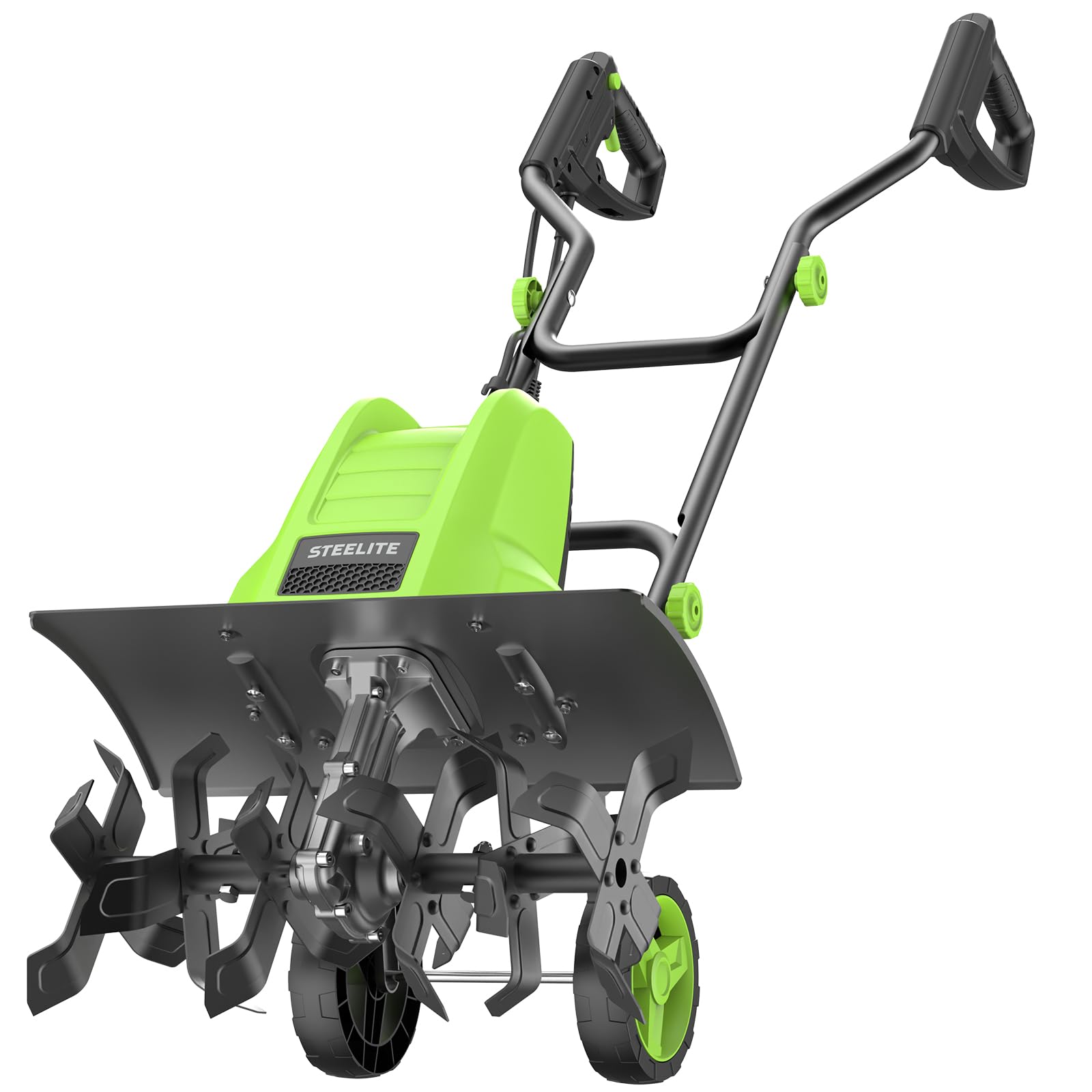
4. STEELITE 18 Inch Width Electric Tiller Cultivator
An 18-inch swath that covers a full bed in half the passes of a narrow unit.
When the job is finishing a whole plot rather than tending a couple of beds, width is what buys back your weekend. This corded machine cuts an 18-inch-wide, 8.7-inch-deep path, so it covers far more ground per sweep than the 9-inch SOARFLY or the 12-inch Sun Joe TJ602E above. Its 13.5-amp pure-copper motor spins at 380 RPM with 24 steel tines doing the cutting, and two adjustable-height wheels let it ride over different soil conditions.
For long sessions, the ergonomic handle and textured soft-grip surface keep control steady even with gloves on or in damp weather. There is a safety switch to stop accidental starts and an overload protection system that guards the motor during extended use, which matters when you are working a large area in one stretch. The handles fold down to a compact footprint for garage or shed storage.
Performance is the thing that earns it a place here, with raw power a close second. It chews through rooty ground and turns hard dirt up nicely while staying light enough to steer. The cord is your planning constraint — you will want a heavy-duty extension lead and an outlet within reach, since the machine itself has no battery option. Stick within cord range and it is a genuinely capable bed builder.
Coverage you feel instantly: an 18-inch width and 8.7-inch depth mean fewer overlapping passes across a large patch of garden.
The cord is your limit: a 13.5-amp motor needs a proper heavy-duty extension lead, so map your outlet distance before you start.
The pick for: medium to large yards, garden plots, and flower beds where wide coverage saves the most time.
Not ideal for: plots with no accessible outlet — a battery machine in this list will serve you better.
5. Earthwise TC70090 Electric Tiller/Cultivator

A featherweight corded unit that quietly outlasts flashier machines season after season.
At 20 pounds, this is one of the lightest corded tillers you can hand-carry to a bed, and its soft ergonomic grip and single-lever switch keep the operation simple. The 9-amp motor drives four alloy-steel tines to cultivate up to 12 inches wide and 8 inches deep — the same depth as the Sun Joe TJ602E, but with a slightly different feel in the hand. Because it draws from an outlet, there is no battery to top up and no runtime to watch.
What a lot of owners keep coming back to is how well it simply works. It handles flower beds and small garden areas, digs down 6 to 8 inches, and cuts through rocks and small roots with ease, so thick grass and clay surrender after you mow the area first. The effect on light-to-medium ground is where it shines, and its low-maintenance, planet-friendly design means your routine is just plug, work, and wipe down.
Be realistic about scale. For a half-acre of virgin sod this is not the tool — the corded reach and light frame will fight you. But for the modest garden bed or a few raised planters, dirt and small roots break up better than the price suggests. A few heavy surface roots can wind around the shafts, which is normal for any tiller and simply needs a clearing break.
Built to keep going: a 9-amp motor with four steel tines and a 12-inch-by-8-inch cut, wrapped in a 20-pound frame you can carry anywhere.
Choose this if: you want a light, simple, cord-powered tiller for small garden beds and flower areas.
Look elsewhere if: you are working ground too far from an outlet or need to clear acreage rather than a few beds.
6. Westinghouse 18-Inch Electric Tiller Cultivator

A 15-amp bruiser that goes deeper and wider than almost anything corded here.
Depth is the reason to reach for this one. It cultivates up to 9 inches down — the deepest reach on this list — so you can break up a bed far below the surface where clay stays hard. It cuts an 18-inch-wide path with a 400 RPM motor (400 revolutions per minute, the speed the tines spin) turning six sets of integrated steel blades. That 18 inches of width and 9 inches of depth means it tears through compacted soil and preps a bed for planting in fewer passes than the narrower machines above. It is the corded pick for a gardener who wants real muscle without stepping up to a bigger, heavier tiller.
Even at this power level, it stays manageable. The 23.9-pound frame with an ergonomic H-type handle is comfortable to steer, and the handles fold for storage. Buyers describe it as well built and easy to assemble, with torque that surprises for its size, and note it is small enough to maneuver around established plants without uprooting them. It handles rocky ground, but keep a firm grip and control the machine rather than letting it lead.
One honest behavior to expect: on dry, loose ground it has a tendency to hop, a quirk a few owners point out, so work when the soil is slightly damp and angle the blades in gradually. It also wants a heavy-duty cord, and on a long job the motor can run warm. All that aside, the quality and power customers keep praising are real, and it out-muscles the lighter corded picks here on sheer tilling depth.
Why it earns its premium slot
- 15-amp, 400 RPM motor cuts 18 inches wide and up to 9 inches deep — the deepest reach here
- Six sets of integrated steel blades break up compacted soil and improve drainage
- 23.9-pound frame with an ergonomic H-type handle folds down for storage
- 2-year limited warranty with factory testing behind it
What to plan around
- Bounces on dry, loose ground — work slightly damp soil in gentle passes
- Wants a heavy-duty extension cord, and the motor can run warm on long jobs
- No handle lock to hold the folded position during transport
The one for: medium-to-large gardens where tilling grunt and deep reach matter more than cordless freedom.
The catch: it is heavy enough that short sessions suit it better than all-day tilling, so pace your work.
7. Sun Joe TJ605E
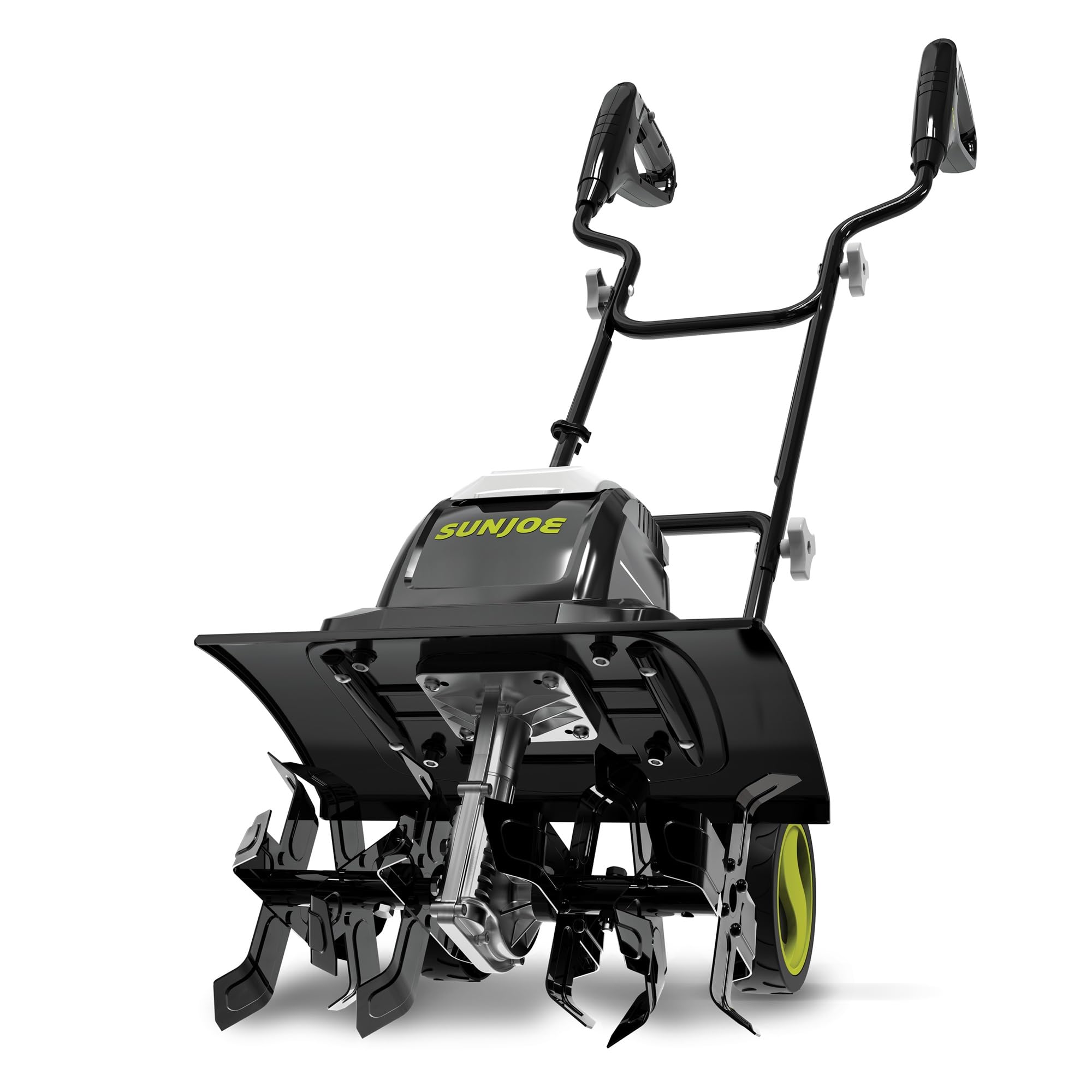
The wide-path corded tiller built for breaking sod on a plot that backs onto an outlet.
Step up to this if your garden is larger than a raised-bed cluster and you want to cover serious ground per pass. Its 15-amp motor delivers up to 400 RPM and cuts a 15.7-inch-wide path up to 7.7 inches deep, with six rust-proof angled steel tines built to keep working through seasonal jobs. That wide swath beats the 12-inch Sun Joe TJ602E below on coverage, which means fewer laps across a long row.
A 4-position wheel setup lets you control the working depth with real precision, and the foldable handle collapses for compact storage. Owners run it through some surprisingly stubborn ground — hard Georgia clay, rocky soil, and dense sod all give way, and the reaction is often surprise that a corded electric machine chews through hard-packed earth that well. On a large project, that capability is a genuine relief compared with hand work.
Two things to weigh before committing. The safety system requires you to hold a button and squeeze the trigger together, which adds a deliberate step to every start. The machine also behaves more like a cultivator than a heavy tiller: it excels on broken or previously worked ground but will not cut fresh sod alone. There is no variable-speed adjustment, so you either run its pace or feather the trigger by hand. For plots you already keep in rotation, it is a quietly capable partner.
Wide and deep enough to run rows: a 15-amp motor with six steel tines cuts 15.7 inches wide and 7.7 inches down with 4-position wheel depth control.
The honest limit: it is a cultivator at heart, so it loves broken ground and struggles to open untouched sod on its own.
Go here if: you run a large vegetable plot, already keep the ground worked, and have an outlet within cord reach.
Elsewhere if: you want to break raw ground or need variable speed control for delicate weeding.
8. RYOBI ONE+ 18V Cordless Cultivator P2750

A tidy 8-inch cultivator that makes weed patrol and light soil fluffing almost pleasant.
Do not mistake this for a ground-breaker — it is a compact cultivator for light work, and it is excellent at exactly that. It runs on an 18V 4.0Ah battery with a charger included, gives roughly 40 minutes of work per charge, and charges up in about an hour and a half. Because it is cord-free and light, it is easy to grab for a quick pass around the beds or to knock back weeds between rows without hauling out the big machine.
Functionality is where it wins the most approval. Buyers report being consistently surprised how much soil prep time it removes from a small area. It handles harder soil better than its 8-inch, 18V size suggests, and assembly takes only a single screwdriver. Older gardeners favor it too — one owner put it plainly: “Easy even a old.lady can handle it.” A safety lockout button keeps it from firing up accidentally, and the tines just need an occasional cleaning when you are working fresh ground.
Set your expectations to match the tool. It tills soft soil beautifully, but hard, grassy ground is a different story, so use it on soil you have already worked and let it refresh rather than break. It also asks for some arm effort on tougher patches. For weeding, edging, and light tilling in a small garden or around the house, though, it earns its keep.
What it does beautifully
- 18V 4.0Ah battery with charger included — about 40 minutes of run per charge
- Compact 8-inch cultivator that saves serious time on soil prep and weeding
- Light enough for older gardeners and simple screwdriver assembly
- Safety lockout button prevents accidental starts
Keep it in context
- Not a true tiller — best for light tilling and weeding, not breaking new ground
- Tines need occasional cleaning when working fresh ground
- Battery life feels short to some if you push it hard
Perfect for: small gardens, weed patrol, and quick refresh passes on soil you already keep cultivated.
Not meant for: digging virgin sod or hard clay — that calls for a corded machine in this lineup.
9. Ryobi RY18CVA-0 Motor Hoe 18V ONE+ Battery (Body Only)

Drop from four tines to two and it slips down narrow rows no other pick can enter.
For a gardener who works tight rows and small patches, the standout here is flexibility. The tine set adjusts tool-free from four tines down to two, letting you cultivate between closely spaced rows without hacking the plants you are trying to protect. Three speed settings let you match the pace to the job, and the adjustable auxiliary handle keeps the machine comfortable over long sessions. It weighs 4800 grams, or just under 11 pounds, so it is genuinely easy to carry and steer.
Runtime is a real selling point at this level: with a RYOBI 18V ONE+ 4.0Ah battery RB1840X, it runs over an hour. Since this is the body-only version, you supply the battery yourself — but if you already own other ONE+ tools, that shared battery system is a genuine advantage. Owners who put it to work describe running it across large patches of garden and finding it keeps going, and praise how quickly the tines detach to clear out wrapped roots so you can carry straight on.
The honest catch is the price and the ecosystem. Because it ships without a battery, your real cost depends on whether you already own ONE+ packs; buy this cold and you are paying for a tool and battery separately. It is also better suited to maintenance and refinement work than to clearing untouched land. But for precision around established plantings, the 4-to-2 tine change and three speeds make it the most adaptable machine on this list.
The tine trick: a tool-free change from four tines to two lets you work narrower between rows than the fixed cutting widths of every other pick here.
Ideal for: ONE+ owners who want precise, battery-powered cultivating between rows and on small patches.
Weigh first: the body-only format means you must already own a battery, or budget for one alongside it.
Know the Specs
Amps and RPM
Amps measure how much current a corded motor draws from your outlet — more amps generally mean more muscle through clay. RPM is rotations per minute, the speed the tines turn; higher numbers churn faster but do not always dig deeper. A 15-amp motor at 400 RPM cuts more aggressively than an 8-amp motor at 300 RPM, but the lighter machine is easier to control in a tight bed.
Battery Amp-Hours
Amp-hours, written as Ah, measure battery capacity — how long a pack runs before it needs recharging. A 4.0Ah pack holds roughly twice the charge of a 2.0Ah pack, which is why machines that ship with two packs or a single larger one stretch your work time. When a tiller is battery-powered, the Ah rating and the number of packs in the box matter more than raw RPM.
Common Questions
Can an electric rototiller break new ground or only refresh existing beds?
Is a corded or battery electric tiller better for a small garden?
How deep should an electric rototiller till for a vegetable garden?
Do I need an extension cord for a corded electric tiller?
How long does a battery tiller run on a single charge?
Can an electric tiller handle clay soil and roots?
What is the difference between a cultivator and a rototiller?
How do I stop an electric tiller bouncing on hard ground?
What maintenance does an electric tiller need between seasons?
Will an electric tiller work for raised beds and between rows?
The Bottom Line
For most small gardens, the electric rototillers for small gardens winner is the Sun Joe TJ602E. Its 8-amp motor and 12-inch-by-8-inch cut turn established beds in about two hours instead of two days by hand, and it is the crowd favorite at 4.5+ stars across 800+ ratings. If you want cord-free freedom with two batteries in the box, grab the SOARFLY Cordless Tiller. And for deep, wide coverage of a larger plot, the Westinghouse 18-Inch reaches the full 9 inches down.
How we choose
We do not accept paid placement. Every pick is matched to a real buyer and a real use-case; we do not hands-on test units.
Sources
Specifications: manufacturer listings and product documentation. Review insights: verified customer reviews, as of October 2026. Pricing: not shown on this page (it changes often); check the current price via the retailer link.
As an Amazon Associate, Home Digitized earns from qualifying purchases. This does not affect which products we feature.