
Disclosure: This post contains affiliate links. As an Amazon Associate I earn from qualifying purchases, at no extra cost to you. Learn more
Specs are compiled from manufacturer listings and verified buyer reviews and can change over time — please confirm the key details on the product page before buying.
Landscape solar spotlights are simple machines: a small panel drinks daylight, a battery stores it, and an LED throws it exactly where you point it at night. The catch is that two lights with the same headline brightness can behave completely differently by hour four of a dark evening. This guide sorts the current field by how much light you actually get, how long it lasts, and whether the housing survives a real winter.
This guide is built by comparing the manufacturers’ published specifications and the patterns across verified customer reviews, so you get each pick’s real strengths and trade-offs instead of marketing spin.
Most buyers focus on lumens and ignore beam type, panel placement, and battery duration — the three things that decide whether an uplight actually survives the evening. Here is how to pick the right landscape solar spotlights for your yard, pathway, or facade.
Top Picks

How To Choose The Best Landscape Solar Spotlights
A landscape spotlight fails for one of three reasons: it doesn’t put light where you aimed it, it dies before you go to bed, or water gets inside and kills the electronics. Fix those three and the rest is taste. Everything below is about matching the fixture to the actual spot you want lit.
Start with the beam, not the lumens
A narrow beam throws a tight pool of light up a trunk, a flagpole, or a house number. A wide beam washes a path, driveway apron, or garage face. Both exist in this category, and picking the wrong shape wastes brightness you already paid for.
Run-time per mode beats peak brightness
Every multi-mode spotlight drops its output to stretch the evening. A light rated for 20 hours burns dim; the same light on high might run 8 hours. Decide which mode you will actually leave it set to, then read the number for that mode.
Panel placement decides everything in shade
If your target spot sits under a roof overhang, tree canopy, or on a north wall, a fixture with a permanently attached panel will starve. A detachable panel on a cable can sit in full sun while the light sits in shade — the single most useful design decision for shaded yards.
Match Kelvin to the mood, not to fashion
Cool white concentrates light and reads clinical; that is what you want for security washes, driveways, and highlighting architectural shapes. Warm white adds a golden tone to foliage and house facades, which is why most garden designers use it for tree uplighting.
Side-by-Side Comparison
| Model | Best For | Brightness | Color Temp | Pack Count | Amazon |
|---|---|---|---|---|---|
| Solar Spot Lights Outdoor 8 Pack, IP67 Waterproof Solar Landscape Spotlights★ Best Overall | Spreading light across a large yard | 200 lm | 3500 Kelvin | 8 Pack | Amazon |
| HGGH Solar Lights Outdoor Waterproof IP67, 60 LEDCool White Power | Bright cool-white security washes | 800 lm | 8500 Kelvin | 4 Pack | Amazon |
| Brightown 4Pack Solar Spot Lights OutdoorBudget Multi-Mode | Multi-mode lighting on a modest budget | 800 lumen | 6500 Kelvin | 4 Pack | Amazon |
| NBKLS Solar Spot Lights for Outside, 21 LED | Warm-white tree and facade uplit | 650 lumen | 2800 Kelvin | 4 Pack | Amazon |
| JEJOT Solar Spotlights Outdoor Waterproof | Low-profile accenting along walkways | 200 lm | 6500 Kelvin | 6 Pack | Amazon |
| Consciot Solar Spot Lights Outdoor, 170° Wide Beam | Color-changing seasonal displays | 600 lm | 6500 Kelvin | 4 Pack | Amazon |
| APONUO Solar Spot Lights Outdoor 4-in-1 with 9.8ft Cable | Shaded trees with a panel placed in sun | 150 lm | 3000 Kelvin | 4 Pack | Amazon |
| Solar Spot Lights Outdoor, 10 Pack Outdoor Solar Lights for Yard | Lighting a large yard on ten fixtures | 450 lm | 3000 Kelvin | 10 Pack | Amazon |
| Linkind Smart Solar Spotlights SL6C, Dual Ring | App-controlled color and synchronized light shows | — | 6500 Kelvin | 4 Pack | Amazon |
Detailed Reviews
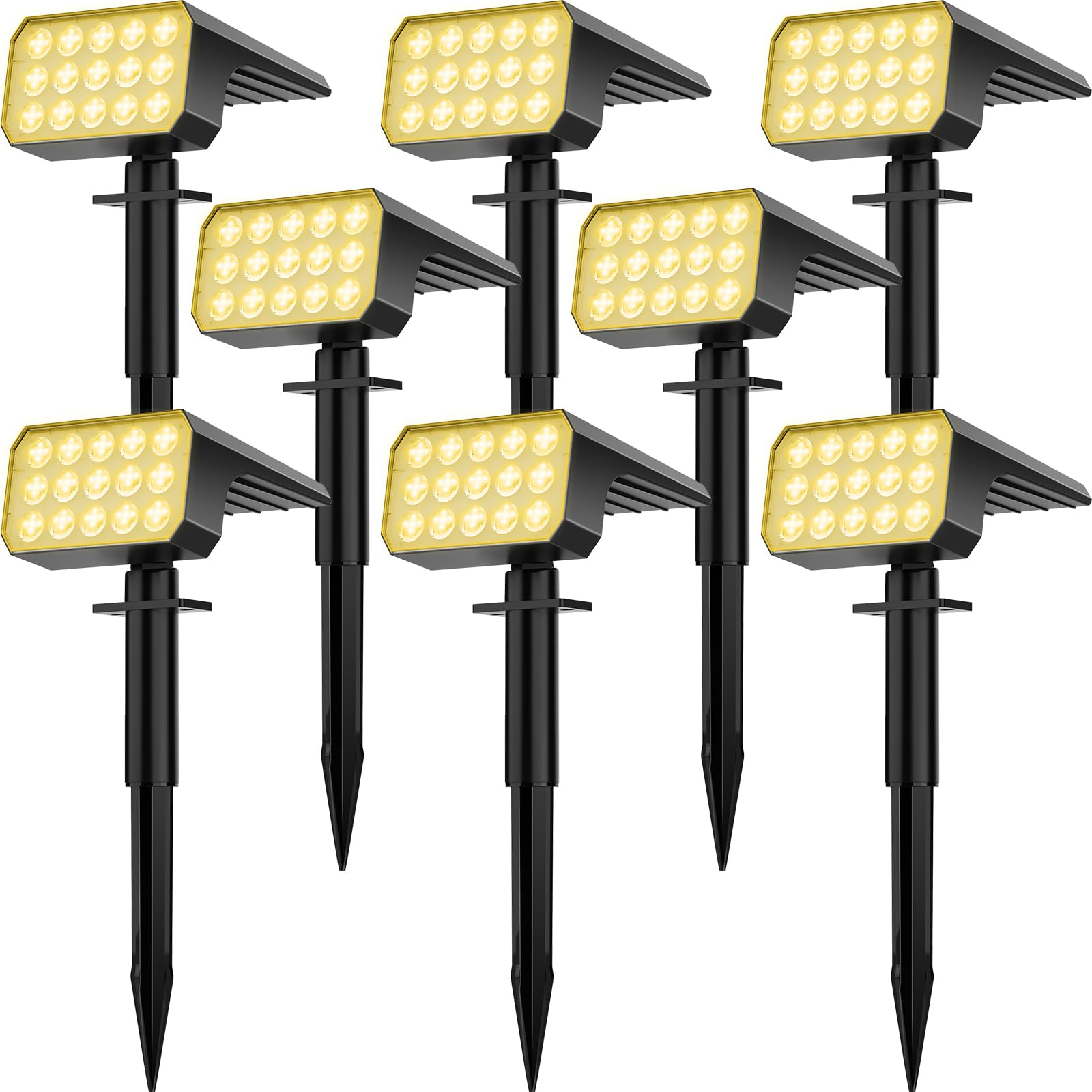
1. Solar Spot Lights Outdoor 8 Pack
Our pick — 4.5+★ from 500+ verified ratings; the strongest balance of quality and price.
Eight warm-white fixtures with up to 20 hours of runtime per charge, sized for a long driveway or border planting.
If you have more ground than money, this is the set that solves it. Eight fixtures in one box is double the pack count of the HGGH set above, and at 3500 Kelvin the beam sits at the coppery end of the color scale, so foliage and stone read like they were painted rather than lit. A spotlight lens in front of each LED concentrates the beam, which is what makes the modest 200 lm rating do more visible work than the number suggests.
The run-times are the real story. Low mode holds for 20 hours, medium for 12, strong for 8, and a breathing mode also runs to 8 hours. Because the day-night sensor sits on the panel itself, dusk turns them on without you thinking about it. A polycrystalline silicon panel handles the charging.
Installation is genuinely two-way. Ground stake for lawn, wall bracket for siding, and the head tilts through 90° so you can aim the beam where you want it. The housing is ABS and the IP67 waterproof rating covers rain, snow, wind, frost, and heat.
Where this one pulls ahead
- Eight fixtures per box, versus the four-pack coverage of the HGGH set above — twice the lights for a wide yard.
- Four modes spanning 20-hour low to 8-hour strong output, plus a breathing mode for soft accent use.
- IP67 waterproofing rated to work through rain, snow, frost, and temperatures from -68℉ to 140℉.
- Two mounting choices from the start: ground spike or wall bracket.
What to account for before you buy
- At 200 lm these are accent lights, not floodlights — they won’t blow out a driveway like a 650-lumen NBKLS fixture.
- Warm 3500 Kelvin is a mood choice; if you want crisp security lighting, the 8500 Kelvin HGGH suits better.
Best for: anyone whose yard is bigger than four lights can cover, especially a long dark driveway or long border planting.
Think twice if: you need a hard punch of light on a specific object — the warm, low-lumen output is aimed at atmosphere, not security.
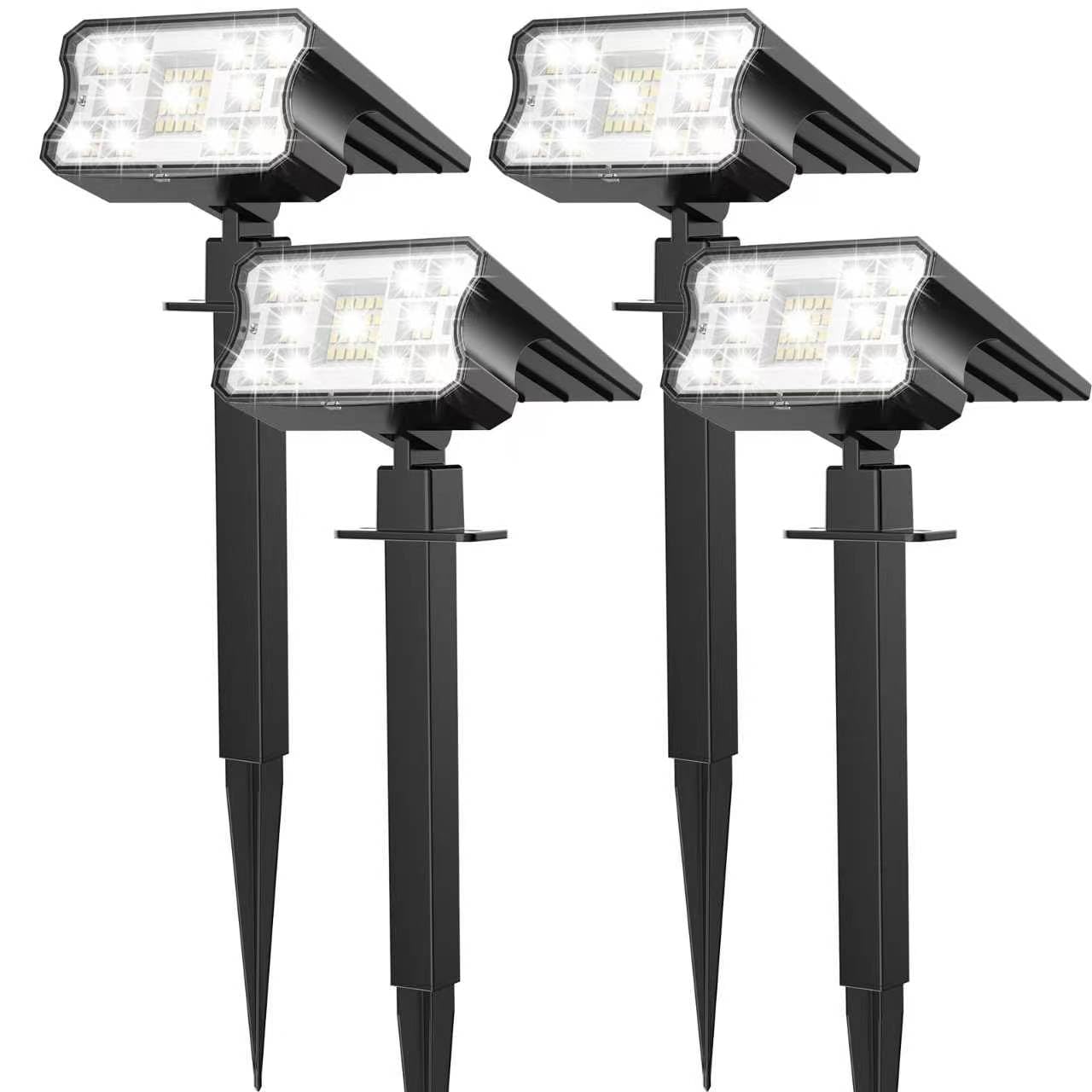
2. HGGH Solar Lights Outdoor 4 Pack
800 lumens of cool white from four fixtures — four times the output of the 200-lumen eight-pack above.
This is the brightest option here. At 800 lumens and 8500 Kelvin, it towers over the 200-lumen 3500 Kelvin set above — four times the light output, and at a color temperature more than double it, the light reads stark and cool rather than warm and lantern-like. Sixty industrial-grade LEDs sit under the lens, and the maker rates 9 to 24 hours of runtime after a 6 to 8 hour solar charge, so a single afternoon in direct sun should carry you into the small hours.
The physical details stack up too. The IP67 rating shrugs off rain, snow, ice, and dust, the housing survives -4°F to 140°F, and the built-in triple circuit protection guards the electronics against a bad cell. Installation is tool-free — ground stake for path lighting, wall bracket for downward accent on fence or patio — and the light sensor turns them on at dusk and off at dawn with no timer to set.
Two honest limits. The panel and light head move together, so you cannot angle one without affecting the other — one owner described adjusting the light and watching the solar panel swing with it. And the low mode holds for 24 hours but reads as ambiance rather than spotlight. Practical for a soft wash of light; not a security floodlight.
What owners consistently report: the initial brightness and cool-white punch land well, and the lights hold through a run of rainy days without dying on the second evening.
The trade-off to know: runtime on the highest setting is where expectations split — some owners see them run until morning, others find them fading at the four-hour mark, which usually traces back to how much direct sun the panel caught that day.
Reach for this if: you want maximum brightness per fixture and a cool white look for a driveway, path, or facade wash — 800 lumens is the strongest single output in this group.
Look elsewhere if: you need to angle the light and panel independently, or you prefer a warm, amber-lit garden rather than crisp white beams.
3. Brightown 4Pack Solar Spot Lights Outdoor
Three brightness modes — 30%, 60%, and 100% — for dialing a courtyard’s light up or down as the seasons shift.
The pitch here is tunability. An 1800mAh battery powers 58 LEDs behind a multi-lamp integrated head, and three modes step down through 30%, 60%, and 100% output — good for 20 hours, 15 hours, and 12 hours respectively on a full charge. That is a genuinely wide spread of settings, and unlike the HGGH set above, you can throttle the light down to a soft ambient glow without changing fixtures. The panel here is polycrystalline silicon with a PET reflective film and a 30% conversion efficiency rating, and just 4 hours of sun carries you into the evening.
Two mounting paths again: stake it in the lawn for landscape duty, or screw it to a wall as a downlight. The PC+ABS shell is impact-resistant, and the IP67 rating is the same class the 8-pack above carries, with an ultrasonic de-fogging treatment on the lens to keep moisture from fogging the light path over time.
Performance splits over the seasons, though — the honest pattern is bright and fast-charging in the mild months, less consistent under intense summer sun and short winter days, when buyers report noticeably dimmer output. That is not a fault; it is what solar spotlights do when the sun changes angle, and the three-mode dimmer gives you somewhere to retreat to when the length of day shrinks.
The performance envelope: the 20-hour low-mode run-time is the standout figure, and it is what makes the fixture useful through the shoulder seasons when the panel gets less daylight.
Reality check on summer output: heat saps the panel’s efficiency, so treat the brightest mode as a shoulder-season perk, not a July guarantee.
Choose this if: you want three distinct brightness levels to match the mood and season, and you like the idea of dialing output down instead of swapping lights.
skip it if: you need peak brightness all summer — cool-white consistency through extreme heat is exactly where this one softens.
4. NBKLS Solar Spot Lights 4 Pack

Twenty-one LEDs at 2800 Kelvin, the warmest beam here, for uplighting tree trunks and columns.
Warm white at 2800 Kelvin is the warmest beam in this group — softer and more golden than the 3500 Kelvin 8-pack above, and miles from the 8500 Kelvin surgical white of the HGGH set. If you are uplighting tree trunks, stone walls, or house facades, that warmth is what makes foliage read as alive rather than fluorescent. Twenty-one LEDs deliver 650 lumens, and the multi-LED layout throws a concentrated beam that carries further up a tall object than the low count suggests.
The genuinely useful spec here is that the light head and the solar panel each rotate up to 180° independently. That means you can point the panel toward the southern sky while aiming the beam at a shaded tree — a physical arrangement that the HGGH design above cannot do because its head and panel move as one. Three brightness modes: low for 18 hours, medium for 12, high for 6. The solar panel is monocrystalline silicon rated to 28% conversion.
Inside the box you get the four fixtures, eight mounting screws, eight wall plugs, four ground stakes, and a manual — everything needed for either wall mount or ground stake installation. IP67 waterproofing covers rain, snow, wind, frost, and heat. The unit is tall and slim, so it disappears into deep lawn while still aiming light upward.
Specs that do the work
- Fully independent 180° adjustment — panel one way, beam another — where the HGGH design above locks them together.
- 2800 Kelvin is the warmest output in this group, ideal for tree and facade uplighting.
- 28% solar conversion rate from monocrystalline silicon, and low mode runs 18 hours.
- IP67 rated and shipped with all mounting hardware for wall or ground use.
The real limits
- 650 lumens is mid-pack — the HGGH 800 lm fixture still leads on raw brightness.
- High mode only lasts 6 hours, so a long summer evening will run into the mode floor.
Perfect for: warm-white uplighting of trees, columns, and architectural features — 2800 Kelvin and independent 180° adjustment are the combination to look for here.
Not ideal for: cool-white security lighting — 2800 Kelvin reads yellow-gold, so a driveway alarm light it is not.
5. JEJOT Solar Spotlights Outdoor Waterproof, 6 Pack
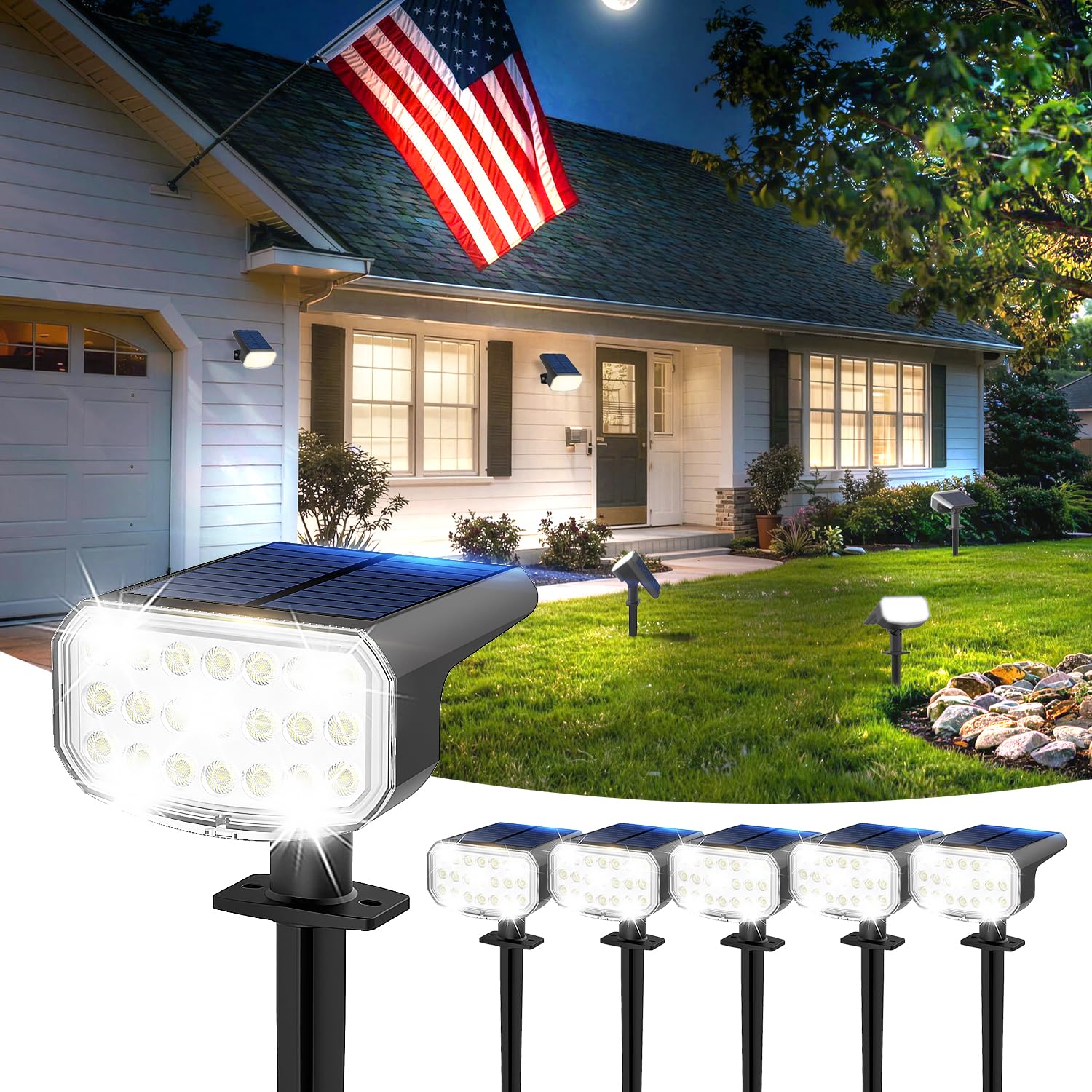
A low-profile six-pack built to tuck into low plantings and along walkway edges.
Where the 8-pack above spreads across a wide lawn with tall stake-mounted fixtures, this set is compact and light on the ground — a squat housing that tucks into low plantings, along walkway edges, or on the face of a wall. Six fixtures means a longer run of soft accent lighting than the four-pack options, and the 6500 Kelvin cool white output keeps the light neutral and clean without tipping into the cold 8500 Kelvin of the HGGH above.
The design carries two separate brightness modes — high for maximum wash, low for a softer glow that lets the light run longer into the night. Control is by touch, and installation is simple: stake into soil or mount to the wall with the included screws, no wiring required. The beam points downward, which is the right orientation for washing a wall or lighting a tidy garden bed.
Two things about the housing stand out. The finish is matte, which cuts reflection and keeps the light from drawing attention to itself during the day, and the ABS build has a built-in automatic drainage system that clears lens moisture rather than letting condensation accumulate behind the cover. The IP65 waterproof rating is a step below the IP67 class of the HGGH set, so if you get driven rain blowing sideways for days, treat the 8-pack as the more weather-hardened option.
Best use case: shrub and walkway accenting where you want six low-profile lights that read as part of the planting rather than as equipment.
What to plan for: the IP65 rating is fine for standard weather but ask more of the 8-pack or the NBKLS on a wind-driven rain wall.
Made for: accenting shrubs, walkways, and low walls with a tidy six-light run — the low-profile profile disappears into the garden bed.
Step up if: you need the extra weather hardening of IP67 or higher output per fixture, both of which the top pick above delivers.
6. Consciot Solar Spot Lights Outdoor
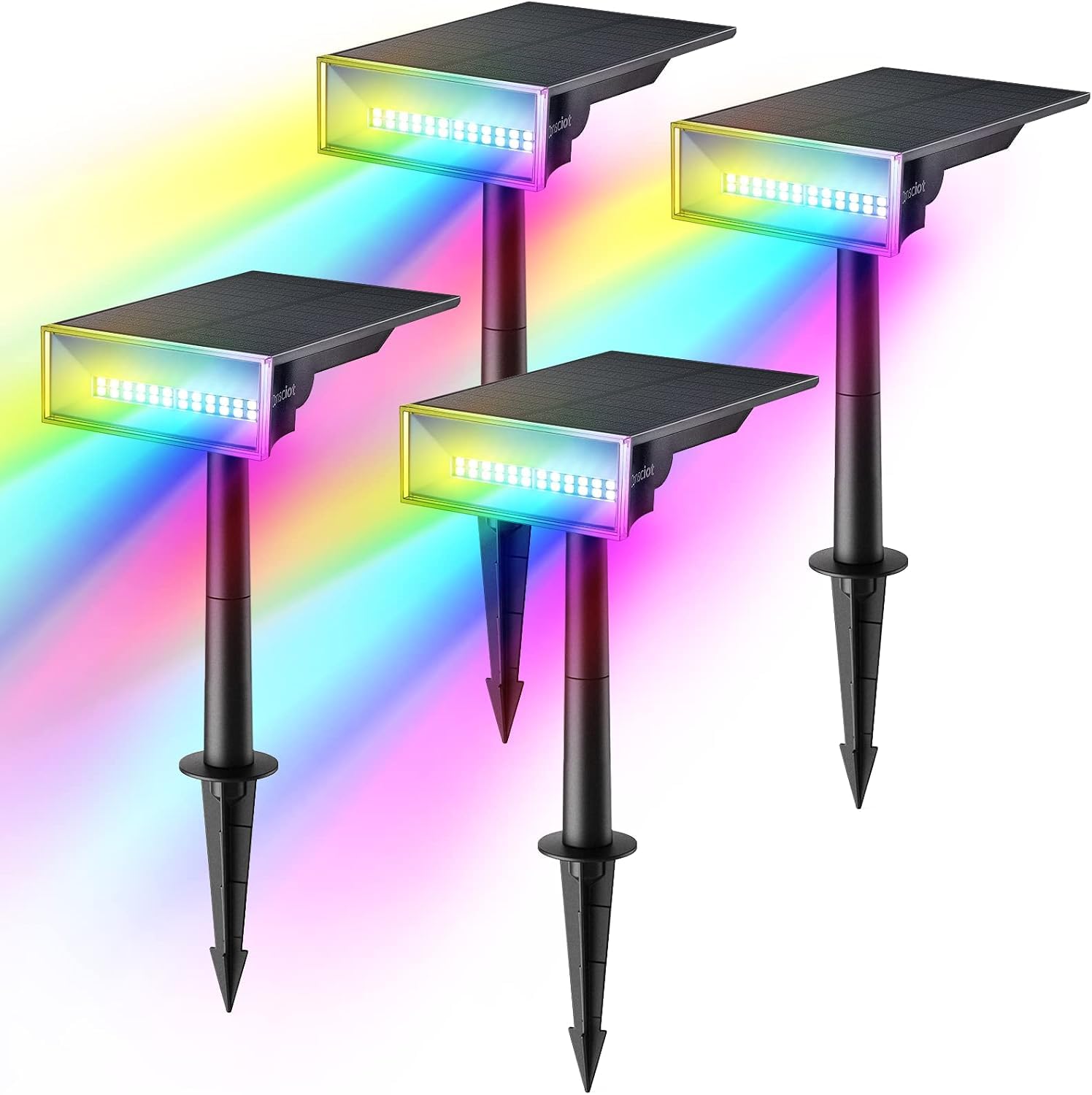
Seven fixed colors plus an auto-cycling mode for holiday displays and seasonal color.
There is nothing else on this list that does color. Eight modes — red, green, blue, yellow, purple, azure, white, and a multi-color cycle — step through with a short press of the button, and the 600-lumen output at 6500K keeps the light bright enough that a colored wash actually lands on a wall rather than smudging. Twenty-four high-brightness LEDs sit under the lens, and a monocrystalline silicon panel at 20% conversion keeps them fed.
The panel adjusts vertically through 170° so you can chase the sun across the day, and the installation is genuinely one-button: plug the ground stake in and go, no drilling. That simplicity is why these get used for parties, holiday displays, and seasonal exterior decoration — the color choice is a single tap, and no pairing or app is needed.
The durability picture is where expectations split. Some owners run them for a full year without issue and the charge reliably carries through the evening. Others report less longevity — a light dimming early in the evening, or water finding its way past the seals after a hard rain. The colored modes are also inherently dimmer than white because the LEDs are filtered, so treat this fixture as an effects light rather than a brightness play. It is the pick for atmosphere and seasonal color, not for a dark driveway.
What the color modes bring
- Eight modes including red, green, blue, yellow, purple, azure, white, and an auto-cycling color show.
- 600 lm output at 6500K is bright enough that color washes read clearly on a wall or hedge.
- One-button control means children and guests can change colors without any setup.
- 170° adjustable panel chases the sun without repositioning the fixture.
What to weigh
- Colored output is naturally dimmer than white on the same fixture, so this is a mood light first.
- The seals are not the strongest in this group — extended sideways rain is where this one is most likely to complain.
Choose this for: seasonal displays, parties, and any yard where switching the beam color from pink to purple to white on a whim is the whole point.
Skip if: you want bright, uncolored security lighting — a 650-lumen monochrome fixture will outperform it every time.
7. APONUO Solar Spot Lights Outdoor 4-in-1 with 9.8ft Cable

A detachable panel on a 118-inch cable lets you charge in full sun while the light sits in shade.
If your target spot sits under a canopy or on the north side of the house, this is the fixture the rest of the list can’t match. The solar panel detaches from the light head and connects on a 118-inch cable, which means you can plant the panel in full sun and put the light where the shadow actually is — an arrangement the HGGH and NBKLS designs above physically cannot offer. A single high-efficiency LED delivers 150 lumens at 3000 Kelvin, and dual 2000mAh batteries keep the output running 8 to 12 hours per charge.
The beam is genuinely warm — 3000 Kelvin sits between the 2800 Kelvin NBKLS and the 3500 Kelvin 8-pack above, which is the golden-amber range most garden designers default to for uplighting. Adjustment runs to 270°, so you can tip the head up or down to frame a trunk, a sculpture, or a wall. Two modes: high for the main wash and low for the gentle version.
The build is IP65 and the panel and light can be ground-staked or wall-mounted independently, with extension cords available separately if 118 inches is not enough. The lower lumen figure is the honest trade: this is not a brightness machine, it is a placement machine — the whole point is putting light where the sun cannot reach.
The defining feature: the 118-inch cable between panel and light, which lets a shaded tree get bright even when the panel can’t sit next to it.
The brightness trade: at 150 lm this is the dimmest on the list, so pick it for placement, not for output.
The right call if: your target spot is deep shade and the panel needs a separate sunny home — this is the only fixture here built around that scenario.
Wrong pick if: you need punchy output on a bright target — a 650 or 800-lumen fixture will feel stronger.
8. Solar Spot Lights Outdoor 10 Pack
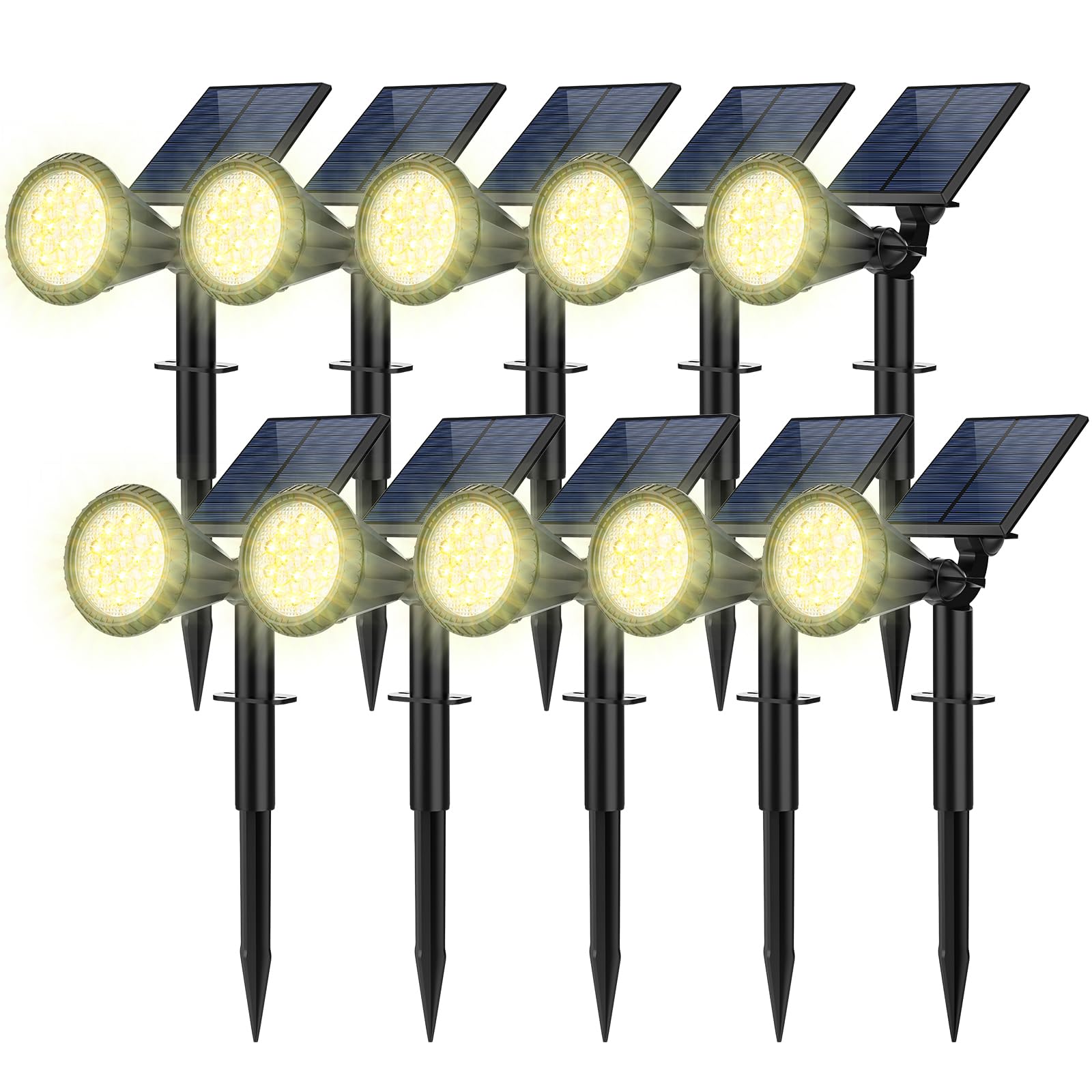
Ten warm-white fixtures per box — the largest pack count on this list.
When the yard is measured in acres rather than square feet, ten fixtures in one box is the pragmatic answer. This is the largest pack count in the group, beating the 8-pack above by two units and doubling the four-pack sets. Each fixture carries 14 high-power LEDs delivering 450 lumens at 3000 Kelvin — the same golden range as the APONUO above, so the beam has that soft, warm quality that reads naturally against foliage and stone.
The light head and solar panel each rotate up to 180° independently, which is the same physical arrangement the NBKLS set above offers. That means you can aim the beam up a sculpture, a tree, or a flag, while keeping the panel square to the sun — genuinely the feature that decides whether a shade-adjacent installation works. Four lighting modes step down through low for 20 hours, medium for 10 hours, high for 8 hours, and a breathing mode that also runs 8 hours. The panel is monocrystalline silicon at 20% conversion.
The housing is high-strength ABS with IP65 waterproofing and a -4℉ to 140℉ operating range, so it holds up under standard rain and frost. Two installation paths again — ground stake or wall mount, no wiring. The color modes are limited compared to the NBKLS warm-white and the Consciot colored set, but on a warm-white fixture that is not a loss. The main thing to know is that 450 lumens per fixture across ten fixtures adds up to a consistent, even, low-intensity wash of light rather than a few high-intensity pools.
Because you get ten
- Ten fixtures per box — more coverage per purchase than any other pick on this list.
- Independent 180° adjustment on both the light head and solar panel.
- Four modes spanning 20-hour low output all the way up to 8-hour high output.
- 3000 Kelvin warm white and 450 lumens per fixture for a golden, natural garden wash.
What to plan for
- IP65 rather than IP67 — fine for normal weather, less so in wind-driven rain against a wall.
- 450 lumens per fixture is a wash, not a beam — broad coverage over a big property, not a bright punch on one object.
Reach for this if: your landscape runs long and you would rather spend once on ten warm-white fixtures than deploy a smaller set and still want more.
Look elsewhere if: you need bright punch on a single object — this set spreads light evenly, it does not concentrate it.
9. Linkind Smart Solar Spotlights SL6C, Dual Ring Multicolor
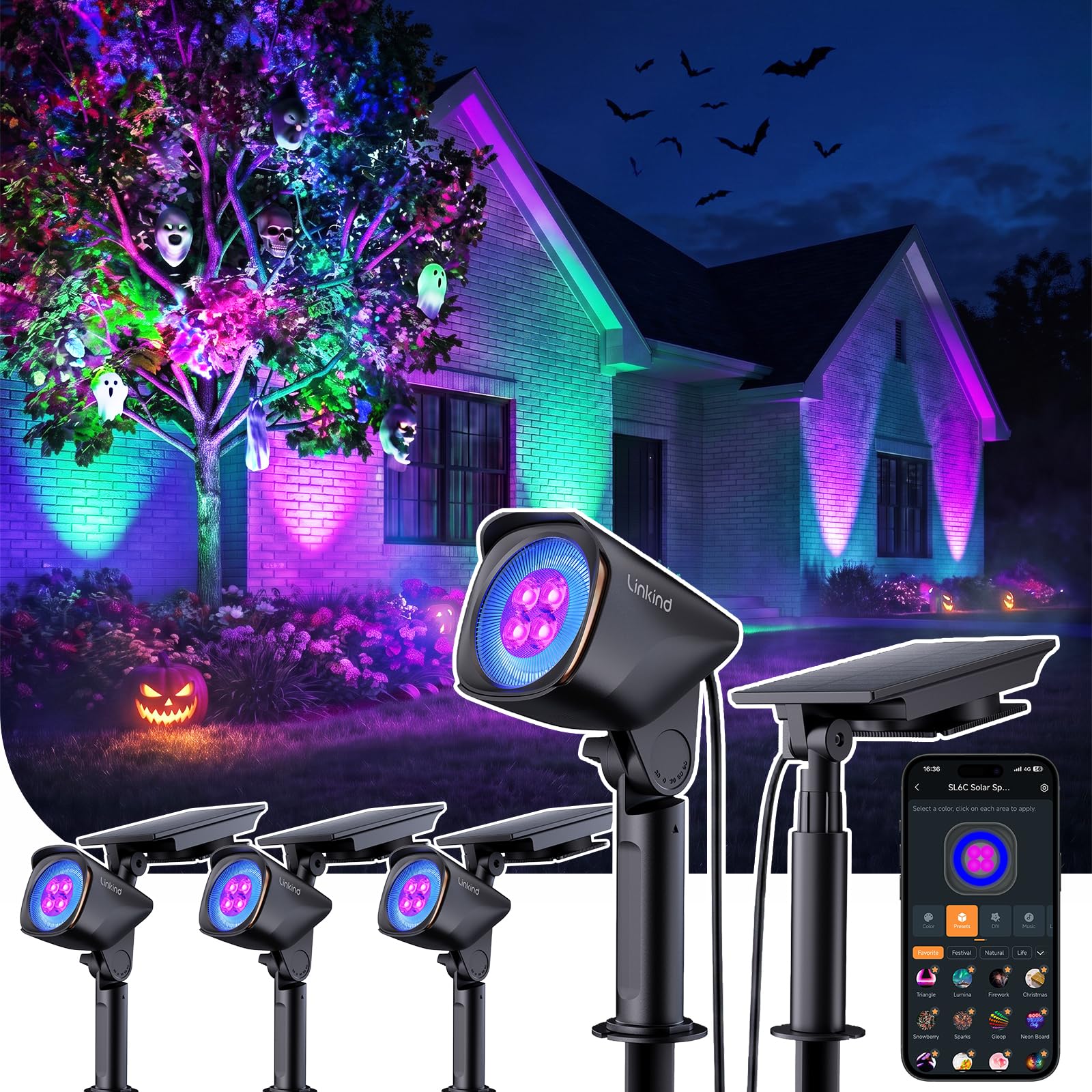
Two independent light rings, sixteen million colors, and an app that syncs eight groups.
This is the only fixture here with real software behind it. Each spotlight has two rings with separate beams — an inner 32° spot for tight accents and an outer 82° flood for wide yard and plant coverage — and you can control them independently through the AiDot app. Sixteen million colors, tunable white, and brightness adjustment through the app; a hub opens the door to Alexa and Google voice control; and the platform groups up to 32 lights into eight named groups for synchronized scenes.
The charging story is the other half. The solar panel detaches from the light head and connects on a 118-inch extension cord, so you can put the panel in full sun and the light in shade the same way the APONUO above does — and then add USB-C charging as a backup option when the panel has been starved for a few days. Build is IP66 with an ABS+PC shell rated from 14°F to 104°F, and installation supports ground stake, wall mount, or the separate panel-and-light split.
Beyond the presets — 55 of them, plus music sync for parties — the platform supports scheduling and dusk-to-dawn automation with luminance detection. The honest trade-off is brightness: the colored modes emphasize effect over raw output, so mounting this as a security light is the wrong fit. It is a smart, colorful landscape light with serious automation, aimed at someone who wants to build scenes and sync them across the yard.
Where the software earns its keep: 32-light groups, 55 presets, and music sync make this the only fixture on the list that stores a lighting plan rather than offering a mode switch.
What is not the point: raw brightness. The value here is the control layer, the dual-ring beams, and USB-C as a solar backup — not lumens on a dark driveway.
Best for: anyone building a scene-based outdoor lighting plan with color, scheduling, and voice control — 16M colors and 8 groups is a genuinely different product class.
Not the one if: you want a simple set-and-forget solar spotlight — the app and hub deliver the value, so paying for it when you won’t use it makes no sense.
Know the Specs
Brightness (lumens) and why the number alone lies
Lumens measure total light output — the higher the number, the brighter the fixture. But two lights with the same rating can behave very differently once the beam shape is factored in. A narrow beam at 200 lm reads brighter on the target than a wide beam at the same figure, because the same light is concentrated on a smaller pool. On this list, brightness runs from 150 lm on the APONUO up to 800 lm on the HGGH, and the wide spread exists because landscape lighting has two jobs: highlighting a specific object, and washing a broad area. Match the beam first, then let lumens pick the winner for your situation.
Color temperature in Kelvin and what it looks like at night
Kelvin tells you what color the white light reads as. Lower numbers — 2800 or 3000 Kelvin — look warm and golden, the color of candlelight and incandescent bulbs. Higher numbers — 6500 or 8500 Kelvin — look cool and clinical, the color of a bright laptop screen. On this list, the NBKLS set at 2800 Kelvin is the warmest, the two 8-pack and 10-pack fixtures above sit at 3500 and 3000 Kelvin, and the HGGH set at 8500 Kelvin is the coolest. Warm white tends to read better on foliage, stone, and wood; cool white tends to read better on concrete, driveways, and architecture.
Common Questions
How many hours do solar spotlights actually last per night?
Will the lights stay on all night after a sunny day?
Can a solar spotlight sit in a dark place if the panel gets sun?
What does IP65 versus IP67 mean for a landscape light?
Do landscape spotlights work on a shady north-facing wall?
How high up can a solar spotlight throw light?
Can I mount these on a wall as well as stake them in the ground?
Do colored solar spotlights look dimmer than white ones?
What happens if the solar panel gets scratched or dirty over time?
Do I need the app to use the Linkind smart solar spotlights?
The Bottom Line
For most yards, the landscape solar spotlights winner is the Solar Spot Lights Outdoor 8 Pack because it delivers eight fixtures, four modes that stretch from 20-hour ambient to 8-hour strong output, and IP67 weather hardening in a single box. If you want maximum brightness per fixture with a genuinely cold, crisp white, grab the HGGH 60-LED set — its 800 lm is the strongest single output here. And if you need to light a shaded tree with the panel sitting somewhere sunny, the APONUO 4-in-1 with its 118-inch cable is the one to reach for.
How we choose
We do not accept paid placement. Every pick is matched to a real buyer and a real use-case; we do not hands-on test units.
Sources
Specifications: manufacturer listings and product documentation. Review insights: verified customer reviews, as of October 2026. Pricing: not shown on this page (it changes often); check the current price via the retailer link.
As an Amazon Associate, Home Digitized earns from qualifying purchases. This does not affect which products we feature.