
Disclosure: This post contains affiliate links. As an Amazon Associate I earn from qualifying purchases, at no extra cost to you. Learn more
Specs are compiled from manufacturer listings and verified buyer reviews and can change over time — please confirm the key details on the product page before buying.
A router is the one woodworking tool that turns a rough board into a finished edge, and the wrong one will burn your stock, snap a bit, or bog down halfway through a plunge. The fix is matching the motor and the base type to the work you actually do. If you cut cabinet doors and edge profiles all day, you need horsepower and a plunge base. If you trim laminate and round over shelf edges on weekends, a compact palm router will do the job without wearing out your forearms.
This guide is built by comparing the manufacturers’ published specifications and the patterns across verified customer reviews, so you get each pick’s real strengths and trade-offs instead of marketing spin.
If your router stalls on oak or burns a groove, the culprit is usually one of three specs: collet size (the opening that grips the bit), amperage (the motor’s power draw), and base type (fixed or plunge). Those three numbers, plus how often you swap bases, decide whether a router handles hardwood or fights you. Here are the routers for woodworking projects that hold up under real cutting loads.
Top Picks


How To Choose The Best Routers for Woodworking Projects
Buying a router is really three decisions stacked on top of each other. First, how much power you need. Second, which base type suits the cuts you make. Third, whether the collet accepts the bit shanks you already own or plan to buy. Get those three right and you will not outgrow the tool.
Match the motor to the wood, not the brochure
Amperage tells you how much current the motor can pull, and horsepower tells you how hard it can push a spinning cutter through stock. A compact router in the 5.6-amp to 6.5-amp range handles roundovers, flush trimming, and light dadoes in softwood and plywood. Step up to 11 amps or 12 amps when you cut hard maple, white oak, or run wide panel-raising bits that swallow a lot of material in one pass.
Horsepower ratings on routers are usually peak figures at the spindle. Two routers with identical amp ratings can still feel different because of how the electronics hold speed under load. Electronic feedback — the circuitry that keeps rpm steady when the bit bites — matters more than the biggest number on the box.
Fixed base, plunge base, or both
A fixed base locks the motor at one depth, which makes it rock solid for edge profiles, trimming, and table-mounted work. A plunge base lets you lower the spinning bit into the middle of a board, which is how you cut mortises, stopped grooves, and inlays. A combo kit gives you both bases plus one motor you swap between them, so you are not buying two machines.
Palm routers sit in a different lane. They are one-handed, light enough to steer along a curve, and small enough to reach into tight spots a full-size router cannot. They trade away horsepower and plunge depth for control.
Collet size decides your bit budget
The collet is the tapered clamp that grips the bit shank. A 1/4-inch collet accepts the small-shank bits sold everywhere. A 1/2-inch collet grips a thicker shank that resists flex and chatter during heavy cuts, and it is the size most panel bits and large roundovers are made in. Kits that include both let you run any bit you own without an adapter.
Side-by-Side Comparison
| Model | Best For | Amperage | Base Type | Max Speed | Amazon |
|---|---|---|---|---|---|
| DEWALT DW618B3★ Best Overall | Cabinet work and full-size shop routing | 12 A | Fixed, Plunge, D-handle | 24000 rpm | Amazon |
| WORKPRO 6.5 Amp Compact Router ComboBudget Champion | Budget combo kit for hobbyists | 6.5 A | Fixed, Plunge | 32000 rpm | Amazon |
| CRAFTSMAN V20 CMCW400BCordless Freedom | Cordless freedom for V20 owners | 2 A | Fixed | 30000 rpm | Amazon |
| RYOBI R1631K | Everyday trimming and table mounting | 8.5 A | Fixed | 25000 rpm | Amazon |
| Bosch Colt PR20EVSK | One-handed trimming and detail work | 5.6 A | Fixed (palm grip) | 35000 rpm | Amazon |
| DEWALT DW616PK | Two-base versatility on a tighter budget | 11 A | Fixed, Plunge | — | Amazon |
| Bosch MRC23EVSK | Heavy plunge work and table mounting | 15 A | Fixed, Plunge | 25000 rpm | Amazon |
| Makita RP1800 | Deep plunge cuts and hardwood routing | — | Plunge | 22000 rpm | Amazon |
| Triton TRA001 | Table-mounted routing and heavy stock removal | 15 A | Plunge (dual mode) | 21000 rpm | Amazon |
Detailed Reviews
1. DEWALT Router DW618B3
Our pick — 4.5+★ from 950+ verified ratings; the strongest balance of quality and price.
Three bases, one 12-amp motor, and a dust system that actually catches the chips.
If you want one router that covers cabinet doors, mortises, and edge profiles without buying a second machine later, this is the kit that does it. The DW618B3 runs a 12-amp, 2-1/4-HP electronic variable-speed motor from 8,000 to 24,000 rpm with full feedback control, so the bit keeps its speed when it hits hard maple instead of bogging down. Soft start eases the motor up to speed instead of jerking the bit into the wood on switch-on. That combination earned it 4.5+ stars across 950+ owners.
Owners talk most about how much this three-base system simply does, and second about how easy it is to handle and swap bits. That second point is no accident: a spindle lock button (which holds the shaft still) lets you change a bit with one wrench, and quick-release motor latches let you pull the motor pack off one base and click it onto another in seconds. The D-handle base adds a trigger switch with a lock-on feature, the setup most people reach for when freehand routing a long edge.
You get finer depth control here than most rivals at any price. The micro-fine adjustment ring moves in 1/64-inch increments, so you can sneak up on a cut, and the adjustable tool-free steel motor cam lock keeps the setting solid once you lock the base down. Through-the-column dust collection pulls 95% of the chips away and keeps the bit visible on dark walnut. Two collets, 1/4-inch and 1/2-inch, come in the box, so you are not hunting for an adapter the first time you run a panel bit. At 2.25 hp, it out-powers the 1.5 hp RYOBI R1631K below by 50%, so heavy stock removal stops being a fight.
Where It Wins
- 3 bases — fixed, plunge, and D-handle — swap in seconds off a single motor pack
- 1/64-inch micro-fine depth increments hold tight for repeatable cuts
- Through-the-column dust collection captures 95% of chips
- Both 1/4-inch and 1/2-inch collets included for thick-shank bits
What To Weigh
- Durability comes up as a mixed point among owners, so store it in the kit box rather than a loose truck bed
- Adjustability is also a mixed note — the fine ring rewards reading the manual first
- Full-size body and the 24-inch width mean it lives on a bench, not in a kitchen drawer
The Shop Workhorse: Buy this if you want one machine for cabinet doors, mortises, and every edge profile you will ever cut.
Think Twice For: Fast one-handed trim work where the palm grip on the Bosch Colt below is a better fit.
2. WORKPRO 6.5 Amp Compact Router Combo Kit
Two bases, six bits, and a speed dial that spins higher than routers costing four times as much.
This kit is the first place serious hobbyists look when they want to start routing without emptying the tool budget. Its 32,000 rpm top speed beats the DEWALT DW618B3 above at 24,000 rpm, and that 33% higher ceiling helps small-diameter bits leave a cleaner finish on light passes. The 6.5-amp motor gives you six selectable speeds from 12,000 to 30,000 rpm via the dial on the body, so you can run slow for a big roundover and fast for a trim cut.
The build holds up better than the price suggests. All-metal gears and hardware are the detail hobbyist owners point to, and bit changes stay tight with no slipping after repeated use. The rack and pinion depth knob adjusts smoothly, and the depth locks down firmly when clamped — though it drifts slightly when the clamp is open, so check depth with a gauge on anything critical. Rubber-wrapped handles cut down on hand fatigue during long sessions, and the transparent dust hood deflects flying chips while keeping your cut line visible.
The box is genuinely broad: six router bits, both a fixed and a plunge base, 1/4-inch and 3/8-inch collet cones, a straight guide, two template guides, a trimming guide, two wrenches, two dust collectors, and a guide holder. The straight guide rail is designed to stay flat without deforming under load. On the honest side, the included bits divide opinion — plenty of owners set them aside and buy their own for anything where finish matters, and there is a noted case where the 1/4-inch collet arrived deformed so that standard shanks would not seat, so check yours the day it lands. Owners also report the motor can cut out if you force it too fast through a cut, though it restarts without issue, which is a sign to let the tool set the feed pace rather than pushing it.
Value You Can See: Six bits, two bases, and two collet sizes arrive in one box for hobbyist money — most people buying this never need to add accessories.
Feed It Gently: The motor prefers a steady hand over a forced one, so on hard stock take several light passes instead of one deep plunge.
Reach For This If: You are a hobbyist who wants both base types and a full accessory spread without committing to premium money.
Look Elsewhere If: You plan to cut nothing but thick hardwood all day — the 6.5-amp motor is the limiting factor there.
3. CRAFTSMAN V20 Router Tool CMCW400B
No cord to drag across a finished panel — just grab a V20 battery and go.
Anyone already sitting on a stack of Craftsman V20 batteries will get this router cutting minutes after unboxing, no outlet required. A brushless motor spins it from 16,000 to 30,000 rpm on the variable speed dial, which covers everything from a slow roundover to a fast trim pass. The depth adjustment knob lets you set bit height quickly, and an LED light under the base shines on the work area so your cut line stays visible in a shadowed shop corner.
Being cordless has an obvious cost, and this is where the numbers bite: 2 amps against the 12 amps of the DEWALT DW618B3 above, and 4.1 pounds against 6.5 pounds on the RYOBI R1631K below. In real terms, that means the Craftsman excels at edging and light trimming rather than hogging out deep mortises. Owners describe exactly that — one long-time corded router user noted surprise that V20s compact power provides sufficient torque for edging without bogging, plus precise height adjustment and easy bit changes. Separate the compact shell from the capability and it is a trim-and-edge machine, not a panel-raiser.
Included with the bare tool are an edge guide for keeping a straight line along a board and a dust port adapter. There are a couple of design grumbles worth a heads-up. The dust collection and eye shield are fiddly to fit and the plastic dowel that supports them feels flimsy, so treat that assembly with care and plan to leave it off for quick jobs. Both points are assembly details, not cutting faults — the motor itself earns its keep. Owners with V20 batteries say it competes with more expensive routers.
Built For One Setup: The obvious buy for anyone already stocked with Craftsman V20 batteries who wants to leave the cord at home.
Know Before You Buy: It ships bare — no battery and no charger in the box, so budget for those if you are starting fresh.
4. RYOBI 8.5 AMP 1-1/2 Peak HP Fixed Base Corded Router R1631K

A fixed-base corded router that slots straight into a router table and does not flinch on oak.
The R1631K is the answer for anyone who wants a full-size corded router without the combo-kit footprint. Its 8.5-amp motor spins to 25,000 rpm and carries a 1.5 hp rating, while the body is lighter than most in its class. It is made to sit in a router table and stay there for raised-panel work, slot cutting, and repetitive edge profiles.
Owners rate its functionality more than anything else — it works the way you expect and keeps working. That shows up in the wood it will chew: this router has been used successfully on oak, very hard pine, and pressure-treated lumber, all of which punish an underpowered motor. The fixed base also accepts the Bosch RA1141 router table directly, with the standard caveat that you will need to drill one small hole to line up the depth-adjustment access, so you can adjust from above the table instead of reaching underneath it.
Since this is a fixed-base-only tool, there is no plunge capacity — that is the trade for a simpler, stiffer platform. The one control quibble owners raise is the on/off switch. It is mounted on the body rather than on a handle, which takes getting used to if you are coming from a D-handle router. It is a muscle-memory adjustment, not a performance problem, and the fixed base makes up for it with absolute rigidity once the bit height is set. This one lives happily bolted to a table or working freehand on edge profiles; it simply is not built for lowering a spinning bit into the middle of a board.
Why It Earns Its Slot
- Chews oak, hard pine, and pressure-treated lumber without stalling
- Mounts directly into a Bosch RA1141 router table for above-table depth access
- Lightest of the full-size corded options here at 6.5 pounds versus 11.8 pounds on the Bosch Colt’s shipping weight
Honest Trade-Offs
- Fixed base only — no plunge cuts for mortises or stopped grooves
- On/off switch sits on the body, not the handle, so it feels different from a D-handle router
- 1.5 hp puts it below the DEWALT DW616PK’s 1.75 hp and a full two steps under the Bosch MRC23EVSK’s 2.3 hp
Best For The Table: If your routing happens bolted inside a router table, this is the simplest, sturdiest way to get there.
Not For Plunge Work: skip it if you need to cut mortises or stopped dadoes — you want a plunge base instead.
5. Bosch Colt PR20EVSK Router

The one-handed trim router that steers along a curve without fighting back.
Grab this when your work calls for control rather than grunt — trimming laminate, rounding over shelf edges, cutting hinge mortises in a cabinet door, or reaching into a corner where a full-size router simply will not fit. The 5.6-amp motor runs from 15,000 to 35,000 rpm, and the soft-start system eases it up to speed so the bit does not lurch on switch-on. Those finger support pockets around the base are the real ergonomic story here: they let you grip the body low and steer with your fingertips like a pencil.
Quality is what owners talk about more than anything else, and the performance backs it up. The rugged aluminum fixed base is a solid, non-flexing platform for edge routing, and the drop-forged collet holds securely through repeated bit changes. A straight-edge guide is in the box for running a true line down a board, and the hard plastic case keeps the kit protected in a crowded shop. Owners consistently describe it as easier to use than a full-size router for smaller jobs, which is exactly the niche this fills.
Two specs deserve honest mention. The speed control and durability aspects both come up as mixed among owners — the variable-speed dial is the first thing to feel wear over years of use, so treat it with care. And one footgun on the listing: the marketing copy for this tool says it weighs 11.8 pounds, but the technical specification is 1 pound, which is the correct figure for a palm-grip router. At that weight it is a genuine one-hand tool, not a two-hand machine. A full-size router this is not — it will stall on a deep pass through hard maple, and it has a fixed base only, so no plunging.
The Palm Grip Difference: The low finger-support grip lets you run this one-handed along an edge, which is the single biggest reason it beats a full-size router for trim work.
Mind The Dial: Variable speed is genuinely useful, but the control that adjusts it is the part most likely to wear first — gentle fingers make it last.
A Finisher, Not A Hogger: Pick it up if your routing is trimming, edge profiles, and detail work where control beats horsepower.
Want Plunge Depth: This has a fixed base only — for mortises and stopped cuts you want the WORKPRO combo kit above instead.
6. DEWALT Router DW616PK

Give up the variable-speed dial and you save real money on a two-base DEWALT kit.
Here is the honest trade the DW616PK makes: it gives you the two-base flexibility of the DEWALT system — fixed base and plunge base plus both 1/4-inch and 1/2-inch collets — but not the electronic variable speed or soft start that the DW618B3 above carries. What you keep is an 11-amp, 1.75-HP motor, a functional motor-swap system, and a hard case big enough to hold the bits, collets, wrenches, both bases, and the edge guide.
Handling is the part owners warm to. The tool is light for its class at 6 pounds, and the motor swaps between the two bases in seconds. Height adjustment moves fast once you work out the depth gauge, and bit changes are straightforward. Owners who have run it a couple of years and pull it out only when needed describe it as doing exactly what they need when they need it, with no complaints.
The plunge base is the underappreciated half. It drops a spinning bit straight down into the workpiece, which is the only way to cut mortises and stopped grooves. Since it is a fixed-button kit rather than a variable-speed one, though, you set feed speed by feel rather than with a dial. Choose it if the base swap matters more to you than the speed control. Since the DW618B3 gets soft start and full speed control, that is the upgrade path if you ever want them. A minority of buyers have had kits arrive short on parts, so it is worth doing a full parts count the moment the box opens.
The Two-Base Value Read: Fixed and plunge bases with both collet sizes for noticeably less than the flagship DEWALT kit — the flexibility survives, the speed dial does not.
What You Give Up: No electronic variable speed and no soft start, so the motor jumps to speed at switch-on and you manage feed rate by hand.
A Smart Compromise: Choose it if you want both bases and a full accessory case without paying flagship DEWALT money.
Hold Out For The Upgrade: Step up to the DW618B3 above if variable speed and soft start matter to you — those are the two things this kit leaves off.
7. Bosch MRC23EVSK Combination Router
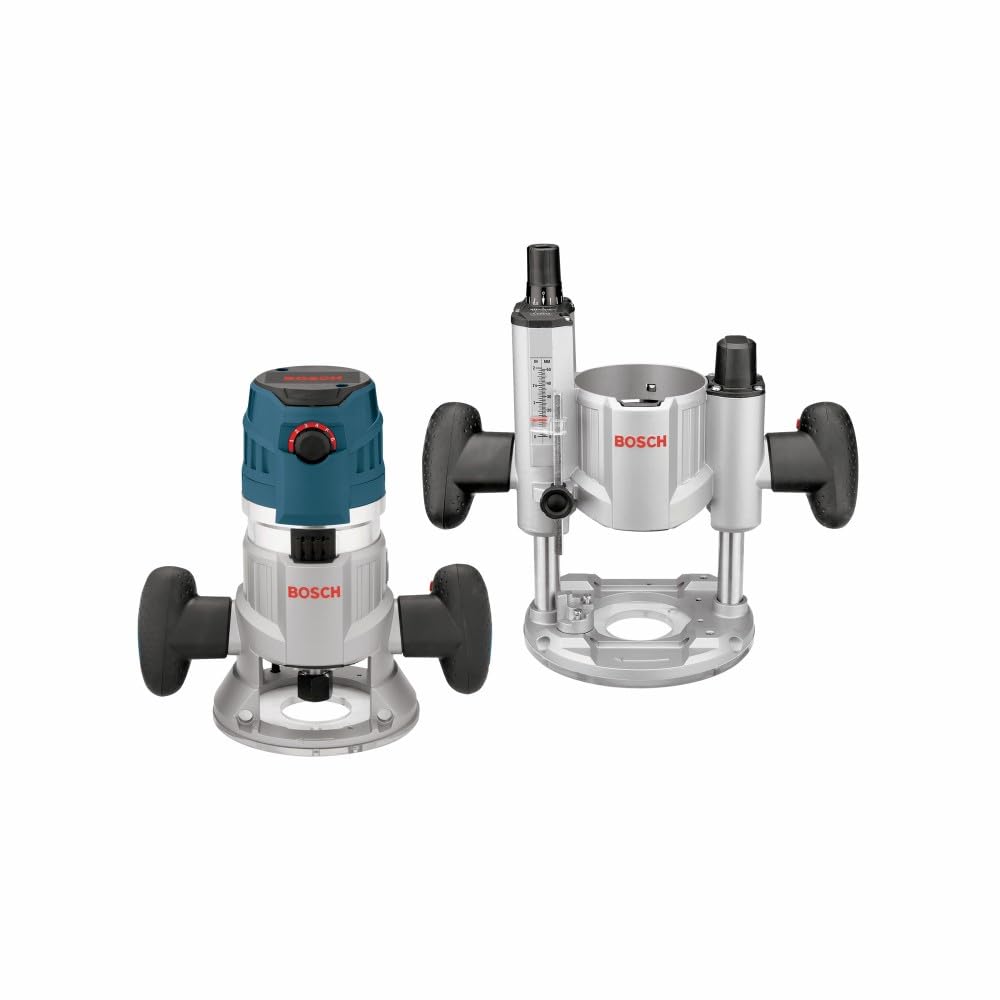
2.3 horsepower and a trigger in the handle — the router for people who cut a lot of wood.
This combo kit earns its place at the heavy end of routing. The 15-amp, 2.3-HP motor runs from 10,000 to 25,000 rpm with a soft-start system, and it holds speed under load rather than sagging on a deep cut. That 2.3 hp sits clearly above the RYOBI R1631K’s 1.5 hp and the DEWALT DW616PK’s 1.75 hp above, and this is where the extra power shows up — one owner cut 84 feet of tongue-and-groove in a single session.
The design thinking is where this tool separates itself. A trigger-control system lives in the handle for one-hand speed control while routing, and a precision-center design keeps the bit sitting on your cut line. The fixed base carries a 1-5/8-inch continuous microfine depth adjustment range, and threaded holes let you mount the fixed base straight into a router table. Owners specifically single out the plunge base as precise, the depth setting as phenomenal, and the motor swap between bases as easy. Note that it is heavier than smaller routers, which matters at the end of a long session.
Two owner nits worth knowing before you buy: pulling a few thousand rpm off full speed smooths out a slight vibration some owners notice at the top end, and the coarse adjustment lock is a bit stiff to operate. Lights on the base stay on whenever the tool is powered, with no switch of their own, which is a minor convenience quibble. What matters more is the caveat underneath: some units in the wider MRC23EVSK review pool have been reported failing to power on from the start or dying within a short period of use, and reliability comes up as a genuinely negative theme. Check yours the moment it arrives and exercise your warranty if it misbehaves — the well-built units are well-loved, but the return path matters on this one.
The Case For It
- 2.3 hp motor holds speed under load through tough hardwoods
- Trigger in the handle for one-hand speed control plus a precision-center design
- 1-5/8-inch microfine depth range with threaded holes for table mounting
- Plunge base praised as precise with a sturdy plunge stop
What To Plan For
- Heavy — owners notice the weight over a long session
- Reliability is a real theme in the review pool; test yours on arrival
- Coarse adjustment lock is stiff, and the base lights have no independent switch
For Regular Cutting: Pick it if you route often and want a heavy motor with a handle trigger and a plunge base that feels precise.
If You Route Rarely: A lighter kit like the DEWALT DW616PK above is easier to store and does not tie up as much money on a shelf.
8. Makita RP1800 3-1/4 HP Plunge Router

A plunge-only powerhouse with a depth capacity that lets the bit sink deep into the board.
If your cuts are mostly mortises, stopped grooves, and deep inlays, this is the router for you. The RP1800 is a dedicated plunge router with a 15-amp motor delivering 22,000 rpm and a plunge depth capacity of 0 to 2-3/4 inches — that is the full range the bit can be pushed down into the workpiece, and it is generous enough for deep mortises and long stopped grooves. It runs on linear ball bearings for smooth plunge action, so the base travels straight down and back up without binding.
Where the rest of the field gives you a plunging base on a combination kit, this one is designed around the plunge stroke alone. Quick release plunge depth adjustment with micro control plus three preset depth stops lets you hit repeat cuts the same way every time — set three different depths, stop on each, and you have repeatable joinery without re-measuring. That is a genuinely different way of working from a fixed-base table router, and it is the reason to own one of these instead of a kit.
Owners give this tool its highest marks for functionality and power, and it is well documented cutting through hard oak without complaint. The solid construction and clean plunge mechanism earn mention on their own. The honest quirks are the on/off switch locking mechanism, which gets mixed reviews and is described by a couple of owners as poorly made, and opinions on value for money that are split across the wider pool. If you want a switch-lock that feels like a control panel, look elsewhere. If you want raw plunging performance with repeatable depth stops and you can live with a plain switch, this delivers on hard wood.
The Plunge Depth Story: A 0 to 2-3/4 inch plunge capacity with three preset stops is what separates this from every combination kit in the lineup — set the stops once, then hit the same three depths all afternoon.
The Switch To Accept: Plunge action, power, and durability all earn positive note, but the switch lock gets mixed feedback and is not a strong point.
For Plunge-First Work: Buy it if your routing is mortises, stopped grooves, and deep inlays where repeatable plunge depth is the whole game.
A Second-Router Tool: It only ploughs — no fixed base for table work, so it shines as an addition to an existing shop, not as your only router.
9. Triton TRA001 3-1/4 HP Dual Mode Precision Plunge Router

One button flips it from plunge to rack-and-pinion fixed mode — the table router’s table router.
The TRA001’s defining trick is a single button that switches the tool from conventional plunge mode to a fixed-base router with rack-and-pinion adjustment. In a router table, that means you can fine-tune bit height by turning a winder rather than reaching under the table with a wrench — a genuinely different way to work. A micro winder enables continuous fine depth adjustment through the full plunge range, and soft start combined with variable speed lets you match the speed to the cutter. With a 15-amp motor spinning to 21,000 rpm and a 3.25 hp rating, it is the most powerful router in this lineup on paper.
What wins owners over is how it feels to actually use. Single-wrench bit changes come through an automatic spindle lock built into the base, and setup is quick. The multi-function fence, 1/2-inch and 1/4-inch collets, collet wrench, and table height winder all ship in the box. Owners specifically praise its compatibility with Kreg router tables, and they describe the tool as incredibly easy to work with — bit changes and setup especially so.
The pushback is honest and worth reading carefully. Speed control and maintenance come up as mixed points, and durability is a real negative theme in the wider pool — a few units have shown issues over time, so treat the tool well and mount it in a table rather than dragging it around a shop. Value for money is split too: some call it worth the price and others do not for a tool that lives in one place. The bottom line is that this is a table-mounted precision instrument, not a handheld carpenter’s router, and at 13 pounds it makes sense to leave it bolted down.
The Dual-Mode Payoff: The single-button switch from plunge to rack-and-pinion fixed mode is the reason to buy this — under-table depth adjustment on a router this powerful is hard to find elsewhere.
Where The Fence Sits: The feature set is broad, but speed control and durability both land as mixed themes in the review pool — treat this as a fixed installation, not a traveling companion.
Buy It For The Table: This is for the woodworker who wants a permanent table-mounted router with above-table depth control and maximum power.
Not For The Handheld Kit: pass on it if you want a router to carry around the shop — a handheld kit like the DEWALT DW618B3 above serves that role far better.
Know the Specs
Amperage And Horsepower
Amperage is how much electrical current the motor can draw, and horsepower is roughly how much turning force it can deliver to the spindle. Compact routers around 5.6 amps to 6.5 amps are for trimming and light profiles. Full-size units at 11 to 15 amps are for hardwoods, wide panel bits, and heavy stock removal. Matching the motor to the stock matters: an underpowered router will bog down, slow the bit, and leave a scorched, ragged edge instead of a clean one.
Fixed Base vs Plunge Base
A fixed base locks the motor at one depth, giving you rigidity for edge profiles and table work. A plunge base lets you drop the spinning bit into the middle of a board for mortises and stopped cuts. Combination kits ship one motor with both bases so you swap between the two depending on the task. Palm routers are fixed-base only and trade power for one-handed control.
Collet Size
The collet is the clamp that grips the bit shank. A 1/4-inch collet takes the small-shank bits sold everywhere, while a 1/2-inch collet grips a thicker shank that resists flex during heavy cuts — the size most large panel bits and roundovers are made in. Buying a router with both collets in the box saves you hunting for adapters later.
Variable Speed And Soft Start
Variable speed lets you dial the rpm to suit the bit diameter and the material — slower for large cutters in hard wood, faster for small bits in soft stock. Soft start ramps the motor up gradually instead of lurching to full speed at switch-on, which keeps the bit from jerking into the workpiece on start. Electronic feedback holds that speed steady when the bit bites into a tough grain run.
Common Questions
Do I need a plunge base or is a fixed base enough?
What is the difference between a 1/4 inch and 1/2 inch collet?
Can I use a router for cabinet doors and panel raising?
Is a cordless router powerful enough for hardwood?
How much router horsepower do I need for hard maple?
Does the Triton TRA001 fit a Kreg router table?
Why does my router burn the wood edge?
Can I change router bits without removing the motor?
What should I check when my new router arrives?
The Bottom Line
For most woodworkers, the routers for woodworking projects winner is the DEWALT DW618B3 because three bases, a 12-amp motor, 1/64-inch depth increments, and built-in dust collection cover cabinet doors, mortises, and edge profiles without needing a second machine. If you want two bases on a tighter budget, grab the WORKPRO 6.5 Amp Compact Router Combo Kit. And for table-mounted precision, the Triton TRA001 is the one to reach for. With 950+ ratings on the DEWALT, it is the safest place to start if you route more than a few times a year.
How we choose
We do not accept paid placement. Every pick is matched to a real buyer and a real use-case; we do not hands-on test units.
Sources
Specifications: manufacturer listings and product documentation. Review insights: verified customer reviews, as of October 2026. Pricing: not shown on this page (it changes often); check the current price via the retailer link.
As an Amazon Associate, Home Digitized earns from qualifying purchases. This does not affect which products we feature.