
Disclosure: This post contains affiliate links. As an Amazon Associate I earn from qualifying purchases, at no extra cost to you. Learn more
Specs are compiled from manufacturer listings and verified buyer reviews and can change over time — please confirm the key details on the product page before buying.
If you wear glasses, you want to see a full, round picture instead of a keyhole with black edges. The fix is eye relief — the distance between the eyepiece lens and your eye — and for glasses wearers you want long eye relief plus twist-up or fold-down eyecups so the whole image stays visible. Every pick below was chosen for that one job first, then for optical quality. A quick note upfront: this list uses flexible, human-like matching around long eye relief (at least 15 millimeters, and ideally 17 millimeters or more) suitable for eyeglass wearers, so not every pick is the exact magnification or size you might have searched for — the nearest same-type model serves the same purpose just as well.
This guide is built by comparing the manufacturers’ published specifications and the patterns across verified customer reviews, so you get each pick’s real strengths and trade-offs instead of marketing spin.
You will see 8x and 10x magnification, fields of view from 230 feet to 430 feet, and eye relief from 15 millimeters up to 20.2 millimeters. Below, each option is matched to the kind of birding you actually do, so you can pick the right pair of binoculars for bird watching with glasses the first time without guessing.
Top Picks

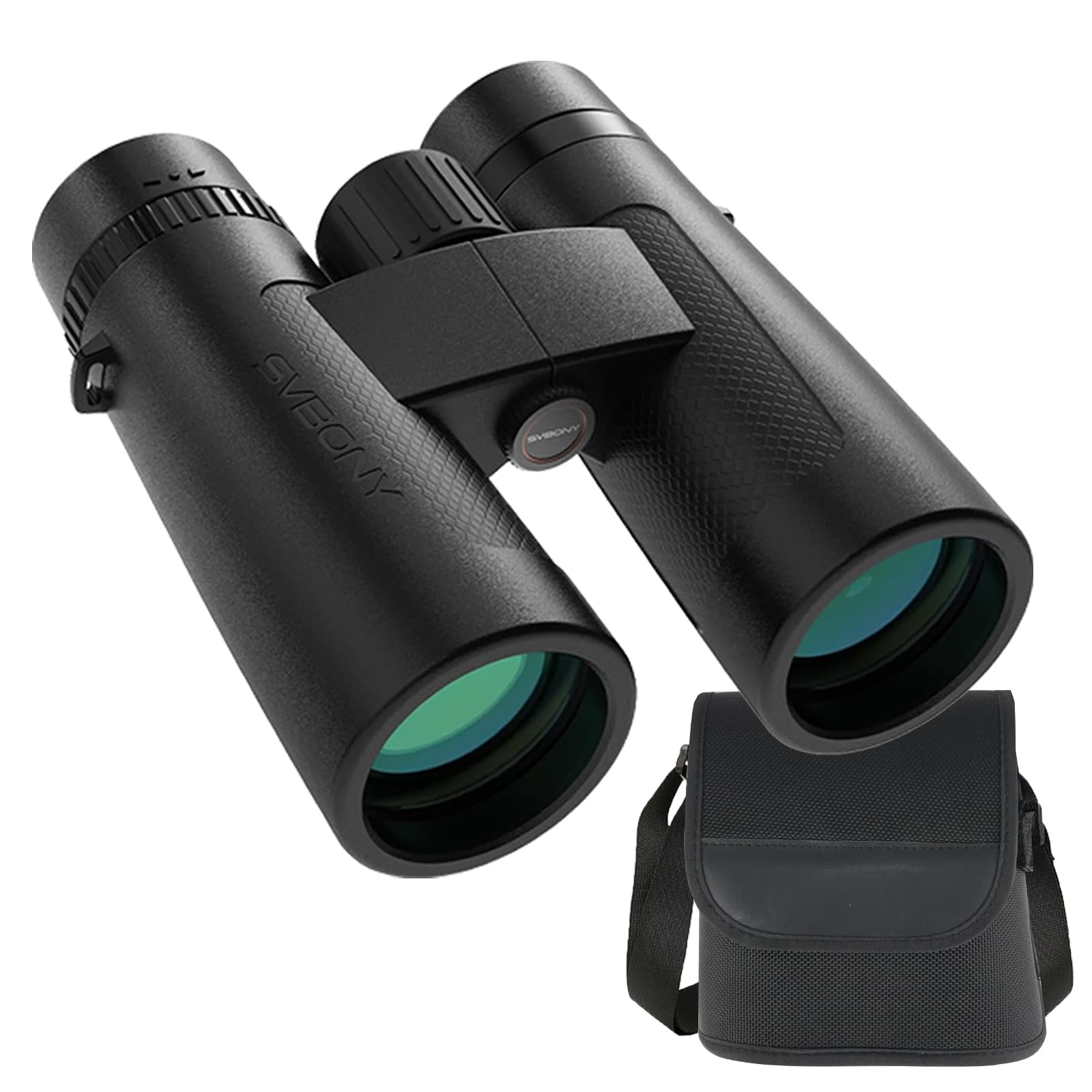

How To Choose The Best Binoculars for Bird Watching with Glasses
Your glasses change the math on binoculars. The lenses sit between your eye and the eyepiece, so they eat up several millimeters of the gap the binocular needs to project a full image. If that gap runs short, you get a tunnel view — a bright circle with dark edges closing in. The number that fixes this is eye relief, and it is the first spec to check, before magnification or brand.
Start With Eye Relief, Not Magnification
Eye relief is the space between the eyepiece glass and your eye where the full field of view appears. For glasses wearers, you want at least 15 millimeters and ideally 17 to 20 millimeters, so your frames and lenses do not push your eye out of that window. The Nikon PROSTAFF P3 offers 20.2 millimeters, which is the most generous here. The Timorn 8×42 sits at the low end at 15 millimeters, still workable for thinner frames but tighter for thick ones.
Twist-Up Eyecups Are Your On-Off Switch
Twist-up eyecups slide up and down to set the exact eye relief you need. Glasses wearers usually keep them twisted down so the eyepiece sits flat against the frame. The SVBONY SV202, the Athlon Neos G2, the Vortex models, and the ZEISS Terra ED all offer this adjustment, which is why they make the cut. Without that adjustment, you are stuck holding the binoculars slightly away from your face to see the whole picture.
8x or 10x: Pick Your Trade-Off
Magnification decides how big and how steady the bird looks. An 8x pair keeps the image steadier in your hands and shows a wider slice of the scene, which is why most backyard and woodland birding favors it. A 10x pair pulls distant birds bigger but shakes more and narrows the view. The 15x Vortex Diamondback HD takes that to the far end — huge reach, but the maker recommends a tripod to stop handshake, and a tripod adapter is included.
Field of View and Exit Pupil in Plain Terms
Field of view is how much sky you take in at once — the Timorn 8×42 shows 430 feet across at 1,000 yards, the widest here, which helps you catch a bird in motion before it disappears. Exit pupil is the circle of light leaving the eyepiece; a bigger one means a brighter image in dim dawn light. The SVBONY SV202 gives 5.2 millimeters, and the Athlon Neos G2 gives 4.2 millimeters, so the SVBONY holds more of that fading light.
Side-by-Side Comparison
| Model | Best For | Eye Relief | Magnification | Field of View | Amazon |
|---|---|---|---|---|---|
| Nikon 7577 MONARCH 5 10×42★ Best Overall | All-round birding with glasses | 18.4 mm | 10x | 288 feet | Amazon |
| SVBONY Upgraded SV202 8×42 EDBest Value | Best value wide view | 17.2 mm | 8x | 8.12 degrees | Amazon |
| Athlon Optics 10×42 Neos G2 HDSmart Pick | Eye-relief hunters and birders | — | 10x | 5.9 degrees | Amazon |
| Timorn 8×42 HD with Phone Adapter | Widest view on a budget | 15 mm | 8x | 430 feet | Amazon |
| Celestron Nature DX 8×42 | Compact hikes and yards | 17.5 mm | 8x | 388 feet | Amazon |
| Nikon PROSTAFF P3 8×42 | Most forgiving for thick frames | 20.2 mm | 8x | 377 feet | Amazon |
| Vortex Diamondback HD 15×56 | Long-range glassing on a tripod | 15.6 mm | 15x | 230 feet | Amazon |
| ZEISS Terra ED 8×42 | Bright low-light birding | 18 mm | 8x | 375 feet | Amazon |
| Vortex Viper HD 8×42 | Premium all-day carry | 18 mm | 8x | 409 feet | Amazon |
Detailed Reviews
1. Nikon 7577 MONARCH 5 10×42 Binocular (Black)
Our pick — 4.5+★ from 700+ verified ratings; the strongest balance of quality and price.
The all-rounder that pulls distant warblers close while your glasses stay right where they are.
For a glasses wearer who wants one pair that does everything from the backyard feeder to a wetland boardwalk, the MONARCH 5 leads the group. Its 18.4 millimeters of eye relief clears your frames so the full picture appears without pressing your face to the glass, and it is the most generous eye relief here after the PROSTAFF P3. Turn-and-slide rubber eyecups let you set that spacing in seconds, and a smooth central focus knob with a flip-down lens cap setup keeps things simple in the field.
The optics carry their weight too. ED (Extra-low dispersion) glass cuts the color fringing that shows up as purple halos around a bright bird against an overcast sky, so you see clean edges instead of purple fuzz. The fully multicoated eco-glass lenses transmit light across the visible spectrum, with an apparent field of view of 51.3 degrees. What wins people over most is clarity — it is the trait owners single out again and again — and bird watching shows up strongly in the feedback, with buyers noting they can pick out feathers on birds. Low-light performance holds up at dusk, and the rubber-armored body is waterproof and fog proof for wet mornings.
Here is the honest catch. At 10x the view is slightly less steady in hand than an 8x pair, and the field of view is narrower than the wide-angle options below — it measures 288 feet at 1,000 yards. Buyers who chose it for a -4.5 prescription report plenty of room and no eye strain with glasses on. If you mostly track quick small birds in tight brush, the 8×42 Nikon PROSTAFF P3 gives you a steadier, wider view for less, though it trades away some magnification reach. The MONARCH 5 is the crowd favorite of the group at 4.5+ stars across 700+ owners.
What earns it top spot
- 18.4 millimeters of eye relief clears your frames so the whole view is visible
- ED glass sharpens edges and reduces the color fringing that ruins a bright bird against gray sky
- Turn-and-slide eyecups adjust to your glasses in seconds
- Waterproof, fog proof, rubber-armored body handles wet mornings
Where it asks for patience
- 10x view shakes a touch more than 8x in unsteady hands
- 288-foot field of view is tighter than the wide-angle picks below
- Some owners find the eyepiece cover clunky to reattach
Reach for this if: you wear glasses and want one confident pair for wetland, woodland, and waterfowl watching with real magnification reach.
Look elsewhere if: you mostly chase fast small birds in thick cover and would rather have a wider, steadier 8x view.
2. SVBONY SV202 8×42 Binoculars
The wide-view bargain that shows more sky per glance than far pricier glass.
If your birding happens in tight woodland where warblers flit from branch to branch, this 8×42 has the field of view that keeps them in frame. It delivers 8.12 degrees — the widest angle in this lineup, and 38% wider than the Athlon Neos G2’s 5.9 degrees. In practice that means you catch the movement and lock onto the bird instead of scanning around hunting for it. That 8.12-degree field pairs with 17.2 millimeters of eye relief, so your glasses stay on and the full round picture stays visible.
The glass punches above its tier. Ultra-low dispersion ED glass reduces chromatic aberration — the color smearing at high-contrast edges — so a dark bird against a bright sky stays crisp, and the fully multicoated, phase-corrected optics hold detail from dawn and dusk onward. Its 5.2-millimeter exit pupil beats the Nikon MONARCH 5’s 4.2 millimeters, so this SVBONY gathers 24% more of the fading light your eye receives. The body carries an IPX7 waterproof rating — meaning it survives a dunking, not just rain — with non-slip rubber armor, an integrated tripod mount, and a rotating eyecup to match your glasses or bare eyes.
Where it stumbles is minor and worth knowing. The eyecups run through just two stop positions plus fully down, so eye-relief setting is less granular than the twist-up designs elsewhere; buyers report it stays manageable. The objective lens covers’ retaining ring can come loose and let the caps wander. And the longevity of the build is still an open question given how new this pair is to the market. What wins people over is quality for the money — owners note it holds its own against name-brand glass costing several times more, and one buyer sums up the value: “Excellent value vs + Sky Rovers Banner Clouds.”
The view that sells it: an 8.12-degree field of view and a 5.2-millimeter exit pupil together give you a wide, bright image that is easy on glasses-clad eyes.
The small trade-off: eyecup stops are limited to two positions plus down, so fine-tuning eye relief takes a bit more fiddling than rival designs.
Best fit if: you want the widest field of view here and the most value, and you mostly bird in cluttered, close-quarters habitat.
Consider the alternative if: you demand a rock-solid long-term build record and fine control over every eyecup position.
3. Athlon Optics 10×42 Neos G2 HD Binoculars
Built around the eyeglass wearer from the start, with twist-up eyecups and long relief as the headline feature.
Athlon designed this pair specifically for people who keep their glasses on, and it shows in the details. The twist-up eyecups offer intermediate stops, so you can dial the eyecup to the exact position where your lens and the eyepiece agree, instead of settling for fully up or fully down. The manufacturer notes that long eye relief matters most for eyeglass wearers precisely because it lets you still see the entire field of view — and that is the whole game here. The multi-coated optics and BaK4 glass prisms, which reflect more light to your eyes, combine to give a brighter, sharper image than single-coated lenses.
This is a 10×42, so it pulls distant birds in close in the way the 8x models cannot, and it stays waterproof to protect the glass through harsh weather or an accidental dunking. The trade-off of 10x is a narrower slice of the scene, and that shows in the numbers: its apparent field of view is 5.9 degrees, against the Nikon MONARCH 5’s 51.3 degrees, so if you want the broadest possible picture the MONARCH 5 or the wide-angle SVBONY serve you better. What earns it a place is quality and value — the two things owners talk about most — along with a clear image and the adjustable eye relief that makes it usable with glasses.
It also travels well. Reviewers call it portable and easy to carry, with boat use and general outdoor trips coming up as the situations it suits. The close-focus design helps when a bird lands near you, letting you pull focus on something a few feet away. Think of it as the pick for a glasses wearer who wants 10x reach in a compact, comfortable body and does not need the widest possible window on the sky.
Why glasses wearers like it: twist-up eyecups with intermediate stops let you fine-tune the gap to your exact frames and prescription.
The reach trade-off: 10x magnification narrows the field of view, so tracking fast, close birds takes more panning than an 8x would.
Pick this if: you want 10x pull and a design that treats glasses wearers as the default, not an afterthought.
Think twice if: your birding is mostly quick, close movement and you want the widest possible view.
4. Timorn 8×42 HD Binoculars

The sky-sweeper that catches birds on the move and even lets you photograph them.
When a bird will not hold still, a wide view beats a powerful one. This Timorn shows 430 feet across at 1,000 yards — the widest slice of the scene in this whole lineup — so you can find movement and follow it without losing the bird out the side of the frame. The 8x magnification keeps the image steady in your hands, which matters if you are tracking swallows or shorebirds in flight. Its field of view of 8.2 degrees and the fully multicoated green-film optics give a bright, true-color image across the range, and the 5.2-millimeter exit pupil holds detail as the light fades.
The kit is the part that separates it. It arrives with a smartphone adapter, a 360-degree swivel tripod, and a tripod mount, so you can turn the binoculars into a steady camera and capture photos or video — the attachment fits iPhone, Galaxy, LG, HTC, Sony, and other smartphones. Nitrogen purging prevents internal fogging, and it survives an accidental dip with waterproofing rated up to 1 meter for 30 minutes. The close focus of 10 feet lets you study a bird on a near branch or a butterfly on a flower.
The honest caveat is eye relief. At 15 millimeters it is the shortest here, so if your glasses have thick frames you may need to twist the eyecups down and nudge slightly closer for the full picture. That is the catch on an otherwise exceptional value — what gets praised most is overall quality, followed by image quality, and buyers who took it on safari report it held its own with seasoned guides. The separate diopter adjustment for each eye solves a mismatched-prescription problem, though its placement near the focus wheel means it can get bumped, so check it before a long session. If you have thick frames and want extra room, the PROSTAFF P3’s 20.2 millimeters gives you far more margin.
Standout strengths
- 430-foot field of view sweeps the widest scene in this group
- Phone adapter, tripod, and mount included for photos and video
- 8x magnification stays steady for tracking birds in flight
- Nitrogen-purged, waterproof to 1 meter for 30 minutes
What to watch
- 15 millimeters of eye relief is the tightest here — thin frames suit it best
- The diopter wheel sits near the focus ring and can be nudged by accident
- Included accessories are basic, though the tripod still works
Ideal for: birders who track fast movement, want the widest view, and like capturing the moment on their phone.
Not the fit if: your glasses have thick frames and you need maximum eye relief for all-day comfort.
5. Celestron Nature DX 8×42 Binoculars
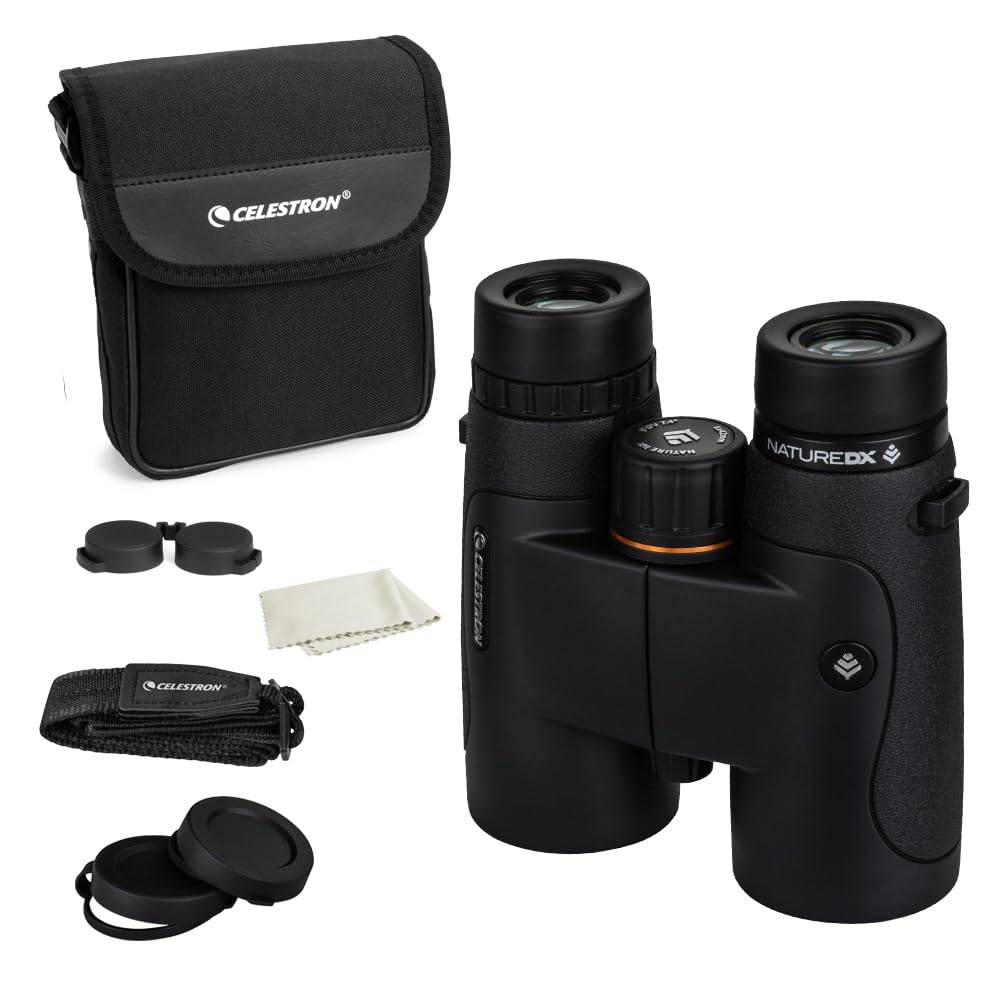
A compact trail companion that rides in a hiking pack and still frames warblers cleanly.
If you want to sling a pair into your daypack and forget about the weight, this Celestron earns its place. It comes in a compact, lightweight frame with 17.5 millimeters of eye relief, enough to keep the full view visible with glasses on. The 42-millimeter objective lenses balance size and brightness, and the fully multicoated lenses with phase-coated BaK-4 prisms — prisms that boost contrast and resolution — deliver crisp, color-accurate images. A 7.4-degree angular field of view helps you scan open landscapes and catch birds in flight, and the 388-foot field of view is broader than the Nikon MONARCH 5’s 288 feet, so you take in more of the scene at once.
The build is meant for weather. The rubber-armored polycarbonate housing shields the glass from bumps and drops, and the nitrogen-purged, waterproof body resists fogging through rain, snow, and humidity. For long sessions it has a built-in tripod adapter socket, so you can mount it on a standard tripod (adapter not included) and study a distant tree line without holding it steady by hand. The 8x magnification keeps the image calm and easier to hold than 10x, and the focus is manual with a center knob for quick adjustment.
Quality is what owners praise most, followed by clarity, and the feedback reflects real birding use — including a buyer whose pair was recommended by a Texas State Park Ranger and used happily at the feeder. The steepness of the price relative to simpler pairs is the trade-off, and this tier is worth it mainly if you bird often and hike with your optics. If value is your priority and you do not need the tripod socket or the compact build, the wider-view SVBONY and Timorn pairs cost less. Keep the eyecup knobs clean and firm to preserve the focus feel over years of use.
Built for the trail: a compact, nitrogen-purged, waterproof body with a tripod socket means it packs small and handles rough weather.
The consideration: it costs more than simpler 8x pairs, so the tripod adaptability and build are where that premium lives.
Go with this if: you hike, bird in wet weather, and value a compact body with an optional tripod mount.
Pass if: you only need an occasional backyard pair and want the lowest-cost wide view.
6. Nikon PROSTAFF P3 8×42 Binocular

The most generous eye relief in the group, made for thick frames and long viewing sessions.
That extra space is exactly what thick frames and strong prescriptions need to see a full, dark-edge-free picture. Turn-and-slide eyecups let you set the spacing precisely, and the smooth central focus wheel keeps adjustments quick when a bird appears without warning. The 42-millimeter lenses gather plenty of light for sharp images even at dawn and dusk, with multilayer coatings that cut reflections and a silver-alloy prism coating for lifelike color.
For a beginner or a casual birder, the 8×42 configuration is close to ideal. The 8x power holds the image steady, and it is easier to follow a moving bird than with a 10x pair. The 377-foot field of view is wide enough for woodland and yard use, and the 5-millimeter exit pupil keeps the image bright as the light dims. The body is fiberglass-reinforced polycarbonate with rubber armor for a secure, non-slip grip, and it uses O-ring seals and nitrogen purging to keep water and fog out through rain and rapid temperature swings.
What owners note most is quality, and it is easy to see why: this is among the most-reviewed 8×42 birding pairs on the market and holds a strong following for bright, crisp images that stay in focus. The main gripe to expect is the diopter wheel, which some find stiff to turn, and the strap can dangle without a fixed loop. Neither gets in the way of daily use. If you want maximum magnification, the MONARCH 5 pulls farther, but for a glasses wearer who wants the most comfortable, most forgiving fit and top value, this is the pair to start with.
The roomiest fit here: 20.2 millimeters of eye relief gives thick glasses and strong prescriptions a full, undistorted view.
A minor quirk: the diopter wheel turns stiffly on some units, so setting it takes a firm hand.
Made for you if: you wear thick glasses or a strong prescription and want the most comfortable, steadiest 8x view on a sensible budget.
Look up the range if: you need real magnification pull for distant waterfowl rather than a broad, steady field.
7. Vortex Diamondback HD 15×56 Binoculars

Serious long-range glass for the birder who studies distant water and open country.
When your birds are a quarter mile out across open water, magnification is everything, and this Vortex brings 15x with 56-millimeter objective lenses. That is a big step up from the 8x and 10x picks here, and it lets you resolve details at distances the others cannot touch. Fully multicoated lenses, a dielectric coating for bright and color-accurate images, and an Armortek coating that shields the exterior lenses from scratches, oil, and dirt keep the view clean. The 15.6 millimeters of eye relief clears glasses, and the twist-up eyecups adjust for comfortable viewing with or without them.
Two features make it practical for long sessions. It is tripod adaptable, and a tripod adapter is included, which matters because the maker recommends a tripod to avoid handshake at 15x — edge-to-edge sharpness at this power really needs a steady mount. It is also built to survive: Argon purging and O-ring seals deliver water and fog proofing in all environments, and the rugged construction withstands recoil and impact. A GlassPak harness for hands-free carry comes in the box, along with tethered objective covers and a rainguard. It carries Vortex’s unlimited, unconditional, lifetime VIP warranty — a fully transferable promise to repair or replace the item if it becomes damaged or defective, excluding loss, theft, deliberate damage, and cosmetic damage that does not affect performance.
Clarity is what earns it the most praise, and the range of view is a real strength — owners note they can see farther than with 10x models. The trade-offs are honest ones. At 15x it is heavier than a mid-size pair and needs that tripod for its best work, and there is a small learning curve: the focus knob is sensitive, going from blurry to clear in a tiny turn. If you carry a tripod to the marsh or scan open country, this is your tool. If you bird on the move in the woods, the steadier, lighter 8x pairs serve you better.
Why long-range birders want it
- 15x power with 56-millimeter objectives resolves distant birds the 8x and 10x picks cannot
- Tripod adapter included, matching the maker’s recommendation to mount it
- Argon purging and O-ring seals keep it water and fog proof anywhere
- Backed by Vortex’s transferable lifetime VIP warranty
What you trade for the reach
- Heavier than a mid-size pair and best used on a tripod
- The focus knob is sensitive — a tiny turn moves from blurry to clear
- Narrow 230-foot field of view, and 15x is not a beginner’s first pair
The right call if: your birding is open-country and long-range, and you will carry a tripod for that extra reach.
skip it if: you want a light, handheld pair for close woodland birding.
8. ZEISS Terra ED 8×42 Binoculars

Bright, fast-focusing glass that keeps pulling detail out of the dawn and dusk light.
For dawn chorus and evening roost, brightness is the spec that matters, and this ZEISS is built around it. It delivers 88% light transmission through its anti-reflective coating and ED glass, giving high-contrast images when the light is thin. The 5.3-millimeter exit pupil is the largest here, so the picture stays bright even as the sun drops, and the fully multicoated optics keep colors true in any weather. It carries 18 millimeters of eye relief, so glasses wearers get a full view, and the fast-focus design puts the large focus wheel right where your index finger lands so you can snap onto a bird the instant it appears.
The body is meant to travel. A waterproof, fiberglass-reinforced casing shrugs off weather and fits easily into a bag, and it comes with covers for the eyepiece and objective lenses plus a carrying case. The 375-foot field of view and the 8x magnification give a steady, wide-enough window for following warblers and watching birds just outside a window — close focus is a strength here, and one pointed phrase in the feedback sums up the appeal: buyers describe seeing “pin feathers on ducks.” The ZEISS hydrophobic antireflective coating with ED glass keeps images true-color in any weather.
Two things temper it. It is heavier than most 8x pairs in this group, though a wide neoprene strap spreads the load, and the included case is minimal — it does not open fully and will not zip shut with the strap attached, an annoyance several owners flag. The glass itself is not ZEISS’s top-tier line, so it trades a little ultimate sharpness for affordability. What you gain is a bright, fast, glass-forward pair for low-light birding, and this is the tier to step into if you want premium optics without the top-of-range cost.
The low-light edge: 88% light transmission and the largest exit pupil here (5.3 millimeters) mean bright images at dawn and dusk.
The case letdown: the included case is minimal and will not close with the strap attached — plan on a third-party bag.
Choose this if: you bird at dawn and dusk and want premium glass that stays bright when the light fades.
Reconsider if: you want a featherweight pair or a roomy, well-padded carry case in the box.
9. Vortex Viper HD Roof Prism Binoculars 8×42
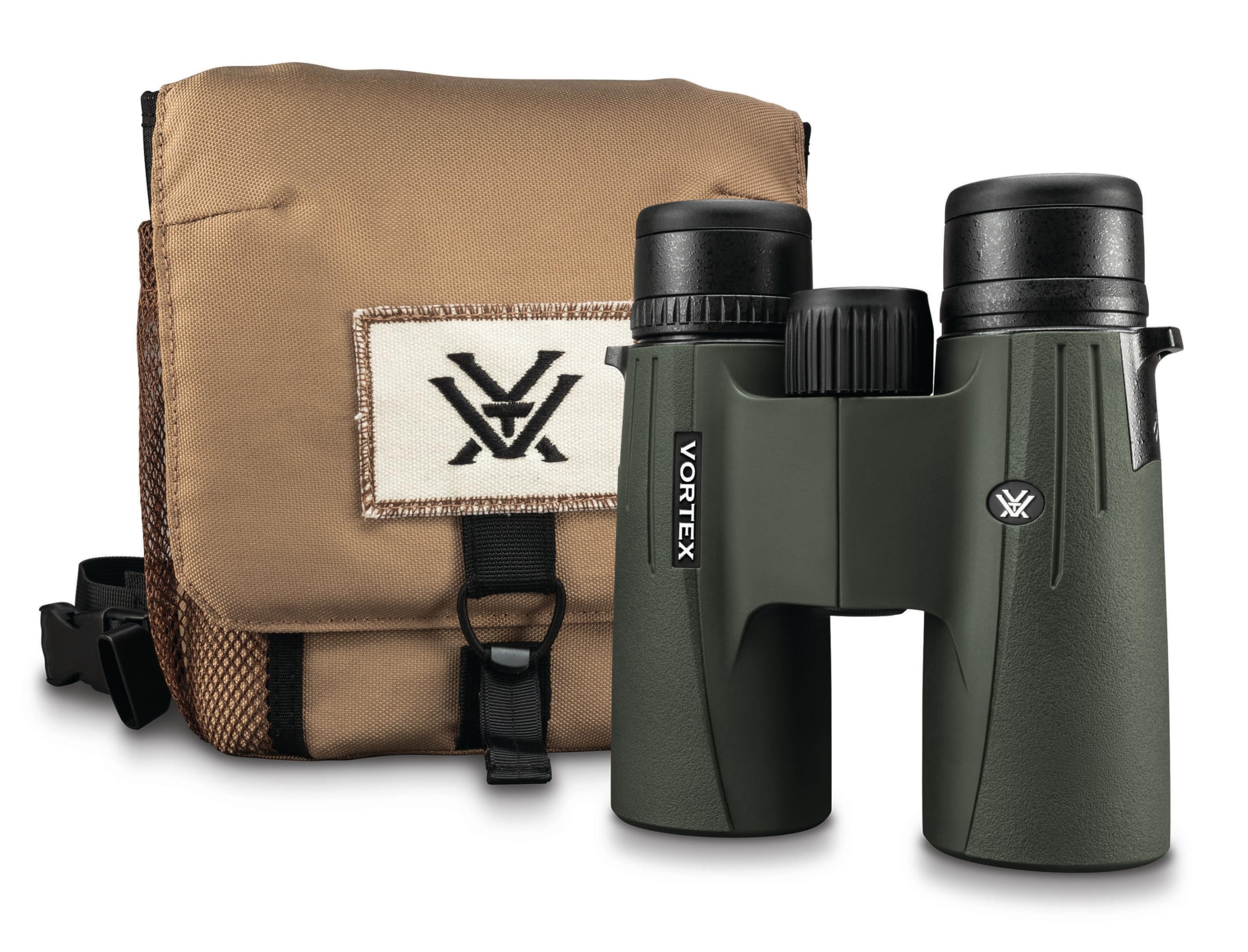
The all-day carry that keeps top-grade clarity strapped to your chest and ready in a heartbeat.
For the birder who is out from first light to last, the Viper HD sells itself on comfort and clarity. It pairs 8x magnification with 42-millimeter objectives in a compact full-size body, and its 409-foot field of view is the broadest of any 8×42 here — wider than the Celestron Nature DX’s 388 feet — so tracking movement across water or meadow is easy. The XR anti-reflective lens coatings give bright, full views in low light, and a high-density optical system delivers edge-to-edge clarity, with 18 millimeters of eye relief so your glasses stay on while the whole image fills the frame.
The handling is where it pulls ahead of its price peers. A locking, right-eye diopter tailors each barrel’s focus to your eyes, and the smooth central focus wheel provides fine control and quick sharp views. A rubber-armored chassis with thumb indents gives a secure grip, and twist-up eyecups rest comfortably against your face with customized eye relief. Argon purging and O-ring seals deliver a lifetime of water and fog proofing, and the included GlassPak chest harness gives comfortable, protected, strain-free carry all day. It shares the Vortex lifetime VIP warranty that repairs or replaces the item if damaged or defective, excluding loss, theft, deliberate damage, and cosmetic damage that does not affect performance.
Quality is the aspect it wins people over with most, closely trailed by clarity, and it holds up in exotic use — one owner even reported real overland travel with it, eyecups and focus wearing in over time and handled under warranty. Budget birders who want the same optics for far less may find the MONARCH 5 a better value, and a select few note the eyecup assembly can wear with hard daily use over years. If your priority is premium glass you can wear on a harness from dawn to dark, this is the pick that delivers it.
Where it leads the pack
- 409-foot field of view — the widest 8×42 view here for tracking moving birds
- GlassPak chest harness included for hands-free all-day carry
- Locking right-eye diopter customizes focus to each eye
- Argon purging and O-ring seals for lifetime water and fog proofing
What a buyer should weigh
- A premium tier — the MONARCH 5 offers comparable optics for less
- The included case is on the bulky, old-fashioned side
- The tripod adapter cover fits tightly and needs a gripper to remove
Top of the list if: you want premium glass you can carry hands-free from dawn to dark, with the widest 8×42 view in the group.
Step down a tier if: you want comparable optics at a more modest outlay and do not need the chest harness.
Know the Specs
Eye Relief
Eye relief is the gap between the eyepiece lens and your eye where the full field of view appears. It sits above everything else for glasses wearers, because your frames and lenses occupy part of that space. Look for at least 15 millimeters, and 17 to 20 millimeters suits most frames comfortably. The Nikon PROSTAFF P3 leads here at 20.2 millimeters, followed by the MONARCH 5 at 18.4 millimeters and the ZEISS Terra ED and Vortex Viper HD at 18 millimeters.
Exit Pupil
Exit pupil is the circle of light that reaches your eye, and a bigger circle means a brighter image in dim light. Multiply the objective lens diameter by the magnification to get it, but as a shopper you simply want the larger number for dawn and dusk birding. The ZEISS Terra ED gives 5.3 millimeters and the SVBONY SV202 gives 5.2 millimeters, while the Vortex Diamondback HD’s 3.7 millimeters reflects its high 15x power and narrow light beam.
Field of View
Field of view is how wide a slice of the scene you see at 1,000 yards, and a broader view helps you find and follow birds in motion. 8x pairs generally show more than 10x or 15x pairs, which is why the Timorn tops the group at 430 feet. When a fast bird disappears from one edge, a wider field means you catch it again sooner, with less panning back and forth.
Optical Coatings
Multi-coated and fully multicoated lenses reduce stray reflections so more light reaches your eye, and ED glass reduces color fringing at high-contrast edges. Vivid true-color images come down to a full coating stack and, on roof-prism designs, phase-corrected or silver-alloy coated prisms. In practice a fully multicoated 8×42 like the Celestron Nature DX with phase-coated BaK-4 prisms keeps a small bird crisp against a bright sky.
Common Questions
Can I use binoculars while wearing glasses?
What is the difference between twist-up and fold-down eyecups for glasses?
Is 8×42 or 10×42 better for bird watching with glasses?
Will these binoculars work with a strong prescription like -4.5?
How do I know if my binoculars have enough eye relief for my glasses?
Are these binoculars waterproof enough for rainy birding?
Do I need a tripod for high-magnification birding binoculars?
What is the widest field of view for bird watching binoculars with glasses?
What does exit pupil mean and why does it matter at dawn and dusk?
Is ED glass worth it for a bird watcher who wears glasses?
Can I take photos through these binoculars with my phone?
The Bottom Line
For most glasses wearers, the winner is the Nikon 7577 MONARCH 5 10×42 because it pairs 18.4 millimeters of eye relief and ED glass clarity with real 10x reach, making it the strongest one-pair-fits-most choice in this group. If keeping your glasses comfortably on matters most and you want the steadiest view, reach for the Nikon PROSTAFF P3 8×42 with its 20.2 millimeters of eye relief. And for wide-view birding on a tight budget, the SVBONY SV202 8×42 delivers an 8.12-degree field with ED optics for very little, backed by a large and happy owner base.
Whichever you pick, match the eye relief to your frames first, then choose 8x for steady wide views or 10x for reach.
How we choose
We do not accept paid placement. Every pick is matched to a real buyer and a real use-case; we do not hands-on test units.
Sources
Specifications: manufacturer listings and product documentation. Review insights: verified customer reviews, as of October 2026. Pricing: not shown on this page (it changes often); check the current price via the retailer link.
As an Amazon Associate, Home Digitized earns from qualifying purchases. This does not affect which products we feature.