
Specs are compiled from manufacturer listings and verified buyer reviews and can change over time — please confirm the key details on the product page before buying.
You hammer a wooden stake into dry summer ground, it splinters halfway down, and your row marker is now a jagged stub. That single snap is the whole problem with cheap garden stakes, and it is fixable. What matters is the wood species, the actual thickness of the stake, and whether the tip was cut smooth enough to slide into hard soil instead of fighting it. Get those three right and the stake holds a taut twine line, a climbing vine, or weed-barrier fabric all season. This article compares four real options by length, piece count, and weight so you can match the stake to your job instead of guessing.
This guide is built by comparing the manufacturers’ published specifications and the patterns across verified customer reviews, so you get each pick’s real strengths and trade-offs instead of marketing spin.
Short staples, 24-inch survey stakes, and four-foot plant supports all solve different problems, so the wrong pick is usually the one sized for someone else’s garden. Here is how each stake handles real soil, real weather, and real hammer blows, plus the honest catch on each.
Top Picks

How To Choose The Best Wooden Garden Stakes
The first decision is not brand, it is job. A stake holding down landscape fabric does a completely different task from a stake holding up a tomato vine. Buy for the task first, then for the soil.
Match the length to what the stake holds
Short five-inch staples are for pinning things flat — weed barrier, garden cloth, sod, tarps. A 24-inch survey stake is for marking lines and holding twine under tension. A four-foot stake is for standing up a climbing plant all season. Using a five-inch pin for plant support gets you a stake that vanishes under the soil surface, and using a four-foot stake to pin fabric wastes length and money.
Nominal versus actual thickness
A stake sold as 1 inch by 2 inch is almost never 1 inch by 2 inch in your hand. Milled lumber is sold by nominal size, which is the rough cut before planing. The Colingmill pack spells both numbers out in its listing, and that clarity is rare. Thicker stakes resist snapping better in hard ground. Thin stakes pin fabric fine but bend or break when hammered into compacted clay.
Tip shape and wood species decide whether it survives the hammer
A smooth, professionally cut point slides into thick soil; a blunt or ragged cut needs force and splits. Wood species matters just as much. SPF (spruce-pine-fir, the common softwood lumber blend) is light and takes a hammer reasonably well. Birch is denser and sturdier but more brittle at the point. Both are untreated wood, so both degrade in wet ground over time — that is the normal trade-off of wood over metal, not a defect.
Side-by-Side Comparison
| Model | Best For | Length | Pieces | Weight | Amazon |
|---|---|---|---|---|---|
| Kitzmans – Dixon LLC 24” Grade and Survey Stakes★ Best Overall | Marking lines and surveying | 24 inches | 25 | — | Amazon |
| Colingmill 48 Pieces Wooden Garden Stakes | Plant support and garden structure | 11.5 inches | 48 | 2.24 kg | Amazon |
| Greenes Fence 4 Ft. Garden Stakes | Tall climbing plants and sign posts | 48 inches | 50 | — | Amazon |
| AMEILOZ 5 Inch Wooden Garden Stakes | Pinning weed barrier and fabric | 5 inches | 100 | 0.37 kg | Amazon |
Detailed Reviews
1. Kitzmans – Dixon LLC 24” Grade and Survey Stakes
Our pick — 4.5+★ from 350+ verified ratings; the strongest balance of quality and price.
Two feet of SPF lumber that holds twine taut without tipping over in the wind.
Two feet is the length that turns a stake into a real marker. This Kitzman’s pack gives you 24-inch stakes in SPF wood — spruce-pine-fir, the standard light softwood blend used in milled lumber — at 1.5 inches wide and 0.62 inches thick. That width is 1.5 inches versus the 0.43-inch width of the Colingmill stakes below, which is why these stand upright under tension instead of bowing. Drive one at each corner of a raised bed and run a string line down the row; the stakes hold the line level while you plant to it.
Where this pack earns its keep is heavier framing work. Surveying, fence layout, and grading are all named uses on the listing, and the wood survives being driven deep with real force. Landscaping and even concrete leveling come up again and again in the review pages, and the stakes come back out reusable for the next project. Twenty-five pieces covers a large yard or several jobs without a second order.
The honest catch: the lumber is not precision-sorted. Buyers report cutting short pieces in the bundle — one note reads, “I had two short cuts in my bundle. It didn’t hold me up but 20″ is visibly not 24″ so whomever packed the box didn’t care.” Measure anything critical before you commit it to the ground, and keep in mind these are untreated stakes facing the normal rot timeline of any wood left in damp soil. The pointed tip is sharp by design, so gloves are a sensible habit when you are handling a stack of them.
What holds up under load
- 1.5-inch width gives a wide face for twine and string lines
- 24-inch length reaches below loose topsoil into firm ground
- SPF wood takes hammer blows and comes back out reusable
- 25 stakes cover surveying, fencing, and garden marking in one pack
Where it asks for care
- Piece lengths are not sorted — check each one before planting it
- Untreated wood rots in wet ground over time
- Sharp points mean gloves are worth keeping nearby
Built for: anyone marking rows, laying out a fence line, or setting survey points where a stake has to stand straight and stay put.
Think twice: if you need exact, uniform lengths for a visible finished edge, since bundle cuts can run short.
2. Colingmill 48 Pieces Wooden Garden Stakes

Smooth-cut tips and 48 pieces — the pack that does plant support and structure in one order.
Colingmill names both sets of numbers, and that transparency is worth noting. The nominal size is 1 inch wide by 2 inches high by 12 inches long, while the actual milled stake measures 0.43 inches wide by 1.375 inches high by 11.5 inches long. Translate that: you are getting a slim, flat stake about a foot tall, which is why this pack suits plant support and light structure far better than heavy marking. Those tips are professionally processed smooth so they slide into thick soil instead of tearing it open.
Solid wood that resists breaking and deforming is the promise here, and the reviews back the finish quality more than anything else — the wood does not splinter the way rough-cut stakes do. You can paint or sculpt them, and one buyer stained a batch for brush edging to blend into the garden. Four dozen pieces at roughly 2.24 kg for the whole bundle also means you are not rationing them. Here is the head-to-head that matters: this bundle carries 48 stakes to the Kitzman’s 25, but each is 11.5 inches against that pack’s 24 inches, so you are trading height for quantity.
The one honest caveat is knots and grain variation. Colingmill states it plainly in the listing: wood has natural nodules that cannot be fully avoided during processing, and a few small ones arrive on the surface. They do not affect how the stake works, but if you are staining for a visible finished edge you will want to pick the clean ones for the front of the bed. Buyers do note these hold well when hammered into dirt, so drive them with a steady hand and a block over the top rather than a wild swing.
The real strength: a foot-tall, smooth-tipped stake at a piece count that lets you support a whole vegetable row, reinforce a raised bed, or edge a border without watching your supply dwindle.
The fine print: at 11.5 inches actual length, these are for low plants and light marking — they are not survey stakes and they will not hold a tall vine.
Best fit: vegetable gardeners and raised-bed growers who want a generous stack of smooth, paintable stakes for plant ties and bed reinforcement.
Not the one: if your job needs two-foot height or a stake that stands above the soil line.
3. Greenes Fence 4 Ft. Garden Stakes (50 Pack)
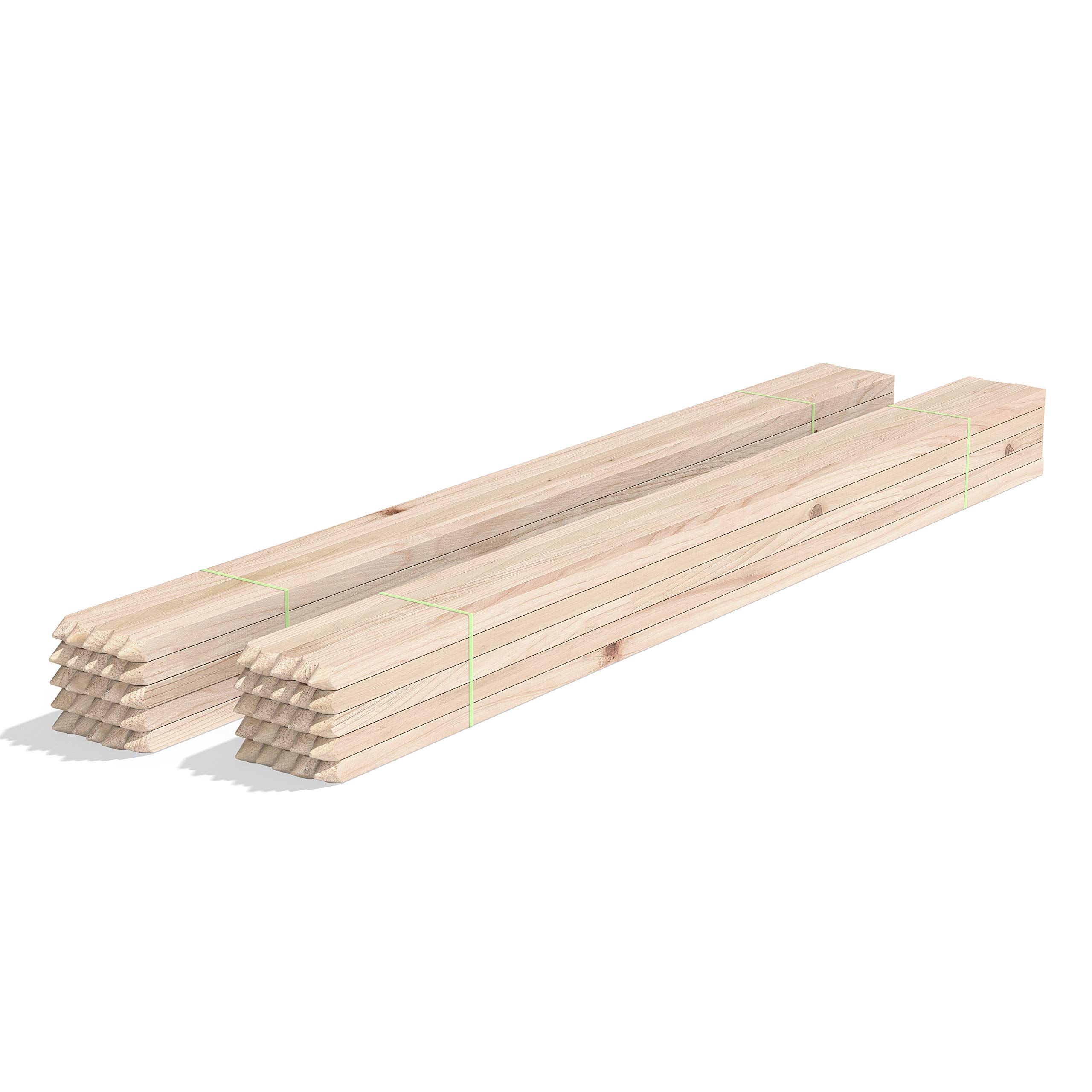
Four feet of pointed hardwood for the plants that outgrow everything else in the bed.
When a climbing vine needs a support pillar, nothing short of a four-foot stake works. Greenes Fence cuts these at 48 inches long and 3/4 inch square, with a pointed end so they push into the soil with a firm hand. That is 48 inches versus the 11.5-inch length of the Colingmill stakes above, which is the whole reason to step up to this pack. Fifty pieces means you can stake a full row of tomatoes or build a teepee trellis without running out.
What wins people over here is the straightness and the strength of the cut. The stakes grip hard summer soil and hold, which is exactly what you want from a stake standing four feet above ground. Sign posts are another named use, so a run of these doubles as a rustic marker line for a driveway or trail. One creative buyer even cut them into short pieces and pressure-glued them between reclaimed redwood planks for a ceiling detail, so the wood quality holds up to far more than dirt.
The recurring gripe is removal, not standing up. In dry, compacted ground these bite hard, and you will need to moisten the soil and rock the stake back and forth to pull it out intact. Some snap underground, though the broken length remains reusable once re-pointed. Splintering is the other thing to plan for — the finish is adequate rather than smooth, and gloves will save your hands. A small share of a shipment arrives split or splits when malletted, and the company’s replacement response has been quick when that happens.
Where the height pays off
- 48-inch length supports tall climbing plants through the season
- Pointed end makes placement quick in normal soil
- 3/4-inch square profile stands straight under weight
- 50-stake count covers a long row or a full trellis
The honest trade-offs
- Hard, dry ground grips these and makes removal a chore
- Rough finish calls for gloves against splinters
- Some stakes snap or split on the way in
Reach for these: for climbing vegetables, tall flowering vines, or sign and trail marking that needs real above-ground height.
Look elsewhere: if you want easy pull-out at season’s end or a splinter-free finish in bare hands.
4. AMEILOZ 5 Inch Wooden Garden Stakes

A hundred birch pins that pin fabric flat and disappear into the soil as they decompose.
These are not plant supports. They are ground staples, five inches long and 1.3 inches wide in a T-shape, made from birch wood, and they exist to hold things flat. Weed barrier, landscape fabric, garden cloth, tarps, sod, and turf are all named uses, and the T-head gives you a broad surface to press or tap without the pin sinking through the fabric. The piece count is the headline: 100 pins at 0.37 kg for the whole bundle, which works out to a light bag you can carry around the yard in one hand. Measure that against the Colingmill bundle’s 2.24 kg, and the weight difference tells you exactly how much material is in each pack.
The appeal of wood over metal here is mower safety. Metal staples and nylon pins catch a blade; these bury into the soil and get out of the way. Being biodegradable is part of the design too — you can leave them in place and let them break down rather than pulling every one at season’s end. Owners mention them surviving being hammered into hard clay to pin cardboard as a biodegradable underlayer.
Be honest with yourself about the size and the strength. These can break under force — the review pages put it plainly: “Be gentle with them. They can break but works well to sub for metal staples.” The recurring note is that they suit small containers and home gardens rather than large-scale work. If you need to pin a quarter-acre of weed barrier, this is not the pack; if you are pinning fabric around beds and containers, 100 pieces is a deep supply. Wood also swells and softens in wet ground, so expect a shorter working life than a metal pin.
Why the count matters: 100 T-shaped birch pins means you pin a whole fabric run without counting pieces, and the mower-safe, biodegradable build lets you leave them in the soil.
The size reality: five inches is short by design — this pack pins things down, it does not hold plants up.
Choose these: for landscaping fabric, weed barrier, tarps, and sod where you want a deep supply of mower-safe wooden pins.
Skip the idea: of using them as survey stakes or plant ties — five inches is the wrong tool for both.
Know the Specs
Nominal versus actual dimensions
A stake listed as 1 inch by 2 inch is the rough-cut size before the mill planes the surface. The finished stake is smaller, which is why Colingmill lists both the nominal 1 inch by 2 inch by 12 inch figure and the actual 0.43 inch by 1.375 inch by 11.5 inch figure. Check the actual number when fit matters — the difference between nominal and actual is what surprises first-time buyers.
Wood species and rot
SPF (spruce-pine-fir) is a light softwood blend that takes a hammer well; birch is denser and sturdier but more brittle at the point. Neither is treated, so both break down in damp soil over time. That is the normal trade-off of wood over metal, and it is why some gardeners leave wooden pins in to decompose rather than pulling them.
Length and what it holds
Five-inch pins hold fabric and sod flat. Eleven to twelve-inch stakes support low plants and mark rows. Twenty-four-inch stakes stand a string line under tension. Forty-eight-inch stakes hold climbing plants above ground. Match the length to the load and the stake holds without levering loose.
Tip treatment
A smooth, pre-cut point slides into thick soil; a blunt or ragged cut splits under force. Colingmill processes its tips smooth, and Greenes Fence cuts a pointed end for easy installation. A sharper point means less hammering and less breakage on the way in.
Common Questions
Will wooden garden stakes rot in the ground?
What is the difference between a garden stake and a survey stake?
Can I hammer wooden stakes into dry hard clay?
Are wooden stakes safe around a lawn mower?
How many stakes do I need to pin down weed barrier?
Why are my new stakes arriving shorter than the listed length?
Can wooden garden stakes be painted?
What is the difference between nominal and actual stake size?
Do wooden stakes come back out at the end of the season?
Can I use short five-inch pins to support plants?
The Bottom Line
For most people buying wooden garden stakes, the Kitzmans – Dixon LLC 24” Grade and Survey Stakes is the pick — 24 inches of 1.5-inch-wide SPF wood gives you a stake that stands a string line straight and survives a real hammer blow, and and it holds 4.5+ stars across 370+ ratings. If you are planting a bed and want a deep stack of smooth, paintable stakes, the Colingmill 48 Pieces gives you four dozen at 11.5 inches for the task. For a climbing vine that needs four feet of support, reach for the Greenes Fence 4 Ft. pack. And if your job is pinning weed barrier flat, the AMEILOZ 5 Inch pins give you 100 mower-safe pieces in one light bundle — pick the length for the job and it will hold all season.
How we choose
We do not accept paid placement. Every pick is matched to a real buyer and a real use-case; we do not hands-on test units.
Sources
Specifications: manufacturer listings and product documentation. Review insights: verified customer reviews, as of October 2026. Pricing: not shown on this page (it changes often); check the current price via the retailer link.
As an Amazon Associate, Home Digitized earns from qualifying purchases. This does not affect which products we feature.