
Specs are compiled from manufacturer listings and verified buyer reviews and can change over time — please confirm the key details on the product page before buying.
If you are heating a garage, a workshop, or a basement, the shortest answer is this: buy the Ashley Hearth AW2520E-P if you want the most heat for the space. Its 2,500-square-foot coverage and 112,800 BTU output leave real headroom for a cold concrete slab, and the 2.7-cubic-foot firebox swallows 21-inch logs. Everything below explains how to match a stove to your actual building, because the number printed on the box rarely matches what a drafty garage feels like in January.
This guide is built by comparing the manufacturers’ published specifications and the patterns across verified customer reviews, so you get each pick’s real strengths and trade-offs instead of marketing spin.
A garage is harder to heat than a living room, so efficiency, log length, and flue size matter more than looks. Below is a straight read on wood burning stoves for garages.
Top Picks


How To Choose The Best Wood Burning Stoves For Garages
A garage loses heat fast. Concrete wicks warmth out of the floor, overhead doors leak air, and there is rarely wall insulation worth bragging about. That means the stove’s printed coverage number is a starting point, not a promise. Buy for the coldest week you actually expect, and give yourself margin.
Match BTU output to the worst night, not the average one
BTU stands for British thermal unit — the amount of heat needed to warm one pound of water by one degree Fahrenheit. Bigger numbers mean more heat per hour. A 26,000 BTU stove and a 112,800 BTU stove are not in the same conversation, and a garage with an uninsulated ceiling will demand the larger one sooner than you think.
Firebox size decides your feeding schedule
The firebox is the metal chamber where the wood burns. A 1.3-cubic-foot box takes 18-inch logs; a 2.7-cubic-foot box takes 21-inch logs. Smaller boxes mean shorter burns and more reloading, which matters a great deal when you are out in the garage in slippers at midnight.
Check the flue connector before anything else
Smoke has to leave the building, and the flue (the exhaust pipe that carries smoke out) does that job. These stoves are built around a standard 6-inch chimney connector, and that pipe is not included. How well your stove drafts depends on your garage roof or wall penetration, the chimney height, and if you need an outside air intake.
Side-by-Side Comparison
| Model | Best For | Heat Output | Coverage | Max Log Length | Amazon |
|---|---|---|---|---|---|
| Ashley Hearth AW2520E-P★ Best Overall | Big garages and workshops | 112,800 BTU | 2,500 sq ft | 21 inches | Amazon |
| Cleveland Iron Works Single Burn RateBest Cast Iron Build | Small shops and corner rooms | 27,000 BTU | 900 sq ft | 18 inches | Amazon |
| Ashley Hearth AW1120E-P | Small add-on rooms | 68,000 BTU | 1,200 sq ft | 18 inches | Amazon |
| US Stove TH-100 | Tight footprints and zone heating | 26,000 BTU | 750 sq ft | 11 inches | Amazon |
Detailed Reviews
1. Ashley Hearth AW2520E-P Wood Stove
Our pick — 4.0+★ from 60+ verified ratings; the strongest balance of quality and price.
The brute of the list: a firebox that takes 21-inch logs and a heat rating that dwarfs the rest.
For a garage that has to be warm on the coldest night of the year, this is the obvious starting point. It produces up to 112,800 BTU of heat and covers spaces up to 2,500 square feet. Compare that with the US Stove TH-100 at 26,000 BTU and 750 square feet, and you can see the scale difference immediately — one is built for a big shop, the other for a corner.
The 2.7-cubic-foot firebox accepts logs up to 21 inches, and that is what earns it the overnight-feed advantage. Longer logs burn longer. Firebrick lining inside the chamber holds heat and protects the steel, and the secondary combustion system squeezes more heat out of each split while reducing wood consumption and emissions without a catalyst. It needs no electricity, so a garage power cut does not take your heat with it.
Ergonomics are considered, too. You get both adjustable legs and a pedestal base in the box, so you can choose how it sits in the room. A removable ash pan with a built-in ash port makes cleanup quicker, and the heavy cast iron door with air-washed ceramic glass keeps the view clear while helping the glass stay cleaner. It is EPA certified for cordwood. Just know that delivery is by LTL freight — a phone number or email is required for the carrier to schedule.
Where It Delivers
- 112,800 BTU covers 2,500 square feet, enough margin for a cold, drafty slab.
- 2.7-cubic-foot firebox takes 21-inch logs, which means fewer reloads.
- Runs with no electricity, so it keeps working when the grid does not.
- Secondary combustion cuts wood use without a catalyst to wear out.
Where It Bites
- 291 pounds of steel — plan for help and a solid floor path.
- Heat output draws mixed reactions, and some owners want bigger coverage.
- Chimney connector and chimney system are not included.
Reach for this if: your garage is large, poorly insulated, or doubles as a workspace you need properly warm.
Look elsewhere if: you want something that fits a tight corner or you plan to move it around — at 291 pounds it is a permanent fixture.
2. Cleveland Iron Works Single Burn Rate Stove
Cast iron, a sealed fire chamber, and a top you can actually cook on.
If your garage is really a workshop and you just want one corner warm, this stove is a smart middle path. It heats up to 900 square feet from 27,000 BTU (British thermal units, the standard measure of heat output), which is roughly a third of what the AW2520E-P covers. Its build is where it shines: heavy duty cast iron construction, a high temperature matte black finish, and a cast iron door with a ceramic rope gasket (a heat-proof seal around the door) that keeps the fire chamber air tight so embers stay where they belong.
Buyers describe it heating a basement shop of over 1,000 square feet well, and the sealed chamber with air intake ports lets you burn with the door closed rather than propped open. The 2-piece safety handle stays cool while the stove is running, which sounds like a small thing until you have grabbed a hot handle in gloves. It holds 18-inch firelogs, uses a 6-inch flue exhaust, and comes with a 1-year warranty. Assembly is quick and easy by the manufacturer’s description.
One repeated point deserves your attention before ordering: this thing is heavy, and two people minimum is the realistic number for moving it into place. A few owners also find the cleanout routine tedious — ash handling is the chore that comes with any single burn rate stove. The flip side is a fire you can cook on, which several buyers mention with real enthusiasm.
The trade worth knowing: single burn rate means you are not fiddling with a damper to dial the fire up and down — you load it and let it run. That simplicity suits a workshop where you are busy with your hands.
Fit note: at 27,000 BTU this is the right stove for a one- or two-bay garage, not a barn. Match it to a 900-square-foot space and you will be comfortable.
Who it beats: anyone who wants cast iron durability and a cooking surface in a modest space.
Its limit: the cleanout takes patience, and the 18-inch log limit means shorter splits than the Ashley 2,500.
3. Ashley Hearth AW1120E-P Wood Stove
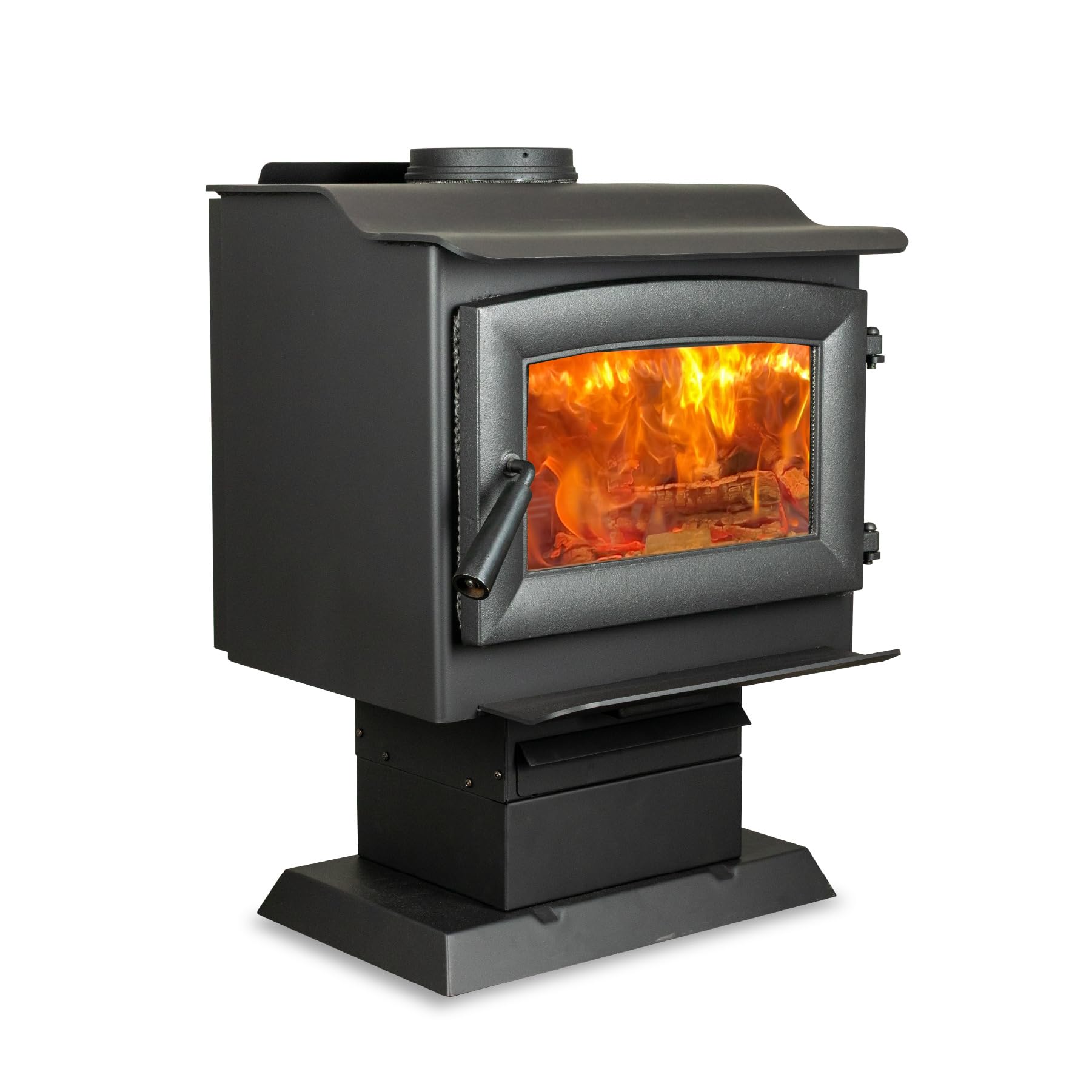
The one for a single-bay garage or a small add-on room that needs steady, not scorching, warmth.
At 68,000 BTU and 1,200 square feet of coverage, this sits neatly between the compact US Stove and the big AW2520E-P. Its 1.3-cubic-foot firebox accepts logs up to 18 inches, so you feed it a little more often than the 21-inch models but still get a proper fire rather than a constant babysitting job. It needs no electricity, which matters when a winter storm takes the power out and your garage is where the generator lives.
The secondary combustion system reduces wood consumption and emissions without a catalyst, and the firebrick-lined interior protects the steel and helps combustion. A heavy cast iron door with air-washed ceramic glass gives you a clear view, and the integrated removable ash pan speeds cleanup. You get both adjustable legs and a pedestal base. It is EPA certified, and with a separately sold fresh air intake kit it can be approved for mobile home or transportable building use. It uses a standard 6-inch chimney connector, not included.
Where this one asks for care is burn control. Owners describe the damper and combustion air intake as fiddly, and some report short burns of two to three hours and visible smoke with poor draft. Those complaints cluster among people pushing it hard in larger or leakier spaces, which is exactly the mistake to avoid with a 1,200-square-foot stove.
Why owners like it: the look earns as many kind words as the build — the large window showing logs is a genuine pleasure on a cold evening, and it fits a small room without overwhelming it.
The honest catch: expect to feed it roughly hourly on cold days with dry seasoned wood, and budget for flue pipe, which one owner notes can cost more than the stove itself.
Right stove for: a one-car garage or small add-on room where 1,200 square feet is a genuine match, not a stretch.
Wrong stove for: a drafty double garage — the burn control struggles when you ask it to heat beyond what it was built for.
4. US STOVE 750 SQ FT STOVE, 75% EFFICIENT

A tiny footprint for a garage that simply cannot spare the floor space.
The pitch here is footprint, not firepower. This stove measures 13 inches deep by 16.4 inches wide by 26.75 inches tall and weighs 139 pounds, which is a fraction of the Ashley 2,500’s 291 pounds and its 25.6-inch depth. It heats up to 750 square feet at 26,000 BTU and 75% efficiency, and it is EPA certified and approved for mobile home use in the USA. If your garage is small and the stove has to tuck into a corner, that narrow body is the whole reason to consider it.
The compromises are real and you should walk in knowing them. It accepts logs up to 11 inches, which is short enough that you will be splitting smaller and feeding more often. The burn time is listed up to 8 hours, but the small firebox means that figure depends on getting a dense, well-packed load. Stove pipe and blower are both sold separately, so factor those into the setup. This is a zone-heating stove — the manufacturer describes it as a fit for smaller houses or targeted warmth.
Packaging is the recurring frustration. Several units arrive with bent latches, cracked handles, or a shifted firebrick baffle, and getting the baffle back in the right spot without directions takes some figuring. Plan on inspecting it carefully at delivery, and if you can collect it locally, all the better.
The case for it: the compact dimensions win where floor plan is the deal-breaker, and at 139 pounds it is far easier to move than any other pick here.
Accept this going in: the 11-inch log limit and small firebox mean frequent attention, so it suits a garage you are in and out of, not one you want to leave burning overnight unattended.
Pick this when: space is the constraint and 750 square feet of coverage is honestly all your garage needs.
Pass on it if: you want long unsupervised burns or you expect to load full-length splits — the 11-inch maximum rules it out.
Know the Specs
BTU Output and Coverage
BTU is the unit of heat energy per hour. A stove’s coverage rating is the square footage the maker expects it to warm under reasonable conditions, and garages rarely meet reasonable conditions. Always compare a stove’s BTU against the others in the same list rather than trusting the coverage figure alone.
Firebox Size and Log Length
The firebox volume determines how much wood fits at once. A larger box with a longer maximum log length means longer gaps between reloads. If you plan to load full splits rather than short pieces, match the firebox to your log length before anything else.
Secondary Combustion
A secondary combustion system burns off gases that would otherwise go up the flue, which increases heat output and reduces wood consumption and emissions — without needing a catalyst, which is a consumable part on some other stoves.
Flue Diameter and Draft
These stoves are designed around a standard 6-inch chimney connector. The pipe and the chimney system are typically sold separately. Draft depends on chimney height, outdoor temperature, and whether combustion air can enter the room, so plan the venting before you buy.
Common Questions
Can a wood burning stove be installed in a garage?
How many BTUs do I need to heat a garage?
What size logs do the stoves on this list take?
Do these wood stoves need electricity to run?
What chimney and flue pipe do I need?
Is a single burn rate stove better than one with a damper?
How long will a stove on this list burn overnight?
Why does my stove let smoke into the room when I open the door?
Do these stoves come with the pipe and blower included?
Can I cook on a wood stove in my garage?
The Bottom Line
If your garage is big, cold, and hard to heat, the Ashley Hearth AW2520E-P is the pick to beat — 112,800 BTU and 2,500 square feet of coverage give you the margin that matters when the temperature drops. For a workshop or corner room where you want cast iron simplicity and a cooking surface, the Cleveland Iron Works Single Burn Rate Stove earns its place. And if floor space is your real constraint, the US Stove TH-100 fits where nothing else will, provided you accept its 11-inch log limit and hands-on feeding routine.
How we choose
We do not accept paid placement. Every pick is matched to a real buyer and a real use-case; we do not hands-on test units.
Sources
Specifications: manufacturer listings and product documentation. Review insights: verified customer reviews, as of October 2026. Pricing: not shown on this page (it changes often); check the current price via the retailer link.
As an Amazon Associate, Home Digitized earns from qualifying purchases. This does not affect which products we feature.