
Specs are compiled from manufacturer listings and verified buyer reviews and can change over time — please confirm the key details on the product page before buying.
You thread a nylon tie, pull it as hard as your fingers allow, then attack the leftover tail with side cutters and hope you do not slice your thumb. A zip tie tightener does that whole job in one squeeze — it pulls the tie to a repeatable tension and trims the tail clean, so every bundle ends up looking the same instead of “good enough.” The picks below cover the whole spectrum: stainless-steel tie guns for outdoor fencing and exhaust wrap, nylon-tie tensioners for ductwork and wiring harnesses, and small pistol-grip tools for cable bundles inside a rack.
This guide is built by comparing the manufacturers’ published specifications and the patterns across verified customer reviews, so you get each pick’s real strengths and trade-offs instead of marketing spin.
The big fork in the road is tie material: stainless steel ties need a metal-toothed gun with a hardened blade, while nylon ties need a tensioner that grips soft plastic without snapping it. Below you will find the tension range, the maximum tie width, and the real gripes that decide which tool earns a place in your bag — everything you need to pick the right zip tie tightener without guessing.
Top Picks


How To Choose The Best Zip Tie Tightener
Start with the tie, not the tool. A gun built for stainless steel will chew up soft nylon, and a plastic-tie tensioner has no teeth to grab metal. Match the tool to the material you actually use, then narrow by width and tension.
Match the tool to your tie material
Stainless-steel cable ties need a gun with a hardened blade and a jaw that grabs metal — the OFFO and IWISS tools are built for exactly that, and the IWISS pairs with 316SS ties. Nylon ties, the familiar plastic ones, need a tensioner with a smooth pull so it cinches instead of cutting through. The Malco TY4G and Klein 86570 are nylon-rated, and the Malco handles 125 lb and 175 lb ties.
Check the maximum tie width before you buy
This is the spec that ruins more purchases than any other. A tool that swallows only narrow ties will not accept wide heavy-duty ties, and you find out after the job starts. Compare the width each tool accepts against the widest tie in your drawer — the Eastwood takes ties up to 1/4 in. wide, while the Klein handles a maximum tie width of 15/32-Inch.
Decide between automatic and manual cutting
An automatic breakaway blade fires the moment your set tension is reached, which is fast on repetitive jobs. A manual cut-off waits for you to pull the lower handle, so you can cinch a little tighter or back off before committing. The Malco TY6 runs the automatic route; the TY4G is the manual one. Pick automatic for speed on repetitive runs, manual when you want the final say on the cinch.
Side-by-Side Comparison
| Model | Best For | Tie Type | Max Tie Width | Tension / Cutting | Amazon |
|---|---|---|---|---|---|
| Malco TY4G★ Best Overall | HVAC ductwork and nylon ties | Nylon (125 lb and 175 lb) | — | Adjustable knob, manual cut-off | Amazon |
| OFFO Metal Cable Tie GunBest Value | Stainless steel ties outdoors | Stainless steel and plastic | 12 mm cutting width | Adjustable pressure, automatic cut | Amazon |
| Zhushan Nylon Bundling Tool | Home electrical and cable work | Nylon, 2.4 mm to 12 mm | 12 mm | Adjustable tension, flush cut | Amazon |
| IWISS WCT-322 | Exhaust wrap and CV boots | 316SS stainless steel | 0.47 in (12 mm) | Tension screw, one-squeeze cut | Amazon |
| Eastwood Cable Tie Gun | Wiring harnesses and clean finishes | Nylon | 1/4 in | Adjustable tension, flush cut | Amazon |
| Klein Tools 86570 | Heavy-duty 120–250 lb ties | Nylon, 120 to 250 lb | 15/32-Inch (1.2 cm) | Up to 65-Pound of tension, cuts tail | Amazon |
| Malco TY6 | Overhead flex duct installs | Nylon (125 lb and 175 lb) | — | Adjustable knob, auto cut-off | Amazon |
Detailed Reviews
1. Malco TY4G Gripped Tensioning Tool with Manual Cut-Off
Our pick — 4.5+★ from 600+ verified ratings; the strongest balance of quality and price.
The ductwork veteran that lets you decide the exact moment the blade drops.
If you spend your days sealing fiberglass duct take-offs, the TY4G was drawn for you. It tightens nylon ties to a repeatable pull, then you pull the lower handle and the blade trims the excess tail — one motion, no hunting for snips while you balance on a ladder. It works with both 175 lb heavy-duty ties and thinner 125 lb ties, and the adjustment knob lets you dial the pressure so you do not crush the duct lining.
What wins people over is the build. Owners talk about quality more than anything else in their write-ups, and the hardened steel stampings with a baked-on enamel wrinkle finish and nickel-chrome plating back that up. Folks who have run one for years say it simply keeps going, and Malco covers it with a lifetime warranty. The manual cutter is the part repeat buyers single out — you control the cinch, so you can nudge a tie tighter than an automatic blade would allow, then cut. At 5.6 ounces it is light enough to hang off a pouch all day, and the gray vinyl cushioned grips with built-in hand stops cut down on pinch and fatigue during a long run of collars.
The honest catch: mind your tie width. As buyers report, “mind the width of large format zip ties as this will not accept 0.5 inch width.” If your drawer is full of extra-wide heavy-duty ties, this one may not close around them. The cutting action itself draws mixed feelings — the manual step is a feature to some and a chore to others who want the blade to fire on its own.
What earns its keep
- Adjustable tension knob dials in the same pull every time on 125 lb and 175 lb ties.
- Manual cut-off gives you the final say before the blade fires.
- Hardened steel stampings with nickel-chrome plating and a lifetime warranty.
- Vinyl cushioned grips with hand stops ease repetitive ductwork.
Where it pushes back
- Will not accept 0.5 inch wide large-format ties.
- The extra manual step slows you down if you want an automatic blade.
- Costs more than the entry-level pistol-grip tools.
Reach for this if: you install ductwork or tie nylon bundles daily and want full control over the final cinch.
Think twice if: your ties run wider than half an inch — this one will not close around them.
2. OFFO Metal Cable Tie Gun, Stainless Steel Tightener & Cutter
Turns stainless tie work from a knuckle-buster into a one-squeeze job.
Metal ties are a different animal from plastic — you cannot nick the end clean with side cutters without leaving a razor edge. The OFFO solves that with a SKD11 steel blade and an automatic cut, so you fasten and trim in one motion and the cut comes out clean without sharp edges. Adjustable bundling pressure lets you set the pull, and it handles self-locking and stepped ties too, and can cut without tightening first.
Owners use it for outdoor fencing and security work, where stainless ties hold where plastic fails. The cutting performance draws steady praise — the blade bites through with a light squeeze, and the TPR handles and updated trigger cut down on hand fatigue over a long run. It is compact at 8.27 inches long, so it tucks into a pouch and reaches into a confined space where a bigger tool will not fit.
One trade-off to know before you buy: as one owner put it, “wish it didnt have to have so much material in jaw before it grabs, but when it does, it gets real tight.” In other words, you need to feed a fair amount of tie through before the jaw bites. The cutting bar also pushes up rather than pulling down, which can nudge you toward two hands on tight jobs.
The stainless specialist: if your work is stainless steel cable ties — fencing, exhaust wrap, security bundles — this is the value pick that does the job cleanly. The 12 mm cutting width and automatic blade cover most standard metal ties.
The one adjustment: expect a fumble on short tails until you learn how much tie the jaw wants.
Best fit: anyone switching from plastic to stainless ties who wants a clean cut without a second tool.
Not your tool if: you mostly work with soft nylon — the metal-grabbing jaw is overkill for plastic.
3. Zhushan Nylon Cable Tie Bundling Tool

The one tool that swallows everything from skinny 2.4 mm ties to 12 mm monsters.
Most homeowners own a shoebox of mixed-width nylon ties, and that is exactly where this Zhushan earns its place. It handles nylon ties from 2.4 mm to 12 mm in width, so the skinny ties in the drawer and the fat ones both load up. It is light at 0.25 kg with a 165mm length, and the metal body is built to last through years of cable and wire work. It covers electrical installs, cable management, and construction tie-downs.
What it does best is grip and pull. Owners describe it pulling zip ties flawlessly and holding tension during the cinch. The adjustable tension lets you dial in for different tie sizes, and the flush cut is designed to leave a neat finish without sharp edges. Owners keep coming back to the grip and pull: it cinches 2.4 mm to 12 mm ties without slipping.
The honest caveats are real here. The tension adjustment draws mixed feedback: there is no preset tension, so you have to use care or you can snap a tie. The flush cut is also mixed — it makes a clean square cut but can leave a small nub that is not truly flush. The all-metal handles have no padding, and durability gets a split verdict, with a sharp blade eventually being the wear point.
One tool, many widths: the 2.4 mm to 12 mm range means the whole drawer of nylon ties works with one tool, and the 12-month warranty covers the first year of use.
Handle the tension yourself: with no preset stop, a light hand and a test tie before you commit will save you from broken ties.
Pick it for: mixed-width nylon tie work around the house, garage, or job site where one tool needs to cover a lot.
Look elsewhere if: you want padded handles and a guaranteed flush cut on every tie.
4. IWISS Metal Zip Tie Gun for Stainless Steel Cable Ties

Slips into a pocket and cuts steel cable ties like it is clipping thread.
At 6.5 inches the IWISS is the compact option — it disappears into a tool pouch and reaches into an engine bay where a full-size gun will not fit. It installs 316SS stainless steel cable ties with a one-squeeze mechanism: the jaws pull the tie to your tension, and the same motion trims the excess metal. A tension adjustment screw lets you tune the pull, and it supports tie widths up to 0.47 in (12 mm).
It earns its place on job-specific work — exhaust and header heat wrap, and CV joint rubber boots on motorcycles and cars, where a stainless tie needs to be cranked and the tail removed cleanly. Owners find it feels made well and cuts steel cables like butter, and the tension adjustment screw separates it from simpler models that lack it. The TPR handles and trigger (a rubbery grip and lever that ease your hand) are built to reduce hand fatigue on long runs.
Two things to weigh. The rubber grips have been a wear point for some owners in sustained sun and outdoor use, so if you tie fence line in summer, plan to wrap the handles or store it out of the sun. And the tension is a mixed bag — some find it perfect, some want it tighter, so dial the screw deliberately before you commit.
Why it earns a pouch spot
- 6.5-inch body slips into a pocket and reaches tight engine and exhaust spots.
- Handles 316SS stainless ties up to 0.47 in (12 mm) wide.
- Tension adjustment screw that simpler models lack.
- Comes with a free tie release tool.
Small print on the job
- Rubber grips can wear down with heavy outdoor sun exposure.
- Tension is a preference thing — dial it before you trust it.
- Stainless-only design will not tension soft nylon ties.
Worth grabbing for: mobile repair work and heat-wrap jobs where a compact steel-tie gun is the whole point.
Not the one for: plastic ties and padded-handle comfort — this is a metal-tie specialist.
5. Eastwood Professional Cable Tie Gun
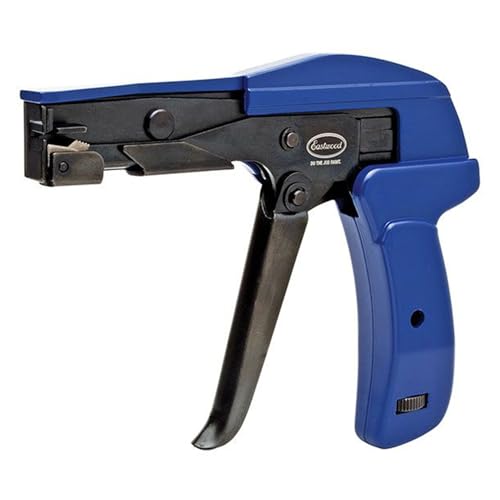
One squeeze and the tail is gone — no sharp edge left behind.
If you are wiring a harness or bundling cables where the finish shows, the Eastwood is built for the look as much as the job. One quick squeeze fastens and cuts the tie, and the adjustable tension keeps you from crimping the wires or overtightening the tie. It handles cables up to 1/4 in. wide, and the all-metal construction with a lightweight aluminum alloy cover gives it a solid heft at 11.5 ounces without feeling clumsy.
Owners describe it as a pro-quality tool that pulls ties tight and cuts them off flush. The solid metal body with minimal plastic draws praise, and the clean cut and working tension adjustor keep it in steady rotation. It earns its place on finish work: one squeeze leaves a flush tail, so a routine cable bundle looks finished.
The obvious limit: 1/4 in. wide cables are the ceiling, so the widest heavy-duty ties will not load. And if you do not set the tension carefully, you can pull a thin tie to the breaking point. Set the tension light and run a test tie before you commit, or thin ties will snap.
Built for finish work: the all-metal construction and flush cut point suit anyone who cares more about the look of a finished bundle than raw speed.
Set it before you pull: the adjustable tension needs a deliberate hand or thin ties will snap.
Go with this: wiring harnesses and visible cable runs where a clean, flush tail matters.
Step up elsewhere if: your ties run wide — this one tops out at 1/4 in.
6. Klein Tools 86570 Tie Tensioning Tool

Built to tension up to 65-Pound of pull on ties rated 120 to 250-Pound.
This is the tool for the big ties — the ones rated 120 to 250-Pound that hold equipment, duct runs, and heavy bundles. It tensions up to 65-Pound (29.5 kg), and the maximum tie width of 15/32-Inch (1.2 cm) takes wide heavy-duty ties that the small pistol-grip guns simply will not close around. You feed the end of the tie through the tip of the tool, squeeze, and the tail cuts flush with the head, leaving no sharp edges like diagonal cutters do.
Tension is the thing owners praise most, and it is easy to see why on the heavy work: it pulls consistent tension without slipping, and the blade cuts easily. The handle grips add comfort for repetitive use, and the build feels solid. For electricians, HVAC, automotive, and industrial work, it stops the guesswork of overtightening or leaving a tie loose. The short orange handle goes nearest the tie, and one light pull clips the tail clean.
Keep it within its 120 to 250-Pound tie rating and it pulls consistent tension without slipping. Push past it and it pushes back — heavier ties beyond the slot need real force or modification to fit, and the durability verdict is mixed, with a share of owners finding it fails sooner than expected. And because it pulls hard, cheap ties can snap under the pressure, so pair it with ties rated for the job.
Where it delivers
- Tensions up to 65-Pound (29.5 kg) on ties rated 120-250-pounds (54.4 to 113 kg).
- Cuts the tail flush with the head, no sharp edges.
- Handle grips keep repetitive use comfortable.
- Maximum tie width of 15/32-Inch (1.2 cm) takes wide heavy-duty ties.
The honest limits
- Cheap ties can snap under the strong pull.
- Ties heavier than its slot need force to fit.
- Some owners mention early durability issues.
Made for you if: heavy-duty ties and consistent tension are your daily reality in electrical, HVAC, or industrial work.
skip it if: you only run thin nylon ties or want a gun for stainless steel.
7. Malco TY6 Flex Duct Cable Tie Tensioning Tool
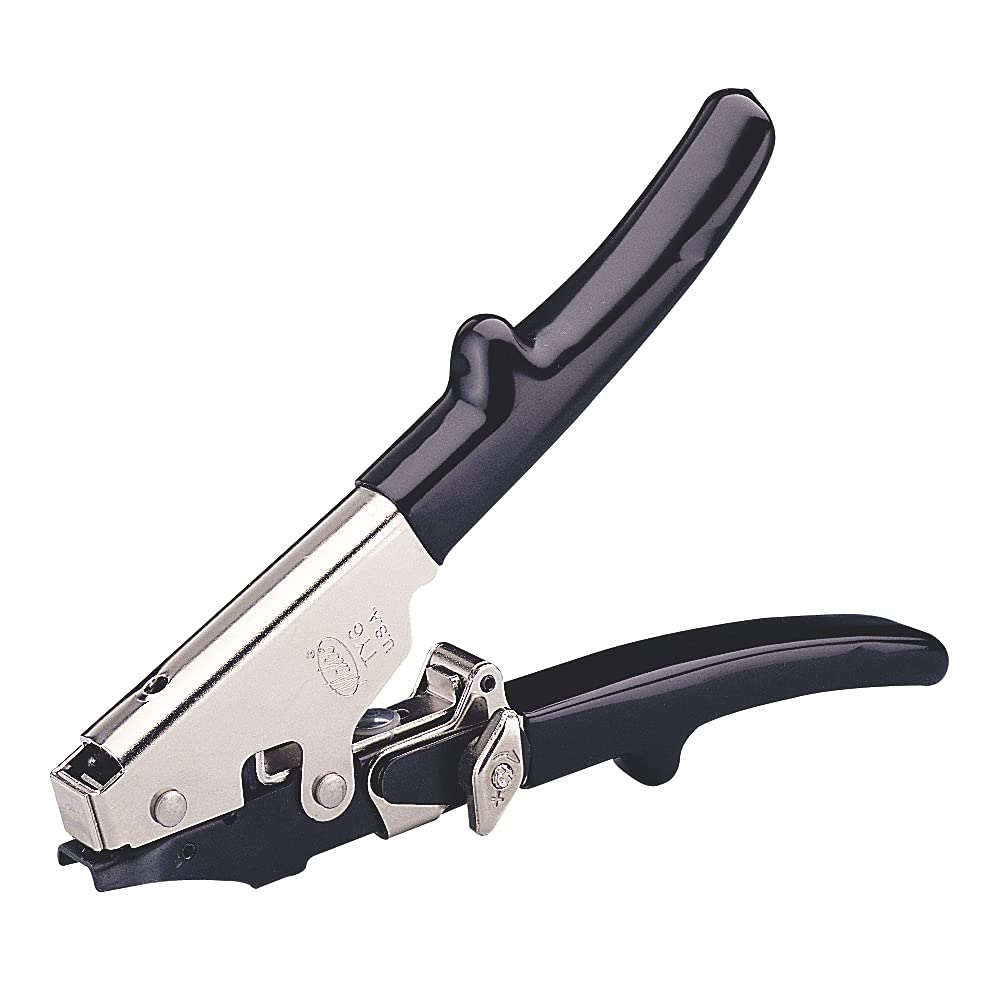
Set the tension once, then tension and trim every collar in a single squeeze.
Overhead ductwork is where this tool separates itself from a manual cutter. The TY6’s breakaway spring (a spring that lets go at a set pull) releases the lower handle the moment your preset tension is reached, firing the blade to flush-cut the tail in the same motion — no second step, no separate snips, no fumbling with a collar while you balance. The finger-operated adjustment knob lets you dial in the exact pull so you do not crush the flex duct lining, and set it once per job and every tie gets the same consistent cinch.
It accepts both standard 175 lb ties and thinner 125 lb ties without adjustment, covering flex duct collars, bundle securing, and equipment tie-downs. The contoured vinyl cushion grips with built-in hand stops minimize fatigue over a large install, and at 8-1/2 inches long and 15 oz. it balances comfortably in hand without the bulk of bigger tensioning tools. The hardened steel stampings and internal parts wear well, and the nickel chrome finish holds up in attics, crawlspaces, and outdoor mechanical rooms.
The thing to learn is the tilt. Owners find the cutter can clip a tie too short if you tilt it toward the inside of the tie head, so angle it the other way and the tie stays put. The strap tightening itself gets mixed reports, with some finding it cuts the tie too far, and the tension knob has been reported to turn stiffly on a rare unit from the start.
The overhead advantage: the auto breakaway blade means one squeeze does the whole job — tension, then cut — which is exactly what you want at 120 degrees in an attic.
Mind the angle: keep the cutter tilted away from the inside of the tie head, and it trims clean without releasing the tie.
Pick this for: HVAC flex duct installs and any repetitive overhead tie job where a one-step tool saves your arms.
Hold off if: you want a simple manual cut-off you control every time — the auto blade takes the decision away.
Know the Specs
Maximum tie width
This is the single number that decides whether a gun will even load your ties. It is the widest tie the jaws can close around, and it is usually given in millimeters or fractions of an inch. A tool rated for narrow ties will simply not accept a wide heavy-duty tie — the Eastwood tops out at 1/4 in., while the Klein takes a maximum tie width of 15/32-Inch (1.2 cm). Check your widest tie before you buy.
Tension and tie rating
Tension is how hard the tool pulls before it stops, and the tie rating is how much pull the tie itself can take. They need to match. A tensioner that pulls very hard will snap a cheap thin tie, while a light pull will not seat a heavy-duty tie on a duct collar. The Klein tensions up to 65-Pound on ties rated 120 to 250-Pound, and the Malco TY4G runs 125 lb and 175 lb ties — pair the tension to the tie, not the other way around.
Automatic vs manual cut-off
Automatic means the blade fires on its own the instant your preset tension is reached, which is fast on repetitive jobs. Manual means you pull a handle or squeeze to engage the blade, so you get a final say on the cinch. The Malco TY6 runs the automatic route; the TY4G is manual. Automatic trades control for speed; manual trades speed for control.
Stainless vs nylon tie material
Stainless steel ties are metal, so they need a gun with a hardened metal-cutting blade and jaws that grip steel — the OFFO and IWISS tools are built for this, and the IWISS installs 316SS ties. Nylon ties are soft plastic, so they need a tensioner that pulls smoothly without cutting through — the Malco and Klein tools are nylon-rated. A steel-tie gun chews soft nylon, and a nylon tensioner has no teeth for metal — match the tool to the tie.
Common Questions
Can I use a stainless steel tie gun on regular nylon zip ties?
What does maximum tie width mean and why does it matter?
Will a zip tie tightener cut the tie too short and make it slip?
Do I need adjustable tension on a cable tie gun?
Can a zip tie tightener cut stainless steel cable ties?
What is the difference between a manual and automatic cut-off?
Will a heavy-duty tensioner break cheap zip ties?
How long should a zip tie tightener last?
Can I use a cable tie gun for exhaust heat wrap and CV boots?
Is a pistol-grip tie gun better than a plier-style tool?
The Bottom Line
For most people, the zip tie tightener winner is the Malco TY4G because its adjustable tension knob and manual cut-off give you full control over nylon ties rated 125 lb and 175 lb, and it is built from hardened steel with a lifetime warranty. If you work stainless steel ties outdoors, grab the OFFO Metal Cable Tie Gun for its SKD11 steel blade (a hard-wearing blade steel) and clean automatic cut. And for overhead flex duct installs where you need one squeeze to tension and trim, the Malco TY6 is the one to reach for.
How we choose
We do not accept paid placement. Every pick is matched to a real buyer and a real use-case; we do not hands-on test units.
Sources
Specifications: manufacturer listings and product documentation. Review insights: verified customer reviews, as of October 2026. Pricing: not shown on this page (it changes often); check the current price via the retailer link.
As an Amazon Associate, Home Digitized earns from qualifying purchases. This does not affect which products we feature.