
Specs are compiled from manufacturer listings and verified buyer reviews and can change over time — please confirm the key details on the product page before buying.
Most tiny phones sell you a cute shape and forget the basics, so this guide separates the ones that genuinely make calls, run apps, and survive daily pocket duty from the ones that turn into desk toys. You will see exactly which mini handsets fit a child, a backup bag, or a screen-time reset, and where each one honestly falls short.
This guide is built by comparing the manufacturers’ published specifications and the patterns across verified customer reviews, so you get each pick’s real strengths and trade-offs instead of marketing spin.
Two things decide whether a mini phone works for you: your carrier’s supported bands, and whether the screen is big enough to type on. Here is how to pick the right one without wasting a return label.
Top Picks


How To Choose The Best World’s Smallest Phone
Buying a tiny phone starts with your carrier’s bands, not the spec sheet. Get the network bands right and almost everything else is preference; get them wrong and the phone becomes a Wi-Fi-only gadget.
Check the network band before anything else
A phone’s cellular technology tells you which generation of network it can join — 3G is the older standard, 4G the newer one. Many US carriers have retired 3G, so a 3G-only handset may never activate no matter how good the hardware is. Match the model’s listed bands to your carrier’s supported bands first.
Decide screen size and how you will type
These screens run from 2.5 inches up to 3.9 inches, and a smaller panel is harder to type on with adult fingers. If texting is the main job, look at the larger end or plan on voice-to-text and a stylus. Pixel density matters too: the more pixels per inch, the sharper the text looks at this size.
Match battery capacity to how you will use it
Battery capacity in mAh tells you the size of the fuel tank, and on a tiny screen even a modest tank goes far when the phone mostly idles. A handset used for calls and standby lasts much longer than one streaming video. Decide whether this is your only phone or a companion device, then size the battery accordingly.
Know the job: kid, backup, or screen-time cut
One mini phone can serve as a child’s first device, a travel-bag emergency handset, or a screen-time cut. Each job wants something different: kids need durability and easy setup, backup users want the widest band support, and focus seekers want full app access without a big screen to get lost in.
Side-by-Side Comparison
| Model | Best For | Screen | Battery | Network | Amazon |
|---|---|---|---|---|---|
| open up Mini Smartphone 2.5 Inch★ Best Overall | Smallest pocket footprint | 2.5 in, 480×320 | 1000 mAh | 3G | Amazon |
| Mini Smartphone XS15Kid Favorite | Kids and fun first phone | 3.0 in HD | 1000 mAh | 3G | Amazon |
| 3.88-Inch Mini SmartphoneBiggest Small Screen | Biggest screen in the small tier | 3.88 in, 854×480 | 900 mAh | 3G | Amazon |
| Mini Smartphone 2.5 Inch Android | Budget Wi-Fi backup | 2.5 in | 1000 mAh | 3G | Amazon |
| Cutwif Mini 4G | Longest talk time | 3.0 in HD | 2600 mAh | 4G | Amazon |
| Mini 4G Smartphone 3+32GB | Sharper screen and more storage | 3.0 in HD, 301 ppi | 2600 mAh | 4G | Amazon |
| Mini Phone 4G 32G | Kid-safe 4G with expandable storage | 3.7 in HD | 2000 mAh | 4G | Amazon |
| Palm Phone PVG100 | Full-size feel in a wallet-sized shell | 3.3 in | — | 2G/3G/4G | Amazon |
| Unihertz Jelly Star | Full smartphone power, tiny body | 3.0 in, 854×480 | 2000 mAh | 4G | Amazon |
Detailed Reviews
1. open up Mini Smartphone 2.5 Inch
The smallest handset here, and the one that asks the most of your carrier.
If your only goal is a phone that disappears into a coin pocket, this 2.5-inch body delivers. At just 1.8 oz it is lighter than most keychains, and the 480×320 display is enough for calls, texts, and a little browsing. It ships with a case, screen protector, SIM tray ejector, and USB cable, so it is ready to set up from the start.
The catch is the network. This is a 3G handset that pairs with GSM carriers and GSM SIM cards only, and it will not work with CDMA carriers or on 4G. Buyers report that “This phone has no SIM card and I had to return it ASAP” — the SIM card is not included, so you must supply your own compatible one. Before you order, confirm your carrier still runs a GSM 3G band this phone can join.
Under the glass it runs a quad-core chip with face recognition for open up, Bluetooth, Wi-Fi, and a USB Type C port. The nano-molded body has a dull, fingerprint-resistant finish that feels more solid than the price tier suggests. Treat it as a minimalist calls-and-texts device and it delivers; expect a modern app-heavy experience and you will be disappointed.
What it nails
- The smallest screen and body on this list — 2.5 inches at 1.8 oz
- Accessories included: case, screen protector, cable, and ejector
- Face open up, Wi-Fi, and Bluetooth in a genuinely pocketable shell
Where it bites
- 3G and GSM only — no 4G, and no CDMA carrier support
- No SIM card in the box, so you must source a compatible one
Go for it if: you want the absolute smallest footprint and can confirm GSM 3G coverage in your area.
Look elsewhere if: your carrier has moved past 3G or you use a CDMA network — this phone cannot join either.
2. Mini Smartphone XS15
A 3-inch Android built to be handed to a child, with a battery bigger than the smallest pick.
The XS15 pairs a 3.0-inch HD screen with 2GB of memory and 16GB of storage, which is enough for the basics: music, video, voice and video calls, email, Bluetooth, and the Google Play Store. The loud speaker is a genuine plus for TikTok-style video, and it ships with a tempered film and silicone case already in the box.
Set expectations around reliability, though. Amazon’s buyers find the story split between units that work and units that will not power up, and the quality feedback is similarly mixed. The maker’s own note is telling: use a 5V charging plug, because too high a power plug may not charge it. Parents say kids two and four took to it, and the “adorable” form is the main draw for school-age children.
This is a 3G dual-SIM handset, so check your carrier’s bands before buying a SIM — the listing lists WCDMA B1/B3/B5/B8 and GSM 850/900/1800/1900, and warns some US bands are not compatible. Android 8.1 runs the basic apps but is not built for games. As a first device with real call and video-chat function, it is a sensible pick; as a daily driver, it is not.
What parents get: a genuine Android 8.1 handset with dual SIM, a memory card slot, and a case in the box, so a child can watch and call without borrowing your phone.
The honest snag: reliability is a coin flip across reviews, so buy it as a gift or backup and test it thoroughly on arrival.
Reach for this if: you want a cute, cheap Android to keep a kid occupied and connected.
Think twice if: you need it to work as your own daily phone — the reliability reports are too mixed for that job.
3. 3G Mini Smartphone open up
The largest display in the miniature class, if typing comfort matters more than raw tininess.
At 3.88 inches, this is the biggest screen among the truly mini phones here, and its 854×480 resolution keeps text legible on a panel this small. That extra real estate makes texting and browsing noticeably less fiddly than a 2.5-inch panel. It runs Android with 2GB of memory and 16GB of storage, adds dual SIM and expandable memory, and charges over USB Type C.
The 900mAh battery is the smallest cell here — under the XS15’s 1000mAh — so it suits standby and calls better than heavy video. What wins people over is the look: the listing’s aesthetic appeal is the top positive theme in buyer feedback, and it reads as a cute, well-finished little handset for a child or a student. It has front and rear cameras and face recognition too.
The real limit is activation. Multiple buyers describe a handset that could not be activated on their network even months after purchase, so treat carrier compatibility as a deal to verify before you buy. Google Play is also not certified here, which means banking apps and some others will not download. As a kid’s first phone or a Wi-Fi-heavy mini device, it earns its keep; as a locked-down daily driver, it will fight you.
What stands out: a 3.88-inch 854×480 display that is the roomiest of the mini bunch, plus dual SIM and a memory card slot.
The practical caveat: no Google Play certification means banking and some apps are off the table, and activation can be a battle.
Best suited to: a child or student who wants a bigger screen in a small body and won’t need banking apps.
Steer clear if: you need certified Google Play or a guaranteed quick activation on your carrier.
4. open up Mini Smartphone 2.5 Inch 2G+16G

The cheapest way to test whether a tiny phone fits your life at all.
Here is a 2.5-inch Android with 2GB of RAM and 16GB of storage, a 5.0MP camera, and a 1000mAh battery — the same cell capacity as the small phone up top, in a body that fits a palm. It runs the Google Play Store, so Facebook, YouTube, Instagram, and TikTok are all on the menu, and it supports GPS, FM radio, Bluetooth, dual SIM, and a memory card slot. For a cycling bag or a hiking pack, the lightness is the whole point.
How long the battery lasts depends on how you use it. The maker’s listing and buyer reports disagree — some owners mention four days on an overnight charge when used Wi-Fi-only, while others call battery life poor and switch to airplane mode. That gap usually depends on apps and signal, so keep it lean and it lasts. The touch screen is small enough that a stylus is the realistic way to type, and customers note call sound stays clear.
Before you commit, know that this is a 3G phone and some SIM cards simply will not work with it, which is the most common complaint. The best use case is a Wi-Fi-only emergency device for a child, or a secondary handset in a go-bag. For that, the compact size and low entry point make sense; as a primary phone, it will frustrate.
Solid selling points
- Full Google Play access with 2GB RAM and 16GB storage
- Light enough for a cycling or hiking bag, with GPS and FM radio
What to weigh
- Reports on battery life swing widely between owners
- 2.5-inch touch screen is a struggle to type on without a stylus
Worth trying if: you want a tiny Wi-Fi backup for a child or travel bag at the lowest entry point.
Pass on it if: you need reliable SIM-card activation and full-day battery for real daily use.
5. Cutwif Mini 4G Smartphone

A 4G mini phone with a battery that actually keeps up.
You get the longest battery here: a 2600mAh cell (milliamp-hours, the measure of battery capacity) — the biggest in this round-up and more than double the 1000mAh in the 2.5-inch pick. The maker quotes up to 120 hours of talk time and roughly four days of average use, so a weekend trip can go charger-free. Add a 3.0-inch HD screen and 2GB of memory plus 16GB of storage, and this is the small phone for someone who wants to actually stay reachable. It supports 4G FDD and TDD bands (two 4G frequency types) alongside 2G and 3G, so check your carrier’s list against the band table in the listing before ordering.
Reviewer experience is mixed on the hardware. Some love the compact shell and call it a great first phone for young kids, while others report it stopping after a few weeks. One buyer put it plainly: “To me, it’s too narrow to use, even with a stylus. Should be a little wider.” That narrowness is the recurring trade-off — texting is hard with large fingers, so plan on voice-to-text. It ships with a clear case and screen protector, which helps.
If you want a small 4G handset for a child’s first call-only device or a light backup, the battery advantage and dual-SIM support are real. If you want a compact phone as your main driver, the reliability mixed picture makes it a gamble. Verify carrier support like you would for any mini phone.
Battery is the pitch: a 2600mAh cell with up to 120 hours of quoted talk time makes this the longest-lasting mini in the round-up.
Size the trade-off: the narrow body fights adult thumbs, and some units have stopped working within weeks.
Fits best when: battery life matters most and you want a 4G mini for a beginner.
Look past it if: you need a long-lived primary phone or do a lot of two-handed typing.
6. Mini 4G Smartphone open up 3+32GB

More storage and a crisper panel than most minis, in a pink shell that stands out.
You get room for more apps and photos here: 3GB of RAM (working memory) and 32GB of storage, double the 2GB and 16GB on the XS15 and the 3.88-inch pick. The 3.0-inch HD display also hits 301 pixels per inch (pixels packed into each inch of screen), so text is sharper than on the lower-density minis — small print stays readable without zooming. It carries a 2600mAh battery, the same capacity as the Cutwif above, and runs 4G on the listed FDD and TDD bands.
What reviewers point out lines up: people find it cute and suitable for kids and adults, but several note it is quite slow. One owner describes it as “little and cute” and easy to hook up to T-Mobile, up until the screen went black. That is the pattern with this class of phone: workable setup, mixed long-term durability. It ships with a protective silicone case, manual, and USB Type C cable.
If you want the best-specified mini under the premium tier — more storage than most, sharper than most small screens — this is the one to shortlist. If you want fluid app switching, it will feel sluggish next to the Unihertz. Its 4G band support also has to match your carrier, so confirm that first.
top-tier on paper
- 3GB RAM and 32GB storage — double most rivals on this list
- 301 ppi display is the sharpest small panel in the round-up
- 2600mAh battery and 4G support
What buyers mention
- Performance is described as slow for heavier apps
- Some units have failed after a few months of use
Great match for: someone who wants the most storage and the sharpest display in a tiny 4G package.
skip it if: you expect smooth, lag-free app performance or need proven long-term durability.
7. Mini Phone 4G open up 32G
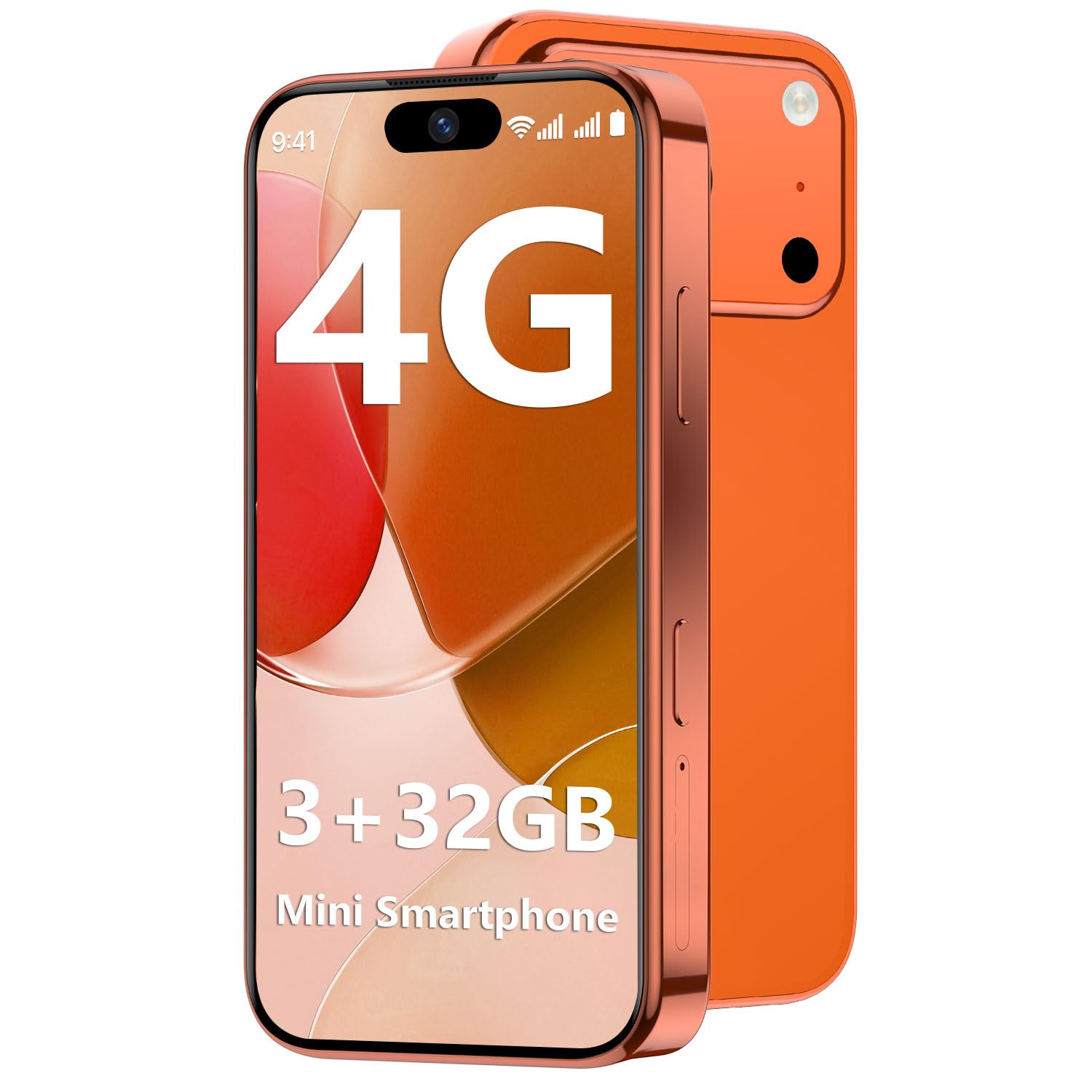
The kid-first mini with the biggest screen of the child-safe group and room to grow.
A 3.7-inch HD screen, 3GB of memory, and 32GB of storage pair with a 2000mAh battery here, plus microSD expansion up to 128GB for movies and school apps. The dual camera setup — a 5MP front and an 8MP rear — is more photography-friendly than the single-camera minis on this list. Dual SIM dual standby and 4G band support make it usable across more carriers, provided your SIM’s bands match the listing.
What wins people over is clearly the kid fit: quality and suitability for little hands are the most praised themes in buyer feedback. One reviewer praises it as a shirt-pocket Android that runs Google Play apps without lag, with solid battery and calls that never drop. The honest limitation is connectivity — several shoppers say the SIM cellular data does not work as expected — and a few find it not worth the money. Performance is also described as slow to load by some owners.
As a gift for a younger child or a compact backup for an adult who avoids large phones, this is a strong option, especially with the memory-card expandability. Treat the carrier data connection as something to verify on arrival, and it delivers. The stereo speakers and included case and screen protector are nice extras at this level.
Kid-focused spec sheet: 3.7-inch HD screen, 3GB RAM, 32GB storage, and microSD up to 128GB give a child room to grow without a big phone.
One real concern: cellular data connectivity is the weak spot in the feedback, so confirm it works before the return window closes.
Choose this for: a first phone for a young child who will use Wi-Fi more than mobile data.
Choose otherwise if: reliable SIM data is a must-have on day one.
8. Palm Phone PVG100

A credit-card-sized phone with full-size features, and a 3.5mm jack to boot.
This is the tiny phone for people who want the shape of a real smartphone, not a toy. It runs on 2G/3G/4G and supports dual front and rear cameras with 8MP front sensor, fingerprint open up, Wi-Fi, Bluetooth, and a 3.5mm headphone jack. Its 32GB of storage is fixed — there is no microSD slot — so plan your apps around that. It has a 3.3-inch touchscreen and is sold as a renewed unit.
Portability is the whole story: it fits in a watch pocket or a wallet and works one-handed. The honest limits are battery and storage. Streaming drains the battery fast and warms the shell, and the fixed 32GB fills quickly if you shoot photos. Owners describe it as a companion device that pairs perfectly with a monthly line, rather than a sole handset, and it has a fingerprint reader instead of a face sensor.
Carrier setup can be fiddly, and the SIM tray needs a finer pin than the included tool. For those who want a tiny, fully featured Android companion and don’t mind a renewed unit, this is a good fit. For heavy users who need all-day battery and lots of storage, look at the Unihertz instead.
What you get: a genuinely wallet-friendly 3.3-inch phone with full Android features, a 3.5mm jack, fingerprint open up, and 32GB storage.
Where it hurts: no microSD slot and a small battery that drains fast under streaming.
It suits: an adult who wants a tiny second phone for calls and texts with a real headphone jack.
It doesn’t suit: anyone who needs all-day video use or expandable storage as their only phone.
9. Unihertz Jelly Star

A full smartphone’s brain squeezed into a 3-inch transparent body with an LED light show.
This is the one to buy if you want small and capable rather than small and cheap. It runs Android 13 on an octa-core MediaTek Helio G99 processor built on a 6nm process (a more efficient manufacturing size, so it runs cooler and lasts longer on a charge). It carries 8GB of RAM and 256GB of storage — the most memory and space in this entire round-up and eight times the storage of the 2GB+16GB minis above. A 3.0-inch 854×480 display, 2000mAh battery, NFC, OTG, a 3.5mm jack, infrared port, and a dynamic LED notification light complete the package.
What owners praise most is the battery life — the phone holds up well through a day of average use, and fast charging covers the small cell. The build quality gets good marks and the screen reads as more colorful than expected. The fingerprint sensor needs a quick firm press, and the camera auto white balance can leave a yellow tint. It supports T-Mobile and Verizon only, and Verizon setup requires the maker’s forum or support steps, so check your carrier before you commit.
Compared with every other pick here, it is the only one that runs a current Android version and matches the performance of far larger flagships in daily app use. If you are cutting screen time while keeping full smartphone features, this is the pick that makes that trade without giving up apps. Buyers report “Love My Tiny Phone” — the volume button needs repeated presses and the camera can blur, but the ergonomics and pocketability win people over.
Why it’s the premium choice
- 8GB RAM and 256GB storage — the most of any mini here
- Octa-core Helio G99 and Android 13 with NFC and OTG
- 2000mAh battery, fast charging, and dynamic LED notifications
What to accept
- T-Mobile and Verizon only — check your carrier first
- Small fingerprint sensor requires a firm, quick press
- Camera white balance leans yellow in some shots
The pick for performance: you want a tiny phone that runs modern apps smoothly, with the most memory and storage here.
The trade you make: carrier support is narrow and the camera needs dialing in, so it isn’t for everyone.
Know the Specs
Battery capacity in mAh
Milliamp-hours measure the size of the phone’s fuel tank. A 900mAh or 1000mAh cell in a tiny body can last all day in standby but drains fast under video, while a 2600mAh cell gives noticeably more endurance. Match the capacity to your use: calls and standby need less; streaming and apps need more.
Screen size and pixel density
Screen size is the diagonal measurement of the display; pixel density (pixels per inch) measures how sharp it looks. On these mini phones, a 2.5-inch panel is hard to type on, while a 3.88-inch panel is roomier. Higher pixel density makes text and icons clearer at this size, which matters for reading and messaging.
Common Questions
Will a 3G mini phone still work on my US carrier?
Can these mini phones use a normal SIM card?
Is a mini phone good as a first phone for a child?
Can a tiny phone replace my main smartphone?
Do these mini phones support 4G data?
Will WhatsApp and other apps run on a mini phone?
How long does a mini phone battery really last?
Can I expand the storage on a mini phone?
Do mini phones have a headphone jack?
Is a renewed Palm Phone a safe buy?
The Bottom Line
For most buyers, the world’s smallest phone winner is the 2.5-inch open up Mini Smartphone because it packs a genuinely usable Android handset into the smallest footprint here, with a case, screen protector, and USB cable in the box. If you want a mini that lasts longer between charges, grab the Cutwif Mini 4G with its 2600mAh cell. And for the most capable tiny phone with real daily-driver power, the Unihertz Jelly Star — which carries the top rating in this round-up at 4.0+ stars from 100+ owners — is the one to reach for. Whatever you pick, confirm your carrier’s bands before checkout, and set your expectations around a companion device rather than a flagship.
How we choose
We do not accept paid placement. Every pick is matched to a real buyer and a real use-case; we do not hands-on test units.
Sources
Specifications: manufacturer listings and product documentation. Review insights: verified customer reviews, as of October 2026. Pricing: not shown on this page (it changes often); check the current price via the retailer link.
As an Amazon Associate, Home Digitized earns from qualifying purchases. This does not affect which products we feature.