
Specs are compiled from manufacturer listings and verified buyer reviews and can change over time — please confirm the key details on the product page before buying.
If your knife crushes a tomato instead of slicing it, the problem is the blade, not your technique. The short answer: a good chef’s knife is the one that stays sharp after months of onions, feels balanced where your fingers grip it, and doesn’t need a whetstone every week. Below you’ll find nine 8-inch chef’s knives — Japanese and German styles — with the real steel, real weights, and real trade-offs spelled out in everyday language.
This guide is built by comparing the manufacturers’ published specifications and the patterns across verified customer reviews, so you get each pick’s real strengths and trade-offs instead of marketing spin.
Some knives here cut with a delicate Japanese edge, others bring German heft that shrugs off squash and bone-in chicken. You only need one of them — the one that matches how you actually cut. Read on to see how each blade holds up, starting with the crowd favorite at 4.5+ stars across 9,000+ owners, and use this breakdown of the world’s best knife shortlist to choose your forever blade.
Top Picks


How To Choose The Best Chef’s Knife
Almost every chef’s knife on this list is 8 inches long — and that’s not a coincidence. An 8-inch blade gives you enough length to slice a whole cabbage in one draw, but it still fits comfortably on a crowded cutting board. Before you compare brands, get clear on the four things that separate a knife you’ll love from one that ends up in the drawer.
Steel and hardness: what your edge can and can’t take
Hardness is measured on the Rockwell scale (HRC) — a rating of how well the steel resists bending and dulling. A Japanese blade in the high 60s HRC holds a razor edge for a long stretch, but it’s also more brittle, so you shouldn’t chop through bone or frozen food with it. German steel tends to sit in the mid-to-high 50s, trading a little top-end sharpness for toughness you can lean on. Pick the harder steel if you mainly slice and want surgical cuts; pick the tougher steel if you chop hard produce and want wiggle room.
Stamped versus forged construction
A stamped knife is cut from a sheet of steel, so it feels lighter and often costs less. A forged knife is shaped from a single block of heated steel, so it usually feels heavier and has a heavier bolster (the thick metal collar between blade and handle). Forged knives tend to feel more substantial and balanced in your hand; stamped knives tend to feel nimble and cost less. Neither is automatically better — it depends on whether you like a little weight behind your cuts.
Edge angle, balance, and how the handle grips
The edge angle — how steeply the blade tapers to its cutting line — runs from around 15 to 16 degrees on German knives to roughly 9.5 to 12 degrees on Japanese ones (both found in the specs above). A narrower angle slices cleaner but dulls faster, so it needs more careful honing. Balance matters just as much: a knife that’s balanced right where your fingers sit reduces the wrist work of a long prep session. And a textured or synthetic handle that stays grippy when wet keeps the knife steady even when your hands are slick with onion juice.
Side-by-Side Comparison
| Model | Best For | Blade Length | Construction | Item Weight | Amazon |
|---|---|---|---|---|---|
| Victorinox Fibrox Pro Chef’s Knife★ Best Overall | Everyday kitchen workhorse | 8 inches | Stamped | 8 ounces | Amazon |
| KYOKU Chef Knife Shogun SeriesBest Value | Sharp Damascus look | 8 inches | Forged | 1.4 pounds | Amazon |
| Wüsthof 8″ Gourmet Chef’s KnifeEveryday Slicer | Light everyday slicing | 8 inches | Stamped | 240 g | Amazon |
| SHAN ZU Damascus Chef Knife | Serious edge retention | 8 inches | 91 Layers Hand Forged Damascus Steel | 220 g | Amazon |
| Shun Classic 8″ Chef’s Knife | Thin Japanese precision | 8 inches | Forged | 206 g | Amazon |
| ZWILLING Professional S 8-inch | Heft and control | 8 inches | Forged | 277 g | Amazon |
| Wüsthof Classic Ikon 8″ | Sharpening-friendly balance | 8 inches | Forged | 9.6 ounces | Amazon |
| Miyabi Kaizen II 8-inch | Japanese edge, daily driver | 8 inches | Forged | 7.04 ounces | Amazon |
| Miyabi Birchwood SG2 8-inch | Showpiece precision | 8 inches | Forged | 1.2 pounds | Amazon |
Detailed Reviews
1. Victorinox Fibrox Pro Chef’s Knife, 8 Inch
Our pick — 4.5+★ from 9,500+ verified ratings; the strongest balance of quality and price.
The no-drama workhorse: an extra-wide 8-inch blade, a wet-grip Fibrox handle, and dishwasher-safe cleanup.
The Fibrox Pro earns the top spot because it gets the fundamentals right without asking you to fuss over it. Its 8-inch high-carbon stainless blade is extra-wide, so a single rocking motion carries a whole onion through the cut. The thermoplastic rubber handle — Fibrox is Victorinox’s name for that textured grip — stays nonslip even with wet hands, which matters when you’re dicing tomatoes at speed. At 8 ounces it’s light in the hand and long enough at 13.4 inches overall to reach across a full cutting board.
What wins people over is that it behaves like a tool, not a trophy: it comes out of its own sheath, handles a mountain of meal prep, and goes in the dishwasher. It comes out of its own sheath, handles a mountain of meal prep, and — unusually for fine cutlery — it’s dishwasher safe, so cleanup doesn’t turn into a ritual. Swiss made, stamped construction, plain edge, and a price that sits comfortably at the value end of this list. That mix of low price, wet-hand grip, and dishwasher-safe cleanup is why 9,000+ owners rate it 4.5+ stars.
Where it shines
- Textured Fibrox handle stays grippy with wet or oily hands.
- Extra-wide 8-inch blade rocks through big vegetables cleanly.
- Dishwasher safe — rare for a knife this good.
- 8 ounces keeps long prep sessions from tiring your wrist.
What to keep in mind
- Plain stainless steel won’t hold a razor edge as long as high-HRC Japanese blades.
- Stamped build feels lighter and less substantial than a forged German knife.
Reach for this if: you want one dependable knife for everyday chopping, dicing, and slicing with zero maintenance drama.
Think twice if: you want a showpiece blade with a hand-forged Damascus finish — this is a working tool, not a display piece.
2. KYOKU Chef Knife – 8″ Shogun Series
Hand-forged Damascus looks with a real VG-10 core — and a sheath in the box.
The Shogun Series is for the cook who wants Japanese-style steel without the top-tier spend. Its core is VG-10 — a stainless steel that holds an edge well — wrapped in 67 layers of Damascus cladding and treated for hardness of 58-60 HRC. The edge is sharpened to an 8 to 12 degree angle using the traditional three-step Honbazuke method, so it arrives ready to shave. Forged construction gives it real heft: it weighs 1.4 pounds and runs 13.2 inches overall, just under the Victorinox’s 13.4 inches.
Owners find it cuts with almost no resistance. As buyers put it: “This knife is very sharp and high quality. Big upgrade from my previous knife. Cuts through onions like they’re nothing.” The fiberglass handle with its signature mosaic pin shrugs off heat, cold, corrosion, and moisture, and the included sheath and case keep the blade protected between uses. One fair caution from longer-term owners: the handle can get slick when wet — dry your grip before heavy chopping.
Straight from the block: the steel and the finish punch above the price, and the protective case makes it gift-ready.
The honest catch: it’s noticeably heavier than the German knives further down, so if you prefer a featherweight blade, size your expectations.
Who it suits: cooks who want Damascus beauty and a keen VG-10 edge on a sensible budget.
Who passes: anyone who wants a light, stamped knife or dislikes a weighty handle in the hand.
3. Wüsthof 8″ Gourmet Chef’s Knife
German pedigree in a light, laser-cut blade built for daily chopping.
This is the entry point into Wüsthof — a family company that’s run seven generations out of Solingen, Germany. The Gourmet trades the brand’s forged heft for a laser-cut stamped blade, which keeps the weight down at 240 grams and makes it a comfortable everyday slicer. The polypropylene handle resists fading, discoloration, heat, and impact, so it won’t look tired after a year on the counter. It also carries a limited lifetime warranty.
What buyers consistently note is that this blade stays sharp longer than they expect at this level. A cook of 15 years found it perfectly balanced right at the joint where blade meets handle — the upshot being less wrist fatigue over a long prep session. It glides through butternut squash and slices tomatoes without crushing them. It’s not as thick a spine as the forged Wüsthofs, so for cracking through the toughest jobs you’ll still prefer a heavier blade.
What stands out: the light 240 g weight makes it an easy all-day knife, and the German build holds up to regular honing.
The trade-off: it must be hand-washed to protect the edge — no running it through the dishwasher like the Victorinox.
A smart pick for: cooks who want German quality without a heavy blade dragging on their wrist.
Skip if: you chop bone or frozen food regularly — this blade isn’t built for punishment.
4. SHAN ZU Damascus Chef Knife, SG2 Powder Steel
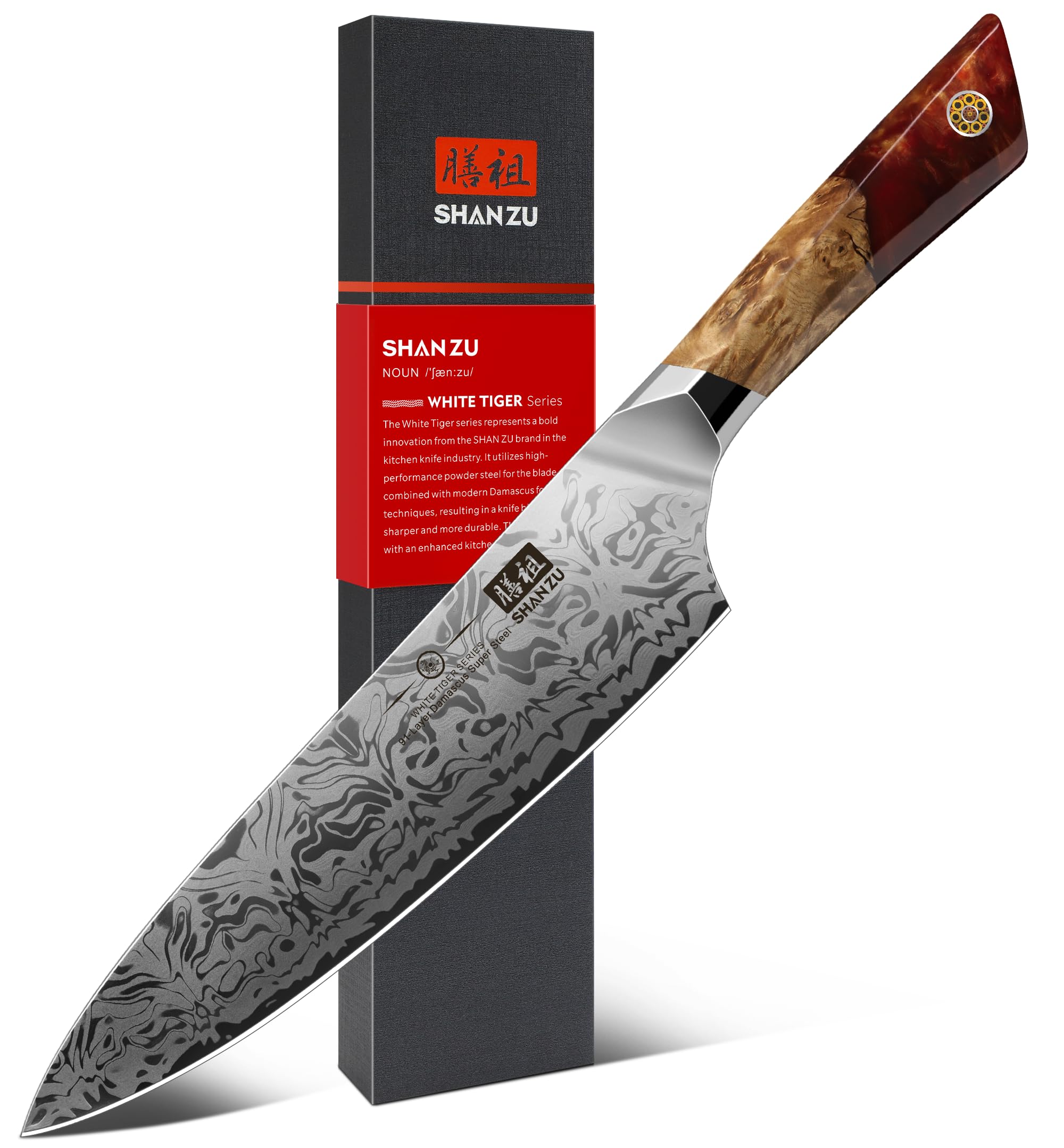
A 64HRC powder-steel edge that stays surgical through heavy shifts.
The number that defines this knife is 64HRC — a hardness rating high even among Japanese knives. That comes from a Japanese SG2 powder-steel core paired with a 12-degree cutting angle, so the edge is fine enough to make clean cuts through vine-ripe tomatoes. Around that core sit 91 layers of hand-forged Damascus, layered and heat-treated until the pattern forms, which also adds rust resistance and toughness. The maple handle is fused with resin and finished for grip, and it’s one of the lighter premiums here at 220 grams.
This one earns its place with people who cut for a living. It’s been used commercially 10 to 12 hours a day and still holds its edge, with a professional sharpener rating the steel top-notch for how well it keeps and restores an edge. The forge-to-table look — described as elegant and solid, almost like a jewel-handled artifact — doesn’t hurt either. It arrives with a gift box and carries a 5-year warranty.
The real draw: 64HRC hardness plus a 12-degree edge means serious edge retention for daily slicing and dicing.
The fine print: high hardness means you should keep it away from bone and frozen food, and it’s a premium-tier buy.
Reach for it if: you slice and dice a lot and want a hard, fine edge that stays razor through long sessions.
Leave it if: you need a knife for heavy, brutal chopping instead of precision work.
5. Shun Classic 8″ Chef’s Knife
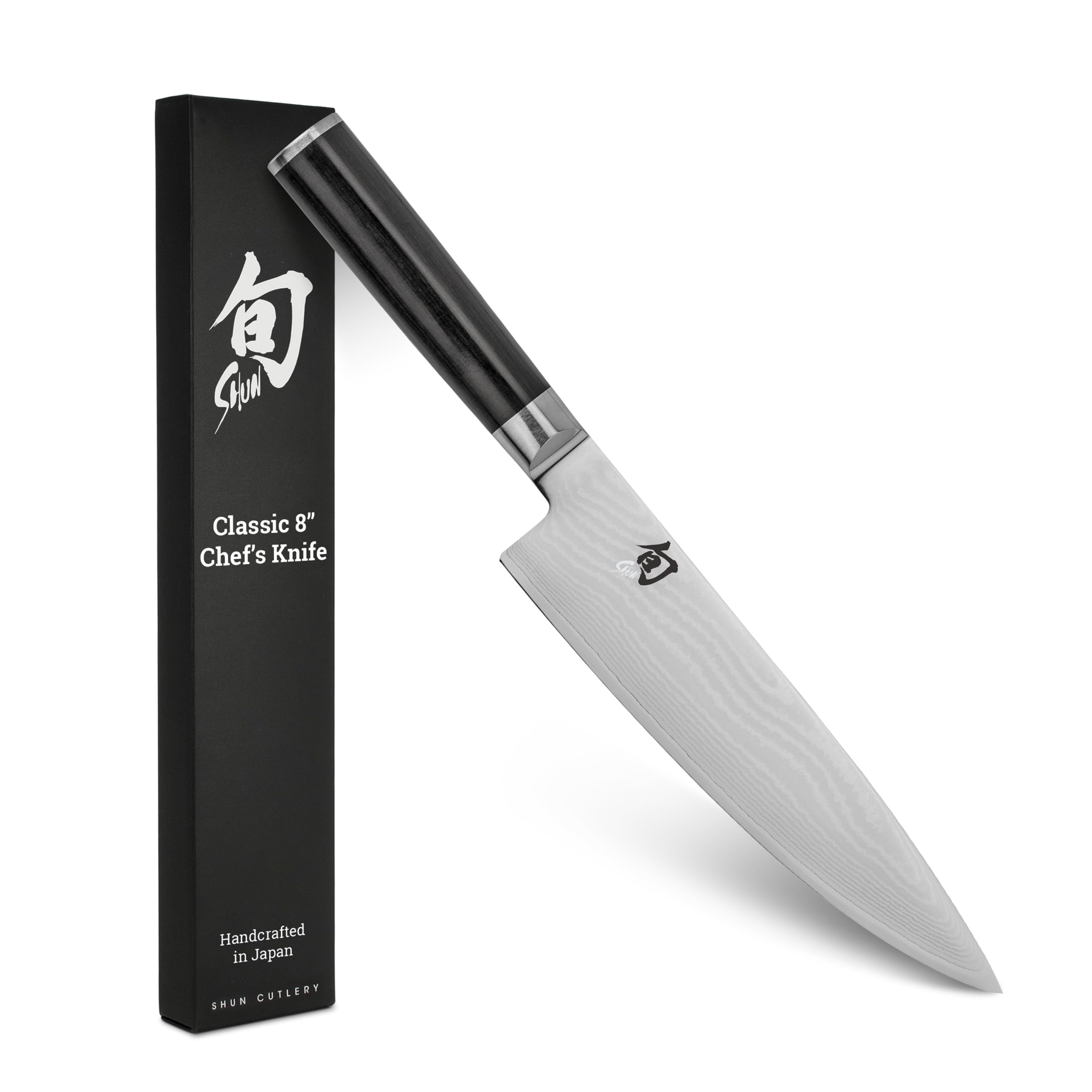
The thin, featherlight Japanese blade that turned a whole country onto Damascus.
Shun introduced this style to American kitchens, and the Classic still defines it. At 206 grams it’s among the lightest knives here, and its VG-MAX steel core is wrapped in 68 layers of Damascus cladding, honed to a 16-degree edge. The D-shaped Pakkawood handle — a laminated wood composite — is built to feel right in either hand, and the blade is handcrafted in Japan. If you’ve never held a thin Japanese blade, the difference is immediate: it slices rather than pushes.
Sharper than a German knife right from the start is the common experience, especially on tomato and sausage skin where a thin edge matters most. The trade-off is delicacy. Owners describe the blade as noticeably thinner and best kept away from abuse by bones and frozen food — treat it as a precision instrument. Hand washing and drying after each use keeps the edge and finish in top condition. Free sharpening and honing back this one up over the long haul.
What buyers love
- Ultra-sharp 16-degree edge slices cleanly with light pressure.
- At 206 g it stays light and balanced through a long prep.
- Free sharpening and honing from the maker.
Know before you buy
- The thin blade is delicate — don’t chop through bone or frozen items.
- Must be hand-washed and dried; it’s not built for the dishwasher.
Best matched to: cooks who prize a thin, light Japanese edge and don’t mind a little careful handling.
Look elsewhere if: you want one tough blade you can chop anything with.
6. ZWILLING Professional S 8-inch Chef’s Knife

Heft, control, and a German edge that holds up to daily chopping.
The Professional S is for the cook who likes to feel the weight of the blade doing the work. Forged from a single piece of high-carbon stainless steel, it comes in at 277 grams — the heaviest here — with a three-rivet polymer handle bonded securely to the full tang (the strip of steel running through the handle). The blade is ice-hardened and rated 57 Rockwell (a hardness scale for steel), with a 15-degree edge sharpened for both sharpness and durability.
The balance is the headline: owners say the 277 g weight sits right where you pinch the bolster, so it slices cherry tomatoes paper-thin. Backed by a made-in-Germany build and special-formula steel the brand has refined for close to three centuries, it handles everything from a pile of onions to heavier prep work. The catch is that satisfying heft — if you prefer a light, quick knife, this one will feel like more tool than you want.
Why cooks choose it: the 57 HRC forged blade and 277 g weight give a stable, controlled cut with excellent edge retention.
The honest note: it’s heavy and premium-tier, so it’s best for cooks who like a substantial blade rather than a featherweight.
The right fit: serious home cooks who want a balanced, hefty German blade they’ll reach for daily.
Not the one for: anyone who wants a light knife or cuts for hours and prefers less weight in hand.
7. Wüsthof Classic Ikon 8″ Chef’s Knife
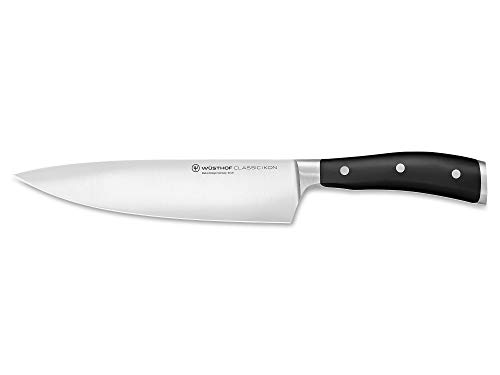
A forged German knife with a partial bolster that’s easier to keep razor-sharp at home.
The Classic Ikon is for the cook who wants German toughness but also wants to sharpen their own knife without fighting the blade. It’s forged from a single block of high-carbon stainless steel, tempered to 58 HRC (a hardness scale for steel), and finished with Wüsthof’s Precision Edge Technology — the maker claims that yields a blade 20% sharper with twice the edge retention than its previous models. The partial-bolster design (the metal collar stops short of the heel) means the full edge can meet a whetstone or honing steel, unlike a full-bolster knife. It weighs 9.6 ounces and runs 14 inches overall.
Longtime owners point out that the partial bolster is the real reason to choose it over the brand’s Classic line — it lets you sharpen the whole edge without grinding down the bolster. It’s versatile too, handling everything from minced garlic to a whole watermelon. The one thing to weigh: it’s a premium-tier purchase, and you’ll want to hone it each use and sharpen it regularly to keep that edge.
The standout: the partial bolster makes the entire edge reachable on a stone, so home sharpening is far simpler.
Weigh this: it’s pricier than the Gourmet, and it rewards the owner who’ll actually maintain it with a hone and stone.
Worth it for: cooks who want German heft and plan to sharpen at home.
Pass on it if: you’d rather never touch a whetstone — the maintenance is part of the deal.
8. Miyabi Kaizen II 8-inch Chef’s Knife

A light, hard Japanese blade that feels at home in a busy weeknight kitchen.
The Kaizen II pairs an FC61 steel core — a fine-carbide steel — with 61 Rockwell hardness and 48 layers of Damascus cladding. At 7.04 ounces it’s the lightest knife on this list, which makes it easy to control through a long session of prep. The blade is hand-honed using the historic Honbazuke method to a 9.5 to 12 degree edge, and the profile is authentically thin, so it slices rather than wedges. The D-shaped pakkawood handle with a thicker, rounded bolster adds comfort and balance.
People who’ve moved over from other Japanese brands often say the handle and balance feel better to them, and the edge cuts cleanly through meat, onions, and even paper-thin garlic slices. It’s a solid step up in performance without the top-tier price of the Birchardwood further down. Just know what you’re getting: a thin, hard blade that rewards gentle, precise cutting and punishes rough treatment.
What makes it click: at 7.04 oz with a 61 HRC core, it’s light enough for all-day use yet keeps a fine, sharp edge.
Keep in mind: the thin Japanese profile isn’t meant for chopping bone or frozen food — treat it as a precision blade.
A good match for: home cooks ready to step into Japanese-style precision without the highest premium.
Think again if: you want a heavy German chopper for tough jobs.
9. Miyabi Birchwood SG2 8-inch Chef’s Knife

A 100-layer Damacus showpiece with an SG2 core and a handle you won’t want to put down.
The Birchwood is the top of this list for a reason: it wraps an SG2 micro-carbide powder-steel core in a 100-layer flower Damascus pattern, handcrafted in Seki, Japan. The Karelian birch handle runs 5.39 inches and feels silky in the hand, and the blade is hand-honed on the three-step Honbazuke process to a 9.5 to 12 degree edge — the finest angle of any knife here. It’s forged, 8 inches long, and one of the heavier Japanese picks at 1.2 pounds.
Owners describe the cut as almost easy. The 9.5 to 12 degree Honbazuke edge bites into a ripe tomato with no pressure and glides through meat, fish, and vegetables. The Damascus pattern and birchwood handle make it a genuine looker, and it holds its razor edge for months of use. The honest catch: it’s the priciest pick here, and you’ll want to hand-wash it and keep it off bone and frozen food to protect that delicate high-hardness edge.
Why it earns showpiece status: 100 layers of Damascus over an SG2 core and a 9.5 to 12 degree Honbazuke edge make it both beautiful and surgically sharp.
The catch to size up: it’s premium-tier and demands careful handling — no dishwasher, no bone, no frozen food.
For the cook who wants: the finest edge and a knife that doubles as kitchen art.
Not for: beginners or anyone who wants a tough, no-rules daily chopper.
Know the Specs
Blade length and item length
The blade length is the cutting edge itself — an 8-inch blade is the balance for most kitchens because it’s long enough for a whole cabbage but short enough to stay nimble on a crowded board. The item length is the full knife from tip to handle end (13 to 14.75 inches depending on the model here). A longer overall knife can feel more balanced in a bigger hand; a shorter one tucks away more easily.
Blade hardness (HRC) and edge angle
Hardness, rated in HRC (Rockwell), tells you how well the steel resists dulling. The Japanese knives here run from 61 to 64 HRC and are honed to 9.5 to 12 degrees; the German knives sit at 57 to 58 HRC with 15 to 16 degree edges. Higher hardness and a narrower angle give cleaner slices but a more brittle edge, so those knives stay away from bone and frozen food. Lower hardness with a wider angle trades a little sharpness for toughness.
Stamped versus forged
A stamped knife is cut from sheet steel and tends to be lighter and more affordable. A forged knife is shaped from a single heated block, usually giving more weight and a heavier bolster. Neither is better in every case — stamped suits long slicing sessions where a light blade is easier on the wrist, while forged suits cooks who want heft and stability behind the cut.
Handle material and grip
The handle is where you actually feel the knife. Materials here range from textured thermoplastic rubber that grips when wet, to resin-fused maple, to Pakkawood (a laminated wood composite), to birch. A handle that stays secure with slick hands cuts down on slips, and the right shape — D-shaped, rounded, or riveted — changes how naturally the knife sits in a pinch grip. If your hands are large or small, handle shape matters as much as blade steel.
Common Questions
Is an 8-inch chef’s knife big enough for most kitchen tasks?
Should I choose a Japanese knife or a German knife?
Can I put a good chef’s knife in the dishwasher?
How often will I need to sharpen a high-HRC Japanese knife?
What’s the difference between a stamped and a forged chef’s knife?
Does the handle material really matter when I’m buying?
Can I chop through bone or frozen food with these knives?
What does the edge angle in degrees actually mean?
Is a gifting box a real sign of quality?
Do I need to hone a forged German knife after every use?
The Bottom Line
For most kitchens, the world’s best knife winner is the Victorinox Fibrox Pro 8-Inch because it delivers a sharp, wide blade, a nonslip grip, and dishwasher-safe convenience that no finicky premium blade can match for everyday use. If you want Japanese precision and a finer edge, reach for the SHAN ZU SG2 with its 64HRC core and 12-degree edge. And for a forged German knife you can sharpen at home, the Wüsthof Classic Ikon is the one to reach for. Whichever blade you choose, hone it before each use and hand-wash the thin Japanese ones, and the edge will last for years.
How we choose
We do not accept paid placement. Every pick is matched to a real buyer and a real use-case; we do not hands-on test units.
Sources
Specifications: manufacturer listings and product documentation. Review insights: verified customer reviews, as of October 2026. Pricing: not shown on this page (it changes often); check the current price via the retailer link.
As an Amazon Associate, Home Digitized earns from qualifying purchases. This does not affect which products we feature.