
Specs are compiled from manufacturer listings and verified buyer reviews and can change over time — please confirm the key details on the product page before buying.
If you practise in your living room, the mat you want is the one that stays put on a hard floor, cushions your knees without turning mushy, and rolls away into a corner afterwards. The Gaiam Premium 6mm is the safest all-round pick for most homes — the crowd favourite, with 4.5+ stars across 22,000+ owners — but the right answer changes once your body, floor and routine come into it. A 1/2-inch mat for sensitive knees, a 32-inch-wide mat for tall frames, and a firm 6mm mat for balance work are three genuinely different buys, and this guide separates them.
This guide is built by comparing the manufacturers’ published specifications and the patterns across verified customer reviews, so you get each pick’s real strengths and trade-offs instead of marketing spin.
Below you’ll find the measurement that changes everything (thickness in millimetres), the surfacing that decides whether your palms stay put, and a plain-English read on each mat. If your knees complain on bare floor, this breakdown of the yoga mat for home practice will point you to the right thickness first.
Top Picks


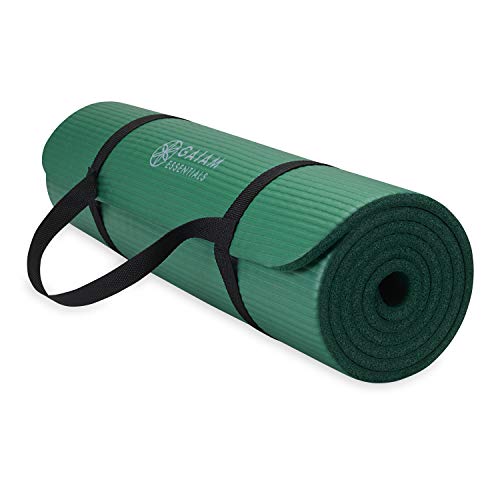
How To Choose The Best Yoga Mat For Home Practice
Home practice puts different demands on a mat than a studio does. Your floor is probably wood, tile or concrete — all unforgiving on knees and elbows — and you are rolling the mat up again afterwards, often into a cupboard or behind a door. So you are balancing three things: enough cushioning to protect joints, enough firmness to keep your balance honest, and enough grip that your palms don’t skate when you warm up.
Start with thickness, because it decides everything else
Thickness is measured in millimetres (mm), and it is the number that changes how a mat feels underfoot. A 6mm mat gives you cushioning while keeping you close to the floor, which keeps standing balance poses steady. A 10mm or 12mm mat (roughly 1/2 inch) is plush and kind to knees, hips and elbows — ideal for floor work, Pilates and stretching — but the extra squish makes single-leg balance harder. Neither is “better”: the 10mm Gaiam is 67% thicker than the 6mm Gaiam Premium, which is the gap between a floor-work mat and a balance-flow mat.
Then check length and width against your own frame
A standard mat is 68 or 72 inches long and 24 inches wide. That works for most people in most poses, but the moment you take a wide stance or roll over in a stretch, your hands and feet start hunting for floor. Wider mats solve this: the KEEP is 32 inches wide, the HAPBEAR and the Karma Fitness are 36 inches, and the Hatha is 40 inches — wide enough that a full routine stays on the mat. If you are tall, the length matters just as much; the Circuit Fitness runs 74 inches against the Gaiam Premium’s 68, and those extra inches are what stop your heels hanging off the end.
Match the surface to how much you sweat
Grip is the most misunderstood spec on a mat listing. A textured surface helps in a dry practice — it gives your palms and soles something to push against. Once your hands get damp, though, texture alone can lose its bite, and a closed-cell foam that resists absorbing sweat tends to hold grip longer. If you sweat heavily, plan on a small towel at the top of the mat for plank and downward dog, and lean toward the denser TPE foams rather than a soft, open foam.
Think about where the mat will live
How often you’ll actually move your mat depends on its weight. The Circuit Fitness weighs 1.5 pounds, so it’s easy to carry room to room. The Gaiam Premium 6mm is 3.1 pounds, and the Hatha is 6.1 pounds — heavier to haul, but it stays flat and stable in a dedicated home-gym spot. Odour matters too: PVC and NBR foams (two common mat materials) often carry a factory smell that fades after airing out for a few days. So unroll your mat and let it breathe before your first session. Last, decide between a carry strap and a full carry bag — a bag is kinder for storage and protects the surface between uses.
Side-by-Side Comparison
Three specs decide most of the buying here. Thickness sets your cushioning against your balance. Length and width decide whether your whole routine fits. The foam type (the material the mat is made from) drives grip, sweat and odour behaviour. Scan across a single column and you can see exactly what you are trading.
| Model | Best For | Thickness | Size (L x W) | Material | Amazon |
|---|---|---|---|---|---|
| Gaiam Premium Yoga Mat, 6mm Thick Print Mat★ Best Overall | All-round home practice | 6 mm | 68″ x 24″ | PVC | Amazon |
| Circuit Fitness by Marcy Non-Slip Exercise MatBest for Travel | Light, portable daily workouts | 6 mm (1/4″) | 74″ x 24″ | TPE | Amazon |
| Gaiam Thick Yoga Mat with Easy-Cinch StrapBest for Knees | Sensitive knees and joint comfort | 10 mm (2/5″) | 72″ x 24″ | NBR foam | Amazon |
| Amazon Basics Extra Thick Exercise Yoga Mat | Plush floor workouts on a budget | 1/2″ (0.5″) | 73.2″ x 24.3″ | NBR foam | Amazon |
| YOTTOY Extra Thick Yoga Mat | Knee-heavy kneeling and Pilates | 12 mm | 72″ x 24″ | TPE | Amazon |
| KEEP Extra Wide Yoga Mat | Wide stances and broad frame | 7 mm (0.28″) | 72″ x 32″ | TPE | Amazon |
| HAPBEAR Large Yoga Mat | Extra-wide home workout space | 6 mm (1/4″) | 72″ x 36″ | TPE | Amazon |
| Karma Fitness Large Workout Mat | High-impact home workouts | 10 mm (0.39″) | 72″ x 32″ | Double-layer TPE | Amazon |
| Hatha Yoga Extra Long TPE Yoga Mat | Tall bodies and dedicated home gyms | 1/2″ (0.5″) | 79″ x 40″ | TPE | Amazon |
Detailed Reviews
1. Gaiam Premium Yoga Mat, 6mm Thick Print Mat
Our pick — 4.5+★ from 22,000+ verified ratings; the strongest balance of quality and price.
The mat that cushions a wooden floor without turning your balance poses to jelly.
If you do a bit of everything at home — a morning flow, some stretching after work, a few core exercises — this is the pick. It handles all of it without feeling like a mattress. At 6mm thick it sits in the useful middle: enough padding that your knees don’t press straight through to a hard floor, but thin enough that you can feel the ground and stay steady in warrior and tree poses. A 5’5″ buyer doing hot yoga reported the 68 x 24-inch size being just right for length and width.
What wins people over is the look — the printed designs are the most-praised thing about this mat by a wide margin, and it does not fade or flake.
Here’s the honest catch. The grip is the second-most-discussed thing about this mat, and it splits opinion: fine when dry, shakier once your hands get damp, with palms sliding out in downward dog at the sweatiest point. It’s also a PVC mat, which the maker describes as a 7P-free formula, and it arrives with a harmless factory smell — unroll it and air it out for 2-3 days. And if you roll it tightly or leave it in a hot car, the thick edge may curl until it flattens again in class.
What earns its place
- The 6mm balance — cushioned for joints, firm enough for steady standing poses
- Printed designs that stay visible after a year-plus of regular use
- 3.1 pounds rolls and carries easily between rooms
- 7P-free PVC formula and a free downloadable yoga class included
Where it pushes back
- Grip gets slippery once your hands sweat — a towel helps
- Harmless factory odour; needs 2-3 days of airing out
- 68-inch length, so very tall users may want extra room
The verdict: If your practice mixes standing flow with floor work on hard flooring, this is the most sensible starting point for most homes.
Think twice if: you sweat heavily or want a longer mat for a tall frame — the Circuit Fitness adds six inches of length.
2. Circuit Fitness Exercise Mat
Six extra inches of length and a weight that barely registers in a gym bag.
At 1.5 pounds this is the lightest mat on the list, and it carries a genuine advantage for long-limbed bodies: 74 inches of length against the Gaiam Premium’s 68. That is the difference between heels staying on the mat and hanging off the end in a reclined stretch. The material is TPE — a closed-cell foam that resists soaking up sweat, so you can wipe it down with a damp cloth and get on with your day.
Two things show up again and again in what buyers report: the thickness feels generous for the weight, and the quality holds up for a mat this light. A 1/4-inch (6mm) surface supports floor exercises and standing poses without wobbling, and the double-sided texture helps it stay put on hardwood, tile and carpet. The shoulder strap is genuinely useful for anyone who takes their mat between rooms, to a studio, or out to a park session.
The mixed signals are worth knowing about. Grip is a coin-flip here — some owners say it doesn’t slip at all, while others find their feet sliding on it. And the carrying strap is the sorest point: a run of buyers received the mat without one, so check the box the moment it arrives. One put it this way: “The only issue was that the carrying strap was missing from the package, but in terms of quality and workout comfort, it’s worth it.”
Room to move, lightly: You get 74 inches of length at just 1.5 pounds, so a tall user can stretch out fully and still carry it between rooms. Very few mats give you that reach without the bulk.
One thing to verify on arrival: the strap is a recurring packaging complaint, so open the box and confirm it’s there before you store the mat away.
Reach for this if: you’re tall, you like to move your mat around the house, and you want a genuinely light mat that wipes clean.
Look elsewhere if: reliable grip through a sweaty flow is your top priority — the textured surface doesn’t suit everyone once palms get damp.
3. Gaiam Thick Yoga Mat with Easy-Cinch Carrying Strap
A 10mm slab of high-density foam that turns a hard floor into something your knees forgive.
If sitting cross-legged, kneeling, or coming down onto your forearms is the part of practice you dread, this is the mat that changes that. The 10mm (2/5-inch) NBR foam is the joint-comfort specialist of the group — it’s 67% thicker than the 6mm Gaiam Premium — so pressure spreads across a wider surface instead of concentrating on a knee or hip. It suits beginners, low-impact yoga, Pilates, stretching and floor work on wood, tile or concrete.
Buyers rave about the quality first and the thickness second. A steady stream of reviewers describe the surface as extra thick and extremely comfortable. The classic verdict: they normally had to stack two or three mats before finding one that worked alone. Knees and back feel noticeably better on it. The textured foam helps keep it planted on most hard floors in a dry session, and the 72-inch length has room for a 5’8″ user to stretch out.
The trade-offs are real but sized. Durability and stability split opinion: plenty of owners get long service, while a few report the foam tearing or sliding on smooth floors. NBR is also an odour-prone foam — a strong initial smell that fades after 24-48 hours of airing out. And the included cinch strap is thin, so if you carry the mat regularly, expect to swap it for something sturdier. One long-term owner noted the original mat went “~2 years before pitting” before repurchasing.
The comfort case: If your knees, hips or back object to hard flooring, 10mm of cushioned foam is the single biggest jump on this list. It’s the mat to buy when comfort outranks everything.
The honest flip side: all that foam softens the floor feel, which is lovely for stretching but less ideal for balance-heavy standing flow, and the strap won’t stand up to daily commuting. This is a home mat first and a portable one second.
Buy it for: a soft, well-cushioned surface for beginners, Pilates and floor routines in one fixed spot at home.
Not the one for: advanced balance work or carrying to a studio every day — the plushness and the thin strap both work against you there.
4. Amazon Basics Exercise Yoga Mat

Half an inch of plush foam at the lowest cost on the list — the beginner’s easy entry.
For a first home mat to get sit-ups and planks off bare floor, this is the cheapest way in. The 1/2-inch NBR foam gives ample padding for planks, sit-ups and stretching, taking pressure off knees and elbows on hard flooring. At 73.2 x 24.3 inches it’s a touch longer than the standard 72-inch mat, and the elastic strap lets you sling it over a shoulder for storage.
What buyers value most is straightforward: the thickness is generous, the surface feels soft yet supportive, and it stays planted for floor work and standing poses alike. One 5/5 owner who uses it 4-5 times a week reported no deterioration or discoloration after two years of use — the kind of long-haul endurance that makes a budget buy feel smart. It rolls and stores easily, wipes clean, and the cushioned feel is genuinely good for general workouts and beginner yoga.
Where it shows its budget roots: the texture gives light grip rather than a sticky hold, so it’s stable for general use but not dedicated to a sweaty flow. Durability splits opinion, with some owners reporting tearing, and the soft foam can dent under high-impact moves or shoes. Also, the extra cushioning is a little too giving for demanding balance poses — great for floor work, less so for a one-legged hold.
Why it works for a first mat: 1/2 inch of foam, a 73.2-inch length and an included elastic strap — the essentials covered without overspending, from a name that isn’t trying to be fancy.
When to step up: if your practice leans on balance or you sweat a lot, a firmer TPE mat or a grippier textured surface will serve you better over time.
Pick this up if: you’re starting out, want maximum cushioning for the least outlay, and your workouts are mostly floor-based.
Pass on it if: you hold demanding single-leg balance poses or need a grippy surface through a heavy sweat session.
5. YOTTOY Extra Thick Yoga Mat

Twelve millimetres of TPE for anyone whose knees or elbows need the most forgiving surface.
At 12mm, this is the thickest mat here, and that number is doing real work. Choose it for kneeling and seated postures, Pilates on hardwood, or knees that find 6mm mats too thin. The TPE foam (a rubber-like mat material) is described by the maker as SGS and TUV certified — two independent safety testing standards — and free of heavy metals and ten types of phthalate (a group of chemicals used to soften plastics). The one-piece foam is built to be non-toxic, waterproof and sweat-proof, so a damp cloth cleans it.
Quality and thickness are what win owners over. The cushioning is described as sufficiently firm for balance poses as well as kind to knees. The 72 x 24-inch surface has a granular top and a water-ripple underside, which keeps it anchored on carpet and hard floors. A 60-year-old home exerciser found it great for cushioning knees and staying in place on carpet. A Pilates user who works out daily on it praised how cushioned and comfortable it is on elbows and knees. It also comes with a carry strap and rolls up to fold away into any closet.
The catch is the odour. Several buyers describe a heavy rubber smell that lingers, even after days of airing out, and one suggests a diluted white-vinegar spray to shift it. The listed size also came up short for a buyer who measured it about 2 inches shorter than advertised. And as with any 12mm mat, all that cushion gives a slightly floaty balance feel compared with a 6mm surface.
The thickest comfort on the list: 12mm of TPE is more padding than any other pick here, and for knee-protection-first practice or floored Pilates, that extra give is the whole point.
Air it out first: the rubber smell is the one complaint that recurs, so unroll it somewhere ventilated for a few days before your first session.
Worth it for: Pilates, kneeling postures and sensitive joints where maximum cushioning matters more than a firm floor feel.
Skip the upgrade if: you’re chasing a fast, balance-heavy flow — the thick foam softens the ground under you more than a 6mm mat does.
6. KEEP Extra Wide Yoga Mat, 7mm Thick 72″ x 32″
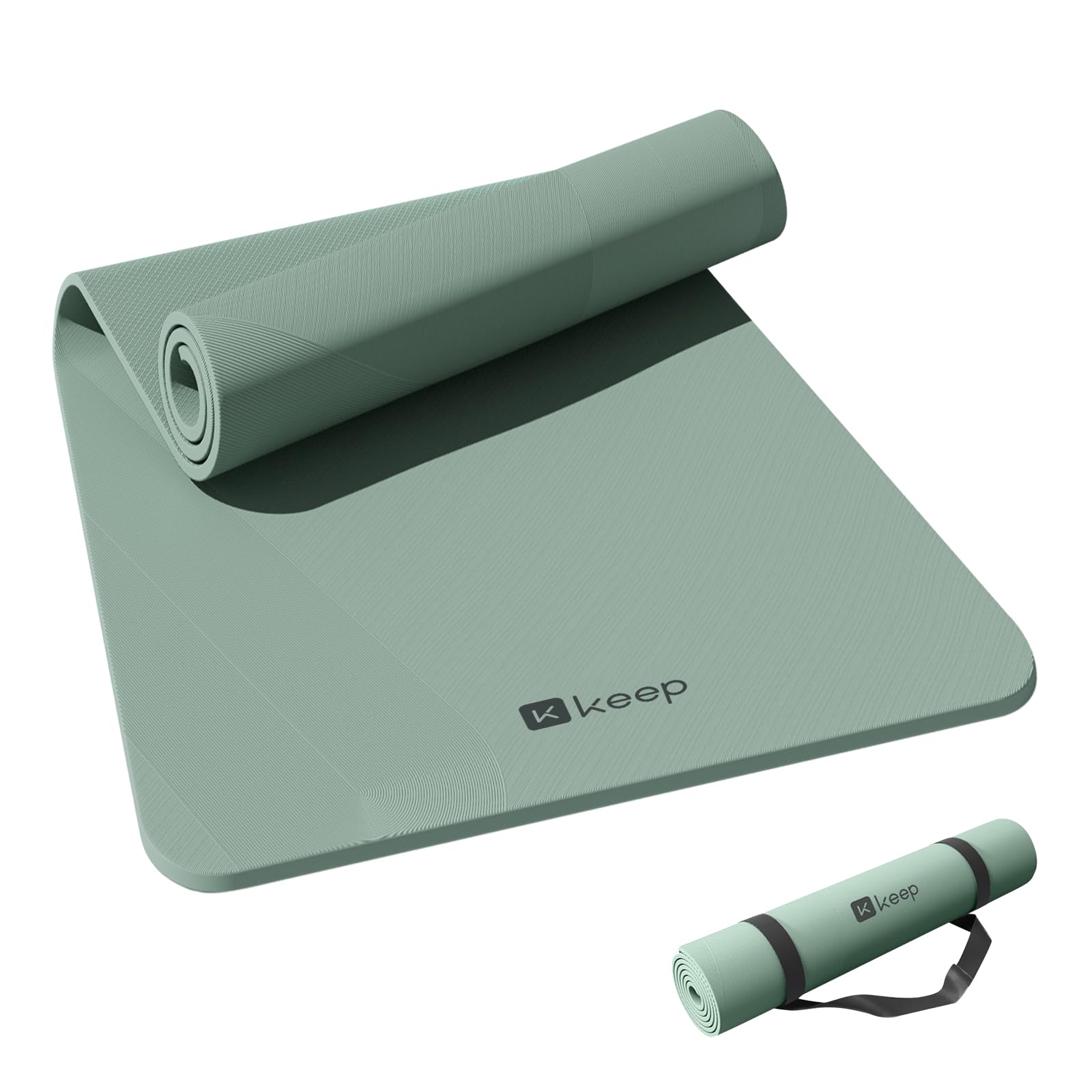
Eight inches more width than a standard mat — room for wide stances without clipped hands.
For anyone with a broad frame, long arms, or a habit of taking a very wide stance, this is the mat that stops the constant shuffling back to centre. At 72 x 32 inches it’s eight inches wider than the standard 24-inch mat, and 7mm of TPE gives it more cushion than the 6mm picks without going plush. It weighs 2.86 pounds and comes with an adjustable polyester strap.
Buyers keep coming back to two things: the extra width and the grip. The top layer has a fingerprint-like anti-slip texture and the underside carries a full anti-slip pattern for a firm hold on dry or damp surfaces. One buyer with 25 years around yoga said it makes practice more comfortable, and another found the width perfect — wide enough to move around without worrying about falling off the edge. The TPE is described as free of plasticizers and formamide, and it wipes clean with cold water.
The trade-off here is that “extra wide” does not mean “extra thick.” At 7mm this is a moderate mat, so if you specifically want that dense cushion-you-can-sink-into feel, look at the YOTTOY or the Gaiam 10mm instead. Durability and slip resistance split opinion, and there’s an initial factory smell — one owner found it cleared after airing out for a few days. It’s also worth airing it out before first use as the maker advises.
For the wide-stance crowd: tall or broad practitioners who keep running out of mat will feel the difference instantly with 32 inches underfoot.
The one compromise: 7mm is a middle-of-the-road thickness — if joint cushioning is your main goal, a 10mm or 12mm mat delivers more.
At 32 inches wide and 2.86 pounds, it is wider than a standard mat, lighter than the 10mm picks, and grippy enough for a full routine in one spot.
7. HAPBEAR Large Yoga Mat, 72″ x 36″ x 6mm
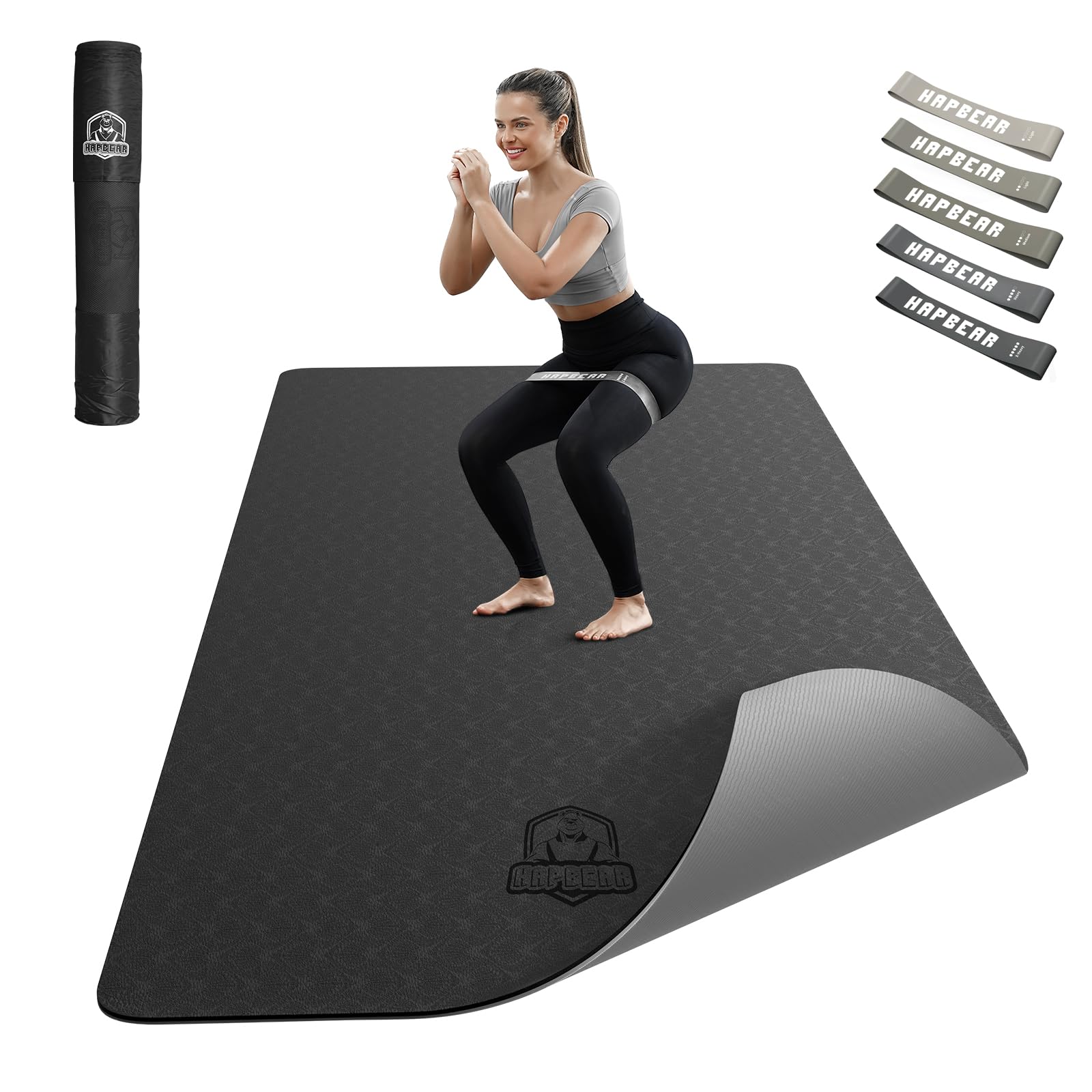
A full 36 inches of width for stretching, rolling and floor work that doesn’t get cramped.
If a standard mat starts to feel like a postage stamp — mid-roll in a stretch, or dropping into a wide lunge — an extra-wide mat fixes it. This one goes to 36 inches wide and 72 inches long. That’s the same width as the Karma Fitness and four inches narrower than the Hatha, so you get a genuinely roomy surface without the biggest footprint on the list. The 6mm thickness keeps you close to the floor for stability while easing knee and wrist strain.
The double-sided grip is the selling point: the textured faces hold on smooth surfaces, which is what you want for intense or quick-moving sessions where a sliding mat is dangerous. The TPE foam is sturdy and easy to clean for daily use, and it ships with a carry bag — plus, per the maker, bonus resistance bands. It handles yoga, Pilates, stretching and home workouts on hard flooring; the maker says not on carpet.
What divides opinion is thickness and durability. Some describe the 6mm as satisfying, others find it almost no thickness at all — it’s a firm surface, not a plush one. A few owners had durability concerns, and remember the airing-out period: some initial scent may be present, so give it 1-2 days. It’s also heavier to move around than the lighter 6mm mats like the Circuit Fitness.
Where the space pays off: 36 inches of width keeps a whole routine on the mat, and the double-sided texture holds firm when you’re moving fast — a good match for home workout circuits as well as yoga.
Set your expectation on cushion: 6mm is a firm, ground-connected feel, so if you want sink-in softness, the thicker NBR foams are a better fit.
Best suited to: home exercisers who want a broad, grippy surface for yoga, Pilates and floor circuits in one spot.
Not for you if: you want a plush, deep-cushioned feel or you practise on a carpeted room — this one wants a hard floor.
8. Karma Fitness Large Workout Mat, 72″ x 32″, 10mm

The mat that steps beyond yoga — dense enough for press-ups, lunges and real home training.
If your “home practice” also involves strength work, this double-layer TPE mat is built for it. At 72 x 32 inches it’s 33% wider than a standard 24-inch yoga mat, so press-ups, sumo squats and lateral lunges can all happen without your hands or feet running off the edge. The dual-layer TPE is denser than standard NBR foam, and it’s waterproof and sweat-resistant, so it wipes clean after a hard session.
Owners describe it as well-made and generous on space, with the “perfect” thickness and good cushioning. Portability comes up too — it rolls up and tucks away easily, and it ships with a proper carry bag plus an adjustable shoulder strap rather than a flimsy strap. The diamond texture gives multidirectional grip on both sides for stable movement during lunges, Pilates and HIIT. Denser than the softer NBR mats, it’s the right call for anyone who wants a firm, supportive surface that supports demanding movement rather than a pillow to sink into.
The honest limitation is bulk. At 10mm and 1.69 kg, it’s heavier and bulkier than the thin 6mm mats to carry, and for pure, gentle stretching some might prefer a lighter mat. It’s also a high-impact-workout mat first — if your main goal is a hushed, meditative flow, it may feel like more mat than you need. Taller users who found 6mm mats thin under the lower back reported this one easing that pressure.
Strong points
- 10mm dual-layer TPE cushions joints and supports dynamic movement
- 32-inch width keeps lunges and press-ups on the mat
- Includes a real carry bag and adjustable shoulder strap
- Textured, waterproof surface for grip and easy cleaning
Trade-offs
- 10mm and 1.69 kg — bulkier to move than a thin 6mm mat
- High-impact focus makes it heavier than a simple meditative stretching mat
- Pricier than the entry-level NBR options
Choose it for: a genuine home-gym mat that handles strength and cardio as well as yoga, with a bag you’ll actually use.
skip it if: your practice is slow, gentle stretching and you’d prefer the lightest possible mat.
9. Hatha Yoga Extra Long TPE Mat, 79″ x 40″ x 1/2″

The biggest mat here by a clear margin — 79 inches long and 40 inches wide.
Sizing isn’t a nice-to-have once you’re past average height: it’s the whole purchase. At 79 x 40 inches this mat is the roomiest on the list, built for tall yogis and anyone with a wider frame who wants space to stretch without feeling boxed in. The 1/2-inch TPE thickness gives ample stability and cushioning, and the reversible design carries a wave pattern on the back that grips the floor.
Comfort and size are the two things buyers praise most, with the comfort cushioning consistently called out — soft, thick enough to protect knees, and free of an unpleasant odour. A 6’1″ user reported the 79 x 40 size suiting them perfectly and flattening out within minutes of unrolling; a slim 5’10” user also found the size perfect for a home gym. Someone with spinal fusion listed the extra-large surface as a help for rolling over and getting up. The TPE is described as high-resilience with good tear and abrasion resistance, and there’s a 30-day satisfaction guarantee.
The realities to weigh: 6.1 pounds and the sheer size make this a mat you mostly keep in one place. It’s stiffer than expected for some, so carrying it between locations without a vehicle is a chore. There’s also a chemical smell that fades over weeks rather than days for some.
Why the size is the story: 79 inches of length and 40 inches of width make this the only mat here that comfortably fits a six-foot-plus frame through a whole routine — no clipped heels, no shuffled stances.
At 6.1 pounds and 79 x 40 inches, it stays in one room. Factor in a permanent spot to unroll it, and a couple of weeks of airing out before the smell leaves.
Made for: tall or broad practitioners who want every pose to fit, and who keep their mat in one place at home.
Look past it if: you need to fold it away daily or want a thin, easily rolled mat for a class — the weight and size work against that.
Know the Specs
Two numbers settle most mat-buying decisions, and once you understand what each one does in a home practice, the rest follows easily.
Thickness
Thickness is measured in millimetres (mm) or in inches, and it’s the number that decides how the mat feels underfoot. A 1/2-inch mat (about 12mm or 10mm) gives deep cushioning for kneeling, sitting and floor work, which suits sore knees and Pilates. A 6mm mat is much closer to the ground, so you stay steady in single-leg balance poses. Neither is better — choose by whether your practice is comfort-led or balance-led.
Width and Length
Width and length decide whether your whole body stays on the mat. A standard mat is 24 inches wide and 68 to 72 inches long. Wide mats go up to 32, 36 and 40 inches, and extra-long mats reach 79 inches — that extra room stops hands, feet and heels wandering onto bare floor mid-pose. If you’re tall or broad, size the mat to your frame before you worry about anything else.
Material and Grip
Foam type changes the feel and the grip. PVC and NBR foams feel soft and can carry a factory smell that fades after a few days of airing out; TPE is a closed-cell foam that resists absorbing sweat and wipes clean easily. A textured surface holds better in a dry session, while a denser foam holds grip longer once your palms warm up. If you sweat heavily, a towel at the top of the mat is a simple safeguard.
Weight and Storage
Weight tells you how easy the mat is to move. A thin TPE mat can weigh as little as 1.5 pounds, while a thick, oversized mat goes past 6 pounds. The heavier the mat, the more it wants a dedicated spot at home. A carry strap helps for light mats, while a padded carry bag protects the surface and makes storage tidier. Match this to whether you practise in one place or move the mat around.
Common Questions
How thick should a yoga mat be for home practice?
Is a thick mat better for knee pain during yoga?
Why does my new yoga mat smell, and how long does it last?
How wide do I need my mat to be?
Does a thicker mat make balance poses harder?
Can I use the same mat for yoga and home workouts?
Is TPE better than PVC or NBR foam for a home mat?
How do I stop my mat from sliding on a hard floor?
How long should a yoga mat last with regular home use?
Do wider mats fit under a bed or in a closet?
The Bottom Line
For most people setting up a practice at home, the yoga mat for home practice winner is the Gaiam Premium 6mm. Its 6mm cushioning handles a wooden or concrete floor without wrecking your balance, and the printed surface has a habit of staying looking new. If your knees need the most forgiving surface on the list, reach for the YOTTOY 12mm. If you’re tall or broad, the Hatha 79 x 40 gives you room no other mat here matches. And for a low-cost, plush first mat, the Amazon Basics covers the basics without stretching your budget.
Match thickness to your joints and width to your frame, and the choice narrows to one or two mats.
How we choose
We do not accept paid placement. Every pick is matched to a real buyer and a real use-case; we do not hands-on test units.
Sources
Specifications: manufacturer listings and product documentation. Review insights: verified customer reviews, as of October 2026. Pricing: not shown on this page (it changes often); check the current price via the retailer link.
As an Amazon Associate, Home Digitized earns from qualifying purchases. This does not affect which products we feature.