
Specs are compiled from manufacturer listings and verified buyer reviews and can change over time — please confirm the key details on the product page before buying.
You want a map game your friends will actually fight over, and you want to know which box delivers that without a four-hour rules lecture first. The short answer: War of the Ring is the pick for anyone who wants a true conquest campaign with real armies and real stakes, while Risk 1959 is the one to grab if your table is casual and you just want the classic world-domination fight. Everything below is built from the manufacturers’ published specs and what buyers report after playing these boxes again and again.
This guide is built by comparing the manufacturers’ published specifications and the patterns across verified customer reviews, so you get each pick’s real strengths and trade-offs instead of marketing spin.
Some boxes here take 60 minutes, others run four hours, and a few permanently change their own board as you play. The real split in this hobby is between one-night skirmishes and slow campaigns, so every pick below is sorted by how much table time and commitment it asks of you. Here are the strongest options for world conquering board games.
Top Picks


How To Choose The Best World Conquering Board Games
World-domination games all promise the same thing — you take territory, you break your friends’ armies, you win the map. What separates them is how long the fight runs and how much the box asks of your group before the first dice roll. Start with play time and player count, because a 60-minute box and a 4-hour box fit very different evenings.
Match the printed play time to your actual game night
A box marked 60 minutes is a weeknight game. A box marked 3 or 4 hours is a Saturday afternoon with snacks and no other plans. Be honest about whether your group has a weeknight or a Saturday afternoon. Owners of the heavier boxes often report that first plays run long — the rulebook has to be learned before the armies move — so plan a learning session separate from your first real game.
Check the player count against your real table
Most conquest games here run 2 to 5 or 2 to 6 players, but “supports” is not the same as “plays well.” Area-control maps (maps you win by holding territories) with a fixed number of starting territories can feel crowded at the top of the count and thin at the bottom. If you usually have two players, War of the Ring’s two-sided war will serve you better than Risk 1959’s 2-to-6 range.
Decide if you want a one-off battle or a campaign
Legacy games permanently change their own board as you play — stickers go down, cards get torn, sealed envelopes get opened. That is thrilling with the same committed group and frustrating with a rotating cast. If your players change week to week, Risk 1959 is the safer buy than Risk Legacy.
Watch for dice luck and rules weight
Almost every world-conquest game resolves battles with dice, which means a great plan can still lose to a bad roll. That swing is the drama for some tables and the frustration for others. Heavier rulebooks add depth but also homework; lighter ones get to the table faster. Pick the rulebook weight your group will actually read.
Side-by-Side Comparison
| Model | Best For | Players | Play Time | Format | Amazon |
|---|---|---|---|---|---|
| War of the Ring 2nd Edition★ Best Overall | Deep two-sided campaigns | 2 to 4 | 2 hours | Miniatures wargame | Amazon |
| Risk 1959 ClassicClassic Favorite | Family game night nostalgia | 2 to 6 | 1.25 hours | Classic area control | Amazon |
| Civilization: A New DawnBest Builder Strategy | Builder-strategy fans | 2 to 4 | 120 minutes | Modular civ builder | Amazon |
| Risk Vintage Bookshelf Edition | Shelf display and gifting | 2 to 6 | — | Classic area control | Amazon |
| Arcs | Tactical space opera | 2 to 4 | 60 minutes | Trick-taking wargame | Amazon |
| Dune: A Game of Conquest and Diplomacy | Quick sci-fi skirmish | 2 to 4 | 30 to 60 minutes | Streamlined area control | Amazon |
| Risk Legacy | Committed recurring group | 3 to 5 | 60 minutes | Legacy campaign | Amazon |
| Axis & Allies 1942 (Renegade) | WWII history buffs | 2 to 5 | 3 hours | WWII grand strategy | Amazon |
| Axis & Allies 1942 (Avalon Hill) | Long-form war campaigns | 2 to 5 | 4 hours | WWII grand strategy | Amazon |
Detailed Reviews
1. War of the Ring 2nd Edition
Our pick — 4.5+★ from 800+ verified ratings; the strongest balance of quality and price.
Two sides, one ring, and a map so big it ships in two sections.
This is the heavyweight on the list, and the box says so plainly. You get 204 plastic figures covering more than 30 different sculptures, a 70 x 100cm game board in two sections, 16 action dice, 5 combat dice and 76 cardboard counters. Sprinkled on top are 110 event and character cards, the rulebook, and two player aids. It’s the most physical, most object-heavy conquest game here — and the crowd favorite at 4.5+ stars across 800+ ratings.
What wins people over is the gameplay itself, which is the single most-discussed strength in everything buyers write about it. The board splits the war into a military conflict and a secret journey: one side pushes armies across Middle-earth while the other hides and moves the Fellowship, and those two tracks tug against each other every turn. Games stay tight — owners talk about how many of them get decided in the final turns, which is exactly the tension you want from a two-hour conquest game. The 2-hour play time is the experienced figure; first plays run noticeably longer.
Here’s the catch, and it’s a real one. Setup alone can eat 20 to 30 minutes, and you’ll be flipping through a long rulebook early on. The miniatures are also hard to tell apart at a glance, which slows combat. As owners mention: “Long setup (20-30 min), deep rules requiring frequent rulebook reference, LOTR familiarity helps, hard-to-distinguish miniatures.” If you and your opponent are patient and you love the books, none of that gets in the way. If you want a game you can teach in ten minutes, look elsewhere.
Where it earns the top spot
- 204 figures across more than 30 sculpts make every battle look like a war, not a counter
- The 70 x 100cm two-section board gives a proper Middle-earth scale
- 110 event and character cards add twists so no two games run the same
- Two-hour play time once you know the rules, with tight endgames
What it asks in return
- Setup can run 20 to 30 minutes before the first move
- The long rulebook gets referenced constantly at first
- Some miniatures are hard to tell apart mid-battle
- Dice add real swing, so a clever plan can still lose a roll
Made for: two players who want a rich, replayable campaign and don’t mind a learning night upfront.
Think twice if: your group wants something teachable in one sitting with no rulebook diving.
2. Risk 1959 Classic Strategy Battle Game
The world-domination game your parents played, in wooden army pieces.
If the phrase “world conquering board game” makes you picture a big map and a pile of little armies, this is the box that made that picture. It’s a faithful reproduction of the 1959 original: a thick oversized quad-fold board (a board that folds in four) with the vintage artwork, six sets of wooden army pieces, high-quality dice (two white, three translucent red), thick area cards, and a rulebook that doubles as a history of the game. Designed for 2 to 6 players ages 8 and up, with an average game time of 60 to 90 minutes — short enough to finish after dinner on a school night.
Fast to teach and fast to table — that’s the whole appeal. The rules are simple enough that a child can follow them, and one owner summed up the family appeal nicely: “Very cool retro look! Great way to get kids off their screens!” Gameplay is what gets praised most, and it’s easy to see why: capture territories, hold a whole continent for bonus armies, and wipe your friends off the map. It runs shorter than many people remember — the specs put it at 1.25 hours — so it’s a realistic weeknight pick.
The honest trade-off is the build of the little pieces. The wooden armies draw mixed feelings: some owners love the retro heft, others find them less sturdy than expected. Allow extra reading time the first night too, because the rules can feel tangled on a first pass. Neither is a deal-breaker — this is a 4.5+ star package across 700+ ratings, and it exists to be played, not preserved.
The case for it: a classic world map with wooden armies, a short rulebook, and a 60-to-90-minute footprint that fits an ordinary evening.
The honest nitpick: wooden pieces split opinion on sturdiness, and the instructions take a read or two to click — plan a practice game.
Reach for this if: you want a recognizable conquest game that plays well with family and guests of mixed ages.
Look elsewhere if: you need deep, asymmetric factions and rich theme in every battle.
3. Sid Meier’s Civilization: A New Dawn
Build a civilization, not just an army, and win your own way.
Not every conquest game is about marching armies — this one lets you win by building, exploring, and out-teching your rivals. It’s the board-game take on the Civilization video game, streamlined so a game runs around 120 minutes with 2 to 4 players ages 14 and up. The pitch in the box is “multiple paths of victory,” which means you can win without ever being the biggest army at the table. That’s a very different feel from Risk, where the map is the whole story.
Replayability is what keeps owners coming back. The map is modular and random, so each session sets up fresh territory, and the leaders and wonders vary the strategy from game to game. One buyer captured the pattern: “Have played this quite bit. Love the game… You will like the multiple strategies to win.” Gameplay time and strategy both draw steady praise, and the with-a-regular-group rhythm is where this shines — people run multiple games in an evening.
Be ready to study, though. Complexity is the most-debated topic around this box: some find it easy enough after one learning game, others find the rulebook dense. There’s also no built-in token storage, so budget for a bag or two of your own. Neither issue changes the verdict for a builder-game fan — it just means you should learn it with someone who’s played before if you can.
Why builders love it: modular random maps and many victory routes mean a new board and a new plan every session.
The trade-off: a heavy rulebook and loose tokens with no storage tray — the learning night matters here.
Best fit: fans of the video game or anyone who wants to win by building and exploring, not only by conquering.
Skip if: you want a quick-to-teach game for a casual party crowd.
4. Risk Vintage Bookshelf Edition

A world-conquest game that looks like a hardcover book on your shelf.
The clever part here isn’t the rules — it’s the box. This is the classic Risk game wrapped in a linen-covered book case with a protective slipcover, sized to stand upright among your books. Inside sits a full-sized folding board with 1993 retro graphics, six sets of molded plastic armies in their own storage boxes, 44 territory cards, 12 Secret Mission cards, and 5 dice. It plays 2 to 6 players ages 10 and up, with both standard play and Secret Mission variations in the rules.
Storage is the star. Everything nests into an integrated internal tray, so setup and pack-up take seconds and nothing spills in the closet. Owners talk about exactly that: one wrote that it’s “really no different than the box game. No more taking up the top shelf in the closet.” It’s also a genuinely thoughtful gift — the box itself sells the presentation, which is why this edition keeps showing up in birthday and holiday hands.
What you’re trading away is bulk and a bit of durability. The fabric-wrapped case is handsome but asks for careful handling if you’re shuttling it to game nights, and the compact book box means you’re not getting a giant table-sized map. At 4.5+ stars it’s the highest-rated pick on this list, though with fewer owners than the big sellers — the crowd is smaller but very happy.
The selling point: a self-contained book box with integrated storage that keeps the whole game together and off the closet shelf.
The catch: the fabric case rewards gentle handling, and the compact board is smaller than an oversized classic map.
Pick this if: you want a gifting-ready, display-worthy copy of Risk that stores tidy on a shelf.
Pass if: you specifically want the oversized 1959-style board on the table.
5. Arcs Board Game by Leder Games
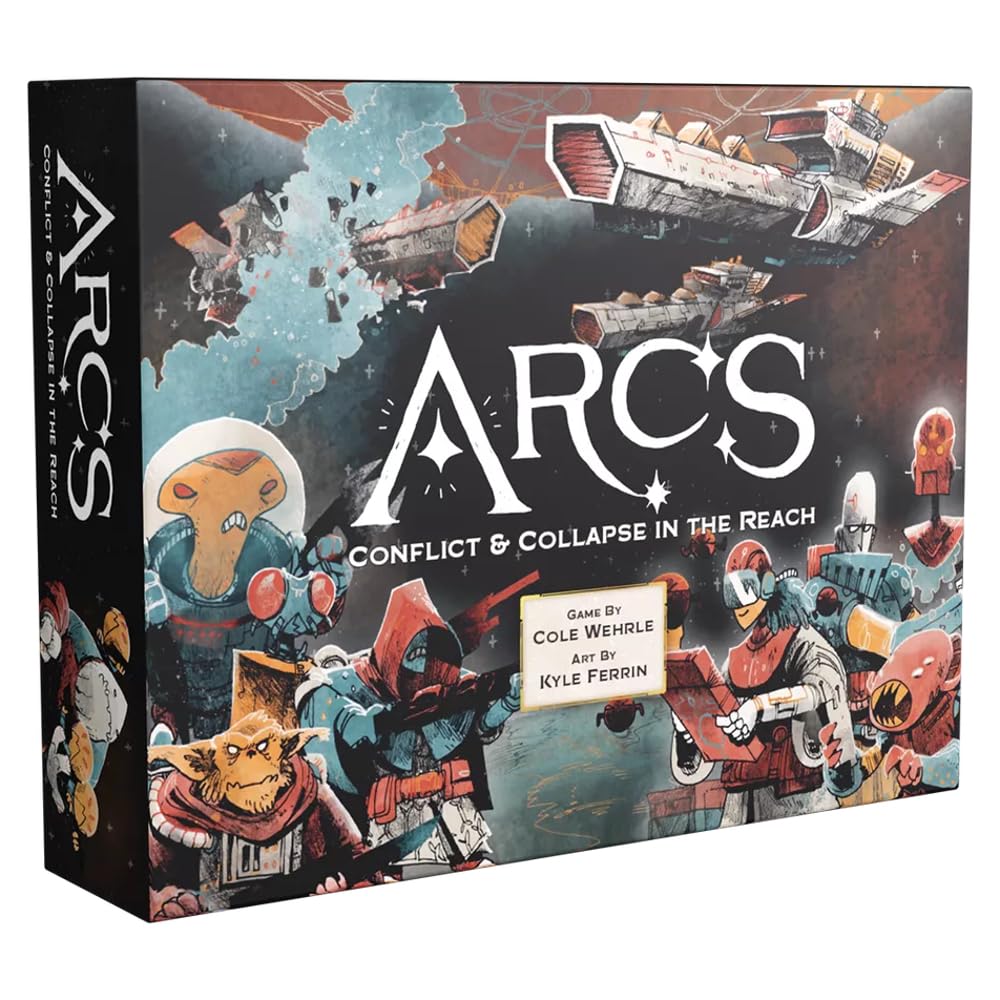
A space conquest where your card play matters as much as your fleet.
Arcs earns its premium slot by doing something different with the conquest format. Instead of simple territory grabs, it runs on a trick-taking-inspired action system — a four-suit card deck where timing and initiative decide what you’re allowed to do each turn. You declare and contest shifting Ambitions each deal, so the goalposts move and only the right objectives score. Battles resolve fast, with the attacker choosing how much risk to take and the defender needing fleets and cards ready. It plays 2 to 4 players ages 14 and up in about 60 minutes.
Component count is genuinely impressive: 28 action cards, 25 Guild cards, 14 Lore cards, 8 Leader cards, 18 battle dice, plus the board, four player boards, and a full set of ships, agents, and markers. Replay value is the big draw — the game plays differently each round, especially once you add Leaders and Lore. One enthusiastic owner put it simply: “This is one our favorite games of all time.” Another warned that if “you don’t like very asymmetrical abstract games, veer away” — asymmetrical meaning each side plays by different rules — a useful signal for whether this is your kind of fight.
It’s not a beginner’s game. The gist is easy to pick up, but owners agree it takes a few sessions to really click, and the asymmetry means everyone at the table is playing a slightly different game. Come with an experienced group and it rewards you; come with total newcomers and expect a rough first night. That’s the honest line for a 4.5+ star game with high replayability.
Why it stands out
- Four-suit trick-taking action system makes card timing the real skill
- Shifting Ambitions keep the victory conditions fresh every deal
- 18 battle dice and a full component set support fast, dramatic combat
- About 60 minutes per game, with Leaders and Lore for extra bite
Where it pushes back
- Heavy asymmetry means a few sessions before the game truly clicks
- Abstract space-opera style isn’t for every table
- Rulebook front-loads concepts you have to absorb before turn one
For: tactical players who want a conquest game where clever card choices decide the war.
Not for: groups that prefer familiar territory-and-dice simplicity over abstract space politics.
6. Dune: A Game of Conquest and Diplomacy

Spice, strongholds, and a whole Dune war that fits in under an hour.
This is the lightest-footprint sci-fi conquest game on the list, and it knows it. You take command of one of four factions — House Atreides, House Harkonnen, the Fremen, and the Imperium — ship forces to Dune, harvest spice, seize strongholds, and knock out your rivals. It handles 2 to 4 players ages 12 and up with a 30 to 60 minute play time, and the board is a compact 10.6 inches in each direction. Game quality is the top-praised strength, and pacing draws steady compliments — buyers describe completing whole games in under an hour.
Where it earns its spot is accessibility. If you want a Dune-themed strategy game that gets to the table on a weeknight, the simpler rules do the work. One buyer called it “an easy to learn Dune themed game with a good amount of replay ability in under an hour.” It’s a faster, streamlined variant compared with the classic 1979 version — less deep, but more likely to actually get played.
The honest caveats: it doesn’t include a built-in bartering system (a way to trade resources), which some groups house-rule in, and the rules could be written more clearly — one owner pointed out that the game flows fine “as long as the players agree to what they think the rules are.” It’s the lowest-rated pick here at 4.0+ stars, which is still a solid game; just know it’s the casual option, not the deepest.
What it delivers: a full four-faction Dune war in under an hour with simpler rules than the classic.
Head’s up: rules clarity is the weak point, and there’s no built-in bartering — house rules help.
Good match for: sci-fi fans who want a short, repeatable skirmish that fits a busy weeknight.
Different game if: you want deep, balanced long-form strategy with crisp rules.
7. Risk Legacy

A Risk game where the board is permanently scarred by your wins and losses.
Risk Legacy is the version that remembers. It uses legacy mechanics — stickers go on the board, cards get torn, sealed components open only after enough wins — so no two games are ever the same, and your copy becomes uniquely yours. The box contains over 275 military units, a gameboard, faction cards, a sideboard, 5 dice, missiles, a sticker sheet, and sealed components, for 3 to 5 players ages 13 and up in about 60 minutes per game.
The shorter session length is what surprises people. Objectives and victory points (4 VP to win) replace the old “eliminate everyone” grind, so games end in a sensible hour instead of dragging all night. Gameplay is the most-praised strength, and an evolving board through stickers and opened packs is the reason people come back. It’s a faster, more connected spin on the classic — and owners describe it as an excellent evolution of the original.
The one big ask is the group. Legacy games assume a steady crew that can play the same campaign over multiple sessions; a rotating cast of players gets less out of it. One 4-star owner also had a packaging problem spoil a mechanic, though the seller refunded — rare, but worth knowing to check the box on arrival. Play with the same friends and it’s a standout; play with strangers and it loses its thread.
Signature draw: stickers, torn cards and sealed packs make your copy permanently unique and fast at about 60 minutes.
One real condition: it needs the same committed group across sessions — frequent player changes sap the legacy fun.
Ideal when: you have 3 to 5 regular players who want a Risk campaign that evolves with every win.
Not ideal when: your table changes players every week and you want a self-contained game.
8. Axis & Allies 1942 Second Edition (Renegade)

Command a WWII superpower across a map that spreads over the whole table.
Axis & Allies is the grand-strategy option for the history buff in your group. You lead Germany, Japan, the UK, the Soviet Union, or the United States from spring 1942, managing both armies and wartime economy. The Second Edition board is a generous 40 by 26 inches, and the box holds 410 plastic pieces, 12 Industrial Complex markers, 100 National Control markers, 80 chips, and 6 dice. It’s built for 2 to 5 players ages 12 and up, and games run about 3 hours.
This is a game about long, deliberate planning — industrial production, frontline pushes, and the slow turn of the war. Owners describe it as deep rather than fast; one called it “a great game” worth the price and noted that games can stretch, which is exactly the point for a WWII strategy fan. It’s clearly not a quick filler, and the Second Edition adds refined rules based on community feedback plus double-sided tokens and resealable storage bags.
The honest trade-off is that you need committed players and time. It’s a three-to-four-hour commitment, and the physical pieces have been noted as a touch less sturdy than older versions, with a couple of opponent colors looking similar on the board. If you love WWII history and a table of likeminded strategists, this box delivers a proper campaign.
What makes it sing
- 40 x 26-inch board for a proper global theater of war
- 410 plastic pieces across five major powers
- Refined rules, double-sided tokens, and storage bags in this edition
- 3-hour play time suits a dedicated game afternoon
The honest friction
- Long sessions and a setup-heavy start
- Some customers note pieces that feel less sturdy than older versions
- A couple of powers share similar colors, which slows the board read
The right call for: WWII enthusiasts who want to command real economies and armies over an afternoon.
Look past it if: your group can’t commit to multi-hour sessions.
9. Avalon Hill Axis & Allies 1942 Second Edition

The full WWII grind — four hours, five powers, one giant map.
If the Renegade edition above is a long game, Avalon Hill’s version is the long-haul marathon, listed at about 4 hours. It’s the same 1942 theater and the same 40 x 26-inch board, with 410 plastic pieces including Antiaircraft Artillery and five sculpts such as UK artillery, submarine and destroyer units, German artillery, and a Russian submarine. It plays 2 to 5 players ages 12 and up, and it wants a table with room to spread out.
What’s interesting is how owners describe the learning curve. Despite the scale, reviewers point out finding it less complicated than it looks and easier to learn with someone experienced at the table. One said: “Not hard to learn the rules at all. After a bit of a langthy set up, game flows very smoothly.” Set-up is the real barrier — several owners note that first-timers need about two hours just to set up and learn — but once the armies are out, the game runs cleanly.
It’s not the edition for a quick night. Games can stretch for many hours, and a couple of small annoyances show up: no paper money, no built-in piece storage, and only 6 dice in the box, which some owners solve by buying extras. This one is for the history lover who wants a full Saturday war on the table.
Why it earns its place: the biggest board and most pieces geared to a full-day WWII campaign, with rules that owners find less daunting than they look.
Be prepared for: long set-up and multi-hour sessions, plus missing storage and just 6 dice — accessories help.
Choose this if: you and a few history-minded players want an all-day WWII event.
Choose another if: you want the same WWII feel in a shorter, easier-to-teach package.
Know the Specs
Play Time (the printed number on the box)
Play time tells you how long a game takes with experienced players — the figure printed after everyone knows the rules. A 60-minute game fits a weeknight; a 4-hour game wants a full afternoon. First plays almost always run longer, so budget extra for the learning night. The gap matters: War of the Ring lists 2 hours while Risk 1959 lists 1.25 hours, and that difference decides which game gets played more often.
Player Count — real, not just “supported”
Every box lists a player range, like 2 to 6 or 3 to 5, but “supports” doesn’t guarantee a good game. Fixed-territory maps can feel cramped at the top of the range and thin at the bottom. If you usually play with two, a game designed as a two-sided war (like War of the Ring) will feel tighter than one built to scale up.
Legacy Mechanics
A legacy game permanently changes its board as you play — stickers, torn cards, and sealed packs that open only after wins. It’s thrilling with the same committed group because your copy becomes one of a kind. It frustrates a rotating table because the evolving story only makes sense if the same players see it through.
Asymmetric Factions
Asymmetric play means each side has different armies, goals, or abilities — not just a different color. That raises replay value and theme, but also the learning curve, since every player is effectively learning a different game. Arcs and War of the Ring lean hard on this; Risk 1959 and Risk Legacy start everyone on similar footing.
Common Questions
Which of these world conquering board games is easiest to teach a new group?
How long does a full game of War of the Ring actually take?
What is a legacy board game and do I need the same players every time?
Can I play Risk with just two people?
Do these games come with dice, or do I need to buy my own?
Which version of Axis & Allies should I buy — the Renegade or the Avalon Hill edition?
Is Dune a good game for casual players?
Do any of these games need expansions to feel complete?
How much table space do these conquest games need?
The Bottom Line
For most people shopping for world conquering board games, the win goes to the War of the Ring 2nd Edition — it pairs a 2-hour play time with 204 figures and a 70 x 100cm board, so it delivers a real campaign in an evening. Then decide what your table needs. If you want a game everyone can learn in ten minutes and play with the kids, the Risk 1959 Classic is the one you’ll actually pull off the shelf, and its 60-to-90-minute footprint beats the long war games for repeat play. For a committed crew chasing changing victory conditions, Arcs is the sharpest tactical choice — its four-suit action system (cards split into four suits, each open up different moves) makes every card play matter.
The one honest nudge: match the printed play time — 60 minutes for Risk 1959, 4 hours for Avalon Hill Axis & Allies — to the free evening you actually have. A 90-minute Risk game that hits the table every week beats a four-hour epic that only comes out once a year.
How we choose
We do not accept paid placement. Every pick is matched to a real buyer and a real use-case; we do not hands-on test units.
Sources
Specifications: manufacturer listings and product documentation. Review insights: verified customer reviews, as of October 2026. Pricing: not shown on this page (it changes often); check the current price via the retailer link.
As an Amazon Associate, Home Digitized earns from qualifying purchases. This does not affect which products we feature.