
Specs are compiled from manufacturer listings and verified buyer reviews and can change over time — please confirm the key details on the product page before buying.
You walk into the gym with a plan in your head, and forty minutes later you cannot remember whether you pressed the 45s or the 50s last week. A workout planner fixes that one problem: it records what you lifted last week so you stop guessing between sets. The short answer: buy one that matches the way you actually train — lifters who log set-by-set need wide entry rows, CrossFit athletes need a WOD template, and anyone tracking food alongside training needs a page pair rather than a single sheet. Everything below is organized around that one question — page size, paper weight, and workout capacity — so you can pick in a couple of minutes.
This guide is built by comparing the manufacturers’ published specifications and the patterns across verified customer reviews, so you get each pick’s real strengths and trade-offs instead of marketing spin.
Nine planners made the cut, sorted by what they actually record rather than what the cover promises. The best of the bunch earns its place with a modest 6” x 8” page and a genuinely thick cover. Read on for the full breakdown of the best workout planner for your own training style.
Top Picks


How To Choose The Best Workout Planner
A workout planner is a paper record of what you lifted, how it felt, and what you plan to lift next. The trick is matching the layout to your training style — wide set-and-rep rows for lifters, a WOD template for CrossFit — so you do not abandon it in week three.
Start With Page Size, Not Cover Design
The size of the page decides whether the book travels with you. An A5 planner measures roughly 6” x 8” — small enough to slide into a gym bag pocket and big enough for full set-and-rep entries. An A6 pocket planner is closer to a passport and disappears into a shorts pocket, but the writing rows get tighter. An A4 planner at 8.5” x 11” gives you roomy daily pages and is the one to pick if you log from a desk at home.
Count the Workout Rows Before You Commit
Number of workouts recorded per book is the spec that decides how often you rebuy. A planner built for 100 sessions at three gym visits a week lasts you about eight months. One built for 200 sessions stretches much further. At six sessions a week, a 100-workout book lasts about four months, so size up to a 200-session option.
Check What Sits Inside the Front Cover
The first few pages tell you whether a planner was designed by someone who lifts. Look for a goal-setting section with target dates, a body-measurement log, a personal-records page, and a calendar. A planner with a five-month calendar grid keeps you from flipping through pages hunting for last Tuesday.
Feel the Paper and the Binding
Paper weight tells you how the book survives a sweaty gym bag. A 120 GSM sheet — GSM meaning grams per square metre, a measure of paper thickness — takes a heavy pen without ghosting through to the other side. Double-wire or Wire-O spiral binding lets a page lie flat on a bench so you can read it mid-set.
Side-by-Side Comparison
| Model | Best For | Page Size | Workout Capacity | Binding | Amazon |
|---|---|---|---|---|---|
| Workout Log Gym 2-Pack★ Best Overall | Best overall for everyday lifters | A5 (6” x 8”) | 100 workouts per book | Double wire spiral | Amazon |
| Gorilla Fit Leather JournalBest Page Feel | Best-feeling pages in the lineup | A5 | 128 workouts | Hardcover spiral | Amazon |
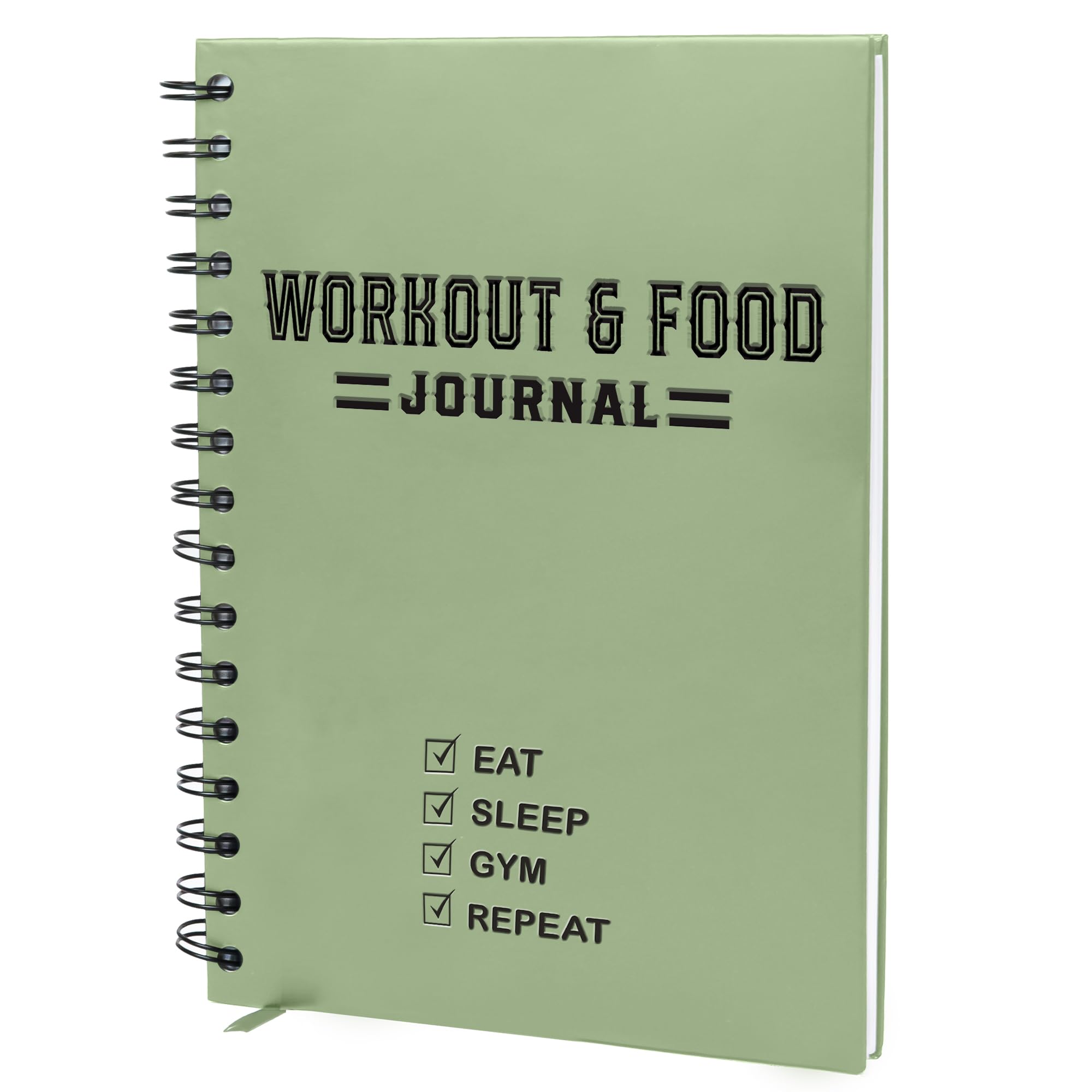
| Nextnoid Fitness & Food JournalBest Two-In-One | Training and nutrition in one book | A5 | 6 months of daily pages | Hardcover spiral | Amazon |
| Gymreapers Workout Journal | Lifters returning after a break | A5 | Daily untracked pages | Reinforced binding | Amazon |
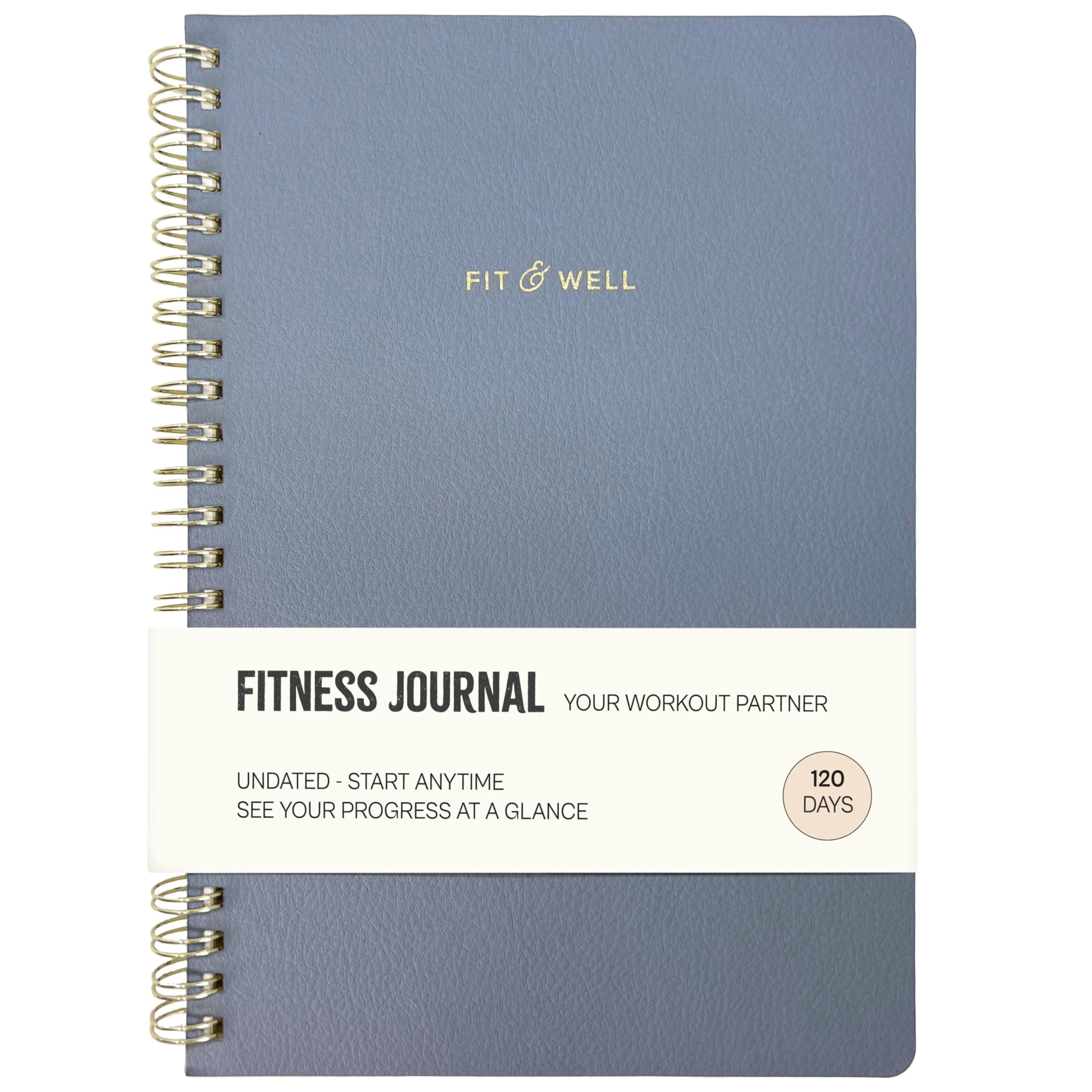
| Kunitsa Co. Fitness Journal | One-page-a-day simplicity | 6” x 8.5” | 120 workouts | Wire-O binding | Amazon |
| WODBOOK Cross Training Journal | CrossFit and WOD athletes | A5 (6” x 8”) | 200 WODs | Wire-bound | Amazon |
| MaLetics A6 Pocket Journal | Pocket carry and travel | A6 (5.83” x 4.53”) | 93 workouts | Spiral-bound | Amazon |
| Portage 3-Pack Fitness Notebook | Bulk value for a training household | 4” x 8” | Over 200 days per 3-pack | Paper soft cover | Amazon |
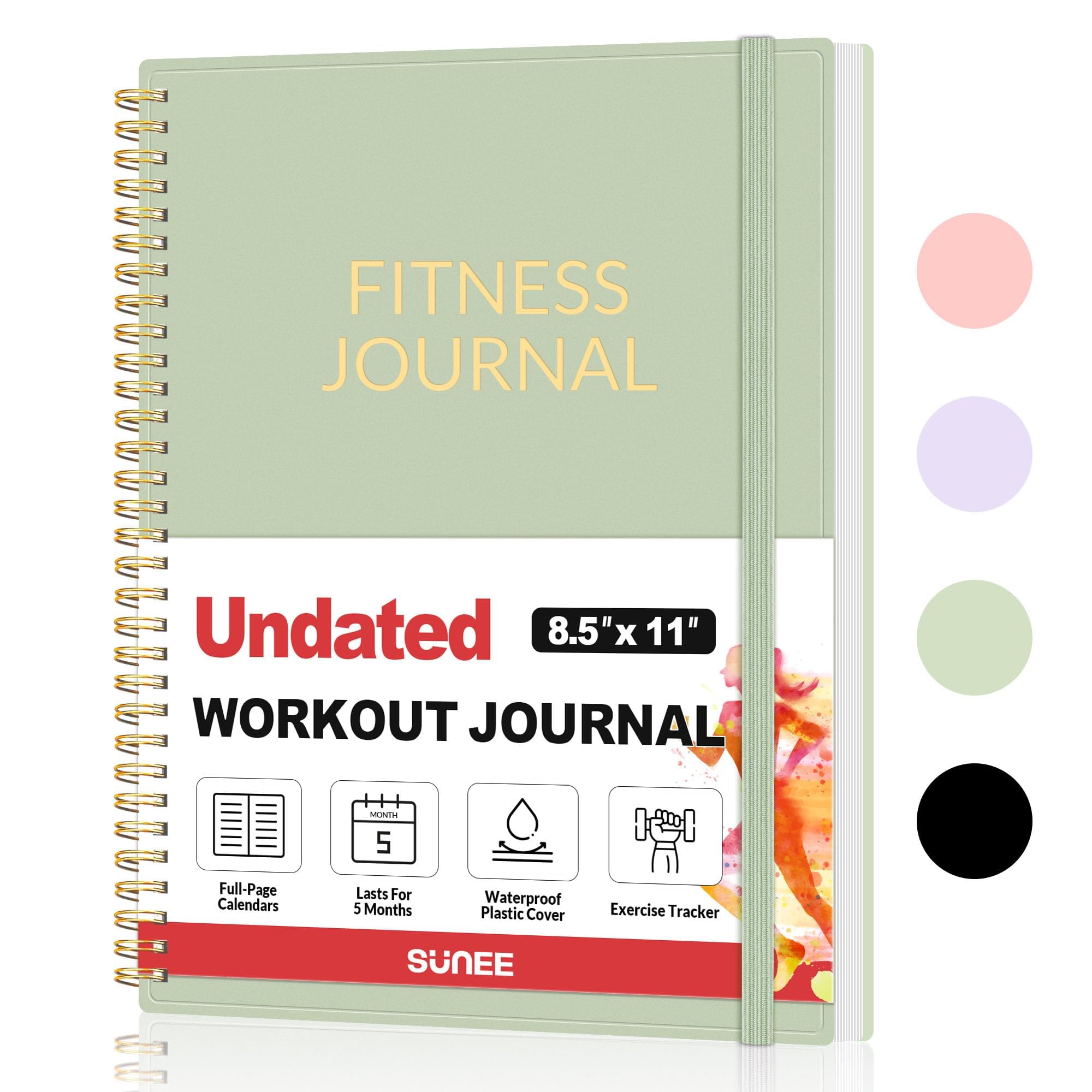
| SUNEE Fitness Workout Journal | Full-page calendars and body stats | A4 (8.5” x 11”) | 145 pages | Spiral-bound | Amazon |
Detailed Reviews
1. Workout Planner 2 Pack A5
Our pick — 4.5+★ from 10,000+ verified ratings; the strongest balance of quality and price.
The everyday lifter’s workhorse, in a two-pack that covers well over a year of training.
This is the one to buy if you just want to log your lifts and get on with the session. Each book holds 100 workouts with room for 9 exercises per session, and you get two of them — so a three-times-a-week habit stretches past the year mark before you shop again. The page is a standard A5 at 6” x 8”, which slips into a gym bag side pocket without bending, and the front section gives you space for 10 fitness goals with target dates so the reason you are there stays written down.
What wins people over is the build, and it starts at the cover. That 500 GSM cover — GSM being grams per square metre, so a genuinely stiff card rather than a floppy sheet — sits over 100 GSM paper and double-wire spiral binding, which means the book opens flat on a bench and takes a knock without shedding pages. Owners treat these as reusable, not disposable; the recurring theme is people re-buying the same book because the format already works for them. It has the largest following of anything here, holding 4.5+ stars across 10,000+ ratings, and that depth of feedback is why it takes the top slot.
Two things to know before you commit. First, the page size is a genuine divider — plenty of buyers call it perfect for a gym bag, while a chunk of others find the writing rows tight, so if you like big handwriting or log long circuits, look at the A4 SUNEE below instead. Second, durability reports split: most books run about eight months of steady use, but a few have come apart early, so treat the spiral with a little care rather than stuffing it under a dumbbell rack. For context on price tier, this is entry-level territory and still the highest-rated pick in the list.
Why it earns the top spot
- Two books in one order — 100 workouts each, so roughly a year of training
- 500 GSM cover over 100 GSM pages, built for the gym floor rather than a desk
- 10 goal slots with target dates plus weekly and monthly progress checks
- Records tempo, rest intervals, and cardio alongside sets and reps
- Double wire spiral lays flat so you can read it mid-set
Where it asks you to compromise
- The A5 page splits opinion — fine for compact notes, tight for large handwriting
- Most books last around eight months of regular use, but a small number fail early
- Nine exercise rows per session will not cover a long circuit workout
Reach for this if: you train two to four times a week and want one book that handles goals, body stats, and set-by-set logging without fuss.
Look elsewhere if: you write large or run marathon circuit sessions — the nine-row page and 6” x 8” format will feel cramped, and the A4 option below suits you better.
2. Gorilla Fit Workout Journal A5
Thick pages and a leather-feel cover that makes logging feel less like homework.
If the reason you keep abandoning planners is that they feel cheap in the hand, this is the fix. The Gorilla Fit pairs a faux leather hardback cover with 120 GSM pages — noticeably heavier stock than the 100 GSM used in the Workout Log Gym two-pack above, which is the spec that decides whether a wet pen ghosts through to tomorrow’s page. It holds 128 workouts across up to 35 weeks of daily and weekly goal tracking, and the layout runs a bigger font than most, so you can read your last set without squinting under gym lighting.
The practical benefit lands in two places. The hardback cover means the book survives being crushed in a bag next to a water bottle, and the A5 footprint at 8.27” x 5.83” slides into the same pocket a paperback would. Tracking spans the full picture — body measurements, goals, and progress all sit in one structured system rather than scattered across three pages you have to hunt for.
The honest catch is volume. It also carries a joint-highest rating in this lineup at 4.5+ stars, though from a smaller pool of owners than the top pick — the crowd favourite has far more ratings behind it, while this one holds the higher score. If you want the most pleasant book to write in rather than the longest-lasting one, this is your pick.
What the thicker stock buys you: 120 GSM pages take a heavy gel pen without bleed-through, which matters if you write hard and hate seeing yesterday’s squats on today’s sheet.
The trade to weigh: 128 workouts is a shorter runway than the 200-session options here, so frequent trainers will be reordering inside a year.
Buy it for the feel: the faux leather hardback and 120 GSM pages make this the nicest book in the lineup to actually open every day.
Pass if page count rules your decision: heavier trainers will get more sessions per book from the WODBOOK or the Nextnoid.
3. Nextnoid Fitness & Food Journal A5
Training on the left page, dinner on the right — the planner for anyone counting both.
Most workout planners ignore the kitchen entirely. This one splits each day across a facing pair: exercise on one side, nutrition on the other, so you are not juggling a separate food app while your gym log gathers dust. It runs 256 pages at A5 size with 120 GSM stock, which is the same heavy paper as the Gorilla Fit but stretched across a much longer book — six months of daily and weekly goal tracking in one volume.
The organisation is what earns the praise here. A 15-section progress tracker sits up front and builds the habit of checking in, and the hardcover spiral binding lets the book lie flat so both pages stay readable while you write. The cover is described as sweat and tear-proof, which matters when the book lives in a gym bag and then on a kitchen counter. Owners describe it as sturdy enough for the trip to and from the gym, and it carries a 4.5+ star rating — the joint-highest score in this list.
Here is the limit worth knowing. The workout calendar covers six months and the progress tracker 33 weeks, so if you train six days a week you will hit the end of the calendar before the end of the book. A small number of units also arrive with a dinged cover in transit — cosmetic rather than structural, but worth a look when the box lands. This is the pick for someone whose goal is a physique change rather than a pure strength cycle.
What it does better than a plain log
- 256 pages pair daily exercise with the meal log on the facing page
- 15-section progress tracker at the front to build the check-in habit
- 120 GSM pages resist bleed-through from a heavy pen
- Hardcover spiral binding lays flat on a counter or bench
Where it stops short
- The calendar runs six months and the tracker 33 weeks — fast trainers outpace it
- Occasional units show up with a dented cover after shipping
Made for: anyone whose goal is weight change, not just a bigger squat, and who wants food and training on one open spread.
Not the one if: you train six days a week and want a full year of calendar pages — the six-month grid will run out first.
4. Gymreapers Workout Journal A5

A gym-floor notebook for the guy easing back into lifting after a long layoff.
The Gymreapers journal is built around daily discipline rather than a fixed session count. Its A5 page at 8.27” x 5.83” gives you space to plan the workout before you start, then record the lifts, cardio, recovery, and a short note for next time. That note space is the underrated part — writing “shoulder felt off on incline” is what turns a logbook into a coach. It sits at 4.5+ stars, matching the top pick’s score on a fraction of the feedback.
The build is aimed squarely at the gym floor: a tough A5 cover, reinforced binding, and thick pages claimed to handle sweat and chalk. Compared to the Portage notebook below, which runs a 4” x 8” page, this one is a full A5 sheet — considerably more writing room per entry and a sturdier spine, at the cost of disappearing into a shorts pocket.
The trade-off is focus. Nutrition tracking is deliberately light here — one buyer’s take is that it is “not the best for tracking nutrition in detail,” which is exactly the point if you find detailed food logs tedious and want the book to stay about lifting. It also runs a daily calendar format rather than a fixed workout count, so how long it lasts depends entirely on how consistently you show up. skip it if you want a numbered 200-session grid; it is not that book.
The appeal, plainly: plan it, lift it, jot one line for next time — a loop that takes under a minute and keeps a returning lifter honest.
The honest limit: nutrition gets a corner rather than a section, so pair it with something else if macro counting is part of your plan.
Fits best: someone getting back under the bar who wants a simple daily loop of plan, lift, and note — nothing more elaborate.
Look past it if: you want a fixed workout count you can plan around, or a serious nutrition section.
5. Kunitsa Co. Fitness Journal 120 Workouts
One clean page a day, undated, so a skipped week never leaves a blank gap staring at you.
Undated is the feature that removes the most guilt from a fitness journal. With 120 workouts across undated daily pages, you start on any date and go at whatever pace your week allows — two sessions one week, five the next, no crossed-out days. The Kunitsa runs on soft white ivory paper with 136 pages total, and the Wire-O binding rotates a full 360 degrees so the book folds back on itself and lies flat without needing a table.
At 8.5” x 6” it fits a backpack or gym bag without a fight, and each daily page asks for your exercise and your meals — a lighter pairing than the 256-page Nextnoid above, but enough structure to keep you honest. The layout stays deliberately uncluttered; there is a monthly calendar, goal-setting pages, and a spot for weights per exercise, with nothing asking you to fill in twelve fields before you have even warmed up. It holds 4.5+ stars, and the recurring note from users is that it keeps them on track and reflecting on progress.
Two honest limits. The page count is about five months of daily use, and a fair number of buyers wish a full year were included — if you log every day, expect to rebuy sooner than you might like. And a couple of people find the pages hard to turn out of the wire binding at first. Neither is a deal-changer; both are the price of a book this easy to write in.
Pick this when: you want a light, pretty, undated daily page for workouts and meals and refuse to be scolded by blank dates.
Keep shopping if: you log every single day and want a full year in one book — five months is the realistic runway here.
6. WODBOOK Workout Journal 140 Pages

Two hundred workout-of-the-day templates for athletes who never do the same session twice.
If your training is a daily WOD you did not write, a set-and-rep log is the wrong tool — you need a page that expects a mixed bag of movements, times, and scores. The WODBOOK gives you 200 workout templates across 140 wire-bound pages, which the maker says covers more than eight months of training. Alongside those sit dedicated slots for 47 benchmark WODs, 30 Girl WODs, 22 Hero WODs, 21 travel WODs, and 10 run WODs, plus personal records and a weightlifting percentage chart with a weight conversion table.
Sizing is A5 at 6” x 8”, so it drops into a sport bag pocket and travels to a box without bulk. The page also takes notes beyond the lift — food intake, weight, mood, sleep, and energy level all get a line, which is the kind of tracking that actually explains why a session felt awful. Content depth is what earns the praise, and the range of named benchmarks means you are not re-drawing the same chart by hand each week. It holds 4.5+ stars from a modest but engaged group of owners.
The fair caveat is the binding. A handful of long-term users report the durability is not quite the equal of the price tag, and some find it on the expensive side for a paper notebook. Neither complaint is widespread, but if you want a book to survive three years of daily box sessions, treat the spine kindly or expect to rebuy. Also note the pen slot: some shipments have arrived without a working pen, so bring your own.
What makes it a WOD book
- 200 workout-of-the-day templates, the deepest WOD library in this list
- 47 benchmark, 30 Girl, 22 Hero, 21 travel, and 10 run WOD slots built in
- Weightlifting percentage and conversion charts on the page, so no math mid-session
- A5 wire-bound format fits a sport bag pocket
Buy with eyes open
- A vocal few find the binding durability short of what the price tag suggests
- Some shipments arrive without a usable pen
- No dedicated food-log section — nutrition gets a single line
Built for: CrossFit and HIIT athletes who chase benchmark times and want every named WOD already laid out.
Wrong tool if: you run a fixed bodybuilding split — the WOD template wastes space a set-and-rep log would use.
7. MaLetics A6 Pocket Fitness Journal

A passport-sized log that lives in your shorts pocket and vanishes in a busy gym.
Compact is the whole point here, and the numbers back it: A6 measures 5.83” x 4.53”, against the Portage notebook’s 4” x 8” page and the A5 books above at roughly 6” x 8”. You get 100 sheets of 100 GSM paper under a stitched polyurethane cover, plus a stainless-steel pen with its own holder. For anyone who has tried to write in a full-size notebook while balancing between sets, the smaller footprint is the feature.
The capacity is genuinely thorough for the size: 93 workouts tracked with up to 10 exercises and 2 cardio movements each, 15 goals checked monthly, and a dedicated section for 24 personal records. Owner feedback lands on that focus — the smaller book keeps you off your phone between sets, and one buyer notes the pages can be turned sideways to write lengthways when you need more room. It holds 4.0+ stars, and the recurring praise is that the clear pages give ample writing space for the size.
Now the honest part anyone shopping for a pocket journal already expects: it is small. One buyer put it plainly — “Solid but rather small which I should have expected as it does say it’s a pocket fitness journal.” A separate few found the included pen dried out on arrival, so treat the pen as a bonus rather than a reason to buy. If you write large, size up to the A5 Workout Log Gym.
Best for the minimalist: anyone who wants tracking that disappears into a pocket and never announces itself at the gym.
Caveat to accept: A6 is genuinely tiny — if small handwriting is not your thing, spend the same budget on the A5 top pick instead.
8. Portage Fitness & Workout Notebook 3-Pack

Three slim notebooks in one order, sized to slide into a back pocket mid-session.
This is the volume play. You get three notebooks, each 4” x 8” with 140 pages of 70 sheets, and Portage claims over 200 days of fitness tracking across the three — so a household of lifters can each claim one and still be writing in the third months later. The page format is a lean 4 inches wide, which is the width that disappears into a sweatshirt or back pocket, and the 0.75mm cover is claimed twice as rigid as most competitors so it gives you a firm writing surface without a table.
Layout is the reason it keeps its buyers: straightforward daily entries, easy to read and write, no filler between the workouts. It suits fast, simple sessions — a handful of lifts and a note — rather than a marathon circuit of fifteen movements. Tracking is what earns it praise, which is exactly what you want in a logbook this stripped back, and the three-pack format makes the per-book cost hard to argue with. It carries 4.5+ stars.
The recurring gripe is paper thinness. Pages can rip out of the binding, and heavier ink bleeds through — the honest fix is a pencil or a fine ballpoint rather than a wet gel pen. Note that the maker has a strong service record for this specific issue, sending replacement pads and a cover to buyers who raised it. If you get through a lot of books and do not need a hardcover, this is the most economical way to keep logging.
Where the value lands: three books per order at a lean 4” x 8” footprint, sized to live in a pocket rather than a bag.
The one catch: the paper is thin — expect to write with a pencil or dry pen and treat the spiral gently.
Made for: households with more than one lifter, or anyone who burns through notebooks and wants spares on the shelf.
Trade-off to accept: thin pages beside the thicker 120 GSM books here — pair it with a pencil and it holds up fine.
9. SUNEE Fitness Workout Journal Planner A4
The biggest page here, for anyone who wants room to breathe while writing sets.
Size is the reason to pick this one, and the comparison is stark: A4 at 8.5” x 11” against the 4” x 8” Portage notebook. That matters for two kinds of buyer — the large-handed lifter whose entries cramp in an A5 book, and the trainee who logs body measurements alongside lifts. You get 145 pages of 100gsm paper, a 5-month full-page calendar, and dedicated space for up to 5 fitness goals with progress tracking.
The detail extends past the set-and-rep grid. Pre and post-workout data both get logged, body-part measurements are tracked session over session, and an elastic strap plus a double-sided pocket keep loose notes from drifting out. It offers more content per page than any other book here, which owner feedback reflects — the recurring verdict is that it is well organised, with tracking being the standout. It holds 4.5+ stars, and it is a genuine one-book solution for someone who otherwise keeps a separate measurements log.
The honest catch is the trade you make for that room: A4 does not fold into a pocket. It slides into a bag, not a shorts leg, and a full sheet makes a big target on a crowded bench. The paper is 100gsm, a touch lighter than the 120 GSM stock in the Gorilla Fit and Nextnoid, so use a drier pen if you write heavy. It is also the least pocket-friendly design in the lineup; if portability is your reason for a planner, look at the A6 or the Portage instead.
Suits you if: you want maximum writing room and a proper five-month calendar, and you train with a bag rather than a pocket.
Think twice if: you need a planner to travel light — A4 demands a bag and will not fold away.
Know the Specs
Page Size (A4, A5, A6)
Page size is the spec that decides whether you actually use the book. A5 — roughly 6” x 8” — is the everyday compromise: big enough for a full set-and-rep entry, small enough for a gym-bag pocket. A6 is the passport size, at home in a shorts pocket but tight on writing room. A4 at 8.5” x 11” gives you the most space but demands a bag. Match the size to where you will carry the book — A6 for a shorts pocket, A5 for a gym bag, A4 for a desk at home.
Paper Weight in GSM
GSM means grams per square metre, a measure of how heavy the paper is. Heavier stock takes more ink before it bleeds through to the other side. A 100gsm sheet is fine with a pencil or dry ballpoint; 120 GSM pages handle a wetter pen without ghosting. If you write heavily or use a gel pen, 120 GSM pages stop ink from ghosting through to the next workout.
Workout Capacity
Workout capacity is the number of sessions the book is built to record. A book designed for 100 sessions at three gym visits a week lasts roughly eight months; one built for 200 sessions stretches considerably longer. Divide the session count by your weekly gym visits to see how many months the book covers before you rebuy.
Binding Types
Binding affects whether the book lies flat while you write. Double-wire and Wire-O spirals let a page fold back on itself, so you can balance the book on a bench and read it mid-set. Reinforced and hardback spines hold up better in a busy gym bag. A soft paper cover saves weight and thickness but asks more care.
Common Questions
Will an A5 workout planner fit in a gym bag pocket?
Is a paper workout planner better than a phone app for tracking lifts?
What does GSM mean on workout planner paper?
How many workouts should a good planner record?
Do undated workout planners actually matter?
Can a workout planner double as a food diary?
What is the difference between A4 and A5 workout journals?
Does spiral binding hold up in a sweaty gym bag?
Is a pocket journal worth it for serious lifters?
The Bottom Line
For most lifters, the workout planner that earns the spot is the Workout Log Gym 2-Pack — a 6” x 8” page, 500 GSM cover over 100 GSM paper, and two books per order that carry you past a year of training. Its 4.5+ stars across 10,000+ ratings make it the safest first buy in the category. If page feel is what matters to you and you want heavier 120 GSM stock, the Gorilla Fit hardback writes nicer in the hand. And for anyone training CrossFit rather than a fixed split, the WODBOOK puts all 200 workout templates and its benchmark charts right where your hand lands between rounds.
How we choose
We do not accept paid placement. Every pick is matched to a real buyer and a real use-case; we do not hands-on test units.
Sources
Specifications: manufacturer listings and product documentation. Review insights: verified customer reviews, as of October 2026. Pricing: not shown on this page (it changes often); check the current price via the retailer link.
As an Amazon Associate, Home Digitized earns from qualifying purchases. This does not affect which products we feature.