
Specs are compiled from manufacturer listings and verified buyer reviews and can change over time — please confirm the key details on the product page before buying.
If you want the simplest answer: buy a walking pad that fits under your standing desk without crowding your feet, then make sure the motor is quiet enough that your microphone will not pick it up. Two specs decide almost everything here — deck size (the walking belt’s length and width) and noise level. Get those right and your workday gains thousands of steps; get them wrong and you have an expensive floor mat. This guide walks through nine real under-desk treadmills and explains, in plain terms, which one suits your body, your desk, and your workday.
This guide is built by comparing the manufacturers’ published specifications and the patterns across verified customer reviews, so you get each pick’s real strengths and trade-offs instead of marketing spin.
The first thing to settle is where the machine will live, because a walking pad that stows badly never gets used. Below are the picks that earn their desk space, ranked by how they hold up once the novelty wears off.
You will see deck measurements, horsepower, incline grades and noise figures side by side, plus the honest trade-offs behind each work desk treadmill.
Top Picks
How To Choose The Best Work Desk Treadmill
A desk treadmill fails in one of two ways: the belt is too cramped underfoot, or the motor is too loud for calls. Everything else is decoration. Start with the belt, then work backward to motor and storage.
Deck length and width come first
The walking belt is the surface your feet actually touch, so its length and width decide whether you walk naturally or shuffle. A short, narrow belt forces you to shorten your stride and glance down at your feet. Longer decks — like the 40-inch belt on the Vitalwalk or the 41.3-inch deck on the MERACH — give taller walkers room to land heel-to-toe without clipping the front roller housing.
Auto incline versus manual incline
Incline raises the front of the belt to mimic an uphill grade. Automatic incline changes that angle from your remote or app mid-session; manual incline means stopping and moving physical blocks under the front of the deck. Auto incline is the feature to prioritise if you want to raise intensity without breaking your concentration at the desk.
Motor size and what “HP” actually tells you
Horsepower (HP) is the motor’s rated output. Higher HP tends to mean the belt holds speed more steadily when you step heavily, but it also adds weight to the unit. For slow walking under a desk, 2.0HP to 2.5HP is enough; heavier walkers and joggers benefit from 3.0HP and up. Look for whether a listing says peak versus sustained output, since peak figures describe brief bursts rather than all-day running.
Noise in decibels — what matters for calls
Noise is measured in decibels (dB), a scale where small number gaps are bigger than they look. Under-desk treadmills crowd listings with claims, so compare stated figures like 35dB, 45dB, 54dB and “≤60db” carefully. A machine near 35dB can sit under a microphone; anything near 60dB will be picked up on a call. Footfall noise often outlasts motor noise, so sturdy builds with thicker frames tend to be quieter overall.
Side-by-Side Comparison
| Model | Best For | Max Speed | Max Incline | Motor | Amazon |
|---|---|---|---|---|---|
| PACEROCKER Walking Pad 450 lb★ Best Overall | Heavier walkers wanting auto incline | 5.0 MPH | 12% (9 levels) | 2.5HP | Amazon |
| UREVO Strol 2E ProSmallest Footprint | Small spaces and first-timers | 6.2 MPH (open mode) | — | — | Amazon |
| UREVO Auto Incline 10%Quietest Runner | Quiet apartment use | — | 10% (9 levels) | 2.5HP | Amazon |
| MERACH UltraWalk W60 | Tall walkers needing a wide deck | — | 12% (12 levels) | 3.5HP peak | Amazon |
| Vitalwalk 15% Auto Incline | Uphill intensity in a small flat | — | 15% (6 levels) | 3.0HP brushless | Amazon |
| Mokirui Incline/Decline Pad | Office floors and downhill walks | 4.0 MPH | 10% (+ -4% decline) | 2.5HP | Amazon |
| WalkingPad C2 Foldable | Folding flat under a bed or sofa | 4 MPH | — | 2.0HP | Amazon |
| Maksone Wooden Walking Pad | Tight budgets and slim spaces | 6 km/h | 3% | 2.25HP | Amazon |
Detailed Reviews
1. PACEROCKER Walking Pad Treadmill
Our pick — 4.5+★ from 500+ verified ratings; the strongest balance of quality and price.
A 450-lb steel frame with nine auto-incline steps — a walking pad that keeps its composure.
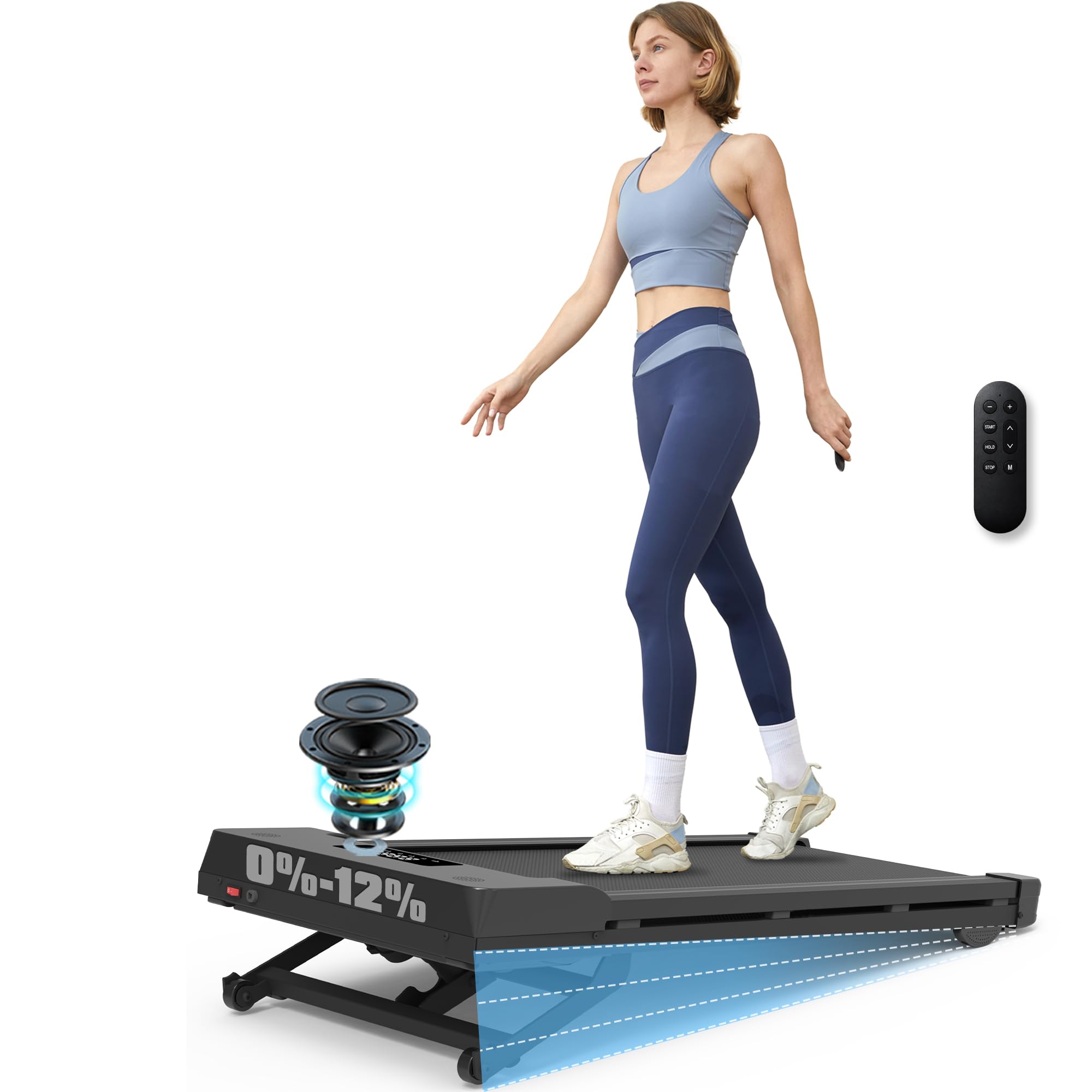
You get a 450 lb weight capacity that is not just a printed sticker on a light chassis. This PACEROCKER has a reinforced alloy steel frame, a 2.5HP motor (a motor that powers the belt) and a 38.6-inch by 15.7-inch deck (the walking surface), so you can walk steadily up to 5.0 MPH — fast enough for a desk-side Zone 2 session (a pace where you can still talk), slow enough to stay under a laptop. The auto incline (a feature that raises the front of the deck) runs nine levels up to 12%, so you can increase effort from your chair without stooping to reposition blocks.
Build quality is what wins people over, and owners back it up: the treadmill is widely described as sturdy, easy to move on its wheels, and secure underfoot at speeds up to 5.0 MPH without wobble. Buyers report it “Holds ~250 lbs without slowdown; includes two remotes and oil squeeze bottle.” The Bluetooth speaker (a wireless speaker you connect to your phone) sounds better than you would expect on an under-desk unit, and the two included remotes remove the losing-the-remote panic that comes with some rivals.
It slides under a desk, bed or sofa thanks to a 48-inch overall depth and 6.5-inch height, but it will not disappear in a studio. Keep it close to something solid to grab for balance, since there is no handrail. As for the crowd verdict, this is the top-rated pick in this guide — 4.5+ stars across 500+ ratings — and it earns the label on stability and incline rather than marketing.
Where It Holds Its Value
- 450 lb capacity on an alloy steel frame, rare at any tier for a walking pad
- Nine auto-incline levels reaching 12%, the steepest auto option here
- Two remotes, oil bottle and tool kit included in the box
- Wheels make under-desk and wall storage a one-person job
What You Should Know Going In
- No handrail, so beginners should keep a counter or wall within reach
- 48-inch depth is the longest in this guide alongside the best picks here
Reach for this if: you are a heavier or taller walker who wants auto incline and a frame that will not groan underfoot.
Measure your clearance first: the 48-inch depth requires a genuine under-desk footprint, not a folding-table gap.
2. UREVO Strol 2E Pro Smart Walking Pad with Safety Handle
Folds flat with a safety handle attached — the walking pad for people who are not sure they will use one.
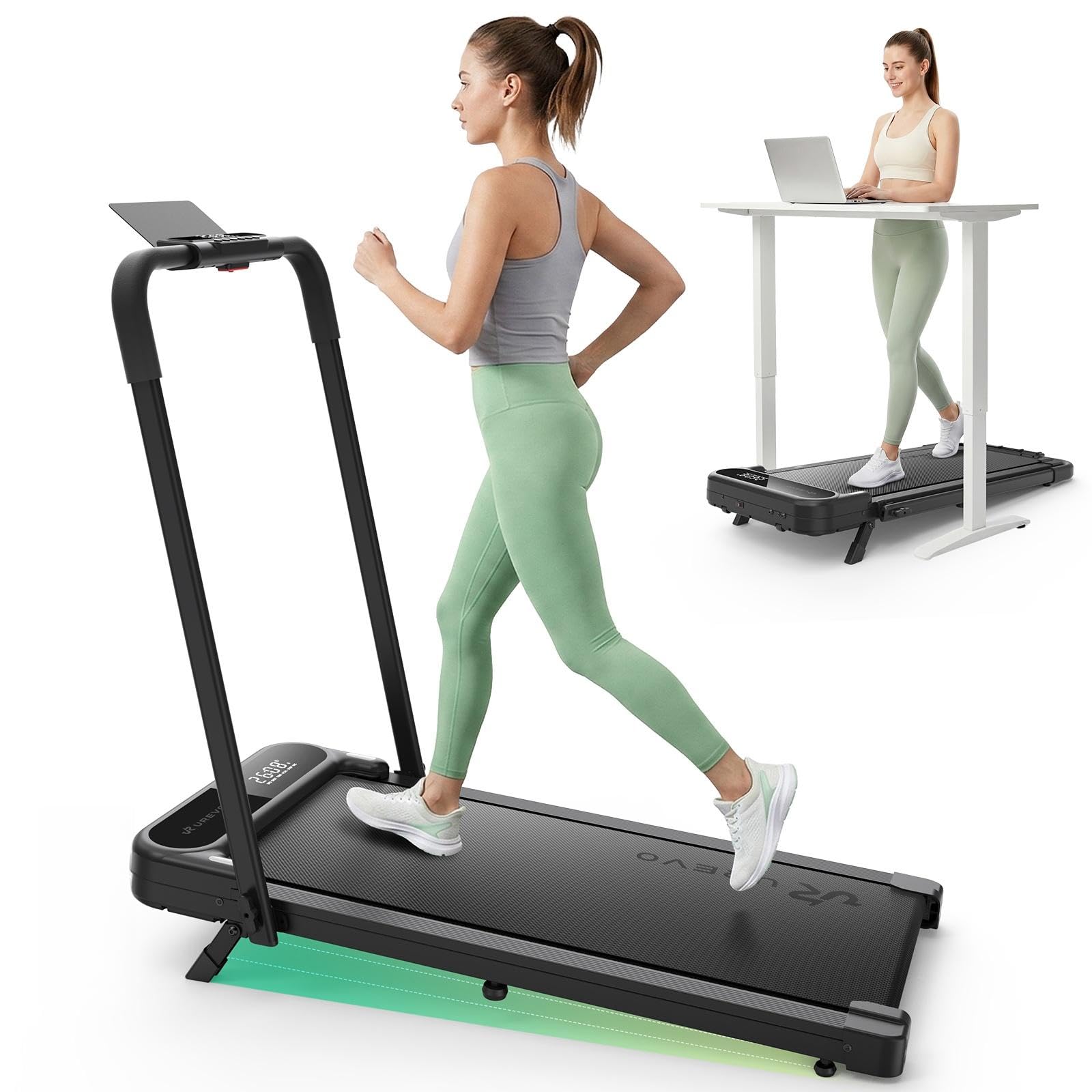
Two features separate the Strol 2E Pro from most of this list. First, it has a safety handle you can hold while getting used to the belt. Second, it folds up compactly — the whole thing measures 44.9 x 21.9 x 4.2 inches and folds down, so it lives in a cupboard when the novelty fades. For a first-time buyer who is not certain walking at work will stick, the handle is genuinely reassuring.
The belt runs 36.6 x 15.2 inches, which is shorter than most here. Users describe the treadmill as easy to set up and running from the start, quiet enough that a sleeping baby is not disturbed, and stable enough for light daily walking. The two modes are simple: open running mode tops out at 6.2 MPH, folding walking mode tops out at 4 MPH, and a one-key mute kills the beeps on the remote.
The app is the weakest part — a couple of owners mention that activities fail to log, and they fall back on a smartwatch instead. Lubrication every 125 miles is another chore printed in the instructions; skip it and the belt will let you know. The 15.7-inch display is legible with the handle folded down, which is when most people will actually use it.
Where it sits: this is the walking pad to try if you want a handle, a fold-flat body and a price that will not hurt if you decide desk walking is not for you.
The catch: app tracking is unreliable and the belt is short, so tall users will shorten their stride.
Good match for: first-time walking-pad owners who want a grab handle while they build confidence.
Look elsewhere if: you need reliable per-walk app logs — a smartwatch will serve you better here.
3. UREVO Auto Incline 10% Walking Pad with Dual Brushless Motor
The dual brushless motor here is the durability play — quieter starts, smoother speed holds.
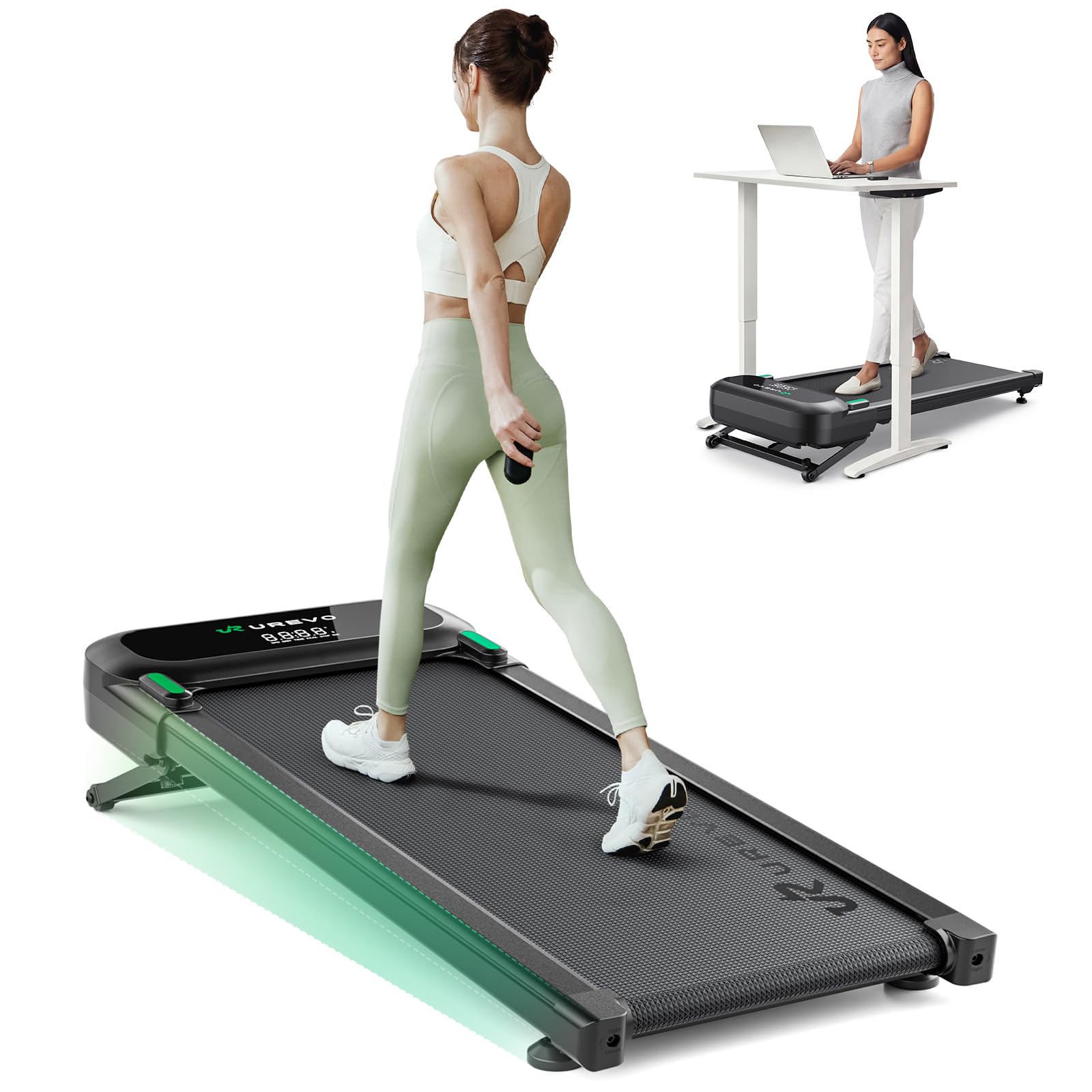
A brushless motor, for anyone shopping this category for the first time, means the motor spins without carbon brushes rubbing against a commutator — fewer wearing parts, generally quieter running and longer service life. The 2.5HP dual brushless setup is why this UREVO tends to be described as quiet first and fast second. Add 12-point shock absorption (eight silicone dampers plus a suspended board and four support points) and you get a belt that protects knees on the way down as well as the motor on the way round.
The auto incline runs nine levels up to 10%, just under the 12% best picks here but plenty for desk work. The 48.8 x 20.3 x 6.1-inch chassis fits under a standard desk and rolls away on wheels; the folding flat position is a real advantage in a small flat. Assembling it is straightforward — clear instructions are the most-praised thing about this model.
Two honest notes. Speed changes in 0.5 MPH steps and the displayed figure runs a touch optimistic, so trust your body rather than the screen. And folding it flat means fully removing the knobs — keep them in a drawer or leave the treadmill standing, since losing them is the quickest way to break the routine. The 300+ strong buyer base rates this one 4.0+ stars.
Desk-day verdict: a rare combination of auto incline, brushless motor and shock absorption at a mid-tier place in this field.
Worth flagging: the speed readout drifts from reality, so do not trust it for logging pace.
Fits neatly with: apartment dwellers who want auto incline and quiet running, with clear assembly.
Pause if: you need accurate speed logging for training plans — the display is approximate.
4. MERACH UltraWalk W60 Walking Pad with 12% Auto Incline
A 16.5 by 41.3-inch deck that finally gives long legs somewhere to land.
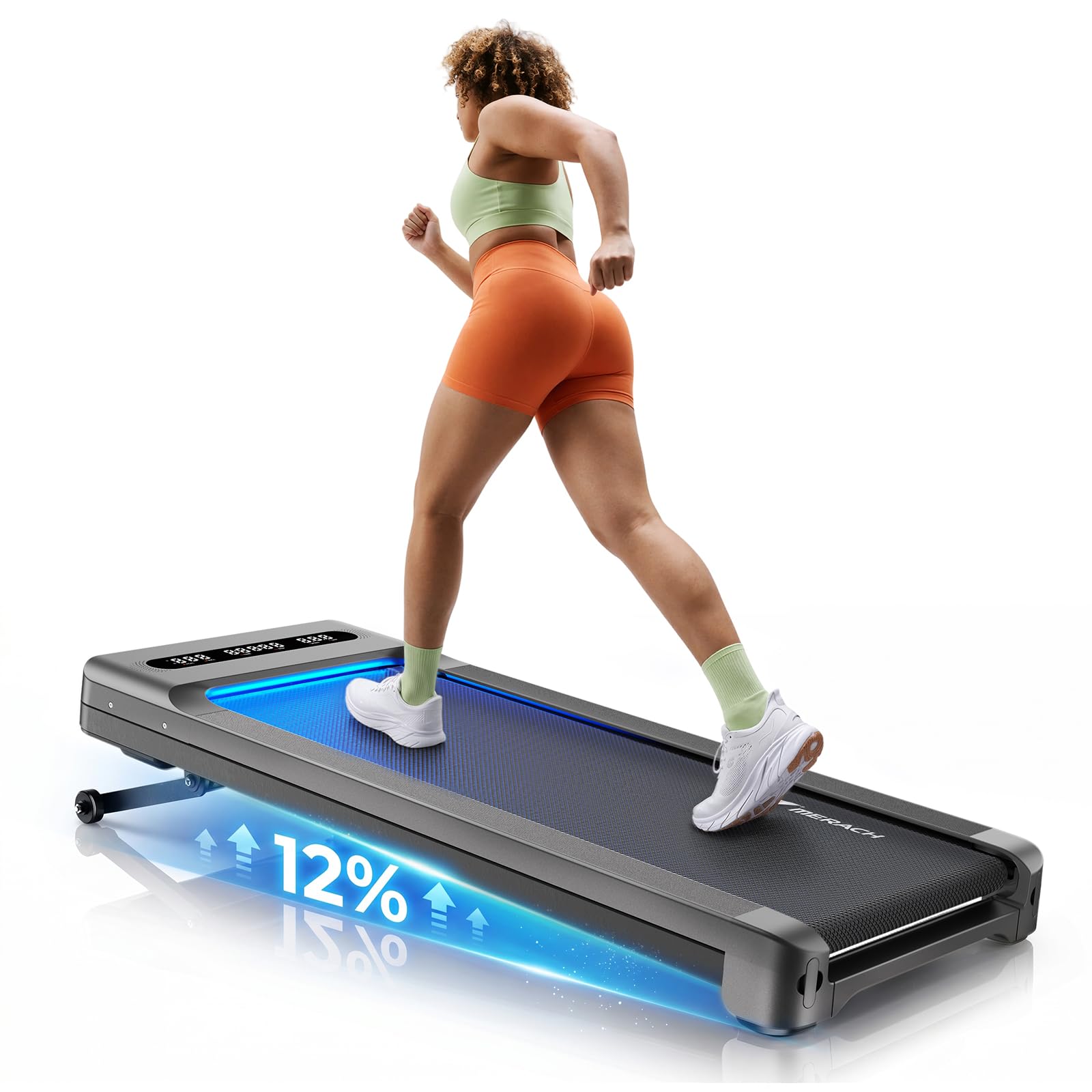
Six-foot walkers keep hitting the same wall on walking pads: a short belt forces you to shuffle, not stride. The MERACH answers with a 16.5 x 41.3-inch deck — the manufacturer says that is 33% more stride space than a standard pad, and at 41.3 inches it is longer than the Vitalwalk’s 40-inch belt. Combined with a reinforced 67.7-lb steel frame and 400 lb peak capacity, this is the pick if your concern is whether the machine will feel big enough underfoot — not whether it will look small in the room.
The motor is a 1.25 CHP / 3.5 HP peak brushless unit with Hall sensor control and dual-vent cooling, rated by the maker for 15,000 hours. Averages around 54 dB on noise places it between the whisper claims of the Vitalwalk and the buzzier budget pads. The 12-level auto incline runs up to 12%, letting you raise the front without stopping. Controls come via remote or app, and there is a child lock for households with small hands.
At 67.7 lb, this is the heaviest walking pad in this guide, and that weight is exactly why it feels so planted. Set it up where it will live; do not plan to move it between floors often. As for reliability, the consensus is that this machine is solid, though an occasional unit arrives with a belt that needs re-centering — fixable, but worth knowing.
Why Taller Walkers Choose It
- 16.5 x 41.3-inch deck is the widest here alongside the best picks — more stride for long legs
- 400 lb peak, 330 lb sustained capacity on a steel frame
- 12 auto incline levels up to 12%
- Bluetooth speaker, app sync to Apple Health and Google Fit, magnetic remote dock
The Honest Drawbacks
- 67.7 lb makes moving it a two-person job between rooms
- Manual covers belt-tension and lubrication less clearly than it should
- Remote is small with a fiddly battery screw
Pick this for: anyone over six feet who has outgrown a short walking belt and wants room to land each step.
The tradeoff: you commit to one spot in the flat, because 67.7 lb and a steel frame do not move casually.
5. Vitalwalk Walking Pad with 15% Auto Incline
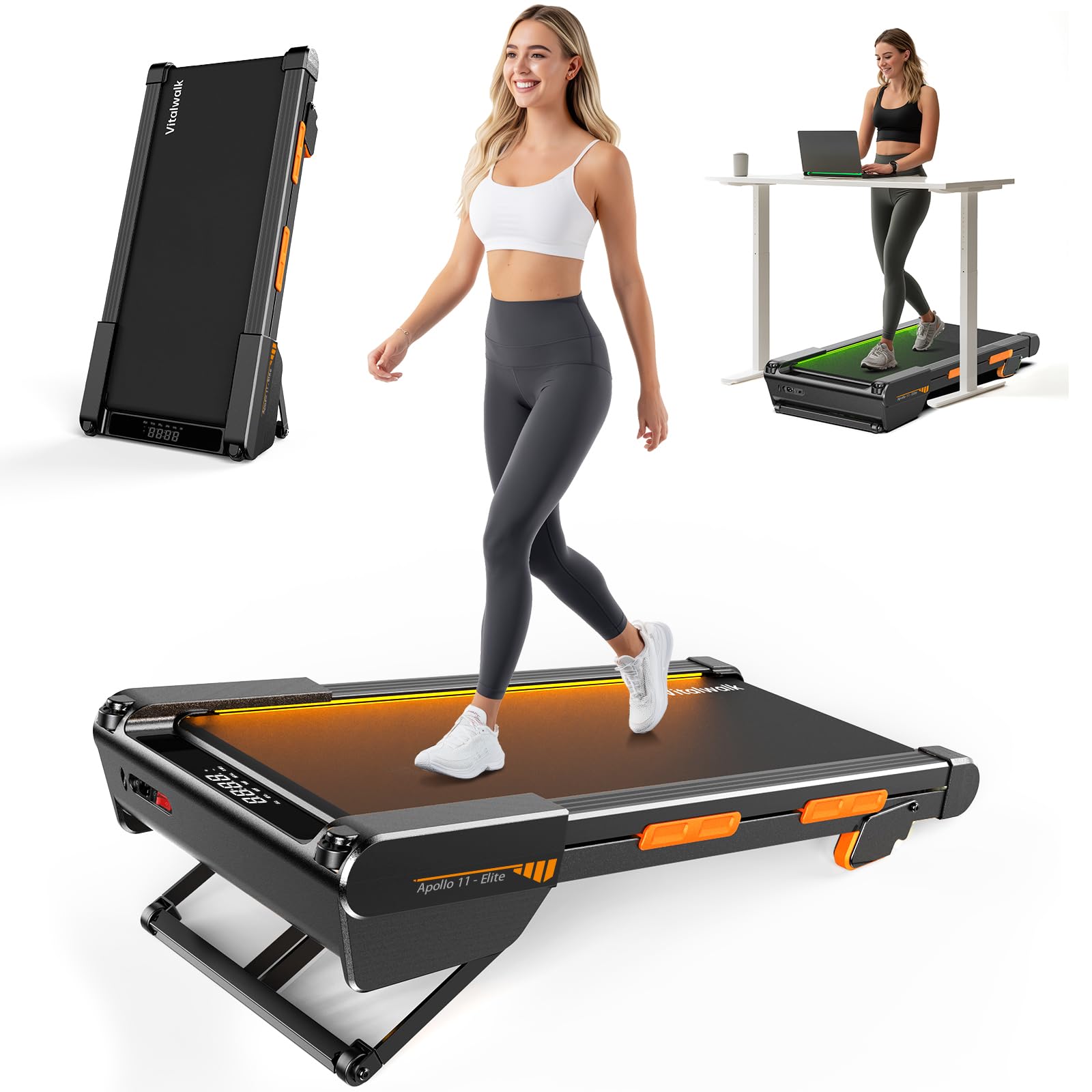
Fifteen percent of uphill grade on a belt you can store in roughly a square foot.
If you want incline to actually change how hard desk walking feels, 15% is the number to notice. The Vitalwalk offers six auto incline levels reaching 15% — steeper than the PACEROCKER’s 12% and the UREVO’s 10% — and pairs that with a 3.0 HP brushless motor rated to run at a library-quiet 35dB. A mute button kills the beeps during Zoom calls, which is a small feature that prevents large annoyances.
The deck design is where this pad gets interesting. A Full-Deck Belt-to-Body layout hides the motor beneath the belt, delivering a 40 x 16-inch walking surface inside a 43 x 20-inch frame. The maker claims 30% more usable belt in a more compact body, and the pad does feel roomier than its footprint suggests. Four wheels move it forward, backward and side to side, and it stands vertically in as little as a 1.5 sq.ft patch.
The honest note is pace consistency. Speed sits among the most-discussed aspects and the sentiment is mixed — some users find the belt struggles to hold a perfectly even speed, especially at walking paces. Footfalls are audible even though the motor is not, so running shoes quiet this one down. The larger remaining doubt: heavy users over time are rare enough that long-term patience is still being proved.
The pitch that lands: the steepest auto incline here with a 40 x 16-inch deck — genuine intensity without adding floor space.
Where it asks patience: pace control is uneven and footfalls are audible without running shoes.
Reach for this if: uphill walking is the whole point and your room cannot spare floor.
Look past it if: you need metronomic, steady speed for structured pace training.
6. Mokirui Walking Pad with 10% Incline and -4% Decline
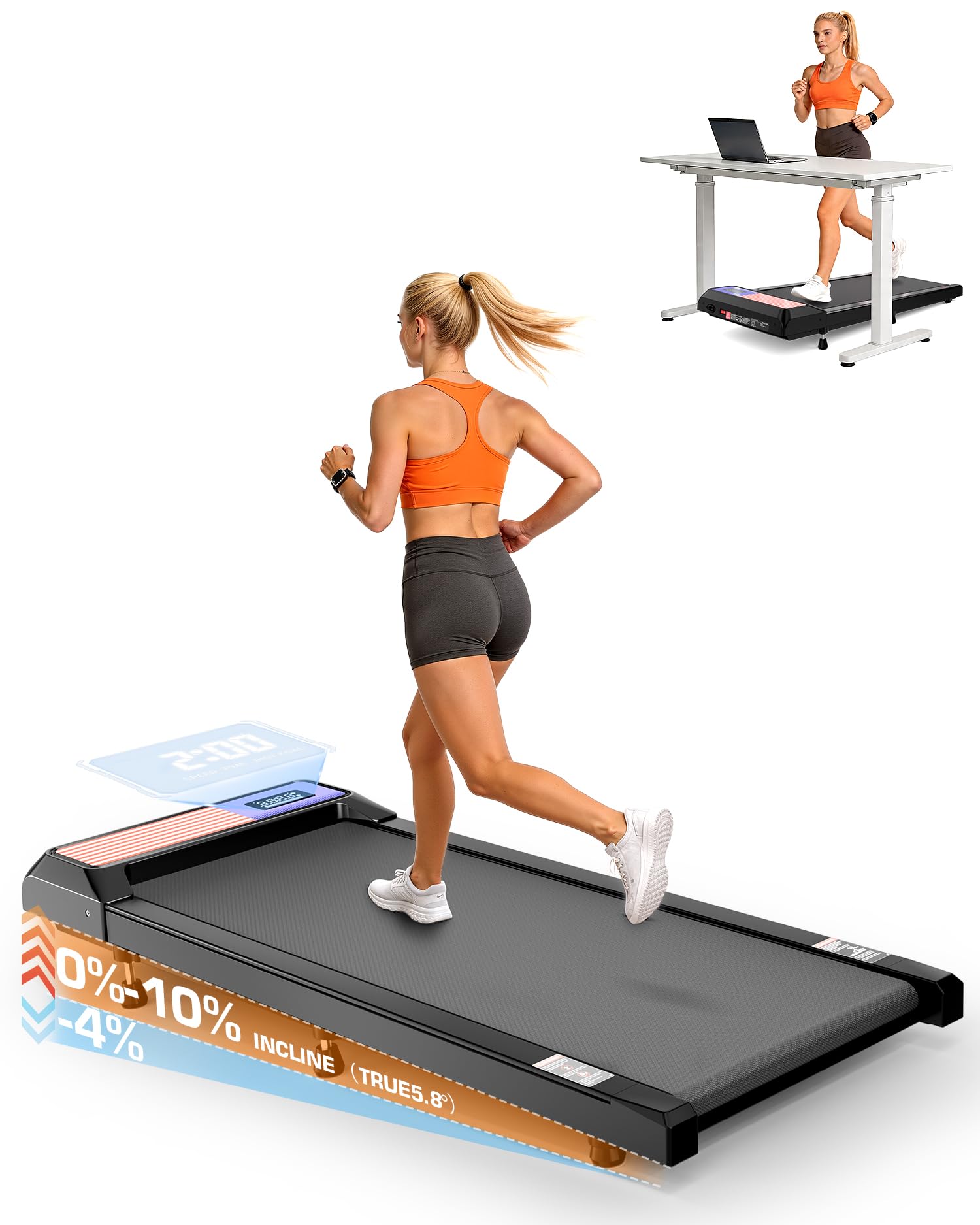
The only pad here that tilts both ways — 10% up, 4% down.
Downhill walking is the reason to consider this Mokirui. Its deck tilts up 10% for climbing and down 4% for downhill strides, so the front goes lower and rear higher — useful if you want both quad-focused uphill work and the different muscle pattern of downhill walking. The 2.5HP motor runs under 45 dB, which is quiet enough for shared offices and late-night use without spouse complaints.
The chassis is the slimmest in this group at 43.1 x 18.5 x 4.6 inches and only 28.7 lb, so one hand moves it under a desk. The walking belt is 15 x 35.4 inches with six layers of cushioning, and top speed is 4 MPH with a 265 lb capacity. A wireless remote handles speed and incline, and the LED display is easy to read while you work.
The desk-day math here is simple. The low 4 MPH ceiling suits walking and light brisk strides, not jogging; the smaller 28.7-lb build suits one person moving it around, not households with two users. Reviews describe a pad that helps accumulate steps while working without disrupting focus or floor surface, and the 4.5+ star score across 150+ ratings makes this the highest-rated pad in the guide.
Why It Fits Office Life
- Under 45 dB — quieter than most, suited to open-plan offices
- Incline 10% and decline -4%, rare on a walking pad
- 28.7 lb is the lightest on this whole list
- 4.6-inch profile slides under desks and sofas with room to spare
Trade-offs to Weigh
- 4 MPH top speed rules out jogging and running
- 265 lb capacity is the lowest on this guide
Choose this for: shared offices and light evening walks where noise matters and running is not the plan.
Rule it out if: you weigh more than 265 lb or want to jog, because the speed cap and capacity close that door.
7. WalkingPad C2 Foldable Walking Pad Treadmill
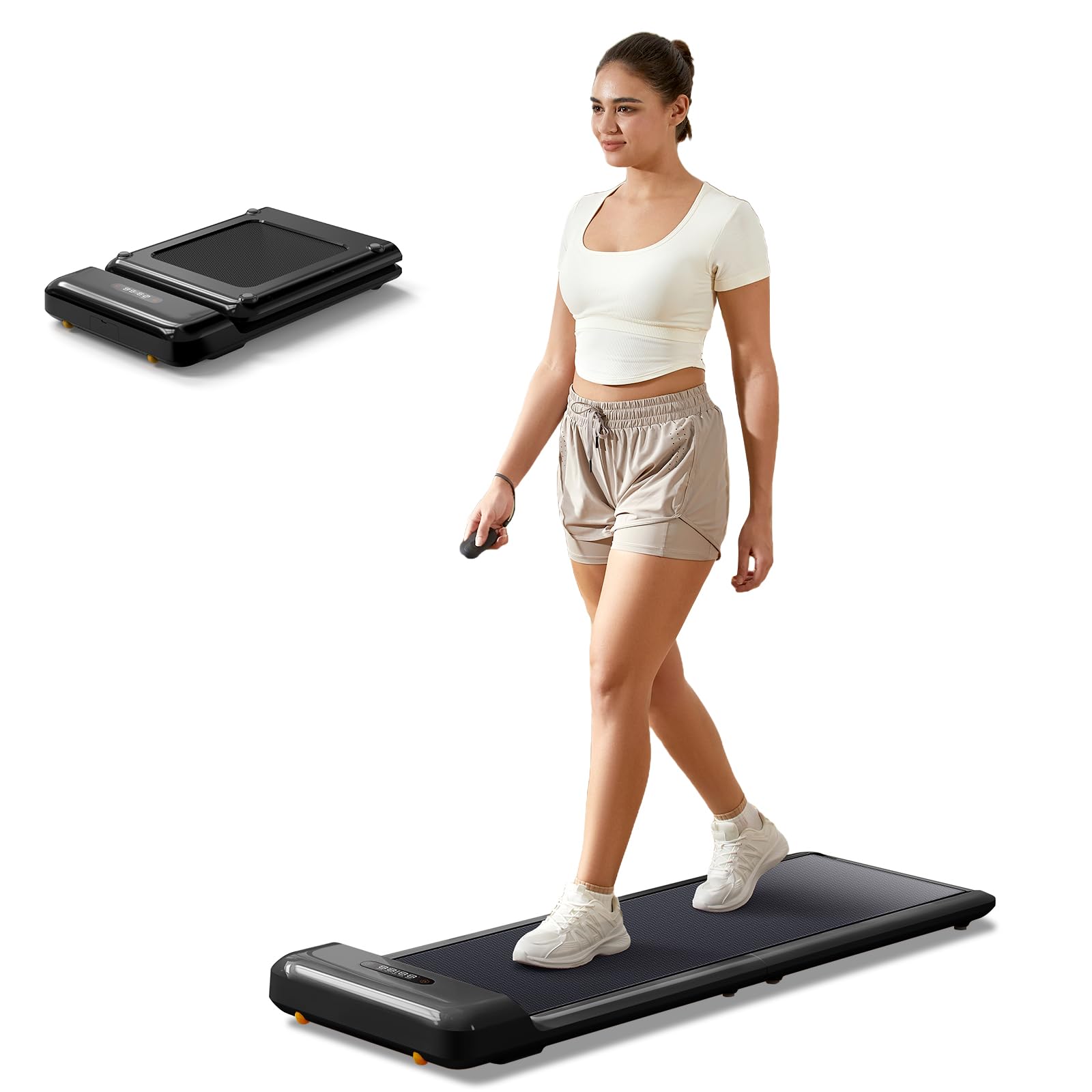
Folds the platform in half at 180° and stores in 5.4 inches of height.
Folding the belt itself in half is a different trick from folding a frame. The C2 splits at the middle along its 56.9-inch length, so it packs into 32.5 x 20.4 x 5.4 inches — a package that hides under a sofa or in a cupboard where a full walking pad will not go. The 55-lb aluminum body is light enough to shift with two wheels, and the 2.0HP motor handles up to 220 lb and tops out at 4 MPH in a working speed range of 1 to 4 MPH.
Durability is the C2’s strength: reviewers point out passing 1,000 miles with the belt still running. The design is tidy enough to live in a living room rather than a spare room, and it ships with no assembly and no subscription for the app — the FootSense controls (controls you tap with your foot) and LED display run steps, time, speed, calories and distance without a monthly fee.
Noise divides opinion — some describe it as very quiet, others as louder than expected. The 220 lb capacity also makes it the least suited here to heavy users, and at 25 kg it is not featherweight despite the folding trick. At 4.0+ stars with 200+ ratings behind it, the C2 earns its spot on storage rather than raw performance.
Storage verdict: the folding platform is genuinely unique in this guide, and the aluminum chassis keeps it manageable.
What to accept: 4 MPH top speed and a 220 lb cap put a ceiling on how hard you can work out.
Ideal for: city flats where every inch counts and a walking pad must vanish at 6 p.m.
Skip if: you are a heavy user — 220 lb is the lowest ceiling in this grouping.
8. Maksone Under Desk Treadmill, Wooden Walking Pad

The 4.3-inch body that genuinely disappears under a bed — and the easiest install here.
At 4.3 inches thick and 34.8 lb, the Maksone is the shallowest pad in this roundup, and it wins on install as much as depth. It arrives assembled, so unboxing is the whole setup. The 14.96 x 35.43-inch belt is one of the wider surfaces here, and the shock absorption system is designed to soak up impact rather than bounce your knees. Motor output is 2.25HP with a stated noise figure of ≤60db, and top speed is 6 km/h with a 300 lb capacity.
Where this pad differs from the others, beyond wood-look styling, is the incline. Three positions adjust manually rather than from a remote, and the top grade is 3% — useful for a bit of extra work, but not the 10% to 15% territory of the PACEROCKER or Vitalwalk. Twelve preset programs and real-time speed, distance, time and calorie stats on the LCD cover the basics without fuss.
Reliability is the honest caveat here and it is stated plainly in the review pattern: some long-term owners describe using it well, while others report the machine did not last a year. Some shoppers say their first unit lasted about 1,000 miles before needing replacement. from the start, the speed shows in kilometres rather than miles, which takes adjusting.
Budget reasoning: 4.3-inch slim depth, included assembly and a wider belt make this the easiest entry into desk walking.
The real watchpoint: long-term reliability divides owners, so buy with the 12-month warranty in mind.
Pick this for: renters and tight spaces where the pad has to slide under a bed between sessions.
Think twice if: you plan years of heavy daily use — reliability here is not the strength of this pad.
Know the Specs
Walking belt length and width
The belt is the walking surface, and its dimensions decide how naturally you stride. A 35-inch belt forces a shorter step than a 40-inch belt, which matters most for tall walkers. Wider belts of 16 to 16.5 inches leave room to drift without clipping the side rails. A desk treadmill with a belt around 38 to 41 inches long tends to feel comfortable for long sessions.
Incline percentage and levels
Incline is the uphill grade you are walking against, expressed as a percentage of rise over run. Three positions might reach 3%, while a nine-level auto system may run to 12% or six levels to 15%. Auto incline changes from the remote or app; manual incline means stopping and moving blocks under the deck.
Motor horsepower (HP)
Horsepower describes how much work the motor can do. Walking-only pads often sit at 2.0HP to 2.5HP; heavier walkers and joggers benefit from 3.0HP to 3.5HP. Check whether a listing quotes peak or sustained output, because peak describes short bursts rather than an all-day session.
Noise in decibels (dB)
A decibel is a unit measuring sound intensity, and small number differences matter. A 35dB motor is quieter than a 45dB one, which is quieter again than a 54dB or ≤60db pad. Footfall on the belt often makes more noise than the motor, so thick frames and running shoes help.
Common Questions
Will a walking pad fit under a standard standing desk?
Is a walking pad quiet enough for video calls?
How long can you walk on a walking pad in a workday?
Do walking pads need lubricant, and how often?
Is auto incline worth it over manual incline?
Can a walking pad support a heavy walker?
Walking pad or a full treadmill for working at a desk?
What speed should you set a walking pad to while working?
Do you need a handrail on an under-desk treadmill?
How do you store a walking pad in a small flat?
The Bottom Line
If you want the work desk treadmill that will not wobble under a heavy walker, the PACEROCKER 450 lb pad is the soundest choice, with nine auto incline levels up to 12% and a reinforced steel frame. Want the widest, most confidence-earning belt for long legs? The MERACH W60 gives you a 16.5 x 41.3-inch deck. And for quiet office use with both incline and decline, the Mokirui is the lightest and lowest-noise pick here. Match the belt to your stride first, and the rest of the list sorts itself out.
How we choose
We do not accept paid placement. Every pick is matched to a real buyer and a real use-case; we do not hands-on test units.
Sources
Specifications: manufacturer listings and product documentation. Review insights: verified customer reviews, as of October 2026. Pricing: not shown on this page (it changes often); check the current price via the retailer link.
As an Amazon Associate, Home Digitized earns from qualifying purchases. This does not affect which products we feature.