
Specs are compiled from manufacturer listings and verified buyer reviews and can change over time — please confirm the key details on the product page before buying.
If your routed corners come out lopsided or your hinge mortises leave gaps you have to fill with putty, the problem is almost never your router — it is that nothing is holding the bit on the line. A good router jig turns a shaky freehand pass into a guided cut you can repeat on the next door, the next shelf, and the next ten after that. The picks below cover edge and mortise work, door hinges, rounded corners, and circles.
This guide is built by comparing the manufacturers’ published specifications and the patterns across verified customer reviews, so you get each pick’s real strengths and trade-offs instead of marketing spin.
Below you will find the jig that suits your bench, the router base it has to bolt to, and the cuts it handles without extra parts. Each pick below lists the router base it fits, so check that before you order.
Top Picks

How To Choose The Best Woodworking Router Jigs
The first question is not which jig is best — it is which jig will physically bolt to the router you already own. Get that wrong and nothing else matters, because a template that does not line up with your base plate is a paperweight. Work through these four checks in order and the shortlist narrows itself.
Check your router base before anything else
Every jig here attaches through the screw holes in your router’s base plate, and those holes sit at different spacings from brand to brand and even model to model. Measure the diameter of your base and the distance between two opposite mounting holes. Some jigs use a multi-hole plate with several patterns punched in it, which covers more routers without drilling; others expect one specific style. A palm router with a small base often cannot carry a large plate, and a big plunge router will overhang a small one.
Decide between a guide bushing and a pattern bit
A guide bushing (sometimes called a template guide) is a metal ring that fits into your router base and rides along the edge of the jig, so the bit follows the bushing rather than touching the template. A pattern bit has a bearing on it that rides the template directly. Bushings let you use a jig much thicker than the bearing on any bit, which is why several picks here include or require one. Know which system your chosen jig uses before you buy, because a bushing that does not seat flat will let the router wander.
Match the jig to the cut you make most
Corner rounding, hinge mortises, dados, and big circles are four different jobs and no single jig does all of them well. If you are hanging doors, buy a hinge template with the bits included. If you build tabletops or speaker cabinets, buy a circle jig with a wide diameter range. If you cut joinery, a dado plate paired with a straight edge is the tool. Buy for the cut you make most, not for every cut on the list.
Side-by-Side Comparison
| Model | Best For | Cut Range | Material | Router Fit | Amazon |
|---|---|---|---|---|---|
| Milescraft 1224 Edge & Mortise Guide★ Best Overall | Edges, dados and mortises | Straight and curved edges | Plastic | Universal base, offset base included | Amazon |
| Gohelper Door Hinge JigBest for Doors | Hanging interior and exterior doors | 2-1/2″ to 5″ hinge lengths | 6061 aluminum alloy | Door side only, bit and drill bits included | Amazon |
| TANYO 7pcs Radius TemplateMost Versatile | Rounded corners and fillets | 18 radius settings | Anodized aluminum | Fits trim, handheld and table routers | Amazon |
| Sigerio 4 in 1 Circle Cutting Jig | Large circles and arcs | 10″ to 58″ diameter | Die-cast aluminum | Multi-hole base, check hole spacing first | Amazon |
| Kreg Corner Routing Guide Set PRS1000 | Radius and chamfer profiles | Three chamfers, five radii | Metal | Any trim router, handheld router or router table | Amazon |
| Bora Router Dado Jig | Wide dados and rabbets | 1/4″, 1/2″ and 3/4″ bits | Plastic | 1″ guide bushing included, full-size routers | Amazon |
| MICROJIG MatchFit Grid Router Guide | Dovetail track grids | Grooves at 4″ on center | High-grade plastic | Routers with 4″–7″ bases and 1–3 HP motors | Amazon |
| Jasper 200 PRO Circle Jig | Speaker rings and round inlays | 2¼” to 18 3/16″ | Polycarbonate | Mounting hardware included | Amazon |
| Trend Varijig Adjustable Template System | Square and rectangular recesses | Up to 23.6 x 23.6 inches | Metal | Requires a router bushing, long bit | Amazon |
Detailed Reviews
1. Milescraft 1224 Edge & Mortise Guide
Our pick — 4.5+★ from 500+ verified ratings; the strongest balance of quality and price.
The one plate that steadies a small trim router on edges, dados and mortises without owning four separate templates.
This is the pick for the woodworker with one router and a list of jobs it has to handle. The Milescraft 1224 is a single guide plate with a wide face for straight and curved edges, plus a smaller offset base that slides over narrow boards where the full plate would tip. Two non-marring mortising pins come in the box, so you can plunge mortises in different board thicknesses without making a separate jig from scrap. At 1.75 pounds it sits on the workpiece without fighting you, and it uses your router’s existing base holes rather than asking you to drill new ones.
What wins people over is how much steadier the cut feels. The extra surface contact keeps the router from tilting and diving at the start of a pass, which is exactly where freehand routing goes wrong. A trim-router user reported a noticeable improvement in control and feed rate with the guide fitted, describing it as more surface contact to prevent tilting and diving — the larger footprint doing the work. The offset base is a small piece of plastic that earns its shelf space the first time you route a profile down an edge too narrow for the main plate.
The honest trade-off is mass. A bigger plate is your friend on long straight edges and a nuisance in tight interior work, where the stock base slips into places this one cannot reach. Save this one for the runs it was built for, and keep your original base plate on the shelf for the tight stuff.
Where this earns its place
- Big contact face holds the router flat through dados, rabbets and edge profiles.
- Two mortising pins included for cutting mortises across different board thicknesses.
- Offset base handles narrow boards the full plate cannot straddle.
- Ships with no drilling required — it mounts to your existing base plate.
Where it gets awkward
- The wide plate blocks interior and offset work the stock base reaches.
- Plastic body with plastic screws — treat the fasteners gently.
- No plunge action built in, so plunge-router owners get the most from it.
Reach for this if: you want one plate that handles edge profiles, dados and mortises on a full-size or plunge router.
Keep your stock base fitted if: the job is an interior cut that has to squeeze into a tight corner.
2. Gohelper Door Hinge Jig, Door Hinge Template Kit
The 6061 aluminum frame clamps to the door face and holds the bit on line for every mortise in the run.
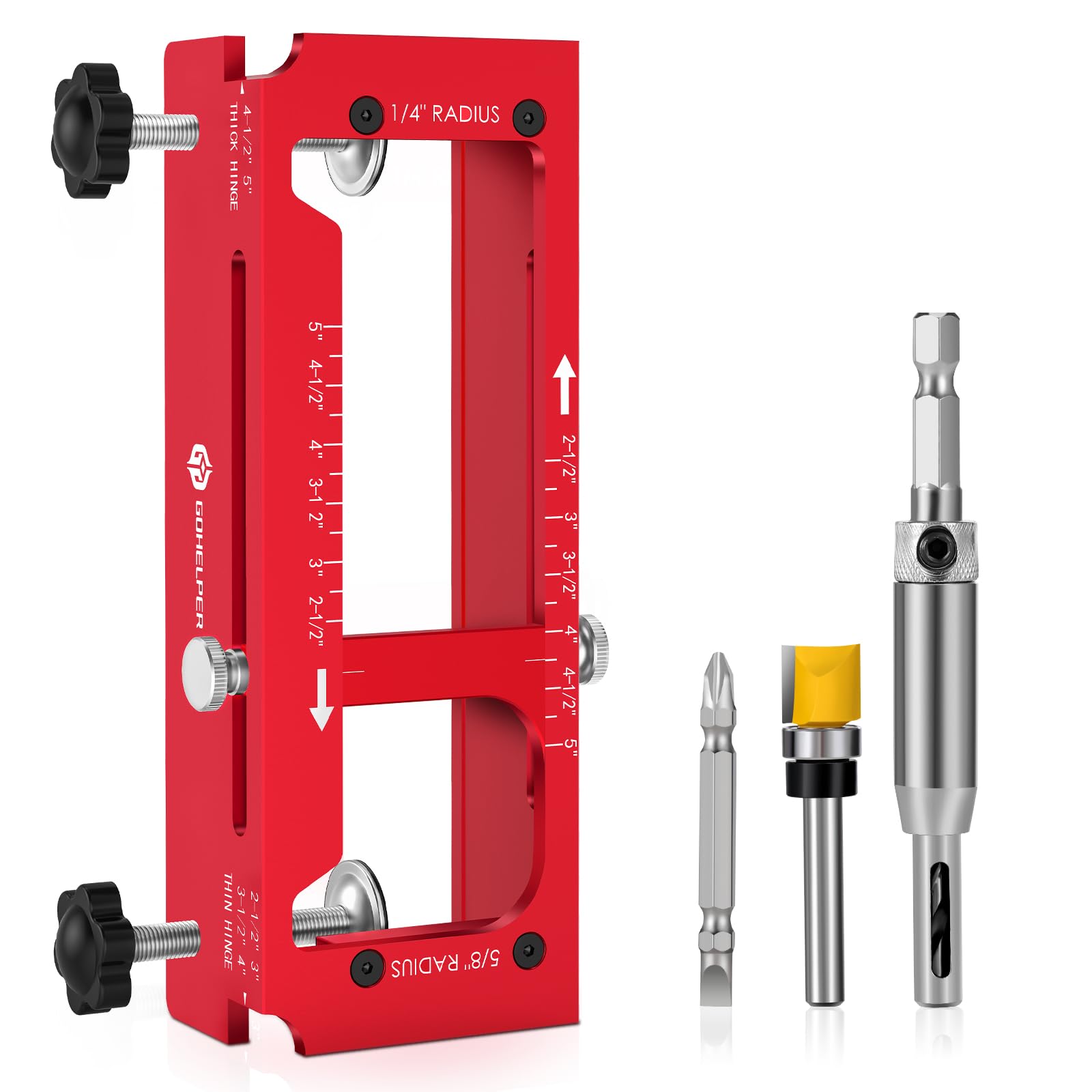
If you are hanging a house full of doors, this jig pays for itself after the first few hinges. The frame is machined from 6061 aluminum alloy — a grade of aluminum that holds its shape under clamp pressure — with an anodized surface that resists wear. It takes both round hinges in 1/4″ and 5/8″ radius and square-corner hinges where you chisel the corners, and it cuts mortises for hinges from 2-1/2″ to 5″ in length. The kit arrives complete with a router bit, a self-centering hinge bit, a double-ended screwdriver bit and a manual, so you are not hunting for a matching bit before the first door.
The build is what carries this one. Cutting professional-looking hinges is the entire point, and reports of prefinished doors routed with minimal damage are the kind of outcome you want. The metal frame sits against the door face and keeps the bit from drifting, so both leaves of a hinge line up. Where it costs you is adjustment: it has fewer dials than a fancy router-sled setup, so plan your hinge position before you clamp rather than after. There are two realities worth knowing before you order, and neither is a deal-breaker.
It works on the door, not the jamb — a second jig or careful layout handles the frame side. And while the router and drill bits earn praise for surprising sturdiness, the included hole saws draw criticism for dulling quickly and cutting slightly oval, with the 1″ saw singled out. Buy a decent hole saw separately if your project needs clean holes; the jig itself needs nothing extra.
Fit first: measure your doors. Buyers have used this on prefinished doors with hinged sizes listed above, and it is one of the few kits that includes the self-centering bit you will need on the jamb side.
The honest bit: its clamp is the whole trick — skip the separate clamps and you will spend as much time chasing alignment as you would with a hand-cut mortise.
Suits: anyone with more than a couple of doors to hang, from a first-time DIYer to a working carpenter.
Skip the included hole saws if: your build needs perfectly round holes — the router cutter is the reliable part, not the saws.
3. TANYO 7pcs Router Corner Radius Template
One paper-box set that replaces the drawer of single-radius corner templates you were about to buy.
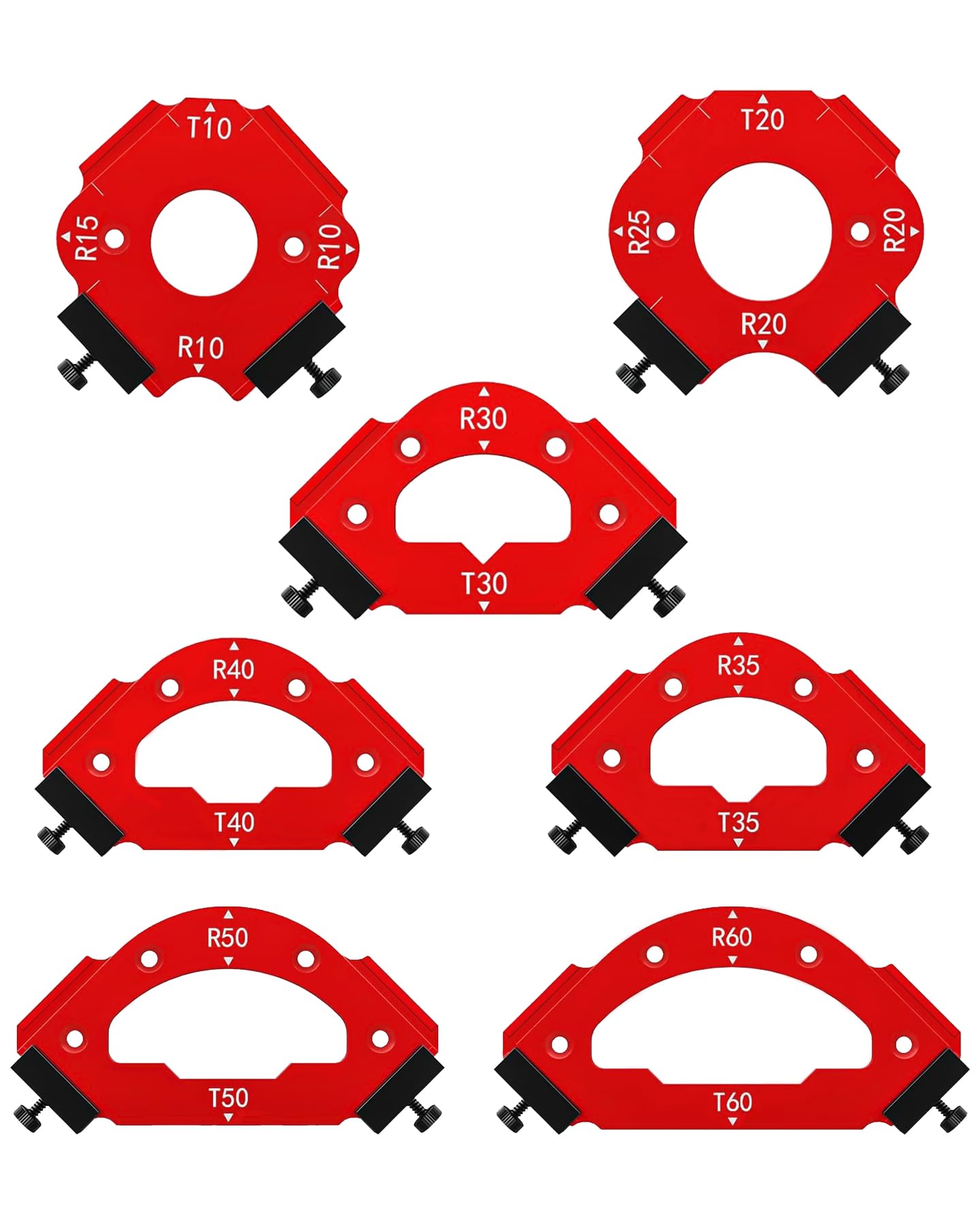
Roundovers are where a router earns its keep and also where a beginner gets found out, because a wobble in the arc shows under any finish. TANYO’s set packs 18 radius angles into 7 pieces — R10 through R50 plus T10 through T60 — and the stops adjust so you can set the arc and guide the router along it rather than eyeball the sweep. It handles outer round corners, inner fillets and oblique angles, which covers picture frames, furniture edges, table and chair corners, and general panel trimming.
Where the money shows is in the smaller set count: 7 pieces against a single-template hinge kit like the Gohelper above, which is one frame. On radius work the whole advantage is having the arc marker you need on hand instead of measuring tape on bare wood, and the set is compact enough to keep in one box. Owners describe the material as high hardness aluminum alloy, CNC machined and anodized for wear resistance, and the sense of a tool built to survive shop life comes through in the handling.
The recurring gripe is accuracy at the arc itself — cuts running about a sixteenth of an inch off on the flat sides have been reported — so test-cut on scrap before you commit to a finished panel. The other thing to plan for is that the stops only mean something if you tighten them down hard. An adjustable edge stop that slips quietly ruins the corner you already routed. Tighten, test, then cut.
Where the value sits: 18 radius settings in one paper box means you stop buying a template per curve, and the anodized aluminum body resists the dents a plastic corner guide collects.
Pick this if: rounded corners turn up in your projects often enough to justify a dedicated set.
Scrap test before cutting: set the radius you need, make one pass on offcut stock, and check the flat-side alignment against your square.
4. Sigerio 4 in 1 Router Circle Cutting Jig

For tabletops and speaker baffles too wide for a compact circle plate — it reaches a 58-inch diameter.
This jig cuts circles and arcs from 10″ to 58″ in diameter on a one-piece die-cast aluminum base, with an extension rod and a stable mounting system that resist flex. The same plate does triple duty when paired with its positioner: grooving and straight-line routing come along for the ride. Multi-hole mounting patterns mean it covers a wider spread of router bases than a single-brand plate would.
Here is where it separates itself from the Jasper below, and the direction is simple — the Jasper tops out at 18 3/16″, while this one reaches 58″. That is a different class of cut, and the oversized base means the router has support far out from the pivot. Cuts come out clean and the plate does not chatter when you set up carefully, which is what you want on anything you intend to finish.
The buyer who needs to hear the downside is the DeWalt compact router owner. The mounting holes did not line up for some buyers, and at least one needed a thumb screw swap plus washers to make it work. Others found the plate holes misaligned with a plunge router base and drilled new ones. Check your router’s base diameter and screw spacing against the multi-hole pattern before ordering, and if you are a DeWalt compact owner, expect to do a little fitting.
The honest trade-off: wide capability comes at the cost of fit certainty — this is not a plate that drops onto every small router without fuss.
Who it rewards: the woodworker who checks the mounting pattern first and wants one plate doing outsize circles, grooves and straight runs.
Go here for: furniture-scale arcs and arcs on panels a compact circle jig cannot reach.
Measure your router first if: you run a small DeWalt — the mounting pattern is the one place this jig pushes back.
5. Kreg Corner Routing Guide Set PRS1000
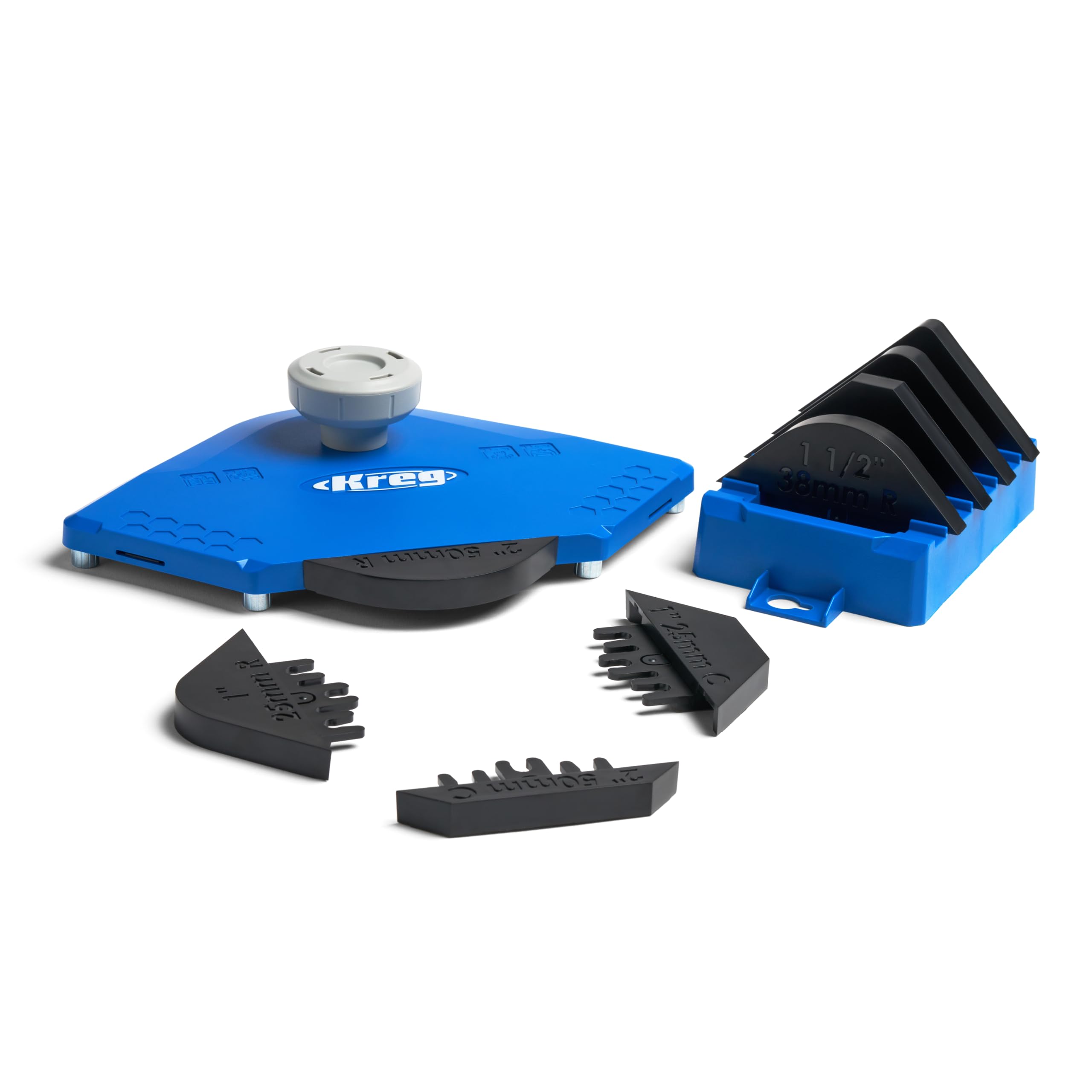
Five radii and three chamfers on one gripped guide — the corner profiles a bookshelf needs, set and repeated.
Kreg’s corner set is the one to buy if you build shelves, frames and small furniture where corners want a chamfer or a soft round rather than a full bullnose. It creates three chamfer sizes and five radius sizes on any trim router, handheld router or router table, so the tool you already own is the only other thing you need. Adjustable edge stop posts and a GripMaxx surface hold the workpiece and the guide in place, and a large handle keeps your hand where it should be.
The grip is the part that does the work. A guide that creeps mid-pass gives you a corner that will not match the last one, and owners find the Kreg holds its setting from door to door. Cut four corners on a test panel and you will see the repeatability — same chamfer, same radius, no re-measuring between passes. It costs less than buying a separate template for each of the eight profiles.
Be honest about the learning curve, though. Template and guide alignment need attention — the mixed reports on corner cutting trace back to setup, not the tool — and a wrong bit in a radius slot will show in the cut. Get your stops tight, fit the right bit for the profile, and this one delivers. Rush the stop setup and the corner comes out as uneven as a freehand pass.
Why it stays on the bench: three chamfers and five radii on one guide mean you do not buy a dedicated template for each profile.
Setup is everything: the stops and grip only save you if the first corner is squared away — measure once, then repeat.
Best for: shelf and frame builders chasing a clean, matched corner profile on every piece.
Look elsewhere if: you need exact hinge mortises — this is a profile guide, not a door template.
6. Bora Router Dado Jig for Woodworking

The dado plate that clamps to a straight edge and turns a full-size router into a repeatable cabinet-maker.
Bora built this plate for one job and does it well: cutting straight, repeatable dados and rabbets across a wide panel. It ships with a 1″ standard guide bushing already fitted, so it mounts to almost any full-size router with no drilling or bolting. The cutting adjustment lets you run a 1/4″, 1/2″ or 3/4″ bit and swing wider for dados wider than the bit, and it pairs with Bora’s WTX and NGX clamp edges if you already own that track system. At 15″ by 10″ the plate is large enough to balance a heavy router on the edge of a board.
What wins people over is the cut — tight dados that fit the shelf stock with no sanding. The straight-edge system sets the reference line once, then the plate runs along it for every shelf. The adjustment notches make setup quick and the alignment holds. It suits casework runs — a bookcase’s worth of shelves — rather than a one-off frame.
The honest part: this plate is plastic, and it is built for full-size routers, not palm routers. A few buyers found the baseplate hole oversized for the guide bushing and swapped in a universal baseplate with a 1-3/16″ hole to fix it. Another found that lifting a running router gouged the plate, and recommending attaching the baseplate to the jig permanently. Both are fixable, and the cut you get once set up is worth the tinkering — but this is not a plate that mounts perfectly on the first attempt for every router.
What it does properly
- Large 15″ x 10″ plate keeps a full-size router steady on a board edge.
- 1″ guide bushing included, no drilling to mount.
- Runs 1/4″, 1/2″ and 3/4″ bits and adjusts for wide dados.
- Pairs with Bora WTX and NGX clamp edges for a repeatable setup.
Plan around these
- Plastic construction, and the plate can be gouged if the running bit is lifted.
- Not made for palm routers — full-size machines only.
- Some router baseplates leave the bushing sitting loose until swapped.
Your jig if: you are building casework and need dados that fit shelf stock on the first pass.
Think twice if: all you own is a palm router — the plate is sized around a full-size machine.
7. MICROJIG MatchFit Grid Router Guide

It walks a dovetail grid across a full sheet without a single pencil mark — 4-inch spacing, indexed by the base itself.
This guide exists for one workflow: routing dovetail tracks for MatchFit clamps across workbenches, sleds and jigs. The self-indexing base sets each groove exactly 4″ on center, so you route one track, drop the base into it, and the next one is already spaced. That works across a full 4×8 sheet or a compact sled with minimal setup and no measuring. It takes routers with 4″–7″ bases and 1–3 HP motors, and it needs a 1-3/8″ Porter-Cable style bushing base plate or adapter, which is not included.
The part owners come back to is precision — perfectly spaced grids, with a simple clamp that lets you swap routers quickly without changing bit height. Cross-grain grooves want cutting first to avoid tear-out, and the second pass runs in the reverse direction; that is technique, not a jig flaw, but it is the difference between a clean grid and a chipped one. The plastic body is described as very durable, and the jig centers the router for you.
Budget for the extras before you commit. You need a 1/2″ x 14 degree dovetail bit and a 1/4″ relief bit, neither of which ships in the box, and one buyer received the wrong dovetail bit with no relief bit and had to buy another. Value is the split opinion here — the tool is precise, and the cost of entry to the MatchFit system adds up once you factor in the clamps and bits. Read the directions before the first cut; getting ahead of them is the one thing that trips new owners.
The standout spec: 4″ self-indexed spacing means one track becomes every track, with no layout marks and no cumulative drift across a full sheet.
Check what you own: a 1-3/8″ Porter-Cable style bushing plate is required, and the dovetail and relief bits are separate purchases.
Worth it for: anyone already running MatchFit dovetail clamps who wants a bench grid cut in a fraction of the time.
Not the starting point if: you do not yet own a bushing plate or the two required bits — factor those into the build.
8. Jasper 200 PRO Circle Cutting Router Jig

A 1/16-inch step between 2¼ and 18 3/16 inches — the jig that makes speaker rings fit their drivers.
Where the Sigerio reaches for a tabletop, the Jasper lives for the small, exact circle. It cuts from 2¼” to 18 3/16″ in 1/16″ increments, which is 256 size options, and for a speaker build that is the whole conversation: the hole has to match the driver’s mounting diameter, not come close to it. The 200 PRO is industrial-grade polycarbonate, a tough transparent plastic, at a 0.25-inch thickness that keeps the plate flat under a mid-size router, and the kit includes a calibration disc, pivot pins and mounting hardware.
Precision shows in the cut. A 5 11/16″ setting gives you an exact measurement, and owners cutting countersunk speaker drivers find it lands where it should. The pivot plate is stiff enough that hard stock does not bow it, and one buyer dropped the router and jig onto a concrete floor with the plate surviving undamaged. Because the plate is relieved for the router base, you can run a 1/4″ straight bit and see the scribed mark for setup.
Two things to know before you order. The size markings are hole diameters; add 0.5″ to get a disc, so plan your cut size rather than reading the plate as the finished disc. And the pivot pins are 1/8″, so you need a 1/8″ drill bit for the pivot hole. The plate does not fit every router base from the start — a Makita XTR01Z owner had to drill new holes — so check the mounting hardware against yours. Neither is a design fault; both are the kind of preparation this kind of precision rewards with a clean cut the first time.
Precision by the numbers: 256 diameter options in 1/16″ steps is the reason this one goes on speaker work and fine inlay rather than rough panel circles.
Read the plate right: the marks are hole diameters — add 0.5″ to get the disc you will end up with.
This one for: speaker cabinets, driver recesses and decorative inlays where a sixteenth decides whether the ring fits.
Drill a pilot for the pivot: the 1/8″ center pin needs a starter hole, so set that up before you clamp the plate.
9. Trend Varijig Adjustable Router Template System

A four-rail frame that clamps around a panel and holds a perfect square while you route inside it.
The Varijig is a different animal from the plate-style jigs above — an adjustable metal frame that sets a square or rectangular opening, then you route inside the opening. Its working area goes up to 23.6 x 23.6 inches, which puts inlay panels, hinge recesses that are not on a door, and general panel layouts within reach. The frame is set to a dimension once and holds it, so repeated recesses come out identical, and the anti-tilt shoe keeps the router level across the opening.
What earns its place on a bench is repeatability on shapes no template punches for. It is a jig you clamp in place for a batch of same-size recesses, set once, cut many. Rails can also come off the frame and be used separately as a straight edge, which widens the tool’s job list. Owners who report success fit a router bushing and a long enough bit, set the frame square, and run the cut.
The required extra hardware is where this one tests you. It needs router bushings, not pattern bits, since the extrusion is about 1/2″ thick — thicker than a 3/16″ bearing will ride — and the bit needs 2″+ of cutting length to clear the bushing nut and the extrusion. The clamps that lock the frame are sold separately, and a couple of buyers point out that the included screws are small and awkward. Set the frame with care on the first edge and the second edge is clean; get the bushing support wrong and the router can ride over the jig, scoring the workpiece and the frame.
Where it leads: a 23.6 x 23.6 inch adjustable capacity is the widest working area on this list, and the square it sets is what makes recesses repeat.
Price in the extras: bushings, a long-reach bit and the rail clamps are all needed on top of the frame — budget for them before the first panel.
Buy this when: you need identical rectangular recesses, inlays or panel cutouts and are done making a template for every size.
Check your bit length first if: your router bits are short — the frame is tall enough to need a long cutter.
Know the Specs
Guide Bushing vs. Pattern Bit
A guide bushing is a metal ring that fits in your router base and rides the edge of the template, so the bit itself stays clear of the jig. A pattern bit has a bearing on its shank that rides the template directly. Bushings let the jig be thicker than any bearing, which is why the Trend Varijig and the Bora plate both call for one. The bushing has to sit flat in the base plate — if the hole is oversized, it can lift and the router wanders.
Base Diameter and Screw Hole Spacing
Every plate-style jig bolts to your router through its existing base holes, and the spacing differs between models. A multi-hole base matches several patterns, which is why the Sigerio and Milescraft designs try to cover more routers. If your exact model does not line up, the usual fix is a universal baseplate with a 1-3/16″ opening or drilling new holes in the jig’s plate. Measure before you buy and skip the return.
Radius and Diameter Markings
A radius is the distance from the center of the curve to the outer edge, so a 1″ radius gives a 2″ wide roundover. Circle jigs are also marked by diameter, and the Jasper plate marks hole diameters — add 0.5″ if you want a disc of that size. Set to the mark, cut a scrap, and check before cutting your good stock.
Clamping and Anti-Tilt Support
A jig only guides the cut if it stays put, and the router only cuts true if it stays flat. Clamping systems vary from built-in edge stops and grip surfaces, as on the Kreg guide, to a self-indexing base like the MICROJIG’s, which registers off the last groove. Anti-tilt support, seen on the Trend frame, keeps the router level across an opening. Whatever the design, a jig that moves mid-cut will mar the result regardless of how accurate the markings are.
Common Questions
Will the Milescraft 1224 fit my router?
Do I need a guide bushing or a pattern bit for these jigs?
Can I cut dados wider than my router bit with these jigs?
How do I cut a perfect circle without a circle jig?
What is the widest circle the Sigerio jig can cut?
Does the Jasper plate cut discs or holes?
Why did the Trend Varijig damage its own frame?
Do I need a plunge router for the Milescraft edge and mortise guide?
What router do I need for the MICROJIG MatchFit grid guide?
Will the Kreg PRS1000 work on a router table?
The Bottom Line
For most woodworkers the best woodworking router jigs choice is the Milescraft 1224 Edge & Mortise Guide, because it covers edges, dados and mortises with one plate and the offset base reaches narrow stock the big plate cannot. If door hanging is your job, grab the Gohelper Door Hinge Jig, which ships with the router bit and self-centering bit and works on hinges from2-1/2″ to 5″ in length. And for round table tops or any arc wider than a compact plate can manage, the Sigerio 4 in 1 Circle Cutting Jig reaches diameters from 10″ to 58″ on a die-cast aluminum base.
Take one more thing with you before you order. The best jigs here hold their setting when clamped, but none of them compensate for a router base that does not match the mounting pattern. Measure your base diameter and screw spacing first, and the rest of the setup is straightforward. The Milescraft 1224 is the one to start with if you want a single plate that claims the widest spread of everyday cuts at a modest spend, and the Gohelper kit is worth the extra if doors are on the list.
How we choose
We do not accept paid placement. Every pick is matched to a real buyer and a real use-case; we do not hands-on test units.
Sources
Specifications: manufacturer listings and product documentation. Review insights: verified customer reviews, as of October 2026. Pricing: not shown on this page (it changes often); check the current price via the retailer link.
As an Amazon Associate, Home Digitized earns from qualifying purchases. This does not affect which products we feature.