
Specs are compiled from manufacturer listings and verified buyer reviews and can change over time — please confirm the key details on the product page before buying.
If you want the short answer: buy the Melissa & Doug Wooden Project Workbench if your child is between 3 and 6 and you want a bench that survives daily hammering. It has a real working vise, five wooden tools and a storage shelf, and it is the pick most likely to still be standing after a year of play. Everything below explains why the other seven are worth a look depending on your child’s age, your floor space and how much assembly you are willing to take on.
This guide is built by comparing the manufacturers’ published specifications and the patterns across verified customer reviews, so you get each pick’s real strengths and trade-offs instead of marketing spin.
A wooden workbench is only worth buying if the tools actually work and the wood holds up to a toddler’s swing. That filter is why some popular benches are left out and some compact ones rank high. The safest place to start is a wooden workbench with tools that lists its included tools and its wood type in plain words.
Top Picks


How To Choose The Best Wooden Workbench With Tools
The mistake most parents make is buying the bench that looks fullest in the photo. A bench with sixty pieces means nothing if the vise does not clamp and the hammer is a solid block of painted wood. What you actually want is a bench with a handful of tools that genuinely move — a screwdriver that turns, a wrench that grips, a saw that cuts paper.
Pick the tool count for your child’s age, not for the box
A 2-year-old needs fewer, bigger pieces and a bench low enough to reach without a stool. A 5-year-old can handle a bench with a vise, a rack of tools and a build guide with step-by-step projects. Melissa & Doug points its Project Workbench at ages 3 to 6, and that band is the one where a bench stops being a chew toy and starts being a building station.
Check what the wood actually is
Beech and pine are the two woods you will see named on these benches, and both are legitimate choices for play furniture. Beech is the denser of the two, which matters if your child leans on the bench or climbs it. Where a listing does not name a wood, treat the stated weight as your clue — a bench listed at 19 pounds is a different animal from one listed at 3.1 pounds.
Decide how much assembly you will tolerate
Every bench here ships flat and needs building. Some go together in under an hour with one adult. Others run to roughly two hours and around 45 screws with illustration-only instructions. If you have a power screwdriver and a free evening, that is a small cost. If you are buying this as a gift that must be ready on arrival day, budget the time before the birthday.
Look for storage you will actually use
A bench without a shelf or drawer becomes a pile of loose nuts on the carpet within a week. Storage comes in three flavours on this list: a simple shelf, dual drawers plus a lower platform, and a detachable tool belt. Any of them beats an open bench with nowhere to put the screws.
Side-by-Side Comparison
| Model | Best For | Weight | Stated Size | Tools Included | Amazon |
|---|---|---|---|---|---|
| Melissa & Doug Wooden Project Workbench, 55-Piece★ Best Overall | Long-term daily play | 19 pounds | 24 x 18.75 x 26 inches | 5 wooden tools plus vise | Amazon |
| Melissa & Doug Hammer and Saw Tool Bench (32 pcs)Best for Small Spaces | Tiny rooms and travel | 3.1 pounds | 8.51 x 10.5 x 10.51 inches | Saw, hammer and building pieces | Amazon |
| Small Foot Compact Premium WorkbenchCompact Pick | Small playrooms | 6 pounds | 17.72 x 11.02 x 20.47 inches | 5 wooden tools plus accessory set | Amazon |
| ROBUD Wooden Tool Workbench | Multi-child play | 14.3 pounds | 22 x 12 x 34 inches | Vise, table saw and tool set | Amazon |
| Amazon Basics Wooden Play Toy Tool Set and Workbench | Most pieces per bench | 12.4 pounds | 22.8 x 14 x 30.7 inches | Hammer, wrench, screwdriver, saw | Amazon |
| Wooden Tool Bench for Kids with Electric Drill | Realistic powered play | — | 12 x 23.58 x 34.21 inches | Electric drill, hammer, saw, wrench | Amazon |
| Medoga Tool Bench for Kids | Beech wood build | — | 11.7 x 23.5 x 31.3 inches | Hammer, saw, screwdriver, wrench, vise | Amazon |
| ROBOTIME Wooden Kids Tool Bench | Creative extras | — | 24.8 x 3.54 x 21 inches | Hammer, wrench, tool belt and goggles | Amazon |
Detailed Reviews
1. Melissa & Doug Wooden Project Workbench
Our pick — 4.5+★ from 750+ verified ratings; the strongest balance of quality and price.
A working vise, five wooden tools and a storage shelf in one 19-pound bench.
Buy this one if your child will actually clamp and build, not just look at it. A working vise (a clamp that holds wood still) is the one feature that turns a decorated table into a real play workbench, and this Melissa & Doug model has one. It also gives you a tool rack, five wooden tools and a storage shelf underneath for the hardware. A project idea book comes in the box, so you are not left inventing things to build on day one.
The weight tells you something the photos cannot: this bench is listed at 19 pounds across 24 x 18.75 x 26 inches. Compare that with the Melissa & Doug Hammer and Saw set further down the list at 3.1 pounds and 8.51 x 10.5 x 10.51 inches, and you are looking at two entirely different classes of furniture. The Project Workbench is a piece that stays in one spot in a playroom. The Hammer and Saw set is something a child carries around. For a bench your child grows into rather than out of, this is the one.
Plan for the build: assembly is the honest catch. Reviews are split — plenty of families finish it in under an hour with one adult, while others find the nut and bolt types confusing. Some need the product photo because the leg braces were skipped in the instructions. Buyers also report that the small hardware loosens over time, so extra nuts and bolts are a smart add-on since the little pieces vanish easily. What wins people over is the wood quality and how much time kids spend at it. As one buyer put it: “This was solid after built. I am impressed with quality of wood, just a little pain building as the types of nuts and bolts.”
What earns it first place
- A functioning vise, tool rack and storage shelf — the full workshop layout in wood.
- 19 pounds of solid build across 24 x 18.75 x 26 inches, so it does not shuffle across the floor mid-play.
- Project idea book included, so there is a starting point for building beyond random hammering.
- No batteries — the play comes entirely from the child and the tools.
The parts that need patience
- Assembly takes real care, and the nut-and-bolt types trip people up.
- Instructions have been known to skip the leg braces, so keep the product photo handy.
- Small hardware works loose and goes missing; spare nuts and bolts are a worthwhile add.
Buy this one if: your child is in the 3-to-6 band and the bench will live in one room as a long-term play station.
Think again if: you want something ready in fifteen minutes or small enough to pack away — the assembly and the footprint both ask for commitment.
2. Melissa & Doug Hammer and Saw Tool Bench
A whole workshop folded into something a toddler can pick up with one hand.
Here is the trick that makes this set work: the wood pieces are joined with self-stick tabs (reusable sticky strips) that a child saws through, then reconnects. That gives a 3-year-old the actual sensation of cutting wood without a blade anywhere near their hands. Follow the included blueprints and the pieces become an animal, a house, a robot or a boat — or something entirely invented.
The scale is the point. At 3.1 pounds and 8.51 x 10.5 x 10.51 inches, this is a tabletop bench with handles that let a child carry it between rooms. It is the smallest and lightest pick on this list by a wide margin — the Project Workbench above is listed at 19 pounds, so this one is a different category of object entirely. If your flat has no spare corner for a full bench, this fits on a coffee table and lives in a cupboard afterwards.
The moving parts are where it falls short. The saw handle has snapped for some families when an older cousin gets involved — buyers report “Her cousins (8yo) played with it though and easily broke the saw handle.” The clamp screw can slip instead of holding, the wooden nails only drive halfway, and the storage space inside is tight. None of that stops a 2 or 3-year-old from loving it. Owners mention it holding up through months of daily play without visible wear. Just keep it away from the eight-year-olds.
What parents notice first: the tool set genuinely functions — the hammer drives, the nail remover pulls, and the saw cuts. Kids use it alongside a parent doing real DIY, which is exactly the imitation play this age wants.
And the honest limit: the saw handle is the weak link under rough handling, so this suits gentler play and younger siblings rather than a shared toy between a toddler and a school-age child.
Reach for this if: you need a real sawing and hammering experience that fits on a shelf and travels between rooms.
Look elsewhere if: the bench needs to survive a mixed-age household where an older child will grab the tools.
3. Small Foot Wooden Toys Compact Premium Workbench Playset
A 6-pound bench in classic workshop colours that earns its place by not taking one.
Small Foot builds this one around a small play surface, and the thinking shows in the parts list. You get 5 wooden tools plus a proper accessory kit: 1 screw clamp, 3 perforated strips, 1 joiner’s bracket, 1 saw, 1 screwdriver, 1 wrench, 1 hammer, 5 screws, 5 nuts and 3 wooden nails. That is a workshop that can actually be worked at, not a bench with one decorative hammer.
At 17.72 x 11.02 x 20.47 inches and 6 pounds, it sits low — low enough that one family found it under-sized for their boy and swapped up to the larger model. That is worth hearing before you buy, because height is the thing you cannot fix later. For a 2-year-old, though, the low deck is exactly right, and the same build quality that made one uncle describe it as a good height for his two-year-old nephew is what you are paying for here. It also has a feature the others do not: children can help assemble it, which turns the build into the first activity.
The wood is honest, the tools and accessories store in a way that keeps them visible and reachable, and the illustrations of the busy “miniwobs” give kids a story to play inside. One caveat worth knowing: at least one set has arrived with pieces missing, so open the box and check the parts against the list while the return window is still live. Do that and this compact bench delivers a real workshop in a footprint that fits a bedroom corner.
The case for the compact size: a low deck means a two-year-old can reach the whole bench without a stool, and the space-saving storage keeps every screw and strip visible.
The trade-off to weigh: it will be outgrown by taller four and five-year-olds, so measure your child before you commit.
Suits: families with a 2-to-3-year-old and a bedroom or small playroom that cannot host a full-height bench.
Not for: a taller five-year-old who needs a bench at their own height — go up a size instead.
4. ROBUD Wooden Tool Workbench

Vise, table saw and chalkboard — a full workshop squeezed into a 34-inch frame.
ROBUD went further than most on the working parts. This bench ships with a functional vise, a table saw, a blackboard for sketching plans, a wooden tool set and a project idea sheet. At 22 x 12 x 34 inches and 14.3 pounds it is a full-height bench, so it stands at a comfortable working level for a 3-to-6-year-old rather than asking them to crouch.
Assembly is where this one earns its keep. Parts arrive foam-wrapped, the holes line up, extra screws are included and there is nothing missing from the box — and multiple families describe the whole build as straightforward. The finish is smooth without burrs and the edges are rounded, which is the detail that matters on a bench a toddler leans their whole weight against. Storage comes as a shelf plus a hanging rack, so tools and hardware have homes instead of migrating to the carpet.
The realistic gripe is small-parts bookkeeping. One build came up a single small screw short of hanging the chalkboard, despite four spare large screws in the bag, and the instructions for the toy tools could be clearer. That is an annoyance, not a reason to skip a bench that otherwise delivers on quality and easy height-appropriate sizing. If you want a bench with more moving parts than a plain shelf model, and a build that does not eat your evening, this is the strongest middle-ground pick here.
Why it climbs this high
- Vise, table saw and blackboard all present — three working features beyond a tool rack.
- 34 inches tall, so it suits a standing 3-to-6-year-old.
- Foam-wrapped parts, aligned holes and spare screws make the build unusually painless.
- Smooth, burr-free wood with rounded corners.
Where it stumbles
- Screw counts have come up short on at least one build for the chalkboard mount.
- Toy tool instructions leave some parents guessing.
Go with the ROBUD if: you want the most working features for a 3-to-6-year-old and you would rather build once than fiddle.
Keep looking if: your child is under two — a 34-inch bench is a climb, not a workspace, at that age.
5. Amazon Basics Wooden Play Toy Tool Set and Workbench

Sixty-two pieces, two drawers and a pegboard — the biggest parts count on this list.
If your child’s favourite thing about a workshop is the sheer number of things to sort, this is the bench. The full playset runs to 62 pieces: a pegboard, 2 small drawers, 4 links, 4 gears, 10 screws, 6 nails, 10 nuts, a hammer, a wrench, a screwdriver and a saw. Gears are the piece no other bench here includes, and they add a moving-part puzzle that keeps older toddlers engaged past the first week.
It stands 30.7 inches high across 22.8 x 14 inches of floor, and weighs 12.4 pounds — substantial enough to feel like furniture, light enough that two adults can move it. The bottom tray takes every tool and loose part, which is the difference between a playroom you can walk through and one you cannot. Families report the wood holding up strongly after months of hammering, with quality well above the cheapest sets.
One quirk to know about: the nails have proven a dead end for some builders — they do not fit or drive anywhere useful, so the screws end up doing all the work. The bolts also demand attention to length during assembly, and getting that order wrong means taking the bench apart and starting again. Neither issue sinks the bench, since the screw-based building still works exactly as intended and the drawer storage keeps everything tidy. For a family who wants the most options per bench, this delivers.
The standout detail: gears. Four of them, alongside 10 screws, 10 nuts and 6 nails, make this the most mechanically varied set on the list.
The catch: the nails have not proven usable for every owner, and assembly rewards careful attention to bolt length the first time.
Best fit for: a child who loves sorting, counting and building with lots of loose parts, in a playroom that can hold a 30.7-inch bench.
Less ideal if: you want a bench with a vise and a saw — those are not part of this set.
6. Wooden Tool Bench with Electric Drill
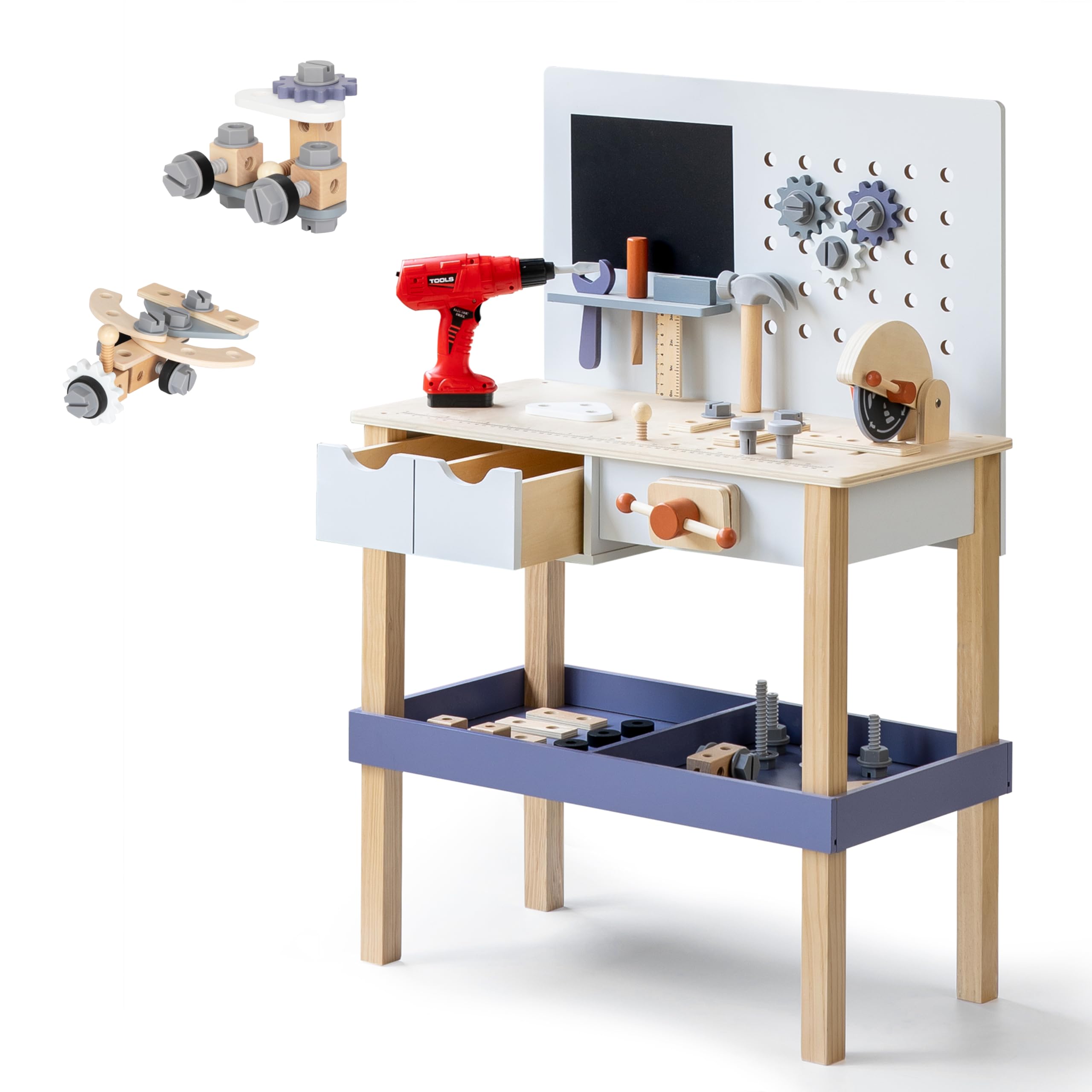
The only bench here with a drill that spins — and two drawers to hide the evidence.
A toy drill that actually turns makes a child feel like they built something, not just pretended. This Leeshyah bench includes a working electric drill sized for a small hand, plus a hammer, saw and wrench. Your child can screw a piece in with the drill the way they have watched you do it. Two drawers and a lower platform give every piece a home — that matters more on a powered set than a plain one.
The bench runs 12 x 23.58 x 34.21 inches in natural wood finish, and the manufacturer lists it for ages 3 and up through 8 years. That range is a clue: the drill and the storage give this one more runway than a simple hammer set, so a five-year-old still finds something to do with it. Families describe the wood as solid and noticeably better than the all-plastic playsets, and the drill as the piece kids fight over.
Now the honest bit about the build. This is the most involved assembly on the list — roughly two hours, around 45 screws, and illustration-only instructions that reward having a power screwdriver on hand. The wood in the drawer and tray is on the thin side, and the pegboard holes are oversized enough that a child has to reach behind to catch the nut. One screwdriver has also broken in normal use. If you are prepared for an evening of building, what you get afterwards is a bench with a genuine motor feature and the most realistic play on this list.
The one feature no rival has: a functional electric drill, plus 2 drawers and a lower shelf, in a 34.21-inch-tall wooden frame built for ages 3 and up.
The realistic warning: budget two hours and a power screwdriver for assembly, and expect thinner wood in the drawer and tray than in the bench frame itself.
Worth it for: the family whose child is fixated on your power tools and wants a drill that turns in their own hand.
Pass if: you are assembling this the night before a birthday — two hours and 45 screws need a clear evening.
7. Medoga Tool Bench for Kids Toy Play Workbench, Beech Wood

Beech wood, a vise and a compartment underneath — the traditional workshop, done properly.
The material here is the story. This bench is made of high-quality beech wood, a denser hardwood than the pine many of these benches use, finished with environmentally friendly water-based paint and described as having a non-irritating smell. At 11.7 x 23.5 x 31.3 inches it stands at a sensible working height, and the off-white finish with bright tool colours makes it look like furniture rather than a toy box overflow.
The parts list is the classic workshop spread: hammer, saw, screwdriver, wrench, vise, screws, nuts, bolts, gears and links. The vise is the one to note, since only a few benches here have a working one. Underneath, a storage compartment takes the accessories and there is a place to hang the tools, which makes the tidy-up a two-minute job instead of a hunt.
The wrench is the known weak point — it has splintered or broken for some families, and the saw blade is held by a wooden play screw that can loosen during cutting. Both are fixable gripes rather than structural failures, and the bench itself goes together easily and owners describe it as lasting for years. Slotted against the ROBUD above, this one gives you beech instead of a mixed wood and a slightly lower stance, at a similar feature count. If wood quality is your priority over the extra blackboard, this is your bench.
Where the money goes
- Beech wood construction with a water-based paint finish.
- Working vise plus hammer, saw, screwdriver, wrench, gears and links.
- Storage compartment under the bench and hanging space for the tools.
- Easy assembly that leaves room for a child to help.
Small parts to watch
- The wrench has splintered under play for some owners.
- The saw blade’s wooden screw loosens when cutting anything thicker than tissue paper.
Choose this when: you want the densest wood on the list and a vise, and you would rather have a quiet paint finish than a bright plastic look.
Leave it if: the saw and wrench getting the hardest daily use — those two tools are the ones that need gentle handling.
8. ROBOTIME Wooden Kids Tool Bench

A bench that hands your child a pencil, a paper roll and a tool belt before they start.
ROBOTIME added three things no other bench here has: a side-mounted drawing paper roll, a pair of pretend play goggles, and a detachable tool belt with pockets. The belt can hang on the bench or be worn around the waist. That belt is the smart part — it turns the whole room into a job site. The goggles complete the outfit and make a three-year-old feel like a professional.
The drawing roll deserves its own mention. A child can sketch a plan right on the bench before building it, which is a genuinely different kind of play from hammering a nail into a hole. The bench itself runs 24.8 x 3.54 x 21 inches in natural wood finish, sized as a toddler bench and recommended for 36 months through 12 years. Bottom shelf and side storage hold the tools, so the paper roll does not become the only thing left on the deck.
Assembly is the friendliest here — one person, a fairly quick build, and easier still if you run a drill with a clutch and an Allen driver through the bolts. The only design note families raise is the paper roll holder, which can be fiddly to reload once a roll runs out. That is a minor gripe on a bench toddlers play with independently from day one.
what separates it: a drawing paper roll, pretend goggles and a wearable tool belt — three genuinely new additions in one bench.
The one flaw: the paper roll holder is awkward to reload, so expect a small wrestling match at roll-change time.
The right pick for: a toddler who wants to draw the plan as much as build it, and a parent who wants an easy one-person assembly.
Skip if: you want a high bench with a vise and a table saw — this one is toddler-height and creative-first.
Know the Specs
Why the Vise Matters More Than the Tool Count
A vise is the clamp that holds a piece of wood still while your child works on it. It is the difference between a bench that behaves like a real workshop and one that is a shelf with a hammer on top. Only a few benches in this list have a working one, so check the included parts list carefully. A bench with fewer total pieces but a real vise often plays better than one with sixty loose screws and no clamp.
Wood Type and Stated Weight
Beech and pine are the two woods named on these benches, and the stated weight is the fastest way to compare them without lifting the box. Heavier listed weights generally signal a bench that stays put when a child leans on it, while lighter ones signal a bench that can be carried. Neither is better in the abstract — a 3.1-pound bench suits a small flat, and a 19-pound bench suits a dedicated playroom.
Self-Stick Tabs and Perforated Strips
These are the two ways these benches let a child “cut” without a blade. Self-stick tabs are reusable sticky strips that can be sawed apart and reconnected. Perforated strips are pre-holed wooden pieces that can be sawn or screwed through. Tabs give more repeat play, strips give more realistic building — a bench with both keeps a child busy longer than one with either alone.
Assembly Load: Screws, Instructions and Time
The assembly burden varies enormously. Some benches go together in under an hour with one adult. Others need roughly two hours and around 45 screws with illustration-only directions. Before you buy, decide whether the build is part of the gift — some children help assemble their own bench, and that turns a chore into the first play session.
Common Questions
What age is a wooden workbench with tools actually right for?
Do the tools actually work or are they solid blocks of wood?
How long does assembly take and do I need power tools?
Is beech wood better than pine for a kids workbench?
Will a wooden tool bench tip over if my toddler climbs it?
What is the difference between self-stick tabs and perforated strips?
Do these benches need batteries?
How many pieces should I look for in a kids tool bench?
Can two children play at one wooden workbench at the same time?
What breaks first on a wooden workbench with tools?
The Bottom Line
The wooden workbench with tools that earns the top spot is the Melissa & Doug Wooden Project Workbench. It is the only pick here that combines a working vise, a tool rack, five wooden tools and a storage shelf in one 19-pound bench. That combination is what makes it worth the build time.
If your space is tight rather than your budget, the Melissa & Doug Hammer and Saw Tool Bench gives you real sawing in a 3.1-pound package that fits on a table. And if your child’s fantasy is your power drill, the Wooden Tool Bench with Electric Drill is the only bench on this list with a motor in it.
One nudge before you decide: the bench with the highest owner score on this list, the ROBOTIME at 4.5+ stars, is also one of the newer arrivals with a smaller review base than the older Melissa & Doug models. That is not a reason to doubt it — it is a reason to weigh the creative extras against the proven track record and pick the one your child will actually play with.
How we choose
We do not accept paid placement. Every pick is matched to a real buyer and a real use-case; we do not hands-on test units.
Sources
Specifications: manufacturer listings and product documentation. Review insights: verified customer reviews, as of October 2026. Pricing: not shown on this page (it changes often); check the current price via the retailer link.
As an Amazon Associate, Home Digitized earns from qualifying purchases. This does not affect which products we feature.