
Specs are compiled from manufacturer listings and verified buyer reviews and can change over time — please confirm the key details on the product page before buying.
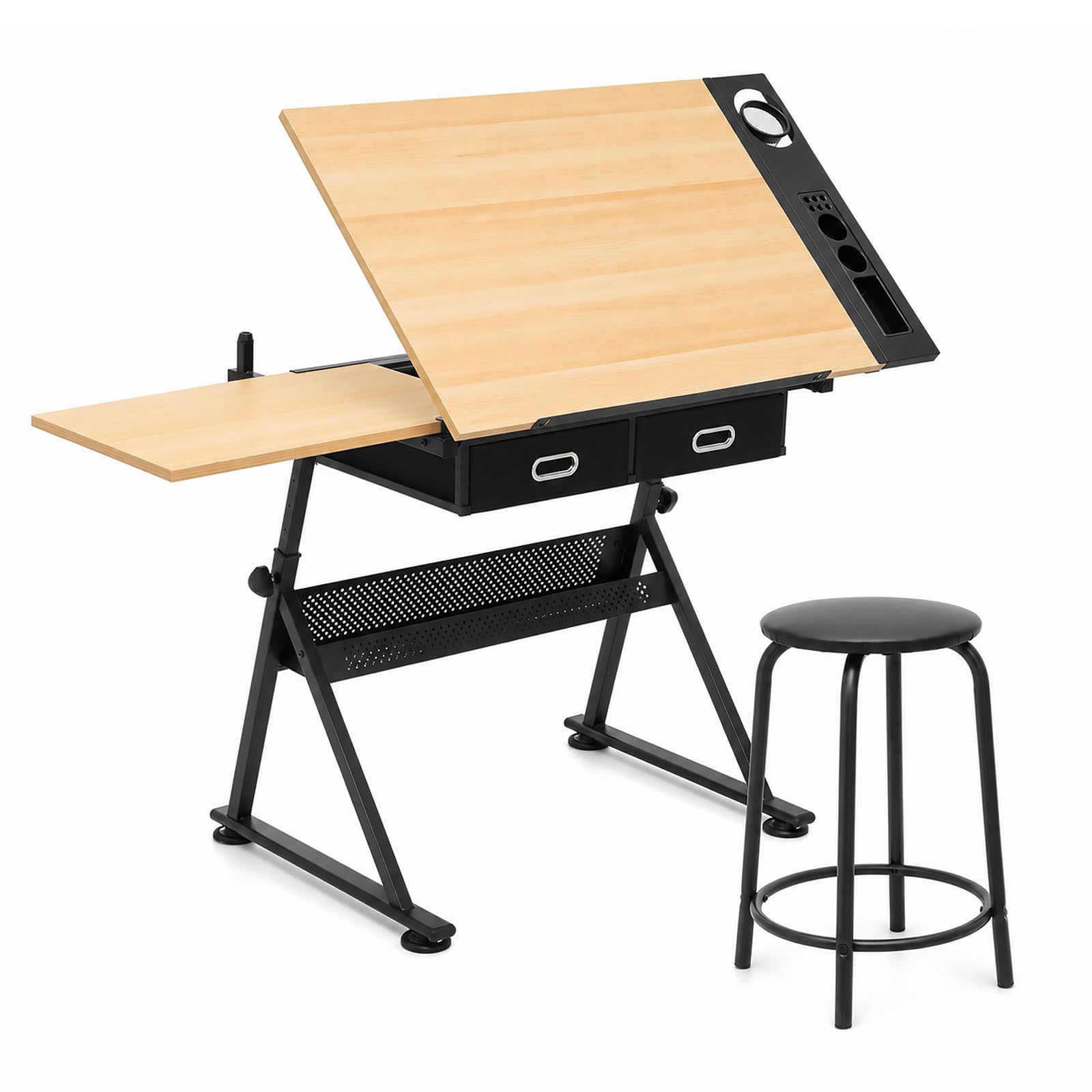
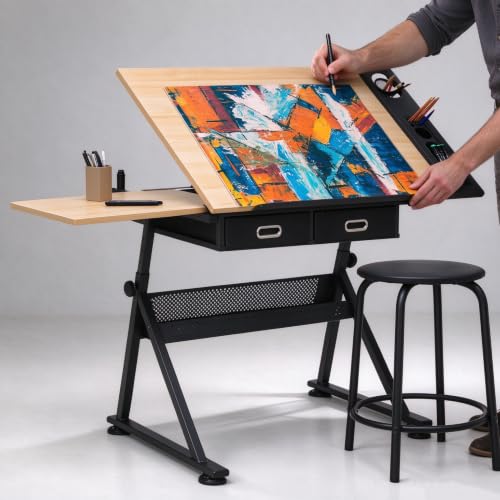
If your back aches after an hour hunched over a flat table, a surface that tilts toward you is the fix. The ZENY Drafting Table does that, swinging from flat to a 60-degree angle while its height moves between 28 and 35.8 inches. It is the easy default for most people: a 34 by 23.6 inch main top, a slide-out side tray, two drawers and a stool in the box. Below, each table is matched to a specific way of working — steep canvas tilts, wide blueprint surfaces, or compact corners.
This guide is built by comparing the manufacturers’ published specifications and the patterns across verified customer reviews, so you get each pick’s real strengths and trade-offs instead of marketing spin.
I’ll walk you through tilt ranges, wood types, and the wobble quirks that separate a steady desk from a shaky one. By the end you’ll know which tilt range, wood frame, and height window fit your studio and your budget.
Top Picks

How To Choose The Best Wooden Drawing Table
A wooden drawing table has one job your kitchen table can’t do: it tips the work toward your eyes so you stop curling your spine over it. Get the tilt mechanism and the frame material right and you’ll draw for hours without the crick. Get them wrong and the top shifts under your hand every time you press a pencil down.
Start with the tilt range, not the size
A flat-only table forces you to lean forward. Look for a tabletop that tilts anywhere from flat to at least 45 degrees — some here reach 60, 65, 70, and even 90 degrees. The steeper you can go, the more upright you can sit while painting or sketching on a raised canvas. A word of warning from the review pages: on some models the angle only locks in a handful of preset notches rather than sliding smoothly to any position.
Then check what the wood actually is
“Wood” on a listing can mean three different things. Solid beech legs with a particle-board top is common at this level and stays stable if the frame is braced. Full solid pine is heavier and pricier. A wood-finish MDF surface gives you a smooth, low-glare drawing face that’s kind to pencils — but it doesn’t love moisture. Check the finish too: bare wood feet can scuff a hardwood floor, so felt pads are a smart add.
Height range decides whether you sit or stand
Measure your seated elbow height before you buy. Tables that adjust from roughly 28 to 36 inches cover most seated work, and the taller ones let you stand for big canvases. The flip side worth knowing: on a couple of the largest tables the lowest setting still sits high for a standard office chair, so tall-frame designs suit standing or a drafting stool rather than a low computer seat.
Think about storage before assembly day
Two drawers and a slide-out side tray keep brushes and a laptop off your working area, which helps when the main top is fully tilted. The trays are shallow and the drawers are cloth, so storage has limits. A few buyers pull the drawers out entirely because they crowd their knees. Decide if you want built-in storage or a cleaner, wider leg opening.
Side-by-Side Comparison
| Model | Best For | Main Tabletop | Height Range | Tilt Range | Amazon |
|---|---|---|---|---|---|
| ZENY Drafting Table★ Best Overall | Most buyers | 34″ x 23.6″ | 28″–35.8″ | 0°–60° | Amazon |
| Athena Collection Wooden Drafting TableBest Value | Ready-to-use studio set | 34″ x 23.5″ | 28″–36″ | 0°–65° | Amazon |
| MoNiBloom Drafting Table and Stool SetWidest Surface | Diamond painting and crafts | 39″ wide | 28″–36″ | 0°–65° | Amazon |
| Houseables Portable Drafting Table | Small-space real wood | 35.5″ x 23.7″ | — | Adjustable | Amazon |
| conda Wood Drafting Table | Compact home office | 35.4″ x 23.6″ | 31.5″–37″ | 0°–45° | Amazon |
| MEEDEN Wood Adjustable Drafting Table | Solid beech on a budget | 35.5″ x 23.5″ | 29.7″–38.4″ | 0°–60° | Amazon |
| MEEDEN Vintage Wooden Drafting Table | Style-led studios | 35.5″ x 23.5″ | 32.7″–38″ | Flat–90° | Amazon |
| VISWIN Wood Drafting Table | Large blueprint work | 42″ x 30″ | 34″–38″ | 0°–70° | Amazon |
| Falling in Art 5-Position Easel Board | Portable sketching | 29 1/2″ x 19 2/3″ | — | 5 positions | Amazon |
Detailed Reviews
1. ZENY Drafting Table
Our pick — 4.5+★ from 3,000+ verified ratings; the strongest balance of quality and price.
The do-it-all starter desk that tilts 60 degrees and throws in the stool.
The main top measures 34 by 23.6 inches — enough to spread a large sketchpad flat or pin up a canvas mid-project. Slide out the secondary surface and you gain a 15 by 23.6 inch tray for brushes, a laptop, or your coffee, all while the main board stays at its working angle. Height moves between 28 and 35.8 inches via a knob on the leg, so one person can raise it without help.
What wins people over here is the build — the steel frame and adjustable surface earn more consistent praise than anything else on the listing, which is why it also leads the whole list. Two drawers and a lower shelf swallow sketchbooks and tubes, and a pencil ledge keeps tools from sliding off when the top is tipped. It also ships with a 20 inch stool, so you have a complete station the moment the box is open.
The catch is assembly and a few rough edges. Buyers report “Frame assembly confusing due to picture-only directions; took ~2 hours solo.” Two sliding-table screws aren’t in the parts list and need holes drilled in the MDF (the engineered wood board the top is made from). The rigid plastic feet can scratch a wood floor until you add felt pads. None of that stops it drawing well — it just means you budget an afternoon and a drill.
What tips the scale
- Tilts 0 to 60 degrees and lifts from 28 to 35.8 inches for seated or standing work
- 34 x 23.6 inch main top plus a 15 x 23.6 inch slide-out side surface
- Stool, two drawers, pencil box, and pencil ledge all included
What to plan around
- Picture-only instructions push assembly toward two hours for one person
- Sliding-side-table screws aren’t listed and need pilot holes drilled in MDF
Best for: the first-time art-table buyer who wants one box to cover desk, storage, and a seat.
Skip if: you have no drill handy — that side table install is the one fiddly step.
2. Athena Collection Drafting Table
A low-glare MDF drawing face with a seat thrown in, built for long sketching sessions.
This one tilts a touch further than the ZENY above — 65 degrees versus 60 — and lifts from 28 to 36 inches, so it straddles seated and standing work without changing desks. The smooth MDF top is the real selling point for pencil work: it’s a low-glare surface that feels warm under your hand, not the cold, slippery finish you get from glass. The main top is 34 by 23.5 inches, with a 23.5 by 15 inch side table that tucks underneath when idle.
Storage is thoughtfully split — a detachable side tray with honeycomb pen holders up top, two fabric drawers and an under-table shelf below. A powder-coated steel frame and non-slip rubber feet keep it planted. The matching padded stool means you’re not hunting for a chair.
The honest trade-off is the manual. Assembly runs long and the illustrations are thin; the material call is mixed too, so treat this as a solid mid-range desk rather than an heirloom. One recurring note is that the right flat table can slide a little and the top won’t lay completely flat on every unit. Manageable, but worth knowing if you need a true horizontal for cutting mats.
Where it shines: a 0–65° tilt with a soft, glare-free MDF face is a genuinely kind surface for graphite and colored pencil.
Small print: thin instructions and a side table that can creep — plan to re-snug the knobs.
Reach for this if: you draw with pencil or pastel and want a warm, glare-free board at 65 degrees.
Look elsewhere if: you need the top to sit perfectly flat for cutting — check yours before committing.
3. MoNiBloom 39” Drafting Table
A 39-inch board for people who need room to lay a whole canvas out flat.
The width is the headline — a 39 inch main surface takes large canvases, blueprints, or full diamond-painting sheets without hanging an edge off the desk. Height climbs from 28 to 36 inches and the top tilts 0 to 65 degrees, so you can draft seated or angle up to stand. A slide-out tray keeps a laptop or brushes within reach while the main board stays tipped. Built-in storage comes as a side stationery tray, two pull-out fabric drawers, and a lower shelf.
The reinforced steel tube frame uses a triangular leg design to hold the top steady through fine line work and shading at full tilt. A matching PU-padded stool arrives with the desk, so the station is complete after assembly. What wins people over is the overall design and how it handles craft work — diamond painters in particular take to it.
Where it gets fussy is the build itself. Some units go together quickly; others arrive with a missing part or a confusing orientation. Check every bag before you start, and don’t fully tighten anything until the frame squares up. A few owners also note the cloth drawers can crowd their knees and spill their contents if yanked fast.
Why the width matters
- 39 inch main surface for large canvases and blueprints
- Tilts 0 to 65 degrees and lifts 28 to 36 inches
- Triangular steel leg design and stool included
Where assembly bites
- Missing parts and reversed orientation show up on some units
- Cloth drawers can crowd the leg area and spill if pulled fast
The fit: diamond painters and crafters who want one wide surface plus storage and a seat.
The caveat: inventory-check every bag and lightly snug screws until squared — then torque.
4. Portable Drafting Table 36″ x 24″
Solid beech legs and a sealed surface, for the studio that cares how the desk looks.
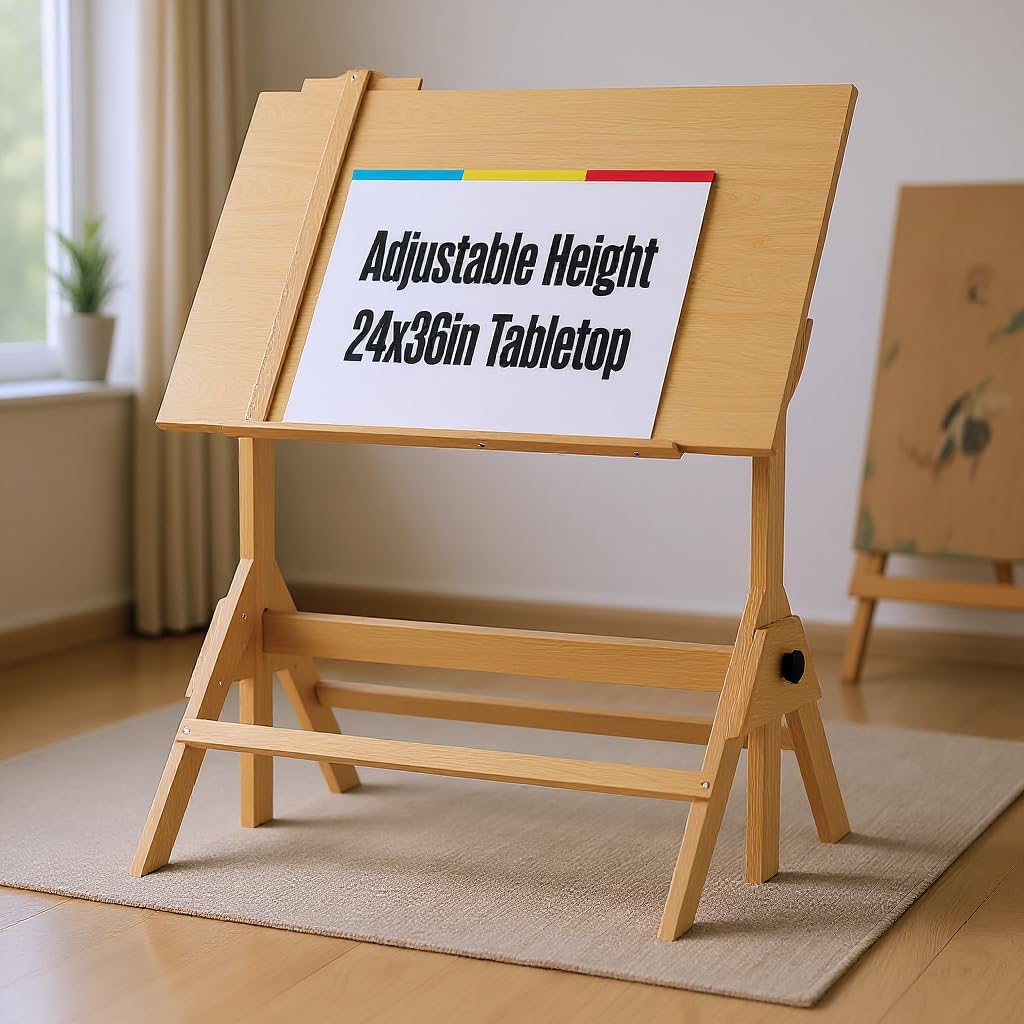
This is the build that feels like furniture rather than flat-pack — a real wood frame on beech legs with a sealed slick top that wipes clean after a paint session. The work surface runs 35.5 by 23.7 inches, close to the MEEDEN below but finished more like a proper drafting table. Both height and tilt adjust to your position, and a T-square ruler ships in the box and rides along the top edge.
The frame is where it earns its place — hand-polished, painted, and steady once squared up. It fits an 18×24 inch sketchbook and a 13 inch iPad Pro on the same surface at once, which says a lot about usable width. That said, there are no drawers or side storage, the bottom ledge doesn’t span the full width, and the bare wood feet want felt pads so they don’t scuff a floor.
Assembly is short but the manual has a known snag: the instructions tell you to mount the tilt bracket inside when it belongs outside, with a washer between bracket and wood. Countersunk marks, meanwhile, tell you where the screw heads seat. Plan about 40 minutes and read each step twice.
The material story: a beech wood frame and sealed top make this the cleanest-looking pick in the batch for a living-room studio.
What you give up: no drawers, and the manual’s first step is documented wrong — bracket goes outside.
Pick this one when: appearance and a sealed, wipe-clean wood top outweigh built-in storage.
Pass if: you need drawers or a full-width pencil ledge for tools at full tilt.
5. conda Wood Drafting Table

A small-footprint solid wood desk for the corner that has to double as a home office.
The listing is unusually plain about assembly, and that’s the standout: clear printed instructions, all tools, and pre-sorted parts. That single detail is why “easy to put together” is the thing buyers mention more than anything else here — no hunting through tangled hardware bags. The top is a 35.4 by 23.6 inch natural wood surface with a built-in pencil ledge and a ruler, sized to hold a table easel or sketch board plus paints, brushes, and a clip-on lamp.
Height adjusts from 31.5 to 37 inches and the top tilts from 0 to 45 degrees — a shallower range than the ZENY or MEEDEN boards, so it suits seated sketching and writing more than steep canvas work. The solid wood build and small footprint make it easy to move yet steady, and reviewers describe it as looking cozy in an office. It also pairs well with a rolling storage cart for a compact art corner.
Two honest limits: shipping damage occasionally shows up and needs a repair or a return, and the 45-degree cap stops short of the near-vertical tilts you get elsewhere. If you only ever work seated and flat-ish, neither matters.
Straight-talking strengths
- Clear printed instructions, tools, and pre-sorted parts in the box
- Solid wood frame with a small footprint for tight spaces
- Built-in pencil ledge and ruler on a 35.4 x 23.6 inch top
Where it stops
- Tilt tops out at 45 degrees — less than a full steeper-angle tilt
- Occasional shipping damage requires repair or a swap
The right buyer: a seated sketcher or writer with a narrow corner and a low tolerance for confusing builds.
Not for you if: you need the top to swing almost upright for large acrylic work.
6. MEEDEN Wood Adjustable Drafting Table
Solid beech legs and a 29.7–38.4 inch lift make this the desk daily painters keep for years.
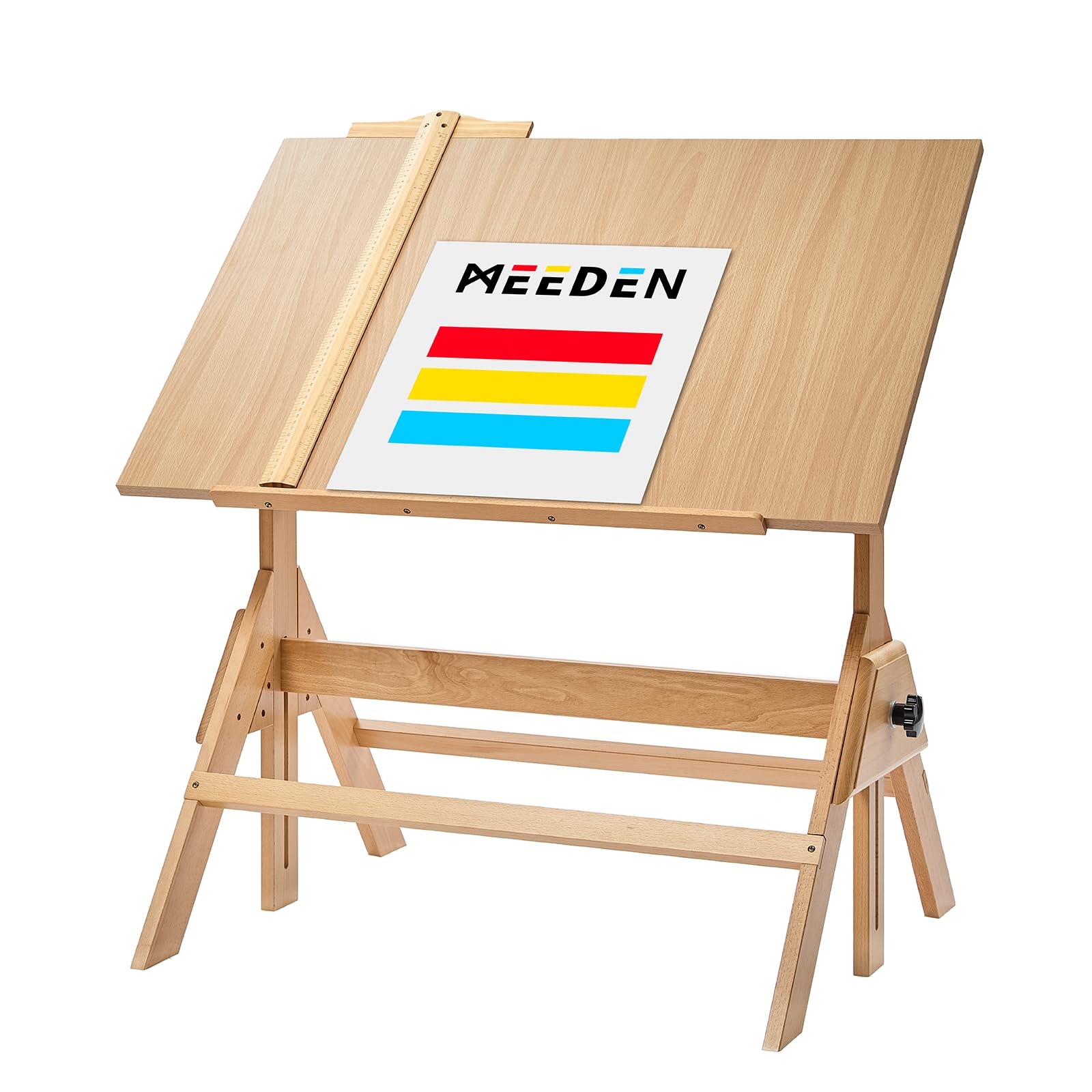
Height runs from 29.7 to 38.4 inches here, the widest seated-to-standing window in this group, and the top tilts flat to 60 degrees. The 35.5 by 23.5 inch particle-board top wears a smooth natural finish with a 25 inch built-in pencil ledge, while solid beech legs and a cross-support design keep it from twisting. Handedness of the frame aside, this is the desk serious hobbyists keep — some owners have run a pair for years and simply sanded and tung-oiled the surface after heavy daily watercolor use.
It arrives with clear instructions, a handy assembly tool, and parts bagged separately so nothing goes missing — roughly 20 minutes for two people. A 24 inch T-square with inch and metric scales comes included. The build quality is the thing everyone raves about, and it doesn’t wobble once set.
The adjustment is the friction point. The top is heavy, and you lift it while tightening knobs on both sides. That is hard to do alone and can tilt unevenly, so some folks slide stacks of paper under each side as a helper. It is rock-solid once locked; getting there just takes two hands and patience.
The takeaway: solid beech and a 29.7–38.4 inch lift make this the durability pick, and it doesn’t wobble once squared.
Beat the catch: raise the top with a second person, or stack paper under each side before you torque the knobs.
Suits: the daily painter who wants a real-beech desk to grow old with.
Think twice if: you work solo and change the tilt often — lifting that top while tightening takes effort.
7. MEEDEN Vintage Wooden Drafting Table

Dark walnut grain and a 90-degree swing for the studio that doubles as a showpiece.
Where it stands apart is range: the height offers 6 positions from 32.7 to 38 inches, and the top tilts from flat all the way to 90 degrees across 7 angles. That near-vertical option is genuinely rare at this size and suits propped-up canvas or reference boards. The walnut-colored particle-board top carries a built-in pencil ledge, a 24 inch T-square is included, and the thickened beechwood legs sit on an H-frame with a semicircle iron sheet for an industrial look.
Threaded-hole redesign was aimed squarely at cutting the shake, and it holds — the desk sits rock-solid on carpet and the finish stays consistent. Assembly is a manageable hour with labeled hardware grouped by step. Owners treat it as a furniture piece, not a workbench, and the design is what earns the affection.
Two things to weigh: the adjustability needs a fair number of knob turns and isn’t easy, and the included T-square is mostly decorative — plan to buy a metal one for precise work. Some units show minor cosmetic dings on the H-stand, though never on the drawing surface.
Design-first: a flat-to-90° tilt and walnut grain make it the most convincing statement piece here.
Trade-off: the T-square is decorative and the knobs take many turns — buy a metal ruler.
Choose it when: a 90-degree near-vertical tilt and a vintage look matter to your studio.
Leave it if: you want one-hand tilt changes — this needs patience with knobs.
8. VISWIN Wood Drafting Table 30″ X 42″

A 42 by 30 inch pine board for construction plans and full-sheet layouts.
Size is the whole argument: the 42 by 30 inch pine top takes a full set of construction plans or a wide canvas with room to spare, matching the MEEDEN Extra-Large below on surface area. The pine frame uses an H-frame build (a frame shaped like the letter H) with thickened legs and hand-polished corners. It adjusts from 34 to 38 inches in height and 0 to 70 degrees in tilt — the steepest swing short of the 90-degree MEEDEN vintage. A professional oil finish keeps the surface smooth for easy cleanup.
Owners find it exceeds expectations on design and fairly easy to build, with labeled parts and quick setup. It’s stable and solid once assembled and looks sharp enough to pass for a home office desk. That width is the reason most buyers come — plenty of room to spread out and tilt.
The height is the honest snag. At its lowest setting the table still sits high, which is fine standing or on a stool but too tall to line up flush with a standard office desk or computer chair. Treat it as a dedicated art or drafting station, not an L-desk partner.
What earns the space it takes
- 42 x 30 inch pine surface for full plans and wide canvases
- Tilts 0 to 70 degrees, height 34 to 38 inches
- H-frame pine build with polished corners and oil finish
Measure twice
- Lowest setting still sits tall for a standard office chair
- Height won’t allow comfortable standing for everyone
This is your desk if: you draft on large-format plans and want a big surface at 70 degrees.
Measure first if: you planned to pair it flush with a normal-height desk.
9. Extra Large 5-Position Wood Drafting Table

A fold-up beech board that turns any table into a tilted drawing surface.
This isn’t a full desk — it’s a portable board you drop on a table or your lap. The 29 1/2 by 19 2/3 inch beechwood surface weighs 8.1 pounds, folds for storage, and sets into 5 tilt positions with a bar that locks firmly so your work stays put. Solid European beech gives it a smooth, consistent finish, and four non-slip rubber feet protect the surface underneath.
Two jobs it does well: sketching support for a light board, and diamond-art canvas work, where the bottom tray holds pencils and blending sticks. The beech build is what owners praise most, and it’s light enough to carry from room to room. Locking the board at one of five angles lifts your work toward eye level so you stop hunching over a flat table.
Know the limits. The bottom piece isn’t solid, so lap use needs a cutting board or firm surface under it, and the plastic corner pieces can pop loose. It also can’t match a framed desk for steadiness at steep angles. If you want a real upright drawing station that never shifts, this isn’t it — but as a portable board it does the job.
The fit: a lightweight beech easel for sketching on the table, on the couch, or on the floor.
The limit: hollow base and loose plastic corners mean it needs a firm surface and gentle handling.
Reach for this if: you want a portable tilt board without committing to a full desk.
Not for a fixed studio: framed desks hold steeper angles steadier than this folder does.
Know the Specs
Tilt Range (Degrees)
Tilt is the angle your work surface can rise from flat. More degrees means you can sit upright instead of leaning over the page. The picks here run from a fixed set of positions at 5 steps, up to smooth ranges hitting 60, 65, 70, and 90 degrees. If you paint large canvas upright, go for the steeper range; for writing and flat cutting, a 45-degree cap often is enough.
Height Adjustment (Inches)
The height range decides whether you can sit at a chair or stand at the desk. Most tables move from around 28 inches up toward 38. A 28-inch low end pairs with a standard chair; a higher floor suits a drafting stool. Check your own seated elbow height against the low number before you buy — a table that never drops below your desk height can’t double as a computer station.
Frame and Top Material
The frame is the legs and cross supports; the top is the drawing surface. Solid beech or pine legs with a particle-board or MDF top is the common, stable formula at this level. A full solid pine build is heavier. MDF gives a smooth, low-glare face that’s kind to pencil tips. Watch for bare wood feet and add felt pads to protect a floor.
Surface Size and Storage
The main tabletop sets how big a canvas you can flatten. Common sizes run from a 29 1/2 inch portable board up to 42 by 30 inch full desks. Slide-out side trays and drawers keep tools off the working area, but they can crowd your knees. Decide which trade you want before committing.
Common Questions
Can a wooden drawing table tilt flat enough to use as a writing desk?
What tilt angle do I actually need for painting versus sketching?
Is a particle-board top good enough, or do I need solid wood?
Why do the feet on these tables scratch my floor?
How long does assembly take and do I need two people?
Can I adjust the height on my own, or is it a two-person job?
Will a 42-inch table fit a standard art studio or home office?
Do I need a stool, or does a normal chair work?
Is a drafting table worth it over a flat desk and a book stand?
Do these tables hold a light pad or a drawing tablet steadily?
The Bottom Line
If you want the smoothest start with one purchase, the ZENY Drafting Table covers desk, stool, drawers, and a 60-degree tilt in a single box — just budget an afternoon for the build. Prefer solid beech you’ll keep for years? The MEEDEN Wood Adjustable Drafting Table lifts from 29.7 to 38.4 inches and gives you the widest seated-to-standing window on this list. And if your work runs to full construction plans or wide canvas, the VISWIN Wood Drafting Table hands you a 42 by 30 inch pine surface that tilts to 70 degrees — though plan to stand at it, since its lowest setting sits high for a chair. Whichever way you lean, check the tilt range and the lowest height against your own seated elbow height before anything else.
How we choose
We do not accept paid placement. Every pick is matched to a real buyer and a real use-case; we do not hands-on test units.
Sources
Specifications: manufacturer listings and product documentation. Review insights: verified customer reviews, as of October 2026. Pricing: not shown on this page (it changes often); check the current price via the retailer link.
As an Amazon Associate, Home Digitized earns from qualifying purchases. This does not affect which products we feature.