
Specs are compiled from manufacturer listings and verified buyer reviews and can change over time — please confirm the key details on the product page before buying.
Most wood joints fail for one boring reason: your holes did not line up. A wood joint tool fixes exactly that — it holds two boards in a fixed relationship so the biscuit, dowel, or screw goes where you planned. Which one you need depends on your job: portability, repeatability across a whole cabinet run, or the fastest possible box build. Below are nine tools that each handle one of those jobs well, sorted by what they actually do rather than by brand noise.
This guide is built by comparing the manufacturers’ published specifications and the patterns across verified customer reviews, so you get each pick’s real strengths and trade-offs instead of marketing spin.
You will see how fence adjustments, bushing sizes, and clamp design change the result in real stock. The fastest route to clean joints is picking the right wood joint tool for the joint style you build most.
Top Picks

How To Choose The Best Wood Joint Tool
Start with the joint, not the tool. Edge-to-edge glue-ups for a tabletop want a biscuit joiner. Cabinet boxes and face frames want a dowel jig or a pocket-hole jig. Decorative box corners want a router-table jig with indexing keys. Buying for the wrong joint style is the most common way to end up with a tool that sits in a drawer.
Biscuit joiner or dowel jig first
A biscuit joiner cuts a shallow slot with a small circular blade. A dowel jig drills round holes through hardened bushings. Biscuits are faster and more forgiving on alignment because the slot is wider than the biscuit. Dowels are stronger in some joints but demand tighter hole placement, so the jig’s build quality matters far more. If you are joining slabs and want speed, go biscuit. If you are building frames and want strength with cheap consumables, go dowel.
Check the bushing and biscuit sizes before you buy
Dowel jigs are built around specific pin diameters, most commonly 1/4-inch, 5/16-inch, and 3/8-inch. Confirm your jig covers the size you actually use, because a missing bushing means buying an accessory set later. Biscuit joiners work in numbered sizes — #0, #10, and #20 — and each number corresponds to a slot depth setting on the tool. Make sure the depth selector offers those settings directly rather than asking you to eyeball a scale.
Clamping method decides your workflow
Self-clamping jigs grip both boards at once, so the same setup drills matching holes in both pieces. That is the single biggest time saver on repeat work. Jigs without a built-in clamp need a separate trigger clamp, which is fine for one-off repairs but slows down a run of ten cabinet sides. Pocket-hole jigs sit in a third category: they clamp to the workpiece itself, so you carry the jig to the board instead of the board to the jig.
Side-by-Side Comparison
| Model | Best For | Joint Type | Power Source | Tool Weight | Amazon |
|---|---|---|---|---|---|
| DEWALT 20V MAX XR Biscuit Joiner (DCW682B)★ Best Overall | Slab and panel glue-ups | Biscuit | Battery powered | 6 pounds | Amazon |
| Milescraft 1334 Joint MasterBest Value | Fast edge, corner and surface dowels | Dowel | Hand tool | 16 ounces | Amazon |
| Kreg Dowel Jig Kit (KHJD345)Most Compact | Furniture and cabinet doweling | Dowel | Hand tool | 1.46 pounds | Amazon |
| Milescraft 1311 Joint Pro | Two-board clamp-ups in one setup | Dowel | Hand tool | — | Amazon |
| ELEON Self Centering Dowel Jig | Wide stock and big clamping openings | Dowel | Hand tool | 1.63 kg | Amazon |
| Dowl-it 1000 Self-centering Doweling Jig | Simple shop work with no loose parts | Dowel | Hand tool | 2.4 pounds | Amazon |
| Kreg Pocket-Hole Jig 520 (KPHJ520PRO2) | Portable pocket holes on site | Pocket hole | Hand tool | 2.72 pounds | Amazon |
| Router Table Box Joint Jig | Repeatable box and finger joints | Box / finger | Router-table accessory | — | Amazon |
| Makita XJP03Z Plate Joiner | Contractor-grade biscuit work anywhere | Biscuit | Cordless (18V LXT) | 7.6 pounds | Amazon |
Detailed Reviews
1. DEWALT 20V MAX XR Biscuit Joiner
Our pick — 4.5+★ from 400+ verified ratings; the strongest balance of quality and price.
A cordless biscuit joiner with a dual rack-and-pinion fence, built for slab and panel work.
If you are gluing up tabletops or wide panels, this is the tool that removes the cord tangle from the equation. The brushless motor (a motor design with no carbon brushes to wear out) keeps cutting consistent across the common biscuit sizes. What wins people over is the build itself — the quality of the machining comes up more than anything else in the feedback, with the cordless freedom a distant second.
The fence is where the accuracy lives. Dual rack and pinion means both ends of the fence move together on toothed tracks, so the fence stays parallel to the blade instead of drifting at one end. Depth, height, and bevel all adjust without a tool, and the integral fence swings from 0 to 90 degrees for mitred work. A depth selection knob clicks between #0, #10, and #20 biscuit sizes, so you choose the slot depth by name rather than by measuring. Biscuits themselves sell separately.
You get a motor, blade, and battery mount in the hand, and that costs you weight: at 6 pounds it is a substantial tool — 4.1 times the weight of the Kreg dowel jig further down this list. The paddle switch runs the length of the handle, so left-handed and right-handed users both reach it comfortably. The package includes a 4-inch blade plus two dust ports — one Airlock-compatible (Airlock is a twist-lock hose fitting) and one angled. A buyer with four decades of carpentry calls it accurate, well-balanced, well-machined, and smooth to operate.
What earns it the top slot
- Dual rack and pinion fence keeps both ends aligned, which is the whole game in biscuit joinery
- Tool-free depth, height, and bevel adjustment, with bevel travel from 0 to 90 degrees
- Cordless 20V MAX platform means no lead dragging across a glued panel
- Ambidextrous paddle switch suits both hands
- Two dust ports included, so you can route extraction either way
What to weigh before buying
- Tool only — no battery or charger in the box, so you need the DEWALT 20V MAX platform already
- Biscuits are sold separately
- 6 pounds gets tiring overhead or on vertical face frames
Best for: anyone already on the DEWALT 20V MAX battery system who joins slabs, panels, or wide glue-ups and wants the fence to stay true.
Think twice if: you have no 20V MAX batteries — the bare tool saves you nothing until you buy into the platform.
2. Milescraft 1334 Joint Master Doweling Jig
Sixteen ounces of aluminum that clamps itself to the board and drills all three dowel sizes.
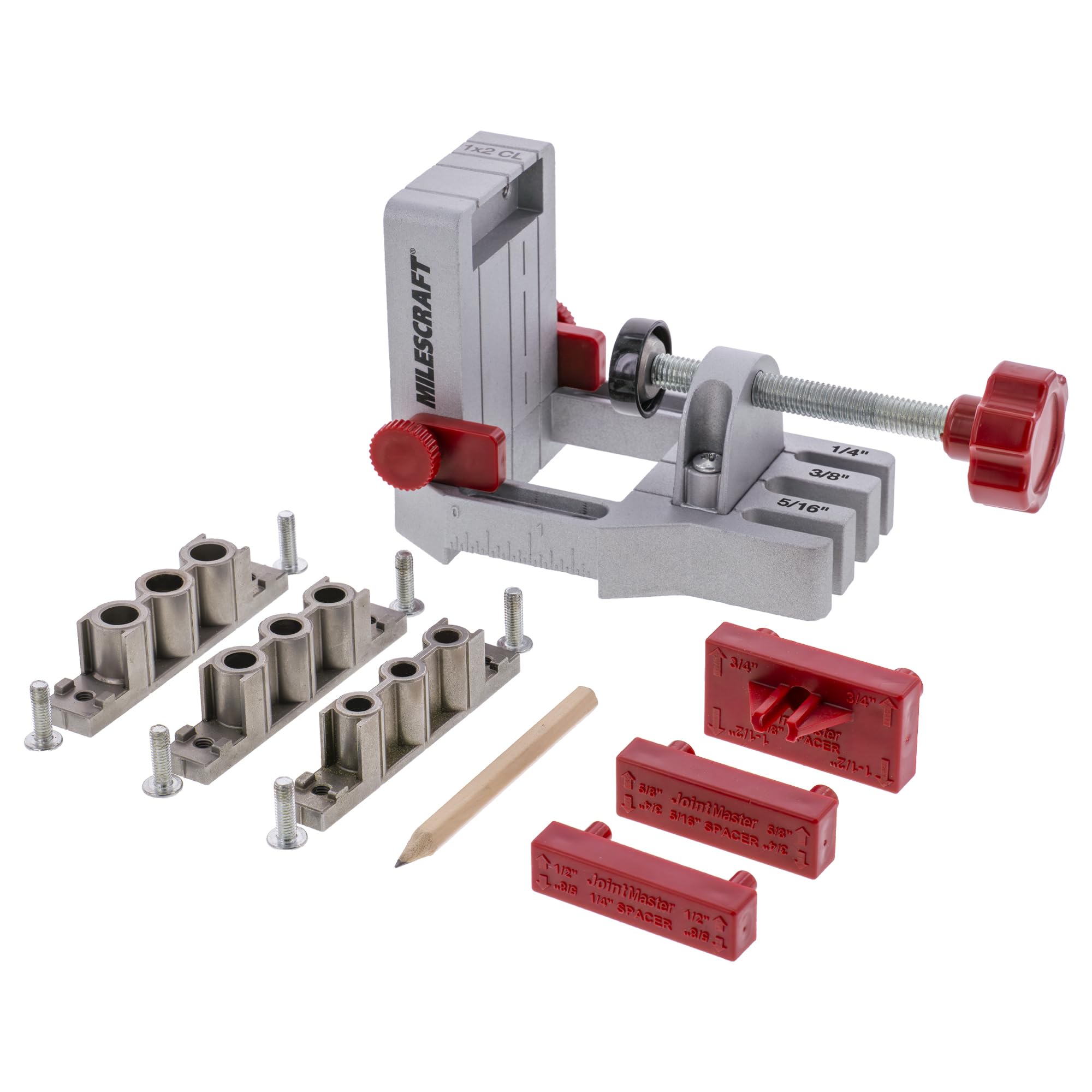
This is the jig for someone who wants to stop fighting two clamps and a loose board. The body is all aluminum, so it will not flex or bow under clamping pressure. Retractable edge stops drop down and automatically line up the second board so the dowel pins land in the same spot both times — the small feature that turns a two-step job into a one-step job. Hardened steel bushings carry the drill through at 1/4-inch, 5/16-inch, and 3/8-inch.
Twenty-one owners single out how many joint styles it handles: edge, corner, and surface joints all come off the same block. Switching from end work to surface work takes seconds — pull two screws, move the plate. It handled end, surface, and face dowels in 2x10s, which is real stock, not a picture frame. The weight is 16 ounces, which sits comfortably in one hand and is far lighter than a biscuit joiner with a motor in it.
Where it asks for patience: adjustability is the one thing buyers split on. Some find the precision settings exact; others find dialing it in fussy and the Phillips-head screws dated. A jig this capable rewards a few minutes of setup with scrap before you commit to your good boards.
Storage reality: there is nowhere built in for the centering spacers and spare parts. A small shop box solves it in ten seconds, but plan for it.
Reach for this if: you build a bit of everything — cabinets, repairs, small furniture — and want one block that clamps itself and covers three dowel diameters.
Look elsewhere if: you need a jig for tight interior spaces, where a more compact body will serve you better.
3. Kreg Dowel Jig Kit, Woodworking Doweling Jig, KHJD345
Under a pound and a half, with guides that pop out so you can drill tight cabinet corners.
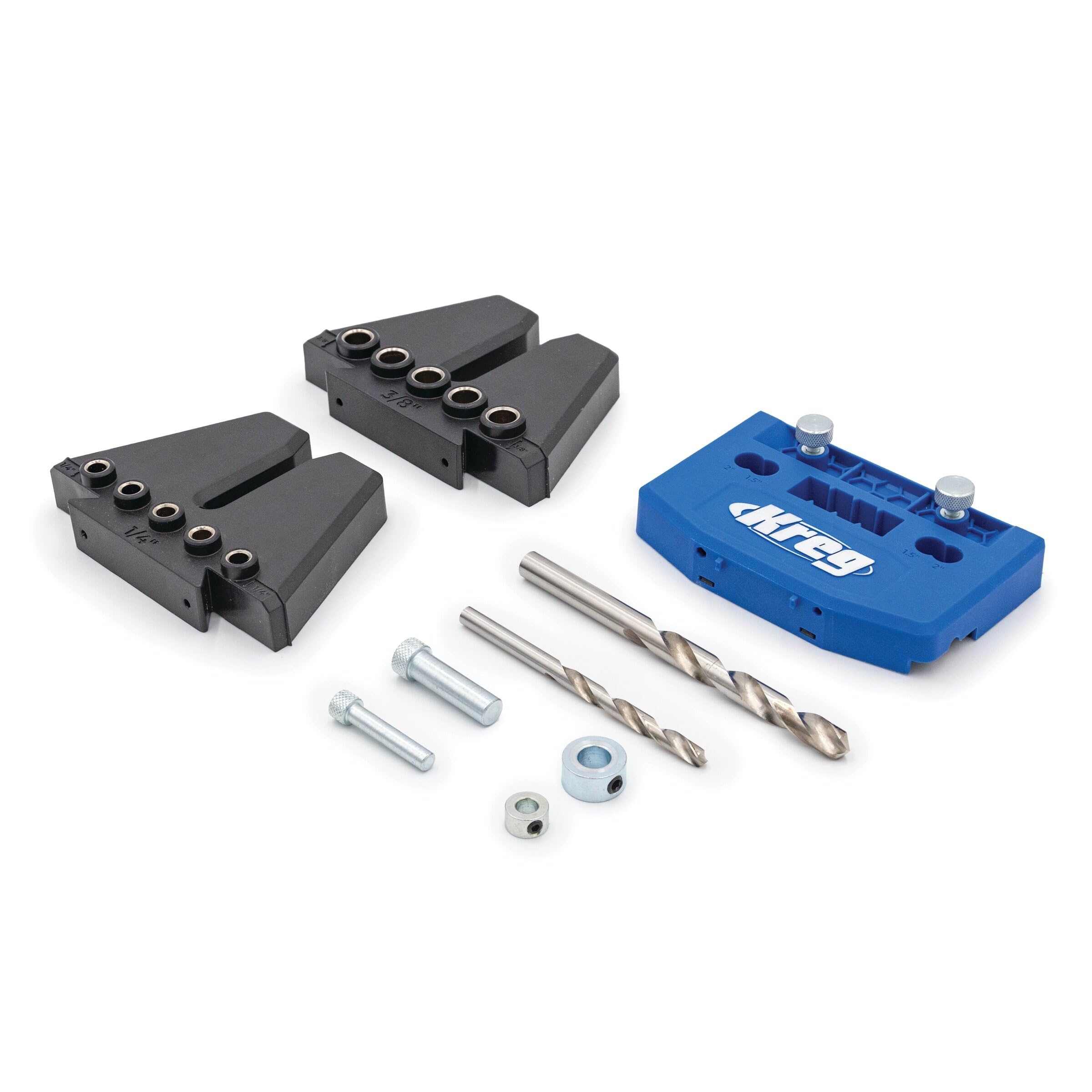
At 1.46 pounds this is the lightest thing on the list — a full 4.1 times lighter than the DEWALT biscuit joiner, and that gap is the entire pitch. You can carry it in a tool bag and hold it against a cabinet side with one hand. Hardened steel drill guides keep the bit tracking straight, and removable guide blocks let you pull a guide out of the way where a whole frame will not fit.
The alignment pin and built-in centering do the setup work for you, which is why the tool gets described as simple to use over and over. It is built for cabinets and furniture — the kind of work where you are drilling a lot of holes at one fence position and want repeatable results rather than maximum clamping force. The steel guides mean the drill bit follows the same path every time instead of wandering in soft pine.
Here is the trade-off, and it is a real one. Hole depth draws the most criticism in the feedback, and several buyers find the holes are not perfectly centered on hardwoods. One buyer found it cutting slightly off perpendicular in oak and worked around it by rotating the guide 180 degrees and redrilling. It is also the least adjustable jig here — centered joinery on complex angles still needs your own measuring. On a booked-out cabinet run, that costs time.
Suits: a home woodworker building bookshelves and cabinet carcases who wants a light, clamp-ready jig the whole shop can share.
Not the one for: hardwood joinery that has to be dead centered and perfectly perpendicular every time without a workaround.
4. Milescraft 1311 Joint Pro Doweling Jig
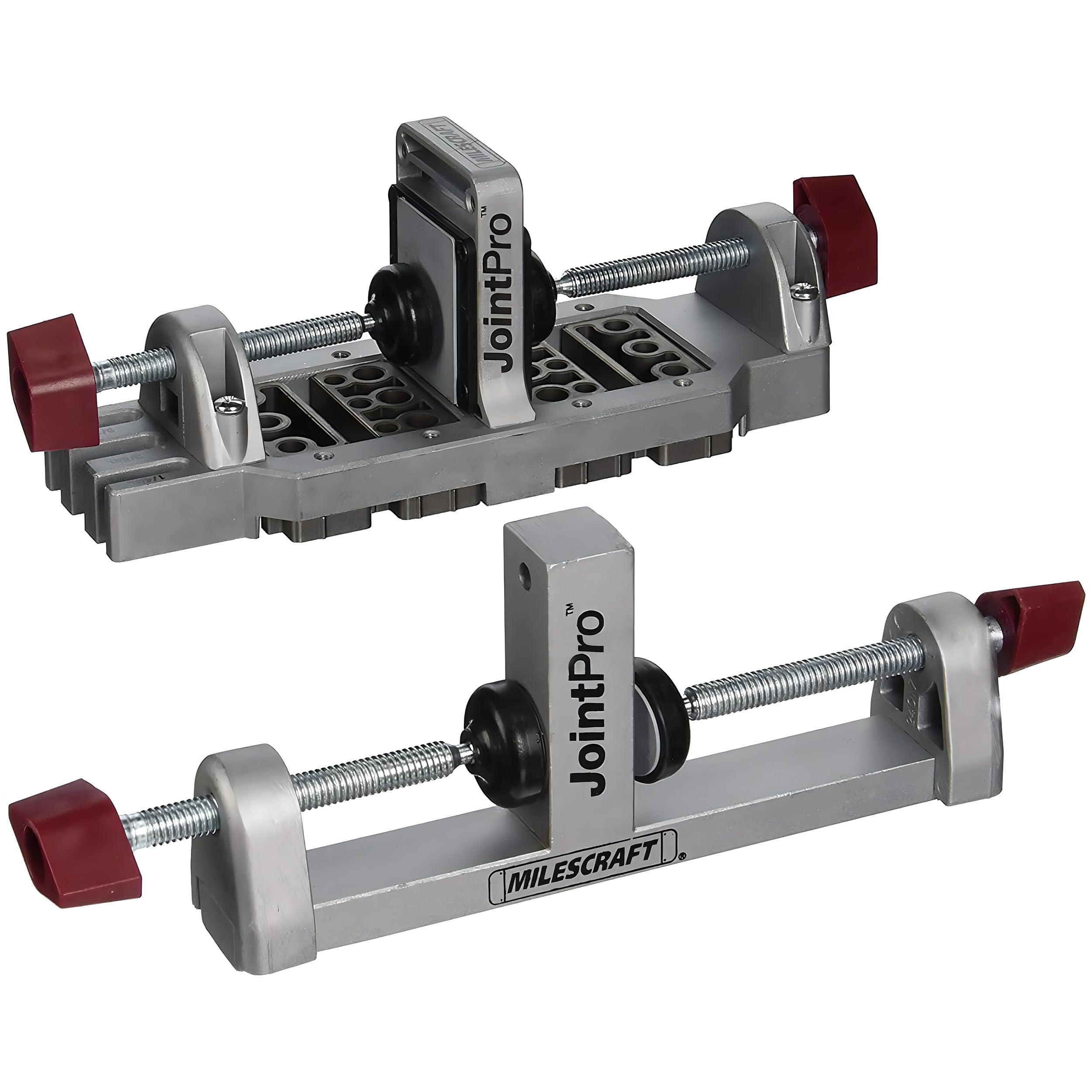
Clamps both boards at once and drills six matching holes before you move anything.
The headline number here is six: one setup can drill up to six matching holes per board, which is what makes a corner joint come together without a second measuring session. Up to three holes go through each hardened steel bushing block in 1/4-inch, 5/16-inch, or 3/8-inch. The main body and sub body clamp the two boards simultaneously, so the alignment is locked in by the tool rather than by your pencil marks.
It is an all-steel jig with heft — plastic appears only on the clamp knobs and feet. That mass is why it holds position while you drill. Its edge over the ELEON further down is that both halves clamp together in one motion; the ELEON asks you to set each side. On a run of doors or face frames, that difference compounds.
One planning note that matters: the dowel holes sit slightly off dead center by design, so you must orient the boards correctly — one face up, the other face down for edge-to-edge work — so the offset cancels out and the finished surfaces meet flush. Read that line twice before your first cut.
Where it falls short: no drill bits and no stop collars in the box, so budget for those separately, and the soft Phillips clamp screws can strip if you overtighten. Uneven clamp pressure between the two ends produces misaligned holes, so tighten evenly.
Worth it for: panel glue-ups and multiple door frames where a single clamp-up that drills both boards is worth more than any single feature.
Plan around: buying bits and stop collars on day one, and treating the clamp screws gently.
5. ELEON Self Centering Dowel Jig with Elongated Jaws
A jig that opens to 6.7 inches, so thick stock and wide rails stop being a problem.
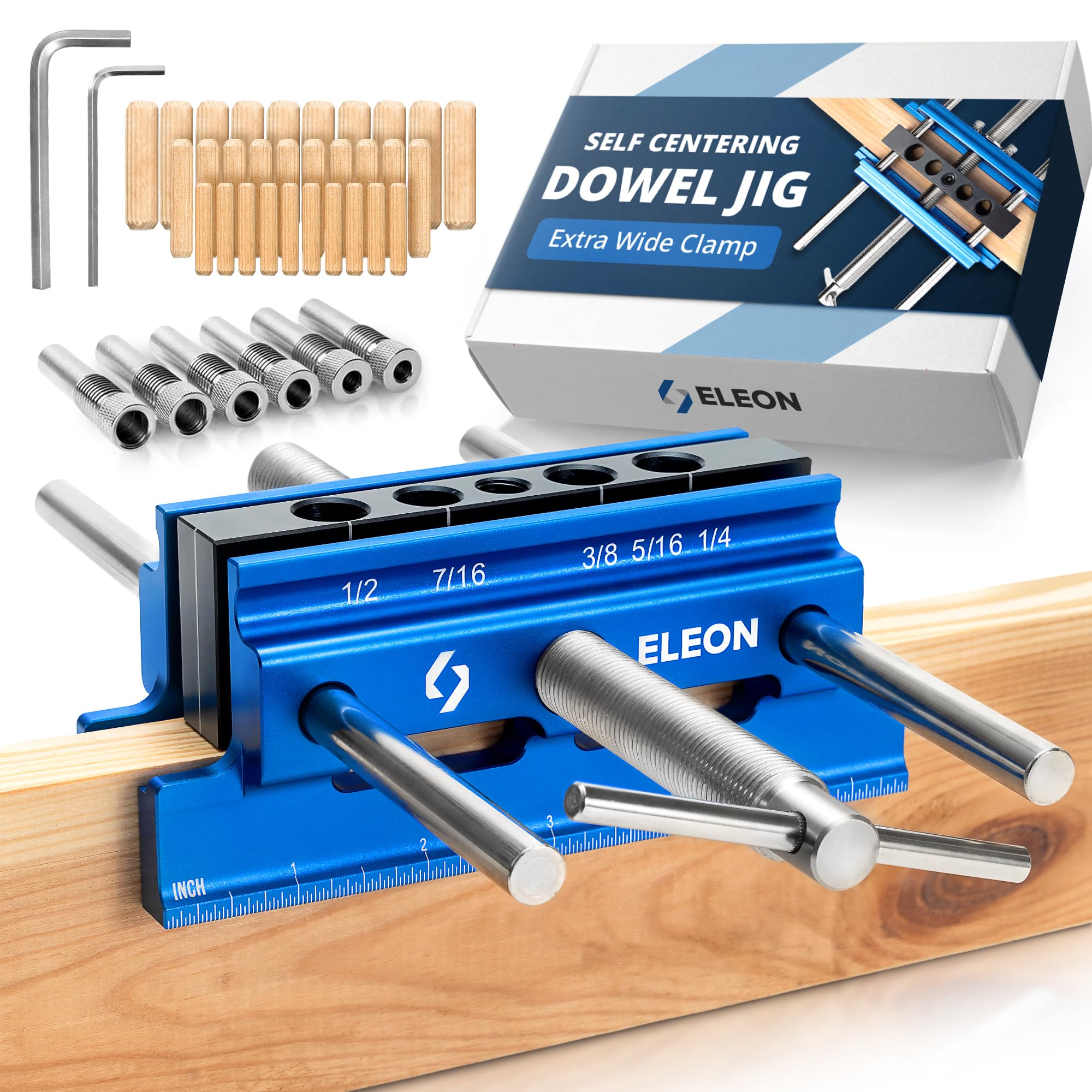
Most self-centering jigs choke on anything thicker than a shelf board. This one clamps across an opening up to 6.7 inches, which puts 2-by material and chunky table aprons well inside its range. The jaws are elongated rather than the narrow side clamps most jigs use, and the longer contact patch with a grip pattern is why it holds firm instead of walking. Ruler markings along the body let you space dowels without reaching for a tape.
Quality is what buyers talk about more than anything else, and the second most-praised point is the value — a fair read, given the box includes six drill bushings, 30 dowels in assorted sizes, and an instruction sheet. It also arrives pre-calibrated with calibration instructions, so you are not guessing on the first cut. The aluminum alloy body at 1.63 kg has enough mass that it sits still under clamping force. One user redid a cabinet frame in a fraction of the time a failed drill-press method had cost.
The alignment question is where the feedback splits. The self-centering mechanism is precise for many users, but others find the alignment marks sit slightly off center, and a few note that over-clamping can bend the outside plates. Treat it as an accurate jig for cabinet and shelving work rather than a precision instrument for stair rails.
The case for it
- 6.7-inch clamping opening handles thick stock other jigs cannot reach
- Six bushings plus 30 dowels included, so your first project starts immediately
- Elongated jaws with a grip pattern hold the board without slipping
- Ruler markings on the body speed up dowel spacing
The honest limits
- Alignment marks can read slightly off center — check against a square before trusting them
- Outside plates bend if you over-clamp; snug is enough
- Included bits work but brad-point bits cut cleaner holes
Go with this one if: your projects live in thick stock — shop furniture, aprons, heavy shelving — and you want the dowels included.
Skip it for: high-precision joinery where a thousandth matters, such as curved stair work.
6. Dowl-it 1000 Self-centering Doweling Jig

One solid steel block, no loose pieces to lose, and a clamp that seats tight every time.
The design philosophy here is the opposite of a feature list: a precision-hardened solid steel center block, self-centering, and nothing that comes apart. There are no separate bushings to drop on the shop floor and no inserts to misplace. At 2.4 pounds it has real mass, and that weight plus a stiff clamping mechanism is why it seats and locks hard against the stock.
Ease of use is what carries this jig — it comes up more than build quality, which is saying something for a tool people also describe as stout. The drill guide is quality steel, and 3/8-inch brad-point bits from major brands seat with no wiggle. Holes come out tight enough that dowels need a slight hand wiggle to seat, which is a good sign rather than a bad one. It handles 1x and 2x lumber for end-to-edge T-joints and edge-to-edge panels without complaint.
The thing to know before you buy: it is not built for end-to-face joints, so plan those on a different jig. There are also no adjustable drill hole inserts — you get one fixed geometry, which keeps it simple but rules out offset work. The alignment marks want decent lighting to read. And buy drill bit collars, because you will want a depth stop.
Why it feels expensive in the hand: the casting weight and tight action read like a much dearer tool, and the clamping mechanism never binds or sticks.
What you give up: adjustability. If your work moves between joint styles constantly, a jig with swappable guides will serve you better.
Ideal for: the home shop that wants one dowel jig set up once and used for years on panels and T-joints without fiddling.
Wrong pick if: your joinery includes end-to-face work or you need adjustable hole spacing.
7. Kreg Pocket-Hole Jig 520

The pocket-hole jig you carry to the board instead of dragging the board to the bench.
Pocket holes are a different joint family from biscuits and dowels, and this jig earns its place because of one design decision: the clamp is built in. That means you can take the jig to a cabinet already fixed to a wall and drill where the workpiece is, rather than hauling the workpiece to a benchtop jig. The VersaGrip handle rotates a full 360 degrees so you can find a comfortable angle on awkward assemblies.
The GripMaxx clamping surface is an anti-slip pad that holds the material while you drive the bit, and the body is impact-resistant polymer with a steel frame. It covers material from 1/2 inch to 1 1/2 inches thick and ships with 60 screws. Quality and ease of use are the two things the feedback keeps returning to, with setup described as quick. One buyer drilled roughly 100 holes through it in a week after replacing an off-brand jig.
A reality check on the numbers: this jig has the fewest ratings of any pick here, so the track record is shorter than the dowel jigs above. What is there is strong, though. And pocket holes are visible unless you plug them — if the joint will be on show, biscuits or dowels leave a cleaner face.
Buy this if: you assemble cabinets and built-ins on site, and bringing the jig to the work matters more than hiding the joint.
Consider the alternatives if: your joints are visible and you want a clean face on both sides.
8. Router Table Box Joint Jig
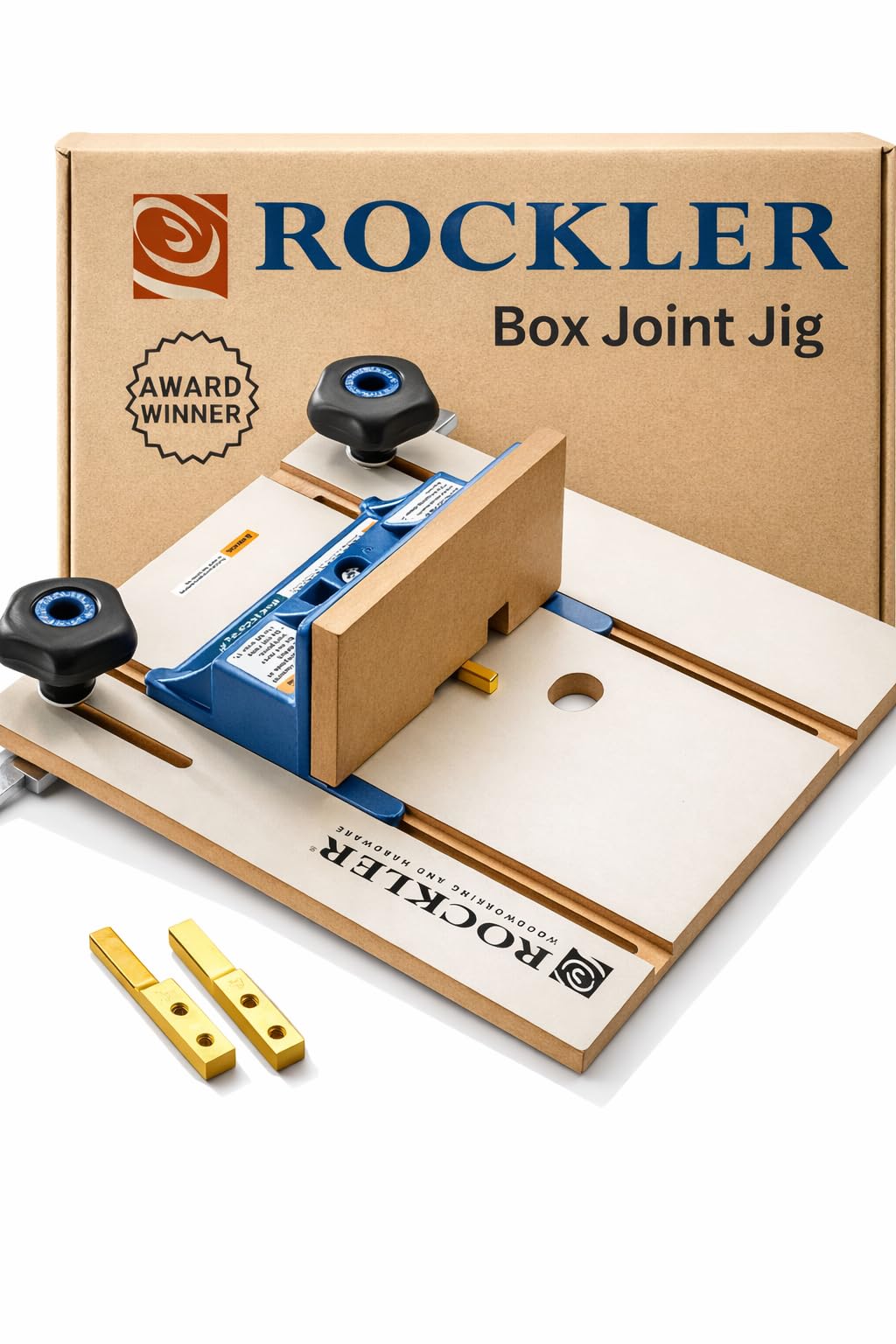
Interlocking finger joints, cut on a router table, spaced by brass keys that never drift.
This one is not a dowel or biscuit tool at all — it makes interlocking box joints, the alternating finger pattern on drawer corners and small chests. The keys do the spacing: three precision-machined solid brass indexing keys for 1/4-inch, 3/8-inch, and 1/2-inch fingers, stored in slots on the sled so they stay with the jig. Brass does not wear at the rate an aluminum or plastic index would, which is why uniform finger spacing holds up across a run.
The sled rides on long skis that keep it square to the bit, and tabs underneath stop the sled at the end of each cut so you cannot over-travel into the previous finger. It locks into a 3/4-inch miter slot with the soft-grip knobs. The platform is melamine-coated MDF, a low-friction surface that slides easily and lets the fence control tear-out. Detailed instructions get it cutting in about half an hour, which is quick for a router-table accessory.
Setup is the sticking point, and it is worth saying plainly: the jig works well once dialed in, but getting it dialed in takes patience and a sacrifice board or two. Use a good bit and test on scrap before you commit your good stock. Also check your bit before you order — a 3/8-inch bit with a 3/8-inch shank will not fit a standard router collet, so match the shank to your router.
Strong points
- Three brass keys cover 1/4-inch, 3/8-inch and 1/2-inch finger widths in one jig
- Sled tabs prevent over-travel, so finger alignment stays consistent
- Keys store on the sled and swap without hunting for them
- First cuts possible within about half an hour of assembly
Where it bites
- Setup is fussy and takes scrap-wood trial cuts to get right
- Requires a router table with a 3/4-inch miter slot — no table, no jig
- Watch the bit shank diameter against your router collet before buying
Pick it for: drawer boxes, small chests, and any project where you want the finger pattern rather than a hidden joint.
Hold off unless: you own a router table and are willing to spend the setup time on test cuts.
9. Makita XJP03Z 18V LXT Cordless Plate Joiner

A cordless biscuit cutter with a cast pivot fence and positive stops at 0, 45 and 90 degrees.
The fence is the story. It runs on a rack-and-pinion system — a toothed track and gear pairing — that moves the fence in a controlled, repeatable way rather than relying on friction to hold a setting. The cast aluminum pivot fence has three positive stops at 0 degrees, 45 degrees, and 90 degrees, so a mitred cut is a click rather than a measurement. It centers on 3/4-inch material without shimming.
Depth selection runs to six one-touch settings covering #0, #10, and #20 biscuit sizes and the most common bisquit dimensions. Large cam locks hold the fence adjustments, which is the kind of detail that matters once you have made the same adjustment for the fiftieth time.
Feedback points at a tool that cuts fast and accurate, with a blade that is sharp from the start and alignment that holds. A contractor who has run several other biscuit joiner brands ranks this one ahead on slide smoothness and setup ease. The honest catch is the trigger: it sits awkwardly for some thumbs. If you have large hands, try one before committing.
The standout spec: six depth settings with one-touch stops, which means a #20 biscuit is a deliberate selection rather than a depth guess.
The realistic caveat: 7.6 pounds plus 18V LXT batteries makes this a two-hand tool on vertical work, and it is the most expensive pick here.
Built for: the contractor or serious shop already on Makita’s 18V LXT batteries who needs a joiner that travels to the job.
Look at the DEWALT instead if: you are on the 20V MAX platform and want the lighter of the two cordless joiners.
Know the Specs
Biscuit numbers: #0, #10, #20
Biscuits are graded by a number that corresponds to the size of the compressed wood wafer, not to board thickness. The number you select sets the slot depth on the joiner. A joiner with a depth selector knob or one-touch stops lets you switch sizes deliberately, while a joiner without one forces you to eyeball the depth. Match the biscuit number to the job: small for thin panels and edge banding, large for thicker glue-ups that need more internal strength.
Dowel bushing sizes
Dowel jigs work through hardened steel bushings in fixed diameters, and the three most common are 1/4-inch, 5/16-inch, and 3/8-inch. The bushing is what keeps the drill bit tracking straight, so hardened steel matters — a soft bushing wears and lets the bit wander. Confirm your jig covers the size you actually use, and remember some jigs leave out the drill bits and stop collars entirely, so budget for them separately.
Tool weight in the hand
A biscuit joiner carries a motor, a blade, and a battery mount, so it weighs considerably more than a dowel jig. Six pounds is manageable on a flat panel; on a vertical face frame or overhead, that weight becomes the limiting factor. Dowel jigs sit between 16 ounces and 2.72 pounds, and that range is why they are easier to hold in awkward positions.
Clamping and alignment
Self-clamping jigs grip both boards in one setup and drill matching holes in both, which saves a whole re-measure step. Jigs that require a separate trigger clamp are lighter and cheaper but slower on repeat work. The alignment method matters as much as the clamp: retractable edge stops, alignment pins, and centering mechanisms all aim at the same goal — putting the hole in the same place on both boards without a tape measure.
Common Questions
Is a biscuit joiner better than a dowel jig for edge-to-edge glue-ups?
Will a dowel jig work on 2×4 and 2×6 material?
Do biscuit joiners come with a battery?
Do dowel jigs include the drill bits and stop collars?
Can a router table box joint jig be used on a table saw?
What is the difference between a pocket-hole jig and a dowel jig?
How accurate does a biscuit joiner fence need to be?
Why do my dowel holes come out off center?
Can I cut a biscuit slot without a biscuit joiner?
How long does a setup usually take on a box joint jig?
The Bottom Line
For most woodworkers, the winner among these wood joint tool picks is the DEWALT 20V MAX XR Biscuit Joiner. Its dual rack-and-pinion fence (a fence driven by toothed rails at both ends) keeps both ends of the fence aligned, which is what makes a glue-up come out flush. If dowels are your joint and you want the jig to clamp itself, grab the Milescraft 1334 Joint Master — 16 ounces, three dowel diameters, retractable edge stops. And for cabinet work where the jig has to travel to the board, the Kreg Pocket-Hole Jig 520 is the one to reach for.
One last thought for the fence-focused buyer: the DEWALT is the crowd favorite here at 4.5+ stars across 400+ ratings, and the cheapest dowel jig on this list has more ratings behind it — but the DEWALT holds the higher score while solving a harder problem.
How we choose
We do not accept paid placement. Every pick is matched to a real buyer and a real use-case; we do not hands-on test units.
Sources
Specifications: manufacturer listings and product documentation. Review insights: verified customer reviews, as of October 2026. Pricing: not shown on this page (it changes often); check the current price via the retailer link.
As an Amazon Associate, Home Digitized earns from qualifying purchases. This does not affect which products we feature.