
Specs are compiled from manufacturer listings and verified buyer reviews and can change over time — please confirm the key details on the product page before buying.
If your phone keeps dragging your waistband down mid-run, the fix is a belt that hugs your hips and holds a phone flat against your body — not a pouch that swings. The Fitgriff Running Belt is the one to start with: it carries a phone, keys and cards in separated compartments, and it is the crowd favorite at 4.5+ stars across 16,000+ ratings. Below you get nine belts sorted by what each one actually does well, from a five-pocket hydration carrier to a race-day bib clip.
This guide is built by comparing the manufacturers’ published specifications and the patterns across verified customer reviews, so you get each pick’s real strengths and trade-offs instead of marketing spin.
You will see which belts fit a 25-inch waist and which stop at 30, which ones carry water and which only carry a phone, and where a stretchy pocket starts to bounce once you overstuff it. For most women, that means a slim, bounce-free belt with a zippered phone pocket — the nine options below are sorted by waist range, pocket layout and whether they carry water.
Top Picks

How To Choose The Best Women’s Running Bag
Most women buy a running belt, wear it once, and never touch it again because it slid up to the narrowest part of the waist or the phone bounced against the hip bone. Getting the fit right is almost entirely about two numbers on the listing: the waist range and the pocket size. Everything else — reflectors, bottle pockets, bib clips — is a bonus you add once the basics work.
Start with the waist range, not the stretch
A belt that lists a range like 25 inches to 47 inches will sit snug on a small frame and still close on a larger one. A belt that starts at 30 inches, like the WATERFLY, has no setting for a 26-inch waist even pulled all the way in. Elastic hides a slightly loose fit for a mile or two, but on a long run a loose belt rides up to your ribs. Measure your natural waist and your hip line before you pick, and note that several belts are designed to sit low on the hips rather than at the belly button.
Match the pocket to the phone you actually carry
Your phone in a thick case is the main reason running belts get sent back. A pocket that stretches to hold a passport will fit a cased phone; a fixed slim pocket may only take a bare phone or a smaller model. If you run with a big-screen phone plus a case, pick a belt whose pocket is described as fitting all phone sizes. Also check for a second smaller pocket for keys, so they do not scratch the screen.
Decide if you need water on board
A plain phone belt weighs almost nothing and disappears under a shirt. A hydration belt carries bottles in dedicated pockets, which is the difference between finishing a half marathon and rationing sips. The trade-off is weight and bulk: bottles sit at your hips and your arms can graze them. If your longest run is under an hour, a phone-only belt is the lighter, less fussy choice.
Check what the belt does not promise
Sweat resistance and water resistance are not the same as waterproof. Several belts here protect against sweat and light rain but let moisture through seams in a downpour. Read the care instructions too — most of these are hand wash only, and a couple can go in the machine. A hand-wash-only belt you dread cleaning ends up unwashed and smelly, so check the care label before you buy.
Side-by-Side Comparison
| Model | Best For | Waist Range | Pockets | Weight | Amazon |
|---|---|---|---|---|---|
| Fitgriff Running Belt★ Best Overall | Everyday runs and walks | S-M (adjustable elastic) | 1 | 0.08 kg | Amazon |
| Sanhurst Running Belt Fanny PackLowest Profile | Minimal carry, low-profile | One size fits all | 1 | Under 3 ounces | Amazon |
| Q-RUN Hydration Running BeltBest Hydration Pick | Long runs with water | 25-33 inches | 5 | 0.26 kg | Amazon |
| WATERFLY Running Belt Fanny Pack | Marathon and triathlon bibs | 30″ to 39″ | 3 | 3.52 ounces | Amazon |
| adidas Pacer Running Waist Pack | Disappearing under a tee | One size | — | 3.84 ounces | Amazon |
| SPIbelt Running Belt Original | Wide waist range | 25″ to 47″ | 1 | 59 g | Amazon |
| Nathan Zipster Max Running Belt | Oversized phones | Sized by chart (Small tested) | 4 | — | Amazon |
| SPIbelt Dual Pocket Pro | Two separated pockets | 29″ to 47″ | 2 | 0.07 kg | Amazon |
| FlipBelt Zipper Running Belt | Long runs, lots of gear | Sized by wear position | 4 | 4 ounces | Amazon |
Detailed Reviews
1. Fitgriff Running Belt for Men & Women
Our pick — 4.5+★ from 16,500+ verified ratings; the strongest balance of quality and price.
The belt that vanishes on your hip and keeps your phone scratch-free.
It lands on top because it splits your carry into a main phone compartment and a small compartment for keys, cash and cards. That separation is what stops your keys from grinding against your screen. The belt itself measures 10″ long, 2″ wide and 2″ tall and weighs 0.08 kg — light enough that you stop noticing it a few minutes into a run. Compare that to the Q-RUN hydration belt at 0.26 kg and the difference is obvious: this one is built for a phone and a few essentials, not for water.
Fit is where it earns its keep. The straps are infinitely adjustable and elastic, so you dial in the tension rather than picking a hole. The size chart matters, though — the S-M size is built for a waist up to about 32 inches at maximum adjustment, and anything over that needs the larger size. A 33-inch waist fits the M/L perfectly. The polyester fabric is hand wash only, and the two reflector strips run along the zip so dusk runs and early starts get a little more visibility.
Buyers single out the material and stitching more than any other feature. It fits snug without twisting, and it stays put through running, walking, hiking and lifting. The honest limit is water: sweat and light rain are handled, but this is not 100% waterproof, so a heavy downpour can push moisture through the seams. If your phone lives in a case you also want a ziplock in the pocket on wet days.
What earns the top spot
- Separate phone and key compartments keep the screen scratch-free
- Infinitely adjustable elastic strap stays put without twisting
- Reflector strips along the zip for low-light runs
- 0.08 kg, so it disappears once you start moving
Where it draws the line
- Sweat and light rain only — seams can let moisture through in heavy rain
- Hand wash only
- No water bottle pocket
Reach for this if: you want a phone, keys and cards on a daily run at a waist under about 33 inches, and you want to forget you are wearing anything.
Step up in size if: your waist measures past 32 inches — the S-M tops out there and the larger size is the right call.
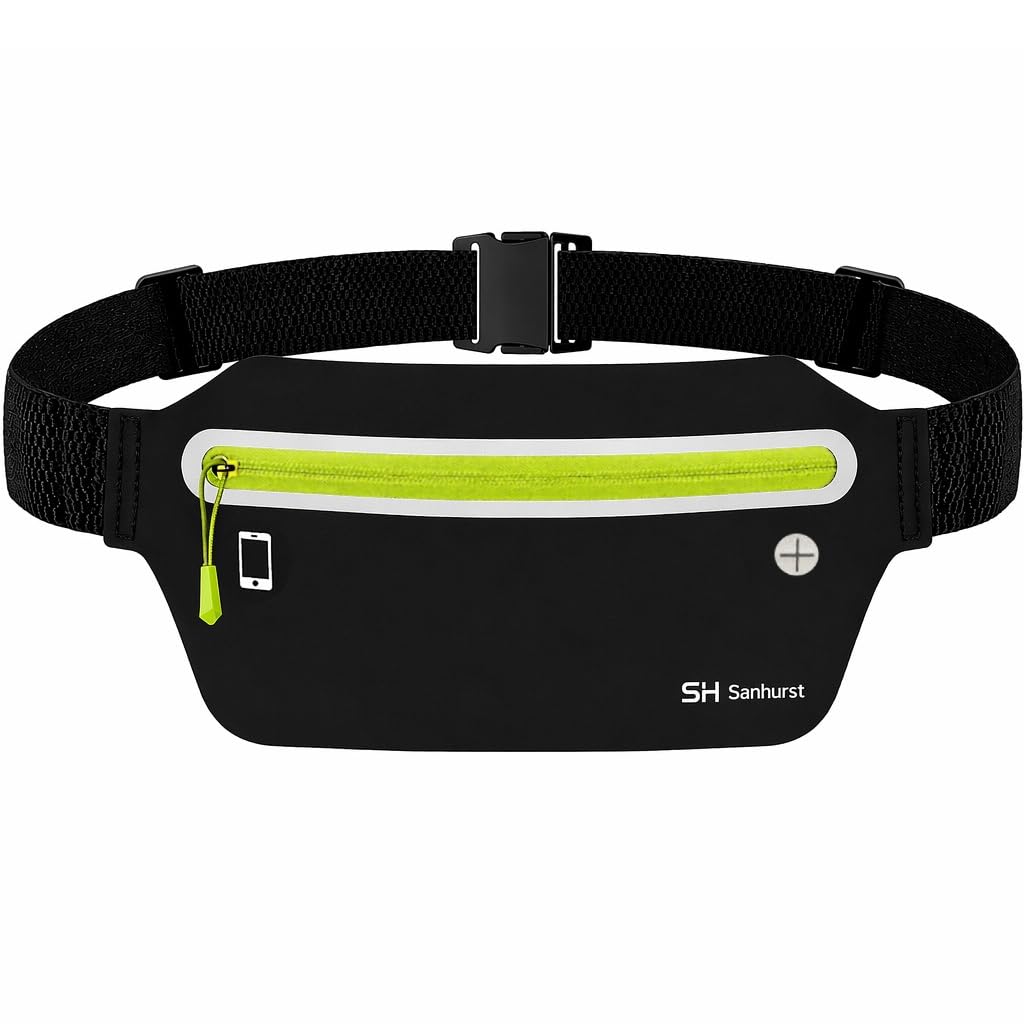
2. Sanhurst Running Belt Fanny Pack
The featherweight that sits flat enough to hide under a shirt.
At under 3 ounces, this is the lightest belt in the group, and the size difference shows up in the pouch dimensions: 9.5″ long, 5″ wide and 4.65″ tall against the Fitgriff’s 2″ width. That extra body gives it a flatter, broader footprint against your stomach instead of a narrow tube. The flat design and thin buckle are why it stays low-profile under a shirt — a detail that comes through constantly in what owners write about it.
Storage is a single zippered pocket that swallows a folded phone with room for a compact wallet in the front section. A Samsung Fold 4 fits in the main pocket. That is note, because a folding phone is a chunkier carry than most. There is also a built-in headphone port so wired earphones can run out of the pouch while your phone stays zipped away, plus a reflective strip and a sweat-and-water-resistant nylon shell. The storage volume comes in at 61 cubic inches.
The catch is that this is a compact carrier and nothing more. It will not take a water bottle or bulky items, and the fit range assumes an average body shape — one belt that closes neatly on most waists can sit awkwardly on a much larger frame. The construction itself holds up well: stitching, buckle and zippers are described as well made, and the cord port and 8-inch zipper make the pouch easy to work with one hand.
What the slim build buys you: a pouch that stays under a tee and does not flap, with a headphone port for wired buds and a reflective strip for dim mornings.
The honest caveat: one pocket means your phone and keys share space, so expect to protect the screen yourself.
Pick it for: short runs and gym sessions where you want a phone and a couple of small items and nothing else.
Pass on it if: you need a water bottle or carry bulky gear — this pouch is not built for that.
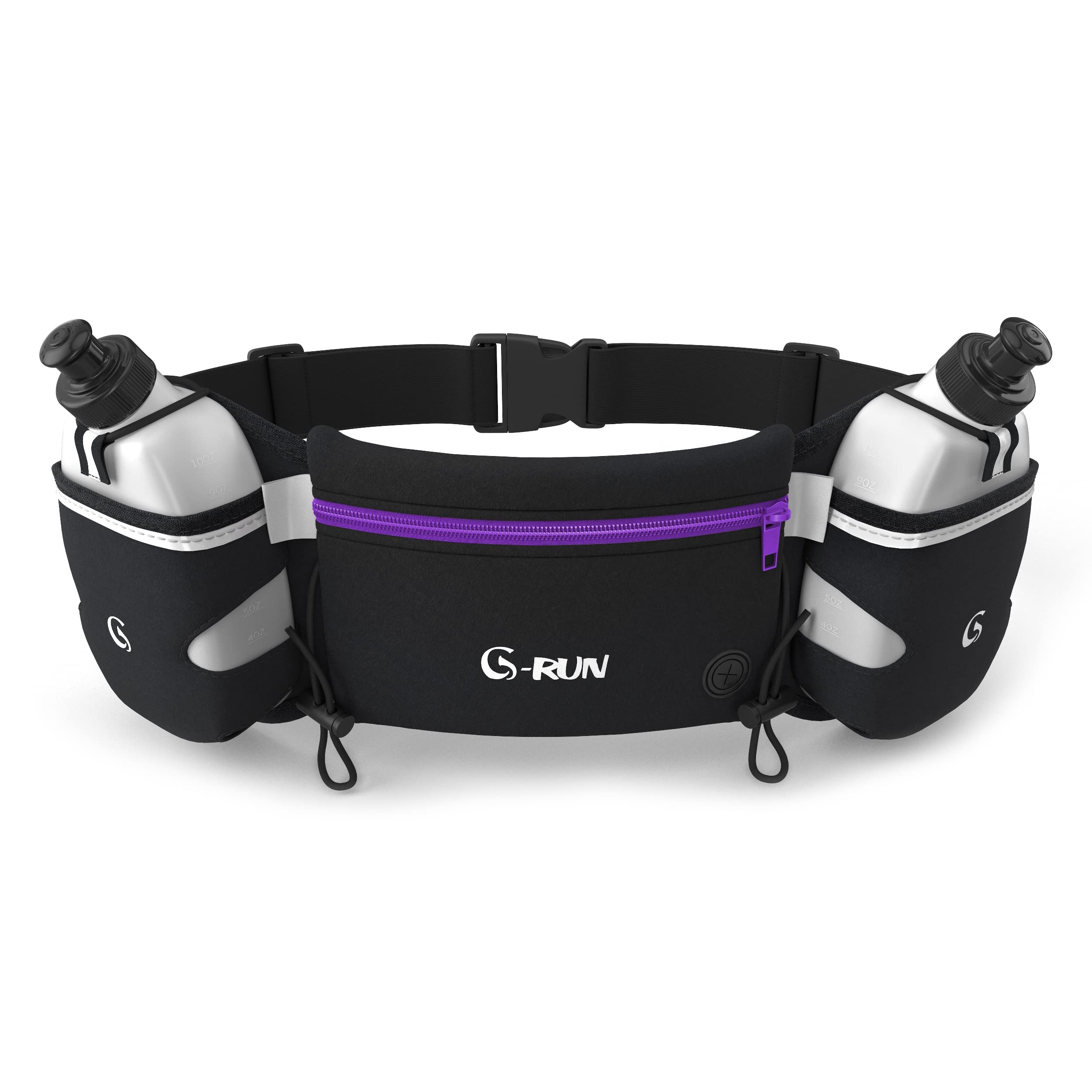
3. Q-RUN Hydration Running Belt with Bottles
Five pockets and two bottles — the belt that carries a whole long run.
If your runs stretch past an hour and you are tired of plotting water stops, this is the one. Five pockets is the most in this lineup — versus one on the Fitgriff — and the layout is what matters. Two of them hold the bottles, and there is a large zippered pouch with inner pockets for ID, cards and keys. A Samsung S22 Ultra fits in the main pouch with room to spare.
Stability is where owners are devoted: the bottles sit snug in their pockets and the belt does not bounce, even when loaded. It is also adjustable far enough for most frames — the listed size runs 25 to 33 inches with a 51-inch strap. Worth knowing: the belt is sized generously, so a 29 to 30-inch waist needs the elastic cinched heavily and a smaller frame may be better served by sizing down. The neoprene body is hand wash only and rated water repellent rather than waterproof.
Two practical quirks to accept up front. Bottle removal is easy, but sliding a bottle back into its pocket mid-run takes a little aim. And the bottles do sit at your hips, so your arms can graze them through the stride — people mostly find this harmless rather than irritating. What you gain is real: water and snacks within one-handed reach, front or back, without stopping. A one-year warranty covers the belt if a zipper or bottle gives out.
The long-run case: water, gels, cards and keys all ride in five pockets with no bounce, which is exactly what a half marathon or a hot summer loop asks for.
Where it gets fiddly: re-seating a bottle while sprinting takes practice, and the sizing runs large enough that small waists need a firm cinch.
Best suited to: distance runners and anyone who does not want to detour for water.
Look elsewhere for: a strip-it-on-and-forget minimal belt — the bottles add weight at the hips.
4. WATERFLY Running Belt Fanny Pack
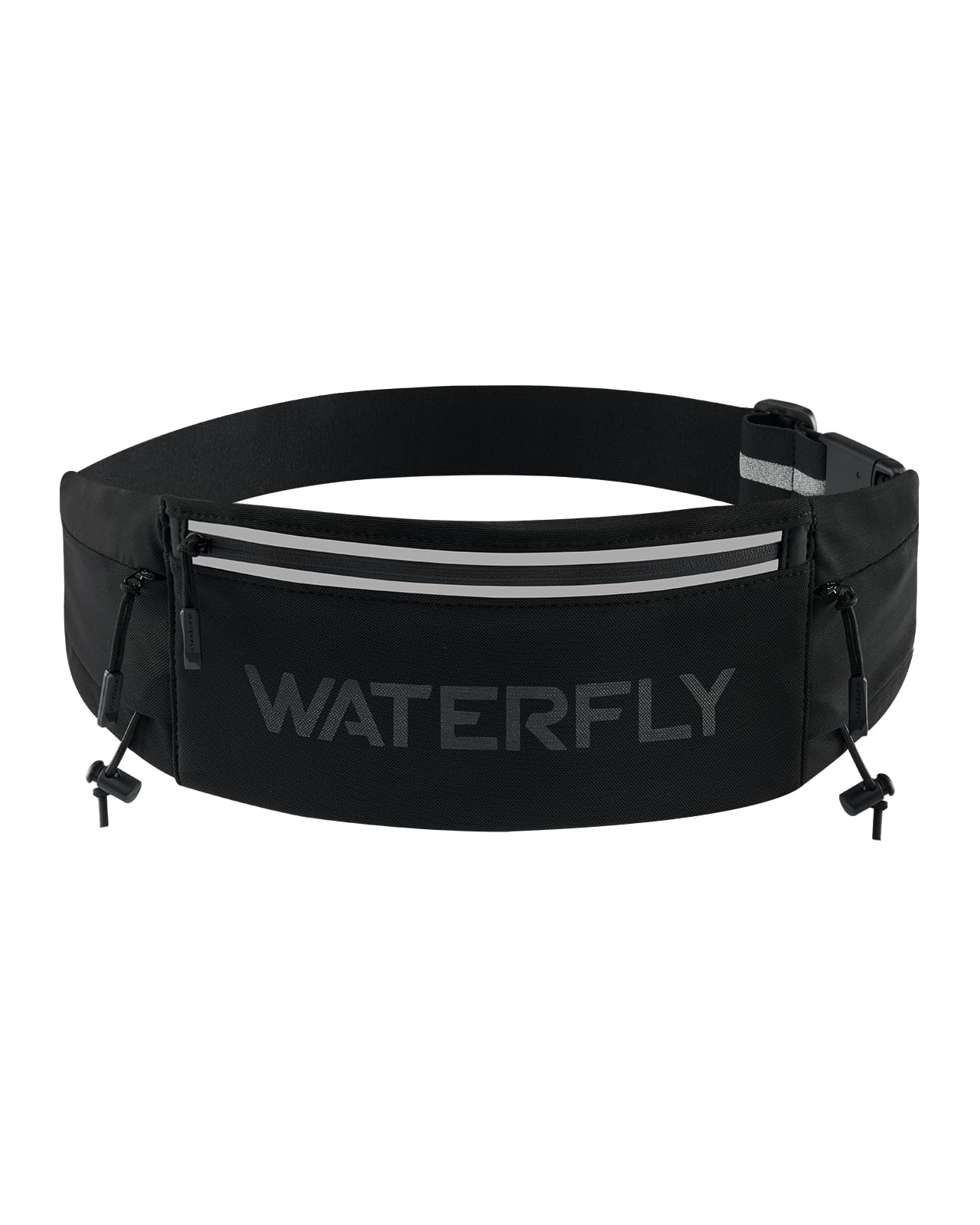
The one that pins on your bib and clips your gels for race morning.
This is the belt built around a specific problem: race morning. A hole-punched bib clips straight onto the included clip, so you skip the safety pins entirely. Three pockets do the rest of the work — a water-resistant phone pocket sized for phones up to 7″, plus two zippered mesh side pockets for earphones, energy gels, tissues and keys. At 3.52 ounces it stays light while the breathable mesh back panel wicks moisture.
The waist band is where it splits from the pack. It fits 30 to 39 inches, and the elastic is thick and dense for a snug hold that cuts bounce. That range is the limiting factor: a 26-inch waist has no setting here, because even fully tightened the belt still sits too big. If you are petite, check that 30-inch floor carefully before you commit. Everyone inside that range gets plenty of stability — nothing shifts on a 13.1-mile run with a phone, keys, wallet and three gel packs on board.
The other thing to know is water. It handles sweat and light rain, but a half hour of driving Florida rain soaks the main pocket even tucked under a shirt. Treat it as a dry-day belt and bag your phone on stormy runs. Reflector strips add dusk visibility and a durable anti-slip buckle keeps the elastic where you set it. Hand wash only.
Race-day convenience: the bib clip removes a small but real annoyance from race morning, and the three-pocket layout keeps gels, keys and a phone apart.
Fit note: start at a 30-inch waist. Below that, this belt simply will not tighten enough.
Made for: marathon and triathlon days, plus anyone who runs with gels and wants a bib holder built in.
skip it if: you run in heavy rain — the phone pocket soaks through, so bring a dry bag.
5. adidas Pacer Running Waist Pack
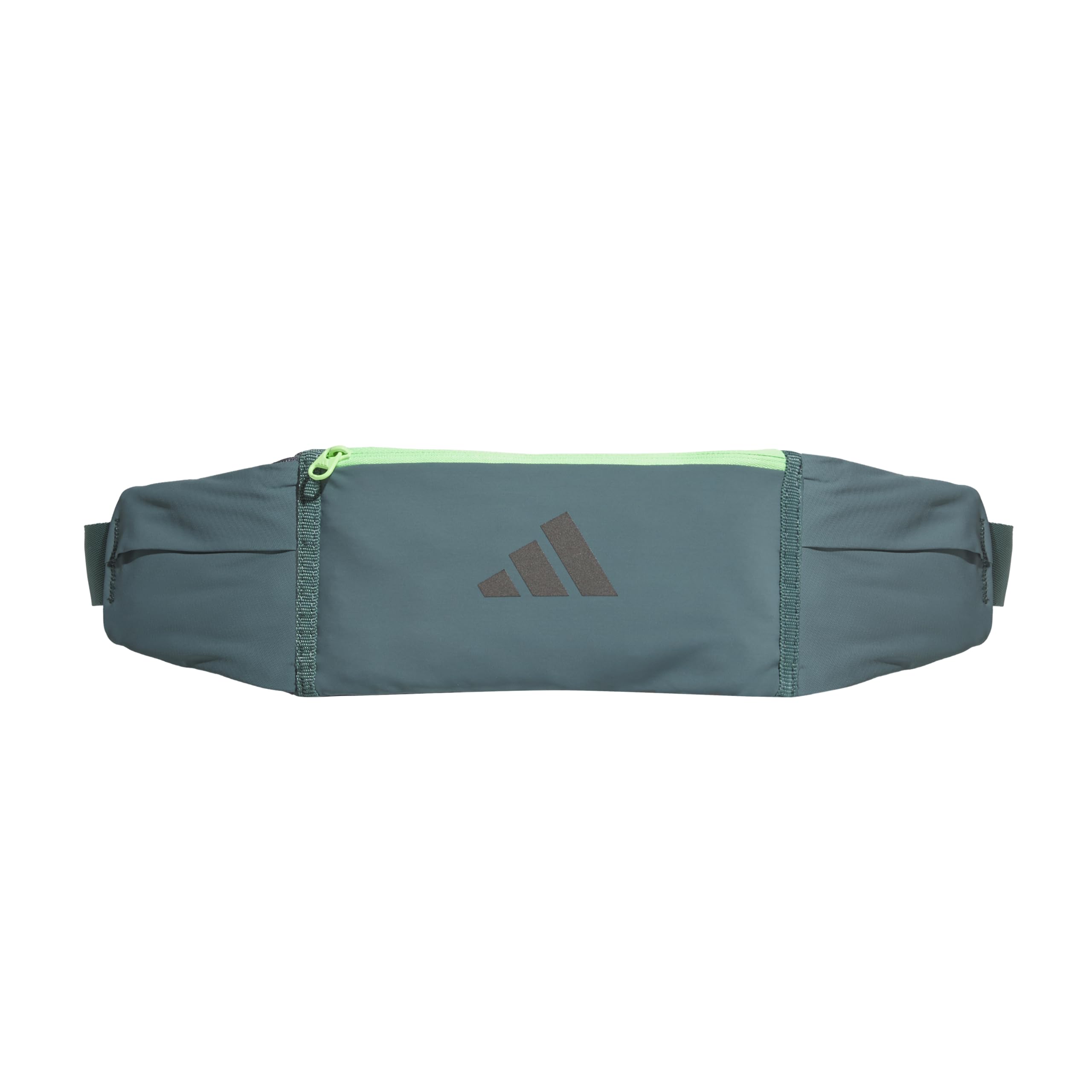
Mesh so thin it reads as a layer, not a bag.
This belt is built to disappear under a tee shirt. It is a stretch mesh waist pack with a slim profile, aimed at women who want their phone on their hip without a visible bulge. An iPhone 17 fits in the pocket without trouble, and two small pockets hold a key fob or a chapstick. That is enough for a bare phone and cards, and the whole thing weighs 3.84 ounces.
Fit comes from an adjustable elastic webbing strap that moves with your stride and cinches close to the body for a no-bounce feel. Because it is one size with an adjustable strap, the fit is broad rather than dialed to a specific number — most waists can find a snug setting. The mesh-backed fabric breathes, which is why it feels more like a layer than a bag once it is on. The zip-secured compartments hold a phone, a keycard, transit pass, ID, cards and a snack for training, travel days or theme parks.
Two honest notes. First, it carries little — a phone plus a couple of small things and no more, so plan around that. Second, the reflective accents on this pack are for look and decoration only; the brand states outright that this is not personal protective equipment. Do not count on it to make you visible on a dark road. The nylon body is hand wash only.
What makes it feel invisible: the stretch mesh and slim build let it sit flat under a shirt while a phone rides on the hip without a bounce.
Be clear-eyed about: the reflectors. They are style accents, not safety gear, so wear a light on dark runs.
Right for: women who want a phone, cards and a key to vanish under a shirt for a 5K or a travel day.
Not for: anyone packing gels, a bottle or extra layers — the capacity stays deliberately small.
6. SPIbelt Running Belt Original

One stretchy pocket that opens wide enough for a passport.
An expandable pocket is the difference between a phone belt and a belt that fits everything you actually carry. This one stretches out to 9″ x 4″ x 2″, which swallows a phone, a passport, gel packs, headphones, keys, ID and cards without bouncing. The elastic is a soft 1-inch band that does not chafe, and the waist range is the widest in the group: 25 inches all the way to 47 inches. If you have bounced between sizing on three belts, this range solves that.
Owners consistently report no bounce, no sliding and no pocket dragging down. The pocket sits at the center of gravity so a full load stays balanced instead of sagging to one side. Marathon runners cram a phone plus six full-size gels into it with minimal bounce. It is also comfortable enough for daily runs with a Samsung S24 Ultra in a case, gels and pepper spray all riding along.
The trade-off is durability. A single pocket with nothing to separate items means no second compartment for gels, and the stretch fabric wears out over years of heavy use — though many get a long life out of it before it stretches thin. Hand wash only. If your waist sits in the middle of that 25-to-47 range and you want one belt that holds everything, this is a strong answer.
The case for one big pocket: an expandable 9″ x 4″ x 2″ pouch plus a 25-to-47-inch waist range fits more body types and more loads than almost anything else here.
Where it asks patience: the stretch does eventually wear — this is not a buy-it-once-forever belt, and it has only one compartment.
Choose it when: your waist is anywhere from 25 to 47 inches and you want one pocket that holds everything.
Consider a two-pocket belt instead if: you carry gels regularly and want them separated from keys.
7. Nathan Zipster Max Running Belt

Built around oversized phones — the pouch takes a Pro Max with room left.
This belt exists for the phone that does not fit. The largest front pocket swallows an iPhone 17 Pro Max with space around it, and four pockets total — two zippered and two open side pouches — keep things organized. The super soft stretch lightweight mesh body fits close to the waist, and the belt weighs almost nothing in hand. If you have ever fought a phone into a too-small pouch, this is the opposite experience.
Sizing deserves attention because the fit varies with position. Sizing down is the smart move here: one runner found the Small looped and bouncy at the waist but calmer worn lower on the hips, and another small-framed woman found the Large slightly loose when worn low. The takeaway is to check the size chart against your measured waist and lean toward the smaller option. When it sits right, there is no bounce, no sliding and no repositioning mid-run.
The weaknesses are worth knowing. The pouches are not sweat-proof, so bag anything you cannot get wet. Getting a phone in and out of the snug front pocket takes a moment. The mesh can also stretch out with heavy use over time, which brings a little bounce back on bare skin on long-run days. Hand wash only.
The oversized-phone answer: a front pocket that takes an iPhone 17 Pro Max plus four total pockets means no more cramming or case removal.
The fit rule: size down and expect to wear it lower on the hips — that combination changes how stable it feels.
For you if: you run with a large phone in a thick case and normal pouches will not take it.
Think twice if: you carry a soft flask and expect the pocket to stay dry — bag anything moisture-sensitive.
8. SPIbelt Dual Pocket Pro Running Belt

Phone up front, wallet and keys in their own lane.
The dual-pocket version of the SPIbelt carries an expandable pocket for your phone and a smaller one for everything else. The main pocket stretches to 8″ x 4″ x 2″ and takes a phone, passport, exercise accessories, ID and cards. The second pocket expands to 3″ x 3″ x 2″ and is sized for keys and headphones. The two pockets let you split the load so nothing scratches the screen, which the original one-pocket belt cannot do. The 1.5-inch soft elastic band fits waists from 29 to 47 inches without chafing.
Buyers report the soft, flat band is why they keep wearing it. The band is soft, the low-profile pouches lie completely flat against the body, and the front pocket worn across the stomach cuts bounce for a secure run. The belt sits at the narrowest point of the waist and stays there. One buyer got it for a 14-year-old cross-country runner with diabetes, to keep glucose tablets and a phone within reach on the course, and the load stayed secure and accessible the whole time.
Fit runs on the generous side at the small end. The smallest setting can sit loose on a 28-inch waist, and the belt will slide up to the waist’s narrowest point. If you are at the edge of the range, size down. The belt is made in the USA and weighs 0.07 kg, and it is hand wash only.
Where the second pocket earns its place: keys and headphones get their own 3″ x 3″ x 2″ space, so the phone pocket stays flat against your stomach with less bounce.
Small-waist caution: the smallest setting can slide on a 28-inch waist, so sizing down matters here.
Best for: anyone who wants a real divider between phone and keys, on a band that does not chafe.
Otherwise look at: the single-pocket original if you carry only a phone and a key.
9. FlipBelt Zipper Running Belt

Four openings, a zip, and no buckles rubbing anywhere.
This is the belt for the runner who carries a full load: phone, passport, cards, cash, keys and even a small frozen water bottle. Four pockets work as three slip openings plus a zippered pouch and an internal key hook, and the openings are wide enough for a passport or a large phone in a case. The pull-on design has no buckles and no chafing, and the moisture-wicking fabric dries quickly while you sweat. At 4 ounces it is the heaviest phone belt here, and it justifies the weight with the most storage.
The zipper model is a real upgrade over the plain version for one reason: security. The original let a phone and a soft flask bounce too much during an ultramarathon; the zippered pouch holds the phone securely against the body. The fit is where you want to pay close attention, because how you wear it changes the size you need. Low on the hips means size up, on the hips means true to size, and at your natural waist means size down. A medium on a 31 to 32-inch waist fits snug and comfortable, and it ran 16 miles in 85 to 88-degree heat with a phone, a frozen bottle and cards with barely a shift.
Take the sizing seriously. The stretch band can be hard to step into for less limber users, and since it has no buckle you pull it on like a pair of shorts. The zippered pouch, on the largest size, has a 5.25-inch opening — a big phone in a very thick case can be a two-handed squeeze. Machine wash and dry or hang dry is allowed, unlike most of the others here.
What you gain for the extra weight: a zippered pouch plus three slip openings, buckle-free comfort and machine washability.
The trade-off to size around: no buckle means you pull it on, so pick a size you can step into and expect a snug fit.
The right call when: you carry a full kit on long runs and want a zipper that keeps the phone put without buckles digging in.
Wrong call if: you have limited mobility in your hips — the pull-on design needs you to step into it.
Know the Specs
Waist range
This is the number that decides whether a belt works at all. A range like 25 to 47 inches covers most bodies with a single product, while a 30-to-39-inch range leaves smaller waists with nothing to tighten. Elastic disguises a loose fit for a short run but lets the belt ride up on a long one. Read the range as a hard limit, not a suggestion, and lean toward sizing down when you are at the edge — a snug belt stays put far better than a roomy one.
Expandable versus fixed pockets
An expandable pocket stretches to take a phone, a passport, gels and headphones all at once, and it flattens back down when empty. A fixed pocket holds a specific phone size and no more. Expandable tends to bounce less when full because the stretch holds the load tight, but it can wear thin over years of use. Fixed pockets are more predictable but less forgiving of a chunky case.
Sweat-resistant versus waterproof
Almost every belt here handles sweat and light rain, which is enough for most training. Waterproof is a different claim that few of these make. Seams are the weak point, and heavy rain can push moisture through even when the outer fabric repels it. If you run in storms, bag your phone in plastic before it goes in the pocket, or choose a belt whose pouch you can seal.
Reflective strips and bib clips
A reflective strip helps drivers spot you at dusk, but one adidas pack states plainly that its accents are decorative and not personal protective equipment. Treat reflectors as a bonus and pair them with a small light for dark runs. A bib clip, found on race belts, attaches a hole-punched race number without safety pins — a small convenience that matters on event morning.
Common Questions
Will a running belt fit my phone if it has a thick case on?
Should I size down or up for a running belt?
Do these belts actually stop the phone from bouncing?
Can a running belt carry a water bottle?
Are running belts safe in the rain?
How do I wash a running belt?
Can I run a marathon with a running belt instead of a vest?
Will a running belt fit under a shirt without showing?
What is the difference between a belt with a buckle and a pull-on belt?
Do I need a bib clip on my running belt?
The Bottom Line
For most women chasing a hands-free run, the women’s running bag pick is the Fitgriff Running Belt. It separates the phone from keys so the screen stays clean, adjusts without slipping, and disappears at 0.08 kg — and it holds the highest rating here across the largest number of owners. If your long runs need water, the Q-RUN Hydration Running Belt puts bottles and snacks in five pockets without bouncing. And if you want to carry a full kit with zero buckles, the FlipBelt Zipper is the one to reach for. One last nudge: measure your waist against the listed range before you click, and when in doubt take the smaller size.
How we choose
We do not accept paid placement. Every pick is matched to a real buyer and a real use-case; we do not hands-on test units.
Sources
Specifications: manufacturer listings and product documentation. Review insights: verified customer reviews, as of October 2026. Pricing: not shown on this page (it changes often); check the current price via the retailer link.
As an Amazon Associate, Home Digitized earns from qualifying purchases. This does not affect which products we feature.