
Specs are compiled from manufacturer listings and verified buyer reviews and can change over time — please confirm the key details on the product page before buying.
Rotted window sills, soft door frames, and crumbling porch posts don’t always mean a carpentry bill. A two-part epoxy wood filler mixes from a resin and a hardener into a putty that cures harder than the wood around it, then sands, drills, and paints like the real thing. The right pick depends on how big the void is, how long the working time needs to be, and whether you’re patching a hairline crack or rebuilding a section of missing trim.
This guide is built by comparing the manufacturers’ published specifications and the patterns across verified customer reviews, so you get each pick’s real strengths and trade-offs instead of marketing spin.
Below you’ll find nine fillers sorted by the repair they handle best, from a small-kit starter to a marine-grade rebuild compound, so you can match the putty to the job before you open a can. These are the picks that hold up in real exterior repairs, and this breakdown of epoxy wood filler covers working time, cure speed, and sandability for each one.
Top Picks


How To Choose The Best Epoxy Wood Filler
A wood filler that’s just a paste in a tube dries out, shrinks, and falls out of a deep hole. A two-part epoxy putty is different: you mix a resin with a hardener and the chemical reaction cures it into a solid that bonds to the wood. That’s the version worth buying for rotted trim, window sills, and posts. Here’s what decides which one fits your job.
Match the putty to the size of the void
A small crack or a screw hole only needs a little material and a short working time. A missing section of sill or a deep rotted trough needs a filler that stays put on a vertical surface without drooping. Some two-part putties are thick and high-tack so they resist sagging while they harden, while others are more malleable and press into voids like clay. Think about the shape of the hole before the brand.
Read the working time before you mix
Working time, also called pot life, is how long the mixed putty stays spreadable. Short-cure fillers cure fast but give you less room to shape and smooth. Longer working times are friendlier for a first-timer or a big rebuild. Whatever the number on the package, mix only what you can apply in that window, because once the reaction starts it doesn’t pause.
Prep the wood or the repair won’t last
Epoxy bonds best to solid, dry wood, not to punky, crumbling rot. Most experienced users dig out the soft material, treat the surrounding wood with a hardener or liquid consolidant, and then pack the putty into the cavity. Skipping this step is the most common reason a patch fails, so budget for a hardener alongside the filler.
Side-by-Side Comparison
| Model | Best For | Form | Full Cure Time | Working Time | Amazon |
|---|---|---|---|---|---|
| PC Products PC-Woody 48 oz★ Best Overall | Large exterior rebuilds | Paste (two cans) | 24 hours | 30–40 minutes | Amazon |
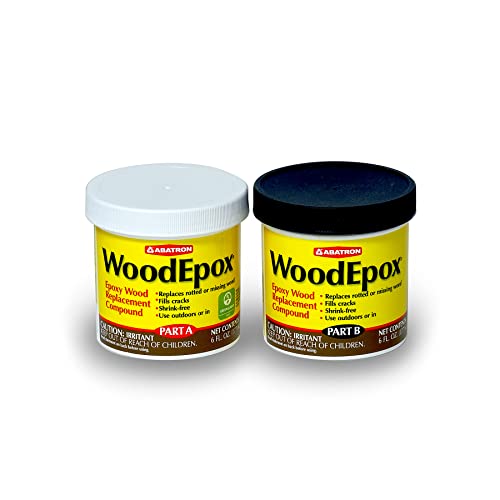
| Abatron WoodEpox Kit 12 ozPrecision Pick | Small precise patches | Putty (two-part kit) | 120 minutes | 20–30 minutes | Amazon |
| PC Products PC-Woody 6 ozBest Small Kit | First-timer spot repairs | Paste (two cans) | 24 hours | 30–40 minutes | Amazon |
| J-B Weld 40003 Wood Restore | Fast hard surface | Putty + hardener | 15 minutes to workable | Not listed | Amazon |
| System Three SculpWood 8 oz | Sculpting and shaping | Putty (tube) | 24 hours | Sets under 1 hour | Amazon |
| PC Products PC-Woody 24 oz | Mid-size outdoor jobs | Paste (two cans) | 24 hours | 30–40 minutes | Amazon |
| Woodon / REHOUPTY 32 oz Kit | Multi-surface repairs | Paste (bottle kit) | 24 hours | 30 minutes | Amazon |
| J-B Weld 40006 Premium 32 oz | Big deep rot fills | Putty (hand-mix kit) | 60 minutes | Sets in ~15 minutes | Amazon |
| TotalBoat Fixwood | Marine & exterior wood | Paste/putty (two-part) | 7 days | Not listed | Amazon |
Detailed Reviews
1. PC Products PC-Woody Wood Repair Epoxy Paste, 48 oz
Our pick — 4.5+★ from 700+ verified ratings; the strongest balance of quality and price.
The big-can workhorse that packs a rotted window sill full and stays put while it hardens.
What wins people over here is raw effectiveness — it does the one job it’s sold for, and it does it on log homes, rafter tails, window frames, and door frames. The 48 oz two-can size gives you enough material for a serious run of exterior repairs without coming back mid-project. Both cans are paste, so you scoop equal volumes onto a flat surface and stir with a stiff putty knife.
The spec to plan around is the working time: you get a spreadable window before it sets, and the high-tack body resists drips and sags while it hardens. Full cure runs 24 hours. It handles an application temperature range of 35 to 115 degrees F and a service range of -20 to 200 degrees F, which is why the same can works on a cold-weather repair and a hot sun-baked deck. Sanding is the part to respect: cure it fully, and don’t try to shape it while it’s still soft.
You get a repair that has held up through summers and winters on exterior trim, but watch the cost and mix discipline. A lot of buyers call it expensive for what it is, and the maker warns against mixing in teaspoon-size amounts or smaller because a lopsided ratio is easy to hit. Adhesion also draws mixed feedback, so clean and prime the wood first. Mix in generous, equal volumes and you get that durable repair. Buyers report filling voids as large as “a 2×5-6 inch void” with it. If you’ve got a big exterior rebuild, no other filler in this guide carries this much material and this much tack in one purchase.
What it brings to the job
- 48 oz across two cans — enough for a full run of trim repairs
- High tack holds on vertical and overhead surfaces without dripping
- Resists dry rot, UV light, fresh and salt water
- Sands and takes paint and solid stain well once cured
What to plan for
- Buyers call it expensive compared to budget fillers
- Mixing in tiny amounts throws off the ratio
- Adhesion needs solid, prepped wood underneath
Reach for it when: you have a wide exterior repair and want one can that covers all of it.
Pass if: you’re only patching a single small screw hole and don’t want to buy the large size.
2. Abatron WoodEpox Kit, 12 oz
Dry putty that presses into a void like clay and never drips down your trim.
Restorers favor this kit because both parts are dry and knead into a putty you press in by hand. Both parts are dry, and when you knead them together they become a putty you press into the cavity by hand. It conforms to contours and stays where you put it, so overhead and sidewall repairs don’t droop. The 20–30 minute pot life gives you a real window to work and smooth, though you’ll want vinyl gloves because the mixed putty gets sticky. The full cure runs 120 minutes, which is quick by the standards of this category.
It bonds to previously damaged wood and resists water, pests, and UV (ultraviolet light) once cured. It can be painted, stained, drilled, carved, sawed, nailed, planed, sanded, and routed just like natural wood. Owners mention using it to build up missing sections rather than cutting out and replacing — including “3/4-inch-deep rot on header board behind fascia.” The kit is GREENGUARD certified (a third-party low-emission standard) and contains almost no VOCs (volatile organic compounds that can smell and off-gas), so it’s a low-odor option for interior work too.
You save a window frame instead of replacing it, but value is the honest sticking point. A chunk of the feedback finds the 12 oz kit pricey for how much material you get, and adhesion draws mixed notes — you’ll do best pairing it with the liquid epoxy consolidant (a thin epoxy that soaks into old wood to strengthen it) first, which bonds old wood to the compound. For historic homes and small, precise rebuilds, though, saving a window frame instead of replacing it is the whole point. Pair it with the liquid and the repair holds like a load-bearing patch.
Best at fine work: dry, kneadable putty that shapes into tight trim and window sash corners with no run-out. GREENGUARD certified with almost no VOCs.
The trade-off: the small kit costs more per ounce than larger cans, and it wants the liquid consolidant for maximum hold.
It suits: restorers and anyone saving a small rotted section on a window, door, or column.
Look elsewhere if: you’re filling a deep trough across a large board and need bulk material.
3. PC Products PC-Woody Wood Repair Epoxy Paste, 6 oz
A starter-size can of the same tan paste, sized for one or two small repairs.
Same formula, smaller footprint. This 6 oz two-can kit gives you the high wet-grab tack, the 30 to 40 minute work time at 70 degrees F, and the 24-hour full cure. It resists dry rot, UV light, fresh and salt water, and the chemicals in pressure-treated wood, so it’s ready for a deck repair or a door frame. One thing to know up front: the maker says this paste won’t bond to wax paper, Teflon, or polyethylene, so test a small area on anything unusual.
In practice it handles a range of small jobs — knot holes, screw holes, a rotted door frame base. The consistency is like thick peanut butter once mixed, which makes it easy to portion 50/50 and easy to sand smooth. It takes paint and wood stain and machines after it cures. If you’ve got a big void, know that it sags initially, so set a timer and reshape it as it firms up; rubbing alcohol on your fingers smooths the surface for a clean finish.
Where it frustrates is application. The mixed paste sticks to tools and hands, and the feedback on adhesion and staining splits — some find it takes satin stain surprisingly well and blends acceptably, others say stain sits on top rather than soaking in. Mix in proportion, work it while it’s tacky, and this little kit earns its place for spot repairs without committing to the big can.
Why it works for small jobs
- 6 oz size suits one or two repairs without waste
- 30–40 minutes of work time to shape and smooth
- Handles interior and exterior wood, rot, and treated lumber
- Sands smooth and takes paint and stain
Where it’ll test your patience
- The paste is sticky and clings to tools and bare hands
- Large fills sag and need reshaping as they set
- Stain results vary from patch to patch
Pick it for: a single rotted sill or a handful of knot holes where you don’t want a big can.
Skip if: your job needs bulk material and repeated re-mixing to finish.
4. J-B Weld 40003 Wood Restore Repair Putty
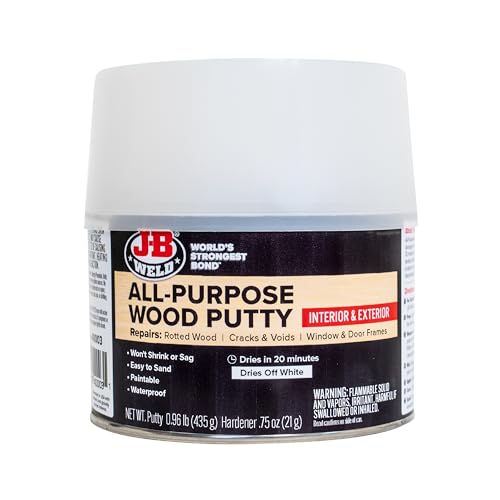
When the repair needs to feel hard by lunch, this one gets there in 15 minutes.
The headline is speed: J-B Weld’s Wood Restore dries to a hard workable surface in 15 minutes and won’t shrink, crack, or split. Once it’s set, you can shape, sand, drill, carve, screw, and paint it. That 15-minute workable surface makes it the pick for a small repair you don’t want to leave overnight. It’s made for rotted wood on windows, door frames, eaves, corner boards, columns, posts, stairs, fences, and furniture.
The physics of a fast cure come at a cost. A short working window means you mix small batches and move quickly, and that’s exactly where frustration creeps in. The consistency is tough to spread smoothly and it dries so fast that overworking a batch wastes it. Plan your steps before you mix, and don’t count on reshaping a large fill after the first few minutes. Fill deep holes in layers, not all at once.
For its size and role, it earns its keep on quick fixes: a porch post hole, a bit of rotted trim, a cracked board. It’s not the filler for a big rebuild where you need time to sculpt and smooth. Use it where instant hardness matters and the void is small enough to fill in one quick pass.
Why it earns its spot: 15-minute workable surface and it won’t shrink, crack, or split — the fastest hard cure on this list. Sands and takes paint once dry.
The trade-off: the same speed makes it hard to spread and reshape, so large fills get tricky. Mix small batches and layer deep holes.
Fits best: a homeowner who wants a quick, hard fix on a small void and doesn’t mind working fast.
Not for: a big sculpting job where you need more than a few minutes to blend.
5. System Three SculpWood Putty, 8 oz

A non-shrinking putty that holds whatever shape you carve into it.
SculpWood is for the jobs where the shape matters as much as the strength. It’s a non-shrinking two-part epoxy putty ideal for filling voids from wood-rot and animal damage, and it presses in without leaving gaps or air pockets. Mix it 1:1, pack the cavity, and slightly overfill — it sands and machines easily once cured. The full cure time is 24 hours. The maker says to pair it with RotFix epoxy for the best adhesion to wood, and to use lacquer thinner, denatured alcohol, or white vinegar for cleanup.
You can sculpt a missing corner, rebuild a ribbed trim detail, or build up a curved surface rather than just filling a hole, because it holds a shape. The 1:1 ratio (equal parts resin and hardener) and smaller tube make it friendly for small, careful jobs. Customers note success on a 75-year-old wooden boat’s rub rail and on sculpted organic shapes over wire, which speaks to how well it takes a form.
Honest limits: it’s expensive per ounce, and it needs a hardener step first for a lasting bond on deep rot. Working time is on the shorter side depending on temperature, and the mixed putty is sticky — wet your fingers or knife with rubbing alcohol to keep it from grabbing. If you need to fill a rough trough, this is tougher to spread than a paste. But for detail work and shaped patches, it’s the one that behaves like modeling clay.
Where it shines
- Holds a sculpted shape and doesn’t shrink as it cures
- 1:1 mix and a small tube for careful patches
- Sands and machines easily; takes a stain like mahogany
- Good for curved, shaped, and detailed rebuilds
Where it asks more
- Expensive per ounce for a small tube
- Wants RotFix or a hardener step for deep rot
- Sticky to work with; needs alcohol cleanup
Best suited to: a shaped or detailed repair where you’re rebuilding a form, not just plugging a hole.
Think twice if: you’re filling a wide flat trough and need a smooth-spreading paste.
6. PC Products PC-Woody Wood Repair Epoxy Paste, 24 oz

A middle-size can that trades no strength for a lower cost per repair.
The 24 oz size is the practical middle ground in the PC-Woody line. You get the same tan two-part paste, the same high tack that resists drips, and the same 24-hour full cure. It resists dry rot, UV light, fresh and salt water, and it works indoors or out across an application range of 35 to 115 degrees F and a service range of -20 to 200 degrees F. For an outdoor cedar arbor or a door frame, that’s enough capability without stepping up to the largest can.
Value is the real story here. The cost per ounce lands lower than the premium two-part kits, and the quality holds. Reviewers point out patches that cure harder than the original wood and sand smooth within 1 to 2 days. It mixes easily, works horizontally or vertically, and stays useable in the can for a long stretch after you open it — one of the few fillers where a half-used can lasts.
The one honest note: the same tack that makes it hang on a vertical surface can make it hard to spread into a fine, thin patch, and adhesion draws mixed feedback depending on the prep. Clean and dry the wood first, mix equal volumes, and it behaves. At 24 oz, it covers several repairs and stays useable in the can for the next job.
Why it makes the cut: quality and strength hold at 24 oz, at a lower cost per repair than the premium kits. Long shelf life after opening means it’s still usable on the next job.
What to watch: it’s sticky and tacky, so thin, precise spreading takes patience.
Go with it if: you want a strong all-purpose can that covers several repairs and keeps.
Choose a different size if: you only need a tiny patch or you’re doing fine sculpting work.
7. Woodon / REHOUPTY Epoxy Wood Putty Kit, 32 oz
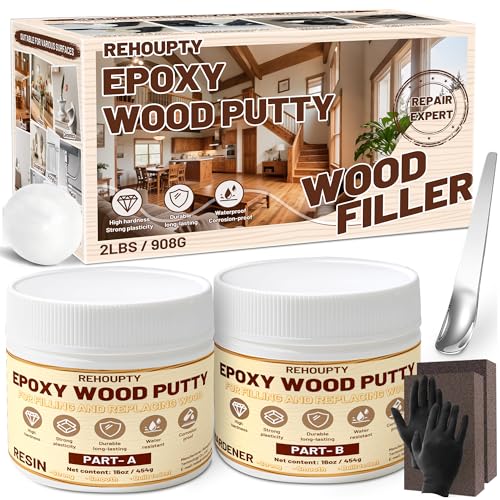
A two-bottle kit that arrives ready to use, with scoop, gloves, and sanding blocks in the box.
The first thing you’ll notice is what’s in the box: 16 oz of part A, 16 oz of part B, a scoop, gloves, and two sanding blocks. For a first repair, the included scoop, gloves, and sanding blocks make it a single purchase. The formula is a quality-epoxy resin and hardener that mixes 1:1 and gives a 30-minute working time, then fully cures in 24 hours. Once it’s hard, you can sand, drill, paint, stain, saw, or carve it like wood.
Versatility is where this kit pulls ahead. Beyond wood, the maker lists metal, plastic, tile, glass, ceramic, and stone as repair surfaces, so it’s a useful can for a house full of small fixes — furniture, cabinets, floors, railings, and columns. It holds up in a wide temperature window from -58 to 302 degrees F, and it won’t crack or shrink. A tip worth stealing from the review pages: chill the mixed putty to slow the reaction and buy yourself working time, or leave it in the sun to speed the set.
Mixed signals on value and ease are the fair warning. Some find it a bit pricey for the volume, and once it starts setting it gets hard fast, so a first-timer can feel rushed. Mix small amounts and work quickly. For a kit that hands you the tools and a wide range of surfaces, it’s a strong value for the money.
What’s in the box
- Complete kit: scoop, gloves, and two sanding blocks included
- Works on wood, metal, plastic, tile, glass, ceramic, and stone
- Wide -58 to 302 degrees F service range
- 30-minute working time before it sets
What catches people out
- It sets hard fast once working time is up
- Some find it on the pricey side for the volume
Ideal for: a first repair where you want the accessories included and a filler that handles more than wood.
Not ideal if: you need a long, forgiving working window for a large rebuil.
8. J-B Weld 40006 Wood Restore Premium Epoxy Putty Kit, 32 oz

A hand-mixed putty for the deep, wide rot that smaller kits can’t reach.
When a window trough or a railing gouge is big enough that one small tube won’t cut it, the 32 oz premium kit is built for it. The putty is hand-mixable, has a Play-Dough consistency that packs into deep voids, and cures to roughly the same density as wood. The maker says it won’t rot, shrink, crack, or pull away, and it sands, machines, and paints after 60 minutes. Use it on doors, windows, columns, posts, window frames and sills, or large cracks.
The working style is where it wins people over: a thick, workable putty that stays put overhead without runoff, versus a wet paste that sags. Shoppers say success filling a rotted trough under a window and repairing deck railing gouges, with strong adhesion and an invisible result once painted. It also bonds to concrete and fills around nails you can’t remove, which comes in handy on tricky exterior jobs. Sand it with a power sander for the smoothest finish.
The honest caveat: curing divides people. Some find it solidifies in a few hours, while others report batches that never harden — a reminder to mix equal parts thoroughly and not work in poor conditions. Plan a fast workflow, because the working window closes quickly and it gets hot as it sets. For big, deep rot where you need bulk material and a putty that grips, this is the go-to size.
Where it delivers: 32 oz of workable putty that cures to wood’s own density and grips deep cavities without runoff. Great for troughs, sills, and railing gouges.
The honest catch: cure results vary — mix thoroughly and equal-part, because the working window closes fast.
Best for: a large exterior rebuild with deep rot and plenty of surface area to cover.
Skip if: you’re after a slow, forgiving cure for a delicate detail patch.
9. TotalBoat Fixwood Marine Grade Epoxy Putty
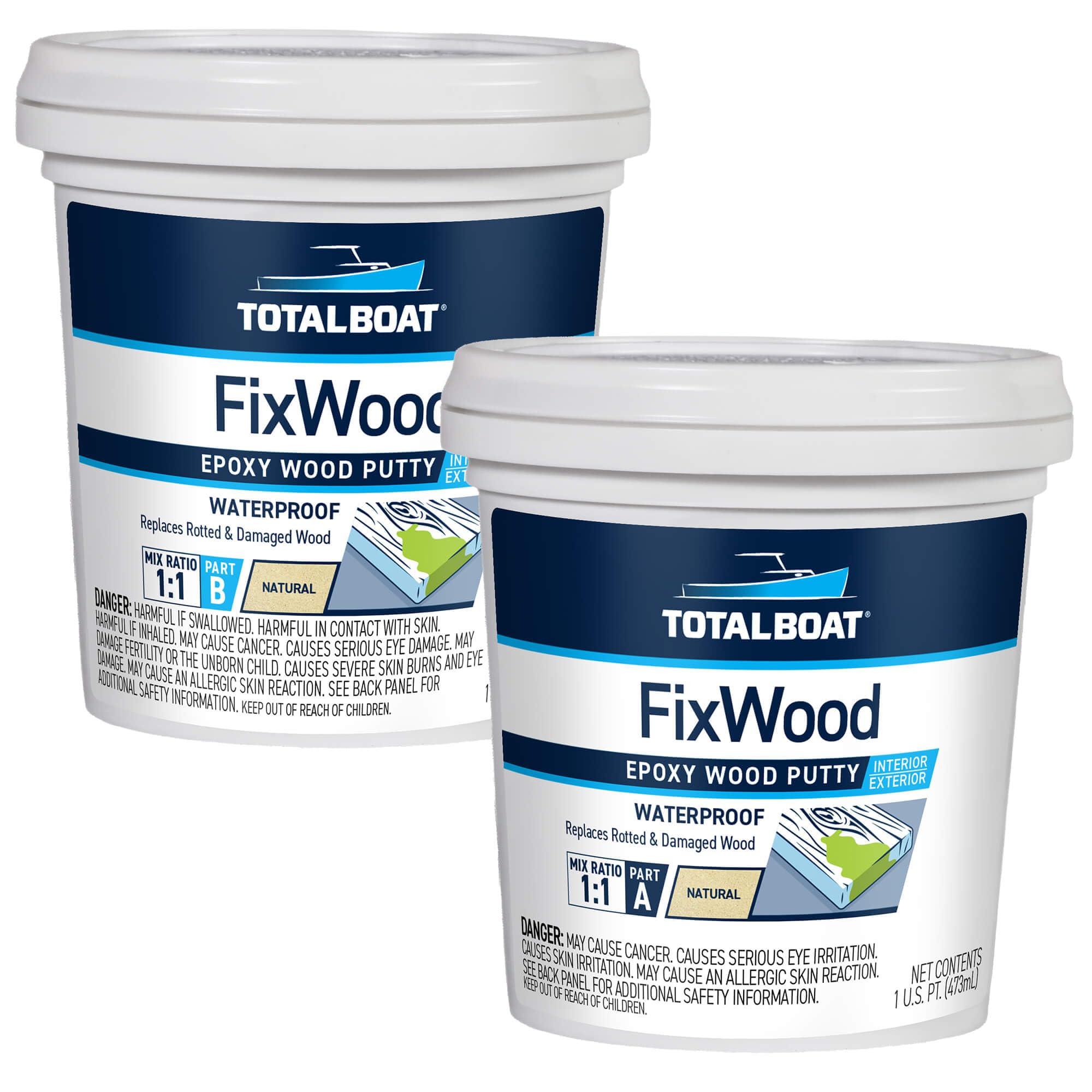
Boat-grade putty reformulated to press into rot and stay put while you shape it.
FixWood is the pick for wet, exposed wood. Its 100% waterproof, marine-grade formula suits decks, fascia boards, rafters, window sills, shutters, and split wood. The two-part paste has been reformulated for better workability, so it mixes more easily and presses into damaged wood, staying in place without sagging, shrinking, or cracking while it cures. Once hard it can be sanded, carved, drilled, cut, painted, or stained to blend with the wood, and it takes nails and screws for a structural hold.
You get a putty stiff enough to hold on vertical surfaces without sagging, and shapeable enough to rebuild missing sections and painted outdoor decorations alike. Application wants clean, prepped wood. For deep rot, the maker says to use TotalBoat Penetrating Epoxy first to consolidate the surrounding wood. Full cure is listed at 7 days, which is the longest in this guide and worth planning around — but it sands and paints long before that once it reaches hardness.
The recurring complaint is cost and spreadability: it’s an expensive solution, and some find it hard to spread and level with a putty knife, especially for thin patches. It’s best for larger holes rather than fine surface work. If you’re rebuilding on a boat, a dock, or a weather-beaten exterior where waterproof strength matters, it’s the one to reach for.
Where it delivers
- 100% waterproof once cured for marine and wet-exterior use
- Holds shape on verticals without sagging or cracking
- Takes nails and screws for a structural repair
- Stainable and paintable to blend with surrounding wood
The honest catches
- Expensive compared to standard wood fillers
- Hard to spread and level for thin, fine patches
- 7-day full cure takes the longest of the group
Choose it for: boat repair, docks, and exterior wood that sees constant water.
Hold off if: you’re patching thin scratches on indoor furniture and want an easy-spreading paste.
Know the Specs
Working Time vs. Full Cure Time
Working time (also called pot life) is how long the mixed putty stays spreadable and shapeable. Full cure time is when it reaches full hardness. A short work time and a fast cure suit quick spot fixes. A longer work time and a longer cure suit bigger rebuilds where you need to shape and smooth. On a two-part epoxy, the clock starts the moment you mix, so use the labeled window and mix only what you can apply within it.
Paste vs. Putty
Paste spreads like thick peanut butter and clings with high tack, which suits vertical and overhead work and large fills. Putty is drier and more clay-like, so it presses into tight voids and holds a carved shape. Neither is better — it depends on whether you’re smoothing a broad surface or sculpting a detailed patch. If you’re shaping a missing corner, lean toward putty; if you’re covering a wide sill, a tacky paste usually sags less.
Sandability and Sta in
Once cured, a good epoxy filler should sand to a smooth surface and accept paint or wood stain. Sandability runs from easy to tough, so choose a filler that sands readily if you’ll be blending the patch into a finish. Stain absorption varies — some take stain well while others leave a patch that sits a shade lighter. Test on a scrap or a hidden spot before you commit to an exposed repair.
Prep and Adhesion
Epoxy bonds to solid wood, not to soft, crumbling rot. Dig out the punky material, then treat the surrounding wood with a hardener or liquid consolidant, and pack the putty in once it’s dry. This prep step is the difference between a repair that holds and one that pulls out. If a product lists a companion consolidant, use it — it’s how the epoxy anchors to the old wood.
Common Questions
Does epoxy wood filler work on wet or rotted wood?
How long does epoxy wood filler take to cure?
Can I paint or stain over epoxy wood filler?
What’s the difference between epoxy wood filler and regular wood putty?
Will epoxy wood filler hold screws and nails?
How much epoxy wood filler do I need for a window sill repair?
Can epoxy wood filler be used outside in cold weather?
Is a paste or a putty better for vertical surfaces?
How should I store leftover two-part epoxy wood filler?
Can epoxy wood filler be sanded smooth for a finished look?
The Bottom Line
For most exterior repairs, the epoxy wood filler winner is the PC Products PC-Woody 48 oz because it carries enough high-tack paste to cover a wide trim rebuild and holds through summer and winter. If you’re saving a small, precise section of a window or column, grab the Abatron WoodEpox Kit — its dry, kneadable putty shapes into tight trim without dripping. And for deep rot on a marine or weather-beaten exterior, the TotalBoat Fixwood is the one to reach for, with its 100% waterproof cure and 7-day full set.
How we choose
We do not accept paid placement. Every pick is matched to a real buyer and a real use-case; we do not hands-on test units.
Sources
Specifications: manufacturer listings and product documentation. Review insights: verified customer reviews, as of October 2026. Pricing: not shown on this page (it changes often); check the current price via the retailer link.
As an Amazon Associate, Home Digitized earns from qualifying purchases. This does not affect which products we feature.