
Specs are compiled from manufacturer listings and verified buyer reviews and can change over time — please confirm the key details on the product page before buying.
If tiny buttons and buried menus are what stopped you from enjoying a camera, the fix is simpler than you think: buy a point-and-shoot with big controls, real optical zoom, and a screen you can actually read. That is exactly what these nine picks deliver, and each one earns its spot for a different reason.
This guide is built by comparing the manufacturers’ published specifications and the patterns across verified customer reviews, so you get each pick’s real strengths and trade-offs instead of marketing spin.
Below you will find plain-English notes on zoom, screen size, batteries, and handling, plus the honest trade-offs that matter most. Every pick here is a straightforward point-and-shoot, which is what makes these the best digital cameras for seniors for everyday photos.
Top Picks

How To Choose The Best Digital Cameras for Seniors
Most cameras sold today are built for people who already know photography. A camera that suits older hands is different: fewer menus, a bigger screen, and a zoom that does the hard work for you. Here is what actually matters when you compare models.
Optical zoom versus digital zoom
Optical zoom uses the glass lens to magnify, so the picture stays sharp as you zoom in. Digital zoom just enlarges the middle of the frame on the camera’s computer, which softens the image. The Kodak PIXPRO AZ528 offers 52x optical zoom, while the 8K AUREAPIX uses 20x digital zoom — a real difference when you want a crisp shot of a bird feeder or a stage performer.
Screen size and button feel
A larger screen makes framing and reviewing photos easier on the eyes. The 8K AUREAPIX carries a 3.5-inch screen compared to the 2.7-inch screen on the Kodak PIXPRO FZ55. Bigger is not automatically better though, because a large flip screen adds bulk. Look for a camera whose controls you can read without your glasses.
Batteries and memory cards
AA batteries (standard household batteries sold in any grocery store) mean you are never stuck waiting for a charge. Rechargeable lithium-ion packs save money over time but need a cable. The Kodak PIXPRO AZ255 runs on AA cells, while the Kodak PIXPRO AZ528 uses a rechargeable pack. Check which memory card type the camera takes, because SD, microSD, and SDHC cards are not interchangeable.
Side-by-Side Comparison
| Model | Best For | Zoom | Screen | Battery | Amazon |
|---|---|---|---|---|---|
| Kodak PIXPRO FZ55★ Best Overall | Simple everyday snapshots | 5x optical | 2.7 in | Rechargeable Li-Ion | Amazon |
| 8K AUREAPIX 96MPBest for Video | Vlogging and selfies | 20x digital | 3.5 in flip | Lithium-Ion Polymer | Amazon |
| NBDDIGITAL True 5K 64MPBudget Champion | Beginners and gifts | 18x digital | 3.0 in flip | Lithium Polymer | Amazon |
| Minolta MN40Z ProShot | Moon and bird shots | 40x optical | 3.0 in | 4x AAA | Amazon |
| Kodak PIXPRO AZ528 | Long-distance daytime shots | 52x optical | 3.0 in | Rechargeable Li-Ion | Amazon |
| Canon PowerShot SX500 IS | Proven all-rounder | 30x optical | 3.0 in | Lithium Ion | Amazon |
| Panasonic LUMIX ZS99 | Travel and concerts | 30x optical | Tiltable touchscreen | Lithium Ion | Amazon |
| Canon PowerShot SX720 HS | Low-light and Wi-Fi sharing | 40x optical | 3.0 in | Lithium Ion | Amazon |
Detailed Reviews
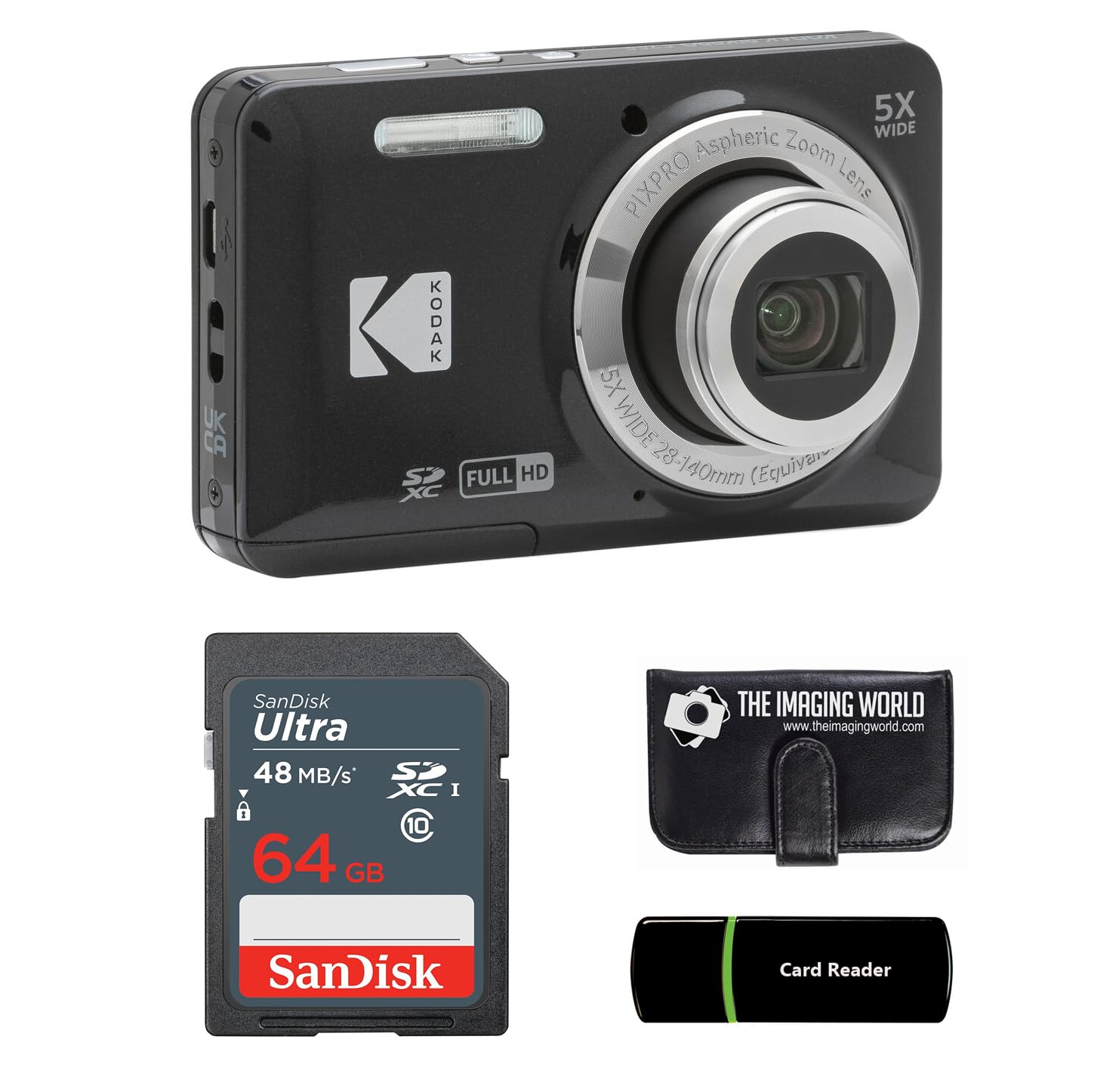
1. Kodak PIXPRO FZ55 Black 16MP Digital Camera
Our pick — 4.5+★ from 100+ verified ratings; the strongest balance of quality and price.
The pocket camera that comes with everything already in the box.
This is the pick for someone who wants to open a box and take photos the same afternoon. It runs on a 28mm wide-angle lens with a 16MP 1/2.3-inch CMOS sensor (a light-sensing chip that turns light into your image). That lens is the same field of view as most phone cameras, so framing a group of grandkids in a living room feels natural. The camera also ships as a full kit: the body, a rechargeable Li-Ion battery, USB cable, AC adapter, wrist strap, a 64GB high-speed card, a card reader, and a memory card wallet.
The 5x optical zoom and 2.7-inch LCD keep the operation basic. Full HD 1080p video records at 30 fps (30 frames a second, smooth enough for family clips), with digital image stabilization to steady handheld video. There is a built-in flash and a panorama mode for wide landscapes. Battery weight is 18 g, and the whole thing slips into a bag or coat pocket.
Owners rate this camera’s picture quality and ease of use above every other pick here. Buyers report that picture quality and ease of use are the top praises, with camera quality drawing the biggest share of positive notes by a wide margin. One review sums it up: “Takes amazing pictures and is easy to use, not having to find a compatible SD card was so convenient.” The FZ55 stands out if you worry about setup, because the 64GB card, reader, and battery all arrive in the box.
What buyers keep praising
- Complete kit: 64GB card, reader, wallet, and battery all included
- 28mm wide-angle lens with 5x optical zoom for everyday framing
- Built-in flash and 1080p Full HD video at 30 fps
- Slim, pocket-sized body that fits in a bag
What to know before buying
- The 2.7-inch LCD is smaller than the 3.5-inch screen on the 8K AUREAPIX
- Zoom reach is modest next to the 25x on the Kodak AZ255
- Settings take a little exploring to learn
Reach for this if: you want one box with everything needed and a camera that works like your phone’s camera.
Look elsewhere if: you need long zoom for wildlife or stage shots, where the Kodak AZ528’s 52x reach is the better match.
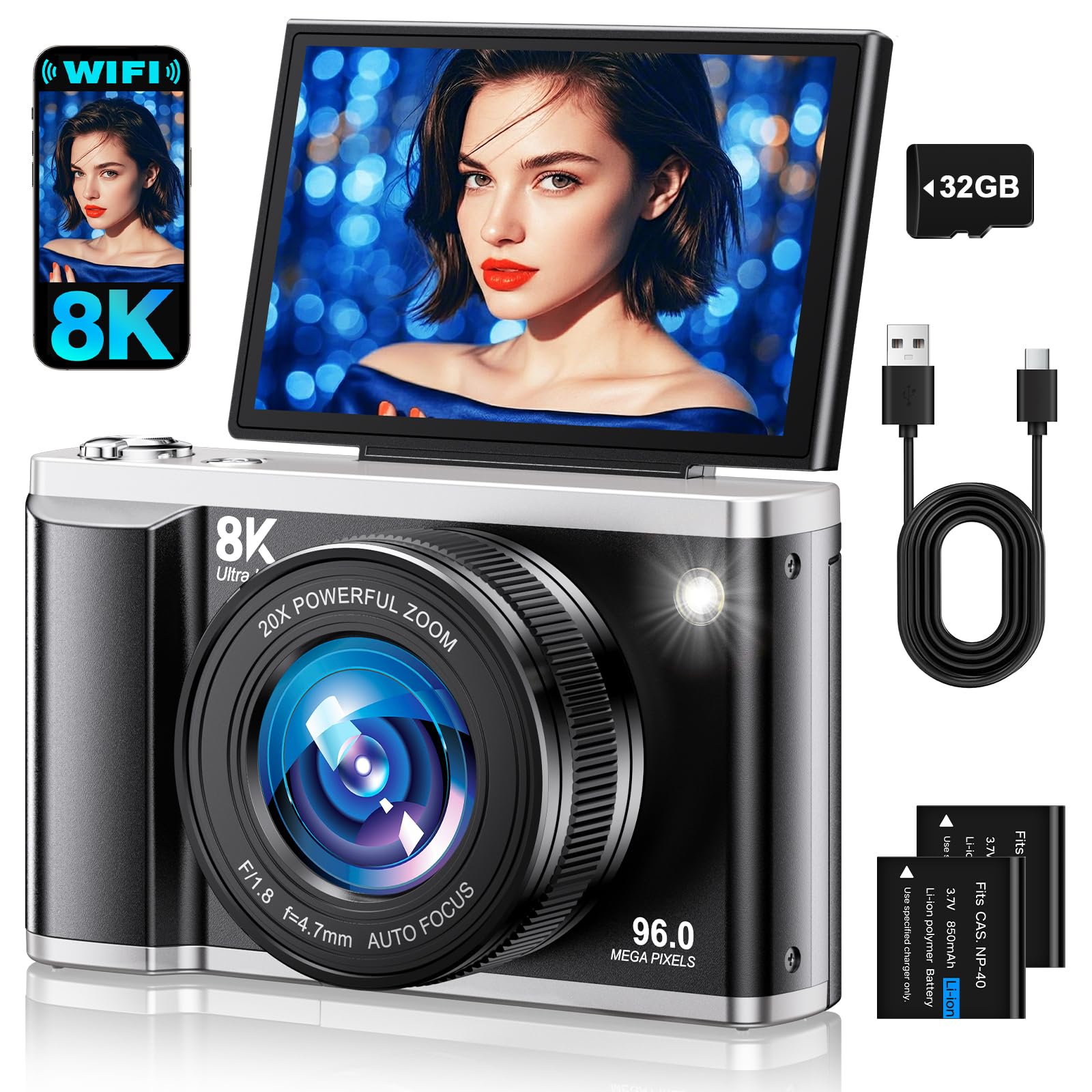
2. 8K AUREAPIX 96MP Digital Camera with WiFi
A big screen and instant sharing for anyone who wants to record, not just photograph.
If your goal is filming birthdays, recitals, or video calls rather than stills only, this is the one to look at first. The lens offers 20x digital zoom and an f/1.8 aperture (a wide opening that lets in more light for indoor shots). It records 8K video and 96MP stills — a far higher megapixel count than the Kodak PIXPRO FZ55’s 16MP, so you can crop into a photo and still keep detail. The screen is 3.5 inches and flips a full 180°, which is larger than the 2.7-inch panel on the Kodak FZ55.
Sharing is a real draw here. Built-in WiFi sends photos and video to your phone through the “Viipulse” app for iOS and Android, so a clip can go to YouTube, TikTok or Facebook without moving a memory card. Plug it into a computer and it doubles as a webcam for Zoom calls, using its own microphone. Two batteries come in the box, along with a 32GB SD card, cable, and wrist strap.
The flip screen and light body are why owners recommend it. Ease of use earns the second-most positive notes here, with quality earning the top spot. The honest catch: this is a fixed lens, so the 20x zoom is digital magnification only, and buyers who shoot in bright daylight sometimes want more optical reach for very distant subjects.
Where it shines: the 3.5-inch flip screen and built-in WiFi let you frame a selfie, record 8K video, and send the result straight to your phone without a card reader.
Pick it for: video-first users who want a big screen, two batteries, and easy phone sharing.
Think twice if: you mostly take long-distance stills, where an optical-zoom bridge camera wins.
3. NBDDIGITAL True 5K 64MP Digital Camera, 18X Zoom
A friendly, gift-ready starter camera with a flip screen and controls that make sense.
This camera is built for the person who is new to photography and does not want a DSLR’s complexity. It shoots 64MP stills and 5K video on a CMOS sensor, with an 18x digital zoom — slightly less magnification than the 20x on the 8K AUREAPIX. A dial switches between slow-motion, macro, filter, and other preset modes, so you are turning one knob instead of digging through a menu tree. The 180° flip screen rotates for selfies, and a built-in fill light helps indoors and at night.
Inside the box you get the camera, a 32GB memory card, USB cable, and a shoulder strap, plus two rechargeable high-capacity batteries for extended trips. The body carries a retro look with a sturdy metallic lens. It runs on a lithium polymer battery that weighs 28 g, heavier than the 18 g pack in the Kodak FZ55 but still comfortable to carry.
The value story is what keeps buyers happy. Owners consistently call the NBDDIGITAL an all-in-one bundle with accessories they did not expect, and several mention features they still have left to explore after weeks of use. One honest note appears more than once: a few owners mention the listed megapixel count did not match what arrived, and one described the included carrying case as mediocre. Those are worth checking against your own expectations, but they are a small slice of the story.
The trade-off to weigh: the 18x zoom is digital rather than optical, so very distant subjects soften — fine for travel and family shots, less so for wildlife at a distance.
Best for: a beginner, a teen, or anyone who wants an all-in-one starter kit with a flip screen.
Skip if: you need a true optical telephoto for long-distance detail.
4. Minolta MN40Z ProShot 20 MP Bridge Camera

Reach across a field or up to the moon without changing a lens.
The selling point here is reach. A 40x optical zoom lens pulls distant subjects close, and buyers routinely point it at birds, outdoor scenes, and the moon. Still shots come in at 20MP and video records in 1080p FHD. The camera also has optical image stabilization, which keeps long-zoom frames steady when your hands are not. It uses four AAA batteries included in the box, so power is a store trip away, just like the Kodak AZ255.
The body is compact and light, with a 3.0-inch LCD, a built-in flash, and continuous shooting up to 30 frames per second for quick bursts. WiFi with app integration lets you send photos to a smartphone. Face detection helps the camera lock onto people instead of the background. ISO range tops out at 3200 for dimmer rooms.
Owners describe the MN40Z as a strong starter model with plenty of features for the money, and the 40x zoom earns frequent mention. A few note the autofocus is slow and that the plastic shell feels less than premium, and one reviewer noted the mode dial icons not matching their actual settings. Those are the honest quirks to know about before buying. For hobbyists who want one camera that does a bit of everything, it remains a solid choice.
What stands out: the 40x optical zoom and complete kit — camera, 3.0-inch screen, WiFi, and batteries — travel as one self-contained package.
Ideal for: bird watchers, moon photographers, and anyone who needs serious reach in a small body.
Reconsider if: you prize fast autofocus and premium build feel above long-range zoom.
5. Kodak PIXPRO AZ528 16MP Digital Camera, 52x Optical Zoom

The longest zoom on this list, built to bring far-away subjects right up close.
That headline number is 52x optical zoom, the most reach of any camera here. A 24mm wide-angle lens covers sweeping landscapes at the wide end, then stretches to tight telephoto shots of birds, wildlife, and athletes. This is genuine optical sharpness rather than a digital crop, so detail holds up as you zoom. A 16MP BSI CMOS sensor (a chip designed for better low-light sensitivity) pairs with built-in optical image stabilization, which keeps handheld telephoto frames crisp even at full 52x without a tripod.
A 6fps burst mode catches fast action — 6 frames per second for wildlife or sports — and you can review the results on the 3.0-inch LCD and keep the sharpest. Built-in WiFi transfers photos straight to a phone or tablet, or lets you use the phone as a live remote viewfinder. 1080p Full HD video records smooth sequences, and the rechargeable lithium-ion battery keeps a long session going. It accepts Class 10 SD, SDHC, or SDXC cards up to 1.5TB.
Owners rate the AZ528’s overall quality highest and its value close behind, with the lightweight body drawing steady praise. Honest notes are present too: some customers note blurry photos or autofocus trouble, and a small number mentioned it stopping working after a few months. That is a minority view given how many owners are happy. The number that matters for judging this: 52x optical zoom versus the 25x on the Kodak AZ255 above, more than twice the reach in the same kind of compact body.
Why this pick wins
- 52x optical zoom with 24mm wide angle and OIS
- 6fps burst mode for action and wildlife
- Built-in WiFi for phone sharing and remote viewfinder
- 1080p video and support for cards up to 1.5TB
What to watch
- Autofocus and picture quality draw mixed notes from owners
- A few report blurry results in tricky conditions
- Low-light shooting is a weak spot versus dedicated cameras
Choose it when: reach matters most — distant wildlife, sports, or stage performances.
Look elsewhere when: you shoot mostly indoors in dim light, where fast autofocus counts more than zoom.
6. Canon PowerShot SX500 IS 16.0 MP Digital Camera

A camera with a long track record and a zoom that stays steady in the hand.
This camera is more mature than the newer AUREAPIX above. It uses a 16MP 1/2.3-inch CCD sensor (an older but proven chip design) paired with a DIGIC 4 image processor (Canon’s image computer). The lens is a 24mm wide-angle with 30x optical zoom and optical image stabilization, so you can zoom in on distant subjects without blur. The 3.0-inch TFT color LCD has a wide viewing angle, so two people can look at the screen together and both see it clearly. Video records in 720p HD with stereo sound using a dedicated movie button.
One thoughtful feature for anyone shooting at long range: an Enhanced Zoom Framing Assist button helps you track and hold a subject steady during super-telephoto shooting, which matters when a small bird will not sit still. High Speed AF helps lock focus quickly. It is built for a big screen too — one owner projected 16MP shots onto a 55-inch HDTV over HDMI and found them vivid.
Owners give the SX500 IS strong marks across the board, with picture results winning the most admiration and the 30x zoom close behind. It is small enough to carry without a bag and light enough to hold for a while. The honest catch is low light: a few note the CCD sensor shows noise at higher ISO in dim rooms, so night shots lean on a tripod or a brighter scene. One mention of a scratched lens and one of a missing lens cap show up, but these are exceptions rather than the pattern.
Why it earns its spot: 30x optical zoom with optical image stabilization in a small, well-established body means the reach is real, and the wide-view LCD is easy on the eyes.
Great for: anyone who wants a proven, easy-to-carry zoom camera with a track record.
Look past it if: you shoot frequently in low light where a newer sensor would help.
7. Panasonic LUMIX TZ/ZS99 Point and Shoot Camera

A pocket travel camera with a big tilt screen and low-maintenance USB-C charging.
For concerts, trips, and everyday shooting, the appeal is the combination of a bright screen and thoughtful convenience. The 24-720mm LEICA lens offers 30x optical zoom with 60x Intelligent Zoom, and the 1,840k-dot tiltable touchscreen lets you shoot from any angle — including holding the camera up high in a crowd. Video records in 4K at 30p, with 4K PHOTO bursts at 30fps and high-speed HD video at 120fps for slow-motion clips. USB Type-C charging means one cable you probably already own.
Sharing is designed to be simple: Bluetooth v5.0 pairs the camera to your phone, and a dedicated Send Image button pushes photos and videos straight to the Panasonic Image App. The battery weighs 44 g, which is on the heavier side among the picks here, so it is less of a featherweight than the more compact options.
Owners praise the ZS99’s build quality and user-friendly interface, with the 30x zoom getting consistent credit and the tilt screen a favorite for travel. Honest notes do surface: several reviewers point out image quality falling short of their phone’s camera, and a few mention autofocus feeling slow or menus being hard to navigate. A small number describe receiving a grey-market unit without US warranty coverage, so it is worth buying from a reputable seller. Treat the reviews as a healthy mix rather than a uniform rave.
Where it delivers
- 24-720mm LEICA lens with 30x optical zoom
- 1,840k-dot tiltable touchscreen for any angle
- 4K video at 30p and USB Type-C charging
- Bluetooth v5.0 with a dedicated Send Image button
Honest drawbacks
- Image quality draws mixed notes from owners
- Autofocus and menu navigation divide opinion
- Some units arrived without US warranty coverage
Best if: you want one pocket camera for travel, concerts, and easy phone sharing.
Skip if: you want top-tier image quality over convenience and reach.
8. Canon PowerShot SX720 HS Black

A small body that punches above its size when the lights go down.
The reason this one stands apart is its sensor and processor pairing. A 20.3MP CMOS sensor works with the DIGIC 6 image processor (a faster image-processing chip) to hold detail in dim settings, which is the kind of scene where several other picks in this list struggle. Its 40x optical zoom uses Intelligent IS (Canon’s hand-shake correction) to keep images steady, and the 3.0-inch LCD (about 922,000 dots) stays readable from a wide angle. Video records in 1080p Full HD at 60p with stereo sound.
Sharing is built in with Wi-Fi and NFC, so photos and videos move to a phone or tablet without a cable. The camera is small enough to slip into a pocket, which is why owners regularly note they can take it anywhere.
What SX720 HS owners celebrate most is image quality, with the 40x zoom close behind and the compact size following. The low-light strength is a real advantage — one buyer describes it replacing a DSLR for simple point-and-shoot use and handling indoor shots well without flash ghosting. A few mention Wi-Fi setup and an awkward charging setup, and one reported a memory card error, so treat those as the rare exception. On balance, this is a capable all-rounder with a clear strength in dim rooms.
The standout: the 20.3MP CMOS sensor with DIGIC 6 processing delivers the strongest low-light performance among the point-and-shoots here, which matters for indoor family gatherings.
Perfect for: indoor family photos, dim venues, and anyone who values low-light quality in a pocket-size body.
Bypass it if: you want the absolute longest optical zoom, where the AZ528 or MN40Z go further.
Know the Specs
Optical zoom vs digital zoom
Optical zoom uses glass in the lens to magnify a distant subject, so the picture stays sharp. Digital zoom enlarges the center of the frame with the camera’s internal computer, which softens detail. When you compare a 52x optical zoom to a 20x digital zoom, the optical number is the one doing the real work. Look for an optical figure if long-distance shots matter.
Battery type
AA and AAA cameras let you swap in store-bought batteries anywhere, which suits travel. Rechargeable lithium-ion packs cost less to run over time but need a cable. Both are common among these picks, so choose based on whether you would rather carry a charger or a spare pack of batteries.
Common Questions
What is the difference between optical zoom and digital zoom on these cameras?
Can these cameras be used by someone who has never owned a digital camera before?
Which cameras take AA batteries instead of a rechargeable pack?
Is a larger screen easier to see when reviewing photos?
How much zoom do I really need for bird watching or wildlife?
Can I transfer photos straight from these cameras to my phone?
What memory cards do these cameras take and are they included?
Will these cameras take good pictures indoors or in low light?
Do any of these cameras record video as well as taking photos?
Is a bridge camera with a long zoom hard to hold steady?
The Bottom Line
For most people, the best digital cameras for seniors pick is the Kodak PIXPRO FZ55 because it arrives as a complete, ready-to-use kit that takes the guesswork out of setting up. If long-distance zoom is what you want most, grab the Kodak PIXPRO AZ528 for its 52x optical reach. And for dim indoor family photos, the Canon PowerShot SX720 HS with its 20.3MP CMOS sensor and DIGIC 6 processing is the one to reach for — and if you want to compare the full range before deciding, all nine models are lined up in the table above.
How we choose
We do not accept paid placement. Every pick is matched to a real buyer and a real use-case; we do not hands-on test units.
Sources
Specifications: manufacturer listings and product documentation. Review insights: verified customer reviews, as of October 2026. Pricing: not shown on this page (it changes often); check the current price via the retailer link.
As an Amazon Associate, Home Digitized earns from qualifying purchases. This does not affect which products we feature.