
Specs are compiled from manufacturer listings and verified buyer reviews and can change over time — please confirm the key details on the product page before buying.
You want one knife that opens fast with one hand, holds an edge through a season of cardboard, and sits in your pocket without dragging your pants down. The problem is that a lot of folding knives look right in the photos and then disappoint in the hand — a stiff thumb stud here, a slippery stainless handle there, or a blade so short it cannot handle a real box. This guide separates the picks that owners actually keep carrying from the ones that end up in a drawer. Four things decide whether you reach for the knife or leave it home: the blade steel (the metal mix that sets how long the edge lasts), the lock type (how the blade stays open), the carry weight in ounces, and the blade length in inches.
This guide is built by comparing the manufacturers’ published specifications and the patterns across verified customer reviews, so you get each pick’s real strengths and trade-offs instead of marketing spin.
Every knife below has been sorted by what it is genuinely good at — a tactical flicker, a lightweight carry, a compact box opener, or a premium steel showpiece. By the end you will know exactly which of these Case Pocket Knives fits your hand, your pocket, and the jobs you actually do.
Top Picks


How To Choose The Best Case Pocket Knives
Three things separate a knife you carry every day from a knife that lives in a drawer: the steel in the blade, the lock that holds it open, and how heavy it feels clipped inside your pocket. Everything else — the handle color, the finish on the blade, the shape of the clip — is taste. Get the steel, the lock, and the weight right and the knife stays in your pocket for years. Get them wrong and the knife ends up in a drawer.
Blade steel decides how often you sharpen
Cheap blades go blunt fast because the steel is soft. Better steel holds a working edge through more boxes, tape, rope, and cardboard before it needs attention. A knife with a modest steel like 8Cr13MoV or 420HC will still cut well — it just wants a few passes on a stone more often. A knife with a premium steel like CPM MagnaCut is built to keep cutting longer between sharpenings, which is exactly why it costs more.
If you sharpen your own knives and enjoy it, a softer steel is a pleasure because it touches up quickly. If you want to touch up once a season and forget about it, pay for the better steel. The difference shows up most on cardboard, which is the quiet enemy of every folding knife edge.
Blade length is a legal decision, not just a cutting one
Blade length in inches is the number most buyers ignore until it matters. A longer blade cuts deeper and tackles bigger jobs, but many places cap the blade length you can legally carry. A blade around 2 to 2.5 inches tends to be the easier choice for daily city carry, while a 3.5 to 4 inch blade leans toward heavy outdoor and utility work. Check your local rules before you fall for a long blade you cannot legally take out of the house.
Lock type changes how the knife feels in use
A liner lock uses a thin bar inside the handle to hold the blade open — light, simple, and easy to close one-handed. A frame lock uses the handle itself as the lock bar, so it tends to feel more solid because it is thicker steel. A crossbar lock and its relatives release by pulling a small bar across the top of the handle, which many people find the friendliest for one-handed open and close. None of these is unsafe when it is well-made; they just feel different.
Side-by-Side Comparison
| Model | Best For | Blade Length | Weight | Blade Steel | Amazon |
|---|---|---|---|---|---|
| Smith & Wesson M&P Special Ops★ Best Overall | Tactical everyday carry | 4 inches | 3.2 ounces | 9Cr18MoV stainless steel | Amazon |
| CRKT Drifter 6450SFrame Lock Tough | Slim durable frame-lock carry | 1.25 inches | — | Stainless steel | Amazon |
| Spyderco Ambitious LightweightCompact Classic | Compact city-friendly carry | 2.5 inches | — | 8Cr13MoV stainless steel | Amazon |
| Kizer Drop Bear 2 | Button-lock fidget and EDC | 2.92 inches | 2.85 ounces | AEB-L | Amazon |
| Kershaw Outlier | Karambit-style tactical grip | 2.6 inches | 3.6 ounces | 8Cr13MoV stainless steel | Amazon |
| Buck Knives 726 Mini Spitfire | Featherweight USA-made carry | 2.75 inches | 2.1 ounces | 420HC stainless steel | Amazon |
| CIVIVI Yonder | Small daily-task blade | 2.88 inches | — | 14C28N stainless steel | Amazon |
| CIVIVI Incindie | Showpiece Damascus carry | 3.48 inches | 3.82 ounces | Damascus | Amazon |
| Kershaw Bel Air | Premium steel, light carry | 3.05 inches | 2.56 ounces | CPM MagnaCut steel | Amazon |
Detailed Reviews
1. Smith & Wesson M&P Special Ops Knife
Our pick — 4.5+★ from 800+ verified ratings; the strongest balance of quality and price.
The big-blade workhorse that fills a large hand and flicks open on command.
If you want a knife that feels like a serious tool the second you grip it, this is the one. The blade runs 4 inches long on a 9.3 inch overall frame — that is a full-size blade, and it is roughly 3.2 times the length of the CRKT Drifter’s 1.25 inch blade. That extra steel is the whole point. It makes short work of thick cardboard and heavy tape, and it is the kind of blade you want when a job turns out to be bigger than you planned.
The spring-assisted opening is the part owners talk about most. The blade is held open by a liner lock — a thin steel bar inside the handle that snaps behind the blade — and it is rated ambidextrous, so either hand works. The G10 handle (a glass-fiber composite that stays grippy when wet) gets praised for filling a large hand completely, and the 3.2 ounce weight feels substantial without being a brick. The 9Cr18MoV stainless steel blade carries a Titanium Nitride coating, which is a hard surface layer that helps resist scratches and wear.
Here is the catch you need to hear before you buy. That 4 inch blade is longer than the legal carry limit in plenty of places, so check your local rules first — a knife this size can be a home-and-outdoors tool rather than a daily city carry. There is also no belt sheath in the box, and the edge can arrive serviceable rather than razor-sharp, so a few passes on a stone helps. Buyers report the assisted action smooths out after about an hour of opening and closing.
Stainless full tang
- 4 inch tanto blade on a 9.3 inch overall frame handles real work, not just envelopes
- Spring-assisted flipper opens fast one-handed, with a liner lock that holds firm
- G10 handle is praised for filling a large hand and staying grippy when wet
- 9Cr18MoV steel with Titanium Nitride coating resists stains and sharpens easily
Heavy carry
- The 4 inch blade exceeds carry limits in many areas, so verify your local rules
- No belt sheath included and the factory edge may need a touch-up
- At 3.2 ounces it is heavier in the pocket than the featherweight picks below
Duty ready: you want a full-size, hard-working assisted folder for outdoors, survival, and heavy utility cutting at home.
Too big: you carry in a city with a blade-length cap, or you want the lightest possible pocket knife.
2. CRKT Drifter Folding Knife 6450S
A slim stainless frame lock built to take hard use for years, not months.
The Drifter is the pick for someone who wants a simple, tough knife with no fuss and no gimmicks. The frame lock is the standout: instead of a thin bar inside the handle, the handle itself is the lock, using a thick lock bar that presses behind the blade. That thicker steel is why owners describe the lockup as solid and the whole knife as sturdy. It is a 6.5 inch folded tool with a satin-finish stainless blade that keeps a clean, understated look.
At 1.25 inches, this blade is noticeably shorter than the 4 inch Smith & Wesson at the top of the list — the biggest contrast in this guide, and it splits buyers in two. If you want one knife that stays sharp a long time and slices cleanly through everyday material, owners mention the edge lasting six months or more between sharpenings. If you want a large blade for heavy jobs, this is not that knife — the short blade and a narrow, flat handle are the recurring gripes. A few owners also find the pocket clip stiff at first.
Frame lock compact: the stainless steel handle shrugs off hard use and the finish keeps its looks, which is why this one keeps showing up as a long-term carry rather than a novelty.
Small blade: the buyer who wants a low-maintenance, classic-looking daily folder and does not need a big blade to get through the day.
Pocket EDC: anyone who values a rock-solid frame lock and slim carry over blade size.
Hard tasks: you need a longer blade for camp chores or heavy cutting, since 1.25 inches will not cover it.
3. Spyderco Ambitious Folding Pocket Knife
The little Spyderco that disappears in your pocket and still cuts like a full-size knife.
This is the pick for someone who wants a genuinely compact knife without giving up cutting power. The blade is 2.5 inches and the folded knife measures just 3.63 inches — for scale, the Smith & Wesson above runs 9 inches overall, so this one is a different animal entirely. The 8Cr13MoV blade is full-flat-ground, which means it tapers from spine to edge for clean slicing rather than a wedge that shoves material apart. Customers note it chewing through boxes, kindling, apples, and rope without going dull quickly.
The handle is the other half of the story. The scales are injection-molded FRN (fiberglass-reinforced nylon) with Spyderco’s Bi-Directional Texture pattern, which cuts weight compared with G-10 while keeping a firm grip. Skeletonized stainless steel liners add stiffness without bulk, and a LinerLock holds the blade open. The four-position pocket clip is the detail that sells a lot of people: it lets you mount the knife on either side, tip-up or tip-down, so you can set it up however your hand and pocket prefer.
Do not expect a tree-splitting tool here. The blade is short, and a few owners find it stiff to flick open from the start because of that short length and the square corner on the opening hole. Break-in helps. The steel is a solid everyday grade rather than a premium one, so it holds an edge well but likes occasional touch-ups if you cut a lot of cardboard. None of that changes the point: this is a small knife that punches above its size.
Daily carry: daily city carry where a friendly, non-intimidating compact blade matters more than raw size.
Tough jobs: you need a long blade for camping chores or you insist on a flick open straight from the start.
4. Kizer Drop Bear 2 Pocket Knife
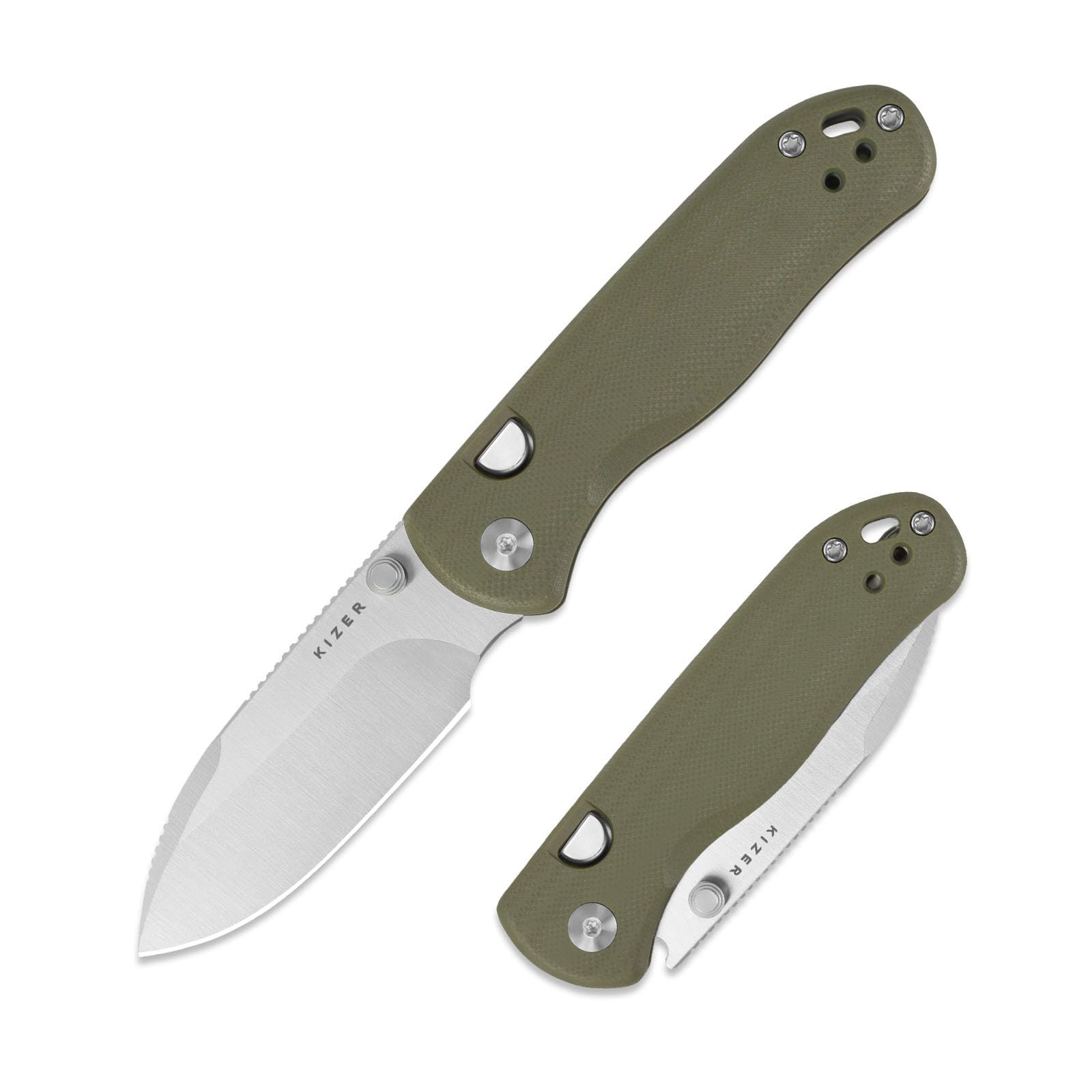
A button-lock folder that glides open on ball bearings and feels like it costs far more.
The Drop Bear 2 earns its spot on one detail owners bring up again and again: it flicks open and shut smoothly with one hand. The action rides on ball bearings — small steel balls in the pivot that let the blade swing with very little effort — and the button liner lock (a thin bar inside the handle that releases when you press the button with your thumb) frees the blade. If you want a knife that is fun to open as much as useful to cut with, this is your pick.
The blade is 2.92 inches of AEB-L steel, a grade known for taking a very keen edge and being easy to sharpen, with good corrosion resistance for humid and dry conditions alike. The whole knife weighs 2.85 ounces and folds to 6.9 inches, so it is light enough to forget in a pocket. The handle is olive green G10, a grippy composite that holds firm in the hand. There is spine jimping (small ridges on the spine for thumb traction), a finger choil (a notch where your index finger sits in front of the handle for control), and a deep-carry reversible pocket clip that keeps the knife low and hidden.
The one honest note: owners with large hands sometimes find the grip a touch small, since the handle is deliberately compact. Buyers with medium hands report a full, comfortable grip. The blade geometry and button are aimed at light-to-medium daily cutting rather than prying or heavy batoning, so treat it as a refined everyday tool and it will serve you well.
AEB-L drop point
- Smooth ball-bearing action with a button liner lock for easy one-handed open and close
- AEB-L blade sharpens easily and resists corrosion in both humid and dry conditions
- Weighs just 2.85 ounces and rides low on a deep-carry reversible clip
- G10 handle with spine jimping and a finger choil for confident control
Short handle
- Small for large hands — medium hands fit best in the compact handle
- Designed for light-to-medium cutting, not heavy prying or batoning
Precise cuts: you want a light, fidget-friendly daily folder with premium-feeling action and easy sharpening.
Large hands: your hands run large or you need a blade for heavy-duty chopping work.
5. Kershaw Outlier Folding Pocket Knife

The karambit-style folder with a ring for your finger and a blade that hooks to cut.
Most pocket knives cut with a straight edge. This one does not. The Outlier uses a hawkbill blade — a curved edge that hooks inward — paired with a steel ring at the handle end that lets you hold it in a reverse grip with your index finger through the ring. That design is what makes it different from everything else on this list, and it is the reason a karambit-style knife cuts rope, straps, and seatbelt-style material so cleanly: the curve catches the material and pulls it into the edge instead of sliding off.
The blade is 2.6 inches of 8Cr13MoV stainless steel with a BlackWash finish (a dark, worn-looking surface treatment that hides scratches and keeps a rugged look as you use it). Assisted opening gets the blade out fast and the liner lock holds it once it is open. The handle is contoured glass-filled nylon — a tough reinforced plastic — with a steel backspacer and jimping for grip. It is rated ambidextrous and the deep-carry pocket clip can be moved for right- or left-handed tip-up carry. At 3.6 ounces it has real presence in the pocket.
Karambit curve: owners repeatedly describe this knife as surviving long-term everyday carry and hard use without falling apart.
Awkward open: the hawkbill shape and reverse-grip ring are a specific skill set. If you have never used a karambit-style knife, the opening and handling take a little practice, and it is less of an all-purpose slicer than a standard drop-point folder.
Self defense: anyone drawn to a tactical karambit profile who wants assisted opening and a rugged, durable everyday knife.
Utility work: you want a simple straight-edge folder for ordinary cutting tasks.
6. Buck Knives 726 Mini Spitfire EDC Pocket Knife, Gray, 2.1 oz
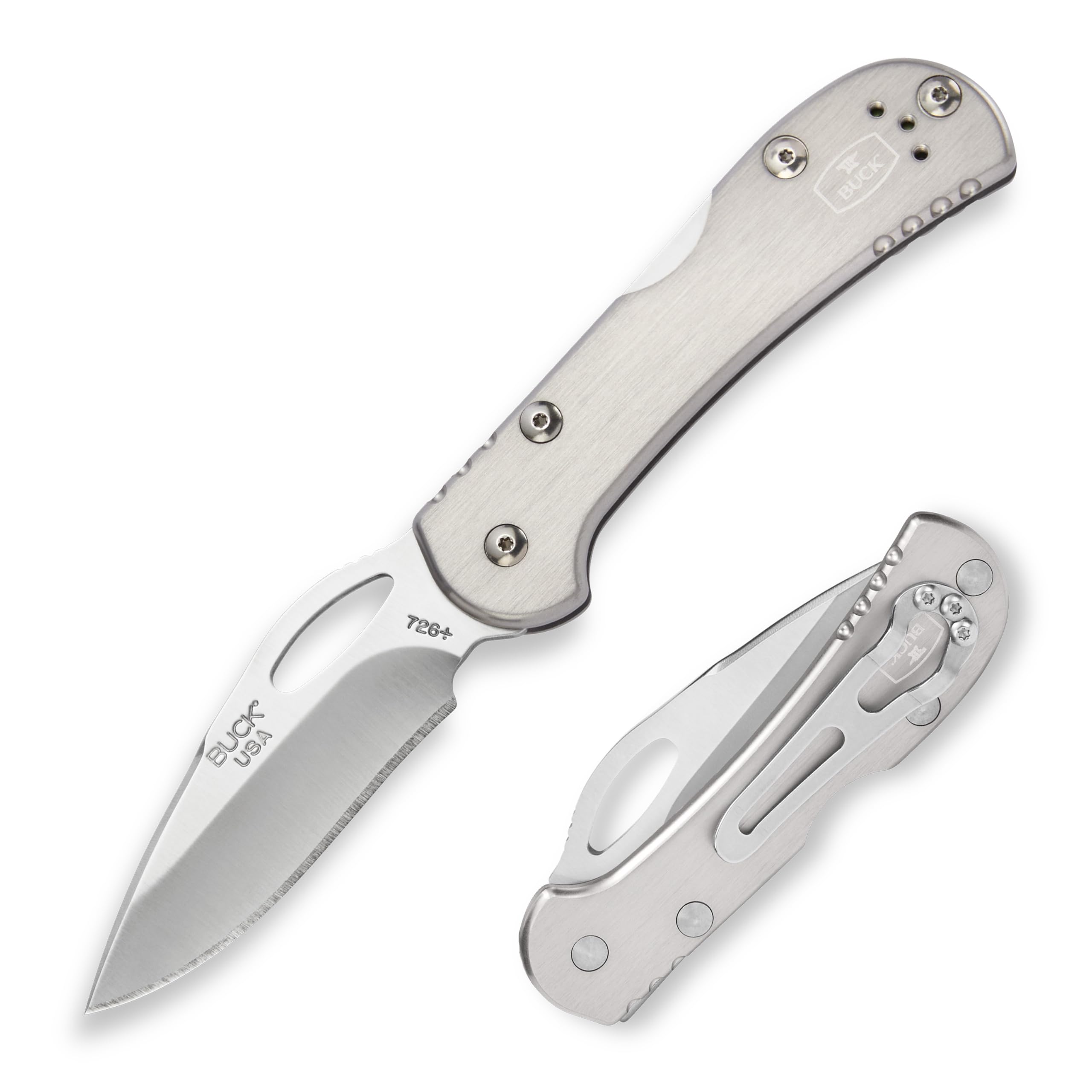
The 2.1 ounce American-made folder that you forget is even in your pocket.
At 2.1 ounces, the Mini Spitfire is the lightest knife in this guide, and clipped inside a pocket that weight basically vanishes. The blade is 2.75 inches of 420HC stainless steel — a workhorse steel that Buck puts through a rigorous heat treat process to get strong edge retention and corrosion resistance. It is a lockback design, meaning the lock is at the back of the handle, and it holds the blade open with the firm, dependable feel that design is known for. The whole thing folds to 3.63 inches.
The build is a slim aluminum handle with a clip that works on a belt, in a pocket, or in a bag, and it is handcrafted in the USA — a detail a lot of buyers specifically seek out. The 420HC blade takes a sharp edge and touches up easily, which suits someone who would rather strop a blade for a minute than send it away. For light chores around the house, at camp, while fishing, or on a hike, it covers everything you would reasonably ask of a small folder.
The honest part: this knife is so light that some people read it as feeling less substantial than it is, and the factory edge can be stiff to open one-handed until it breaks in. A few owners also notice the handle machining is not perfectly smooth, and the grey finish runs a touch lighter than the studio photos suggest. None of that undercuts the value — this USA-made knife carries a lifetime warranty.
Mini Spitfire light: The Buck Knives 726 Mini Spitfire weighs just 2.1 ounces with a 2.75 inch 420HC blade, so it slips into a pocket unnoticed while still handling everyday cutting chores.
Keychain carry: buyers who want the lightest possible USA-made daily carry with an easy-to-sharpen blade.
Heavy use: you prefer a knife with more heft and a hand-filling frame.
7. CIVIVI Yonder Small Pocket Knife

A small, sharp daily companion with a crossbar lock and a blade that holds its edge.
The Yonder is built around two things: a 2.88 inch 14C28N stainless steel blade and a crossbar lock. That steel, from Swedish production, is known for holding an edge well while staying resistant to rust, so it suits a knife that lives in a pocket and cuts boxes, rope, and packaging day after day. The crossbar lock is the release you pull across the top of the handle — many people find it the most intuitive way to open and close a folder with one hand, and it is the detail that makes the Yonder feel smooth rather than stiff.
The handle is Micarta, a layered composite that grips well and looks good as it ages, and the knife has a chamfered edge with jimping on the spine for secure handling. At 6.62 inches folded it stays compact, and the deep pocket clip carries low and discreet. Reviewers point out it handling daily light and medium tasks — boxes, plastic, rags — without complaint, and the blade shape is described as cutting smoothly rather than wedging.
The main thing to know is that the action can be tuned quite loose. Some owners find the blade deploys a little too readily, to the point where it flicks open without much effort — great for quick use, less ideal if you want a stiff, deliberate opening. It is also not a fidget knife for a lot of people; the angled rear of the handle can create a hot spot if you flick it over and over. For real cutting, though, this is a strong everyday performer.
City pocket: daily pocket carry where you want a small, sharp, corrosion-resistant blade with an easy one-hand lock.
Outdoor tasks: you want a knife with a firm, deliberate detent or a knife designed for heavy-duty cutting.
8. CIVIVI Incindie Folding Pocket Knife

The Damascus blade you actually want to show people before you cut with it.
The 3.48 inch blade is Damascus steel with a hollow grind and layered, flowing lines — the kind of pattern that changes as the light moves across it, and the reason owners so often mention the appearance of this knife. The blade is longer and visually bolder than the 2.92 inch Kizer Drop Bear 2, and it gives the Incindie a distinctively substantial look in the hand. This is the knife for someone who wants their everyday carry to look as good as it works.
The action runs on a ceramic ball-bearing pivot, which lets the flipper open the blade smoothly and quickly. The handle is CNC-milled for a secure, non-slip grip, so control stays confident even when your hands are wet or you are working in awkward conditions. The knife weighs 3.82 ounces and folds to 7.95 inches overall, keeping it in the everyday-carry range despite the larger blade. The pocket clip is reversible, so both left- and right-handed users can carry it the way they prefer.
Where it earns its place is the combination of looks and real cutting performance — it is not just a display piece. The trade-offs are the usual ones for a Damascus blade: it wants a little care to keep its finish looking sharp, and it rewards owners who take pride in maintaining their knives rather than throwing them in a toolbox. Treat it well and it stays a head-turner.
Show piece: a carry knife that gets noticed, with a long Damascus blade and smooth ceramic-bearing action.
Rough duty: the finish is worth protecting, so this is a knife for careful owners rather than a beater.
9. Kershaw Bel Air Pocket Knife
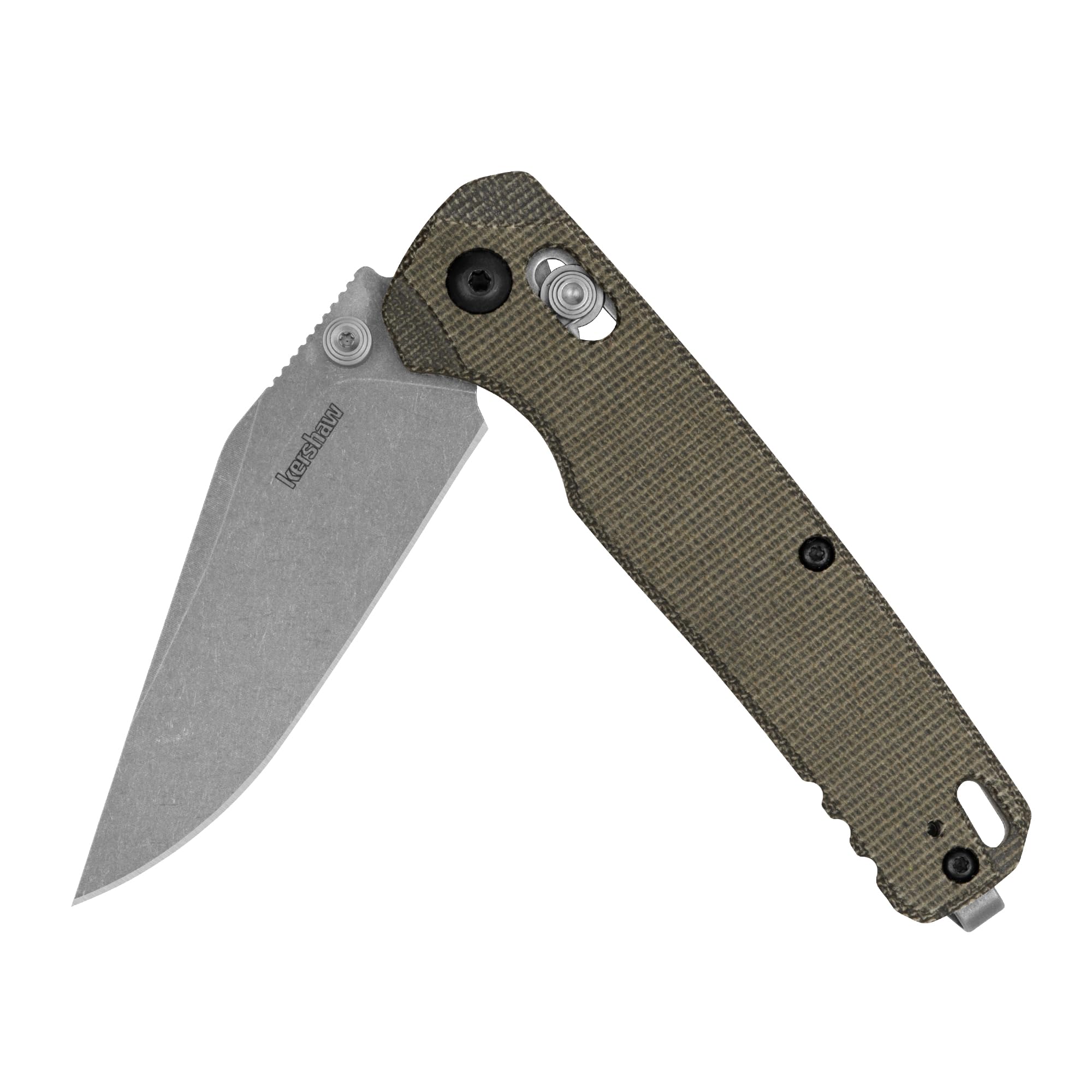
Premium steel and a 2.56 ounce frame — the lightest high-end folder here.
The Bel Air is the knife you buy when you want the best blade steel on this list and you still do not want to feel it in your pocket. The blade is CPM MagnaCut steel, a grade built to be excellent at three things at once: holding an edge, resisting chipping, and resisting rust. For a daily carry knife, that means you sharpen less often and worry less about moisture. It is 3.05 inches long, and it measures 2.56 ounces — lighter than the 2.85 ounce Kizer Drop Bear 2 despite the larger blade, thanks to the canvas micarta handle and a lean overall build.
The action is smooth because of a KVT ball-bearing system, which uses bearings in the pivot to let the blade glide open, paired with a thumb stud for one-handed deployment. The DuraLock mechanism is a crossbar lock, meaning the blade is secured by a bar that crosses the handle rather than a single flexible line — it locks firmly and releases cleanly. The overall length is 7.25 inches, and the reversible pocket clip allows right- or left-handed tip-up carry.
This is where the money goes, and it is worth saying plainly. The Bel Air is the premium pick of the group, and what you are paying for is the steel and the light weight rather than any flashy styling. It is made in the USA, and it is the knife for someone who cuts a lot and wants to spend less time sharpening and more time working. If you only make a few cuts a week, a cheaper steel will serve you just as well — but if you cut daily, the MagnaCut edge is the difference you feel.
USA carbon blade: The Kershaw Bel Air pairs a 3.05 inch CPM MagnaCut blade with a 2.56 ounce frame, giving you premium edge retention in one of the lightest high-end folders you can carry.
American made: heavy daily users who want top-tier edge retention and the lightest possible premium carry.
Budget pick: you only cut occasionally and would rather save on the blade steel.
Know the Specs
Blade Steel Grades
The steel in the blade is the single biggest factor in how long the knife stays sharp. Softer everyday grades like 8Cr13MoV and 420HC sharpen quickly and hold a usable edge through routine cutting, which suits most people. Mid grades like 9Cr18MoV, 14C28N, and AEB-L balance edge retention with toughness and are easy to maintain. Premium grades like CPM MagnaCut are engineered for long edge life and corrosion resistance, which is why they cost more. A higher grade does not make a knife better at everything — it mostly means less time spent sharpening.
Lock Mechanisms
A liner lock uses a thin bar inside the handle to hold the blade open — light and simple. A frame lock makes the handle itself the lock bar, so it tends to feel more solid because the steel is thicker, as on the CRKT Drifter. A crossbar lock and its variants, like the Kershaw Bel Air’s DuraLock and the CIVIVI Yonder’s crossbar, use a bar that crosses the top of the handle — many people find that the easiest design to open and close one-handed. A lockback, like the Buck Mini Spitfire uses, puts the release at the back of the handle and feels firm and familiar.
Common Questions
What blade length can I legally carry?
Is a crossbar lock better than a liner lock?
What does Damascus steel mean on a pocket knife?
How much does a pocket knife weigh matter?
Will an assisted opening knife open in my pocket?
What is the difference between a drop point and a tanto blade?
How often will I need to sharpen a pocket knife?
Can I carry a large pocket knife for outdoor use only?
The Bottom Line
The strongest overall pick here is the Smith & Wesson M&P Special Ops, because it combines a full-size 4 inch tanto blade with fast spring-assisted opening and a grippy G10 handle in a tool that handles real work. If your priority is the best blade steel and the lightest premium carry, the Kershaw Bel Air with its CPM MagnaCut blade is the pick to reach for. And for a knife you will genuinely forget is in your pocket, the 2.1 ounce Buck Knives 726 Mini Spitfire is the everyday companion to grab. Whichever you choose, buy the one whose blade length fits both your cutting jobs and your local carry rules — that single decision saves more regret than any spec on the box.
How we choose
We do not accept paid placement. Every pick is matched to a real buyer and a real use-case; we do not hands-on test units.
Sources
Specifications: manufacturer listings and product documentation. Review insights: verified customer reviews, as of October 2026. Pricing: not shown on this page (it changes often); check the current price via the retailer link.
As an Amazon Associate, Home Digitized earns from qualifying purchases. This does not affect which products we feature.