
Specs are compiled from manufacturer listings and verified buyer reviews and can change over time — please confirm the key details on the product page before buying.
Every dark blob in your photos is a dust speck sitting on the sensor, not on the lens — and a kit with the wrong swab size will smear it around instead of lifting it. The short answer: match the swab to your sensor, buy a kit that includes a sensor cleaner separate from a lens cleaner, and don’t pay a repair shop for a job that takes two swipes. Below you’ll find eight kits that get the sensor-size question right, sorted so you can pick in about three minutes.
This guide is built by comparing the manufacturers’ published specifications and the patterns across verified customer reviews, so you get each pick’s real strengths and trade-offs instead of marketing spin.
Sensor dust shows up as soft grey spots that stay in the same place no matter which lens you mount, and that is your cue to clean. Full-frame bodies need a 24mm swab while APS-C bodies take a 16mm swab, so the size printed on the box is the first thing to check in the best mirrorless camera cleaning kits.
Top Picks


How To Choose The Best Mirrorless Camera Cleaning Kits
Three things decide whether a kit works for you: swab width, whether the bottle is a lens cleaner or a sensor cleaner, and whether the whole thing fits in the bag you actually carry. Get those right and the rest is preference.
Swab width has to match your sensor
Your sensor sits behind the shutter at a fixed width, and the swab has to span it in one pass. A swab narrower than the sensor leaves an uncleaned stripe down one side; a swab wider than the sensor drags cleaner onto the surrounding frame. Full-frame bodies take a 24mm swab. APS-C bodies take a 16mm swab. That single number is the reason two kits can look identical and only one of them suits your camera.
Two bottles, two jobs
Lens cleaner goes on glass you can touch. Sensor cleaner goes on the glass covering the sensor, which is thinner and far less forgiving. A kit that only ships one bottle makes you choose which surface gets the wrong fluid. Kits here like the UES DDR16 and the K&F CONCEPT 25-in-1 carry both, and the sensor fluid is usually the smaller bottle because a single cleaning takes two drops.
Swipe once, then throw it away
Sensor swabs are single-use. Once a swab has crossed the sensor it holds the dust it picked up, so putting it back on the sensor drags that dust straight back. That is why swab counts matter: the K&F CONCEPT 32-in-1 ships 10 replaceable full-frame swabs, while the base K&F CONCEPT 24mm kit ships 6, and the ARVOK 32-piece kit includes 4 wet and 4 dry sticks. Count how many cleans you expect in a year before you decide six is enough.
Side-by-Side Comparison
| Model | Best For | Sensor Format | Swab Count | Cleaner Supplied | Amazon |
|---|---|---|---|---|---|
| Altura Photo Camera Cleaning Kit★ Best Overall | Everyday lens care and travel | Any camera (lens focus) | — | 60 ml lens cleaner | Amazon |
| K&F CONCEPT 24mm Full Frame Sensor Cleaning KitBest Value | Full-frame sensor wet cleans | Full frame (24mm) | 6 | 20 ml sensor cleaner | Amazon |
| ARVOK Professional Camera Cleaning Kit (32 pcs)Most Complete | Beginners who want one box with everything | Any camera (mixed sticks) | 4 wet + 4 dry sticks | 2 × 20 ml cleaning liquid | Amazon |
| UES DDR16 APS-C Sensor Cleaning Kit | APS-C bodies that need repeated cleans | APS-C (16mm) | 12 | 15 ml ultra-pure cleaner | Amazon |
| UES 21-in-1 APS-C Camera Cleaning Kit | Shooters who pack light with a hard case | APS-C (16mm) | 10 | 30 ml lens and sensor cleaner | Amazon |
| K&F CONCEPT 25-in-1 Camera Pro Cleaning Kit | Combo lens-plus-sensor care in one bag | APS-C (16mm) | 6 | 60 ml lens + 20 ml sensor cleaner | Amazon |
| VSGO DKL-20F Sensor Cleaning Kit | Full-frame owners who also clean screens | Full frame (24mm) | 6 | 30 ml lens + 15 ml sensor cleaner | Amazon |
Detailed Reviews
1. Altura Photo Camera Cleaning Kit
Our pick — 4.5+★ from 900+ verified ratings; the strongest balance of quality and price.
The kit you grab for fingerprints and smudges, not for sensor surgery.
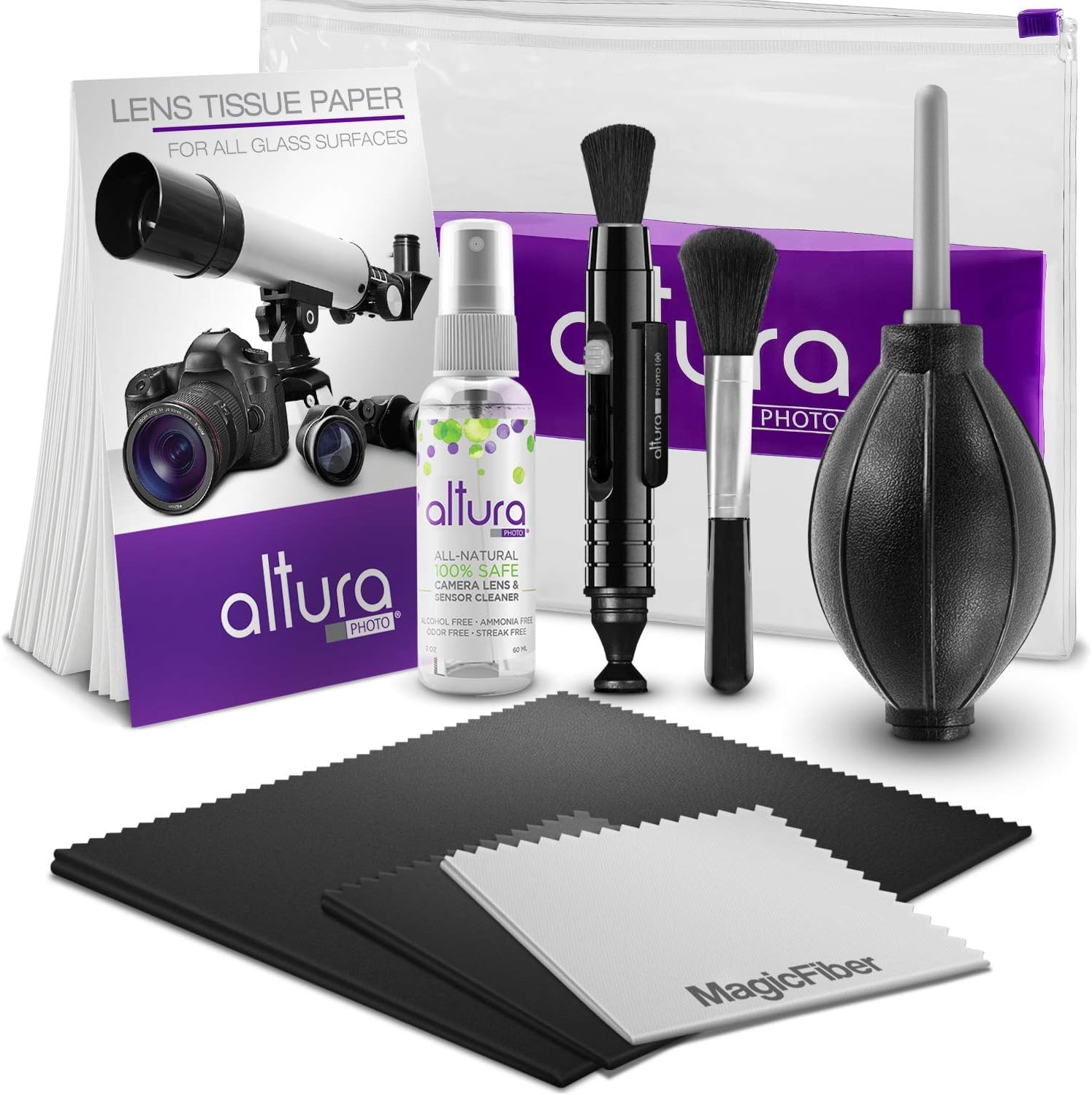
Start with what this kit is not: it is a lens-cleaning kit. There are no sensor swabs in the box, so if you have grey blobs stuck in the same spot in every frame, this is not the tool — you need one of the swab kits further down. What it does, it does for the glass you actually touch all day: the spray bottle, the lens pen, the blower, the brush, and the cloths.
The formula is where the value sits. It is plant-based and free of alcohol, ammonia, and solvents, so it is safe for the anti-reflective coatings on multi-coated glass. The 60 ml bottle is the largest liquid volume of any lens-focused kit here — roughly three times the 20 ml you get in the K&F CONCEPT 24mm sensor kit — which means the bottle outlasts most of the cloths in the box. Buyers report it lifting stubborn grime and clearing tiny fibers and dust off delicate optics without streaks.
One genuinely honest note on fit: a handful of buyers have found the gentle formula too gentle for heavy, baked-on greasy smudges, which means you may need two passes rather than one. That is a mild trade-off, not a flaw — and the 3 MagicFiber cloths and 50 sheets of lens tissue in the box mean a second pass costs you nothing. If your sensor rather than your lens is the problem, or you shoot in the same dusty places the swab kits below are built for, look at those instead.
What buyers keep coming back to
- Works from the start — spray, brush, pen, blower, 3 cloths and 50 tissue wipes all included
- Alcohol-free, ammonia-free plant-based formula that is safe on anti-reflective coatings
- Fits Canon, Nikon, Sony, Fujifilm, Olympus, Pentax, Sigma and Tamron glass with no adapter fuss
- Dual-purpose — the same kit cleans phone and tablet screens
Where it stops short
- Zero sensor swabs, so it cannot do a wet sensor clean
- The gentle formula needs two passes on heavy grease and fingerprints
Reach for this if: you want one tidy kit for lens fingerprints, viewfinder smudges and travel-caked glass across whatever body you own.
Look elsewhere if: you can see the same soft grey spot in every photo — that needs a 16mm or 24mm swab and a sensor-dedicated cleaner.
2. K&F CONCEPT 24mm Full Frame Sensor Cleaning Kits
Six swabs, one bottle, and the only number that matters: 24mm.
The headline here is a full-frame sensor swab at 16mm of usable head width wrapped inside a 24mm profile, and the swabs arrive vacuum sealed so nothing touches the microfiber before you do. Six swabs plus a 20 ml bottle of sensor cleaner is a deliberately narrow kit — it does one job and skips the lens cloths, the blower and the pen. Owners mention a spotted sensor coming clean in two swipes: one wet pass in one direction, then a dry swab back the other way.
The results people describe are specific. One buyer picked up a used Canon and found a load of spots during testing, tried the old Q-tip-style kit that came with a previous camera with no success, then used this and reported it removed every single spot. As that buyer put it: “it removed ever single spot, I mean crystal clean.” The solution is colorless, ammonia-free and low-VOC, and it dries without residue. First-timers report dust coming off on the first attempt with no streaks.
Here is the honest part: the swabs are single-use, and cleaning a sensor often takes two passes, so six swabs is roughly three cleaning sessions. If you shoot in dusty places regularly, budget for extras. And if your camera is APS-C rather than full frame, this is the wrong width — the UES DDR16 further down is the dedicated 16mm answer, at three times the liquid volume in the bottle.
Where the value sits: a dedicated sensor-cleaning kit with a real full-frame swab and a real sensor fluid, without paying for lens cloths you already own. For anyone with spots on a full-frame or crop-frame sensor who has never cleaned it before, six swabs is plenty to learn on.
The one-line verdict: if your grey spots live on a full-frame sensor and you want the simplest possible fix, this is the kit.
But know this going in: swabs are one-and-done, so heavy field shooting will have you ordering refills sooner than you expect.
3. ARVOK Professional Camera Cleaning Kit (32 pcs)
Thirty-two pieces in a water-resistant case — the beginner’s everything box.
Count against the others and the scale of this kit becomes obvious. It carries 32 pieces against the 6 in the K&F CONCEPT full-frame kit — a 5.3x difference in item count — and it is the broadest single box on this list. Inside you get an air blower, a 2-in-1 lens pen, a dust brush, two hard brushes, 4 wet and 4 dry 16mm CCD sticks, two 20 ml bottles of cleaning liquid, six cotton swabs, tweezers, lens paper, a 15×15 cm cloth, five separation bags, a pair of dust-free gloves, a zipper bag and the hard-shell case. The case itself is water-resistant, which matters if your bag rides on a wet shoulder strap.
Owners running it for a year on a Sony A6400 report the 16mm wet and dry sticks are what make it a real sensor option rather than another lens-only kit. That size suits smaller sensors, which is the category most first mirrorless bodies fall into. The blower, pen, spray, cloth and swab sticks also cover cleaning a phone or a pair of glasses, so nothing in the box sits idle.
There is a real catch worth naming. The fluid bottles are not marked with an explicit sensor-cleaner formulation the way the dedicated K&F and VSGO kits are, so this box is easier to recommend as an everything-kit than as your only sensor tool. A small number of units have also arrived with tools that needed a wipe-down from the start — and in the case that went wrong, the seller resolved it directly. Treat this as a starter kit you grow out of, not a lifetime kit.
A buyer’s read: the appeal is breadth for a newcomer — one order instead of six, and a hard case to keep it all in one place while you learn which tools you actually reach for.
Fit check: best on APS-C and smaller sensors, where the included 16mm sticks are the right width.
Best for: the first-time mirrorless owner who wants every tool in one water-resistant case and does not yet know which ones they will use.
Think twice if: you already own cloths and a blower and only need swabs and sensor fluid — the K&F kit above is the leaner, sharper tool for that.
4. UES DDR16 APS-C Camera Sensor Cleaning Kit

Twelve APS-C swabs means twelve chances to get it right.
Swab count is the whole story here: 12 individually vacuum-packed 16mm swabs, which is double what the K&F CONCEPT 24mm full-frame kit gives you. Each swab is built in a Class 100 cleanroom, a controlled environment where airborne particles are filtered out, which is why the swab head arrives clean enough to put on a sensor at all. The 16mm head is sized for APS-C bodies from Sony, Canon, Nikon, Fujifilm and Pentax, and the ultra-soft microfiber distributes pressure evenly so one smooth pass lifts dust and oil together.
The supporting bottle is 15 ml of an 18MΩ ultra-pure formula, alcohol-free and ammonia-free, and it is stated as safe for IBIS systems — the in-body stabilization that physically floats your sensor, which is exactly the part you do not want to press on unevenly. Owners switching from other cleaners report a streak-free, debris-free sensor when they follow the included instructions. The bottle holds enough solution for many uses, so it tends to outlast the swabs that came with it — plan on refill swabs before you need more fluid.
Weigh it at 3.2 ounces and the whole kit disappears into a camera bag pocket, which is the point for anyone cleaning on location. A couple of buyers have flagged that patience and a careful hand matter — a rushed pass is where streaks come from, not the fluid. Sized right for an A6000 or an R100, wrong for a full-frame body.
Why the count wins: at two swabs per careful cleaning, twelve swabs covers about six sensor cleans — enough that you stop rationing them and actually clean when the spots show up.
Reach for this if: you shoot APS-C and want enough swabs on hand to clean whenever dust lands, not just when it becomes unbearable.
Go bigger if: your body is full frame — the 24mm swabs in the VSGO and K&F kits are the correct width for that sensor.
5. UES 21-in-1 Professional APS-C Camera Cleaning Kit
The kit that lives in your camera bag and comes out on location.
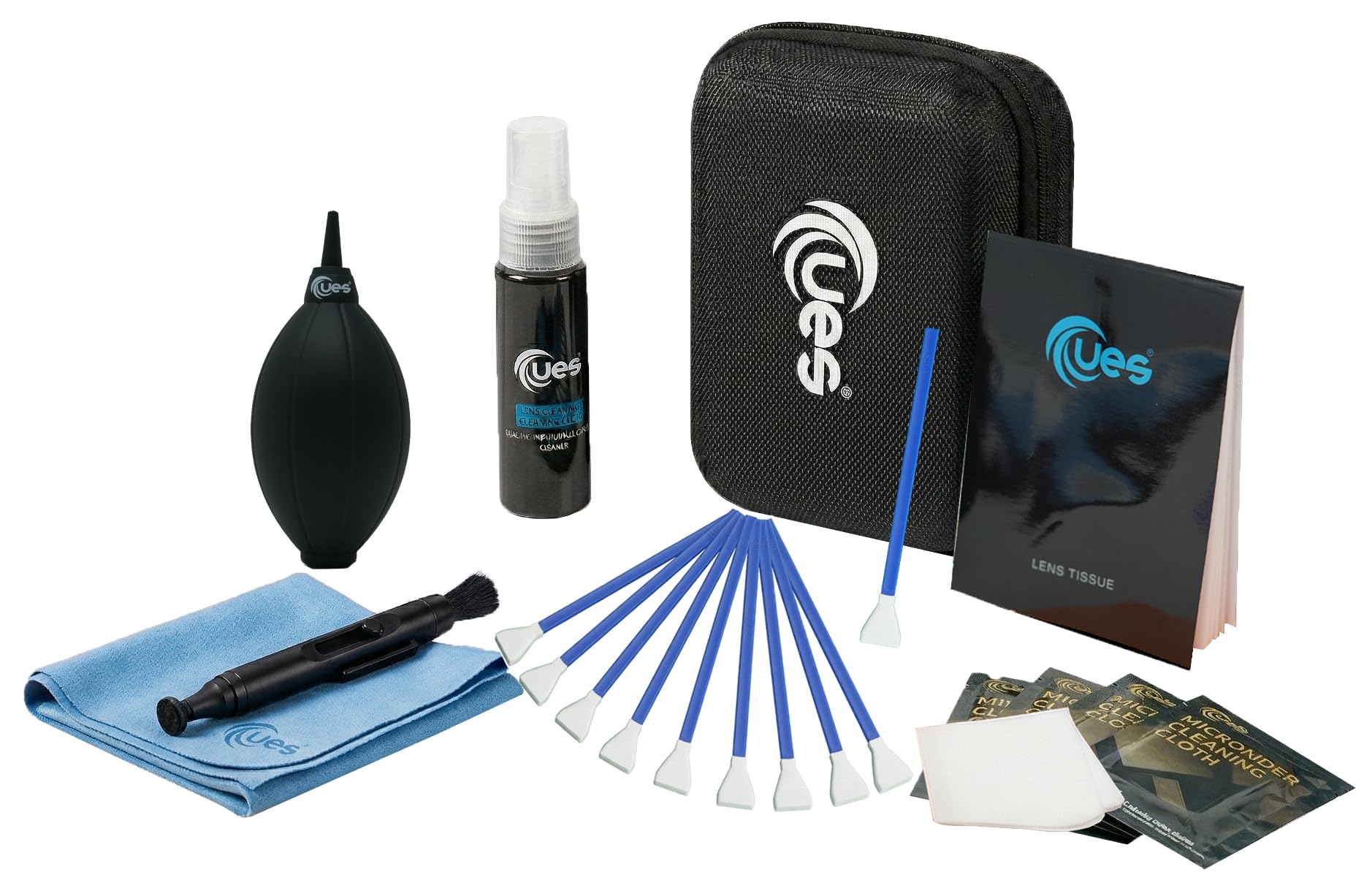
This one is built around a water-repellent hard-shell EVA case — EVA being the firm foam-like material used for protective shells — and it weighs 0.2 kg with everything inside. Ten vacuum-sealed APS-C 16mm swabs sit alongside a 30 ml bottle of alcohol-free, ammonia-free lens and sensor cleaner, five microfiber cloths, a lens pen, an air blower, 50 sheets of recyclable lint-free lens tissue, a micro suede screen cloth and the case itself. For anyone who cleans away from a desk, the hard shell is the feature that survives a backpack.
The blower gets specific praise for the strength of its puff, and the swab-and-fluid pair is what owners describe as the part that actually matters — dust that a blower alone cannot shift comes off in a pass or two. One owner cleared matching spots from a mirrorless sensor with two swabs after a Zion, Bryce and Paria Canyon trip, saving a repair bill. The instructions run a little loose in places — they mention drops where the bottle sprays — but the process itself is simple enough to follow without them.
The honest limit is the swab width. Ten 16mm swabs are the right size for APS-C and can be worked across a full-frame sensor with more effort, but they are not cut for it. If you shoot full frame, the 24mm kits here are the correct tool and this one will feel like a compromise.
Where it earns its place: the case. A kit that stays organized after a month in a rucksack is worth more than one that is technically better but ends up scattered across three pockets.
One real quirk: the printed instructions describe drops rather than sprays, so read them once and then trust the tools.
Best for: the shooter who wants a self-contained, protected cleaning kit living permanently in the camera bag for outdoor work.
Not for: full-frame bodies where a 24mm swab is the correct fit.
6. K&F CONCEPT 25 in 1 Camera Pro Cleaning Kit
Two bottles, two jobs — lens fluid in one, sensor fluid in the other.
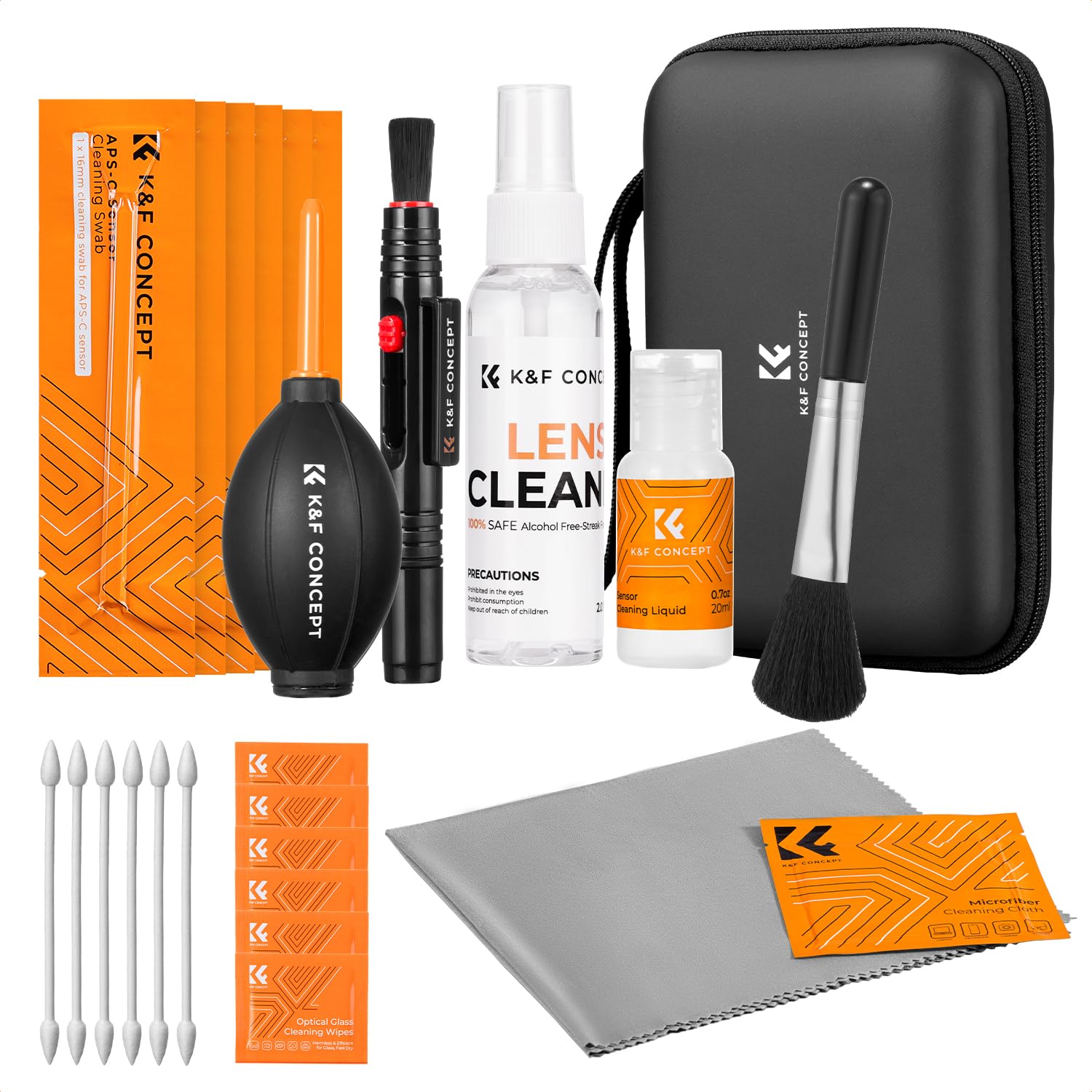
Most all-in-one kits give you one bottle and hope. This one separates the work: 60 ml of lens cleaning solution with a vacuum pump head, plus a 20 ml sensor cleaning solution, both ammonia-free, toxic-free and low-VOC. That split is the reason it sits in the premium tier. Around the bottles you get six 16mm APS-C sensor swabs in individual vac-sealed packs, six cotton swabs, a 36 cm and a 15 cm microfiber cloth, six cleaning wipes, an air blower, a cleaning brush, a lens pen and a storage bag.
Customers note stuck sensor dust coming off cleanly with no streaks, and the result holding until the next clean. The blower earns its own mention as better than expected for its size, and the whole thing packs into a camera bag or hip pack without arguing for space. It has become the kind of kit that gets kept in the bag rather than left at home.
The caveat to check before you buy is the swab width, and it is worth reading twice. The six swabs are 16mm APS-C, and if your body is full frame they will not span the sensor — one owner with a full-frame camera found the sensor cleaning the awkward part of an otherwise excellent kit. Everything else here, including both bottles and all the cloths, works regardless of your sensor size.
Why it earns premium: the two-bottle setup means you never put lens fluid on a sensor. That is the single most common beginner mistake, and this kit designs around it.
The verdict: the strongest choice for APS-C owners who want lens and sensor cleaning handled properly in one compact bag.
Skip if: you shoot full frame — the six swabs are 16mm and will not cover a 24mm sensor.
7. VSGO DKL-20F Sensor Cleaning Kit

Six 24mm swabs, a mini blower, and a pen that does two jobs.
The swab size is the first thing to check and this one gets it right: six 24mm full-frame swabs cut for a full-frame CMOS sensor, paired with a 30 ml lens cleaner and a 15 ml sensor cleaner so the two fluids never get mixed up. The lens pen is the detail worth pointing out — a dual-tip design with an activated carbon powder tip for absorbing fingerprints and grease on one end, and a filament brush for lens crevices and zoom rings on the other. Two different jobs, one tool, nothing extra to carry.
The mini air blower is deliberately small; VSGO built it to reach hot-shoes and zoom rings as well as lens fronts, and it is compact enough to stay in the bag between shoots. The carrying case keeps the whole set together and protected. Owners have leaned on this kit for more than camera work — one emergency MacBook screen clean before a client presentation took seconds with the included cleaner, a kit already in the bag turns a screen emergency into a two-minute fix.
Where it lands honestly: this is a compact kit, not a 32-piece one, and it carries one microfiber cloth rather than a stack. If you want a cloth for every surface and a dedicated brush set, the K&F 32-in-1 below has more of both. If you want a full-frame kit that does the job without the bulk, this is the tighter package — and its 24mm swabs are double the width of the 12mm lines some full-frame buyers get stuck with.
What makes it different: the fluids are labeled and separated by job, and the pen covers grease and crevices without a second tool, so a full sensor clean takes one pass and one polish.
Who it suits: full-frame shooters who also want a kit that handles laptop and monitor screens on the same trip.
Look elsewhere if: you want a deep cloth-and-brush inventory rather than one cloth and a compact case.
Know the Specs
Swab width: 16mm vs 24mm
A sensor cleaning swab is a flat, padded paddle sized to span your sensor in a single pass. The 16mm head fits APS-C sensors, the smaller format used in bodies like the Sony A6000 series and Canon R100. The 24mm head fits full-frame sensors. Get this wrong and one of two things happens: too narrow and you leave an uncleaned stripe, too wide and you drag fluid onto the frame around the sensor. Check your sensor format before the box arrives, not after.
Vacuum sealing and the Class 100 cleanroom
Swabs are fabricated in a cleanroom — a workspace with filtered air and controlled particle counts — then sealed individually in vacuum packaging so nothing touches the swab head until you open it. That matters because a swab is only as clean as its wrapper. An unprotected swab sitting loose in a cloth bag can pick up lint before it ever reaches your sensor, which is the opposite of what you bought it for.
Lens cleaner vs sensor cleaner
These are two different fluids. Lens cleaner is formulated for the anti-reflective coatings on front elements. Sensor cleaner is formulated for the cover glass over the sensor, which is thinner and less forgiving. Look for alcohol-free, ammonia-free formulas and a low-VOC rating, and never swap one bottle for the other just because it is the one already in your hand. Kits that ship both bottles remove the temptation.
Single-use swabs and how many you need
A swab picks up dust on the way across the sensor, so a second sweep with the same swab drags that dust back. That is why swab count drives value: plan on one swab per pass, and two passes per clean, then decide how many cleans a year you expect. Six swabs is a solid starting point for an occasional shooter; ten or twelve keeps you from rationing, especially if you shoot outdoors where dust is routine.
Common Questions
What size sensor swab does my mirrorless camera need?
Can a 16mm APS-C swab clean a full-frame sensor?
How often should I clean my mirrorless sensor?
Is it safe to clean an IBIS sensor myself?
What is the difference between lens cleaner and sensor cleaning fluid?
Can I reuse a sensor cleaning swab?
Do I need a different kit for a DSLR than a mirrorless camera?
Should I use an air blower before a wet swab?
What else can a camera cleaning kit safely clean?
How do I stop my wet clean from leaving streaks?
The Bottom Line
For most people, the right pick from these mirrorless camera cleaning kits is the Altura Photo Camera Cleaning Kit, because it covers the everyday problem most photographers actually have — fingerprints and smudges on the glass in front of the sensor — with a 60 ml plant-based cleaner, three microfiber cloths and 50 tissue wipes that fit any camera brand you own. If you can see the same soft grey spot in every frame, step up to the K&F CONCEPT 24mm Full Frame Sensor Cleaning Kit for a full-frame body, or the UES DDR16 APS-C Sensor Cleaning Kit for 12 swabs at 16mm, which covers repeated cleans better than any kit here. And if you want a single water-resistant case holding every tool for outdoor shoots, the UES 21-in-1 is the one that stays organized in a backpack.
Whichever you pick, buy it before the spots show up — a kit already in your bag turns a sensor clean into two minutes instead of a booked appointment.
How we choose
We do not accept paid placement. Every pick is matched to a real buyer and a real use-case; we do not hands-on test units.
Sources
Specifications: manufacturer listings and product documentation. Review insights: verified customer reviews, as of October 2026. Pricing: not shown on this page (it changes often); check the current price via the retailer link.
As an Amazon Associate, Home Digitized earns from qualifying purchases. This does not affect which products we feature.