
Specs are compiled from manufacturer listings and verified buyer reviews and can change over time — please confirm the key details on the product page before buying.
If you want one answer fast: the Insta360 X4 is the pick most beach-goers end up happiest with, because it shoots everything around you at once and survives the water. A normal camera forces you to point and frame while you are standing in glare, wind and blowing sand — and one splash can end the trip. A sealed, beach-rated camera removes that problem, and all nine below carry a real water-exposure rating rather than a vague “water resistant” claim.
This guide is built by comparing the manufacturers’ published specifications and the patterns across verified customer reviews, so you get each pick’s real strengths and trade-offs instead of marketing spin.
Some of these dive to 33ft without an extra housing while others stop at a pool-splash rating, so the depth number on the box is the first thing to check. Every pick below is sealed and beach-rated, and each one suits a different kind of beach day.
Top Picks


How To Choose The Best Digital Cameras for Beach Photos
Beach photography punishes gear three ways at once: salt water, airborne sand, and glare off the water. A camera built for a dry hike can look identical to one built for the surf and still fail on the first wave. The sections below cover the specs that decide whether the camera survives the trip.
Start With The Waterproof Depth Rating
The depth number tells you exactly how much water the camera is built to withstand. A camera rated to 14 or 15 meters can be snorkeled with, while one rated to 16 feet is meant for splashes, shallow dips and pool use. Read the rating as a hard ceiling, not a suggestion.
Dustproofing matters just as much. Sand is abrasive and gets into every seam, so a camera explicitly marked dustproof is doing real work when you set it down on the beach towel.
Check Shockproof And Freezeproof Claims
Wet hands, rocks and the occasional fumble are part of every beach trip. A shockproof rating is quoted as a fall height in meters or feet, so a 2-meter rating means the camera is built to survive a drop from that height. Freezeproof ratings matter if you are shooting a cold-weather coast or a winter surf session.
Match The Lens And Screen To How You Shoot
If you mostly shoot selfies and group shots with your back to the sun, a flip screen saves you from guessing your framing. If you shoot wide seascapes, a wide-angle focal length around 27mm gives you the whole bay. If you like tide-pool close-ups, a macro light ring around the lens barrel is the feature you will use most.
Battery Life And Charging Realities
Cold water and constant screen use drain a battery faster than its rating suggests. Cameras with a spare battery in the box save you from a dead afternoon, and USB-C charging means you can top up from a power bank between swims.
Side-by-Side Comparison
| Model | Best For | Waterproof Depth | Still Resolution | Battery Life | Amazon |
|---|---|---|---|---|---|
| Insta360 X4★ Best Overall | 360° beach video and reframing later | 33ft (10m) | 72 mp | 135 minutes | Amazon |
| Kodak PIXPRO P1Best Value | Pocket-sized snorkeling and selfies | 16ft | 13 mp | Lithium-ion, USB-C | Amazon |
| AKASO Brave 8 LiteBudget Pick | Budget action clips on the water | 33ft (10m) | 48 mp | 90 minutes | Amazon |
| Kodak PIXPRO WPZ2 Bundle | Deep snorkeling with a full kit | 49ft (15m) | 16 mp | — | Amazon |
| PENTAX WG-1000 | Casual outdoor and shore shooting | 15m | — | — | Amazon |
| PENTAX WG-90 | Macro work with a built-in ring light | 14m | 16 mp | — | Amazon |
| Ricoh WG-80 | Rough, all-weather work and play | 14m | 16 mp | — | Amazon |
| GoPro HERO13 | Hands-free action on waves and boats | 33ft (10m) | 24.7 mp | — | Amazon |
| OM SYSTEM TG-7 | All-round tough compact for tide pools | 15m (50ft) | — | — | Amazon |
Detailed Reviews
1. Insta360 X4 Standard Bundle
Our pick — 4.5+★ from 5,000+ verified ratings; the strongest balance of quality and price.
The one that films everything around you, so a mid-shot wave never ruins the take.
For a beach where you are moving, swimming and looking in every direction, this is the camera that stops you losing shots. It records true 360-degree video in 8K or 5.7K at 60 frames per second (fps, meaning the frame count each second — higher looks smoother in wave motion), so you choose the angle after you are home instead of panicking about framing in the surf. The signature trick is the invisible selfie stick effect: the stick vanishes from the footage, leaving third-person shots that look like a drone followed you across the sand.
Water handling is where it separates from a plain action cam. It goes down to 33ft (10m) with no dive case at all, and to 164ft (50m) with the optional Invisible Dive Case. It also survives cold, running at temperatures as low as -4ºF (-20ºC). Against the cheaper AKASO Brave 8 Lite, the battery gap is the headline: 135 minutes here versus 90 minutes there, and the still resolution lands at 72 mp versus 48 mp. As buyers report, it “beats X3: crisper zoomed image, better battery, screw-in lens guards low distortion, less stitching/warping.”
The catch is the computer sitting back at the hotel. Reviewers are blunt that editing 8K 360 footage asks for a powerful machine — one recommends 32GB of RAM — and the desktop studio software arrives with bugs that can lose transitions or cut projects short. The mobile app will not edit on weaker phones at all. Battery life and reliability both draw mixed notes in the owner pattern, with frequent recharging the most common grumble.
What earns the top spot
- 33ft (10m) waterproof with no dive case, 164ft (50m) with the Invisible Dive Case
- 8K 360 footage with FlowState Stabilization and 360° Horizon Lock for level shots in chop
- 135-minute battery that outlasts the AKASO Brave 8 Lite’s 90 minutes
- AI-assisted reframing in the app means you never had to aim in the first place
The honest trade-off
- Editing 8K 360 files wants a genuinely powerful computer, and the studio software has known bugs
- Selfie stick is not included in this bundle
- Owners mention sky overexposure in daylight and blur in low light
Settle on this: if you want one camera for the whole beach trip and you have a strong laptop or phone for editing, nothing else here covers this much ground per shot.
Think twice: a weaker editing setup will hold this camera back.
2. KODAK PIXPRO P1 13MP Waterproof Digital Camera, Black
A palm-sized 13MP point-and-shoot that folds open like a compact mirror for beach selfies.
This is the one to hand to someone who wants beach photos without learning a camera menu. It is entry-level on cost and light enough to slip into a swim bag, yet it is properly sealed: dustproof, shockproof to 3ft, and waterproof to 16ft for pool trips, snorkeling and splashing around. The 13MP BSI CMOS sensor (a sensor design that gathers more light in dim conditions) pairs with a bright f/2.0 fixed wide-angle lens at a 26mm focal length, so you get the whole bay in frame without shuffling backward into the water.
The standout feature for beach use is the 2.8-inch LCD screen that tilts a full 180 degrees. Flip it up and you frame selfies and group shots perfectly instead of guessing. There is also a built-in three-color ring light (warm, white and cool tones) that fills in faces and close-ups when the light drops, and it records 1080p video at 60fps. It charges over USB-C and comes with a wrist strap, so salt spray and wet hands are handled.
Be realistic on the zoom. It tops out at 4x digital zoom, which crops into the image rather than pulling the subject closer optically — so a distant boat will look softer than a face at arm’s length. And there is no micro SD card in the box, so budget for one before you leave. As the review pages sum it up on this camera: “Palm-sized Kodak PIXPRO P1: 13MP, dustproof, shockproof to 3ft, waterproof to 16ft.”
Why it clicks: the 180-degree tilt screen and the three-tone fill ring are the two features you will reach for constantly on a sunny beach, and the 26mm wide lens captures the scene without you walking backwards. It is also the lightest, most pocketable way into properly sealed beach photography on this list.
Know before you go: digital zoom only, and the memory card is a separate buy.
Reach for this if: you want simple, waterproof, selfie-friendly shots from a camera that disappears into a pocket.
Look elsewhere if: you need real optical reach or a card already in the box.
3. AKASO Brave 8 Lite
A budget action cam that dives to 33ft and ships with the mount kit already in the box.
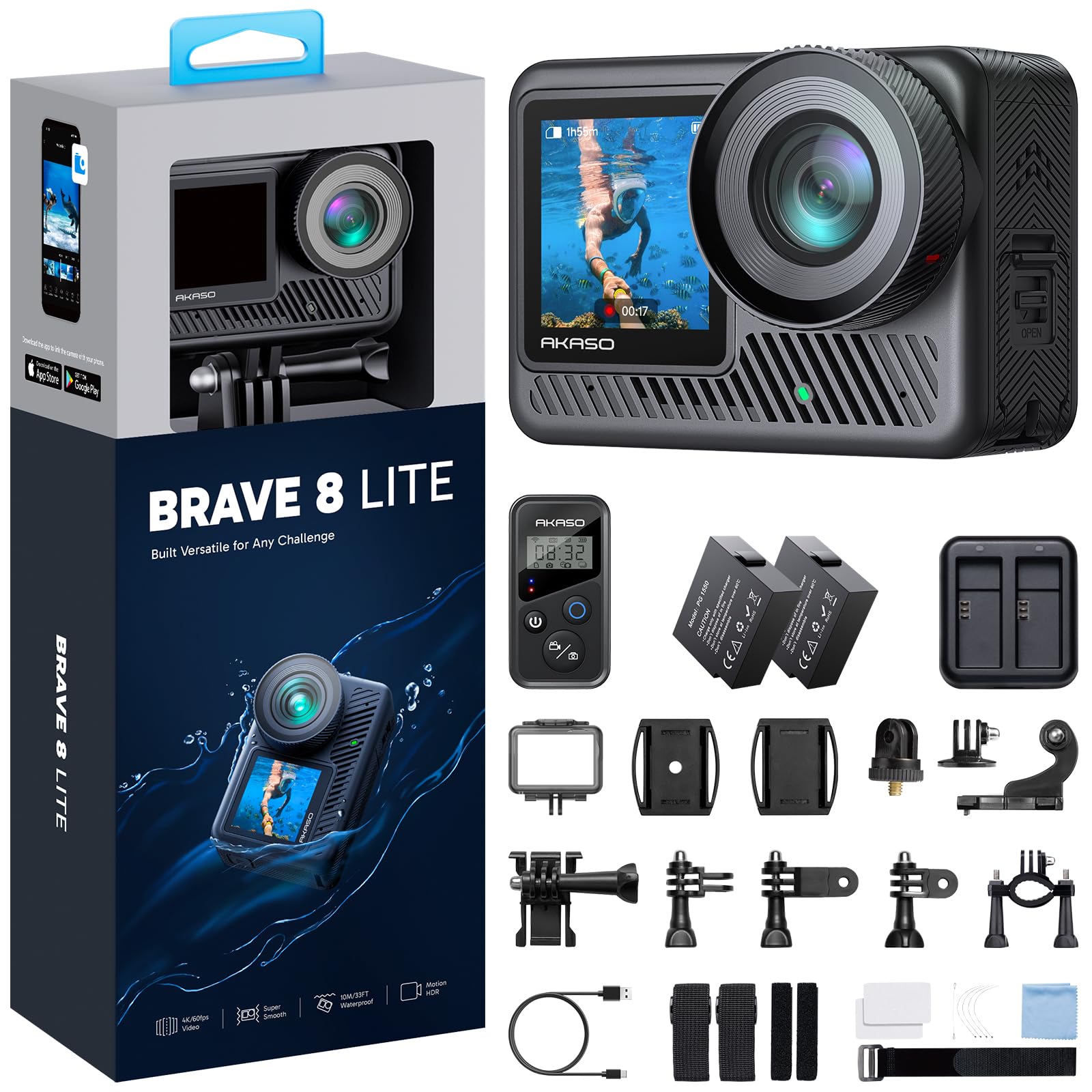
If you want to strap a camera to a board or your wrist and not worry about it, this is the entry-level way in. It shoots 4K at 60fps and stills up to 48MP from a 1/2-inch CMOS sensor, with HDR (high dynamic range, which holds detail in both bright and shadowed areas) to keep midday sand and sky from blowing out. It is waterproof to 33ft (10m) with no case at all, and with the separately sold waterproof housing it reaches 131ft (40m). Two 1550mAh batteries come in the box — the spec sheet lists a 90-minute battery average, and AKASO states each battery records 4K30fps video up to 140 minutes.
Where this falls short of the Insta360 X4 above is in the raw numbers: 90 minutes of battery versus 135, and 48 mp of still resolution versus 72. Its 5x digital zoom does, however, beat the 4x on the Kodak PIXPRO P1. The dual-screen layout puts the front display right where you can see your framing when the camera points at you, and the box also includes a visual wrist remote, a bike handlebar clamp and a helmet accessory kit.
The honest caveat comes from owner experience with its app. Most buyers get crisp results and the stabilization is sufficient for walking, hiking and biking, but it is not built for extreme sports. A recurring complaint is that the AKASO GO app connection can fail, with one owner writing: “it doesn’t connect to the akaso app it a real waste of time.” The memory card door is also stiff to open, and low-light footage gets noisy. For a fair-weather beach day, none of that sinks the camera.
Where the value sits
- 4K60 video and 48MP stills for a budget-tier camera
- 33ft (10m) waterproof without a case, 131ft (40m) with the sold-separately housing
- Two 1550mAh batteries, wrist remote and mount kit all in the box
- 5x digital zoom tops the Kodak PIXPRO P1’s 4x
What to accept
- App connection can be flaky on some units
- Low-light video gets noisy and stabilization is not built for extreme action
- Memory card door is hard to open, and a card is not included
Suits you if: you want a cheap, full-kit action camera for casual surf footage and snorkeling.
Not for you if: you need dependable phone control for every transfer.
4. Kodak PIXPRO WPZ2
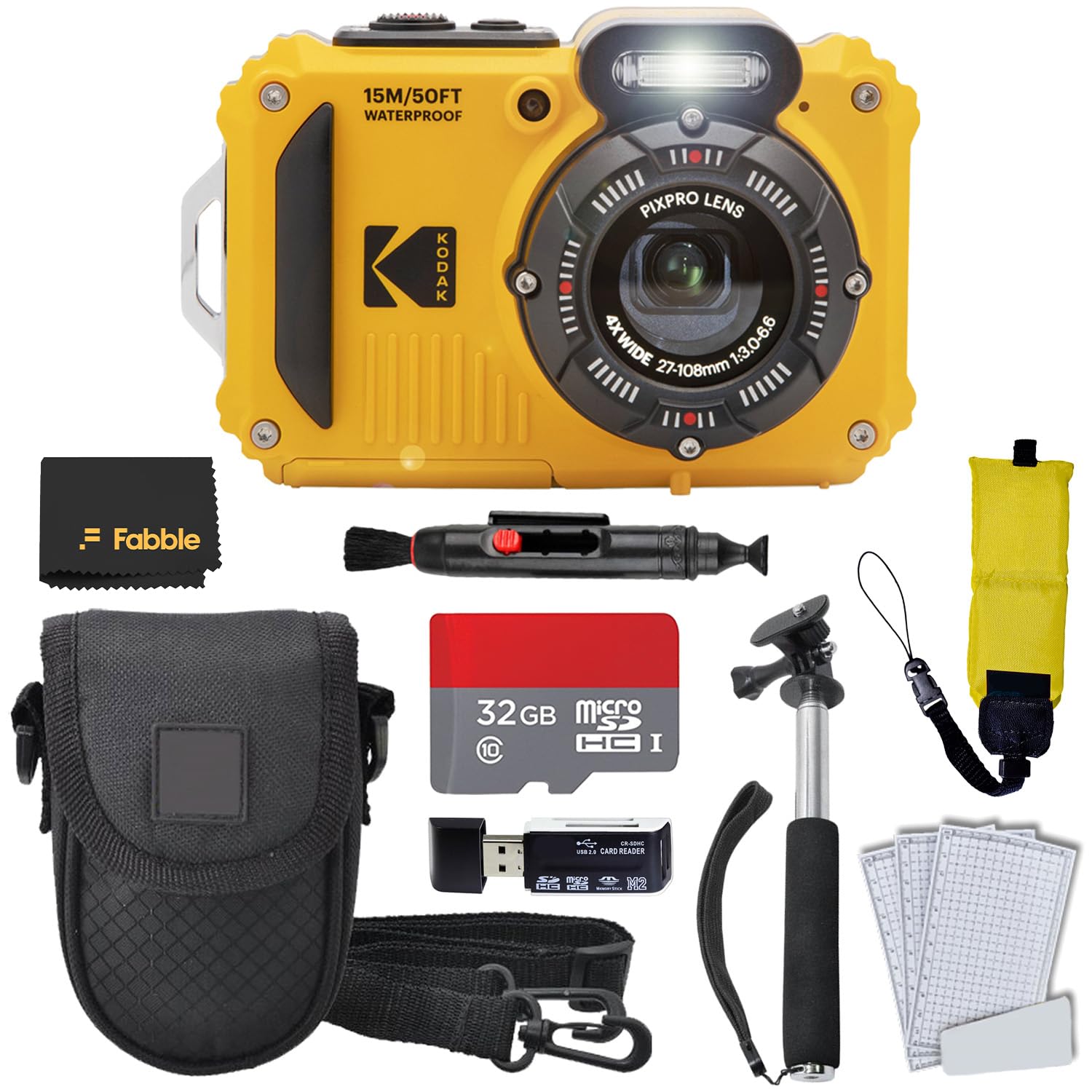
The deep-diving kit camera: 49 feet of water resistance with a floating strap and case.
Snorkelers who go under rather than just paddle around should look here first. The WPZ2 is rated waterproof to 15 meters (49 feet), which is the deepest on this entire list and comfortably beyond the 33ft ceiling of the AKASO Brave 8 Lite and the 16ft limit of the Kodak PIXPRO P1. It is also shockproof from up to 2 meters (6.56 feet) and dustproof, so rocks, grit and sand at the shoreline are a non-issue. The 16MP sensor handles lifelike detail, and the 4x optical zoom (a lens that actually magnifies rather than cropping the image) at a 27-108mm equivalent range gives you real reach for wildlife and distant swimmers.
What sets this apart is the bundle. It arrives with seven items including a compact case, lens pen, monopod, USB card reader, screen protector, a 32GB SD card with adapter, and a floating wrist strap — the floating strap is the detail that saves a dropped camera in open water. It shoots 6 frames per second continuously with just 0.17 seconds between shots, so you can rattle off a burst when the surf breaks. The dustproofing matters most here: salt and sand get everywhere, and this body is built to keep them out.
Owners widely praise this camera for underwater and beach use and for its durability, with clear underwater photos and a battery that ran 4-plus hours underwater on one snorkeling trip. The honest caveats are real but few: a couple of owners note it feels heavy and the battery compartment is trickier to open, and humid weather can fog the outer lens until it dries. One defection down the line is worth knowing about, though the pattern across the reviews is overwhelmingly positive.
The case for it: the 49-foot depth rating is the real headline here, and it out-dives every other camera on this list. Add the floating strap and the memory card already included, and this is the most complete snorkeling setup from the start.
The fine print: it costs more than the pocket PIXPRO P1, and it is the heavier camera to carry on dry land.
Your pick if: you plan to actually go under the surface and want a kit that is ready the moment the box opens.
Overkill if: your beach days are poolside splashes rather than real depth.
5. PENTAX WG-1000 Olive Waterproof Digital Compact Camera

A casual shore camera built to shrug off sandstorms, rain and the occasional drop onto rocks.
The WG-1000 is aimed at the beachgoer who wants a rugged compact and does not need technical controls. It is waterproof to 15 meters for up to one hour of continuous operation, dustproof against dirt and stains, and shockproof against a fall from 2 meters. The 4x optical zoom lens starts at a 27mm wide-angle, so seascapes and wide beach shots fit comfortably in the frame. There is a high-sensitivity ISO 3200 mode for dimmer corners of the day, and a built-in flash handles fill light.
The feature that makes this camera distinct is its creativity layer. You get seven capture modes — including Auto, Manual, Underwater and Scene — plus 20 color modes that range from Black and White and Sepia through Japan Style, Italian Style, French Style, Negative and Sketch. For beach shots you want to look different, that is a lot of built-in looks with no editing app required. It also arrives with an O-CC180 Protector Jacket to shield the body from scratches and an O-ST180 carabiner strap that clips to a backpack.
This is a design where the physical handling needs a heads-up. Buyers split on the controls, with some finding the buttons and menus hard to navigate and others calling the grippy rubberized shell a strength in wet or gritty conditions. The recurring practical gripe is access: the rubber cover has to come off before you can charge, upload or reach the SD card, which is fiddly with sandy fingers. The camera is also not the strongest in low-light image quality.
What it does well: the color mode selection and the 15-meter, one-hour waterproof rating make this a nice balance of durable and playful, and the included protector jacket and carabiner strap keep it safe and portable between shots.
Where it asks patience: menus and button layout are not intuitive, and the protective cover has to be removed for charging and card access.
Good match for: casual beach photographers who want a tough body and built-in creative looks without an app.
Less of a match for: anyone who values fast, obvious controls over everything else.
6. PENTAX WG-90 Blue Waterproof Camera with 6-LED Ring Light

Tide-pool and shells up close, lit by six LEDs wrapped around the lens.
If what you shoot at the beach is small rather than wide — shells, pebbles, a sea urchin in a rockpool — this is the camera shaped for it. Six LED Macro Lights sit around the lens barrel and shine bright, uniform light for close-ups, which is exactly the light you cannot get from the sky when your lens is nearly touching the subject. A Digital Microscope mode goes further into that close-up range, and the included Macro Stand keeps a minimum focusing distance of one centimeter from the subject for steady shots.
The tough-body side is well covered: waterproof for underwater shooting down to 14 meters for up to two hours, shockproof against a fall from 1.6 meters, dustproof, and freezeproof against temperatures as low as -10°C (14°F). The 16MP back-illuminated CMOS sensor and imaging engine reach a top sensitivity of ISO 6400. A 5x optical zoom with 28mm wide-angle coverage handles wider landscapes when you need them, and the 2.7-inch LCD carries an anti-reflection coating to tame beach glare, with an Outdoor View Setting mode to adjust brightness as the light changes. It records Full HD video in H.264 and has a dedicated Underwater shooting mode that tune color and contrast based on real underwater image data.
Owners are genuinely split on this one, and honesty matters here. The camera draws mixed feedback on photo quality, auto settings, durability and ease of use — some find it capable and durable, while others report the rear screen is easy to scratch and image results are inconsistent. Expect to be rewarded for close-up patience and not for point-and-shoot fireworks.
The unique strength: the six-LED ring light and the one-centimeter Macro Stand are things no other camera on this list offers, and they are exactly the tools for rockpool and shell photography.
Honest note: reviews are genuinely divided on photo quality and the screen’s resilience, so this suits macro shooters more than general vacation snappers.
Made for: close-up beach photographers who want macro lighting built into the body.
Not the one for: a broad, everything-camera for a family beach trip.
7. Ricoh WG-80 Orange Waterproof Digital Camera

The rugged workhorse that has already spent years on harsh, wet job sites.
For a camera you intend to treat roughly — surfboards, wetsuits, wet rock and salt — the WG-80 is built from the hard end of the range. It takes underwater shooting down to 14 meters for up to two hours, and the body is shockproof, freezeproof and crushproof. A back-illuminated 16MP CMOS sensor delivers strong low-noise characteristics, and a 5x optical zoom covers a 28-140mm equivalent range for versatility from wide seascapes to moderate reach.
Its six LED macro lights sit around the lens barrel to light close-up subjects, and a dedicated Underwater shooting mode tune color and contrast using data from real underwater captures — which matters a lot one meter down, where everything turns blue-green. An underwater movie mode covers clips as well as stills.
Where this camera shines is in the harshest hands. Owners have run it for years in demanding environments and praise the durability and the close-up mode as the standout features — the body just keeps working where gentler cameras would not. The recurring honest note is speed: the controls and responses can feel slow, and the menu is less nimble than a modern phone. Image quality stops short of what your phone can do in bright afternoon light.
Where it earns its keep: the crushproof, shockproof, freezeproof build is the point of this camera — it survives things that would end cheaper alternatives, and the six macro lights bring the close-up creativity that the shallower point-and-shoots cannot match.
The honest trade: controls and responses feel slow, and photo sharpness will not impress anyone who compares it to a recent phone.
Stands out if: you want a camera that survives real punishment on wet boats, rocks and job sites and are comfortable with slower controls.
Not the one for: buyers chasing the sharpest possible images in perfect daylight.
8. GoPro Limited Edition HERO13 in Forest Green

The water-sport camera that mounts to a backpack and stays out of your hands.
Clip-on, hands-free action is what the HERO13 does better than anything else here. It records 5.3K video at 5376 pixels, and the maker states that is 91% more resolution than 4K and 665% more than 1080p — a genuinely large jump in detail, which also lets you pull stills up to 24.7MP from your footage in the GoPro Quik app. It is rugged and waterproof down to 33ft (10m), with a water-repelling lens cover that the maker says helps cut lens flare and artifacts — a real benefit when the sun is bouncing off the sea.
What sets this apart for beach use is its willingness to adapt to the shot. HERO13 auto-detects HB-Series lenses and filters — including an Ultra Wide mod for action shots, a Macro mod for close-ups and Neutral Density filters that add motion blur — and adjusts its settings on the spot. Burst Slo-Mo slows the action up to 13x normal speed, so you can pull the instant a wave breaks apart. Voice control snaps photos and starts recording without you reaching for anything, which matters when your hands are wet.
The honest caveats are about battery and mount logistics. On a cold day, expect roughly an hour of battery, and switching the battery or memory card means unscrewing the camera from its mount, which is cumbersome in the field. Cloud upload has also proved unreliable for some owners. The upside is that footage quality earns strong owner praise — the recurring verdict, one customer notes, is that the video is “crazy sharp.”
The standout for wet action: 5.3K footage at 5376 pixels, auto-detecting accessory lenses, 13x slo-mo and voice control together make this the most capable hands-free option for surf, boats and diving.
Where it asks for patience: battery runs only around an hour in the cold and the camera has to come off the mount to swap cards or batteries.
Locked in for: surfers, divers and anyone filming while their hands are full and wet.
Overkill for: a casual shore walk where you only snap a handful of stills.
9. OM SYSTEM Olympus Tough TG-7 Red Underwater Camera

The premium all-rounder that dives 50 feet, shoots 4K and gets one centimeter from a subject.
This is the top of the compact range here: a genuinely tough camera that is also serious about image quality. It is waterproof to 15 meters (50 feet), dustproof, shockproof from 2.1 meters (7 feet), crushproof to 100 kilogram-force (220 pound-force), freezeproof to -10°C (14°F), and anti-fog — a build list that covers almost everything a beach, boat or dive can throw at a camera. Its high-resolution f/2.0 lens with 4x zoom and a back-illuminated CMOS sensor keep the optics fast for low-light shore shooting.
What buyers rave about here is the macro and underwater versatility. A variable macro system of 4 modes lets you magnify down to 1 centimeter from the end of the lens, and there are 5 underwater modes including underwater microscope and underwater HDR — the tools for shots a casual phone simply cannot take. It also records 4K movie and 120 fps high-speed video, with a vertical video mode built in for social. On connectivity, it stands apart: Bluetooth, Micro HDMI, Micro USB and Wi-Fi are all on board, so transfer is flexible.
The honest note buyers flag is image quality, which draws mixed feedback — some find it clean and others want more from a premium camera, so this is a camera for people who value the waterproof macro capability and the tough build over raw sharpness above the water. Functionality, water resistance and compact design are its consistently praised strengths.
Why it earns the top tier: the crushproof, freezeproof, anti-fog build plus the 1-centimeter macro system and 5 underwater modes make this the most water-ready all-rounder on the list.
Be honest with yourself: photo quality earns mixed feedback, so if your priority is above-water sharpness, the tough body alone may not satisfy you.
Top choice for: divers and tide-pool shooters who want a premium build with serious underwater and macro modes.
You can pass if: your beach days are dry-land snapshots, where the water depth and macro system go unused.
Know the Specs
Waterproof Depth and Time Ratings
The depth rating tells you how far under the surface the camera is built to go — measured in meters or feet on the spec sheet. Some cameras here also list a time limit, like the PENTAX WG-90 and WG-1000, which are rated for up to one to two hours of continuous underwater operation. Treat both numbers as hard limits: a 16-foot camera is for splashes and shallow snorkeling, while a 49-foot one can be taken down deeper. Always rinse the seals in fresh water after saltwater exposure.
Still Resolution and Sensor Type
Still resolution is quoted in megapixels (mp), and higher simply means more detail to crop and enlarge later. Just as important is the sensor behind it: a BSI CMOS sensor (back-illuminated, which gathers more light in dim conditions) will generally do better than a plain sensor when the light drops, like underwater or on a cloudy shore. A bright aperture — an f/2.0 lens lets in more light than an f/3.5 — matters as much as megapixels on a beach, where you are often shooting into sun or shade.
Common Questions
Is a waterproof action camera or a waterproof compact better for beach photos?
Will a waterproof camera work if I drop it in the sand?
How deep can I take these cameras without extra housing?
Can I use one of these cameras for snorkeling and diving?
Do these cameras come with a memory card?
What kind of battery life should I expect on a beach trip?
Are these cameras good in bright beach sunlight?
How do I keep salt water from damaging my camera?
Do I need optical zoom or is digital zoom enough for beach wildlife?
Is a more expensive beach camera actually better?
The Bottom Line
For most beach days, the digital cameras for beach photos winner is the Insta360 X4 because it captures everything at once, dives to 33ft without a case, and runs 135 minutes on a charge — the most all-in-one beach camera here. If you are snorkeling below the surface and want the deepest dive on the list, grab the Kodak PIXPRO WPZ2. And for hands-free action on the water, the GoPro HERO13 is the one to reach for. Match the depth rating to your real plans, carry a spare battery, and rinse the salt off after every trip.
How we choose
We do not accept paid placement. Every pick is matched to a real buyer and a real use-case; we do not hands-on test units.
Sources
Specifications: manufacturer listings and product documentation. Review insights: verified customer reviews, as of October 2026. Pricing: not shown on this page (it changes often); check the current price via the retailer link.
As an Amazon Associate, Home Digitized earns from qualifying purchases. This does not affect which products we feature.