
Specs are compiled from manufacturer listings and verified buyer reviews and can change over time — please confirm the key details on the product page before buying.
Buying a film camera is not the same as buying a digital one. You are not chasing megapixels — you are chasing a working shutter, a light meter that still reads true, and a lens mount that has film-era glass you can afford. The short answer for most people: a 35mm SLR body from Canon’s EOS Rebel line gets you reliable autofocus and automatic film loading, while a classic FD-mount body like the AE-1 gets you the vintage feel and full manual control. The catch with every “renewed” film camera is that the body may look immaculate and still have a dead meter, so buy from a listing that tells you what was tested.
This guide is built by comparing the manufacturers’ published specifications and the patterns across verified customer reviews, so you get each pick’s real strengths and trade-offs instead of marketing spin.
Film is unforgiving: a bad shutter wastes a whole roll, and a bad meter wastes your money twice. That is why this breakdown of the best canon cameras for film focuses on what actually breaks, what each body expects from you, and which one fits how you shoot.
Top Picks

How To Choose The Best Canon Cameras for Film
Two decisions decide everything else: which lens mount you are buying into, and how much automation you want the body to handle. Get those right and the rest is condition-checking.
EF mount versus FD mount
Canon built film SLRs on two different mount systems, and the one you pick determines your whole lens shelf. Bodies like the EOS Rebel 2000, Rebel G, Rebel X, and New EOS Kiss take EF lenses — the same bayonet family Canon used well into its autofocus era. Bodies like the AE-1, AE-1 Program, and A-1 use the older FD mount, which is manual focus only. FD glass tends to be the affordable route into a tactile, hands-on shooting style, while EF mount gets you autofocus and zoom lenses in one box.
Metering and ISO range
The ISO range is simply the window of film speeds a body can meter for correctly. A body rated ISO 100-400 is happiest with everyday consumer film stocks, while a body spanning ISO 6-6400 can read much slower and much faster emulsions. If you plan to shoot black-and-white indoors or push fast film at night, the wider window matters more than any other line on the spec sheet.
What “renewed” really means for your risk
Renewed film bodies are professionally inspected and tested listings — but the inspection varies by seller, and that is where the real danger lives. A cosmetics-perfect body with a dead meter or a shutter that fires once and jams is the classic failure. Buy from a listing that arrives with a strap, batteries, and a lens cap, because those small inclusions tell you the seller actually went through the kit. Then shoot a cheap roll of film first to test the shutter and film advance before you trust it with anything important.
Side-by-Side Comparison
| Model | Best For | Lens Mount | ISO Range | Shutter Range | Amazon |
|---|---|---|---|---|---|
| Vintage Canon AE-1 35mm SLR with 50mm 1:1.8 Lens (Renewed) | Vintage feel and hands-on manual control | Canon FD | ISO 12-3200 | 1/1000 to 2 sec plus Bulb | Amazon |
| Canon Rebel 2000 SLR with 28-80mm EF Lens (Renewed) | Everyday autofocus film shooting | Canon EF | ISO 100-400 | 30 sec to 1/2000 sec | Amazon |
| Canon New EOS Kiss SLR AF Film Camera with 35-80mm EF Lens (Renewed) | Great condition and beginner-friendly controls | Canon EF | ISO 100-3200 | 30 sec max | Amazon |
Detailed Reviews
1. Vintage Canon AE-1 35mm SLR Camera
The all-metal FD-mount classic with ISO 12-3200 metering and a 1/1000-to-2-second shutter
This is the camera most people picture when they decide to shoot film, and the reason is simple: it meters for an enormous stretch of film stocks. The ISO range runs from 12 all the way to 3200, so the same body happily handles slow fine-grain black-and-white and fast color film for dusk. Shutter speeds run from 1/1000 second down to 2 seconds, plus a Bulb mode for long exposures — so you can freeze a moving subject in daylight or leave the shutter open on a tripod at night.
What you get for that: a body that reads light through the lens itself, which is what TTL metering means — the meter sees exactly what the lens sees, so your exposures stay honest as you swap between the 50mm 1:1.8 lens in the box and any other Canon FD glass you add later. The mount accepts FD lenses from wide-angle through telephoto, so your lens shelf can grow without replacing the camera. You also get a choice between shutter-speed-priority automatic and full manual, which means a beginner can shoot in auto on day one and slide into manual control later.
The honest part: film camera bodies this old can arrive beautiful and still misbehave. Buyers report that one unit “arrived looking almost new. But the light meter doesn’t function, despite trying a new battery.” That is the risk you carry with any renewed mechanical body. What wins people over, though, is the condition — camera quality is the thing praised most here by a clear margin — with owners describing bodies that look nearly new, complete with lens cap and neck strap. The practical move is to run a test roll immediately and confirm the meter reads correctly, rather than assuming the cosmetic condition tells the whole story.
What earns its keep
- ISO 12-3200 window covers slow black-and-white right through to fast color film
- Shutter range of 1/1000 to 2 seconds plus Bulb gives you daylight action and night tripod work
- Canon FD mount opens up a deep, affordable pool of manual-focus lenses
- Shutter-speed-priority auto plus full manual means it grows with you
The trade-off to accept
- Functionality draws mixed feedback — some bodies arrive fine, others have a meter or shutter that fails
- Manual focus only, so this is not the pick if you want the camera to focus for you
- Two pounds of metal body is heavier around your neck than the plastic EOS Rebels below
Made for: shooters who want the tactile, all-metal experience and don’t mind manual focus — with 4.0+ stars across 100+ ratings, it is the crowd favorite in this lineup.
Know before you buy: run a test roll the moment it lands, because the light meter is the part most likely to disappoint on a renewed body.
2. Canon Rebel 2000 SLR Film Camera
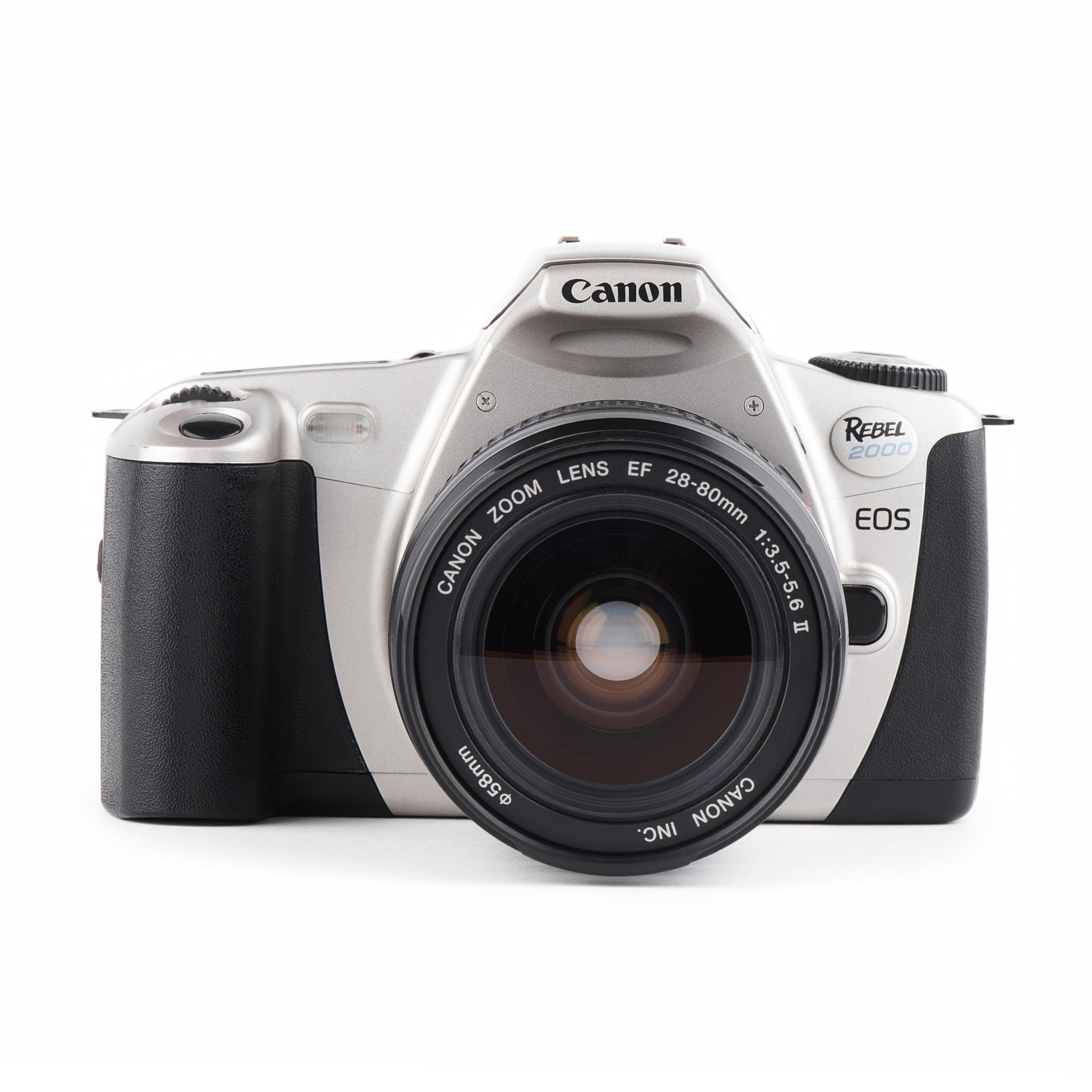
The EF-mount autofocus body that loads, advances, and rewinds film for you
Here is the contrast with the AE-1 above, and it is a big one. The AE-1 asks you to focus by hand and minds a narrow ISO window. This Rebel 2000 covers ISO 100-400 and lets the camera do the work: a 7-point autofocus system picks the focus point for you, so you can shoot a moving kid or a walking dog without hunting for focus. Loading is automatic, advancing is automatic, rewinding is automatic — you drop the film in, close the back, and shoot.
The 28-80mm zoom lens in the box does the rest of the work. It covers moderate wide-angle through short telephoto, which is the exact range you want for travel, family gatherings, and street shooting. You get four exposure paths — Program AE, Aperture Priority, Shutter Priority, and Manual — so you can be as hands-off or as hands-on as your mood allows. There is also a built-in pop-up flash for indoor shots and for filling in shadows on a bright day.
Owners describe exactly the pattern you would hope for from a workhorse: functionality comes in as the strongest positive here, with everyday use right behind it. In plain terms, this is the body people keep in a bag and use constantly rather than one that sits on a shelf. The limitation to go in with clear eyes is the metering window — at ISO 100-400 it is the narrowest in this group, so specialty slow film and pushed high-speed stocks are off the table compared to the Rebel X below.
Where it wins: automatic film loading, advancing, and rewinding remove every fiddly step that trips up new film shooters.
Where it stops short: the ISO 100-400 range is the tightest of these seven bodies, so slow emulsions and pushed film are not options.
Grab this one if: you want a film camera that behaves like a modern one — autofocus, auto advance, built-in flash — and you shoot standard-speed film.
Step up instead if: you want to experiment with slow black-and-white or pushed film, where the wider ISO range of the Rebel X is the difference.
3. Canon EOS Rebel G 35MM SLR Film Camera
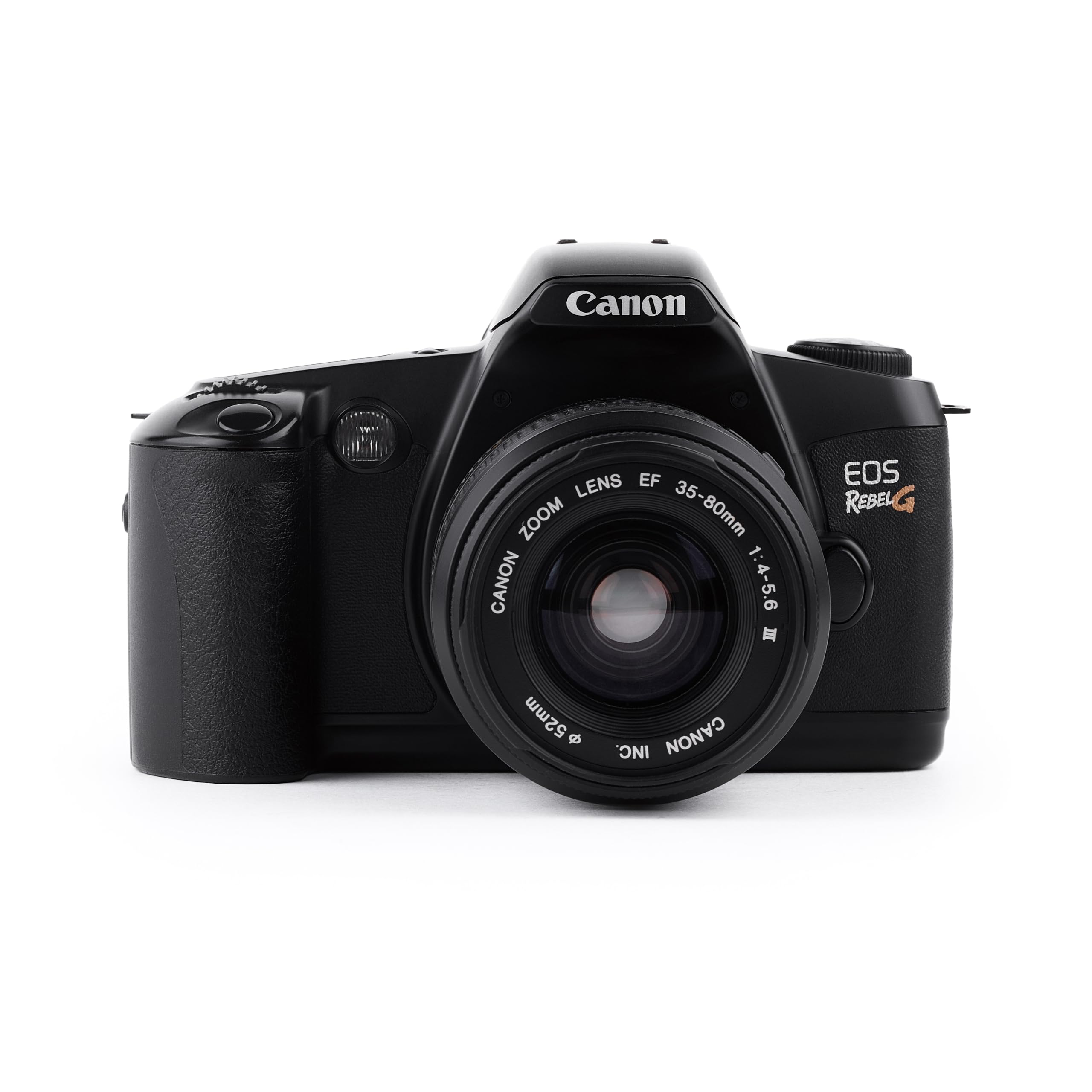
The EF-mount starter kit that ships with batteries and a strap already fitted
If you have never loaded film and have a class to pass, this is the least frightening way in. It arrives ready to shoot — the kit includes batteries already fitted and a strap, so you can loRebel G above depends on the individual unit’s condition — and condition is exactly where this listing earns its place. Owners consistently describe bodies arriving in excellent shape with a newer quality lens, lens cap, neck strap, and battery included, with the meter, screen, and buttons all working.
What you get functionally is a wide-area autofocus point that locks onto portraits, landscapes, and action without drama, plus an LCD display that makes settings readable for someone new to film. Shooting modes run the familiar ladder: full auto, program, aperture priority, and shutter priority. ISO coverage spans 100-3200, which is wider than the Rebel 2000 and Rebel G and narrower than the Rebel X — a sensible middle ground that covers everyday color film and most black-and-white stocks. Maximum shutter speed is 30 seconds.
The mixed signal to understand is photo quality: some owners get results they call amazing, while others describe dark lines in their photos. Those dark lines usually trace back to the film or the processing rather than the body, so it is worth running your first roll through a lab you trust before judging the camera. The condition and value feedback, by contrast, is uniformly warm — people are surprised by how well a three-decade-old body holds up, describing only a faint bruise or scratch.
What buyers keep coming back to: condition — these bodies arrive clean, complete, and ready to shoot, with the lens described as genuinely good.
What to factor in: photo quality draws a mixed response, with some owners seeing dark lines, so test a roll before you rely on it.
Pick this if: you want the beginner-friendly Rebel G experience but you value arriving in excellent shape over saving the last few dollars.
Look elsewhere if: you need the widest film-speed window, where the Rebel X clearly leads on metering.
4. Canon AE-1 Program 35mm SLR Film Camera
< to ISO 6-6400, as on the Rebel X, and you can meter very slow fine-grain film at one end and fast low-light film at the other. The wider the window, the fewer creative limits you bump into — but a narrower range is not a defect, it just tells you which film stocks to buy.
Shutter speed range and what you can shoot
Shutter speed is how long the film is exposed, and the range tells you the conditions the body can serve. A fast end like 1/2000 second lets you freeze motion in bright daylight. A slow end of 2 or 30 seconds, plus Bulb mode, lets you shoot on a tripod at night or capture light trails. Bulb mode simply means the shutter stays open as long as you hold the release, which is why it only makes sense with the camera on a tripod and a cable release attached.
Autofocus versus manual focus with film
EF-mount EOS bodies here focus themselves, using either a 7-point system or a wide-area autofocus point, which is a big help if you wear glasses or shoot moving subjects. FD-mount bodies like the AE-1 and A-1 rely on you turning the lens ring, using a split-image viewfinder to confirm focus. Neither is better outright — autofocus is faster and easier, manual focus is more tactile and generally cheaper to buy into because FD glass is plentiful.
What renewed condition really tells you
Renewed means the seller inspected and tested the body, but the depth of that inspection varies. The parts that most often fail on old film bodies are the light meter and the shutter — the meter stops reading light accurately, or the shutter fires once and jams. A body can look cosmetically perfect and still have either problem. That is why the smart move on every pick here is to run one inexpensive test roll before you trust the camera with a shoot you care about.
Common Questions
Can I use modern EF lenses on the older FD-mount Canon bodies?
What does the ISO range on a film camera actually control?
Is a renewed film camera worth buying over a used one from a marketplace seller?
Why do some renewed bodies arrive with dust behind the lens?
What is Bulb mode and when would I use it on a Canon film SLR?
Do these film cameras need batteries to work at all?
How do I test a renewed film camera before trusting it with a real shoot?
Can I shoot black-and-white film in any of these Canon bodies?
What is the difference between the EOS Rebel G and the New EOS Kiss?
The Bottom Line
The best pick here for most people who want the classic film experience is the Vintage Canon AE-1 with the 50mm 1:1.8 lens, because its ISO 12-3200 metering and 1/1000-to-2-second shutter range cover nearly everything a film shooter tries, and it carries the most positive owner feedback in the group. If you want the camera to handle focus and film advance for you, the Canon Rebel 2000 brings 7-point autofocus and a 28-80mm zoom to the table. For anyone who needs the widest possible film-speed window in one body, the Canon EOS Rebel X is the one to reach for.
One nudge before you commit: whatever body you choose, budget for a test roll — the light meter and the shutter are the two parts that decide whether a renewed film camera turns out to be a keeper, and a single cheap roll tells you that in an afternoon.
How we choose
We do not accept paid placement. Every pick is matched to a real buyer and a real use-case; we do not hands-on test units.
Sources
Specifications: manufacturer listings and product documentation. Review insights: verified customer reviews, as of October 2026. Pricing: not shown on this page (it changes often); check the current price via the retailer link.
As an Amazon Associate, Home Digitized earns from qualifying purchases. This does not affect which products we feature.