
Specs are compiled from manufacturer listings and verified buyer reviews and can change over time — please confirm the key details on the product page before buying.
You already know the problem: the castle shot from forty rows back, the parade float that turns into a smudge, the character meet-and-greet where your phone just cannot keep up. A theme park is the hardest place on earth to take a photograph. The light swings from blinding midday sun to pitch-dark rides in seconds, the crowds push you further from the stage than you planned, and you are juggling a bag, a stroller, and a melting snack while trying to press the shutter. So the camera you want is not the fanciest one — it is the one that gets out of your bag fast, zooms far enough to beat the crowd, and still has power left when the fireworks start.
This guide is built by comparing the manufacturers’ published specifications and the patterns across verified customer reviews, so you get each pick’s real strengths and trade-offs instead of marketing spin.
Below you will find point-and-shoots, bridge cameras, and mirrorless kits, sorted by how they actually behave on a park day. Every pick here is a real option; the trick is matching the one that suits your bag and your hands to the way you shoot. These are the cameras for disney world that make the most sense to carry.
Top Picks


How To Choose The Best Cameras for Disney World
Three things decide whether you come home with keepers or a card full of blur: reach, light gathering, and how fast the thing comes out of your bag. Get those right and the brand printed on the front stops mattering.
Zoom reach is the park superpower
Parades, stage shows, and character greetings almost always put you further away than you want to be. Optical zoom — real lens reach that magnifies without softening the image — is what closes that gap. A digital zoom simply crops and enlarges the pixels you already have, which is why those shots look grainy. If your trip centers on shows and parades, a longer optical reach pays off more than a bigger sensor.
Sensor size and low light
Dark rides, evening shows, and restaurants all test how well a camera handles dim light. A larger sensor gathers more light, which usually means cleaner images when the sun drops. That is why a mirrorless camera with a bigger sensor tends to pull ahead indoors, while a small point-and-shoot with a long zoom is easier to carry all day and better for outdoor reach.
Side-by-Side Comparison
| Model | Best For | Sensor | Optical Zoom | Power | Amazon |
|---|---|---|---|---|---|
| Sony Alpha a6400★ Best Overall | All-day photo and video | 24.2 MP APS-C | — (interchangeable lens) | Rechargeable NP-FW50 | Amazon |
| Kodak PIXPRO AZ255Best Value | Beginners who want easy reach | 16 MP CMOS | 25x | 4 AA batteries | Amazon |
| Kodak PIXPRO AZ528Longest Reach | Long-reach travelers | 16 MP BSI CMOS | 52x | Rechargeable Li-ion | Amazon |
| Canon EOS R100 | First mirrorless kit | 24.1 MP APS-C | — (18-45mm kit lens) | Rechargeable Li-ion | Amazon |
| Panasonic LUMIX ZS99 | Concerts and stage shows | — | 30x | USB Type-C charging | Amazon |
| Canon EOS R50 | Content creators | — | — (18-45mm kit lens) | Rechargeable Li-ion | Amazon |
| OM SYSTEM E-M10 Mark IV | Handheld stability | 20 MP Live MOS | 3.0x (14-42mm kit lens) | — | Amazon |
| Nikon Z 50 | Two-lens one-bag travel | 20.9 MP | — (two kit lenses) | — | Amazon |
| Sony RX100 VII | Discreet premium pocket carry | 20.1 MP 1.0-Type | 8.3x (24-200mm) | Rechargeable | Amazon |
Detailed Reviews
1. Sony Alpha a6400 APS-C Mirrorless Camera Body 4K Black
Our pick — 4.5+★ from 600+ verified ratings; the strongest balance of quality and price.
The autofocus machine that locks onto a dancing character before you finish lifting it
The a6400 earns its spot with one number: 0.02 seconds to lock focus, which Sony claims is the fastest autofocus speed in this camera. In plain terms, it grabs a moving subject almost the moment you raise it to your eye — so when a parade float rolls past and you have a two-second window, you still get the shot. Real-time tracking and object tracking (features that follow a face or a body as it moves) keep a kid running toward a character sharp without you chasing them with the shutter button.
The reach comes from the lens, not the body. This listing is the camera body only, so you pick the zoom yourself through the E-mount system, and the body carries 850 autofocus points. For scale, the Kodak PIXPRO AZ255 runs 25 autofocus points — a 34x gap in focusing coverage that shows up as more shots where the subject is sharp and the background falls where it should. The 24.2 MP APS-C sensor also out-resolves the AZ255’s 16 MP sensor; that is 51% more resolution, which gives you room to crop a distant shot later without it falling apart.
The flip screen tilts up for vlogging and down for self-portraits, and the body records 4K (ultra-high-definition video) with time-lapse and slow/quick motion without any editing. One catch worth planning around: battery life is the weak spot, and the running advice from long-term users is to carry spares — as buyers put it, “Only con: short battery life (carry 3).” A second and third NP-FW50 pack (Sony’s rechargeable battery for this camera) cost little and turn a half-day camera into a full one. It holds 4.5+ stars across 600+ owners, the highest rating in this guide.
Why it earns the top spot
- 0.02 sec autofocus with real-time subject and object tracking keeps moving characters and parade floats sharp.
- 850 autofocus points across 84% of the sensor — far broader coverage than the 25-point Kodak AZ255 and its 34x gap.
- 24.2 MP APS-C sensor out-resolves the 16 MP AZ255 — 51% more resolution for cropping distant shots.
- 4K video with time-lapse and slow/quick motion built in, no post-processing needed.
Where it asks something of you
- Battery life runs short on long park days — budget for spare NP-FW50 packs.
- Body-only listing means you buy a lens separately.
Best for: shooters who want fast, reliable autofocus for both stills and film on the same trip.
Think twice if: you would rather not buy lenses and spare batteries separately.
2. KODAK PIXPRO AZ255 Digital Camera
The camera that runs on gas-station batteries and still reaches the far float
Here is the one feature that should sell this camera to anyone traveling with a family: it runs on standard AA batteries. No proprietary pack to charge overnight, no wall outlet hunted down in a hotel room. If you run dry halfway through the day, you buy four AA cells at any park kiosk or grocery store and keep shooting. That single design choice removes the biggest power anxiety of a long park day, and it is why the AZ255 keeps showing up in bags alongside trip snacks.
Reach comes from a 25x optical zoom built on a 24mm wide-angle lens, so you get sweeping landscape shots at one end and pulled-in shots of stage performers and kids on a field at the other. Optical image stabilization counters hand shake at long range, which is the difference between a keeper and a blurred frame when you cannot step closer — and in a theme park, you almost never can. Video tops out at 1080p Full HD, and it takes Class 10 SD, SDHC, or SDXC cards up to 512GB.
The honest picture: this is a starter camera, and its 25 autofocus points are a fraction of the Sony a6400’s 850. Reviews split along exactly those lines — the ones who love it shoot outdoors in good light and get sharp, detailed results, while the indoor-low-light crowd is thinner on praise. In practice, a lens hood or a little shade on the zoom will sharpen up shots on blinding afternoons. One long-term note to weigh: a buyer who shot with it for over two years reported a small dark spot eventually appearing on the sensor that could not be cleaned. At 4.0+ stars across a couple hundred owners, it is the cheapest way to start shooting a park trip.
The AA advantage: Standard AA cells mean you can refill power any place that sells batteries — a genuine plus for a full day away from a charger.
Realistic expectations: Its 25 autofocus points and 16 MP sensor sit well below the mirrorless picks here, so count on it for bright outdoor shooting rather than dark rides.
Pick this if: you want a low-stress first camera that never needs a wall charger.
Pair it with: a spare set of AA cells and a Class 10 SD card, since neither is a given from the box.
3. Kodak PIXPRO AZ528 Digital Camera
Double the optical reach of the AZ255, so the back row stops mattering
If one number decides this pick, it is 52x. That is the optical zoom on the AZ528, and it is twice the 25x of the Kodak PIXPRO AZ255 — a 2.1x gap in real glass reach. In a theme park, that gap is the whole game: it means pulling in a performer across the full width of a plaza or catching the detail on a rooftop without ever leaving your spot in the crowd. It also keeps the camera happy in one bag for the whole day.
The 16MP BSI CMOS sensor adds a backside-illuminated design for better low-light performance, and the built-in optical stabilization keeps long-range handheld shots crisp without a tripod. Burst mode shoots 6fps to catch fast action and let you keep the sharpest frame on the 3in LCD. Wi-Fi means you can transfer straight to your phone from the field or use the phone as a live remote viewfinder, and video records at 1080p Full HD. Cards up to 1.5TB and a rechargeable Li-ion pack keep sessions running.
Two honest notes from owner experience. Reviews on picture quality and zoom land mixed — many call the zoom phenomenal, some report blur, and the fix either way is the same: brace your elbows or the camera against a railing, because at full 52x (the lens’s maximum zoom, which magnifies the scene 52 times) any small motion shows. And there is no viewfinder (the small eyepiece you look through) on this model, so a bright midday screen can be hard to read; tilt the screen down rather than fighting the sun. It holds 4.0+ stars across 700+ owners who accept its low-light limits.
Reach is the headline: 52x optical more than doubles the AZ255’s 25x, so you get stage and parade shots the shorter cameras cannot attempt.
Steady hands required: At full zoom, mild blur is the common knock — a railing or a firm grip keeps it sharp.
Made for: travelers who want the biggest zoom in the smallest bag without buying lenses.
Set expectations on: there is no viewfinder, so plan on angling the screen away from direct sun.
4. Canon EOS R100 Mirrorless Camera

A full mirrorless kit you can hand to a beginner and still get sharp photos
The R100 is the friendliest way into mirrorless photography (a camera with interchangeable lenses but no mirror inside): it arrives as a complete kit with the body and a Canon RF-S 18-45mm f/4.5-6.3 IS STM lens already paired. The camera carries a 24.1MP APS-C CMOS sensor (a 24.1-megapixel image chip that captures the picture) with the DIGIC 8 image processor (the chip that turns that data into a photo), and it uses Dual Pixel CMOS AF across 143 AF zones (autofocus points that lock onto your subject) — fast, accurate focusing that tracks faces and people so the moment you press halfway is the moment it is ready. Auto scene modes and a simplified menu take the guesswork out for anyone stepping up from a phone.
The included 18-45mm lens handles the bread-and-butter shots — family portraits, daily snapshots, travel landscapes — and built-in image stabilization in the lens steadies handheld shots. The kit also brings Wi-Fi and Bluetooth for quick phone transfers, a 2.36m-dot OLED electronic viewfinder, and a 3″ 1.04m-dot LCD. On video it shoots 4K 24p with a crop plus Full HD 60p. Compared with the pricier full-frame kits above, this is the value-focused route into the same Canon autofocus system.
The one design trade-off to note: there is no built-in flash in the box, so you rely on ambient light or an external unit — fine for parks where the lighting is strong, less so for dark corners. Owners rate it 4.5+ stars and consistently call it a complete starter kit that needs nothing else to begin. Build-wise, check the neck strap before a big day out, as it has been known to slip.
One buyer sums the appeal: the R100 is a complete, easy, all-you-need starter — a kit that quietly upgrades the moment you add a longer lens.
Go here if: you want mirrorless quality with no separate lens shopping and a gentle learning curve.
Weigh this: you will want a slip-on flash for dim interiors since none is included.
5. Panasonic LUMIX TZ/ZS99 Point and Shoot Camera

Pocket-sized with a 24-720mm Leica lens that pulls the stage right to you
This is the camera a concert or stage-show goer wants: a 24-720mm Leica lens with 30x optical zoom that still slips into a pocket. That range covers a wide crowd shot and a tight zoom on a performer’s face from wherever your seat turns out to be, and it does it without the bulk of a mirrorless kit. Video reaches 4K at 30p, 4K PHOTO bursts run at 30fps, and there is HD high-speed video at 120fps for slow-motion moments like parades and outdoor shows.
Travel-friendly extras carry the day here. The 1,840k-dot tiltable touchscreen lets you shoot from any angle — handy when you are stuck behind a taller row or holding the camera above a crowd. It charges over USB Type-C, so one cable covers it alongside your phone, and built-in Bluetooth v5.0 plus a dedicated Send Image button pushes photos and videos straight to your smartphone through the Panasonic Image App.
The mixed feedback is worth naming honestly: image quality draws split reviews, and users who shoot indoors or at night notice noise (grainy speckles in the picture) above ISO 1600 (the camera’s sensitivity setting for low light). A couple have flagged grey-market units sold without a US warranty, so check the seller before buying. But the zoom earns consistent praise, battery life held up through a full evening for more than one owner, and At 4.0+ stars across 600+ owners, its 30x zoom is a lot of reach for the price. — provided you shoot in decent light.
What wins people over: a 720mm zoom in a body this small, with 4K video and a tiltable screen built in.
Where it stumbles: Noisier at the high end of the ISO range, and there’s no flash to fall back on indoors.
Right for: travelers who prize reach and portability above a big sensor and shoot mostly outdoors.
Look elsewhere if: you shoot a lot of dark-ride and restaurant shots in tough light.
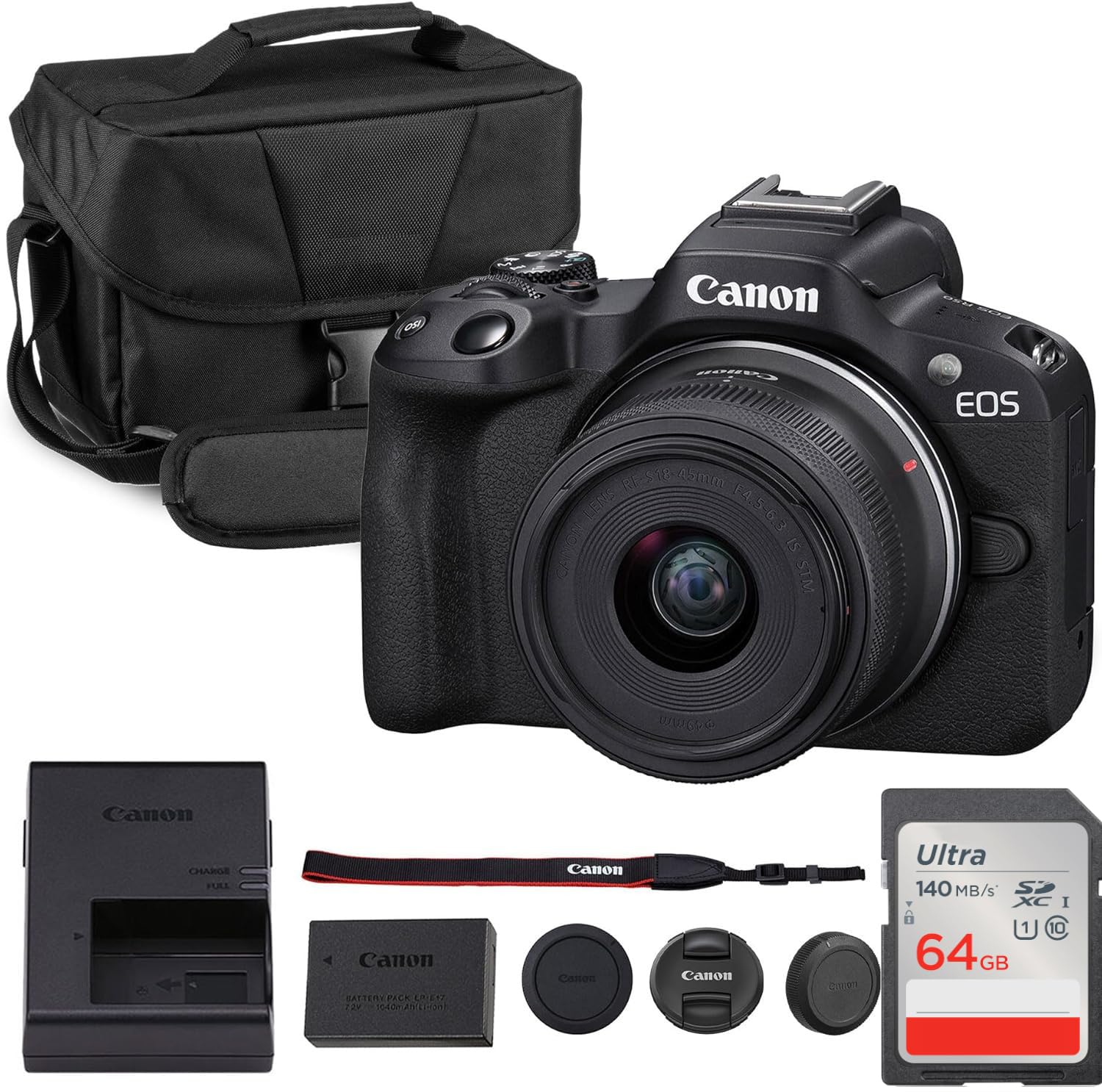
6. Canon EOS R50 Mirrorless Camera with 18-45mm Lens Bundle
A mirrorless built for filming your day out, then posting it before the ride ends
If your park trip is really a content trip — vlogs, reels, clips for the family group chat — the R50 is designed around exactly that. It shoots oversampled 4K with Dual Pixel autofocus, which means sharp, smooth footage with reliable subject tracking, face and eye detection keeping whoever is on camera crisp as they move. That autofocus works across 99 autofocus points and switches cleanly between stills and video.
The kit bundles the Canon RF-S 18-45mm f/4.5-6.3 IS STM lens, a compact zoom covering wide to standard focal lengths with image stabilization and a smooth STM motor for quiet focusing. For park use that range covers walk-around shots, portraits at a character greeting, and the wide crowd views you want for a parade’s background. Creative Assist gives in-camera guides, and vertical video tools mean you can shoot straight to a social-ready format instead of cropping later.
The sensor is 10-bit with an SDXC card slot, and it is a strong step up from a phone for the whole shooting day. One thing to plan for: there is no built-in flash, so nighttime shots lean on the available light — the pop of a fireworks show is fine, a pitch-black ride is not where it shines. Owners rate it 4.5+ stars and repeatedly call it easy to carry, with image quality that beats a phone.
The creator’s case: Oversampled 4K with Dual Pixel AF and vertical video support means fewer edits and faster sharing.
Note before you buy: No built-in flash means low-light shots depend on available light.
Choose this if: you shoot as much video as photos and want it social-ready straight from the camera.
Not for: anyone who needs a built-in flash or a longer zoom without adding a second lens.
7. OM SYSTEM Olympus E-M10 Mark IV Camera

In-body stabilization that lets you shoot fireworks handheld, no tripod needed
The standout spec here is in-body 5-axis image stabilization that compensates for hand shake up to 4.5 shutter speed steps. In practice, that means you can shoot in noticeably dimmer light without a tripod and still get a usable frame — exactly what a dark ride exit, a night parade, or a fireworks finale demands. The 20MP Live MOS sensor delivers clean detail, and the flip-down monitor even has a dedicated selfie mode that turns on automatically when you flip it down.
Connectivity is handled by Bluetooth and background connection through the OI Share app, so your phone stays paired for quick transfers. If you like creative looks, there are 16 Art Filters with 31 types, including an Instant Film mode for a nostalgic feel. The bundled 14-42mm zoom covers a general walk-around range, and with the compact pancake option the whole kit becomes genuinely pocketable for everyday carry.
Two practical notes from owners. The kit lens cap is tiny and easy to lose, and the screen only flips down, so self-shooting means guessing your framing. It holds 4.5+ stars across 400+ owners, and the praise is consistent on image quality and value.
Stabilization is the win: 4.5 stops of shake compensation keeps handheld shots sharp when light is low.
Small caveat: A non-articulating screen and a fiddly little lens cap are the everyday annoyances.
Best match for: shooters who hate carrying a tripod and want clean low-light handheld results.
Consider a different pick if: you want a fully articulating screen for selfie framing.
8. Nikon Z 50 with Two Lenses

Two lenses in one bag: wide for arrival shots, telephoto for the parade
What makes the Z 50 kit stand out is that it ships with two lenses instead of one. The 16-50mm covers the wide end for group shots in front of the castle and everyday walk-around views, and the 50-250mm takes over for the telephoto work (zoomed-in shots of distant subjects) — a parade float, a stage performer, a character across a plaza. Swapping between them covers nearly every park scenario without buying anything extra.
The body uses a 20.9MP sensor and a large 55mm lens mount, the first DX-format mirrorless to adopt it, which helps with image quality and low-light performance. A selfie flip-down touch LCD makes it straightforward for self-portraits and vlogging, and Wi-Fi plus Bluetooth pair easily to a phone for transfers. Video shoots 4K UHD, and autofocus spans 209 points across contrast and phase detection. Owners praise the picture quality and compact size, and one called the 16-50mm and 50-250mm “Z” lenses amazing for the kit. The two lenses retract for easy backpack storage.
Battery life is the caveat to plan around, since reviews show mixed experiences with charging. But the sharper boundary is lens choice: outside the two DX lenses included, useful Z-mount options thin out fast, so if you dream of adding primes or a wide lens later, this system leaves less room to grow. For a trip-photography shopper, though, the two-in-one kit is hard to overlook at 4.5+ stars across 400+ owners.
Two lenses, one bag: Wide 16-50mm and telephoto 50-250mm cover arrivals and parades without extra purchases.
Plan around this: Mixed reports on battery charging, and the Z DX lens lineup is thin beyond the two included.
Suits: travelers who want both wide and telephoto reach handled from the start.
Not for: a long-term lens collector who wants a wide array of native primes to grow into.
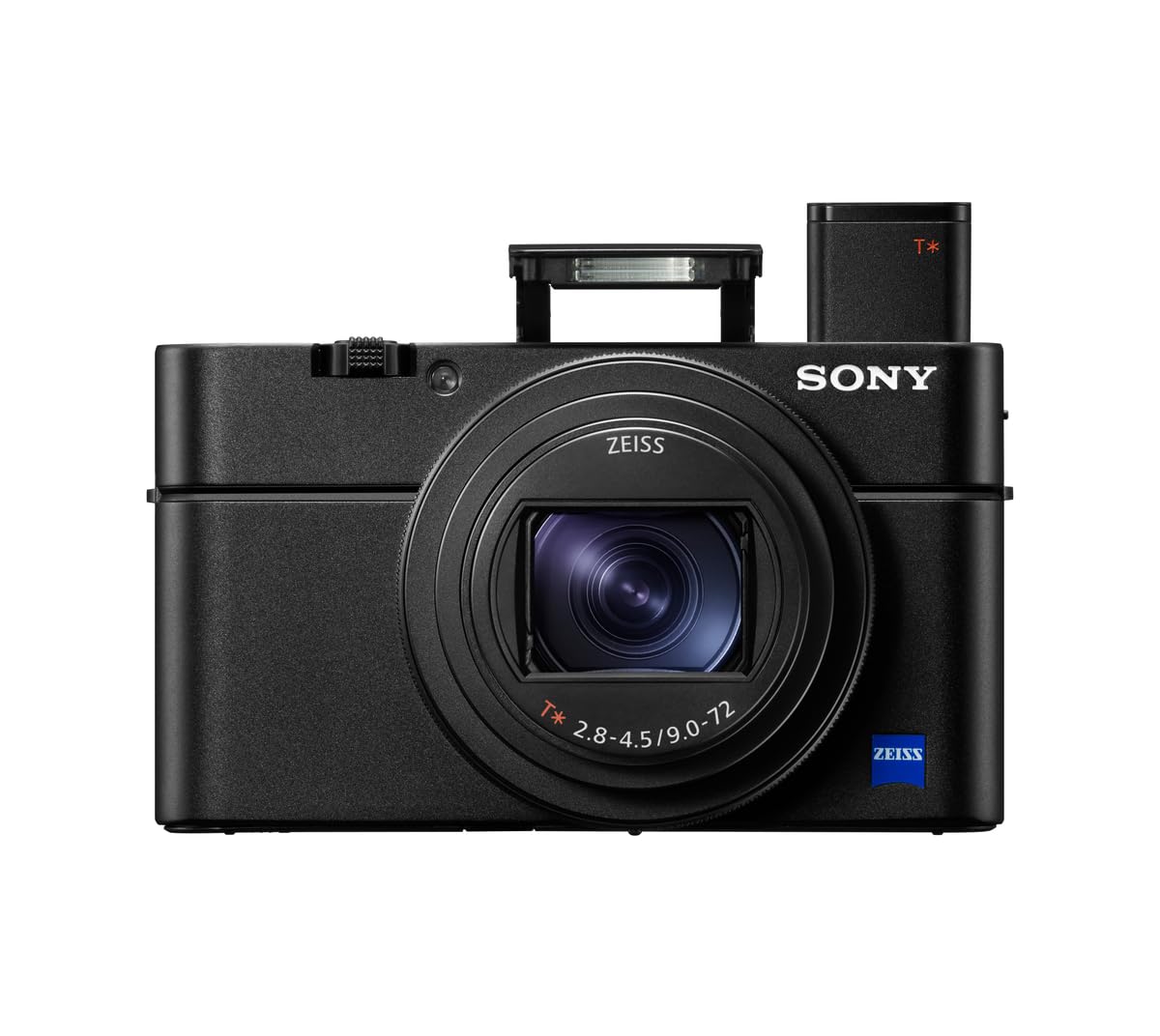
9. Sony RX100 VII Compact Camera
Pro-grade speed in a body small enough to hide in a park bag pocket
This is the camera for someone who wants mirrorless speed without the bulk. It packs a 20.1MP 1.0-type stacked CMOS sensor behind a Zeiss Vario Sonnar T 24-200mm f/2.8-4.5 zoom lens — a genuine wide-to-telephoto range in something that vanishes into a purse or a loose pocket. Autofocus locks in 0.02 seconds using 357-point phase detection plus 425-point contrast detection, so subjects come into focus almost before you realize you pressed the button.
Speed is the theme. It shoots up to 20fps blackout-free, running AF and AE calculations up to 60 times per second — so a fast character or a moving parade element stays tracked and captured rather than missed. AI-based real-time tracking follows subjects in stills and video, with real-time eye AF for people and animals. Video records 4K with S-Log3, a microphone jack, and Active mode stabilization, which is why the RX100 VII gets called a pocket camera that matches up with serious bodies.
Two real-world notes. It is priced like the premium camera it is, and it is not weather sealed (protected against rain and dust), so a sudden downpour is a reason to tuck it away. It is also slippery and small, and owners commonly add an aftermarket grip for a firmer hold. Owners consistently praise the 24-200mm Zeiss zoom for covering wide to telephoto in a pocket-sized body. At 4.0+ stars across 600+ owners, the value really depends on if you need that speed in your pocket.
Speed in your pocket: 20fps blackout-free shooting with AI real-time tracking matches much larger cameras.
Non-negotiable extras: Not weather sealed and slippery — a case and a grip are wise additions.
Right for: photographers who want one discreet pocket camera for both stills and 4K video.
Weigh the premium: The high price and lack of weather sealing mean you’re paying for speed and portability, not ruggedness.
Know the Specs
Optical zoom vs digital zoom
Optical zoom uses the glass lens to magnify a distant subject for real, keeping detail intact. Digital zoom just enlarges pixels you already captured, which is why those shots look soft and grainy. For parade and stage shots, optical reach is what counts — and the differences are real: the Kodak PIXPRO AZ528 runs 52x optical against the Kodak PIXPRO AZ255’s 25x, more than double the glass reach. The Panasonic LUMIX ZS99 sits at 30x on a 24-720mm lens, and the Sony RX100 VII covers a 24-200mm range in a far smaller body.
Autofocus points and speed
Autofocus points are the zones the camera can lock onto a subject within — more points and faster lock means fewer missed shots when something moves. The Sony Alpha a6400 claims 0.02-second autofocus with 850 points, while the Kodak PIXPRO AZ255 offers 25 points. That gap matters most with fast subjects: a dancing character or moving parade element stays sharp with wide coverage, and slips soft with sparse coverage. Speed of lock and number of points are the two numbers to weigh.
Sensor size and low light
A bigger sensor gathers more light, which tends to mean cleaner images when the sun goes down or inside a dark ride. APS-C sensors, like the 24.2 MP one in the Sony a6400 or the 24.1 MP in the Canon EOS R100, are larger than the 1.0-type sensor in the Sony RX100 VII and the compact sensors in the point-and-shoots. Larger sensors often handle low light better, though they usually mean a bigger, heavier camera to carry all day.
Power and memory for a full park day
How a camera takes power decides how many spares you pack. AA batteries, as in the Kodak PIXPRO AZ255, can be topped up from any store that sells batteries. Rechargeable packs mean carrying spares or a charger, and in-camera USB charging, like the USB Type-C on the Panasonic LUMIX ZS99, means one cable can top it up from a power bank. On memory, a Class 10 SD card is the standard — the AZ255 takes cards up to 512GB, while the AZ528 accepts up to 1.5TB, plenty for a trip’s photos and video.
Common Questions
Do I need a camera at all if my phone takes good photos?
How much optical zoom do I really need for parades and stage shows?
Will a micro SD card work in these cameras?
Can I take these cameras on rides and into the parks?
Is a mirrorless camera better than a point-and-shoot for a park day?
How do I transfer photos to my phone while I’m still in the park?
Will I be able to shoot in low light on dark rides?
Are the batteries easy to replace mid-trip?
Do any of these come with a lens already included?
Can I attach an external flash or microphone to these?
The Bottom Line
For most people, the best cameras for Disney World start with the Sony Alpha a6400 because its 0.02-second autofocus and 850 focus points keep moving subjects sharp whether you shoot stills or video. If you want maximum reach without buying lenses, the Kodak PIXPRO AZ528 with its 52x optical zoom and built-in Wi-Fi is the easy grab. And for a low-stress, never-needs-a-charger first camera, the Kodak PIXPRO AZ255 running on ordinary AA cells is the one to pocket on the way out the door.
How we choose
We do not accept paid placement. Every pick is matched to a real buyer and a real use-case; we do not hands-on test units.
Sources
Specifications: manufacturer listings and product documentation. Review insights: verified customer reviews, as of October 2026. Pricing: not shown on this page (it changes often); check the current price via the retailer link.
As an Amazon Associate, Home Digitized earns from qualifying purchases. This does not affect which products we feature.