
Specs are compiled from manufacturer listings and verified buyer reviews and can change over time — please confirm the key details on the product page before buying.
Most hand pruners fail the same way: the blade dulls, the handles rub a blister, and a branch that should snap clean instead crushes and bruises the plant. The pruners worth your money keep cutting after the first hundred snips, not just the first ten. This guide breaks down nine genuinely well-regarded models by what actually matters at the cutting edge: blade steel and type, cutting capacity, handle feel, and whether the moving parts can be replaced instead of thrown away.
This guide is built by comparing the manufacturers’ published specifications and the patterns across verified customer reviews, so you get each pick’s real strengths and trade-offs instead of marketing spin.
Some pruners are built to be sharpened and handed down, others to be light enough for all-day pruning on small hands, and the difference shows up fast in the wrist. Match the tool to your hand and your branches, and you will stop buying replacements every season.
Top Picks


How To Choose The Best Rated Hand Pruners
You will notice three things about hand pruners only after you have used them: how the blade meets the branch, how the handle fits your hand, and whether you can service the tool or must replace it.
Blade type: bypass versus anvil
A bypass pruner works like scissors, with one curved blade sweeping past a hook to slice cleanly through living wood. That clean cut heals faster on green stems and shrubs. An anvil pruner instead presses the blade down onto a flat plate, which crushes the cut a little but handles dry, dead, or woody branches with less effort. Most gardeners keep a bypass for everyday trimming and reach for an anvil when branches are old and hard.
Cutting capacity and blade size
Every pruner is rated for a maximum branch thickness, often given in inches or millimeters. Stay within that limit and the cut stays clean; force it past the rating and you bruise the plant and strain your hand. If your branches regularly run thicker than the rated cut, you want loppers or a small saw instead.
Handle fit and hand size
Handle length and grip width decide whether the pruner feels like an extension of your hand or a fight. Small-handed gardeners do better with short, narrow handles and sometimes an adjustable dial to close the gap. Rotating handles reduce friction during a long session, though they take some getting used to. Left-handed gardeners should look specifically for a left-hand model rather than trying to adapt a right-handed one.
Serviceability and blade steel
Pruners with replaceable blades and springs last far longer than sealed throwaway tools, because a sharpening or a worn spring does not end the tool’s life. High-carbon and hardened steels hold an edge well but can rust if left wet, so a quick wipe after use pays off over the seasons.
Side-by-Side Comparison
| Model | Best For | Blade Type | Cut Capacity | Replaceable Parts | Amazon |
|---|---|---|---|---|---|
| Felco F2★ Best Overall | All-around pro use | Anvil | 1 inch | Every component | Amazon |
| Okatsune 103Best Value | Japanese-steel value | Bypass | — | — | Amazon |
| Corona BP 4214D Flex DialBest for Small Hands | Small hands, adjustable fit | Bypass | 3/4 inch | — | Amazon |
| ARS HP-VS8R | Long sessions, less strain | Bypass | 15 mm | — | Amazon |
| Corona BP 6250 MAXFORGED | Large branches on a budget | Bypass | 1 inch | Blade | Amazon |
| Original LÖWE 1.104 | Hard, dry, old wood | Anvil | 22 mm | All parts | Amazon |
| KAKURI Japanese Shears | Bonsai and fine trimming | Bypass | 8 inch | — | Amazon |
| ARS ARS-VS-8XZ | Small hands, quick release | Parrot Beak | 22 mm | Blade | Amazon |
| Felco F9 | Left-handed gardeners | Bypass | 1 inch | — | Amazon |
Detailed Reviews
1. Felco F2 Pruning Shears
Our pick — 4.5+★ from 14,000+ verified ratings; the strongest balance of quality and price.
The tool that keeps cutting for years without a single replacement part you cannot buy.
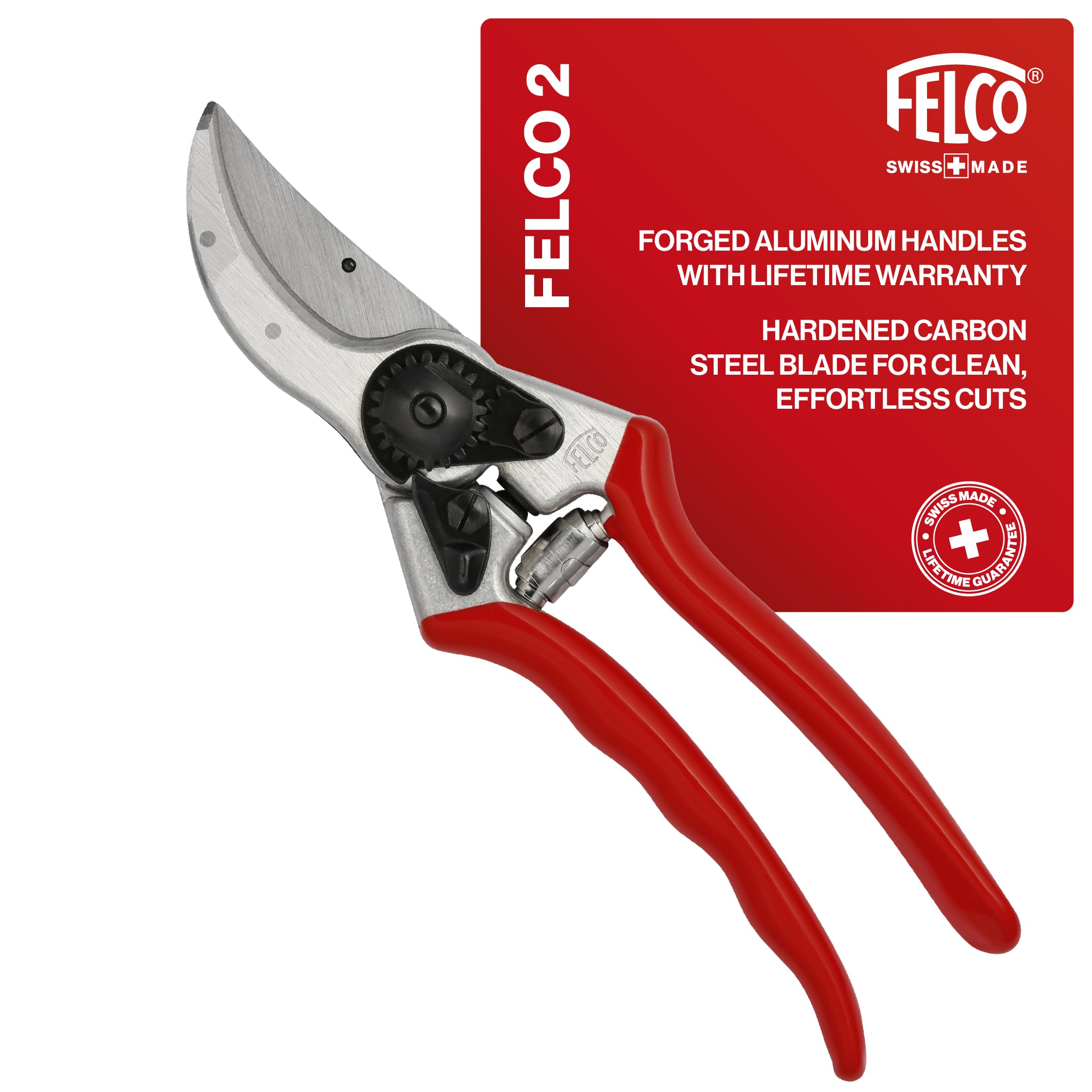
If you prune a lot and want one pair to last, the Felco F2 is the model most professionals fall back on. Its hardened steel blade slices through branches up to 1 inch thick — thick enough for most shrubs and small tree limbs — so you spend less time sawing and more time shaping. The forged aluminum handles are lightweight yet strong, and the maker covers them by a lifetime guarantee. An angled head with a non-slip coating reduces wrist strain, so a long session does not leave you sore. At 9.25″L x 4″W, it is a full-sized tool built for medium to large hands.
The F2’s real advantage is that every component can be replaced or sharpened, so a dulled blade or a tired spring never ends the tool’s life. That is the opposite of disposable pruners. The blade is an anvil type, meaning it presses down onto a flat plate rather than slicing past a hook — great for old, hard wood but a little less gentle on soft green growth than a bypass pruner like the Okatsune 103.
The catch is value. Some owners find the F2 worth every season of use, while others consider it pricier than they expected for a hand tool. Because the whole build is serviceable, it tends to make sense for anyone who prunes regularly — think hedges and shrubs several times a year — rather than the casual once-a-season gardener. As owners put it, the cut is “like a hot knife through butter,” which is the kind of edge you are paying for.
What earns it top spot
- Hardened steel blade rated for branches up to 1 inch thick
- Every component replaceable or sharpenable, so the tool lasts far longer than sealed rivals
- Forged aluminum handles keep the weight down while staying strong
- Angled head and non-slip coating ease strain during long pruning runs
Where it asks for more
- Some buyers find the price steeper than expected for a hand tool
- Anvil blade is less gentle on soft green growth than a bypass option
- Full 9.25″ length suits medium to large hands better than small ones
Buy it if: you prune often and want a tool you can sharpen and rebuild for years.
Think twice if: you only snip a few stems a season and want the lightest possible spend.
2. Okatsune 103 Bypass Pruners
A lightweight Japanese bypass pruner that leaves Felco owners second-guessing their loyalty.
For anyone who wants a genuinely sharp bypass pruner without stretching the budget, the Okatsune 103 is the pick. The blade is made of high-grade blade steel, hand-finished in Japan, and the 5.5-centimeter blade length pairs with a vinyl-coated handle for a non-slip grip. It weighs just 230 g, so it disappears in the hand during long pruning. It is ambidextrous, which means both left- and right-handed gardeners get a clean cut without switching tools — a real plus given how few options serve lefties well.
Owners consistently single out the cutting quality. One 5-star review writes, “These things cut like butter, and the price was great compared to the Felco’s.” Another long-time horticulture worker says they have tried Felco and ARS and always come back to the Okatsune for the sharp edge and easy resharpening. The lock can be flicked open by rubbing it against your hip, which is a nice touch when your hands are full.
Not everything is easy. A few owners note the grip feels narrow when the handles are fully open, which can make thick branches awkward and occasionally nip the skin. The higher-carbon steel can also rust if you leave it wet after use. Those are handling quirks rather than build flaws — if you prefer a wider grip or plan to cut branches above the Okatsune’s rated capacity, a model like the Corona MAXFORGED or a full-sized Felco may suit you better.
Blade quality first: the hand-forged Japanese steel is the standout — sharp from the start and easy to bring back with a few strokes of a stone.
One honest catch: thin handles and a rust-prone high-carbon blade mean you should wipe it dry after every session, or step up to a stainless-friendly pruner.
The smart buy: anyone who wants pro-grade sharpness without pro-grade pricing, especially ambidextrous or left-handed gardeners.
Look elsewhere if: you have large hands or often cut branches over an inch thick.
3. Corona Clipper BP 4214D Flex Dial Bypass Pruner
Dial down the handle spread and this pruner finally fits hands that standard tools ignore.
If a standard pruner always feels like it is fighting your fingers, the Corona BP 4214D is the answer. Its standout feature is an adjustable FlexDial with 8 positions, letting you set how wide the handles sit. A lower number brings the grips closer for a smaller reach; a higher setting opens the blades wider for thicker branches. The Full steel construction and ComfortGel grips round out a tool that is designed to reduce fatigue during longer pruning sessions. Its compact profile is 0.8″L x 4″W, which is dramatically shorter than the 9.25″L x 4″W Felco F2 — a lighter, closer-reach design that suits smaller hands.
The 3/4-inch cutting capacity is where you need to be realistic. That is plenty for thinner stems, roses, and light shrubs, but if you regularly cut branches close to an inch thick you will want a more powerful tool. The coated non-stick blade and ShockGuard bumpers help cuts stay smooth while softening the jolt each time the blades close. Owners repeatedly point to the adjustable fit as the reason they chose it — one 5-star buyer writes, “These are great shears especially for people with smaller hands.”
The one area with mixed feedback is the locking mechanism, so treat the lock gently rather than forcing it. That said, plenty of users find it locks and open up more cleanly than other pruners they have tried. For small-handed gardeners, this is one of the few models that genuinely adjusts to you.
The FlexDial is the whole deal: 8 positions let you close the grip down for small hands or open it up for larger branches without switching tools.
Honest scope note: 3/4-inch capacity and a mixed-review locking mechanism mean this is best treated as a lighter-duty everyday pruner.
Suits you if: small hands or an adjustable fit are your top priority and your branches stay under three-quarters of an inch.
Step up if: you need consistent 1-inch cuts — the Felco F2 or CORONA MAXFORGED handle larger branches better.
4. ARS HP-VS8R Rotating Handle Hand Pruner

A rotating grip built for the gardener whose hands ache after hour three.
The ARS HP-VS8R is aimed at anyone who prunes for hours and wants less friction on their palm. Its defining feature is the rotating handle that rolls with your fingers as you squeeze, cutting down on blisters and hand strain — a real benefit for arthritic hands. The 5.4-centimeter blade is chrome plated and easy to sharpen, and the tool runs 10.4 ounces with 8-inch handles that fit normal-sized hands. Compared with the 5.5-centimeter blade on the Okatsune 103, the ARS blade is a fraction shorter, but the rotating grip is the real point of difference.
The rotating design takes some getting used to. If you are used to a fixed handle, the roll under your fingers can feel odd at first — one owner described it as disconcerting until it clicked. Once it does, the ergonomics pay off. One reviewer with arthritic hands reports four-plus hours of use without gloves or blisters. It is a tool that rewards a little maintenance.
The main gripes are the hard plastic handle, which scratches easily and can feel slick in gloves, and the squeeze-to-open feature that some users dislike. If you want soft rubbery grip material, the Felco F12 or the full-metal Löwe may feel better in your hand. Otherwise, expect genuinely long life if you keep the pivot clean.
Best ergonomics in the test: the rotating handle is the biggest single upgrade for anyone prone to hand or wrist pain.
Note the trade-off: the plastic grip can slip inside gloves and the squeeze-to-open mechanism is not to everyone’s taste.
Reach for this if: you log long pruning days and want the smoothest grip available.
Think again if: you prefer a fixed handle or find squeeze-to-open locks awkward — the Felco F2 is more traditional.
5. Corona Tools BP 6250 MAXFORGED Aluminum Bypass Pruner

A forged-steel bypass pruner that makes easy work of inch-thick branches.
The Corona BP 6250 MAXFORGED is built for anyone whose pruning regularly crosses the one-inch mark. Its precision-honed forged steel blade slices through live branches, woody stems, and green growth up to a full 1 inch, and the blade is replaceable so the tool does not become useless when it dulls. Lightweight aluminum handles keep the 9.6-ounce pruner balanced in the hand, and the contoured non-slip red grips make it easy to spot if you set it down in mulch or grass. A self-cleaning sap groove helps keep the blade from gumming up mid-session — a detail the Okatsune and simpler bypass pruners lack.
Buyers report that it stands comparison with pruners they have trusted for decades. Several owners mention clean, scissor-like cuts on branches up to the 1-inch rating. It also includes a wire-cutting notch and a shock-absorbing bumper, so the tool handles more than just branches.
The most recurring gripe is the locking mechanism — a few owners find the thumb lock fussier than they would like. It does not stop the pruner from cutting, but it is worth knowing before you buy. If you want the same 1-inch capacity with a heavier German feel, the Löwe 1.104 is an anvil alternative worth comparing.
Big-branch specialist: the 1-inch cutting capacity and forged steel blade make it the pick for heavy green growth.
One weak spot: the thumb lock is the one component that divides owners, so treat it with care and it will hold up well.
Pick this for: inch-thick branches and a heavy cutting load without stepping up to loppers.
Consider smaller if: you mostly trim thin stems — the Corona BP 4214D Flex Dial fits that work with a smaller build.
6. Original LÖWE Professional Anvil Pruner 1.104

A German anvil pruner that chews through dead, dry wood without flinching.
The Löwe 1.104 is the anvil pruner to reach for when your branches are old, hard, and stubborn. Its long-lasting carbon steel blade is coated with a sliding lacquer for corrosion protection and reduced friction, and the blade closes onto an anvil plate that presses cleanly through dry limbs rather than slicing past them. It handles 22-millimeter cuts — a genuinely thick branch — and an optimal power transfer built into the mechanism means less effort per squeeze. At 8.27″L x 3.94″W and 290 g, it has a heavier, sturdier feel than most bypass pruners, which some gardeners prefer for bigger hands.
The build is intended for medium to large hands, and all parts are replaceable, including the blade. A one-hand safety lock keeps it secure when you set it down. In use, customers note that it makes easy work of rose stocks and tree branches, and that the one-finger lock works smoothly and stays put. Several say it outlasted Fiskars pruners whose anvil wore out first.
It also runs toward the heavier end of the group. If most of your pruning is green stems, a bypass design is kinder to the plant. But for dry, woody branches, this is a standout tool.
Anvil done right: the carbon steel blade, sliding lacquer coating, and 22-millimeter capacity make dry wood feel easy.
The honest trade-off: it is heavier and it crushes rather than slices green growth, so keep a bypass pruner handy for soft stems.
Suits you if: your pruning skews toward old, dry, woody branches and you want a heavy-duty German build.
Go bypass instead if: you mostly trim green growth — the Okatsune 103 handles living wood more gently.
7. KAKURI Japanese Pruning Shears for Gardening 8″ Heavy Duty

Hand-forged Japanese steel for the gardener who treats precision as the whole point.
The KAKURI 8-inch pruning shears are for anyone who wants a fine, clean cut — bonsai trimming, delicate plant work, and precise branch shaping. The blade is made of Japanese carbon steel, hand-forged by craftsmen and blacksmiths in Sanjo, Japan, and sharp enough to cut with light force rather than a hard squeeze. The 2.3-inch blade pairs with wooden handles, and the whole tool weighs 7.7 ounces, rising to 10.2 ounces with the included natural leather cowhide sheath. There is also more blade length here than the shorter-bladed bypass pruners in this list, giving you more reach in the cut.
Owners who know their pruners tend to be impressed. One Master Gardener with a decade of experience called them the best of twelve-plus brands tried. Others note that they slice through one-inch branches with little effort and that the locking mechanism stays secure. The leather sheath is another nice touch for carrying them around the garden.
The higher-carbon steel that makes them so sharp also rusts more easily if left wet, so you should dry and oil the blade after use. One owner reports the middle spring snapping, which is worth knowing about, and some also find the value-for-money and durability mixed. If you value the highest possible cutting precision and are happy to maintain your tools, this is a great fit; if you want a low-maintenance workhorse, a stainless-steel pruner is a better match.
Precision above all: hand-forged Japanese carbon steel gives clean, light-force cuts that suit fine work like bonsai and delicate trimming.
The maintenance tax: the same high-carbon steel that sharpens beautifully will rust if you skip the dry-and-oil step after each use.
Built for you if: you do precise, careful trimming and do not mind wiping and oiling the blade.
Skip if: you want a hard-use tool you can leave in a bucket — a stainless or heavily coated pruner better fits that life.
8. ARS ARS-VS-8XZ Hand Pruner

A compact Japanese pruner with a one-squeeze release that smaller hands love.
The ARS-VS-8XZ is the pruner for anyone whose hands feel swallowed by full-sized tools. Its 8-inch frame is built to fit regular to smaller hands, and the squeeze-to-release locking mechanism opens the blades with one motion — no fumbling with a thumb catch. The high-carbon tool steel blade is hard chrome plated to resist rust and sap and is specially hardened to keep its edge, and it is replaceable when it finally dulls. At 220 g, it stays light on the wrist during long sessions.
Owners are vocal about the feel. One review reads simply, “They are well built and not flimsy in anyway. The perfect length and feel great in my hand as I have small hands.” Others report the release is quicker than the Felco’s thumb lock. Despite the compact size, it handles branches up to about a half-inch with ease.
The honest caveats: new units can feel stiff for a week or two of daily use, and the plastic handle can slip in gloves. A few owners find the lock sometimes does not fully engage. If you need a lighter tool for small branches, this is a great fit; if you cut thick hardwood all day, a full-size pruner or the ARS HP-VS8R is the better match.
Compact and capable: a proper 8-inch frame with a Japanese hardened blade and a quick squeeze-to-open lock that smaller hands can work one-handed.
Know before you buy: the plastic grips can feel slick in gloves and the mechanism can be stiff for the first week or two.
Best fit for: smaller hands that want an easy, one-handed release in a lightweight Japanese pruner.
Look at the ARS HP-VS8R instead if: you cut branches thicker than a dime day in and day out.
9. Felco F9 Pruning Shears — Left-Handed

The left-handed pruner that ends years of cutting sideways.
If you are left-handed and tired of fighting right-handed tools, the Felco F9 is built specifically for you. The blade is oriented for a left hand, which means you see where you are cutting instead of peering around the handle. It runs 8.3 inches long with a 1-inch cutting capacity, forged aluminum handles, a rotating handle, and ergonomic shock absorbers for comfort. A sap groove and a wire-cutting notch are built in, and the hardened steel blade with screw-mounted anvil ensures reliably clean, precise cuts. At 0.54 lb, it stays light enough for extended work.
Left-handed owners describe an almost instant sense of relief. One review puts it, “We don’t even notice how we struggle being left handed in a right handed world until the tools for left handers are here!” Others note it comes sharp and stays that way with occasional sharpening, and that the tool lasts years — one owner reports replacing a lost pair that had served for twenty-plus years.
Two honest notes. First, the F9 is designed for medium to large hands, so gardeners with very small hands may find it a touch big — the ARS-VS-8XZ is a better size match there. Second, some consider it pricy compared with the mid-range options. If left-handed comfort matters to you and the price is not a dealbreaker, this is the pruner to buy.
Left hand, done right: the mirrored blade and rotating handle make cutting genuinely intuitive for left-handed gardeners.
Worth the premium: forged aluminum, replaceable parts, and a 1-inch capacity make this a long-term tool, not a seasonal one.
Your pick if: you are left-handed and want a professional-grade pruner that finally fits your hand direction.
Not your pick if: you have very small hands or want a lighter, cheaper everyday tool — the Corona Flex Dial is a better small-hand match.
Know the Specs
Bypass vs Anvil Blades
A bypass blade slices past a hook like scissors, which is why it makes the cleanest cut on living, green growth — the kind that heals fastest on shrubs and trees. An anvil blade presses down onto a flat plate instead, trading a little of that clean slice for raw force, which makes it the better pick on dry, hard, or old wood. If your pile of branches is mostly fresh, go bypass; if it is mostly dead and woody, anvil saves your grip.
Cutting Capacity
Cutting capacity is the maximum branch thickness a pruner is rated to cut, and it is usually listed in inches or millimeters. Stay within that number and the cut stays clean and easy; force the tool past it and you bruise the branch and strain your hand. Match the capacity to your actual branches — thin-stem work is comfortable with a smaller rating, while thick limbs need a higher one or a move to loppers.
Blade Steel and Maintenance
Hardened and high-carbon steels hold an edge well but tend to rust if left wet, so a quick wipe and occasional oil keep them healthy. Chrome-plated and coated blades resist sap and moisture with less fuss. Whatever the steel, a few strokes of a sharpening stone bring a quality blade back to life — which is why replaceable, sharpenable blades usually outlast sealed ones.
Handle Fit and Ergonomics
Handle length and grip width decide how the pruner sits in your hand during long sessions. Rotating handles reduce friction and blisters, adjustable dials let you close the grip for smaller hands, and shock absorbers soften each cut. Medium to large hands suit longer 8-inch-and-up handles, while smaller hands do better with compact frames and grips that bring the handles closer together.
Common Questions
What is the difference between bypass and anvil hand pruners?
Which hand pruners are best for small hands?
Are there left-handed hand pruners?
How thick a branch can hand pruners cut?
Should I buy a pruner with replaceable parts?
How do I stop high-carbon steel pruners from rusting?
What does a rotating handle do on hand pruners?
Is an adjustable-grip pruner worth it for smaller branches?
Can the same pruner handle both green growth and dry dead wood?
Which Felco is best for left-handed gardeners?
The Bottom Line
For most buyers, the rated hand pruners winner is the Felco F2 because its hardened steel blade, 1-inch cutting capacity, and fully replaceable parts make it the one that keeps working season after season. If you want the sharpest cut for the money, grab the Okatsune 103. And for left-handed gardeners who are tired of adapting, the Felco F9 is the one to reach for. Whichever you pick, a wipe-down and a few strokes on a sharpening stone will keep the blade biting cleanly for years.
How we choose
We do not accept paid placement. Every pick is matched to a real buyer and a real use-case; we do not hands-on test units.
Sources
Specifications: manufacturer listings and product documentation. Review insights: verified customer reviews, as of October 2026. Pricing: not shown on this page (it changes often); check the current price via the retailer link.
As an Amazon Associate, Home Digitized earns from qualifying purchases. This does not affect which products we feature.