
Specs are compiled from manufacturer listings and verified buyer reviews and can change over time — please confirm the key details on the product page before buying.
If your greenhouse seedlings stretch tall and thin while the leaves below stay pale, the problem is almost always the light overhead, not your watering. You need a fixture that pushes enough usable light deep into the canopy and holds a steady timer through a cloudy week — and the nine picks below are sorted so you can find that fixture fast. The one that earns the top spot is the VIPARSPECTRA XS1500 Pro, a 150-watt bar light with dimming and daisy-chain wiring, and it is the safest all-rounder for a home greenhouse bench.
This guide is built by comparing the manufacturers’ published specifications and the patterns across verified customer reviews, so you get each pick’s real strengths and trade-offs instead of marketing spin.
Your greenhouse gets free sunlight for part of the day, then nothing — so a grow light has to either carry the whole load or blend cleanly with the sun. That is why the picks below are judged on spectrum coverage (how many light colors the fixture produces), dimming control (how far you can turn the brightness down), and heat rather than wattage alone. Here is a practical shortlist of the led grow lights for greenhouse plants.
Top Picks


How To Choose The Best LED Grow Lights for Greenhouse Plants
A greenhouse is a strange lighting environment. You can have blazing sun at two in the afternoon and a flat grey sky by four, so the fixture you buy has to work alongside whatever nature is already delivering that day. That changes which specs matter most.
Spectrum matters more than you think
Plants read light in wavelengths, and a full-spectrum grow light blends several of them at once. Blue light around 400–500nm keeps leaves compact and leafy, while red around 620–680nm drives flowering and fruiting. Some fixtures add far-red or IR wavelengths, and those are often used to nudge plants into stretching and finishing. A light that hits all of those bands can carry seedlings through to harvest without you swapping fixtures at the flip.
PPFD, the number that actually reaches your plants
PPFD is the amount of usable light landing on a given spot per second, measured in micromoles per square meter per second. It drops fast as you raise the fixture, so a light rated for high PPFD at four inches will deliver far less at two feet. Check the manufacturer’s stated PPFD at a realistic hanging height for your bench rather than the closest, highest number.
Dimming, daisy-chaining and timers
Dimming lets you dial intensity down for young seedlings that would otherwise scorch, then push it higher as plants mature. Daisy-chaining means running a single power cord between several fixtures so one switch or one dial controls the whole row. In a greenhouse where you might run four or five bars down a bench, that wiring detail saves real hassle.
Heat and airflow in a small greenhouse
LEDs run cooler than old HPS bulbs, but the driver and the diode board still warm a closed greenhouse. Fixtures with aluminium heat sinks, removable drivers, or built-in fans move that heat away from the canopy. If your greenhouse gets hot midday already, look for a light you can mount the power supply outside the growing space.
Side-by-Side Comparison
| Model | Best For | Wattage | Dimmable | Coverage | Amazon |
|---|---|---|---|---|---|
| VIPARSPECTRA XS1500 Pro★ Best Overall | Overall home greenhouse bench | 150 watts | Yes, daisy-chainable | 3×3 ft veg / 2×2 ft flower | Amazon |
| VShape T8 2FT 8 PackBest Value | Seed starting on shelves | 24 watts per bar | No | Up to 8 linked bars | Amazon |
| Barrina T10 Pro VerticalBest for Tall Plants | Corner plants and tall shelves | 42 watts | No, foot switch on/off | 4ft–5.6ft adjustable height | Amazon |
| KingLED KING2000 | Small tents and supplemental light | 200 watts | No, VEG/BLOOM switches | 3×3 to 3×5 ft tents | Amazon |
| Barrina TX-L84 4FT | Wide bench coverage | 168 watts | No | 47.24″ × 19.69″ at 11.8″ | Amazon |
| MARS HYDRO SP3000 | 2×4 tents and greenhouses | 300 watts | Yes, 0–100% | 2×4 grow tent | Amazon |
| MARS HYDRO TS3000 | Larger 4×4 to 5×5 spaces | 420 watts | Yes, daisy-chain compatible | 5×5 ft veg / 4×4 ft bloom | Amazon |
| AC Infinity IONFRAME EVO3 | Smart 2×4 setup with app control | 280 watts | 10 brightness levels | 3×5 ft veg / 2×4 ft flower | Amazon |
| HLG 600 Rspec FR | Serious full-cycle commercial grows | 600 watts | Yes, 100W–600W knob | Veg 5×5 ft / Flower 6×6 ft | Amazon |
Detailed Reviews
1. VIPARSPECTRA XS1500 Pro LED Grow Light, 150W
Our pick — 4.5+★ from 900+ verified ratings; the strongest balance of quality and price.
The small bar that punches like a fixture twice its size — and can be dialed down for delicate seedlings.
Here is the number that defines this light: it draws 150 watts while the maker says it stands in for a traditional 250W HPS/MH bulb. That is the whole pitch in one line — the same light coverage for less electricity and less heat in a closed greenhouse. The beam spreads across 120 degrees, and the optical lenses are built to push that light out to the corners evenly rather than leaving a bright hot spot dead center. For a 3×3 ft veg area or a 2×2 ft flowering bench, that spread is what stops the outer plants from leaning in toward the middle.
What wins people over is the sheer consistency of output. Buyers report that the PAR reading at 50% power matches what cheaper same-spec lights manage at full power, meaning you get your intensity with headroom left on the dial. Daisy-chaining lets you wire up to 20 fixtures for one unified dimming run, which matters if you are lighting a long greenhouse row instead of a single shelf. The dial dimming takes you down low enough for seed starting, and one owner ran nine of them on 2’x5′ shelves at 60% power without issue. The included stainless hooks, rope hangers, and dimming cable get you mounted the same afternoon.
The honest catch is heat and control. Opinion on how warm it runs splits — some growers find it barely warm to the touch, others say it gets hot enough to notice. There is no on/off switch on the body, so a wall timer or smart plug is effectively required to run a schedule. And the four-position dimmer knob is coarse; the finer 10-step control only appears when you wire it to a separate controller. None of that breaks the light, but if you like fine-grained control straight from the start, budget for that add-on.
Where It Earns Its Keep
- 150 watts standing in for a 250W HPS/MH, so less draw and less heat in a sealed greenhouse
- Optical lenses spread light to the corners for even edge-to-edge output across a 3×3 veg space
- Dimming plus daisy-chaining up to 20 units gives one-dial control across a whole bench
- Full spectrum covering white 3000K, 5000K, red 660nm and IR 730nm across all growth stages
Worth Knowing Before You Buy
- No on/off switch on the body — you need a timer or smart plug to run a light schedule
- Heat output splits opinion: described as cool-running by some growers and noticeably warm by others
- The on-board dimmer is a coarse four-position dial; fine control needs a separate controller
- No power linking — only the dimming signal daisy-chains, so each fixture still needs its own outlet
Reach for this if: you want one light that covers a modest greenhouse bench from seed through flower without buying twice.
Look elsewhere if: you need an on-body switch for a simple plug-in-and-go setup without adding a timer.
2. VShape T8 2FT Grow Light, 24W, 8 Pack, Linkable
Eight slim bars that turn a wire shelf into a seed-starting rack for the price of one serious fixture.
If you are filling a wall of starter trays rather than one big canopy, this kit is built for that: eight 2-foot bars, each drawing 24 watts, and you can link up to 8 lights on a single cord. The V-shaped reflector is the clever part — it concentrates the beam, and the maker says it lifts light efficiency, so you get more usable output from the same 24 watts. Pop the reflector off and the bar widens to a 270-degree beam angle (the spread of light it throws) for broader, softer coverage.
What buyers keep coming back to is how hard these work for seedlings. The full spectrum runs 380–460nm blue and 540–800nm red, which is squarely in the range that keeps leafy starts compact and pushes tomato and pepper growth. The maker rates the lifespan up to 20,000 hours, and the aluminium body uses flame-retardant interior material. Installation is genuinely simple: zip ties or the included clips hang them under a shelf, and the 48-inch connecting cords and 59-inch switched power cords let you lay out a clean row without a tangle of adapters.
The trade-off is control and color. These are not dimmable — it is full power or nothing, so you cannot gently step a new tray of seedlings up in intensity the way you can with a dialed fixture. The pink-tinted glow is polarizing too: it reads warmly to some growers and makes pale plants look difficult to judge, so you will want to check foliage under normal light. The light is also listed as not waterproof, so keep it clear of overhead misting and drips in a humid greenhouse.
Why seed starters favor it: the pack economics and the linkable wiring let you light an entire shelf of trays from one outlet, and the reflector squeezes extra intensity out of low-wattage bars.
The honest limit: no dimmer and a pink cast mean these are best as dedicated seedling workhorses rather than full-cycle flowering lights.
Your pick if: you start flats of peppers and tomatoes every spring and want shelf coverage without buying premium fixtures.
Think twice if: your greenhouse is misted heavily or you need dimming to protect tender new sprouts.
3. Barrina T10 Pro Vertical Grow Light, 42W
A freestanding pole lamp that shines sideways, so tall plants get light down the length of their stems.
Most grow lights point straight down, but this one stands up and lights from the side — exactly what a monstera, a philodendron, or a tall tomato needs, because those plants want light along their stems and leaf nodes, not just on their topmost leaves. It runs 42 watts through up to 169 LEDs (light-emitting diodes, the tiny bulbs that make the light), and the height adjusts from 4ft to 5.6ft with two extension rods, so it grows with the plant. A disc base and heavy bottom keep it stable even at full extension.
Color accuracy is a genuine advantage here that few growers think about until they need it. The CRI is 88, which means the light renders plant colors close to true, so yellowing leaves and pest damage show up clearly instead of hiding behind a heavy purple tint. The warm yellow output is easy on the eyes and lights up a whole shelf or corner of a room, so many buyers park it right next to their furniture and enjoy the glow. Assembly needs no tools, and it includes a mechanical timer plus a foot switch for on/off.
The recurring gripe is a lack of adjustment. There is no dimmer and no way to shift the color temperature (how warm or cool the light looks), so the only control is the on/off foot switch — if you want softer light in the evening or reduced intensity for a young plant, this fixture cannot deliver it. It is also listed as not waterproof, which rules it out for a damp propagation corner, and the lamp area runs warm over a long day. That makes it a fit for dry, decorative indoor plant corners rather than a humid greenhouse bench.
The vertical advantage: side-lighting along a 4ft–5.6ft adjustable pole is something no flat panel fixture can replicate for tall, upright plants.
Where it falls short of the top pick: at 42 watts it is a fraction of the VIPARSPECTRA’s 150 watts, so it supplements rather than replaces, and the missing dimmer keeps it simple by design.
Suits you best when: you have a tall specimen plant in a room corner and want it lit without a ceiling rig.
Skip this one if: you need dimmable, water-resistant lighting for a humid greenhouse propagation area.
4. KingLED KING2000 Grow Light for Indoor Plants

The broad, budget-friendly panel that covers a small greenhouse corner and lights deep into layered foliage.
This panel earns its place on footprint. It fits 3×3, 3×4 and 3×5 ft tents, and hung six feet above the floor it spreads across roughly 5.6×5.6 ft for supplemental light without a tent at all — unusually wide for its class. Output tops out at 6680 lumens, and the 120-degree beam is designed to push that light beneath layered foliage rather than stopping at the top leaves. The maker is upfront that very dense canopies may still need side lighting, which is a fair, honest limit for any panel this shape.
The VEG and BLOOM switches are the practical feature here. You run VEG for seedlings and early green growth, add BLOOM as plants mature, and keep both on through flowering for maximum output. The spectrum blends blue at 460nm, red at 660nm, and white across 3000K–5000K, so it carries a plant through its whole cycle. Four built-in fans push air through openings in the panel, keeping the diodes cool and moving air around the fixture itself — useful in a closed greenhouse where still air invites problems.
Two things to weigh honestly. First, there is no dimming — your only intensity control is the VEG/BLOOM switch combination and how high you hang it, so protecting delicate seedlings means raising the light rather than turning it down. Second, it is a 200-watt draw that runs fans, so it adds both heat and audible noise to a small space. For a bench where you want maximum coverage with minimal fuss, though, the trade is a reasonable one.
The coverage story: a 5.6×5.6 ft spread at six feet is genuinely wide for a single panel, which is why it suits a greenhouse corner over a tightly packed shelf.
Adjust your expectations: 200 watts and four fans mean real heat and noise, and the absence of a dimmer limits fine control.
Made for you if: you need one fixture to blanket a small greenhouse area with deep-penetrating light and don’t mind the fan hum.
Better options exist if: you grow delicate seedlings that need dimmed intensity or you want a silent fixture.
5. Barrina TX-L84 4FT LED Grow Light, 168W, 4 Panels

Four spaced panels on rails, built to light an entire bench row evenly instead of one bright circle.
Four separate LED panels on a 4-foot rail change how evenly light falls. Hung 11.8 inches above the plants, the maker says this covers 47.24″ by 19.69″, and the spacing between panels keeps light from concentrating in one spot — so a whole flat of seedlings gets roughly the same intensity instead of the middle scorching while the edges starve. It runs 168 watts total, split across two 84-watt fixtures, and the maker rates it as replacing 1840 watts of traditional plant lighting.
The diode count is the headline spec: 864 LEDs pushing 504.68 μmol/m²/s of PPFD measured at just 3.94 inches. That is a genuinely high figure, and the spectrum blends 430–460nm blue for strong stems, 620–680nm red for flowering and fruiting, and 680–780nm IR to boost seed starting. Brightness is what buyers notice most — the fixture puts out 8100 lumens with a CRI of 90+, so plant colors stay close to natural daylight and you can actually read leaf health at a glance. Linkable for up to 4 lights on one 79-inch switched cord, and the panels are spaced to keep air moving for 360° cooling and longer LED life.
Be clear on one limitation going in: this fixture has no dimming and no spectrum adjustment, so it is all-or-nothing at full output. A couple of buyers also note the fixture is narrow at 5.99 inches wide, meaning you may need a pair to fully cover a wide 1020 tray, and the power cord draws some mixed feedback. The open skeletonized panel design moves heat well but does not shrug off moisture the way a fully sealed metal housing might, so in a damp greenhouse keep it clear of spray.
what separates it: 864 LEDs delivering 504.68 μmol/m²/s PPFD (the amount of usable light that actually reaches your plants) across four spaced panels is a combination aimed squarely at even, high-output bench coverage.
The gap to note: at 168 watts it sits well below the 600-watt HLG below in raw power, and the lack of dimming means it runs full-tilt always.
A strong match if: you light a long bench of herbs, cuttings or flowering crops and want even coverage without hot spots.
Not the fit if: you want to dial intensity down, or need a sealed housing for a constantly misted greenhouse.
6. MARS HYDRO SP3000 Grow Light Dimmable Full Spectrum
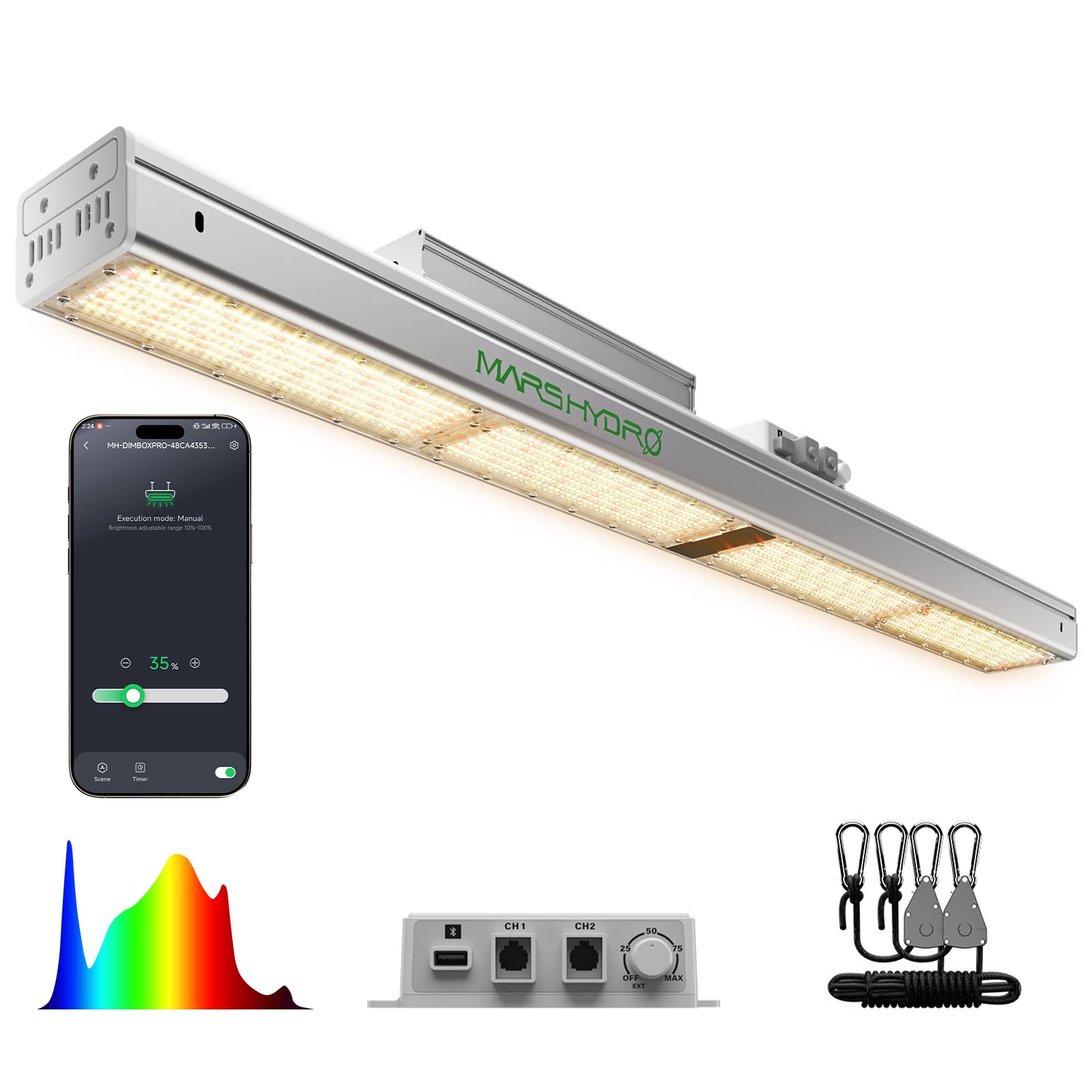
A slim 300-watt strip bar built specifically for 4×2 spaces, with dimming that runs through the whole chain.
The SP3000 is a 300-watt fixture designed around a 4×2 grow tent or greenhouse bay, and the efficiency figures are what justify the step up in price. It delivers a high PPF of 727.2 umol/S at an efficiency of 2.8 μmol/J, which is the maker’s measure of how much usable light you get per watt spent. That efficiency is the reason it can run a full cycle while keeping electricity costs down — you are paying for more photons per unit of power, not just raw wattage.
Dimming is where this light flexes. The 0 to 100% adjustment lets you run gentle intensity for germination and dial it up for flowering, and the daisy-chain dimming function can connect up to 50 lights under one control for commercial-scale runs. The spectrum mimics sunlight with warm white at 3000K, red at 660nm, and white at 5000K. Cooling is handled by aluminium lampshades and thick heat sinks, and the housing uses waterproof sealing to tolerate the humid air and occasional splash of a working greenhouse, with a lifespan rated up to 50000 hours. Add the separate WiFi module and you get app control, auto-timing, seedling/veg/bloom recipes, and even sunrise-and-sunset dimming.
The honest read is that the smart control is an optional extra rather than built in — the WiFi and App functions require buying a separate connector to activate, so factor that in if automation is the reason you’re looking here. Buyers also flag durability as a mixed long-term signal rather than a uniform verdict, though the overall build quality lands as the strongest theme. For a 4×2 setup where dimming and climate tolerance matter most, the fundamentals are solid.
Strengths Worth Paying For
- 300 watts at 2.8 μmol/J efficiency delivers 727.2 umol/S PPF, so you get more usable light per watt
- 0–100% dimming suits every stage from germination through flowering
- Daisy-chain dimming links up to 50 lights under one control for larger greenhouse runs
- Waterproof-sealed aluminium housing and thick heat sinks handle humid greenhouse air
Details to Plan Around
- WiFi and app control need a separately purchased connector — they are not included
- Long-term durability draws mixed signals from longer-term owners, even as build quality leads reviews
- It is a slim 42.8″ long strip, so it suits a 4×2 bay rather than a square footprint
- Tuned to a 4×2 area — a larger space needs more units or a bigger bar
Choose this if: you run a 4×2 greenhouse bay and want a dimmable, water-tolerant bar that sips power.
Pass if: you expect app automation to be included, or you need to light a much larger open area with one fixture.
7. MARS HYDRO TS3000 420W LED Grow Light

A 420-watt square panel that floods a 4×4 bloom footprint and dims smoothly on one box.
Where the SP3000 above is tuned to a 4×2 strip, this TS3000 is a 420-watt square panel sized for 5×5 ft in veg and 4×4 ft in bloom. The maker rates it at 1210μmol/s PPF and says it replaces a 600-watt HPS fixture while cutting energy use by 40%. The diode layout is dense in the middle and sparser at the edges, a deliberate arrangement to even out the light and reduce the hotspot that squares panels often create. A white reflector hood with a 120-degree refraction angle pushes that output wider.
The dimming setup reveals a thoughtful design: the dimmer box offers both a manual knob and an expandable smart mode, and a separately sold controller open up app control with schedules, sunrise/sunset dimming, and grow recipes. That means you can run it dumb from the start and add automation later, and the same controller can operate your smart and regular lights together. Buyers consistently praise the plug-and-play start and the smooth dimmer, which lets you keep intensity from scorching plants hung close. The 2m extension cord on the removable power supply is handy — in a hot greenhouse you can park the hot-running driver outside the growing space.
Heat is the recurring caveat. Owners describe it running noticeably warm, and the dimmer box can make the fixture tilt on its hangers unless you counterweight it. It is also a 3.78 A draw at 420 watts, so confirm your circuit can take it alongside other greenhouse equipment. None of this is a dealbreaker for a large grow, but it is the difference between a light you set up once and one you babysit.
The power argument: 420 watts covering 5×5 ft veg and 4×4 ft bloom, with 1210μmol/s PPF and a claim of cutting energy use 40% versus a 600W HPS, makes it a serious room-filler.
The honest caveat: it runs hot and the dimmer box can unbalance the fixture on its hangers, so airflow and a stable hang matter.
Ideal when: you run a 4×4 to 5×5 flowering space and want one high-output panel with smooth dimming.
Consider a smaller bar if: your greenhouse bay is narrow, since the square footprint and heat suit larger open areas better.
8. AC Infinity IONFRAME EVO3, 280W Samsung EVO Bar LED
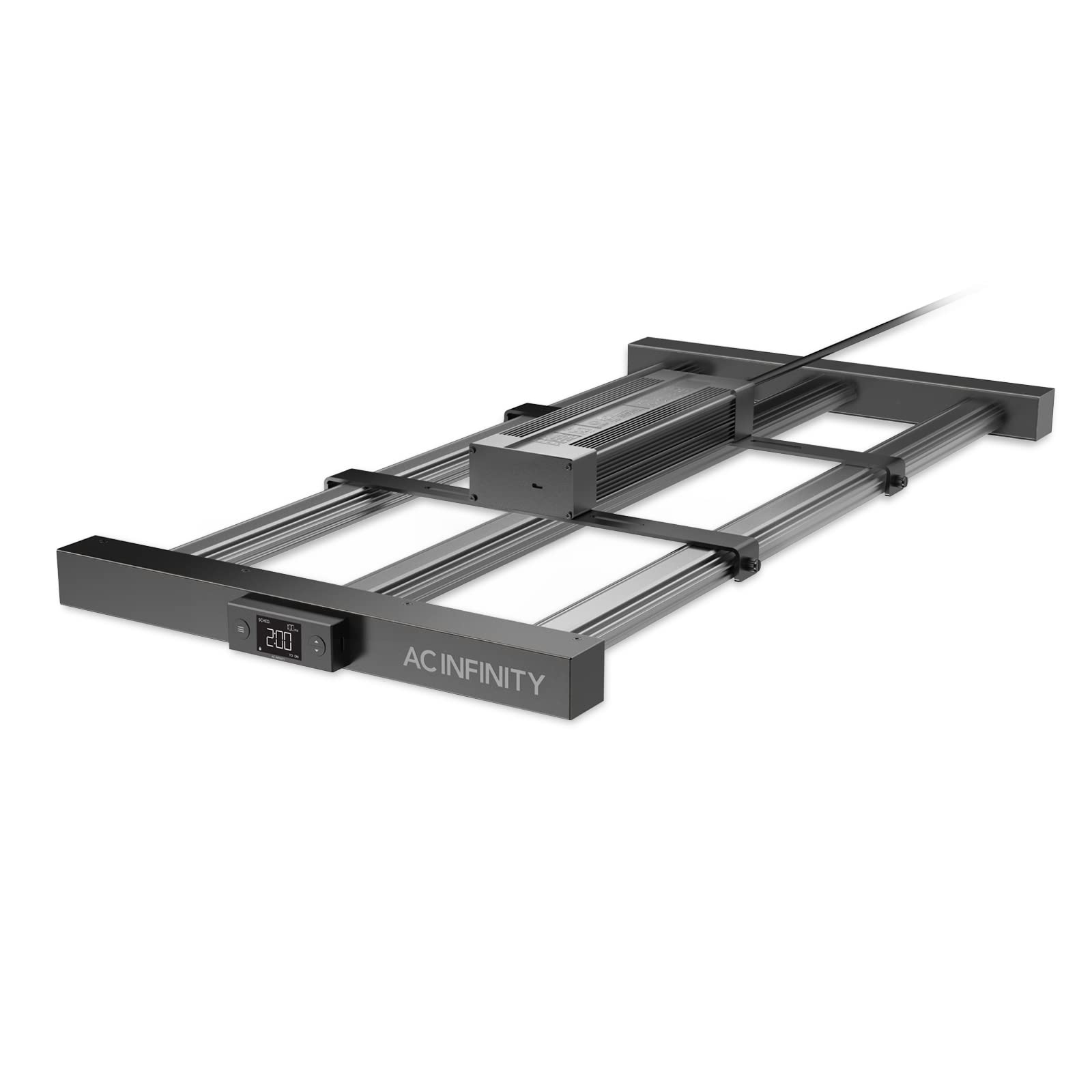
A smart 280-watt bar with sunrise-and-sunset dimming and app control for a hands-off greenhouse schedule.
For greenhouse growers who want to set a schedule and walk away, the control system is the reason to look here. This fixture runs schedule controls, sunrise/sunset dimming, and 10 brightness levels, and it is compatible with the AC Infinity UIS platform so you can run it through a WiFi app. That quiet sunrise ramp-up and sunset fade matter because they ease plants into and out of their light period instead of flipping between full dark and full blast every day.
The diode choice is the efficiency story. It uses Samsung LM301H EVO LEDs, each rated at 3.14 µmol/J PPE — the maker’s measure of electrical-to-light conversion. In real terms that means 280 watts of draw produces a lot of usable photons, backed up by 840 diodes and a 1745 PPFD rating. The numbers it publishes for coverage are 3×5 ft for veg and 2×4 ft for flower, and the bar-style shape with algorithmically spaced diodes is designed to cut hotspots and push light deep into the canopy. It carries an IP-65 rating, which is the kind of water-resistance a humid greenhouse actually wants.
A removable driver is a feature greenhouse owners should not underestimate — you can park the heat-producing power supply outside the growing space. It also daisy-chains with up to 80 lights, which is more than anyone runs at home but means headroom for a serious operation. On the honest side, heat is the mixed signal across reviews; the fixture does emit warmth, though removing the driver tames it. And if you are not already inside the AC Infinity ecosystem, buying in for the app control means pairing it with their controllers, which is worth knowing before you commit.
Features That Carry It
- Schedule controls plus sunrise/sunset dimming make daily light cycles automatic and gentle
- Samsung LM301H EVO LEDs rated at 3.14 µmol/J PPE for efficient output from 280 watts
- IP-65 rating and removable driver handle humid greenhouses and let you move heat outside
- Algorithmically spaced diodes cut hotspots and push light deep into the canopy
Things to Weigh
- Heat output splits opinion — it emits warmth, so the removable-driver trick is worth using
- App control works best if you pair it with AC Infinity’s own controllers
- At 280 watts it covers 2×4 ft in flower, so a bigger space needs more units
- The premium price reflects the smart feature set, not just raw light output
Right for you if: you want app-scheduled lighting that ramps up and down on its own in a smart-equipped room.
Look past it if: you want simple on/off control and don’t plan to use the AC Infinity ecosystem.
9. HLG 600 Rspec FR 600W LED Quantum Board Grow Light

A 600-watt quantum board with lab-verified efficiency, built for growers who treat a greenhouse like a grow room.
This is the top of the ladder, and the spec that carries it is a high output of 1529 PPF (the total light the fixture produces) at 2.60 μmol/j (how efficiently it turns watts into light), which the maker backs with third-party lab results. Four full-spectrum white quantum boards use Samsung LM301H diodes paired with deep red 660nm emitters, and the whole assembly is custom-sized to drop into a 4×4 ft tent. It is a 600-watt draw, and the dimmer knob lets you scale the output anywhere from 100 watts up to the full 600 watts, so the same fixture can run seedlings soft and finish a heavy bloom at full power.
Coverage and penetration are the practical wins. The maker rates it for 5×5 ft in veg at a 28-inch hang and 6×6 ft in flower at 40 inches, with a recommended mounted height of 28–36 inches above the canopy. The diffused full-spectrum white plus deep red output spreads evenly instead of falling off at the edges, which is what defines the fixture’s performance rather than raw brightness alone. Cooling is fully passive — no fans to fail or hum — and the light is ETL/UL certified and built with a 3-year warranty. For a serious greenhouse that runs full veg-to-flower cycles, the 600 watts and dimming range leave real headroom.
The catch is straightforward. At 600 watts it is the heaviest draw here, and heat dissipation is a mixed point — some owners find it runs hot, which in a sealed greenhouse means you will want good ventilation or distance from the canopy. It is also a fixture that rewards a bigger plan: running it at full power in a small space wastes the dimmer’s range and the coverage. If your greenhouse bay is modest, a 280-watt fixture does the same job without the excess.
Why pros chase it: 1529 PPF at 2.60 μmol/j with third-party lab results and a dimmer spanning 100W to 600W is genuine commercial-grade performance.
Set your expectations: it draws the most power of the group and runs hot, so ventilation and canopy distance are non-negotiable in a closed greenhouse.
Built for: full-cycle growers running a 4×4 to 6×6 space who need lab-verified efficiency and a wide dimming range.
Overkill if: your greenhouse bay is small or you want a light that runs cool without added ventilation.
Know the Specs
PPF and PPFD: usable light vs. light on the leaf
PPF measures the total light a fixture produces, written in micromoles per second. PPFD measures how much of that light actually reaches a given spot on your plant, written in micromoles per square meter per second. A light with high PPF can still deliver weak PPFD if you hang it too high or spread it over too wide an area, which is why the coverage numbers and hanging heights matter as much as the headline output.
PPE and efficiency: light per watt
PPE is the efficiency figure — how many micromoles of light you get for each joule of electricity, written in μmol/J. A more efficient fixture converts more of the power it draws into plant-usable light and less into heat, which is why a 280-watt bar at a high PPE can rival a lower-efficiency fixture that draws more watts. In a closed greenhouse, efficiency also means less waste heat you have to vent.
Spectrum and color temperature
Spectrum is the mix of wavelengths a fixture emits, and color temperature (written in Kelvin) describes how white that light looks. Blue wavelengths around 400–500nm encourage compact, leafy growth, red around 620–680nm drives flowering, and far-red or IR around 730nm can influence stretching. A full-spectrum light blends these so you can run one fixture across seeds, veg and bloom instead of switching bulbs.
Dimming and daisy-chaining
Dimming lets you reduce light intensity without moving the fixture — useful for protecting young seedlings that scorch under full power. Daisy-chaining runs a control or power signal between several lights so one dial or one outlet manages a whole row. Not every fixture links for power; some only share the dimming signal, so read carefully if you plan to run multiple bars from one cord.
Common Questions
How high should I hang an LED grow light above greenhouse plants?
Do LED grow lights work in a humid greenhouse without a tent?
Is wattage or PPFD more important when choosing a greenhouse grow light?
Can I daisy-chain several grow lights off one outlet?
Do I need a full spectrum light for flowering, or just red?
Why does my grow light run hot in a closed greenhouse?
Will a grow light scorch my seedlings?
What coverage area does a 4×4 grow light actually light?
Can I use a white grow light and still judge plant color?
How long do greenhouse grow lights last before I replace them?
Do I need WiFi app control for a greenhouse grow light?
The Bottom Line
For most greenhouse growers, the led grow lights for greenhouse plants winner is the VIPARSPECTRA XS1500 Pro because its 150 watts stand in for a 250W HPS/MH bulb (a traditional high-intensity lamp), the optical lenses spread light evenly across a 3×3 veg space, and the dimming-plus-daisy-chain wiring lets you run a whole bench from one dial. The one thing to know is that the finer control and dimming really shine when you pair it with a separate controller, and the crowd favorite — 4.5+ stars across 900+ ratings — backs that up. If you want wide bench coverage with high diode count, grab the Barrina TX-L84, which pushes 864 LEDs and 504.68 μmol/m²/s PPFD across four spaced panels for even light from edge to edge. And for a smart, app-scheduled 2×4 bay that ramps its light up and down on its own, the AC Infinity IONFRAME EVO3 is the one to reach for.
How we choose
We do not accept paid placement. Every pick is matched to a real buyer and a real use-case; we do not hands-on test units.
Sources
Specifications: manufacturer listings and product documentation. Review insights: verified customer reviews, as of October 2026. Pricing: not shown on this page (it changes often); check the current price via the retailer link.
As an Amazon Associate, Home Digitized earns from qualifying purchases. This does not affect which products we feature.