
Specs are compiled from manufacturer listings and verified buyer reviews and can change over time — please confirm the key details on the product page before buying.
If your lawn gets either too much water or not enough, the fix is usually the controller on the garage wall, not the sprinkler heads. This guide covers the nine yard sprinkler controllers worth installing, sorted by how many zones they run, whether they connect to Wi-Fi, and if you want one that simply works without an app at all.
This guide is built by comparing the manufacturers’ published specifications and the patterns across verified customer reviews, so you get each pick’s real strengths and trade-offs instead of marketing spin.
Start with your valve count, then decide whether smartphone control is worth the extra setup — a simple question that this roundup of the best yard sprinkler controller options answers zone by zone for your own lawn.
Top Picks

How To Choose The Best Yard Sprinkler Controller
Buying the wrong timer almost always depends on one of three things: too few zones, the wrong mounting location, or a smart app you never wanted. Get those three right and everything else is preference.
Count your valve wires before anything else
Each sprinkler zone in your yard runs on its own valve, and each valve needs one wire at the controller. Count them on the old unit or in the valve box. A 4-zone timer physically cannot run a six-zone yard, no matter how good its app is. Buy one or two zones of headroom if you might add a drip line later.
Indoor or outdoor — this is a placement decision, not a feature
An indoor controller expects a garage, shed, or utility room where rain never reaches it. An outdoor model ships with a weather-resistant enclosure and, on several picks here, a keyed locking cabinet. If your current timer hangs on an exterior wall in full sun, buy an outdoor-rated unit or a separate weatherproof case.
Decide honestly if you want Wi-Fi at all
A Wi-Fi controller lets you run a zone from your phone and skip watering automatically when local weather says rain. That convenience comes with a router, a 2.4GHz network, and an app account. A dial timer needs none of that and keeps working through a power blink or a dead router — which is exactly why plenty of owners still buy them.
What actually saves water
Rain delay, rain-sensor input, and seasonal adjust are the three features that pay you back. Rain delay pauses the schedule for a set stretch; a rain sensor input lets a physical sensor on the roof cut watering automatically; seasonal adjust scales every zone’s run time up or down as the weather shifts. Smart models add weather-data skips on top of all three.
Side-by-Side Comparison
| Model | Best For | Zones | Mounting | Smart Control | Amazon |
|---|---|---|---|---|---|
| Rain Bird ESP-TM2 8 Station★ Best Overall | Best all-round upgrade | 8 | Indoor/outdoor | Wi-Fi with LNK module (sold separately) | Amazon |
| Orbit 57899 9-Station Swing PanelBest Dial Value | Dial simplicity, big zone count | 9 | Indoor/outdoor | None (dial and push buttons) | Amazon |
| Hunter X-Core XC400iBest Small-Yard Pick | Small yards, tight budget | 4 | Indoor | None (ROAM remote optional) | Amazon |
| Rain Bird SST900IN | Set-and-forget indoor simplicity | 9 | Indoor | None | Amazon |
| Orbit B-hyve 6-Zone 57946 | App control on a budget | 6 | Indoor/outdoor | Wi-Fi app plus Alexa | Amazon |
| Hunter X-Core XC800i | Eight zones with no app at all | 8 | Indoor | None (Smart Port remote optional) | Amazon |
| ImoLaza 8 Zone WiFi | Weather-driven watering, no fees | 8 | Indoor or outdoor with case | Wi-Fi app, Alexa, Google | Amazon |
| Yardian Pro 8-Zone | Apple HomeKit households | 8 | Indoor or outdoor with enclosure | Wi-Fi plus Ethernet, HomeKit | Amazon |
| Rachio 3 Smart Bundle | Top-rated smart bundle | 8 | Outdoor with included enclosure | Wi-Fi, Alexa, Apple HomeKit | Amazon |
Detailed Reviews
1. Rain Bird ESP-TM2 TM2-8 Controller
Our pick — 4.5+★ from 950+ verified ratings; the strongest balance of quality and price.
Eight zones, indoor or outdoor mounting, and a three-step schedule you already know how to set
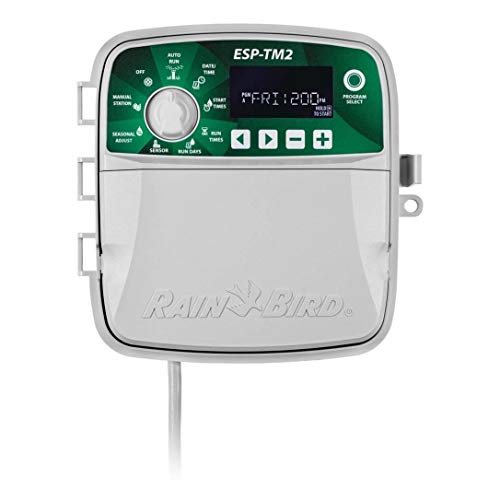
The ESP-TM2 is the crowd favorite, holding 4.5+ stars across 850+ ratings, and the reason is boring in the best way: you wire it, you press three buttons, and your yard waters on time. It runs 8 zones, which covers a typical suburban front-and-back setup with room for a drip line. A factory-installed 6 ft outdoor-rated power cord means you can hang it outside near an outlet instead of hunting for an indoor wall.
Where it earns the top spot is the install. Setup is genuinely a three-step schedule entry, and the large back-lit LCD stays readable in direct sun and after dark. Contractors and DIYers land on the same verdict — this is a like-for-like swap for an old unit. “We have had ours now for 15 months and it has worked perfectly,” buyers report, and the pattern holds: feed the old wires in, mount the box, and the yard is running the same afternoon. At 3.52 pounds it is about three times the weight of the Hunter XC400i at 1.2 pounds, so it hangs like a proper outdoor unit rather than a light indoor box.
Two things worth knowing before you buy. First, the Wi-Fi is not built in — you add a Rain Bird LNK module sold separately, and I would not buy this expecting a plug-and-play app. Second, the controller’s handy extras (Contractor Default to save and restore your schedule, a Delay Watering feature that pauses up to 14 days and then resumes automatically) live on the unit itself, so you still get real flexibility if you never add the module. The recurring gripe in owner chatter is the companion app connection, which occasionally needs a refresh or an unplug to reset.
Where it earns its keep
- Three-step programming you can finish before your coffee goes cold
- Indoor or outdoor mounting from one box, with a factory 6 ft cord already attached
- Back-lit LCD readable in glare and low light alike
- Delay Watering up to 14 days, then auto-resumes on schedule
What to plan around
- Wi-Fi needs the LNK module, sold separately — no app until you add it
- The app connection is the one thing owners push back on
Worth it when: you want eight zones, an outdoor-rated box, and a schedule you can set without a phone.
Think twice when: app control on day one is the whole point — add the module cost to your plan or pick a Wi-Fi-native unit.
2. Orbit 57899 9-Station Timer
Nine stations, no app, and a swing-out panel with push terminals for faster wiring
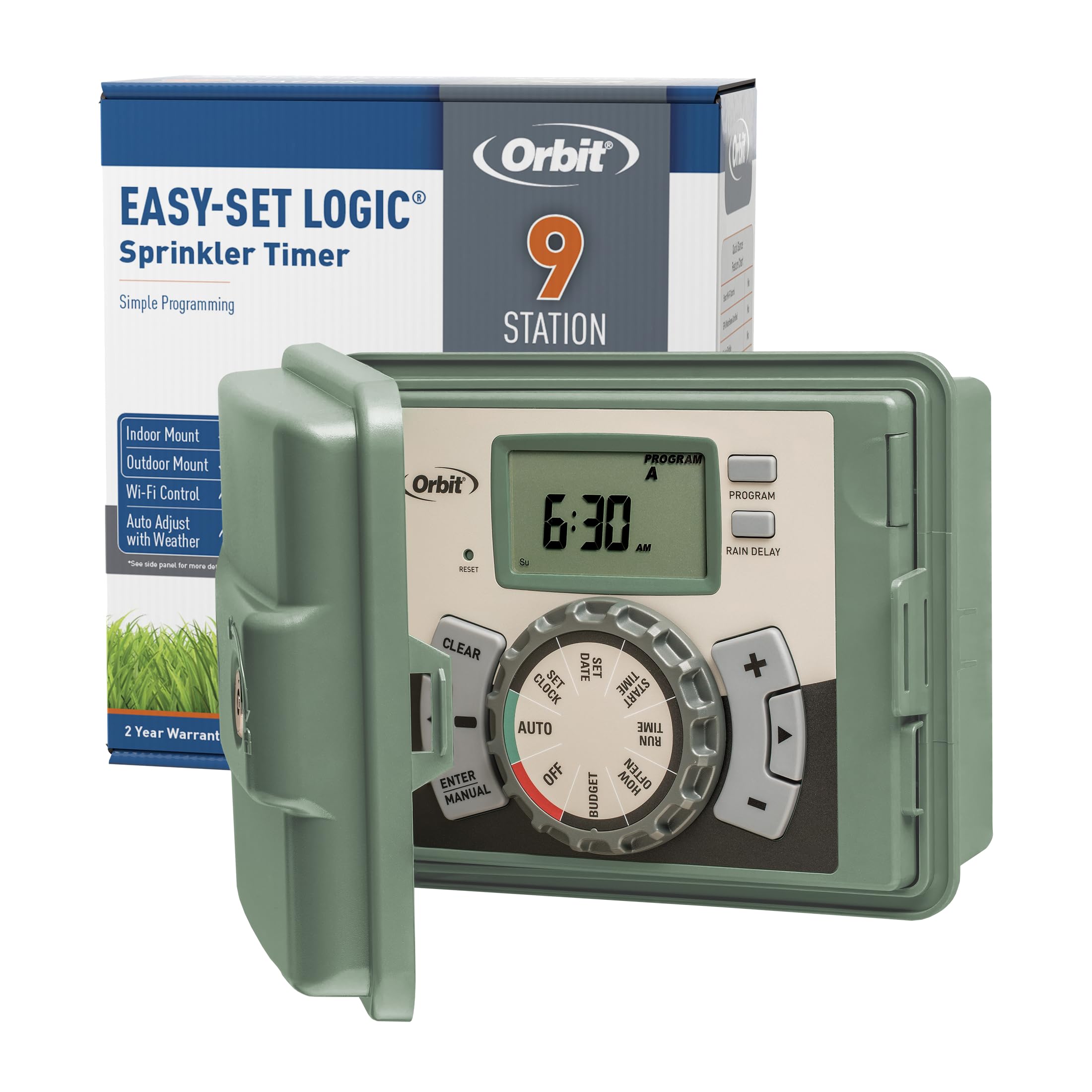
If your yard has more valves than you expected and no router within reach, this is the pick. Nine stations is the most on this list, and the whole design is built for a one-session install: you open the locking cabinet, swing the panel out, and push each wire into a spring terminal instead of fighting tiny screws. It takes 24 VAC valves from Orbit, Hydro-Rain, and other major brands, so an existing system usually drops straight in.
The schedule side is a dial plus a large display, and the programming flow (date, time, days, then start time and run time per station) is what owners describe as self-explanatory. Cycle-and-soak windows, overlapping runtimes, and a rain delay for skipping a watering are all on board. One buyer’s timeline says it all — the unit was “running 30 min later” after arriving, because the built-in transformer means you connect wires and plug it in rather than hardwiring.
The honest trade-offs are small but real. The wire entry hole sits bottom-right while the terminals are bottom-center, so plan your cable routing before you drill. It runs on a CR2032 coin cell for memory backup only, and the manual is thin for unusual setups like a single indexing valve. Longevity is the open question on any dial unit, though the weatherproof keyed cabinet is built to take the weather that an indoor box would not.
Where the value sits: nine zones of straightforward, weatherproof control with push terminals that cut install time noticeably — and cycle-and-soak plus rain delay for water discipline.
Fit note: this is a deliberate non-smart controller, which is exactly why it survives a dead router. Want app control? Look at the Orbit B-hyve further down instead.
Reach for this if: you have up to nine zones, want to mount outside, and would rather turn a dial than open an app.
Look elsewhere if: you want remote zone control from your phone — there is no Wi-Fi here by design.
3. Hunter X-Core XC400i Sprinkler Timer
Four zones of front-panel dial control in the lightest body on this list at 1.2 pounds
Small yards do not need eight zones, and they do not need a Wi-Fi radio either. The XC400i runs 4 zones from a dial and front panel, in a plastic body that weighs 1.2 pounds — the lightest pick on this list by a wide margin, and it hangs on a garage wall without any fuss. If your yard is a front strip, a back lawn, and a couple of beds, this is the shape of controller you actually need.
Programming is where this earns its place. Owners consistently point to how easy the dial-and-panel flow is to learn, and there are three separate programs with multiple start times each if you want different schedules for different beds. Seasonal adjust lets you scale run times from 10% to 150% — a useful dial to turn down in a cool month and crank during a heat wave without re-entering every zone. Non-volatile memory keeps your programs through a power outage, so no reprogramming after a storm.
Two caveats. It is indoor-only, so it belongs in a garage, shed, or utility room, not on an exterior wall. And the memory battery is the weak link — several owners mention it only lasting about eight months, so keep a spare on hand and expect to swap it. The manual also draws mixed reactions; the panel is intuitive enough that most people manage without it, but the printed instructions will not always get you there on a tricky retrofit. For compatibility, it is ROAM Remote ready if you later want wireless zone testing.
The math that matters: 1.2 pounds against the Rain Bird ESP-TM2’s 3.52 pounds — this is a featherweight indoor box for a small, simple yard, and it costs and carries like one.
Best fit for: a four-zone yard with indoor wall space and a preference for dials over screens.
The catch to budget for: replace the memory battery roughly once a year so a power outage does not wipe your schedule.
4. Rain Bird SST900IN Irrigation Controller, Indoor, 9-Station
Nine zones set one at a time from the front panel, with a 72-hour rain delay that resumes on its own
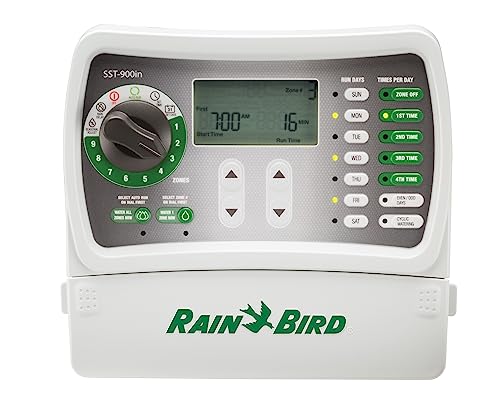
Rain Bird built this around the idea that you should not need the instructions. Zone-by-zone settings mean you dial in each area of the yard separately — full sun out front, shade beds around back — and a one-touch seasonal adjust scales the whole thing up in summer and down in the rainy months. It handles 9 stations, which is enough headroom to absorb a zone or two of future drip line.
The Rain Delay is the feature that quietly saves you money: it pauses watering for up to 72 hours and then resumes the program on its own, so a wet week does not leave you with a flooded lawn or a manual reset. There is also a rain sensor connection if you want a physical sensor to do the skipping automatically. A sealed case keeps moisture, insects, and grime out of the board, and built-in surge protection is a real plus for anyone who has lost a timer to a storm.
Setting expectations: this is indoor-only (garage, home, or a waterproof shed) and it has no app, no Wi-Fi, and no touchscreen. The one quirk owners hit is that each zone has to be programmed individually to match — set one zone and expect to repeat the same steps for the rest, or you will wonder why half the yard runs on a different schedule. Durability is the mixed note; most units run for years, but a few have packed it in after a season and a half, which is worth weighing against the sealed case and surge protection.
What owners like most
- Zone-by-zone schedules that suit a yard with different sun exposures
- 72-hour rain delay that resumes programming automatically
- Sealed case plus built-in surge protection
- Rain sensor input for hands-off rain skipping
Where it falls short
- Indoor only — needs a protected wall, not an exterior one
- You must repeat the programming steps for every zone
- No app or Wi-Fi option at all
Suits you if: you have a nine-zone yard and want to set the schedule once, then leave it alone.
Skip the shortcut: program each zone identically or deliberately — a half-finished zone list is the usual reason a “broken” unit starts behaving oddly.
5. Orbit B-hyve Smart Sprinkler Controller, 6-Zone – 57946

Six zones with app control, a physical panel, and forecast-based rain skips at a mid-range price
Six zones, an app, a weatherproof case, and a screen with real buttons — the B-hyve 57946 is the smart controller that does not make you choose between a phone and a front panel. Setup runs about five minutes once the wires are in. Owners describe the app as easy for a first-timer to program, with custom schedules, manual zone runs, and a watering history calendar all in one place. Alexa works too, if talking to your sprinklers appeals.
The water-saving comes from automatic weather delays. Instead of a roof sensor, the B-hyve checks forecast data and holds off when rain is coming — one owner reports the system ran only twice in three weeks because the skips kept catching rain. That is the whole pitch of a smart controller in a single sentence: it waters less when the sky is already doing the job.
The catch is the word “smart” itself. The automatic watering algorithm gets mixed marks — one detailed critique found a zone stuck at full moisture and refusing to irrigate, with support falling back to manual programming. Honest read: treat the weather skips as the valuable part and program your schedules manually, and this unit performs well. It also needs a 2.4GHz Wi-Fi signal, so a garage on the far side of the house may need an extender. The protective case does mean you can mount it inside a garage or out on a wall, which is flexibility the indoor-only picks do not offer.
The real bargain here: app control, weather skips, a physical screen, and indoor/outdoor mounting together at a mid-range price point — a straightforward step up from a dial timer.
Set your expectations: “smart watering” is the weak spot. Skip that mode, program your zones by hand, and let the weather skips save the water.
Buy it for: six zones, phone control, and rain-based skipping without stepping up to premium money.
Know before you mount: confirm 2.4GHz Wi-Fi reaches the wall you plan to use, and plan to program zones manually.
6. Hunter X-Core XC800i Sprinkler Timer
Eight zones and 12 start times with no Wi-Fi, no app, and no account
Hunter takes the same dial-first approach as the XC400i and stretches it to 8 zones with three programs and four start times each — 12 starts total. That is the number that matters for a yard where the front lawn, the back beds, and a drip line all want to run at different hours. Seasonal adjustment lets you nudge every zone’s run time for the season without retyping schedules. And there is no Wi-Fi to drop, no app to update, and no account to create.
The wiring story is where this pick shines for anyone replacing an old unit. The terminals are laid out so a like-for-like swap is wire-for-wire, and installs run about 30 minutes including the zone times. Owners who have done the job describe it as a painless replacement, and the sharpest piece of advice is to photograph the old wiring before you disconnect anything. A built-in surge protector plus Quick Check diagnostics give you a way to spot a bad valve or wire without guessing. A Smart Port lets you add a Hunter remote later for zone testing.
The recurring criticism is longevity — a handful of customers note units giving out inside three years, so treat this as a controller that may eventually need replacing rather than a lifetime fixture. The plastic-and-metal box is also snug for wiring, which makes a careful, unhurried install wise. It is indoor-only, so give it wall space in a garage or utility room.
The selling points
- Eight zones and 12 start times without any app dependency
- Wire-for-wire replacement for an existing Hunter box
- Quick Check diagnostics and built-in surge protection
- Seasonal adjust scales the whole schedule at once
Trade-offs you accept
- Snug wiring compartment rewards patience
- Indoor-only mounting
- Fails for some owners within three years — plan accordingly
Made for: an eight-zone yard where simplicity beats smartphone convenience and the wall is indoors.
One caution: photograph the old terminal wiring before you swap — the compact box leaves little room for error.
7. ImoLaza 8 Zone Sprinkler Controller
Eight zones that read the weather and never charge you a monthly fee
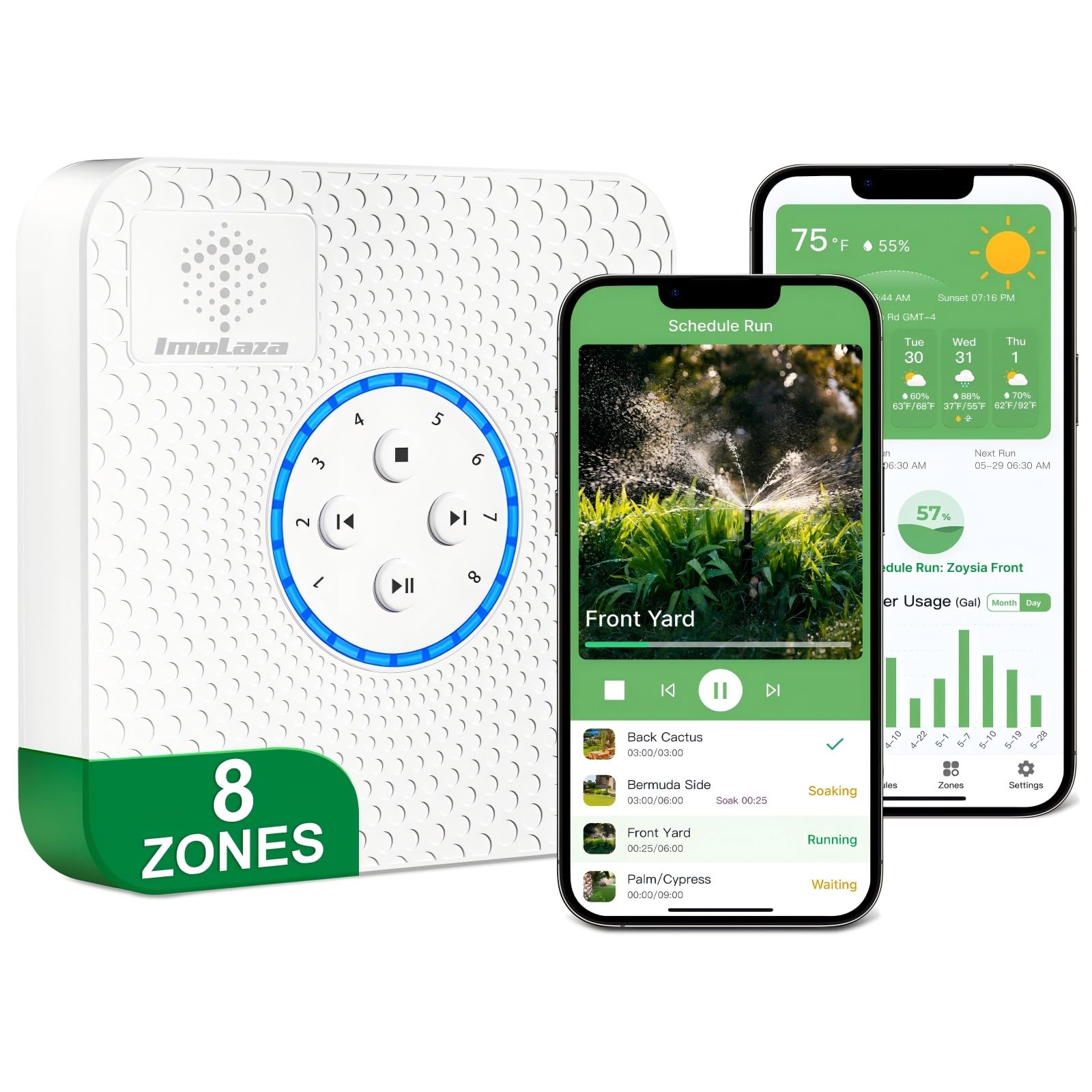
Most smart controllers charge you a subscription for weather-based watering. ImoLaza does it without one, using real-time evapotranspiration — basically a running estimate of how much water your lawn loses to sun and wind each day — combined with local weather data. The controller skips watering on rain, wind, freeze, or saturated-soil days on its own. Zone setup in the app asks about sprinkler type, square footage, soil, plant type, slope, and sun, then builds a schedule from those answers.
The remote control is the daily-use win. You can trigger a single zone from your phone while you are standing over a sprinkler head adjusting it, which beats running back to the garage. There is a dedicated schedule for new grass that can start up to 24 times a day for light, frequent watering — exactly what a fresh seeding or new sod wants. Cycle-and-soak alternates run and pause so water sinks in instead of running off. Alexa and Google Assistant both work, so voice commands cover the hands-busy moments.
The maintenance side is where it separates from cheaper smart units: real-time fault detection alerts you to open or short circuits, a controller that has gone offline, weather-data outages, and — if you have a flow meter — leaks or a pipe burst. That is a lot of protection for a yard you are away from regularly. The honest downsides: the Wi-Fi is 2.4GHz only, and mesh systems have given some owners trouble. One unit failed inside two years and stopped following its schedule, so it is not indestructible. Install runs 15 to 30 minutes on existing wiring, and the slim body can go in a garage or shed with a waterproof case for outdoor wall mounting.
Why it leads on water savings: ET-based scheduling, rain and freeze skips, no subscription, and leak alerts with a flow meter — this is the pick for a lawn under water restrictions or a homeowner who wants the bill to drop.
The fair caveat: plan around a 2.4GHz network and budget for a waterproof enclosure if the unit lives outside.
Start here if: you want weather-smart watering without a subscription and you are comfortable setting up a phone app.
Look past it if: your router is a mesh system you cannot easily split into a 2.4GHz band.
8. Yardian Pro 8-Zone Sprinkler Controller

The one that plugs into Ethernet when the garage signal is hopeless
HomeKit irrigation controllers are a short list, and this is the pick for a house that runs on Siri. It works natively with the Apple Home app, plus Alexa, Google Home, and Home Assistant, with simple voice commands covering the basics. The detail that makes it genuinely different is a built-in RJ45 Ethernet port: wire it straight into your router and you stop worrying about Wi-Fi dead spots in a garage at all. Enhanced Wi-Fi is there as the fallback.
The physical buttons matter more than they sound. You can run a zone or test a sprinkler head right at the panel, without a phone or an internet connection — useful during install, and genuinely useful the day the network is down. ET-based scheduling from hyper-local weather data runs the daily watering automatically. Two sensor inputs let you wire in flow sensors for real-time leak and burst-pipe monitoring if that is on your wish list.
Setup is the easy part: owners describe wiring spring clips, adding the provided zone labels, and pairing to HomeKit in minutes. Expect to register an account and scan the HomeKit code to finish. The two honest limits are that the app lacks a step-by-step quick-start helper for total beginners, and that some of the interior spring clips are stiff to press during wiring. An occasional connectivity drop has happened on long-running units; the support team has stepped in with replacements when it did. If the unit goes outdoors, budget for the custom IP56 enclosure.
What makes it worth the step up
- Native Apple HomeKit support alongside Alexa, Google Home, and Home Assistant
- RJ45 Ethernet for a stable wired link no consumer-grade rival offers here
- Manual buttons that run zones without any smartphone or network
- Two sensor inputs for flow and leak monitoring
What to expect
- Indoor or outdoor only with the separate IP56 enclosure
- App skips the guided walkthrough a beginner would appreciate
Built for: an Apple Home household that wants irrigation in the same app as the lights and thermostat.
Weigh first: if your controller lives outside, add the enclosure to the plan — the panel itself is not weather-rated.
9. Rachio 3 8 Zone Controller

The 4.5+ star bundle that arrives with the weatherproof box in the carton
Here is the highest-rated controller in this group, and the only one that ships with its outdoor case included. The Rachio 3 handles 8 zones and pairs with Apple HomeKit and Alexa, with hyperlocal weather intelligence handling the skips — rain skip, wind skip, freeze skip, and more. The enclosure is custom-designed and fully weatherproofed, which removes the biggest hidden cost of mounting a smart controller outside: buying the box separately later.
Schedules are built from plant type, soil type, and sun exposure, so the lawn gets watered for what it actually is rather than a flat timer. The app lets you run sprinklers, review upcoming schedules, and see estimated outdoor water usage. Install replaces most existing controllers in 30 minutes or less with no special tools, and there is an in-app tutorial if you want a walkthrough. For a smart-home setup, it ties into weather stations and other systems cleanly.
The honest sizing: this controller has the highest rating but a smaller review history than the dial-heavy crowd favorites, so you are buying on strong satisfaction rather than sheer volume of feedback. The bundle price also pushes it to the premium end of this list — you are paying for the enclosure and the brand’s polish together. If you already have a dry indoor wall and a smart controller in the budget, a cheaper Wi-Fi unit may cover the same ground.
Where it wins: the highest rating in this roundup, a bundled weatherproof enclosure, and plant-and-soil scheduling that removes the guesswork from run times.
The catch: premium money for a bundle — if your controller lives indoors, you are paying for an enclosure you will not mount.
Choose it when: you want the top-rated smart controller and the outdoor enclosure handled in a single purchase.
Pass if: your timer already lives in a dry garage — a standalone controller without the box covers the same job for less.
Know the Specs
Zone count and valve wiring
An irrigation “zone” is one group of sprinkler heads fed by a single valve, and each valve needs one control wire landing on a numbered terminal. A 4-zone controller caps your yard at four valves, no matter how big the lawn. Count the wires on the old unit first, then add one or two terminals of headroom if you might zone a drip line later.
Indoor vs outdoor rating
An indoor controller is meant for a garage, shed, or utility room where it stays dry. An outdoor unit ships with a weather-resistant case, often a keyed locking cabinet, and is built to hang on an exterior wall. A smart controller that fits indoors can usually move outside only with a separate weatherproof enclosure, so plan that purchase up front if your install is on an exterior wall.
Weather skips and evapotranspiration
Evapotranspiration, or ET, is simply an estimate of how much water your lawn loses to sun and wind on a given day. Smart controllers use real-time ET plus local weather data to decide whether to water — skipping on rain, wind, or freeze days and adjusting run times otherwise. Dial controllers approximate this with a rain delay and a manual seasonal adjust dial.
Rain delay vs rain sensor input
A rain delay pauses the schedule for a set window, from the 72 hours on the Rain Bird SST900IN to the 14-day Delay Watering on the ESP-TM2, and resumes on its own afterward. A rain sensor input is a separate wired sensor on the roof that cuts watering whenever it gets wet. The delay is free and simple; the sensor input is automatic and hands-off.
Common Questions
Will a sprinkler controller from a different brand replace my old one?
How many zones do I actually need?
Can I put an indoor sprinkler controller outside?
Is a smart sprinkler controller worth it over a dial timer?
What does the Wi-Fi module on the Rain Bird ESP-TM2 actually add?
Why does my controller need a battery if it plugs into the wall?
Does my sprinkler controller work with Alexa or Siri?
How long does a sprinkler controller usually last?
What is cycle and soak and do I need it?
Can I run one zone manually for sprinkler head repairs?
The Bottom Line
For most yards, the best yard sprinkler controller pick is the Rain Bird ESP-TM2 — eight zones, an outdoor-rated box, a back-lit display, and a three-step schedule that takes your kitchen-table nerves out of the equation. If you want app control and weather-based skips without stepping into premium money, the Orbit B-hyve 57946 covers six zones with a phone app and Alexa. And if water savings is the whole goal, the ImoLaza 8 Zone WiFi pairs real-time evapotranspiration with no subscription and leak alerts. One practical nudge: the dial-first crowd favorites carry years of owner experience behind them, so if simplicity is your priority, the Orbit 57899 at nine stations deserves a close look before you commit to an app.
How we choose
We do not accept paid placement. Every pick is matched to a real buyer and a real use-case; we do not hands-on test units.
Sources
Specifications: manufacturer listings and product documentation. Review insights: verified customer reviews. Pricing: not shown on this page (it changes often); check the current price via the retailer link.
As an Amazon Associate, Home Digitized earns from qualifying purchases. This does not affect which products we feature.