
Specs are compiled from manufacturer listings and verified buyer reviews and can change over time — please confirm the key details on the product page before buying.
If you have ever had a wrench’s jaws slip off a rusted pipe fitting and barked your knuckles on the frame, you already know what separates a real heavy-duty wrench from a cheap imitation. The short answer: buy the one whose jaws actually bite and hold, and whose handle you can swing all day without your forearm giving out. That is the RIDGID 31105 here, and the eight others below cover everything from a 12-inch spud wrench for tight valve work to a 24-inch lever for frozen farm bolts.
This guide is built by comparing the manufacturers’ published specifications and the patterns across verified customer reviews, so you get each pick’s real strengths and trade-offs instead of marketing spin.
Every pick below was chosen for one job: grabbing and turning stubborn metal without slipping, rounding, or wearing out. Below you will find the pipe wrenches, spud wrenches, and wide-jaw adjustable wrenches worth owning in a heavy-duty wrench lineup, plus the jaw capacity, length, and weight numbers that tell you which one fits your work.
Top Picks


How To Choose The Best Heavy-Duty Wrench
A heavy-duty wrench is not one tool — it is a family, and picking the wrong member for the job is how fittings get chewed up. Pipe wrenches bite with toothed jaws for round steel pipe. Spud wrenches use smooth or box-end jaws for aligning bolt holes and turning plated hardware. Adjustable wrenches give you a sliding jaw to fit whatever hex nut is in front of you. Decide your job first, then match the numbers below.
Start with jaw capacity, not handle length
The jaw capacity is the widest thing the wrench can grab, measured in inches or millimeters. A 24-inch pipe wrench here opens to 3 inches; a 12-inch spud wrench opens to 2-5/8 inches. If your fitting is a big cast-iron drain union, you need the wider jaw. If it is a 1/2-inch compression valve under a sink, a narrow jaw reaches in where the big one will not fit.
Weight tells you how long you can work
A heavy wrench delivers more leverage, but your arm pays for it. The RIDGID 31105 aluminum pipe wrench weighs 2.7 kg at 24 inches; the RIDGID 31400 spud wrench weighs 1 kg at 12 inches. For overhead or all-day work, the lighter tool keeps your grip fresh. For a single stuck bolt, the heavier lever wins.
Match the jaw material to the metal you are turning
Hardened toothed jaws bite steel pipe hard, but they will scar soft brass or chrome. Smooth, toothless jaws grip plated fixtures without leaving marks, which is why spud wrenches exist. Cr-Mo and forged alloy steel bodies resist rust and water corrosion better than cheap cast iron — a real consideration if the wrench lives in a wet mechanical room.
Side-by-Side Comparison
| Model | Best For | Jaw Capacity | Length | Weight | Amazon |
|---|---|---|---|---|---|
| RIDGID 31105 824 Aluminum Straight Pipe Wrench★ Best Overall | Overall pipe work | 3 inches | 24 inches | 2.7 kg | Amazon |
| MAXPOWER Adjustable Offset Hex WrenchBest for Tight Spaces | Sink and drain nuts | 2.63 inches | 12 inches | 1.8 pounds | Amazon |
| RIDGID 31400 Spud WrenchBest for Plated Fixtures | Plated fixtures, tight spaces | 2-5/8 inches | 12 inches | 1 kg | Amazon |
| Crescent 15″ Adjustable Black Oxide Wrench | General garage work | — | 15 inches | 16 ounces | Amazon |
| MAXPOWER 24″ Adjustable Wrench | Oversized fasteners | 2.4 inches | 24 inches | 2.85 kg | Amazon |
| Performance Tool W356B 2-1/2-Inch Combo Wrench | Fixed large hex | 2.5 inches | — | 8.8 pounds | Amazon |
| Bahco 9035 R Ergo X-Wide Adjustable Wrench | Confined-space access | — | 12 inches | 1 kg | Amazon |
| KLEIN TOOLS 3239 16-Inch Spud Wrench | Bolt-up and alignment | 1.63 inches | 16 inches | 2.4 pounds | Amazon |
| CRAFTSMAN CMMT81627 24″ Adjustable Wrench | Wet, dirty shops | — | 24 inches | — | Amazon |
Detailed Reviews
1. RIDGID 824 Pipe Wrench
Our pick — 4.5+★ from 700+ verified ratings; the strongest balance of quality and price.
The 24-inch aluminum bruiser that turns stubborn pipe without dragging your arm down.
Start with the number that decides this pick: a 3-inch jaw capacity on a 24-inch handle. That is the widest bite in this lineup, and it means cast-iron drain unions and big threaded pipe fittings sit fully inside the jaws instead of half-gripped. The forged alloy steel hook jaws are full-floating, so they seat themselves on the pipe as you lean in rather than skidding off the round surface.
What makes it the pick for most people is the aluminum body. At 6 lbs (2.7 kg) it is dramatically lighter than an all-steel wrench of the same length, and that is the difference between a smooth swing and a shouting match with your own wrist at hour six. RIDGID puts that aluminum frame on an I-beam handle, which keeps the strength where the load goes while trimming the dead weight. As buyers put it: “First looking at it, you would think it weighs 50 lb.” Then they swing it and the heft turns out to be pure leverage, not dead mass. It is the crowd favorite here — 4.5+ stars across 700+ ratings — with owners praising its value for the money and long-term durability.
Here is the honest catch: a 24-inch wrench is long, and it does not fit through tight cabinet gaps or behind a wall where a 12-inch tool slides in. It is built for open pipe work, not confined spaces. The self-cleaning threads and replaceable hook jaws, heel jaws, and spring assemblies mean you can service it instead of replacing it, which is why so many owners treat it as a lifetime tool. Compared with the MAXPOWER 24-inch adjustable below, this one carries a 3-inch jaw versus 2.63 inches — the RIDGID simply grabs wider pipe.
long straight pipe grip
- 3-inch jaw capacity takes on the biggest pipe fittings in this list
- Aluminum I-beam body weighs 2.7 kg at 24 inches, light enough to swing repeatedly
- Full-floating forged hook jaws bite the pipe and ratchet with one hand
- Replaceable jaws and spring assemblies keep it serviceable for years
heavy in tight spots
- The 24-inch length will not fit into cramped cabinet or wall cavities
- Toothed jaws will scar soft brass or chrome, so not for plated fixtures
pipe work pick: you want a single heavy pipe wrench that opens to 3 inches and still feels manageable in the hand.
overhead fatigue: your work lives behind a wall or under a sink where a 24-inch handle cannot swing.
2. MAXPOWER Offset Hex Wrench
A slim-jawed sink specialist that slides behind a vanity and grabs drain nuts a fat wrench cannot reach.
Reach under a sink and you will understand why this one exists. Its jaws are thin and offset, sliding into the tight gap behind a wall or inside a cramped vanity cabinet where nothing else fits. The 2.63-inch jaw capacity spans from 1-1/8 inch up to 2-5/8 inch (29 to 67 mm), enough for waste assembly nuts, sink strainers, and flush valves.
The offset hex jaw wraps around hex nuts and square fittings instead of pinching two flats, so you get balanced torque without slipping or marring the edges. The jaws themselves are heat-treated Cr-Mo steel paired with a ductile iron body and powder coating to shrug off rust and water corrosion. Owners praise its build quality, rating it close to a name brand. It is also one of the lightest wrenches here: at 12 inches and 1.8 pounds it hangs off your fingertips while you twist.
The trade-off is real: the offset jaw design is a specialist, not a general pipe wrench. Ductile iron is tough but it will not take the same beating as the RIDGID’s forged alloy steel if you lean a cheater bar on it. And the locking rod that holds the jaw assembly can work loose — buyers report welding a rod back on after the original fell out on a used job. For drain nuts and flush valves under a sink, it does exactly what it should.
offset hex reach: slim, angled jaws and a 2.63-inch bite make quick work of strainers, drain unions, and flush valves where bigger tools refuse to fit.
red cast bulk: it is a light-duty specialist built for tight access, so treat the jaw-locking rod gently and save the heavy pipe jobs for a forged pipe wrench.
under-sink fit: sink work, drain nuts, and flush valves where a full pipe wrench simply will not squeeze in.
precision needed: you need to lean hard on a big rusted steel pipe — this jaw is built to be nimble, not brutal.
3. RIDGID 31400 Spud Wrench, 12-inch Adjustable, Red
Smooth jaws that grab chrome and brass without leaving a single tooth mark behind.
Chrome fixtures scratch, and that is the whole reason this wrench exists. Its jaws are smooth and toothless, so they grip plated hardware without gouging the finish — you can remove a shower valve or chrome fitting and reuse it. As owners mention: “The Jaws are very smooth so it won’t damage brass and chrome, attached is a picture on a compression valve for a 1/2 inch line, love this tool!”
It opens from 3/8 inch to 2-5/8 inch, giving you broad adjustment in a narrow head that fits into tight, hard-to-reach spots on the job. The 2-1/2-pound build is sturdy without dragging your arm down, and the bright-red handle is easy to find on a cluttered bench. Ridgid rates it to 150 ft-lb of torque and backs it with a lifetime warranty against material defects. Owners rate build quality as its strongest trait, with the adjustability a close second.
The limit is straightforward: those smooth jaws are gentle by design, so on a frozen steel pipe that needs a hard bite you want the toothed RIDGID 31105 instead. And at 12 inches it trades leverage for maneuverability, so a truly stuck bolt may need the longer handle. Spend the money for the plated and round-stock work, and it earns its keep nicely.
The verdict is clear enough for anyone swapping chrome supply valves and brass sprinkler heads: it will not round the edges, and the adjustment range covers the small-to-medium fittings that fill a remodel.
ironwork duty: plumbers and remodelers who pull or replace chrome and brass fixtures and refuse to scar the finish.
fine adjustment: your job is a seized steel pipe — smooth jaws are the wrong bite for that fight.
4. Crescent 15″ Adjustable Black Oxide Wrench, AT215BK

A 15-inch adjustable with a wide tapered handle that beats fatigue on long garage sessions.
Here is the wrench that treats your hand like it matters. The tapered, wide handle spreads pressure across your palm instead of digging a ridge into it, which is the difference between a comfortable afternoon and a raw hand at the end of the day. The hex jaw design grips the fastener firmly to cut slippage, so you are not chasing the nut across the bolt head.
The forged alloy steel body is heat-treated for toughness, and a laser-etched scale marks both SAE and metric sizes for fast identification. At 15 inches and 16 ounces it lands in a manageable middle — long enough to lean into a tight bolt, light enough to keep control. Action is smooth and non-jerky compared with cheaper adjustable wrenches, so the jaw advances where you put it instead of skipping. It takes high force well too, including on an 8-foot extension.
Size up carefully before you buy. The wrench is genuinely bigger than some buyers expect, so check the 15-inch length against the clearance you actually have. It is an adjustable, not a pipe wrench — so it grips flats and hex heads, not round steel pipe. For home-improvement and garage turning of big hex nuts, though, the wide handle is a real comfort upgrade.
The quiet win here is grip comfort without giving up leverage — check the size first, then enjoy a full, fatigue-free swing.
rust resistance: home garages and general repair where hand comfort on a 15-inch wrench matters more than brute pipe work.
cramped spaces: you are turning round steel pipe or need a 24-inch lever — an adjustable jaw is the wrong shape for that.
5. MAXPOWER 24″ Adjustable Wrench, 2.4″ Jaw, Tapered Handle
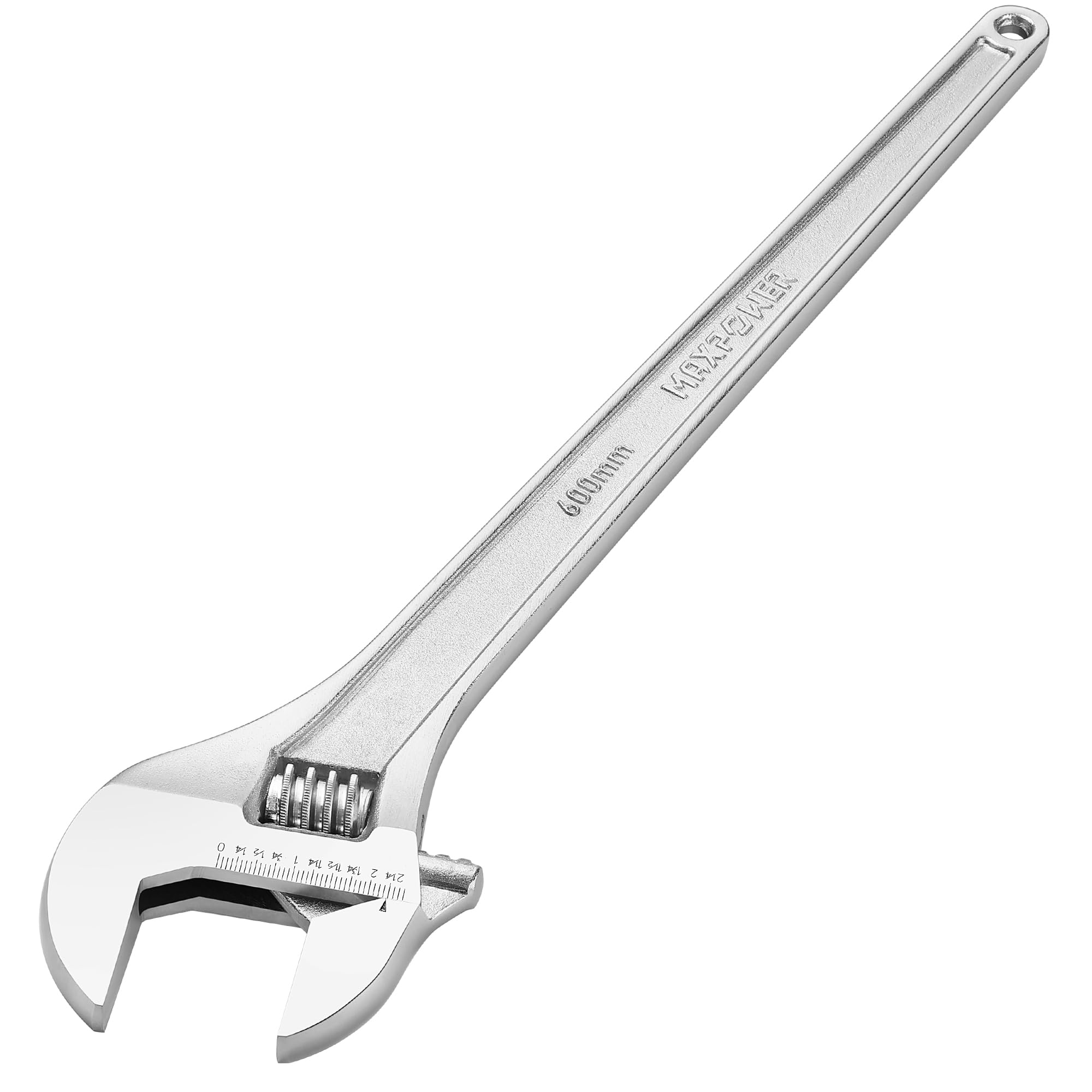
The 24-inch adjustable that spans massive rusted nuts and gives you the lever to break them free.
Big, rusted, and unmoving is exactly what this wrench is built for. The 24-inch length and 2.4-inch (62 mm) jaw span oversized fasteners, and the added weight and length hand you the leverage to crack them loose. It is a beast on old farm equipment and seized bolts. The tapered handle measures 9/16 inch thick and is contoured to keep your grip steady while you put your back into a turn.
Heat-treated forged Cr-V steel gives the body its toughness, and a polished finish resists corrosion and wipes clean after a greasy job. The wide jaws ride on a non-slip worm gear for easy adjustment and secure positioning, so the jaw stays where you set it. Dual SAE and metric scales let you size a nut or pipe by eye before you commit. Owners praise its build quality, saying it holds its own against a Crescent.
The catch is the same one every 24-inch wrench carries: at 2.85 kg it is heavy, and that weight is exactly what gives you the leverage but also what makes long overhead work tiring. If you are reaching into a tight cabinet, its length and mass work against you. Size its 2.4-inch jaw narrower than the RIDGID 31105’s 3-inch bite, so the widest pipe fittings still belong to the pipe wrench. For big fasteners, though, the leverage is exactly right.
two-inch jaw opening: a 24-inch handle and 2.4-inch jaw mean a rusted farm bolt meets its match without a cheater bar.
long handle swing: 2.85 kg will tire you on overhead work, and the long handle is no friend to tight clearances.
stubborn bolts: mechanics and equipment owners facing oversized, rusted hex nuts that need real leverage.
small jobs: tight-space cabinet work or extended overhead turning, where the weight and reach fight you.
6. Performance Tool W356B 2-1/2-Inch Combo Wrench, Satin Chrome

A fixed 2-1/2-inch combination wrench for one giant nut that no adjustable can hold firmly.
Sometimes you do not want a sliding jaw — you want a fixed one that cannot wander. This 2-1/2-inch combination wrench closes fully around a hex and holds it without the jaw drifting, which is why it shines on a specific size like a 2-5/16 trailer ball. The box end has rounded corners to boost torque, and the body is drop-forged and hardened chrome alloy steel with a professional raised-panel design.
There is real heft here: at 8.8 pounds it is the heaviest single wrench on this list, and that mass translates into a solid, planted feel on a big fastener. It carries a lifetime warranty. Owners mostly talk about how well it works on the particular oversized nut they bought it for, and how the fit lands right on Ford, Chrysler, and Jeep hardware when the size matches.
The catch is the size itself. It fits one dimension, so if your nut is not 2-1/2 inches it simply will not grip — some buyers want it closer to a different size and find theirs is not the right match. It also will not reach a round pipe or a variable fitting the way an adjustable does. Buy it when you know your exact size; if you need flexibility, the adjustable wrenches above are the better fit.
For a single large job that keeps coming back, a fixed wrench that never slips is worth keeping in the box.
one-size tasks: you know your exact oversized hex size and want a fixed box end that cannot slip off.
varied fasteners: you need one wrench to cover many sizes — a fixed 2-1/2-inch jaw is a one-job tool.
7. Bahco 9035 R US Ergo X-Wide Adjustable Wrench, 12-Inch

Extra-wide jaws on a short slim head — the adjustable that gets in where straight wrenches snag.
This is a wrench built around a contradiction that works: wide jaws on a short handle. The shorter length and slim, tapered jaws combine easy access into confined areas with serious turning strength, so you reach the fitting and still have the muscle to move it. The wide opening takes on fittings up to 2 inch, and the smooth action holds its setting so the jaw does not creep.
It is precision hardened and treated against corrosion, then finished in black phosphate, and it weighs 1 kg at 12 inches — easy to keep in a tool bag. Owners value its money-to-quality ratio most, with adjustability close behind; the mechanism feels fluid and precise rather than loose or grindy. Owners describe a reverse pitch adjustment that snaps the jaw into place and holds it under load. It is made in Spain and covered by a limited lifetime warranty.
The thing to weigh is that this is a heavier build than a standard crescent, which some owners notice in the hand, and the smooth operation demands care — a tool that adjusts this smoothly invites you to lean on it hard, and the short handle limits how much leverage you actually get. It fits plumbers, electricians, and maintenance workers who need access more than brute length.
Confirm what it does well: wide access, a jaw that holds, and smooth adjustment in a package that disappears into tight spots.
big nut grip: maintenance and plumbing work that lives in confined access, where reaching the fitting is half the battle.
budget buyers: you want maximum leverage on a frozen bolt — the short handle is built for access, not arm wrestling.
8. KLEIN TOOLS 3239 16-Inch Adjustable Spud Wrench

A 16-inch American-made spud that lines up bolt holes and holds the nut while you drive it.
Bolt-up work is a two-brained job: you line up a hole with one hand and drive the bolt with the other. This Klein spud wrench is shaped for it. The 16-inch continuous-taper handle slides into a misaligned bolt and rivet hole to lever the pieces together, while the adjustable head opens to 1-5/8 inches to fit heavy nuts and bolts up to 1 inch. There is even a designated lanyard hole for tethering it up high, compatible with the maker’s TT1 tether.
It is forged and made in the USA from select alloy steel, with precision-machined jaws chosen and assembled by hand for smooth operation. A knurled adjuster turns without a hitch, and the industrial finish resists corrosion. The thing that defines it in owners’ minds is durability — it does not corrode, and the jaws stay where you set them instead of drifting loose the way cheap adjustables do. The 2.4-pound, 16-inch build is long enough for good leverage but manageable in the hand.
The honest note: the jaw opens to 1.63 inches, narrower than the 24-inch pipe wrenches here, so a very large round fitting is beyond it. And the continuous-taper handle is a specific tool, not a general pry bar — treat it as the alignment aid it was made to be. Spend for the American build and the jaws that hold their size; that hold is what you are paying for.
For repeated bolt-up jobs where slop and drift cost you time, the steady jaw is the whole point.
deep spud work: you are aligning holes and driving bolts up high, and you can tether it to your harness.
quick jobs: you need a wide 3-inch bite on large round pipe — this head tops out at 1.63 inches.
9. CRAFTSMAN CMMT81627 24″ All Steel Adjustable Wrench

A 24-inch chrome wrench that shrugs off a wet mechanical room and keeps its shine.
Most wrenches rust in a damp shop; this one is built to resist it. A chrome finish over alloy steel guards against corrosion, which matters if your tool hangs in a wet, dirty mechanical room or a “water room” where moisture is constant. The dual metric and SAE scale on the head lets you gauge a work piece by eye, and wide-opening jaws add flexibility for bigger nuts.
It is a 24-inch adjustable, so you get a real lever on stubborn fasteners, and it meets or exceeds ASME specifications. In a machine like a loader case, owners have put it on a hydraulic hose connector and found it worked great. The chrome build survives a tough environment — six months in a wet, dirty shop with no rust is the kind of staying power that matters when the tool lives in bad conditions.
The honest reality: this is a budget-minded tool, not a high-end one, and the jaw opening tops out just over 2.25 inches — some owners wish it reached closer to 3 inches for bigger fittings. It is also too light to lean a cheater bar on, so it is a controlled-leverage wrench, not a breaker bar. For wet-environment turning at a fair value, though, the corrosion resistance makes it a sensible pick.
Weigh it for the damp jobs: the chrome finish and the price keep this one in the box long after untreated tools have spotted over.
heavy torque: wet, dirty shops and mechanical rooms where rust resistance on a 24-inch wrench is worth more than showroom finish.
comfort seekers: you need a 3-inch jaw or a bar to lean on — the opening stops near 2.25 inches and the body is too light for heavy force.
Know the Specs
Jaw Capacity
Jaw capacity is the widest object the jaws can clamp, measured in inches or millimeters. A bigger number means the wrench grips larger pipe and nuts. The RIDGID 31105 opens to 3 inches; the Klein 3239 spud opens to 1.63 inches. Match this to your biggest fitting rather than buying the longest handle you can find.
Length and Weight
Length is your leverage; weight is what your arm carries. A 24-inch wrench turns a stubborn bolt with less effort than a 12-inch one, but it is harder to fit into tight spaces and heavier to hold overhead. At 24 inches the RIDGID 31105 weighs 2.7 kg while the RIDGID 31400 spud weighs 1 kg at 12 inches — the shorter, lighter tool is the one you reach for in cramped, prolonged work.
Jaw Style: Toothed vs Smooth
Toothed jaws bite hard into steel pipe and grip the round surface, but they will scar soft metal. Smooth, toothless jaws grab plated brass and chrome without marks and are the choice for fixtures. The pipe wrenches above use toothed hook jaws; the spud wrenches use smooth jaws for finished hardware.
Body Material and Finish
Forged alloy steel and Cr-Mo jaws handle heavy torque and resist wear; a chrome or phosphate finish guards against rust in damp rooms. A polished or black oxide surface cleans up easier after greasy jobs. If the wrench lives in a wet shop, prioritize the corrosion-resistant finish such as the CRAFTSMAN chrome coat.
Common Questions
What is the difference between a pipe wrench and a spud wrench?
How do I know what jaw capacity I need for my pipe?
Will smooth jaws really grip a chrome fixture without scratching it?
Is a 24-inch wrench too big to use under a sink?
What does Cr-Mo or forged alloy steel mean for a wrench?
Should I buy an adjustable wrench or a fixed combination wrench?
How heavy is too heavy for all-day wrench work?
Do these wrenches resist rust in a wet mechanical room?
The Bottom Line
For most buyers, the heavy-duty wrench winner is the RIDGID 31105 because its 3-inch jaw capacity and 2.7 kg aluminum body deliver the widest bite here without the arm fatigue of an all-steel wrench. If you are turning chrome and brass fixtures without scarring them, grab the RIDGID 31400 spud wrench for its smooth, toothless jaws. And for oversized rusted hex nuts that need a long lever, the MAXPOWER 24-inch adjustable is the one to reach for. The 3-inch bite on the RIDGID is the single number that settles most pipe jobs — start there.
How we choose
We do not accept paid placement. Every pick is matched to a real buyer and a real use-case; we do not hands-on test units.
Sources
Specifications: manufacturer listings and product documentation. Review insights: verified customer reviews, as of October 2026. Pricing: not shown on this page (it changes often); check the current price via the retailer link.
As an Amazon Associate, Home Digitized earns from qualifying purchases. This does not affect which products we feature.