
Specs are compiled from manufacturer listings and verified buyer reviews and can change over time — please confirm the key details on the product page before buying.
If you want one black mat that handles sweaty hands, hardwood floors and knee pressure without sliding around, the answer is the Karma Fitness 10mm wide mat. It solves the two problems that ruin most home workouts: your feet running out of mat, and your knees feeling every inch of the floor. Everything below is sorted by what you actually do on the mat, not by marketing claims.
This guide is built by comparing the manufacturers’ published specifications and the patterns across verified customer reviews, so you get each pick’s real strengths and trade-offs instead of marketing spin.
A black mat hides scuffs and sweat marks better than any pale colour, so the real decision is thickness and surface texture. The nine picks below are the black mats worth your floor space, and this breakdown of the black yoga mat options covers exactly how each one feels underfoot.
Top Picks


How To Choose The Best Black Yoga Mat
A yoga mat is one of the few fitness buys where the wrong choice hurts every single session. Too thin and your knees complain on hardwood. Too soft and you wobble during balance poses. Here is what separates the nine picks on this page.
Thickness is the first decision, not a bonus
Thickness, measured in millimetres or inches, decides how much your joints feel the floor. A 10mm mat cushions kneeling and seated poses on tile or concrete. A 1-inch mat goes further and works almost like a floor bed. A 6mm mat like the Manduka stays firm and stable instead, which suits standing poses where a spongy surface would throw you off balance. Pick thickness by the pose you struggle with most.
Width and length keep you on the mat
A standard mat runs around 24 inches wide. That is fine for sun salutations and cramped for lateral lunges or press-ups, when your hands drift onto the floor. The widest pick here stretches to 32 inches. Length matters too — anyone near six feet wants 72 inches or more so the heels of your feet stay on the foam.
Foam type drives grip, weight and smell
TPE (a rubbery plastic foam) is lighter and usually lower-odour than NBR (a denser synthetic rubber). NBR gives deeper cushioning but tends to be heavier and may arrive with a foam smell that needs airing. PVC, used on the Manduka, is the densest and firmest of the three. None of these is better in the abstract — a TPE mat suits a commute to class, NBR suits a home gym, and PVC suits a dedicated studio practice.
Side-by-Side Comparison
| Model | Best For | Thickness | Mat Size (L x W) | Material | Amazon |
|---|---|---|---|---|---|
| Karma Fitness Large Workout Mat★ Best Overall | Home gym and wide floor work | 0.39″ (10mm) | 72″ x 32″ | TPE | Amazon |
| Circuit Fitness by MarcyBest Value | Beginners needing deep cushioning | 0.5″ (12mm) | 72″ x 23.25″ | NBR | Amazon |
| Fitvids High Density MatMost Popular | Everyday yoga and Pilates | 0.5″ (1/2-inch) | 71″ x 24″ | Foam | Amazon |
| adidas Yoga Mat | Studio practice with low bulk | 0.16″ | 69.29″ x 24.02″ | EVA + TPE | Amazon |
| Gaiam Thick Yoga Mat | Joint comfort on hard floors | 0.39″ (10mm) | 72″ x 24″ | NBR | Amazon |
| YOTTOY Extra Thick Mat | Pilates and knee protection | 0.5″ (12mm) | 72″ x 24″ | TPE | Amazon |
| Tone Fitness 1″ Mat | Deep cushioning for sore joints | 1″ | 72.05″ x 24.02″ | NBR | Amazon |
| Hatha Yoga TPE Mat | Wet, sweaty sessions | 0.33″ (1/3″) | 72″ x 27″ | TPE | Amazon |
| Manduka PRO Yoga Mat | Serious daily studio practice | 0.24″ (6mm) | 85″ x 26″ | PVC | Amazon |
Detailed Reviews
1. Large Workout Mat 10mm
Our pick — 4.5+★ from 600+ verified ratings; the strongest balance of quality and price.
Ten millimetres of cushioning on a mat wide enough for sumo squats without stepping off.
The Karma Fitness mat measures 72 inches long and 32 inches wide, which its own listing calls 33% wider than a standard 24-inch yoga mat. That extra width is the reason it wins here: during press-ups, lateral lunges and sumo squats your hands and feet stay on the foam instead of sliding onto bare floor. The 0.39-inch thickness — 10mm — is enough cushioning for a kneeling stretch without the wobble that comes from a spongy mat.
What buyers notice first is the build — the diamond-textured TPE reads denser and more finished than typical NBR foam. It is reversible, with a branded black side and a plain flip side, so you can choose whether the logo faces up. The matching carry bag with an adjustable shoulder strap makes the trip to a studio or the park manageable, even though this is a bulky mat by design.
Here is the real contrast: this is the wide, thick home-gym option, not a travel mat. It weighs 1.8 kg, so it is the sort of thing you leave rolled out or stow in a closet rather than sling over your shoulder every morning. The surface is waterproof and sweat-resistant, and it wipes clean by hand. If a sweaty session is part of your week, that matters more than any logo.
Where this mat earns its place
- 32-inch width keeps hands and feet on the mat during wide floor moves.
- 0.39-inch (10mm) TPE cushioning balances comfort against stability.
- Diamond-textured grip on both sides holds up during sweaty Pilates and weights.
- Carry bag and adjustable shoulder strap included for studio trips.
What to know before you buy
- At 1.8 kg it is bulkier than a thin travel mat.
- Hand wash only, so no machine cleaning after a heavy session.
Reach for this if: you train at home, do strength work or Pilates on the floor, and want room to move.
Look elsewhere if: you need something that disappears into a backpack between classes.
2. Circuit Fitness by Marcy Yoga Mat
Twelve millimetres of dense NBR for anyone who wants joint relief without spending much.
This is the cheapest way onto a genuinely thick mat. The Marcy mat runs 72 inches long, 23.25 inches wide and 0.5 inches thick, with 12mm of high-density NBR foam under you. Compare that to the 10mm Karma Fitness above: this one gives you 0.11 inches more foam, but 8.75 inches less width. If you mostly do yoga, Pilates and seated stretching, that wider cushion is worth having. If you do lateral lunges, you will feel the narrower footprint.
Where it shines is comfort on a hard floor. The thick NBR layer is the sort of surface you kneel on without flinching, and it suits people of all shapes and sizes according to its own listing. At 2.2 pounds it is heavier than the 1.8-pound Fitvids mat. To be accurate: the Marcy weighs 2.2 pounds while the Fitvids weighs 1.8 pounds, so the Marcy is the heavier of the two. That extra weight buys the thicker foam.
The honest caveats are inconsistent grip once sweat builds up and a strap that is the weakest part of the package. Treat the strap as a bonus rather than a promise and the 10mm NBR foam itself holds up. Buyers consistently report that the 12mm NBR foam softens joint impact during floor exercise.
The cushioning argument: 12mm of NBR foam gives you deep support for kneeling and seated work, and it wipes clean with a soft cloth between sessions.
The fit check: grip is inconsistent once sweat builds up, so it suits dry yoga and mat work more than hot, slippery flows.
Pick it for: a first thick mat for gentle yoga, Pilates or stretching at home.
skip it if: you sweat heavily and rely on a tacky surface to hold your hands in place.
3. Fitvids 1/2-inch Yoga Mat
The mat that made half-inch foam normal, with a double-sided grip that stays put on the floor.
If a product can be judged by how many people have already tried it, this Fitvids mat has the deepest track record on the list — it has the highest rating count of any pick here, by a wide margin. The specs explain why: 71 inches long, 24 inches wide and a full 1/2-inch of high-density foam.
The double-sided anti-slip surface is the part buyers single out. It grips on hard floors and stays flat rather than curling at the edges, which is the difference between a mat you trust in a sweaty session and one you fight with. The foam is moisture-resistant, so a quick wipe with soap and water handles the after-session clean. It ships with a carrying strap that fastens with Velcro.
The trade-off is durability at the surface. A few buyers report dents and tears after heavy use, and some notice a rubber or latex smell that fades with airing out. Neither is unusual for thick foam at this tier — think of it as a mat that serves you well for years of weekly use, provided you aren’t dragging it across gravel. For a mat this thick, that is a reasonable bargain.
What it does well: the half-inch foam cushions back, knees and elbows on hardwood, and the double-sided surface keeps the mat from sliding.
The compromise: the foam can dent with heavy use, and a fresh mat may carry a rubber smell for a few days.
Choose this if: you want proven, thick and light in one mat.
Think twice if: you need a surface that survives years of abrasive outdoor use.
4. adidas Yoga Mat
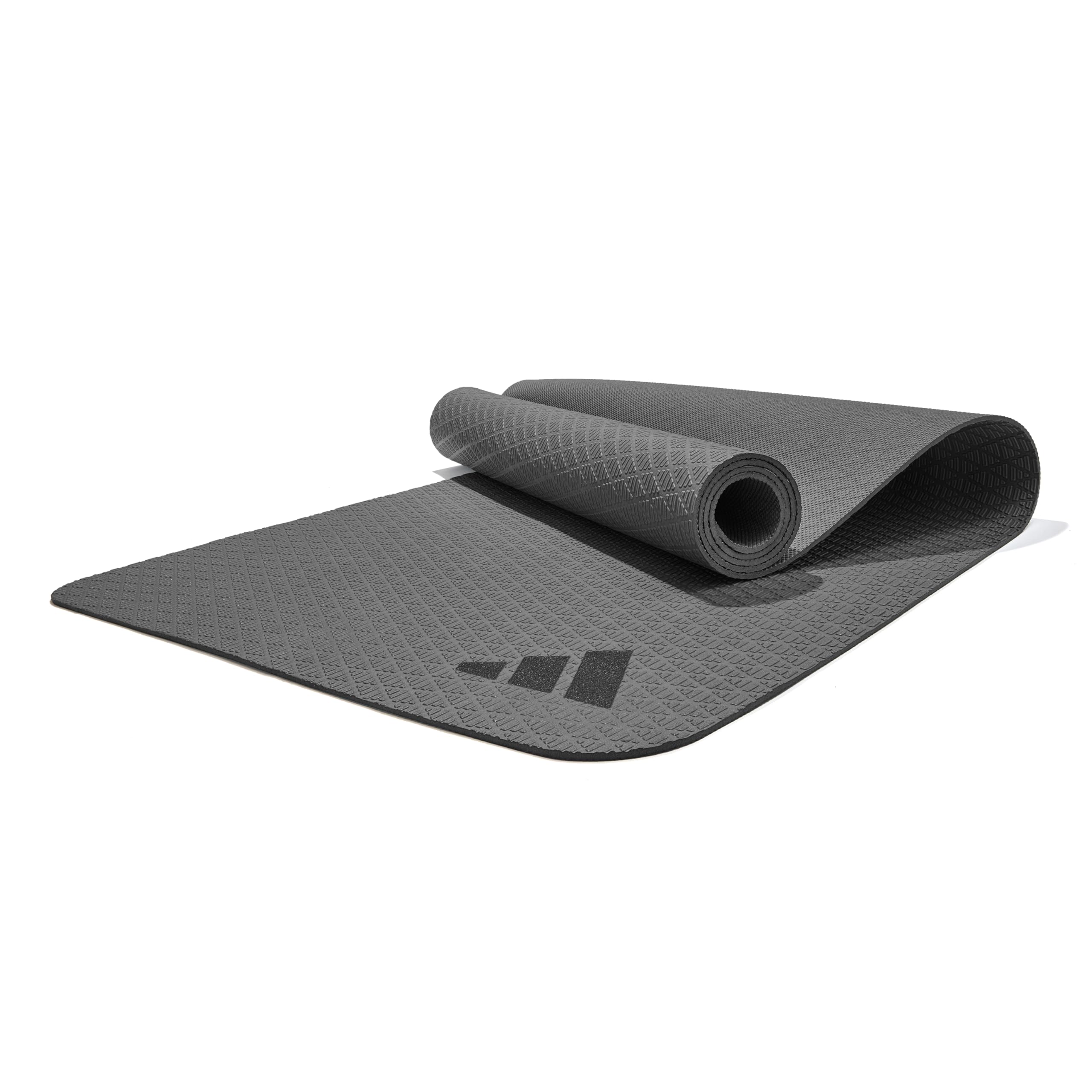
A trim, firm mat for people who want studio manners without the bulk of thick foam.
At 0.16 inches thick, the adidas mat sits at the thin end of this list — far from the 1-inch Tone Fitness and even from the 0.39-inch cards. That is not a flaw; it is the point. A thin, medium-density surface keeps you anchored during standing poses and balance work where a spongy mat would roll underfoot. It rolls into a slim bundle and weighs 0.5 kg, so it slots into a tote and disappears into a studio locker.
The materials are 95% EVA and 5% TPE, and 50% of the construction is reused material. The subtly textured top and base provide traction on most floor types, and the mat lies 69.29 inches long and 24.02 inches wide — enough for most practices, though tall users will want to check against the 72-inch picks here. The surface stays flat without curling at the edges during movement.
One thing to weigh: at this thickness, kneeling poses on concrete will feel hard unless you add a blanket or a knee pad. The adidas rewards a studio practice and dry workouts, and it asks you to keep it clean by hand. If your session is a sweaty vinyasa, the firm surface will hold its shape better than a thick foam mat — you just won’t get the plush feel under your knees.
The everyday reality: the medium-density EVA and TPE blend stays flat, resists slipping and wipes clean by hand.
Worth knowing: 0.16 inches is firm under knees and limited on width for wide-legged poses.
Best for: a regular studio-goer who wants a light, grippy mat to carry.
Not for: anyone who does long floor sessions on a hard surface.
5. Gaiam Thick Yoga Mat

Ten millimetres of NBR aimed squarely at knees that complain on a wood floor.
Gaiam’s thick mat measures 72 inches long and 24 inches wide with 10mm of high-density NBR foam. The 10mm NBR foam is the headline: it is the mat to reach for when kneeling poses ache on tile or concrete. The textured surface reduces slipping on most hard floors during dry workouts, and the softer feel prioritises shock absorption over firmness. That is the right call for stretching, Pilates and bodyweight routines.
What owners talk about most is the same thing — the comfort. You can kneel on it for a full session without a second layer, and the adjustable cinch strap keeps it rolled between workouts. The NBR foam is low-odour, though a fresh mat may still have a foam smell that fades after airing for 24 to 48 hours according to the listing.
The honest limit is lifespan under hard use. Durability and stability are mixed: some owners mention it lasts a long time, others find it tears and slides. Expect roughly two years of weekly use before the soft NBR surface loses its spring. Wipe it with a damp cloth and keep it out of direct sun and it will hold up fine.
The reason to buy: 10mm of NBR foam makes kneeling, seated and back work noticeably easier on hard floors.
The honest limit: a soft foam mat wears with heavy use, and the carrying strap is the weakest part of the package.
Pick this one: if joint comfort comes before everything else in your routine.
Think again: if you want a single mat to handle an intense daily practice for years.
6. YOTTOY Yoga Mat

A thick TPE mat that protects elbows and knees without turning into a wobble board.
The YOTTOY brings 12mm of TPE onto a 72-inch by 24-inch surface, and the foam is the well-chosen kind for Pilates. It is firm enough that balance poses don’t sink, yet cushioned enough that kneeling and elbow planks feel fine. The anti-slip top uses granular bumps to add friction and absorb sweat, and the water-ripple underside grips the floor, so the mat behaves on tile, wood or carpet.
It is also the most carefully sourced foam in this group. The TPE is SGS and TUV certified for environmental safety, free of heavy metals and 10 types of phthalate according to the listing, and made through a one-piece foam process that keeps it odourless and waterproof. At 4 pounds it is one of the heavier mats here, so you will notice it on a commute, but that weight goes into a solid, non-floppy surface.
The catch is the smell. Some customers note a heavy industrial rubber odour that airing does not shift, though others find none. If you are sensitive to foam smell, wash the mat with diluted white vinegar before first use. Otherwise this is a stable mat for a daily Pilates habit, and the included strap makes rolling it away easy.
Why it stands out: firm 12mm TPE gives elbow and knee support while keeping balance poses steady.
The one gripe: a strong rubber smell can linger, and at 4 pounds it is not a light travel mat.
Worth it for: a daily Pilates or home-workout routine that needs cushioning and stability together.
Look elsewhere if: you carry your mat to a class every day and count every pound.
7. Tone Fitness 1″ Yoga Mat
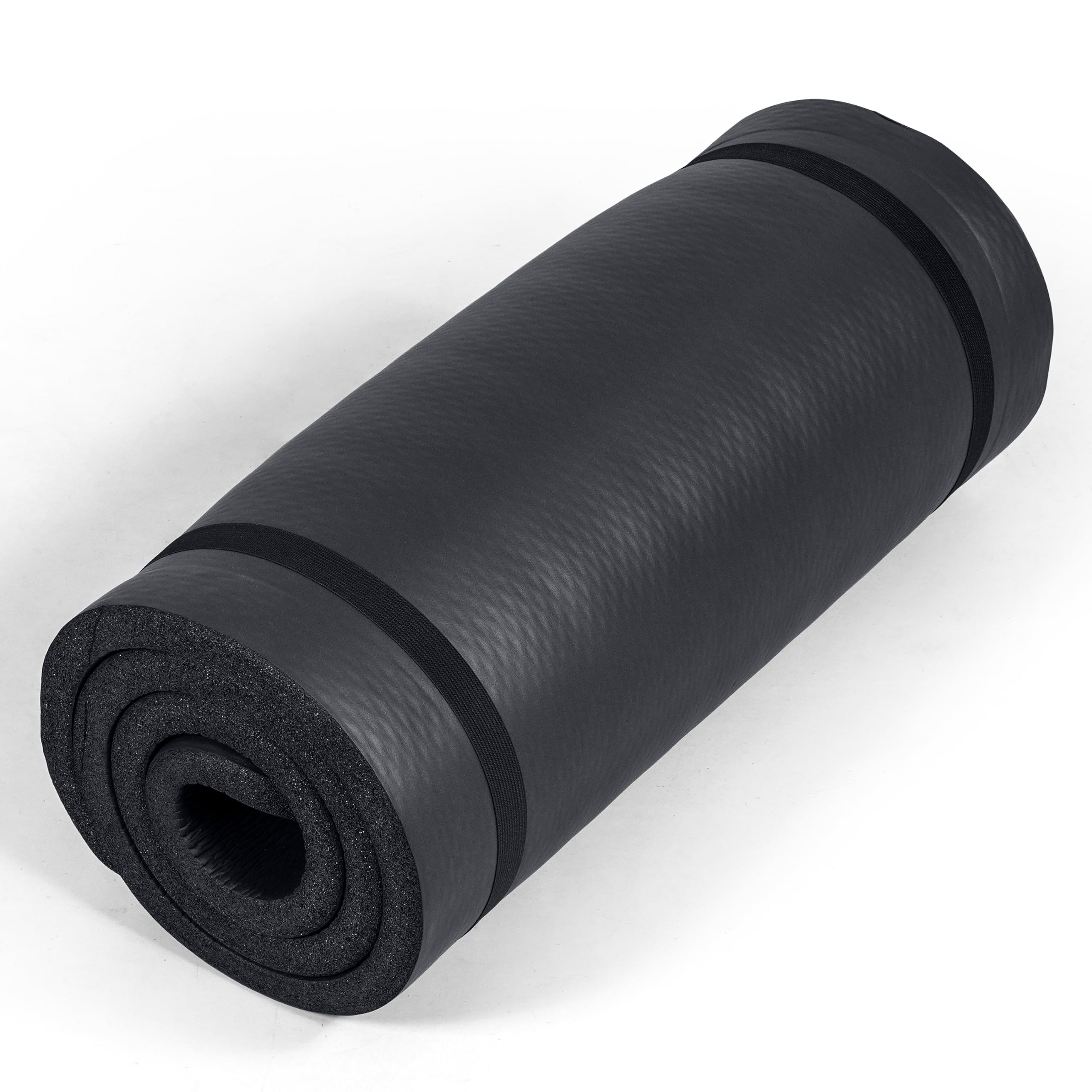
A full inch of foam for anyone who wants the floor to stop being part of the workout.
One inch of high-density NBR foam is the most cushioning on this entire list — more than double the 10mm Karma Fitness and a clear step above the 12mm Marcy and YOTTOY. If your back and knees ache after floor exercises, the Tone Fitness’s full inch of NBR foam absorbs most of that impact. It measures 72.05 inches long by 24.02 inches wide, enough room for stretching, Pilates and core work, and the textured NBR surface adds grip during planks and controlled movement.
The foam is latex-free and easy to wipe clean, and the included strap keeps the mat rolled and out of the way between sessions. At 3.8 pounds it is heavy for a mat, but that weight is the foam doing its job, and buyers who use it at home say it is worth the bulk. The padded surface suits hips, elbows and back on a hard floor, and the strap makes it simple to move between rooms.
Two fair notes before you commit. The thick foam is bulky to transport, so this is a home mat rather than a gym-bag mat. And a few owners find surface imperfections on arrival that they accept at this tier, plus the carry strap is a mixed bag. For the price it remains the most cushioning per inch here, which is exactly the point of buying a 1-inch mat.
What the inch of foam delivers
- 1-inch thickness absorbs impact from kneeling, planks and core exercises.
- Latex-free NBR foam wipes clean and suits daily home routines.
- Textured surface holds traction during controlled movement.
- Carry strap included for rolling it out of the way.
Where it asks for patience
- At 3.8 pounds it is a hefty mat to carry to a class.
- Surface imperfections can appear on arrival, and the strap is mixed.
Reach for it if: floor comfort is your main reason for buying a mat.
Leave it if: you need to travel with your mat or store it in a tight slot.
8. Hatha Yoga TPE Yoga Mat

Twenty-seven inches wide with a double-sided grain that holds when your hands are wet.
The Hatha mat runs 72 inches long, 27 inches wide and 0.33 inches thick. That width sits between the 24-inch standard and the 32-inch Karma Fitness, and the 0.33-inch TPE is a deliberate middle ground: more cushioned than the adidas, less bulky than the 12mm foams. The foam is SGS-certified TPE, which the listing calls odourless and easy to clean, and the extra thickness provides shock absorption under knees and hips.
The reason to pick it is the grip when it gets wet. Both sides carry a grain pattern that keeps hands and feet from sliding even once sweat builds up, which is the one area where several thick NBR mats fall short. It sits calmly on wood, tile, cement and gym floors, so it travels from a studio to a home corner without complaint. The included carrying sling handles transport.
Fair warning: some buyers find a strong odour that needs weeks of airing out, and the material is not the most durable soft foam — heel scuffs can show after months of weekly practice. It is also less sticky than a classic sticky-mat surface right from the start. Wash it with mild detergent and cold water, dry it flat, and keep it out of extended sun to get the best life from it.
Why it earns the slot: double-sided grain holds grip in sweaty conditions, and the 27-inch width gives room for wide poses.
The caution: a strong initial smell and softer foam that can scuff with heavy heels.
Worth grabbing if: you flow sweaty and need a surface that holds grip.
Consider another pick if: odour sensitivity is high on your list.
9. Manduka PRO Yoga Mat

A dense 6mm studio mat built to be the last one you buy, on a serious budget.
Six millimetres of ultra-dense PVC is a different animal from the soft NBR foams here. Where a thick foam cradles you, the Manduka PRO holds its shape under load, so standing balances and Downward-Facing Dog stay steady. The closed-cell surface seals out moisture, which makes it easy to wipe clean between sessions. It is latex-free, made from OEKO-TEX certified PVC in an emissions-free German facility by the manufacturer’s own account, and designed for a lifetime of practice.
Size is the other reason people choose it. The mat measures 85 inches long and 26 inches wide, so a six-footer’s heels and head stay on the mat. Compared with the 72-inch mats on this list, that is 13 more inches of length — the difference between staying on the mat and reaching onto the studio floor. It weighs 9.5 pounds, so it is the heaviest mat here by a wide margin, which is the price of its density.
The real caveat is grip when it’s new. The surface arrives slick and needs breaking in before it holds during sweaty flows — a scrub with water and a mild abrasive, or a salt treatment, is the common approach, though it voids the warranty. Once broken in, owners describe it as stable and long-lasting. It is the mat for a serious, dedicated practitioner who wants to buy once.
Why serious practitioners pick it
- Dense 6mm PVC holds firm in standing and balance poses.
- 85-inch length gives tall users room to stay on the mat.
- Closed-cell surface seals out moisture and cleans easily.
- Latex-free, OEKO-TEX certified PVC construction.
What you accept in return
- Arrives slick and needs breaking in before grip arrives.
- At 9.5 pounds it is not a mat you carry far.
Buy it if: you practise seriously and want one firm mat to last a long time.
pass on it if: you want soft, immediate cushioning straight out of the wrapper.
Know the Specs
Thickness in millimetres and inches
Thickness is the number that changes how your knees and back feel on a hard floor. A 10mm mat has 0.39 inches of foam; a 12mm mat has 0.5 inches; a 1-inch mat has 25mm. More foam means more cushioning for kneeling and seated work, but also a softer, less stable surface for standing poses. Pick thickness by the pose that hurts most.
Foam material: TPE, NBR and PVC
TPE is a lighter, lower-odour foam that suits people who carry their mat to class. NBR is denser and gives deeper cushioning but can arrive with a foam smell that fades after airing. PVC is the firmest and heaviest, built for stability over plushness. None is best in every case — match the foam to where and how you practise.
Mat length and width
A typical mat is 24 inches wide and 71 to 72 inches long. That suits most people, but anyone near six feet or doing wide floor moves should look at the 32-inch or 27-inch options here. A longer mat like the 85-inch Manduka keeps your heels on the foam during long holds. Width is the spec to check if your hands drift off the mat during press-ups.
Grip and surface texture
Grip comes from the texture of the top and bottom surfaces. A textured or double-sided grain adds friction so hands and feet stay put, especially once sweat builds up. A smoother surface can be less tacky when wet but easier to clean. If you flow hot and sweaty, prioritise a mat with a grippy grain and a non-slip base.
Common Questions
Which black yoga mat is best for a tall person?
Is a thicker mat always better for sore knees?
What is the difference between TPE and NBR yoga mat foam?
How do I stop my yoga mat sliding on a hardwood floor?
Why does my new yoga mat smell, and will it go away?
Can I machine wash a black yoga mat?
Is a 24-inch wide mat wide enough for lunges?
How long should a yoga mat last before it needs replacing?
Is a thick yoga mat good for Pilates?
Why do some black yoga mats have no logo showing?
The Bottom Line
For most people, the black yoga mat winner is the Karma Fitness Large Workout Mat because its 72-inch by 32-inch size and 10mm TPE cushioning give you room to move on a hard floor without slipping. If you want the thickest foam for joint comfort, grab the Tone Fitness 1″ Mat. And for a serious studio practice you plan to keep for years, the Manduka PRO is the one to reach for.
One tested-by-many option stands out if you want a low-risk first buy: the fitvids mat has the deepest review history here and a thick, steady surface, which makes it an easy starting point.
How we choose
We do not accept paid placement. Every pick is matched to a real buyer and a real use-case; we do not hands-on test units.
Sources
Specifications: manufacturer listings and product documentation. Review insights: verified customer reviews, as of October 2026. Pricing: not shown on this page (it changes often); check the current price via the retailer link.
As an Amazon Associate, Home Digitized earns from qualifying purchases. This does not affect which products we feature.