
Specs are compiled from manufacturer listings and verified buyer reviews and can change over time — please confirm the key details on the product page before buying.
Most of the heat your wood stove makes never reaches the couch — it stacks up near the ceiling while your feet stay cold. A heat-powered stove fan fixes that without a cord, a battery, or a single watt from the wall. It sits on the hot stovetop, turns stove heat into a small electric current, and pushes that warm air out into the room. The trick is picking one whose blades actually move air once your stovetop reaches its working temperature.
This guide is built by comparing the manufacturers’ published specifications and the patterns across verified customer reviews, so you get each pick’s real strengths and trade-offs instead of marketing spin.
Below you’ll find nine thermoelectric fans ranked by how well they spread warmth, how quietly they run, and how much heat they can take. Each one is heat-powered, so none of them needs an outlet. The right pick depends on your stove type and room size, and this breakdown of the wood stove heat fan options matches each one to a specific setup.
Top Picks

How To Choose The Best Wood Stove Heat Fan
The first thing to understand is that these fans make their own power from heat. A thermoelectric module (a small plate that turns a temperature difference into electricity) sits at the base. The hotter the stovetop gets compared with the cooler air above, the faster the blades spin. That means your fan’s real performance is tied to your stove’s surface temperature far more than to any marketing number.
Match the fan to your stove’s surface temperature
A fan only starts working once the metal underneath it gets hot enough. Some units kick in around 140°F, while others need a hotter surface before the blades turn freely. If you run a modest fire, a fan that wakes up at lower heat will do more for you than a bigger unit that sits idle. Check the manufacturer’s stated working range against how hot your stovetop typically runs.
Look at airflow, not just blade count
More blades do not automatically mean more air. Airflow is measured in CFM (cubic feet per minute — how much air the fan pushes each minute), and it depends on blade size, motor strength, and how freely the blades spin. A wide-bladed two-blade fan can move a surprising amount of air, while a twelve-blade unit with weak motors may barely stir it. Compare CFM figures when they are published, and read what owners say about actual air movement.
Decide where the fan will sit
Flat-top wood stoves are the easy case — you just set the fan down. Fireplace inserts, portable propane heaters, and Buddy-style heaters are trickier and often need a mounting bracket to hold the fan at the right angle. If your stove has a curved top or a grill, confirm the bracket spacing fits before you buy. Several models here ship with a bracket for exactly this reason.
Check the overheating cut-out and the noise
A bimetallic strip (two bonded metals that bend as they heat) sits at the base of most good fans. When the surface gets too hot, the strip lifts the front edge so the motor stops cooking itself. Look for a stated maximum temperature. On noise, the only moving part is the blade assembly, so most of these run close to silent — but a rattle on a low setting is the one thing worth reading up on.
Side-by-Side Comparison
| Model | Best For | Airflow (CFM) | Blades | Weight | Amazon |
|---|---|---|---|---|---|
| Caframo Ecofan Original★ Best Overall | Quiet, long-haul wood stove owners | 100 CFM | 2 | 1.8 lb | Amazon |
| Tomersun 8-Blade Heat PoweredBest Airflow Value | Buddy heaters and flat-top stoves on a budget | — | 8 | 1 lb | Amazon |
| HIDALIFE 6-Blade with BracketBest for Small Heaters | Portable propane and pellet heaters | — | 6 | 1.3 lb | Amazon |
| BLFIRE Dual Motor 12-Blade | Compact stoves with limited stovetop space | — | 12 | 0.91 kg | Amazon |
| Sckee Buddy Heater Fan | Ice fishing and off-grid Buddy heater use | — | — | — | Amazon |
| XTIMES 12-Blade Dual Motor | Heaters, blinds, and small cabins | — | 12 | 1.6 lb | Amazon |
| VODA 12-Blade Large Stove Fan | Big rooms needing high-volume air movement | 280 cfm | 12 | — | Amazon |
| Ecofan Original 100 CFM | Off-grid cabins and classic wood stoves | 100 cfm | — | — | Amazon |
| Freedom Stoves 13″ 4-Blade | Medium to large rooms with a flat-top stove | 348 cfm | 4 | — | Amazon |
Detailed Reviews
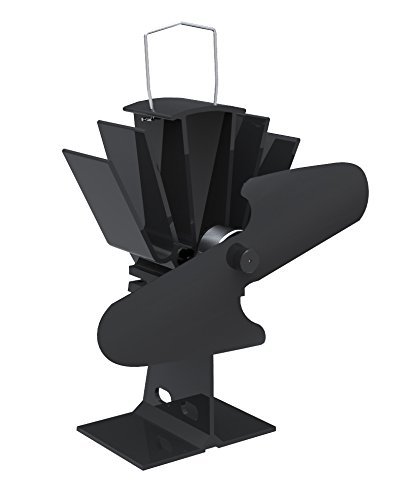
1. Caframo Ecofan Original Heat Powered Stove Fan
Our pick — 4.5+★ from 500+ verified ratings; the strongest balance of quality and price.
The two-blade veteran that has quietly warmed stoves for well over a decade.
This is the fan that built the category, and it earns the top slot on motor longevity rather than raw airflow. It pushes up to 100 CFM (cubic feet per minute — how much air the blades move each minute), a modest figure next to the high-blade-count competition. What it does with that air is spread it evenly and silently. The Canadian design sits on a stovetop surface rated between 300°F and 650°F, and because there are no cords or batteries, it keeps working straight through a power cut.
Where the Ecofan wins is the long game. Owners running it season after season report motors that outlast the firewood, and Caframo sells replacement motors you can swap in rather than buying a whole new fan. The two-blade layout moves less volume than the Tomersun 8-blade, and it carries more heft at 1.8 pounds versus that unit’s 1 pound. That extra weight keeps it planted on a hot stovetop. As buyers put it, “fans still running; replaced 3 motors over 6 years, occasional dusting needed” — a maintenance rhythm, not a failure.
The honest catch is airflow on bigger spaces. A few owners find the gentle push is not enough for a wide open room, and the two thin blades are delicate enough that you handle them with care when lifting the fan off a hot stove. For a standard wood stove in a normal living room, though, that quiet reliability suits most people.
What earns it the crown
- Runs completely silent with no cords, batteries, or outlets
- Motionless on the surface until the stove hits its 300°F to 650°F working range
- Replacement motors keep it serviceable for years instead of a throwaway
Where it asks for patience
- 100 CFM is gentler than the multi-blade fans for large open rooms
- Delicate blades need a careful hand when the stove is hot
Reach for this if: you want one quiet fan you can leave on the stove and forget about for years.
Think twice if: your room is genuinely large and you need maximum air pushed across the floor.
2. Tomersun Wood Stove Fan 8 Blades Heat Powered
Eight aluminum blades turning a buddy heater into a room-wide warm draft.
Eight blades against the Caframo’s two is the headline here, and the maker rates the eight-blade design to move more warm air than a standard four-blade fan, for a unit that weighs 1 pound versus the Caframo’s 1.8 pounds. The thermoelectric module (a plate that converts stove heat into the electricity that spins the blades) means it runs with no batteries and no bill. The maker rates the ideal surface range at 390°F to 480°F and warns against overheating past 570°F.
What wins people over is reliability — it is the thing owners praise most about this fan by a wide margin. It activates on its own once the surface gets hot and keeps spinning after you shut the fire down, distributing the residual warmth instead of letting it drift up to the ceiling. The included bracket is the useful extra, letting you clamp it to portable heaters rather than only flat stovetops. A magnetic thermometer is in the box too, so you can see when you are inside that working range.
The recurring gripe is airflow expectations. Some owners expect a howling draft and instead get a gentle push — this is a circulator, not a floor blower. Set it where you want the warm air to travel and give it a few feet, and it does its job. As one buddy-heater buyer put it: “I have used this fan twice now, it works great on my buddy heater.”
The value read: for a fan that ships with a bracket and thermometer, this is one of the more generous packages in the lineup, and the cooler-working buddy heater crowd is exactly who it suits.
Your match if: you heat with a portable propane heater and want more air movement than a two-blade fan gives.
Pass if: you picture a wind tunnel — expect a steady warm breeze, not a blast.
3. HIDALIFE Wood Stove Fan with Bracket, 6 Blades
A compact bracket-mounted fan that wakes up thirty seconds after the heater lights.
Six blades on a body that stands about as tall as a coffee mug, and the small footprint is the point. It measures 3.5 inches deep and 3.5 inches wide by 7.9 inches high — the sort of compact shape that leaves room for a water pot beside it on a crowded stovetop. The base and blades are anodized aluminum (aluminum treated with a protective oxide layer), so it resists rust and moves heat efficiently. The maker’s stated range is a working surface of 140°F to 653°F, with an overheating guard that lifts the front edge once it hits the top of that band.
Heat distribution is what owners talk about most positively, and the start-up speed backs it up — the blades begin turning within thirty seconds of the heater igniting. The included bracket is meant to mount the fan on portable heater families where a flat stovetop does not exist. It runs at under 25 dB (decibels — a measure of loudness; 25 dB is quieter than a whisper), so it disappears into the background. The maker rates it for a room area of 22 square meters.
The thing to watch is the bracket fit. It clamps fine on some Buddy models but can be too tight across the grill spacing on a Big Buddy, which means a bit of improvised adjustment. Airflow divides opinion in the same way as most fans here — a gentle boost, not a gale. For a three-season porch or a shed, though, that gentle boost is enough to take the chill off.
The quiet upgrade: under 25 dB is a genuinely faint presence, so if a humming fan would drive you up the wall in a small space, this one keeps its voice down.
The bracket caveat: confirm the grill spacing on your specific heater before you count on a drop-in fit — some owners had to reshape the bracket slightly.
Pick it for: a porch, shed, or small room where a propane heater needs its warmth pushed a few feet further.
Look elsewhere if: you have a very wide Buddy grill and want a bracket that bolts straight on with no fiddling.
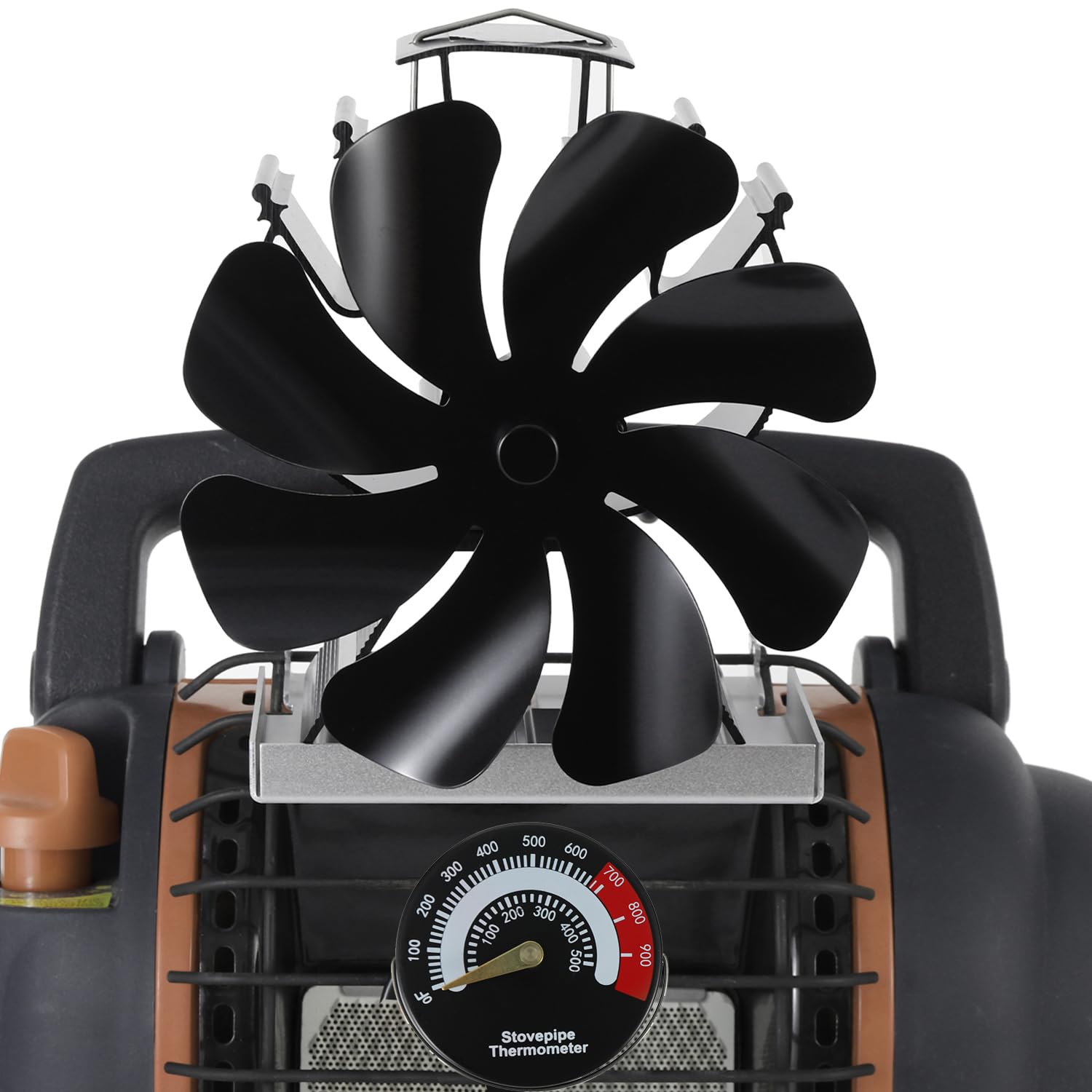
4. BLFIRE Wood Stove Fan Heat Powered Dual Motor, 12 Blades

Two motors and twelve blades packed into a footprint you can set beside the kettle.
Twelve blades driven by two motors is a serious-sounding spec, and the maker claims this layout pushes 50% more warm air than a single-motor fan. Rated at ≤25 dB (decibels — a loudness measure; 25 dB is roughly a soft whisper), it is built to fade into the room. The base and blades are anodized aluminum, so rust is not a worry over a long winter. A temperature-sensing module lifts the fan slightly when the surface runs too hot, protecting the motor, and there is a thermometer so you can keep an eye on the fire.
What owners value is the build — quality is the top thing they call out, and the compact size leaves clear space on the stovetop for a water pot or a kettle. The dual motors also mean the fire can be damped down sooner once the blades are spinning fast, because a fast spin is your cue that the stove is hot. It needs no wiring at all, so a power cut changes nothing. One owner summed it up plainly: “Moves heat around from above the wood stove. No electricity needed so power out, no problem.”
The honest note is that the listing photos can make this fan look bigger than the box reveals — a few people were surprised by the actual size. Airflow lands in gentle-circulator territory rather than a strong blow, and the small blades mean it turns easily but moves air modestly. For a compact stove in a smaller room, that trade fits neatly.
Why it holds its spot
- Dual motors drive twelve blades for faster warm-air circulation
- Small footprint frees up room for a kettle or water pot
- Temperature-sensing module lifts the fan to protect the motor when hot
Where expectations need calibrating
- Photos make it look larger than the real dimensions
- Airflow is a gentle push rather than a strong draft
Lean this way if: your stovetop is crowded and you want dual-motor air movement from a small footprint.
Hold off if: you need a wide fan moving a big volume of air across a large room.
5. Sckee Wood Stove Fan Compatible for Buddy Heater
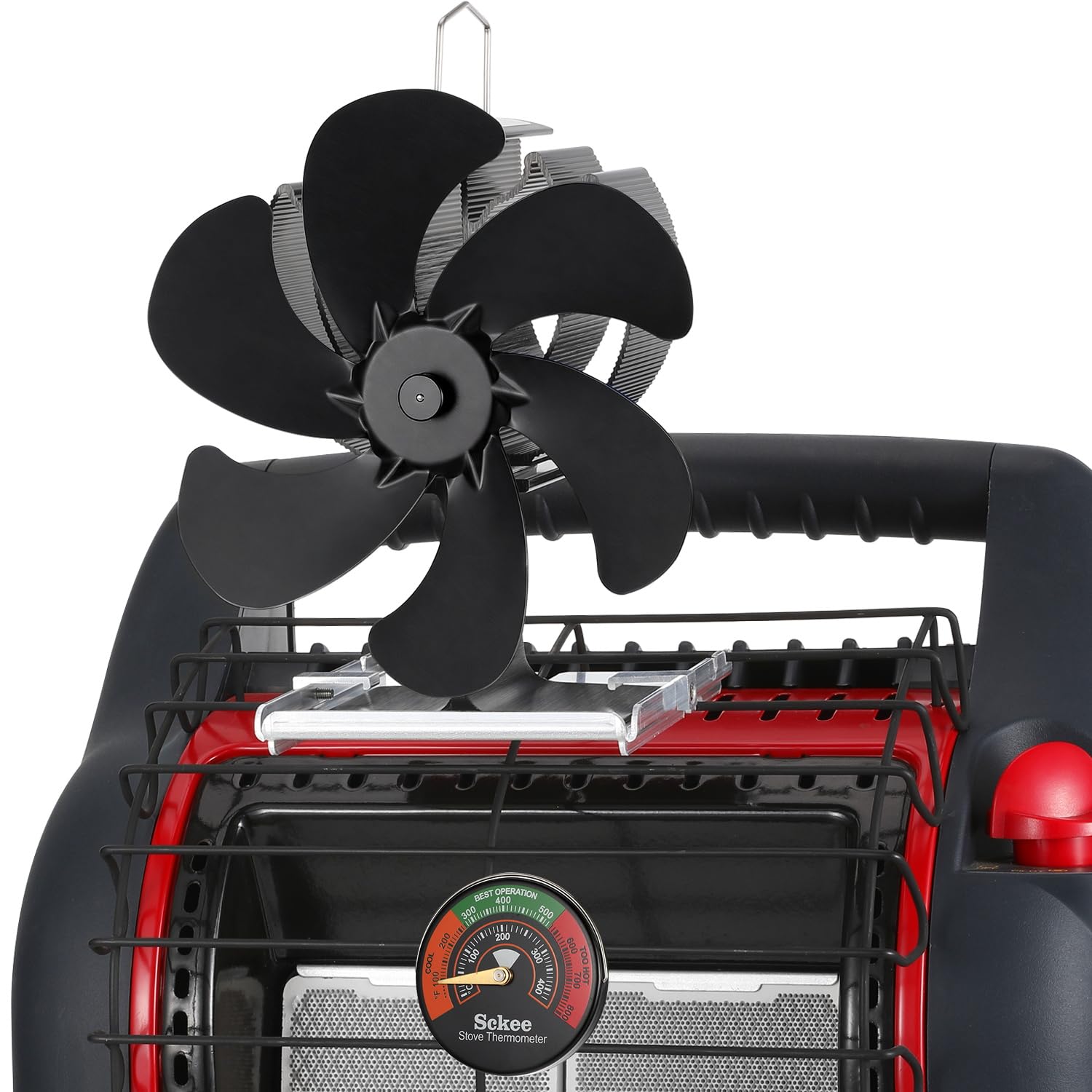
Built to clamp onto Mr Heater propane units for ice shacks and winter tailgates.
This one earns its place on the mounting, not the blade count. It comes with an upgraded bracket and a magnetic thermometer, so you can fix it to a Buddy heater or rest it on a stove. The maker lists its uses openly — picnics, barns, tents, workshops, winter fishing, warehouses, tailgate parties, and emergency heating. That list is the honest description of who this fan is for. An inbuilt bimetallic safety device lifts the front above 644°F (340°C) so the motor and stirling engine set do not cook themselves.
What the ice-fishing and off-grid crowd loves is that it simply works the moment the heater gets going, with no batteries and no wires, so it keeps pushing warmth when the power is out. It runs as long as the heat does. One ice-house owner was blunt about the result: “I leave the heat going consistently and this little fan blows heat all the way across the room.” It packs small enough to drop into an ice bucket, and the setup takes under a minute once the screws go into the metal plate.
The caveat is the heat-up delay. The fan takes time to warm before the blades spin, and longer if the unit itself is cold, so pack it warm if you are heading out onto the ice. And it gets hot while in use, so give it time to cool before grabbing it at pack-up. Those are the physics of heat-powered, not a design fault.
The off-grid pick: silent, cordless, and running purely off the heater’s own warmth, it suits anyone heating a spot with no reliable outlet.
Ideal for: ice anglers, cabin owners, and anyone running a Mr Heater propane unit away from an outlet.
Be prepared for: a warm-up wait before the blades turn and a hot body at packing time.
6. XTIMES 12 Blade Wood Stove Fan Dual Motor
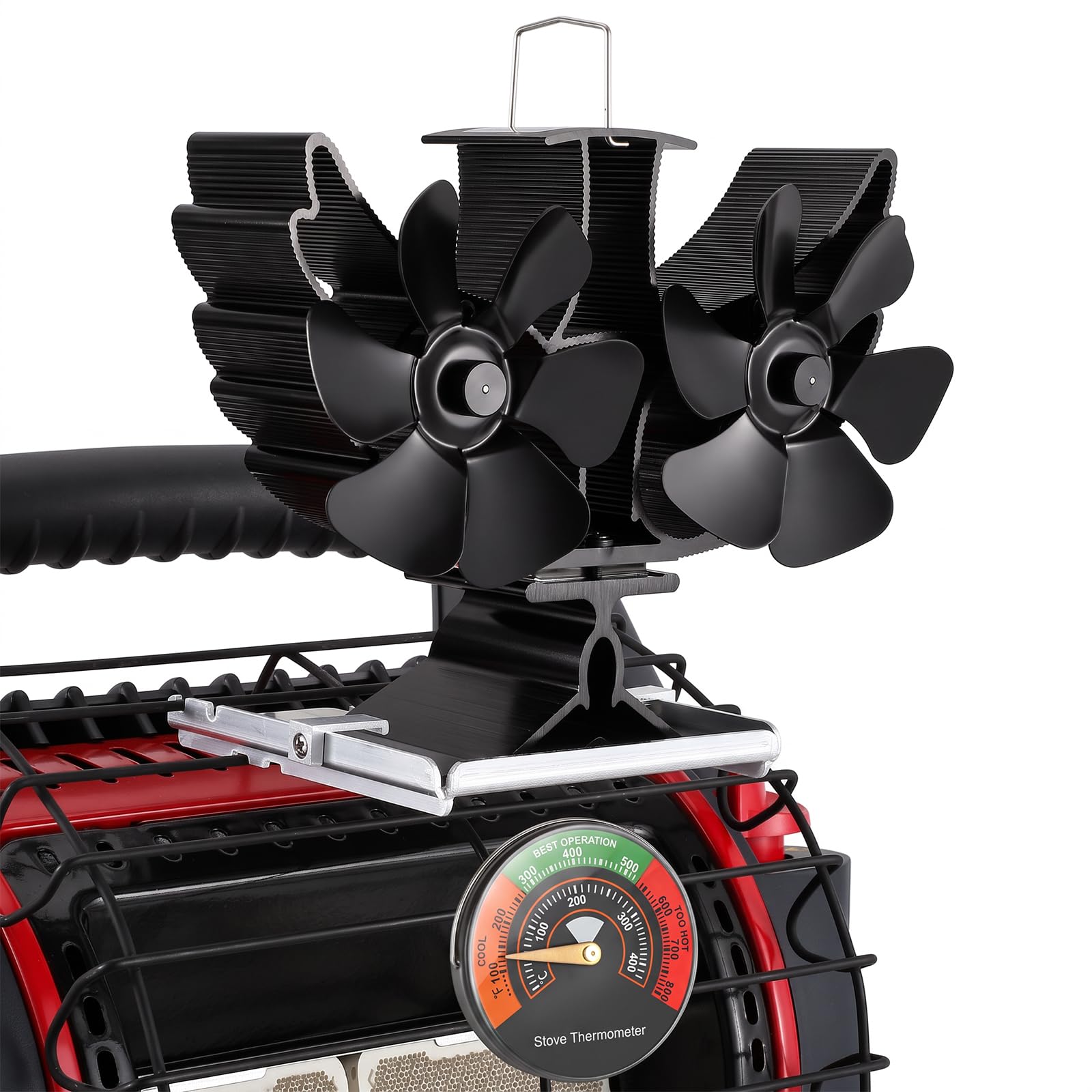
Twelve blades, two motors, and a bracket that lets it follow you from stove to blind.
The dual-fan, two-motor, twelve-blade layout is built for faster air circulation, with the maker rating it at under 25 decibels (a loudness measure — very close to silent). A bimetallic strip in the base lifts the fan’s edge once it reaches its top operating temperature, protecting it from the heat it is riding on. Anodized aluminum means no rust or corrosion while it is running hot. A magnetic thermometer is included so you can watch the temperature of whichever heat source it is sitting on.
Versatility is the real draw. The extra bracket means it can sit on a wood stove or park on a portable heater, and owners have pressed it into service everywhere from a hunting blind to a small cabin. Performance is what it is known for — blowing heat forward and down rather than letting it rise straight to the ceiling. It moves plenty of air without disrupting the stove’s radiant output, and since the only moving part is the blade holder, it stays quiet through the night.
Two small things to know. The fan can rattle slightly on a heater’s low setting, though the sound fades to nothing at higher output, and one owner eased it by gently adjusting a blade. And as with any of these, it works best within its stated temperature window rather than on a cold stove. For a fan that travels between heat sources, neither is much of a hurdle.
The travel-ready build: the bracket plus the 1.6-pound body make it easy to move between a cabin stove and a portable heater without hunting for a flat surface.
The fine print: a faint rattle on low heat is the one quirk to listen for; it typically clears as the heater warms up.
Worth it when: you heat more than one space and want a single fan that mounts on both a stove and a heater.
Skip if: you only ever use a flat wood stovetop and want the simplest possible setup.
7. VODA Wood Stove Fan 12 Blades Large

Triple motors turning twelve blades to push 280 cfm across a big room.
At 280 cfm (cubic feet per minute — the volume of air moved each minute), this is one of the higher-airflow fans here, driven by twelve blades across three motors. It wakes up at around 140°F, spins most efficiently between about 390°F and 570°F, and tops out with a safety device that lifts the front edge above roughly 653°F (345°C). The anodized finish resists rust while the fan runs hot, and the only moving part is the blade assembly, so it runs silently.
The thing owners appreciate most is the heat distribution — it draws hot air out from behind a stove insert and pushes it into the room, and the taller three-motor design is what gets that volume moving. Setup is as simple as setting it on the stovetop; no installation and no wiring. For larger fireboxes and bigger rooms, that air volume is the reason to pick it over the smaller fans.
This is where the honest caveat sits. Reliability is the divider here: some fans run season after season, while a disappointed few have had one stop after a short stretch or found the airflow weaker than the number suggests. Report a faulty unit and support has been quick to make it right. If your priority is a fan that moves real volume in a big room, this delivers on that; if you want the simplest possible low-maintenance unit for a modest stove, a smaller two-blade fan is the safer bet.
Why bigger rooms like it
- 280 cfm of airflow from twelve blades across three motors
- Wakes up around 140°F and peaks near 390°F to 570°F
- No installation, no cords, no battery to replace
What to weigh
- Reliability is a divided picture — most run years, a few did not
- Actual air movement can feel gentler than the airflow number suggests
Choose this for: a large firebox or a big room where you want maximum air volume moved.
Reconsider if: you want the lowest-maintenance, simplest fan for a modest stove.
8. Ecofan Original Heat Powered Stove Fan, 100 CFM

A generously bladed classic for cabins that run on wood alone.
The wide 7.9-inch aluminum blades are what make this Ecofan feel different from a plasticky two-blade knockoff. It generates its own electricity from stove heat and moves up to 100 cfm, ramping speed up as the stove warms and slowing as it cools. There are no cords or batteries, and replacement motors are available, so a worn part can be swapped instead of scrapping the whole fan. It is designed and made in Canada by Caframo, a builder that has been at it since 1955.
For an off-grid cabin this is close to ideal. Owners describe it starting to spin as the stove heats, then pushing warm air into the next room while staying silent. Because it circulates that heat instead of letting it pile up, it can cut how hard a backup propane heater has to work over a winter. Owners also credit the gradual build of heat as the fix for that familiar cycle of cold room, then a suddenly over-hot one that has everyone opening windows.
The limitation is straightforward: a fan this size will not heat an entire house on its own. It is best treated as supplemental circulation for a first floor or a cabin, moving warm air where you want it rather than cooking the whole space. For that role, the wide blades and Canadian build make it a dependable choice.
Made to last: with swappable motors and a wide-blade design, this is a fan you maintain rather than replace every season.
Suits you if: you heat off-grid and want a durable, wide-bladed fan that quietly spreads warmth into a nearby room.
Not for: anyone expecting a single fan to warm a whole multi-room house.
9. Freedom Stoves Heat Powered Stove Fan, 348 CFM
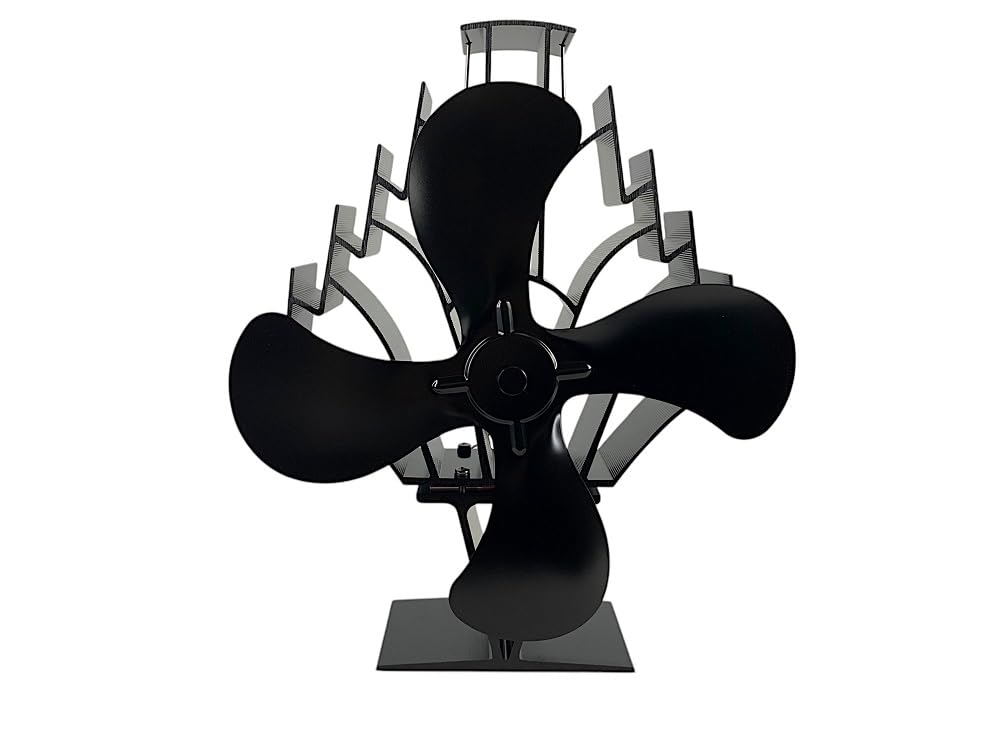
A thirteen-inch four-blader that pushes the most air raw numbers here allow.
At 348 cfm (cubic feet per minute — the largest airflow figure in this lineup), this thirteen-inch, four-blade dual-motor fan is built for medium to large rooms. The 10.5-inch blades are wide and the body stands 13 inches tall, so it sits prominently on a flat-top wood, pellet, or log-burning stove. It ramps its speed up as the stovetop warms and slows as it cools, so its output follows the fire. There is no cord, no battery, no outlet — the stove’s own heat is the whole power supply.
Owners who run hot stoves tend to love it. The recurring theme is that it moves meaningfully more air than the small fans, and quiet operation is the second thing people notice. Owners testing it with a tissue found it pushed the tissue about 6 feet from the stove, while a cheaper fan nearby could not move it from the front edge. One put the difference simply: “it definitely moves some air, although it’s subtle. It’s not 100% silent, but it’s very quiet.”
The trade-off is the price bracket — this is the premium end of the category, and a few buyers feel the air movement does not fully justify the top-tier spend. The airflow sits on the softer side in use even where the rating is high, so if a whisper of a draft is all your room needs, a lower-airflow fan will do it for less. For a big room where the raw airflow matters, though, this is the one that pushes the most.
The high-airflow case
- 348 cfm is the largest airflow figure in the lineup
- Four wide 10.5-inch blades move more air than most compact fans
- Speed tracks stove temperature, so output follows the fire
The premium trade-offs
- Premium-tier spend that a few buyers feel is steep for the airflow
- Actual movement feels subtle even at high rated airflow
The big-room answer: when maximum airflow matters and your stove runs hot, this delivers the most air of the group.
Only if you need it: smaller rooms and gentler fires are well served by a lower-airflow fan for less.
Know the Specs
Airflow (CFM)
CFM stands for cubic feet per minute — the volume of air the blades push each minute. Higher CFM means more warm air moved, but it only counts when the blades are actually spinning at your stove’s temperature. Published CFM figures range widely here, from 100 CFM on the two-blade classics to 348 cfm on the large four-blade fan. Match the figure to your room size rather than chasing the biggest number.
Working temperature range
Every heat-powered fan has a window in which it performs. Some start turning near 140°F, others run best between about 390°F and 570°F, and most list an overheating cutoff where a bimetallic strip lifts the fan to protect the motor. If your stove runs cool and slow, a fan with a lower start temperature will actually do more. A fan that needs a hot surface may sit idle on a gentle fire.
Blades and motors
Blade count is not the whole story. A large two-blade fan with wide blades can move a surprising volume of air, and a twelve-blade fan with weak motors may barely stir it. Dual- and triple-motor designs are meant to push more air faster. Read the CFM and the owner experience together, and treat a high blade count as a hint rather than proof of airflow.
Mounting and footprint
Flat-top wood stoves let you just set the fan down. Inserts, portable propane heaters, and Buddy-style units usually need a bracket to hold the fan at the right angle. Check the bracket spacing against your specific heater before you buy — grill widths vary and a bracket that fits one model can be snug on another. Footprint matters too: a compact fan leaves room for a kettle or water pot beside it.
Common Questions
Will a wood stove heat fan work on a pellet or gas stove?
Does the fan need electricity or batteries at all?
How hot does my stovetop need to be before the fan starts spinning?
Will a fan with more blades always move more air?
Can I use one of these on a Mr Heater or Buddy propane heater?
How loud is a heat-powered stove fan?
What stops the fan from overheating on a very hot stove?
Do I need to maintain or replace parts on these fans?
Is a two-blade fan better than a twelve-blade fan?
How big a room can one stove fan actually warm?
The Bottom Line
The crowd favorite is the Caframo Ecofan Original, and it earns the top spot on a 4.5+ star average across 500+ owners for one reason: it keeps running quietly, season after season, on stoves that never quite stop. If you heat with a portable propane heater and want more air movement than a two-blade fan gives, the Tomersun 8-Blade pushes more volume with a bracket and thermometer in the box. And for a big room where maximum airflow is the whole point, the Freedom Stoves 348 CFM fan moves the most air of the group. Whatever you pick, treat these as quiet circulation helpers, and pick the airflow and start temperature that match the stove you actually run.
How we choose
We do not accept paid placement. Every pick is matched to a real buyer and a real use-case; we do not hands-on test units.
Sources
Specifications: manufacturer listings and product documentation. Review insights: verified customer reviews, as of October 2026. Pricing: not shown on this page (it changes often); check the current price via the retailer link.
As an Amazon Associate, Home Digitized earns from qualifying purchases. This does not affect which products we feature.