
Specs are compiled from manufacturer listings and verified buyer reviews and can change over time — please confirm the key details on the product page before buying.
Buy the saw that matches your actual wood, not the one with the biggest motor number on the box. For most home woodworkers, a 15-amp corded saw with a 7-1/4-inch blade cuts clean and stays cool through plywood, framing lumber and pressure-treated boards all afternoon. Cordless is the better call only when you are working away from an outlet — and then the blade size decides whether you can actually finish the cut.
This guide is built by comparing the manufacturers’ published specifications and the patterns across verified customer reviews, so you get each pick’s real strengths and trade-offs instead of marketing spin.
A saw only earns its place when the blade stays true through thick stock and the base plate does not wander. Below you will find the models that hold up in real workshops, and the trade-offs that decide best wood circular saw for your own bench.
Top Picks


How To Choose The Best Wood Circular Saw
The single biggest mistake is buying motor size alone. A 15-amp saw with a sloppy base plate will wander off your pencil line, while a well-built 14-amp unit with a cast base cuts true all day. Match three things to your work: blade diameter, power source, and how deep you need to cut.
Blade diameter decides your depth of cut
A 7-1/4-inch blade is the standard for framing, decking and sheet goods. It cuts through a 2×4 in one pass and handles 2-by lumber at 90 degrees. A 4-1/2-inch or 5-8/10-inch compact blade cuts shallower — the WORKPRO mini tops out at 1-11/16 inches at 90 degrees — so it trims boards and shelving but will not cross-cut a 4×4 in one go.
Corded power versus a 20V battery
A corded 15-amp saw holds constant power through pressure-treated lumber and thick hardwood, with no battery to recharge. A cordless 20V saw frees you from the outlet and the cord dragging on sheet goods, but its runtime depends on the battery you load. The DEWALT DCS590B is rated for up to 368 cuts per charge with a brushless motor, while the smaller compact saws trade that endurance for one-handed control.
Bevel capacity and positive stops
Look for a positive stop at 45 degrees — it locks the base plate at the angle instead of leaving you to eyeball it. Bevel capacity runs from 45 degrees on the compacts to 56 degrees on the SKILSAW SPT67WL-01. If you cut rafters or trim corners, the extra bevel range matters.
Side-by-Side Comparison
| Model | Best For | Blade Size | Power Source | Bevel Capacity | Amazon |
|---|---|---|---|---|---|
| SKILSAW SPT67WL-01★ Best Overall | All-around workshop saw | 7-1/4 in. | 15 A corded | 56 degrees | Amazon |
| SKIL 5280-01Most Popular | Laser-guided long cuts | 7-1/4 in. | 15 A corded | 51 degrees | Amazon |
| DEWALT DCS590BDeep-Cut Leader | Deep cuts, cordless | 7-1/4 in. | 20V cordless | — | Amazon |
| DEWALT DCS391B | Framing and decking | 6-1/2 in. | 20V cordless | 50 degrees | Amazon |
| WORKPRO W125230AE | Trim and small stock | 4-1/2 in. | 20V cordless | 45 degrees | Amazon |
| DOVAMAN MCS01A | Beginner projects | 4-1/2 in. | 5.8 A corded | 45 degrees | Amazon |
| DEKOPRO DKCS20Q1Y-G | Cord-free DIY | 6-1/2 in. | 20V cordless | 45 degrees | Amazon |
| WEN 3625 | Compact beveling | 4-1/2 in. | 5 A corded | 45 degrees | Amazon |
| SKIL 5180-01 | Budget light-duty | 7-1/4 in. | 14 A corded | 51 degrees | Amazon |
Detailed Reviews
1. SKILSAW SPT67WL-01 15 Amp 7-1/4 In. Sidewinder Circular Saw
Our pick — 4.5+★ from 500+ verified ratings; the strongest balance of quality and price.
An 8.6-pound sidewinder with a 15-amp Dual-Field motor that stays cool through hardwood and framing lumber.
Here is the number that carries this saw: 8.6 pounds, which the maker calls the lightest professional circular saw in its class. That is a 7-1/4-inch blade in a magnesium deck you can carry up a ladder without your forearm burning out. The 15-amp motor uses a Dual-Field design that spreads heat, so long sessions on pressure-treated lumber do not cook the windings.
Bevel range is where it separates from cheaper 7-1/4-inch saws. You get 56 degrees of bevel with a positive stop at 45 degrees, versus 51 degrees on the SKIL 5180-01. The 10-foot cord is the other quiet win — that extra length keeps the plug from snagging on a sheet of plywood while you push through a rip cut. What wins people over is the build; the saw feels solid in the hand, and owners who have run it for eight years report it still cuts 3/4-inch plywood and 1.5-inch hard maple with the same consistent power.
What holds up in the shop
- 8.6-pound body in a magnesium deck — one-handed control on overhead cuts
- 56-degree bevel with a 45-degree positive stop covers rafter and trim angles
- Dual-Field motor design sheds heat so long cuts do not sap power
- 10-foot cord stays clear of the sheet you are cutting
Where the fit gets tight
- Rip-fence threads on the shoe can run tight — an aftermarket fence may need a thread chase before it seats cleanly
- Ships with a 24-tooth blade; fine finish work calls for a higher-tooth blade
Go here if: you want one corded saw that handles framing, decking and hardwood without a second purchase.
Think twice if: you mostly cut small trim and want a compact one-hander — a 4-1/2-inch saw is easier to steer.
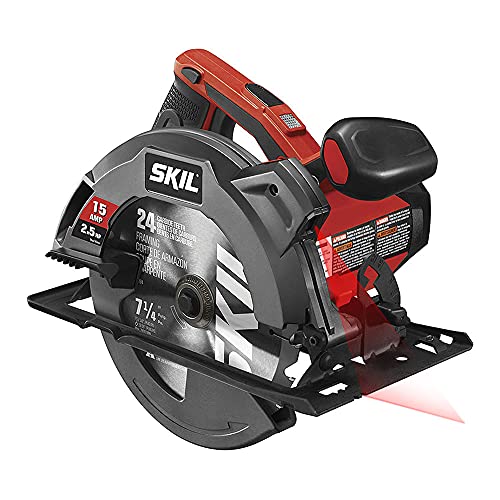
2. SKIL 5280-01 Circular Saw
A laser line and 5,300 RPM make this the saw most home woodworkers end up buying.
Lining up an eight-foot cut on a sheet of OSB is where most cheap saws fail you. This one throws a single laser beam down the cut line, so you steer by the light instead of leaning over to sight the blade. The 15-amp motor spins the blade at 5,300 RPM, and the dust blower keeps sawdust off that line so you can actually see it. The audience has spoken loudly here — 4.5+ stars across 14,000+ ratings — and quality is the theme that dominates the feedback.
Compare it to the DEWALT DCS391B and the difference is price-to-capability. The DEWALT costs more and needs a battery you supply; this SKIL runs on wall power and comes with a 24-tooth carbide blade, a wrench and a carry bag. Owners fit a diamond blade and cut granite pavers with it, reporting it never stalled. The 51-degree bevel with a 45-degree stop handles most trim angles. The honest catch is the depth lever — a few units have had it break within weeks, so set depth with a gentle hand and it will last.
Buyer consensus: cuts through stock like a hot knife, powerful enough for most wood projects, and the laser earns its keep on long rips.
Trade-off to know: the depth adjustment lever is the weak point on a small share of units; treat it carefully and it holds.
Best for: homeowners building a deck or shelving who want a laser to keep long cuts straight.
Look elsewhere if: you need a saw to survive daily jobsite abuse — a brushless pro model holds up better.
3. DEWALT DCS590B Circular Saw
A 7-1/4-inch cordless that cuts 2-9/16 inches deep at 90 degrees and keeps going on one battery.
Depth is the whole story on this one. It cuts a maximum of 2-9/16 inches at 90 degrees and 2 inches at 45 degrees, which means full-depth rips in thick stock without flipping the board. The brushless motor spins up to 5,500 RPM no-load and is rated for up to 368 cuts per charge. An automatic electric brake stops the blade from coasting after you release the trigger — that is what keeps a wide, imprecise cut from happening on the last inch.
The 1,700 MWO figure is the maker’s measure of cutting muscle. At 9.88 pounds it is a saw you notice at the end of a long day, which is the honest trade for more depth and endurance. Owners praise the thumb safety, the deck markings and the blade lock that speeds changes. This is a tool-only kit, so budget for a 20V battery if you do not already run the DEWALT line.
Where it earns the extra weight: deep cross-cuts and bevels in dimension lumber, with a brake that stops the blade before it wanders.
Fair warning: it arrives bare — no battery, no charger, and occasionally a unit ships from a reseller without the blade, so check the box on arrival.
Reach for this if: you are already on the DEWALT 20V battery platform and need full-depth cuts away from an outlet.
skip it if: you have no 20V batteries yet — the tool-only kit leaves you needing a charger and pack before the first cut.
4. DEWALT DCS391B Circular Saw

The 6-1/2-inch cordless that rips 2×8 boards and stops the blade the instant you let go.
This saw earns its spot for deck framing and general carpentry because its 5,150 RPM motor (revolutions per minute — how fast the blade spins) slices through 2×6 and 2×8 lumber without bogging down. The magnesium shoe (the flat metal base that rides on the wood) stays flat for accurate cuts over years of use, so your cuts stay square long after the first job. Release the trigger and an immediate blade stop halts the blade, which matters when you cut overhead or reach across a sheet. The 0-50 degree bevel range (the tilt of the blade for angled cuts) goes a little past the standard 45, so you can cut slightly steeper angles than most saws allow.
With a 4Ah or 5Ah pack, buyers report it lasting all day on light framing. Load a small pack and it drains fast — the runtime is entirely the battery’s job, not the saw’s. At 3.16 kg it stays portable, and the rubber over-molded grip keeps it steady one-handed. The blade sits on the left, which takes a session to get used to if you learned on a right-side saw. Pair it with a 40-tooth blade and it cuts oak and maple cleanly.
The framing argument
- 5,150 RPM in a 6-1/2-inch cordless handles 2×8 boards
- Immediate blade stop after trigger release improves control
- Magnesium shoe keeps the base flat for long-term cut accuracy
- 0-50 degree bevel goes past the standard 45
The honest limits
- Left-side blade forces a learning curve for right-side veterans
- Ships without a rip fence; heavy ripping in thick hardwood can trigger the motor’s heat cutoff
The right call for: deck builders and hobbyists already stocked with DEWALT 20V batteries.
Not your saw if: you plan to rip 2-to-3 inch hardwood all afternoon — a corded 15-amp saw holds power longer.
5. WORKPRO 20V Mini Circular Saw

Three blades, one battery, and a 4-1/2-inch body that reaches where a big saw cannot.
This is the saw for cutting a board in place rather than dragging it to a bench. The 4-1/2-inch blade reaches a maximum depth of 1-11/16 inches at 90 degrees and 1-1/8 inches at 45, which covers trim, shelving and 2×4 stock. The motor spins at 4,500 RPM no-load, and the whole unit weighs 4.36 pounds. A 20V 4000mAh battery comes in the box with a 2.4A charger that fills it in as little as 2 hours.
The kit earns its keep on versatility. You get a 24T blade for wood, a 60T blade for wood and plastic, and a diamond blade for tile, plus a parallel guide, dust hose and a storage bag. Owners cut Trex decking, 2×6 boards and fallen tree limbs with it and report no bogging. The rubberized handle and switch lock make one-handed operation easy and prevent accidental starts. What lets it down occasionally is battery life — a few report the pack giving out, so keep the spare charged.
What buyers rave about: the range of materials it handles with three included blades, and a grip that lets you steer it one-handed.
Keep an eye on: battery life is inconsistent across units, and the stock fine-tooth blade struggles with thicker wood — swap in a good blade.
Ideal for: DIYers who need to cut tile, PVC and trim in tight spots where a 7-1/4-inch saw will not fit.
Pass if: your main job is ripping full sheets of plywood — this saw is too small for that reach.
6. DOVAMAN 4-1/2″ Mini Circular Saw

An extra handle and a wide base plate steady a small saw for first-timers.
Most compact saws wobble when you push them across a board. This one adds a metal auxiliary handle that mounts on either the left or right side, plus a 3.5 by 9.5 inch base plate, so you brace the cut with two hands. The laser and edge guide keep the line straight. At 5.8 amps it cuts a 1-11/16 inch depth at 90 degrees and 1-1/8 inches at 45, and the depth lever adjusts across the full range.
The bevel goes from 0 to 45 degrees in two steps, quick enough to reset between cuts. The package ships with six blades sized for wood, soft metal, plastic and tile, so you can start on a range of projects without a second buy. Owners building a TV cabinet frame report it cutting 2×4, vinyl and plywood without trouble. The honest limit is size: at 17.76 inches long and with real heft in hand, it is beefier than a palm-sized saw, which one buyer found too heavy for delicate work.
What it does well: an auxiliary handle and wide base make it steady, and the laser plus edge guide keep cuts straight without experience.
The real limitation: it sits between a palm saw and a full-size saw in weight and length, so it is not truly one-handed.
Worth it for: first-time saw owners who want a stable, guided tool for home repair projects.
Think again if: you want a palm-sized saw for tight overhead work — this one is longer and heavier.
7. DEKOPRO 20V 6-1/2-Inch Circular Saw
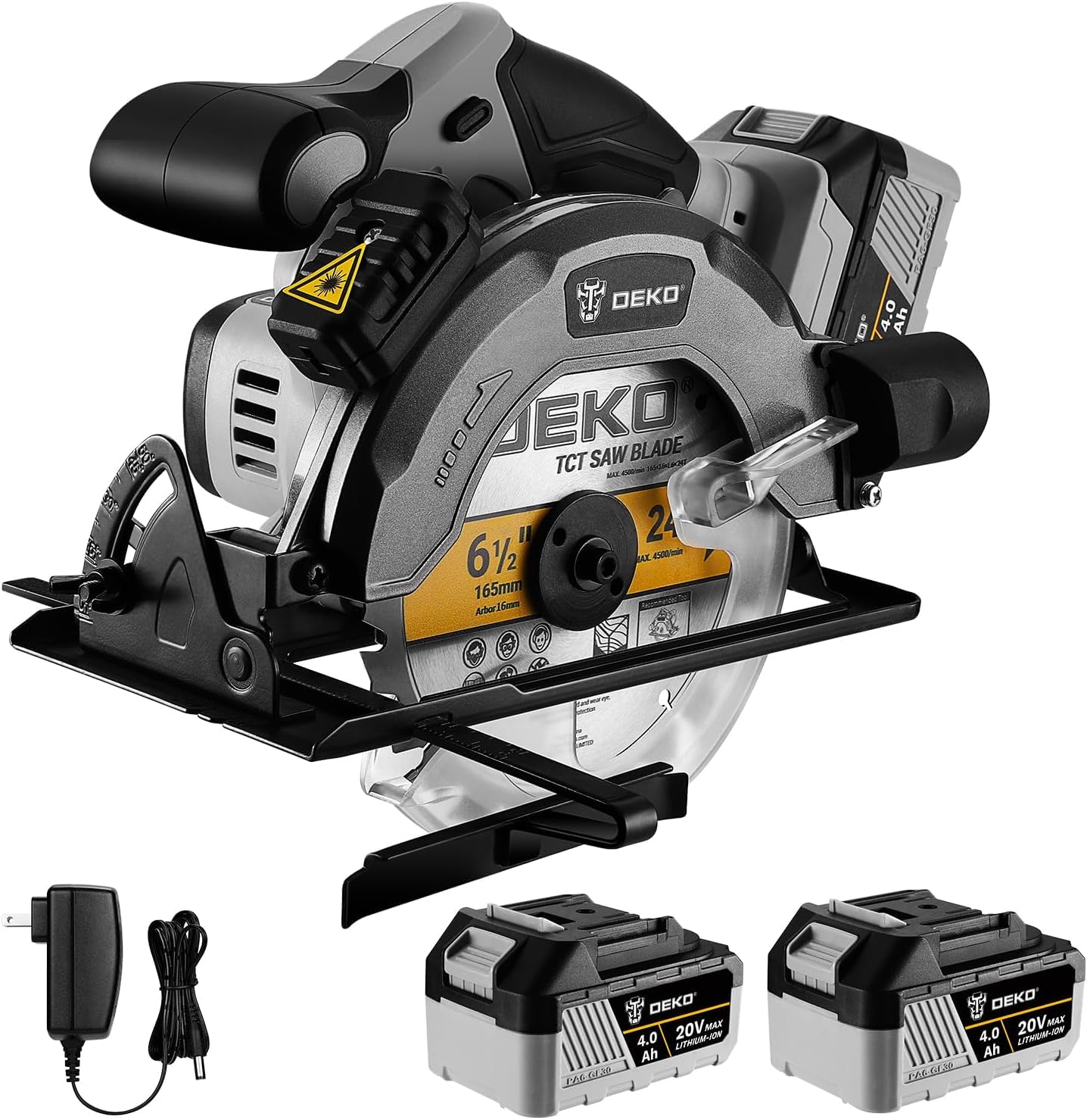
Two batteries and a charger in the box remove the one worry cordless saws carry.
Runtime is the question every cordless saw buyer asks, and this kit answers it by shipping two 4.0Ah batteries plus a charger. The 20V motor turns a 6-1/2-inch carbide-tipped blade at 4,500 RPM no-load, cutting hardwood and softwood with clean edges. The 0-45 degree bevel lets you set trim angles, and a laser projects the line for visibility. The ergonomic handle reduces hand fatigue on long sessions.
Because the batteries are included, this is a complete cord-free setup — unlike the DEWALT DCS391B, which arrives tool-only and needs a pack you already own. Owners who wanted to escape cord hazards say the handle and battery placement feel natural within a few cuts, and the cuts come out clean. The thing to know before you buy is blade changes — a few owners mention difficulty swapping the blade, so check the arbor lock works before your first project.
Why cordless buyers like it
- Two 4.0Ah batteries and a charger included — no separate pack to buy
- 6-1/2-inch carbide blade cuts hardwood and softwood cleanly
- 0-45 degree bevel with a laser line for angled cuts
The catches
- Blade replacement trips up some owners — verify the arbor lock before you rely on it
- Battery life is mixed depending on how hard you push the saw
Choose this if: you want a cordless saw with batteries in the box and no platform to join.
Look elsewhere if: you need full-depth rips in 2-inch hardwood — a 7-1/4-inch saw cuts deeper.
8. WEN 3625 Compact Circular Saw

A 4-1/2-inch blade with a full carrying case, built for trim and small stock.
A 5-amp motor turns the 4-1/2-inch blade at 3,500 times per minute, reaching a maximum depth of 1-11/16 inches. That is enough for 1-inch pine stair treads and trim, and it bevels from 0 to 45 degrees with a laser marking the line. The package includes a 24-tooth carbide wood blade, a carrying case, a dust extraction tube and a two-year warranty — a full kit for occasional carpentry.
The compact body makes it more accurate than a bulky 7-1/4-inch saw on delicate trim work, which is where owners put it to use. It also handles tile, drywall, sheet metal, ceramic and PVC, so one tool covers several jobs. The honest limits show up on thicker stock: it struggles past 1 inch, and the aluminum faceplate can bend if it takes a drop. Figure on swapping the stock blade for plywood work, and remember it cannot reach within about 2-1/2 inches of an edge.
What it nails: precise trim and stair-tread cuts with a laser line, in a case that keeps everything together.
Where it stops short: cuts over 1 inch bog it down, and the faceplate is soft enough to bend on a fall.
Fits best: trim carpenters and DIYers cutting treads, shelving and drywall patches.
Not the one for: anyone cutting framing lumber or thick plywood all day.
9. SKIL 14 Amp 7-1/4-Inch Circular Saw – 5180-01

The 7.2-pound starter saw that keeps a full 7-1/4-inch blade without wearing you out.
Weight is the first thing you notice on a budget saw. This one comes in at 7.2 pounds, versus 8.7 pounds for the SKIL 5280-01 — a difference you feel on long overhead cuts. The 14-amp motor turns a 7-1/4-inch blade at a 51-degree bevel with a positive stop at 45, and the dust blower keeps the cut line clear. The 20-tooth carbide blade is included, so it cuts from the start.
For occasional DIY and home repair, it does the work of a much dearer saw. Owners coming from a heavier saw report it is far easier to manage, and the 14-amp motor rips 3/8-inch plywood into strips without complaint. The honest fit is light duty — this is not a contractor-grade saw, and the depth-of-cut adjustment and trigger safety feel a bit stiff from new. If your work is weekend projects around the house, that trade makes sense.
The value play: a full-size 7-1/4-inch blade in a lighter 7.2-pound body for occasional home use, with a blade and wrench in the box.
Size it right: the depth adjustment is finicky and the build is not contractor-grade, so keep it for spacing and house projects.
Right-sized for: a first saw for occasional plywood and lumber cuts around the house.
Skip if: you need smooth cuts and easy depth setting every day — this one asks for patience on adjustments.
Know the Specs
Amps and what they tell you
The amp rating measures current draw — a rough sign of how hard the motor can push through thick stock before it bogs. A 15-amp saw like the SKIL 5280-01 holds speed through pressure-treated lumber, while a 5-amp compact like the WEN 3625 is built for trim and struggles past 1 inch. Higher amps do not automatically mean cleaner cuts; blade quality and a flat base plate matter just as much.
Blade diameter and depth of cut
Blade diameter sets how deep the saw reaches. A 7-1/4-inch blade cuts through a 2×4 in one pass, while a 4-1/2-inch compact tops out around 1-11/16 inches at 90 degrees. Match the diameter to your stock: full-size for framing and sheet goods, compact for trim and shelving. Tooth count then decides finish — a 24-tooth blade rips fast, a higher-tooth blade leaves a smoother edge.
Corded versus cordless power
A corded saw plugs into wall power and holds constant output all day, with no battery to manage. A cordless 20V saw trades that for freedom from the outlet, and its runtime depends on the pack you load — the DEWALT DCS590B is rated for up to 368 cuts per charge with a brushless motor. Cordless suits jobs away from power and quick cuts; corded suits long sessions in the shop.
Bevel capacity and positive stops
Bevel capacity is the range of angles the base plate tilts to. A positive stop at 45 degrees locks the plate at that common angle instead of leaving you to eyeball it. Capacities here run from 45 degrees on compacts to 56 degrees on the SKILSAW SPT67WL-01. If you cut rafters or corner trim, the wider range gives you angles a 45-only saw cannot reach.
Common Questions
Can a 7-1/4-inch circular saw cut through a 4×4 in one pass?
Is a corded or cordless circular saw better for wood?
What blade should I use for clean cuts in plywood?
Do I need a laser guide on a circular saw?
What does bevel capacity mean in degrees?
Can a compact 4-1/2-inch saw cut 2×4 lumber?
How long does a 20V battery last in a circular saw?
Why does my circular saw bog down in thick wood?
Is a brushless motor worth it on a circular saw?
What is the difference between a sidewinder and a worm-drive saw?
The Bottom Line
For most home woodworkers, the best wood circular saw is the SKILSAW SPT67WL-01. It pairs an 8.6-pound body with a 15-amp motor and a 56-degree bevel (the blade’s tilt for angled cuts) — enough range and power for framing, decking and hardwood in one tool, so you don’t need a second saw for the tougher jobs. If you need laser-guided long cuts on sheet goods, the SKIL 5280-01 keeps an 8-foot rip (a long cut down the length of a sheet) straight. And for full-depth cordless work away from an outlet, reach for the DEWALT DCS590B with its 2-9/16 inch depth at 90 degrees, so it cuts through thick stock without a power cord.
How we choose
We do not accept paid placement. Every pick is matched to a real buyer and a real use-case; we do not hands-on test units.
Sources
Specifications: manufacturer listings and product documentation. Review insights: verified customer reviews, as of October 2026. Pricing: not shown on this page (it changes often); check the current price via the retailer link.
As an Amazon Associate, Home Digitized earns from qualifying purchases. This does not affect which products we feature.