
Specs are compiled from manufacturer listings and verified buyer reviews and can change over time — please confirm the key details on the product page before buying.
If your hands skate forward in downward dog, the mat is the problem, not you. The right pick here is the HAPBEAR Large Yoga Mat — 72 inches long by 36 inches wide by 6mm thick, with the textured grip and the room other mats do not give you. Below are nine mats that genuinely hold, sorted so you can find the one that fits your practice.
This guide is built by comparing the manufacturers’ published specifications and the patterns across verified customer reviews, so you get each pick’s real strengths and trade-offs instead of marketing spin.
Grip, thickness and width are the three things that decide whether a mat feels safe underfoot, and this guide covers all three in plain language for non-slip yoga mats.
Top Picks

How To Choose The Best Non-Slip Yoga Mats
Slip comes from two places: your hands sliding on the mat’s top surface, and the whole mat sliding across your floor. A mat that solves one and not the other still ruins a practice. So read the grip specs as two jobs — a textured top for you, a patterned underside for the floor.
The top surface is what your palms feel
A granular or fingerprint-like texture traps a little air and drainage so sweat does not sit in a film under your hand. Cork works on the opposite principle: it gets tackier as it takes on moisture, which is why hot-yoga mats lean that way. Foam and TPE are grippiest when dry, so a dedicated sweaty practice wants texture or cork rather than a smooth surface.
Thickness decides comfort versus steadiness
Thin mats in the 0.17-inch to 0.28-inch range keep you close to the ground, which helps balance poses and standing work. Thicker mats in the 6mm to 1-inch range take pressure off knees, hips and wrists during kneeling and floor work. If you do both, a mid thickness around 6mm or 7mm is the usual compromise, though trying a thickness against your own joints is the best test.
Width is underrated for gym-style sessions
A standard mat is 24 inches wide. That is narrow once you add a lunge or a push-up, and your hand lands on the floor. Mats at 32 inches or 36 inches wide give you a deck that stays under both hands. The trade is weight and bulk — a wider mat is harder to roll and carry to class.
Side-by-Side Comparison
| Model | Best For | Size (L x W) | Thickness | Material | Amazon |
|---|---|---|---|---|---|
| Large Workout Mat (Karma Fitness)★ Best Overall | Home gym floor coverage | 72″ x 32″ | 0.39″ | TPE | Amazon |
| HAPBEAR Large Yoga MatAlso Great | Widest deck for home strength work | 72″ x 36″ | 6mm | TPE | Amazon |
| Plyopic Ultra Grip PROMost Versatile | Hot yoga and sweaty hands | 72″ x 26″ | 0.17″ | Natural rubber + Eco-PU | Amazon |
| Body By Yoga Luxury Cork | Long-limbed practitioners, hot classes | 80″ x 25.8″ | 0.26″ | Cork + natural rubber | Amazon |
| Hatha Yoga Large TPE | Maximum floor coverage | 72″ x 48″ | 1/2″ | TPE | Amazon |
| Gogokiwi Extra Wide | Push-ups and floor work | 72″ x 36″ | 0.25″ | RecFoam | Amazon |
| Retrospec Solana | Knees and joints that need padding | 72″ x 24″ | 1″ | Foam | Amazon |
| KEEP Extra Wide | Class-goers who still need width | 72″ x 32″ | 0.28″ | TPE | Amazon |
| YOTTOY Extra Thick | Cushioning on a budget | 72″ x 24″ | 1/2″ | TPE | Amazon |
Detailed Reviews
1. Large Workout Mat 10mm Extra Thick 72″x32″
Our pick — 4.5+★ from 600+ verified ratings; the strongest balance of quality and price.
Diamond-texture grip on both faces of a wide, budget-priced home mat.
Most mats at this end of the market give you one textured side. This Karma Fitness mat puts a diamond texture on both, designed for multidirectional grip during high-intensity work — lunges, sumo squats, lateral movement. It measures 72 inches by 32 inches at 0.39 inches thick, which the maker says is 33% wider than a standard 24-inch mat. The double-layer TPE is denser than standard NBR foam, so it holds support under a squat instead of squashing flat.
The practical extras are what sell it. A carry bag with an adjustable shoulder strap comes in the box, so it goes to the studio, the gym or the park without a fight. The closed surface is waterproof and sweat-resistant and wipes clean. And at 1.8 kg, it is lighter than the cork mat by a wide margin but not the lightest here — you will feel it on a long walk, not on the trip to the car.
The honest limit is the size itself. Everything that makes this good for floor work — the 32-inch width, the 0.39-inch depth — is exactly what makes it bulky to roll and store. Owners call that out. It is a home-workout mat first and a class mat second, and the thickness gives you support rather than a plush landing. If you want padding for kneeling, the Retrospec goes deeper; if you want grip for sweat, the Plyopic goes further.
Where it wins: diamond grip on both sides, a 32-inch deck, a shoulder-strap carry bag in the box, and denser TPE than standard foam mats.
What you accept: a bulky roll and supportive rather than soft cushioning.
Worth it for: budget-conscious home workouts that need width and multidirectional grip.
Not the one for: studio regulars who need a slim mat that packs down small.
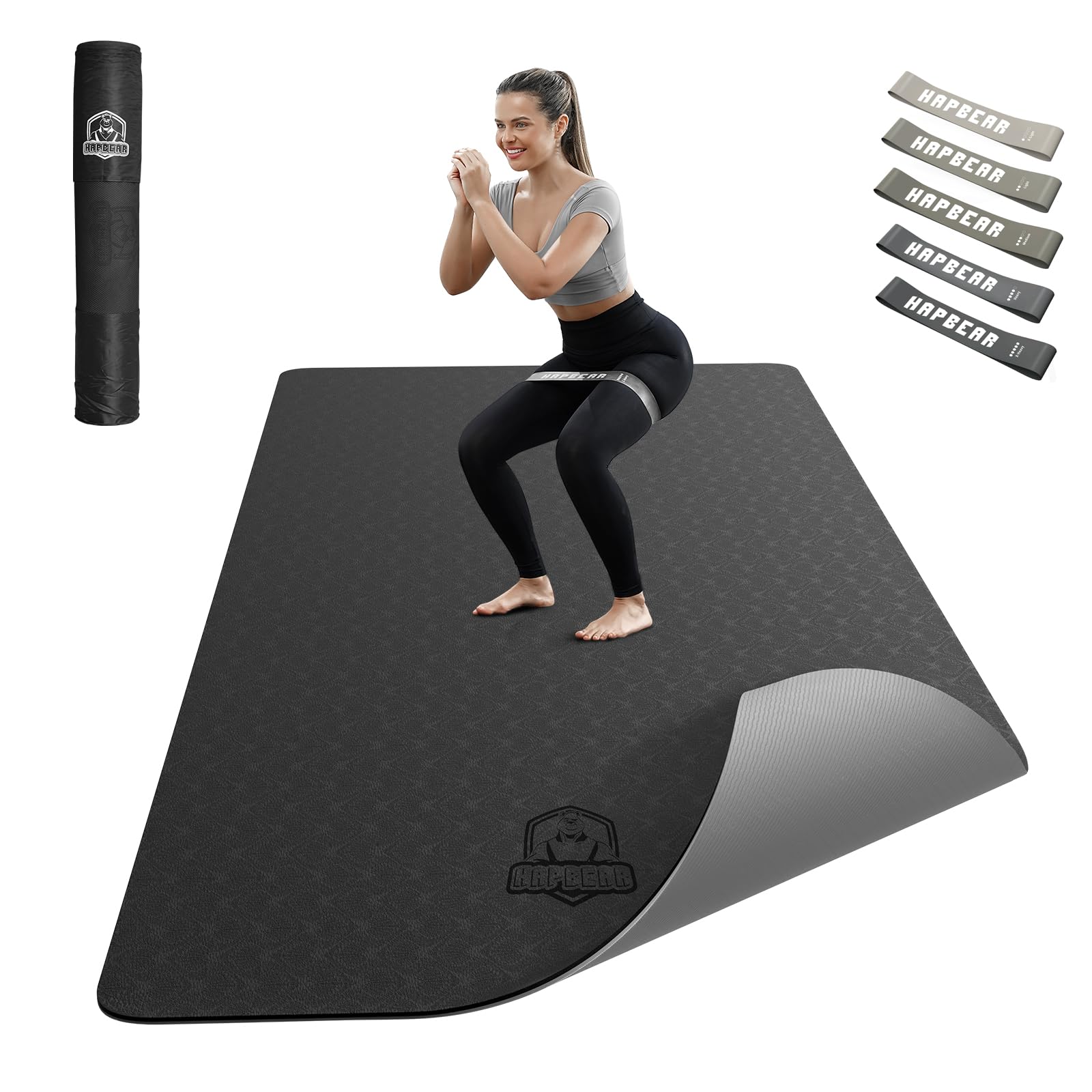
2. HAPBEAR Large Yoga Mat – 72″x36″x6mm
A 36-inch deck that puts both hands on the mat and keeps them there.
The HAPBEAR’s defining number is its footprint — 72 inches long by 36 inches wide, which the maker describes as 50% wider than a standard mat. That matters the moment you drop into a lunge or a sumo squat, because both hands and both feet stay on the mat instead of reaching for the carpet. The 6mm thickness (about a quarter inch) sits in the middle: enough cushioning to take pressure off knees and wrists, thin enough that you do not feel like you are balancing on a sponge.
Grip is handled on both faces. The top has a textured surface for your hands and feet, and the underside carries a grip pattern that holds the mat still on smooth floors. One warning that comes straight from the maker: it is not built for carpet. Buyers confirm it does its real work on hard flooring. It comes with a carry bag and resistance bands, which nudges it toward the home-gym crowd rather than the studio-only crowd.
The trade-off is honest and physical. A 36-inch-wide mat is a bigger object to roll and store than a 24-inch class mat, and at 1.2 kg it is carryable but not featherweight. Several buyers also note the thickness reads thinner than expected for something sold as a cushioned mat — it is a support mat, not a pillow. If you want to sink into padding, look at the Retrospec below instead.
Why this deck earns the top spot
- 36-inch width keeps hands and feet on the mat through lunges and push-ups
- 6mm thickness balances knee comfort against balance-pose stability
- Textured grip on top and floor-holding pattern underneath
- Carry bag and resistance bands included for home sessions
Where it asks you to compromise
- Maker states it is not for use on carpet
- Wide, bulky roll that is slower to store than a slim class mat
- Cushioning is supportive rather than deep
Made for: anyone working out at home on hardwood or gym flooring who wants a wide, steady deck for strength and floor work.
Think twice: if you practice on carpet or want a mat you can sling over a shoulder and forget.
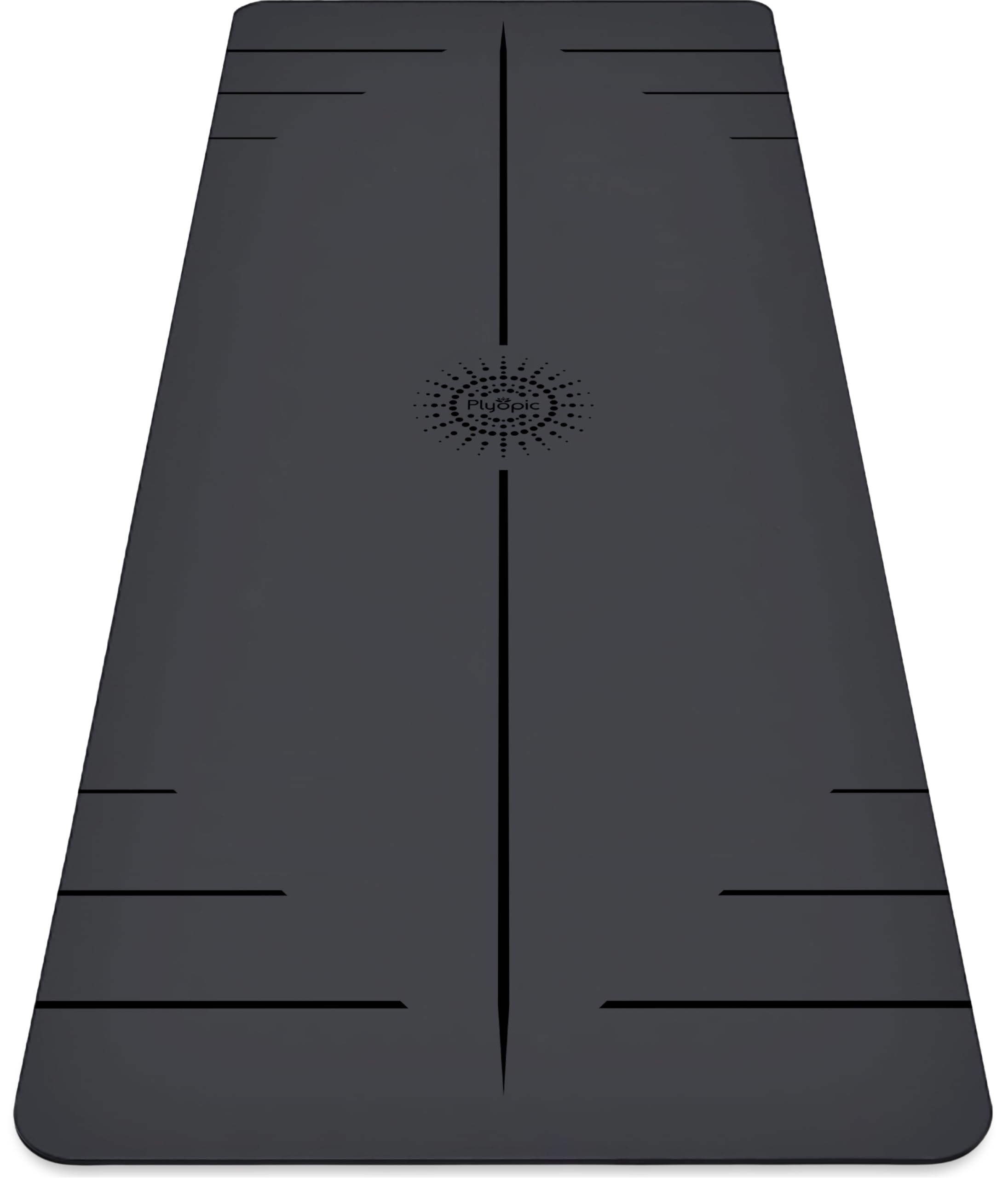
3. Plyopic Ultra Grip PRO Yoga Mat
The mat built for people whose hands betray them halfway through a hot class.
Most non-slip claims are tested on dry hands. The Plyopic Ultra Grip PRO stakes its name on the opposite — the maker says its UltraGrip surface keeps contact as moisture builds, which is the exact condition that turns a smooth mat into a slip hazard. That is who this is for: the hot-yoga regular, the heavy sweater, the person who has tried to fix a sliding mat with a towel. Where the HAPBEAR above is a wide home-gym deck, this one is a dedicated practice mat at 72 inches by 26 inches — narrower, but purpose-built.
The material is natural tree rubber under an Eco-PU top, and the mat measures 0.17 inches thick. That thin profile is deliberate: dense rubber keeps you close to the floor so standing and balance poses feel planted rather than wobbly. Buyers back that up — the grip is what the review pages rave about, holding firm even when hands are slick with sweat. The PoseMap alignment lines are a quieter bonus. They give you reference points for hands, feet and center, so you can check symmetry without a mirror.
Two honest catches. First, natural rubber announces itself: buyers consistently describe a strong rubber smell that fades over roughly 10 days of airing, so plan to unroll it somewhere ventilated before your first class. Second, 0.17 inches of dense rubber is not a cushioning mat. If your knees complain in kneeling postures, this one asks you to add a pad. Many buyers report it became their go-to mat anyway, trading plushness for stability.
Where the money goes: into wet and dry grip that a sweaty practice cannot defeat, plus a dense rubber base that will not slide or stretch like foam — and the maker says the design evolved from 8 years of alignment-mat work.
The real cost: a rubber smell that needs airing time, and cushioning thin enough that sensitive knees will want a pad.
Reach for this if: you sweat hard, practice hot yoga, or have lost faith in “non-slip” labels before.
Pass it by if: you want a thick, pillow-like mat for kneeling work.
4. Body By Yoga Luxury Cork Yoga Mat
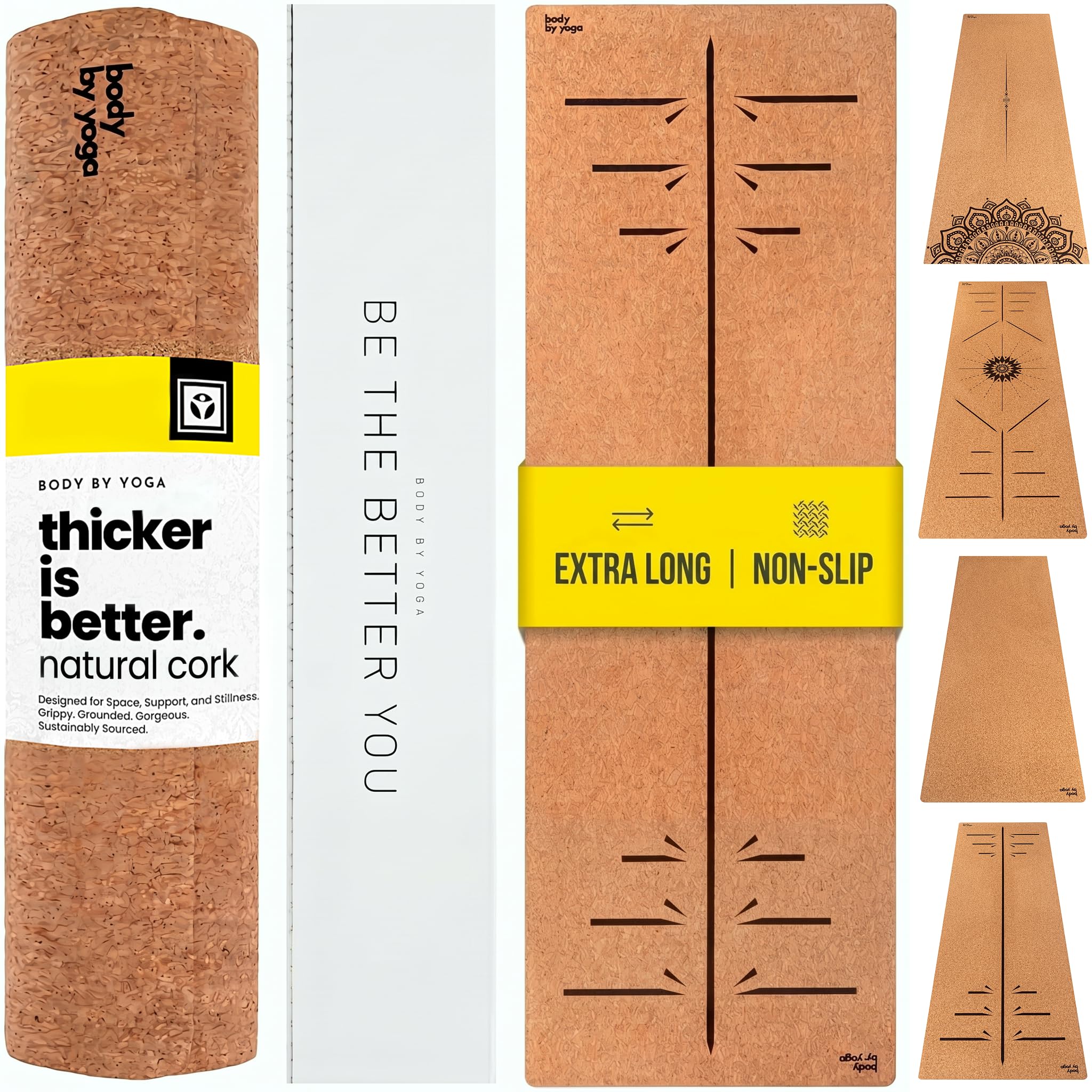
Cork that gets tackier the sweatier you get, and 80 inches of room to use it.
Cork flips the usual grip logic. Instead of fighting moisture, the Body By Yoga mat’s natural cork surface is designed to become more grippy as it takes on sweat — the maker calls it an ideal non-slip yoga mat for hot yoga for exactly that reason. Underneath sits a natural rubber base, and the whole thing measures 80 inches long by 25.8 inches wide at 0.26 inches thick. That length is the standout. If you are tall, or you flow through long sequences without wanting to reset your feet, 80 inches gives you a runway a 72-inch mat simply does not.
On the floor, the weight does the gripping. The mat runs about 9.9 lbs, and the maker is upfront that this is heavier than standard mats by design — the mass is what keeps it from creeping during standing poses. Buyers love it for hot classes and for the cushioning under knees and wrists, describing a firm, supportive surface rather than a plush one. The cork layer is also thicker than most cork mats, so it does not wear down to sandpaper in a season.
That same 9.9 lbs is the one thing to weigh carefully. The review pages are clear that this is not a mat you want to carry far — it is heavy on a walk to the studio, and it is happiest at home or driven to class. If a light, rollable mat that fits in a tote is your priority, this is the wrong pick; the YOTTOY at the end of this list is the opposite end of that scale. For a staying-put mat at home, the weight is a feature.
what separates it: cork grip that improves with sweat and a 0.26-inch-thick cork layer, on an 80-inch mat that fits long frames without feet hanging off.
The honest limit: 9.9 lbs of natural rubber is a commitment to carry — brilliant at home, tiring on a long walk.
Best matched to: tall practitioners and hot-yoga regulars who practice mostly at home or drive to the studio.
Look elsewhere if: you commute on foot with your mat or need something you can fold into a bag.
5. Hatha Yoga Large TPE Yoga Mat 6’x4′

Half an inch of cushioning on a four-foot-wide floor of its own.
There is a size question nobody asks until they own a mat: what if I do not want to be careful? The Hatha Yoga mat answers it with a 72-inch by 48-inch surface — twice as wide as a standard mat, and the widest thing on this list. At 1/2 inch thick, it also delivers the sort of cushioning that changes kneeling and floor work entirely. If your practice includes stretches where a knee or a hip bone lands on the floor, this is the pad that stops you noticing it.
Grip is handled by a special non-slip texture on both sides, and the high-density TPE construction is built to take a beating without tearing through. Owners use it for far more than yoga — Pilates, stretching, jump rope and squats all show up in the reviews, which suits a mat this big. One buyer mentions it as ideal for TRX training. Two bundling ribbons come included for storage, which is more useful than it sounds once you have tried to tidy a mat this size.
Now the size tax, and it is real. At 8.8 lbs, this is a floor mat, not a class mat — nothing about it is designed to travel. Buyers also flag two smaller quirks: the material is prone to scraping because of how soft it is, and dirt particles are harder to wipe off the surface than on a smoother mat. The HAPBEAR is easier to live with day to day; this one is easier on your joints.
What buyers gain
- 72″ x 48″ surface — twice the width of a standard mat
- 1/2-inch thickness that takes pressure off knees and hips
- Double-sided non-slip texture for grip from both directions
- Handles Pilates, stretching and jump rope, not just yoga
What you take on
- 8.8 lbs makes it a stay-at-home mat
- Soft surface is prone to scraping and holds onto dirt
- Takes a large floor area even when rolled
Ideal for: a dedicated home practice corner that wants maximum room and maximum cushioning.
Not for: anyone who wants to carry their mat to a class or store it in a small cupboard.
6. Gogokiwi Extra Wide Yoga Mat 72″x36″
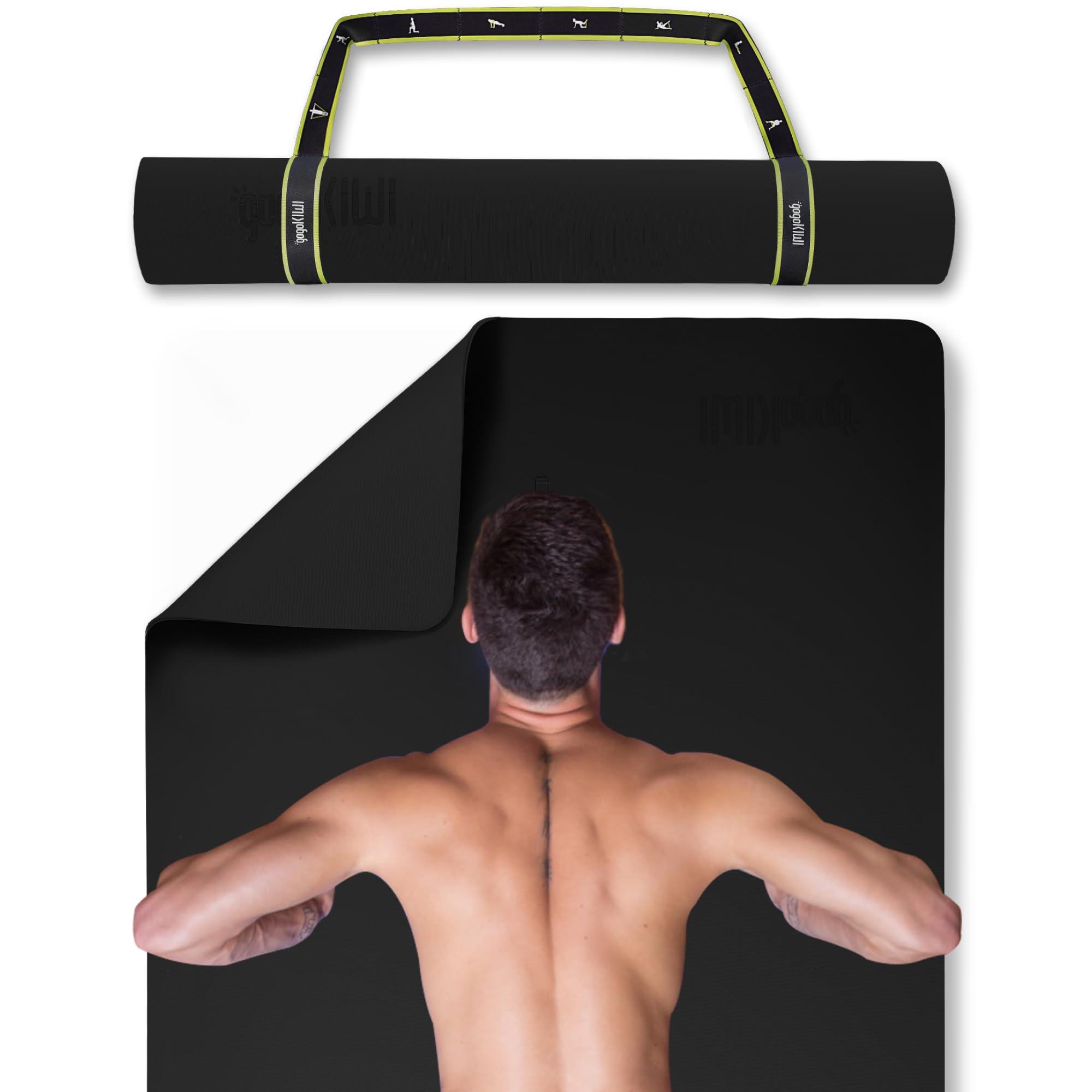
One strap, two jobs — a carry handle that also works as a stretching band.
The Gogokiwi gives you 72 inches by 36 inches of open deck, wide enough that bigger frames and taller bodies can move without sliding off the edge. Thickness is 0.25 inches, closer to the HAPBEAR’s 6mm than to the thick foam mats. That is the right side of the line for standing work: dense enough to stay firm, thin enough to keep you honest in balance poses. The material is RecFoam, and the maker builds it to hold its shape rather than thin out underfoot.
The clever bit is the strap. It rolls the mat up tight for storage, then doubles as a stretching band for hamstrings, shoulders and hips — with exercise images to show you how. Buyers put the width to work in plain terms: push-ups with both hands on the mat, exercise by the pool, room to move. The closed-cell surface keeps sweat on top so it wipes away, and the whole mat is made from 100% recyclable material.
Grip is where you need to read the fine print. The maker designs the texture for dry-hand traction, and grip is the mixed note in the review pages — good for many, too slippery for some specific yoga poses. If you sweat heavily or practice hot yoga, the plyopic is the safer bet. If you want a wide, stable platform for strength and floor work, this one delivers. One more small point: a few owners mention one end staying curled for a while after unrolling, though most of the mat lies flat.
The sell: a 36-inch-wide RecFoam deck plus a strap that earns its place as a stretching band, at a weight light enough to carry at 2.7 lbs.
Reader be aware: the texture is tuned for dry hands — heavy sweaters should look to a wet-grip mat.
Suits you if: you want width for push-ups, planks and floor work and prefer a dry mat.
Think twice if: your sessions end in slick hands and sliding poses.
7. Retrospec Solana 1″ Extra Thick Yoga Mat

A full inch of foam for anyone whose knees have opinions about the floor.
One inch. That is the number that separates the Solana from everything else in this list. The maker describes it as firm 1-inch foam built to take stress off joints, hips, hands and knees, and it measures 72 inches by 24 inches at that full inch of depth. If you have avoided floor work because kneeling hurts, this is the mat that changes the calculation. Buyers consistently point to the cushioning as the reason they bought it — the difference between a mat and a padded floor is exactly this.
Balance and grip get equal attention. The non-slip material is designed to stay on the floor so you can stay balanced on it, and the mat comes with a nylon carrying strap for the trip from home to class. The material is BPA free and free of phthalate, heavy metals and latex. Cleaning is a wipe with gentle soap and water and a hang to dry — the maker specifically says do not submerge it.
Now the catch that comes with every thick mat: your standing poses get bouncier, not steadier. An inch of foam is a friend to knees and a nuisance to balance, so a standing-focused practice may prefer the thinner Plyopic. The Solana is also 24 inches wide, the same as a standard mat, so it is not the pick for wide-deck strength work. And a new mat may release a harmless odor that the maker asks you to air out for a day or two before use.
The reason to own it: 1 inch of firm foam at 72 by 24 inches, with a nylon strap included and a BPA-free build.
The concession: that inch of depth softens balance poses and keeps the deck at a standard 24-inch width.
Choose it for: floor work, Pilates, stretching and any practice where joint comfort outranks tip-toe balance.
skip it if: your practice is built on standing poses and one-legged balance.
8. KEEP Extra Wide Yoga Mat 72″ x 32″

Two-and-a-half pounds of extra width you can actually carry to class.
Here is the balance point between the big home mats and the narrow class mats. The KEEP measures 72 inches by 32 inches at 0.28 inches (7mm) thick — wider than a standard mat, thin enough for balance, and built to travel. It weighs 2.86 pounds, which is 40% lighter than the 4-pound YOTTOY at the end of this list. That gap is the whole story: you get a wide deck without a wide mat’s bulk, plus a free adjustable polyester strap for the walk to the studio.
Grip on this one is constructed rather than claimed. A fingerprint-like texture on top gives you precise control through each pose, and the underside carries a full anti-slip pattern so no corner lifts. The maker says it holds on dry and wet surfaces alike. The material is premium TPE, free from plasticizers and formamide — a plain way of saying it avoids some of the chemical softeners used in cheaper foam mats.
The one thing to plan for is the smell. KEEP tells you directly to air the mat out before first use to let packaging odor dissipate, and the review pages confirm it goes away after a few days outside. Beyond that, this is a thin-feeling mat if you came looking for a pillow — the YOTTOY is the pick for deep cushioning. Buyers describe the extra width as the difference between moving freely and watching your edges, which is the exact point of going wider.
Why it earns its place: 32 inches of width at 0.28 inches thick, 2.86 lbs for travel, with a double-sided texture that holds on dry and wet floors.
The trade-off to know: a packaging odor that needs a few days of airing, and padding that stays on the firm side.
Go for it if: you attend classes and want more width without a mat you cannot carry.
Leave it if: your knees need a full inch of foam under them.
9. YOTTOY Extra Thick Yoga Mat 1/2″

Twelve millimeters of TPE for anyone starting out on sore joints and a budget.
Start with the surface, because that is what keeps you in place. The YOTTOY uses granular protrusions on top to raise friction and pull sweat away, and a water-ripple texture on the reverse to hold on varied floors. Then comes the thickness: 12mm, half an inch, at 72 inches by 24 inches. That is the deepest cushioning in this list after the Hatha, and it is aimed at anyone who wants kneeling and sitting postures to stop hurting. It weighs 4 pounds — the number that makes it a mat you drive to class rather than stroll with.
The material story is more detailed than most. The TPE is described as certified for environmental safety and free of heavy metals and 10 harmful types of phthalate, and the one-piece foam process produces a mat that is waterproof and sweat-proof. Cleaning is a wipe with a damp cloth, cold water and mild detergent, then laying it flat to dry — keeping it out of direct sunlight. Straps come included for carrying.
The recurring gripe is the initial odor. Buyers describe a strong chemical smell out of the packaging that hangs around for days, and even a week outside does not always clear it — treating it with a diluted white vinegar and water spray is the common fix. A few also measure the mat at slightly under the advertised length and width. That is the honest picture: excellent cushioning and grip, with a smell that needs patience before your first session.
Reasons to buy
- 12mm (1/2 inch) thickness for deep cushioning under knees and joints
- Granular top texture to raise friction and handle sweat
- Water-ripple underside grips varied floor types
- TS-Certified TPE, free of heavy metals and 10 phthalate types
Reasons to pause
- Strong chemical smell out of the package that needs airing out
- 4 lbs makes it a chunky mat to carry
- Some units measure slightly under the listed dimensions
Made for: beginners and joint-sensitive practitioners who want the deepest budget-friendly cushioning.
Be aware: the smell is the price of the padding — air it out before your first session.
Know the Specs
Thickness (mm or inches)
Thickness is a comfort-and-balance trade. Thin mats in the 0.17-inch to 0.28-inch range keep you close to the floor, which steadies standing and balance poses. Thick mats from 6mm up to a full inch take pressure off knees, hips and wrists during kneeling and floor work. A mid thickness around 6mm or 7mm is the usual compromise, but trying a thickness against your own joints is the best test.
Grip: top surface vs underside
Grip is two separate jobs. The top surface holds your hands and feet, and a granular or fingerprint texture helps it shed sweat rather than skating on it. The underside holds the mat to your floor, and a patterned anti-slip base is what stops the whole mat creeping during transitions. Cork works differently — it gets tackier as it takes on moisture, which is why hot-yoga mats use it.
Width (24″, 32″, 36″, 48″)
A standard mat is 24 inches wide, which is narrow once you add a lunge or a push-up. Mats at 32 inches or 36 inches wide keep both hands and feet on the deck through lateral movement. The 48-inch mat goes further, taking floor coverage closer to a mat area than a yoga mat. The trade is weight and bulk — a wider mat is harder to roll and carry.
Material: TPE, natural rubber, cork
TPE is a foam-like material that is usually waterproof, sweat-resistant and easy to wipe clean. Natural rubber is denser and heavier, which is what keeps a mat planted and stops it stretching. Cork sits on top of a rubber base and grips harder as it gets damp. Each has a personality: TPE for easy care, rubber for stability, cork for hot classes.
Common Questions
Why does my yoga mat slide on the floor?
Do thick yoga mats make balance poses harder?
How wide should a non-slip yoga mat be?
Is cork better than rubber for hot yoga?
How do I get rid of the smell from a new yoga mat?
Can I use a yoga mat on carpet?
How do I clean a non-slip yoga mat without ruining the grip?
Is a 1/2-inch mat too thick for regular yoga?
Will a wide yoga mat fit in a standard mat bag or strap?
Which non-slip mat is best if my hands sweat a lot?
The Bottom Line
For most people, the non-slip yoga mats winner is the HAPBEAR Large Yoga Mat because it pairs a 36-inch-wide deck with double-sided grip and a 6mm thickness that suits both floor work and standing poses — a combination few mats on this list offer. If sweat is your enemy, grab the Plyopic Ultra Grip PRO, whose wet-grip surface is built for exactly that. And for deep cushioning on a tight budget, the YOTTOY Extra Thick Yoga Mat delivers 12mm of padding without stretching your budget.
How we choose
We do not accept paid placement. Every pick is matched to a real buyer and a real use-case; we do not hands-on test units.
Sources
Specifications: manufacturer listings and product documentation. Review insights: verified customer reviews, as of October 2026. Pricing: not shown on this page (it changes often); check the current price via the retailer link.
As an Amazon Associate, Home Digitized earns from qualifying purchases. This does not affect which products we feature.