
Specs are compiled from manufacturer listings and verified buyer reviews and can change over time — please confirm the key details on the product page before buying.
If your holes keep wandering off the pencil mark, or the wood splinters around the rim, the bit is usually the problem, not your drill. A brad point (a small sharp centering spike on the tip) grabs the mark before the cutting edges touch down, and that single detail decides whether you get a clean hole or a ragged one. Below you will find seven strong picks for woodwork drill bits, sorted by what they actually do well, so you can match the set to the job in front of you.
This guide is built by comparing the manufacturers’ published specifications and the patterns across verified customer reviews, so you get each pick’s real strengths and trade-offs instead of marketing spin.
Some sets are built for long reach, some for wide flat-bottomed bores, and some for everyday cabinet work. Here is what separates them before you spend a cent on woodwork drill bits.
Top Picks
How To Choose The Best Woodwork Drill Bits
The first thing to settle is what kind of hole you are cutting. A clean, accurately placed hole for a dowel or pilot screw calls for a brad point tip. A wide, flat-bottomed recess for a hinge or a door knob calls for a Forstner bit. A fast rough bore through a stud wall calls for a spade bit. Buying the wrong family is the most common mistake, so start there.
Match the tip style to the job
A brad point has a small centering spike that digs into the mark before the cutting edges bite, so the bit does not skate across the surface. That makes it the pick for cabinet work, dowel joints, and any hole where placement matters. Forstner bits bore flat-bottomed holes and are the tool for hinge recesses and knob holes. Spade bits are flat paddles that clear material fast through framing lumber, though they leave a rougher edge.
Look at the steel and the flutes
Chrome vanadium steel resists heat and holds an edge longer than plain high carbon steel, which matters when you are cutting hardwoods that build friction. Flutes are the spiral grooves that carry chips up and out of the hole. Two flutes clear chips well for most work, while deeper or extra-wide flutes help on faster, more aggressive cuts and stop clogging in softer woods.
Check the shank before you buy
A round shank fits a standard drill chuck. A 1/4-inch hex shank fits quick-change chucks and impact drivers, so you swap bits without reaching for a chuck key. If you own an impact driver, hex shank sets save real time on a run of holes, but check that the shank-to-bit junction is solid because that seam is where cheaper sets fail.
Side-by-Side Comparison
| Model | Best For | Pieces | Tip Style | Shank | Amazon |
|---|---|---|---|---|---|
| Fisch Beveled Edge 8-Pc★ Best Overall | Precision cabinet and acrylic work | 8 | Brad Point | — | Amazon |
| MACXCOIP 12-Pc MetricBest Size Range | Full metric size range on a budget | 12 | Brad Point | Straight | Amazon |
| Baker and Bolt 10-Pc Extra Long | Hard-to-reach deep holes | 10 | Brad Point | Straight | Amazon |
| NordWolf 12-Pc Hex Shank | Impact driver and quick-change users | 12 | Brad Point | 1/4″ Hex | Amazon |
| Jorgensen 14-Pc Spade | Fast wide bores in framing lumber | 14 | Spade Point | 1/4″ Hex | Amazon |
| COMOWARE 16-Pc Forstner | Flat-bottomed hinge and knob holes | 16 | Forstner | Round | Amazon |
| Fisch 29-Pc Imperial | Serious shops wanting every SAE size | 29 | Brad Point | — | Amazon |
Detailed Reviews
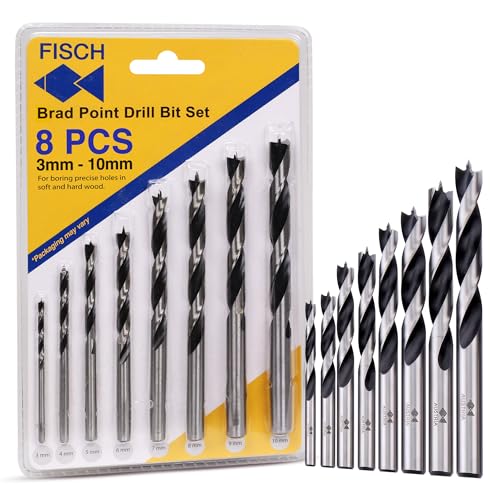
1. Brad Point Drill Bit Set 8 Pcs
Our pick — 4.5+★ from 700+ verified ratings; the strongest balance of quality and price.
An eight-bit Austrian set that bites clean and leaves the rim intact.
This is the crowd favorite for a reason — 4.5+ stars across 700+ ratings, and the sharpness of these bits is the thing that wins people over. Each bit is machined from chrome vanadium steel (a hard steel blend that resists heat and holds an edge), so the cutting edge stays keen through a long run of hardwood. The beveled cutting edge and tune spurs slice the wood fibers before they can splinter, which is why the rims come out crisp on softwoods, hardwoods, MDF, and even acrylic mirror.
The size range runs from a 3mm minimum bore to a 10mm top diameter, and both the cutting diameter and the minimum bore are genuine decisions here. What buyers report matters most: Owners mention the 9mm bit cut roughly 120 one-inch hardwood holes and the 7mm bit about 50 four-inch pen-blank holes with no burning, drifting, or tear-outs. In hard maple and other dense hardwoods, the sharp beveled edge does the cutting instead of the drill.
The catch is worth saying plainly. The hole quality and durability get mixed feedback — a small number of customers note some tear-out and holes running up to 0.2mm off, and starting the largest 10mm bit can take a few spins before it bites. A couple of buyers also want longer lengths for deep work. None of that sinks the set, but if your project demands sub-millimeter placement in every single hole, measure twice and test on scrap first.
What earns it the top spot
- Chrome vanadium steel holds an edge through hardwoods
- Beveled edge and spurs cut down tear-out on MDF, acrylic, and laminate
- 3mm to 10mm range covers cabinet, dowel, and pilot work
- Ran roughly 120 one-inch hardwood holes without burning or drifting
Where it falls a little short
- Occasional tear-out and holes up to 0.2mm off reported
- The 10mm bit can be slow to start on some stock
- Short lengths limit deep-bore jobs
- Eight pieces, so no wide diameters
Reach for this if: you cut cabinets, dowels, or acrylic and want the cleanest hole the money can buy in the brad point family.
Look elsewhere if: your work needs long reach through thick stock — the extra-long Baker and Bolt is the better tool there.
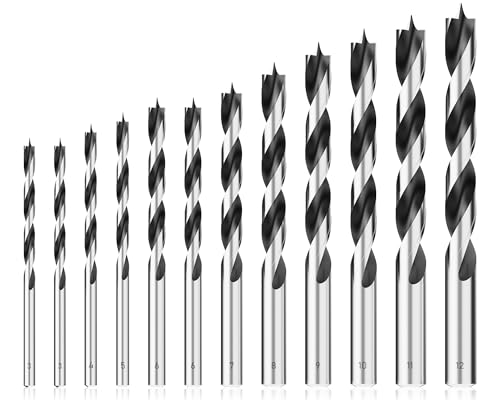
2. 12Pcs (3mm – 12mm) Metric Brad Point Wood Drill Bit Set
Twelve metric sizes from 3mm to 12mm, all in one metal case.
The number that sells this set is 12. Where the Fisch above tops out at 10mm, this MACXCOIP set reaches a 12mm cutting diameter, giving you the top end for larger dowel and knock-down fitting work. You get two bits each at 3mm, 6mm, and a full spread through 4, 5, 7, 8, 9, 10, and 11mm, so the sizes you burn through most often come doubled up. For a metric shop that wants every common hole size in one tray, that is the whole point.
Each bit has a brad point tip (a sharp center point that keeps the bit from wandering) and double cutting edges with extra-wide flutes (the grooves that pull wood chips away fast). The straight shank (the smooth part that goes into the chuck) drops into a standard chuck. Reviewers point out that quality is why they keep reaching for it, and they compare it directly against cheap hardware-store sets that arrive bent or off-center. Their verdict: this set runs more money but is still affordable and far better made, with a metal case instead of plastic. It is a solid step up from throwaway bits.
The honest caveat lives at the shank. The impact-style shank on the sizes that carry one is a weak point — the seam between shank and bit can shear when it gets hot, particularly if you drive it with an impact driver. The size markings also sit in a spot some buyers find awkward to read. Treat these as drill-chuck bits and skip the impact driver, and they will serve you a long time.
Real-world read: a full metric ladder from 3mm to 12mm in one indexed case makes this the practical pick for a shop that works in millimeters and wants the larger top-end sizes the eight-piece Fisch cannot deliver.
The shank warning: keep these in a standard drill chuck rather than an impact driver, and the shank junction stays intact — the seam is the one failure point that shows up in reviews.
Better fit than the rest if: you work in metric and want the 11mm and 12mm sizes without buying them separately.
Think twice if: your workflow is built around an impact driver — the shank seam is the first thing to give.
3. Baker and Bolt 10pc Brad Point Drill Bit Set

A full 12 inches of reach lets you drill where a stubby bit simply cannot go.
Twelve inches of bit length is the whole reason to buy this set. The extra length puts the tip where a standard bit will not fit, so you can drive pilot holes down through a stacked build, reach between a wall and a stud, or bore a wire channel through a guitar body. There are 10 bits spanning 1/8-inch up to a 1/2-inch cutting diameter, each in high-speed steel (a tough steel that resists heat) with titanium coating to help it run cooler and last longer. That 3.18mm minimum bore is only six percent wider than the 3mm floor on the Fisch eight-piece above, so the small end stays agile.
The standout story in the reviews is real cutting muscle: Shoppers say the 1/2-inch bit cut cleanly through a 5-inch solid pressure-treated wood block, and for very long timber screws the bits worked exactly as needed. The steel stays true over that extended length, which is not something every long bit manages — a warped 12-inch bit cuts an oval hole. That straightness keeps pilot holes for lag screws and deep wire channels on line.
The trade-off is durability at the extreme end. Extra-long bits flex under load, and while a slight amount of give helps in tight spots, a full set this length will not tolerate abuse the way a short, stiff bit does. Keep the feed steady and let the tip do the work rather than leaning on it. The set also ships with a storage sleeve to keep the long shanks organized between jobs.
Why it earns a slot: 12-inch length combined with 10 sizes from 1/8-inch to 1/2-inch covers the deep-reach jobs that shorter brad point sets leave undone.
Where it asks for care: the same length that gives reach also gives flex, so steady pressure and a straight feed keep these bits cutting true.
The tool for you if: you regularly drill pilot holes through thick stacked timber or reach into tight spaces a short bit cannot enter.
Not the first pick if: you only cut shallow cabinet holes — a compact set will be easier to control.
4. NordWolf 12-Piece Brad Point Wood Drill Bit Set

Twelve imperial sizes from 1/8″ to 1/2″, all on a 1/4-inch hex shank.
If you own a quick-change chuck or an impact driver, this is the set to reach for. The 1/4-inch hex shank snaps straight into a standard or quick-change chuck with no chuck key and no locking socket, so you swap from a 1/8-inch pilot bit to a 1/2-inch bore in seconds. Twelve bits cover the imperial ladder: 1/8-inch in duplicate, plus 5/32, 11/64, 3/16, 7/32, 1/4, 5/16, 3/8, and 1/2-inch, packed in a rail with the sizes lasered on for instant reading. The larger 5/16, 3/8, and 1/2-inch bits each come with one piece of that hex shank.
Build quality is where this set quietly impresses. The storage case uses a real metal hinge pin instead of a plastic one, and each slot is hot-stamped with the bit size, which tells you the maker cared. Buyers put quality at the top of the list — among the most-praised things about these bits — and describe the tips cutting fast and smooth while staying sharp on hardwood, softwood, and composites. The double flutes and extra-wide flutes clear chips in a hurry and keep the bit from clogging.
One practical note: there is no closing lid covering the points in the case, so the tips are exposed on the rail. It is a small thing, but if you toss the case loose in a tool bag, keep it from bouncing against other metal. Durability feedback is mixed, which for a high-carbon steel set means keeping the feed steady on the hardest woods rather than forcing them.
The case for it
- 1/4″ hex shank fits quick-change chucks and standard drills
- 12 imperial sizes from 1/8″ to 1/2″, with common sizes doubled
- Metal hinge pin and hot-stamped size slots show real attention
- Tips cut fast and stay sharp on hardwood and composites
The small snags
- No lid over the points, so tips are exposed on the rail
- Mixed durability feedback means steady feed on hard stock
- No metric sizes on the rail
Pick it up when: your drill or impact driver takes a 1/4-inch hex shank and you want fast bit swaps.
Hold off if: you work in millimeters day to day and want a metric ladder instead.
5. Jorgensen 14-Piece Spade Drill Bit Set with Storage Pouch

A self-feeding paddle set that pulls itself through lumber up to 1-1/2 inches.
For fast, wide holes through framing lumber, this is the set. You get 13 spade bits running all the way up to a 1-1/2-inch cutting diameter, plus a quick-load connector in a storage pouch. Spade bits clear material in a rush, and the self-feeding threaded tip on this set bites into the wood and pulls the bit through instead of making you lean on the drill. Buyers describe the big bit pulling itself through old, dense 2x4s without straining.
The engineering details back that up. The deep-flute paddle design clears chips fast, and the impact-resistant shaft takes the torque of heavy work. The 1/4-inch hex shank fits quick-change impact drivers and drills with less slippage, and the bits support a maximum speed of 1500 RPM. Quality is what people praise most here, and the carry pouch gets its own nods for portability. A customer sums up the cut nicely: as owners put it, the bit “basically pulls itself through wood.”
Two things to respect. Wide spade bits (flat, paddle-shaped bits for boring large holes) work best in a drill press, and the threaded self-feeding tip (a screw point that pulls the bit into the wood) demands care in a handheld drill because it can grab and pull hard. That self-feeding pull is what makes it fast, but it needs a firm two-handed grip in a handheld drill. Buyers report mixed durability, so keep the speed reasonable and let the bit clear chips rather than forcing it through knotty stock.
Where it shines: 13 sizes up to 1-1/2 inches plus a self-feeding threaded tip make this the fastest way to bore big holes through studs and joists.
The caution: the self-feeding tip can grab in a handheld drill, so brace your stance or use a drill press on the widest bits.
Made for you if: you run cable, pipe, or framing work and need big, fast holes through lumber.
Not the right call if: your holes need clean, flat-bottomed recesses for hardware — reach for a Forstner bit instead.
6. COMOWARE Forstner Bit Set 16 PCS

Sixteen Forstner bits up to 2-1/8 inches for flat-bottomed hinge and knob holes.
When you need a hinge recess or a door-knob hole with a flat bottom, a Forstner bit is the correct tool, and this set gives you 16 of them in diameters from 1/4-inch up to 2-1/8 inches. The X-wing design bores smooth, flat-bottomed holes and curls the chips out fast, so material evacuates instead of packing around the cutter. A sharp center spur locates the exact center of the hole without walking, and the round shank grips firmly in a drill press or a handheld drill.
The heat treatment on the carbon steel is meant to hold sharpness through hardwood and softwood alike. One useful detail is reach: this set steps down to a 6.3mm minimum bore, so it still handles tight hardware work where some larger Forstner kits start too big. The 16-piece spread means you are unlikely to meet a hinge, knob, or model-making hole that you cannot size exactly.
Be realistic about the family’s limits. Forstner bits are less forgiving than brad points and spade bits — they cut slower, and the carbon steel here can lose its edge faster under heavy, continuous use. Users report mixed results on how long they hold an edge, so keep the speed moderate. The organized case gets a warm nod for keeping the set sorted, which honestly is half the battle with 16 loose bits.
The honest version: 16 diameters to 2-1/8 inches give you a full range for flat-bottomed hardware holes, and the center spur keeps the placement exact — but this family cuts slower and rewards patience.
Keep an eye on: edge life on dense hardwood — run moderate speed and let the bit clear its own chips.
For you when: you install hinges, knobs, or need clean flat-bottomed recesses in wood, plastic, or PVC.
Not the everyday bit: for pilot holes and dowels, a brad point set will be faster and easier to control.
7. Fisch Brad Point Spiral Drill Bit Set 29 Pcs

Twenty-nine imperial brad point bits from 1/16-inch to 1/2-inch, machined in Austria.
Chances are you will not find all 29 fractional sizes in a single case anywhere else — this is the complete SAE ladder from 1/16-inch to a 1/2-inch cutting diameter, all in chrome vanadium steel. That every-size-below-half-inch coverage is what makes it a workshop foundation. When a plan calls for an oddball fractional size, you have it. When you burn through your most-used bit, its neighbor is one slot away.
The brad point tips carry the same beveled edges and tune spurs as the eight-piece Fisch at the top of this list, so they enter cleanly and resist tear-out on softwood, hardwood, MDF, and acrylic. What people praise most is the sheer quality of the machining — these bits bite fast and leave perfect, smooth holes. A customer puts it vividly: as owners mention, comparing these to the best a big box store offers is “like comparing a shotgun to a laser,” most obvious in baltic birch plywood. On dense stock the difference shows.
The compromises sit outside the cutting edges. The plastic index case is the weak link — there are reports of it splitting or breaking, and buyers wish a premium set came with a metal case. Durability also earns some sharp comments on this set. The bits themselves, though, are checked straight and true to size, so a spare metal case is a worthwhile addition if you plan to carry them between jobs.
Why a serious shop picks it
- All 29 fractional sizes from 1/16″ to 1/2″ in one case
- Austrian-machined chrome vanadium steel that runs straight and true
- Beveled brad point cuts cleanly through hardwood and plywood
- Hard-to-find full SAE set — metric sets are easy, fractionals are not
What could be better
- Plastic index case can split — a metal case is worth adding
- Durability comments are less rosy than the cutting praise
- The spending sits at premium territory for a bit set
Buy it if: you want a complete fractional ladder in one case and value clean cuts over short money.
Pass if: your plans call for metric sizes or you rarely need the odd fractional diameters.
Know the Specs
Brad point vs Forstner vs spade
A brad point tip has a small center spike that pins the mark so the bit does not skate — best for dowels, pilot holes, and cabinet work. A Forstner bit cuts a flat-bottomed hole with a clean rim, which is the right tool for hinge and knob recesses. A spade bit is a flat paddle that clears fast through bulky lumber but leaves a rougher wall. Pick the tip to match the hole, not the drill.
Flutes and chip clearance
Flutes are the grooves that lift wood chips out of the hole. Two flutes handle most cuts well. Extra-wide or deep flutes clear chips faster and stop clogging in soft stock or high-speed work, which keeps heat down and the edge cool. A clogged bit heats up, dulls faster, and burns the wood, so flute quality matters as much as tip shape on a hard job.
Steel and coating
Chrome vanadium steel resists heat and holds an edge longer than plain carbon steel, which is why the toughest tests — dense hardwoods and long runs — reward it. High carbon steel cuts well but expects steadier feed and lighter loads. Titanium coatings help a bit run cooler. None of it means the bit will last forever; steady feed and letting the tip do the work extend any bit’s life.
Shank and chuck fit
A round shank drops into a standard drill chuck and grips firmly for drill-press work. A 1/4-inch hex shank locks into quick-change chucks and impact drivers so you swap bits fast, but the seam where shank meets bit is the weak point on cheaper sets under impact heat. Match the shank to your drill, and if you use an impact driver, check that seam holds up.
Common Questions
What is a brad point drill bit used for in woodworking?
Is a brad point bit better than a Forstner bit for hinge holes?
Can I use these wood drill bits in an impact driver?
How long will a wood drill bit stay sharp?
What is the difference between metric and imperial drill bit sets?
Why do my drill bits wander off the mark?
Do I need extra-long bits for drilling deep holes?
What flute count should I look for in a wood drill bit?
Can these drill bits cut through plastic and PVC too?
The Bottom Line
For most people buying woodwork drill bits, the winner is the Fisch Beveled Edge 8-Piece set. It runs the hardest-hardwood tests without burning or drifting, and its beveled brad point leaves the cleanest rim of the group. That makes it the one set that flatters your drill on cabinetry and dowel work. If you want a full spread of large metric sizes, grab the MACXCOIP 12-piece for its 3mm to 12mm ladder. And for deep, hard-to-reach pilot holes, the Baker and Bolt 12-inch extra-long set is the one to reach for. One honest nudge: the Fisch eight-piece is the highest-rated pick in this lineup at 4.5+ stars across 700+ ratings, and that pattern of owner satisfaction makes it the safest first buy before you add a wider set later.
How we choose
We do not accept paid placement. Every pick is matched to a real buyer and a real use-case; we do not hands-on test units.
Sources
Specifications: manufacturer listings and product documentation. Review insights: verified customer reviews, as of October 2026. Pricing: not shown on this page (it changes often); check the current price via the retailer link.
As an Amazon Associate, Home Digitized earns from qualifying purchases. This does not affect which products we feature.