
Specs are compiled from manufacturer listings and verified buyer reviews and can change over time — please confirm the key details on the product page before buying.
If you are adding a wood handrail to a staircase, a porch step, or a garage entry, the one thing that matters most is whether the rail stays rock-solid when someone actually leans on it. A loose rail is worse than no rail, because it trains you to lean on something that gives way. This guide sorts out which wood staircase railing picks hold firm, which ones suit a short step-up versus a full flight, and where each one asks you to compromise.
This guide is built by comparing the manufacturers’ published specifications and the patterns across verified customer reviews, so you get each pick’s real strengths and trade-offs instead of marketing spin.
You will see which rails carry the highest weight ratings, which come with the mounting hardware in the box, and which wood species need a finish coat before they go up. The shortlist below covers wall-mount wood staircase railings from 36 to 94.5 inches, rated from 250 to 550 pounds.
Top Picks
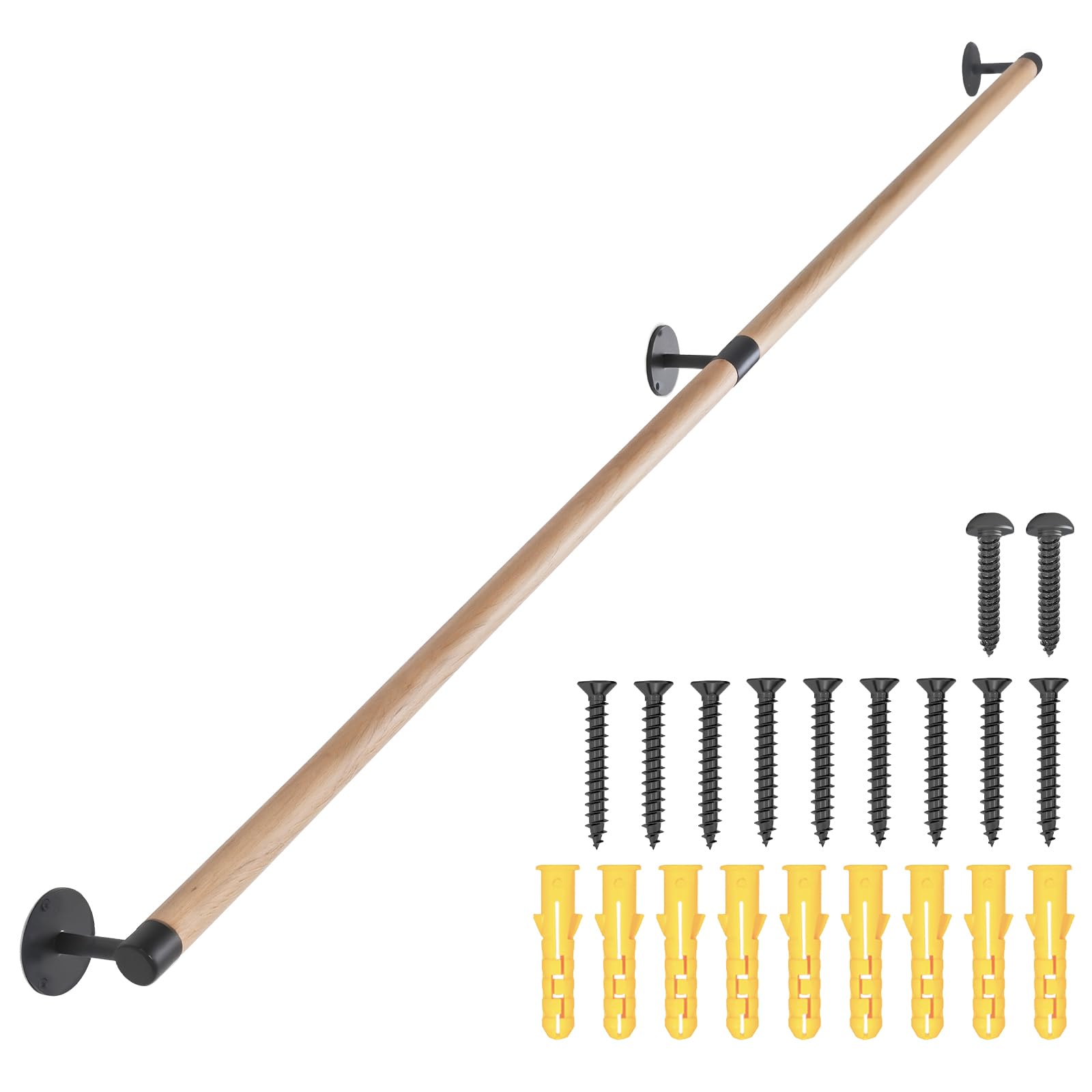

How To Choose The Best Wood Staircase Railing
A wood staircase railing is a semi-permanent fixture, so the wrong pick means patching drywall and drilling again. Four specs decide whether a rail feels solid or shaky: mounting method, wood species, rail length, and rated weight capacity.
Mounting method and bracket strength
Every rail here is wall-mounted, which means the brackets carry the load. Look at how many brackets come in the box and how thick the metal is. A rail with two brackets spans less distance than a longer rail with three or four, and longer spans flex more under a hand. If your wall studs sit far apart, check the bracket hole spacing before you buy — a bracket drilled for wide studs will not line up with a narrow one.
Wood species and finish
Pine is the light, budget-friendly choice and often ships with a polished or coated surface you can wipe clean. Oak is denser and heavier, and unfinished oak lets you stain it to match your floors. Walnut brings a darker, richer look. An unfinished rail needs light sanding and a finish coat before it goes up, while a pre-finished rail is ready to mount the day it arrives.
Length, diameter, and grip
Measure the run you need to cover, then decide whether one long piece or two shorter pieces suits your wall. Diameter matters more than most buyers expect: a round profile around 1.4 to 2 inches fits most hands comfortably, while a thicker profile gives a chunkier grip. Round profiles are easy to wrap your fingers around; a flatter 6010-style profile gives a wider, flatter palm rest.
Side-by-Side Comparison
| Model | Best For | Length | Weight Capacity | Wood / Finish | Amazon |
|---|---|---|---|---|---|
| 7 FT Wooden Stairs Handrails Wall Mount (Purife)★ Best Overall | Long flights and heavy daily use | 84 in | 400 lbs | Solid wood, painted | Amazon |
| 4FT Wooden Stair Handrails (JuneFanwei)501 lb Capacity | High load capacity on a short run | 4 ft | 501 lbs | Pine, polished | Amazon |
| 5 FT Wood Handrails (Henka) | Slim round rail for porches and step-ups | 60 in | — | Pine, polished | Amazon |
| Wooden Stair Handrail (SPTZQURY) | Wet areas and DIY bracket placement | 4 ft | 550 lbs | Pine, polished | Amazon |
| Solid Red Oak Handrail Kit (G&T Wood Products) | Staining to match existing woodwork | 36 in | 250 lbs | Red oak, unfinished | Amazon |
| Wooden Handrails for Indoor Stairs (CHSSIH) | A darker, furniture-grade look | 94.5 in | — | Wood, lacquered walnut | Amazon |
| 6FT Wood Stair Handrails (YEOOE) | Six-foot runs with adjustable height | 6 ft | — | Pine, polished | Amazon |
Detailed Reviews
1. 7 FT Wooden Stairs Handrails Wall Mount by Purife
Our pick — 4.5+★ from 250+ verified ratings; the strongest balance of quality and price.
The full-flight rail that covers a whole staircase in one unbroken piece.
Here is the number that decides it for most buyers: 84 inches of continuous rail. That is 84 inches against the 60-inch Henka below, and a single unbroken piece means no joint to flex mid-run. You mount one rail and your hand travels the whole way down without hitting a seam. For a standard interior staircase, that is the difference between a rail that feels built in and one that feels bolted on.
The rail itself is solid natural wood with a rounded edge, finished in a paint tone that sits comfortably next to wood furniture and most staircase styles. It is rated for 400 pounds, and the metal brackets do the holding, so the load goes into the wall rather than into the wood. Buyers use these on loft hallways, garage entries, basement stairways, exterior porch steps, and even as a bathroom grab bar — the wall-mount format travels wherever you need a hand.
What wins people over is the build quality, with the sturdiness right behind it — the rail reads as a proper piece of joinery rather than a hardware-store dowel. The thing to know before you order: 400 pounds is the lowest rating among the heavy-capacity rails here, below the 501-pound JuneFanwei and the 550-pound SPTZQURY. That is a fine number for everyday support, but if you want maximum rated headroom on a short run, one of those two edges it out.
What earns the top spot
- 84 inches of single-piece rail covers a full staircase run with no mid-stair joint.
- Solid wood grip with a rounded edge that is comfortable to wrap a hand around.
- Rated to 400 lbs with sturdy metal brackets taking the load into the wall.
- Paint finish slots in next to wood furniture and most stair styles.
Where it gives ground
- 400 lb capacity is the lowest of the three high-load rails in this guide.
- Wall-mount installation means drilling and locating studs before you start.
Go with this if: you want one continuous rail down a full flight and value an unbroken grip over a raw capacity number.
Second-guess it if: your priority is the highest rated load on a shorter run.
2. 4FT Wooden Stair Handrails by JuneFanwei
The short-run rail that is rated to hold more than almost anything else here.
If a heavy lean is your worry, this is the rail to look at first. That rating sits on solid pine and stainless-steel brackets, so the strength is split between dense wood and corrosion-resistant metal rather than resting on the wood alone.
At 3.35 inches wide it is the chunkiest rail in this group — the 1.38-inch Henka below is a far slimmer profile at the same general length class. A wider rail gives your palm more surface to press against on the way down, which is why it works so well on a garage entry or a porch step. The pine carries a polished, water-resistant coating that wipes clean and stands up to an outdoor deck. The box includes two brackets, 24 screws, 12 expansion bolts, and a drill bit, so you are not hunting for hardware mid-install.
Quality is what buyers praise most here, with installation ease close behind — this is one of the quickest rails to hang, and the polished pine surface gets called out for feeling smooth rather than splintery. The honest caveat is the bracket thickness: a couple of buyers found the thin metal mounts flex under weight and wished for beefier brackets. On a well-anchored stud it holds fine, but it is worth checking that at least two brackets land on solid wood.
The trade-off worth knowing: the 4.4-pound rail arrives as a thick, solid piece — great for grip, heavier to hold overhead while you mark your drill points.
Reach for this if: the rail needs to carry real weight on a short, high-traffic run like a garage or deck step.
Look elsewhere if: you want a slim, understated profile — this one is deliberately chunky.
3. 5 FT Wood Handrails by Henka
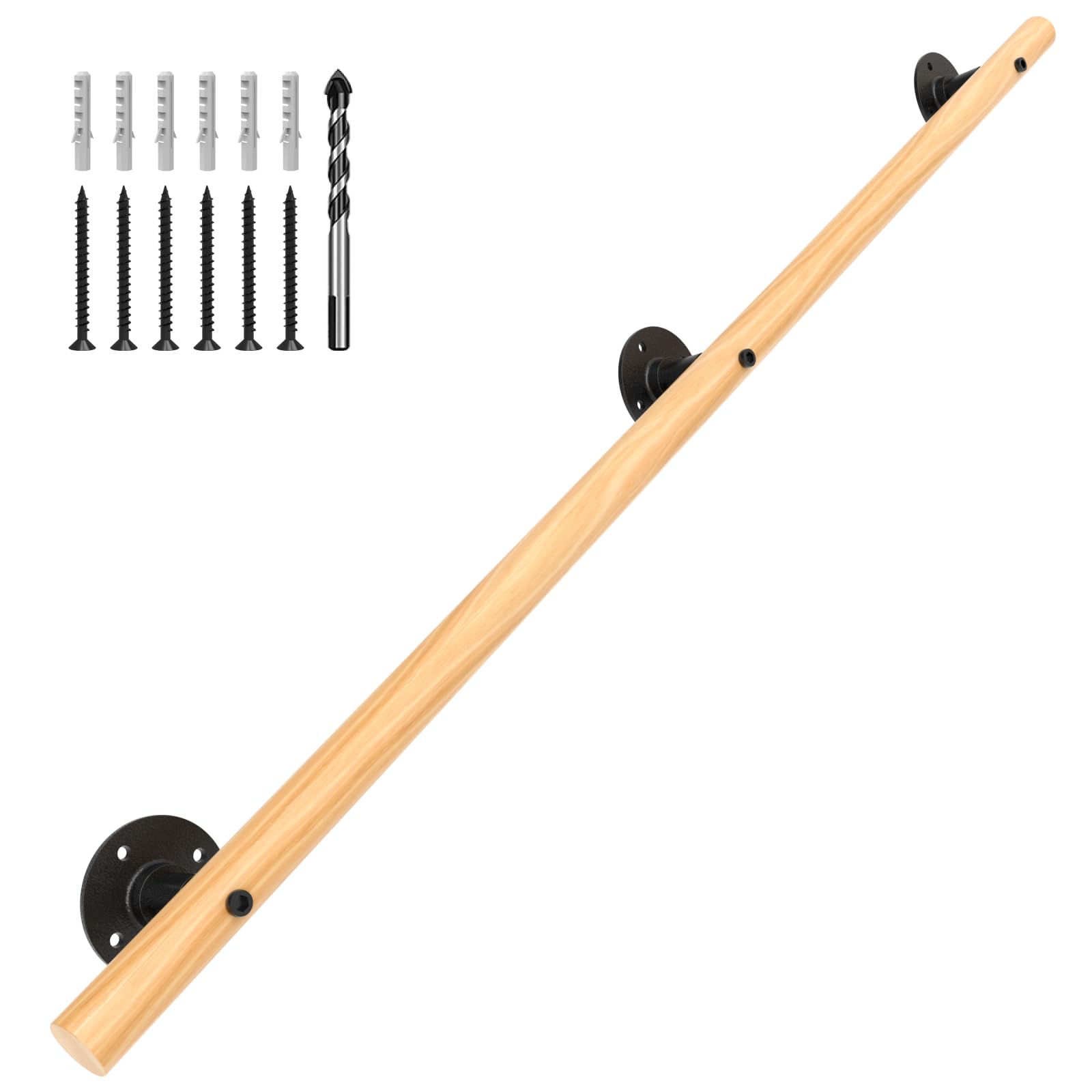
A light, round rail that disappears into a porch instead of dominating it.
This is the rail for the buyer who wants support without a heavy piece of furniture on the wall. It weighs 2.5 pounds against the 4.4-pound JuneFanwei — you can carry it up a ladder one-handed and hold it steady while you mark holes. The 1.38-inch round pine profile is also far slimmer than the 3.35-inch JuneFanwei, so it reads as a subtle trim line rather than a chunky bar.
Round wood with an anti-skid texture is the whole design brief here. Your fingers wrap fully around a slim round rail, and the polished surface stays comfortable on bare hands. It is built for porches, lofts, corridor steps, and the kind of short step-up where you just want a steadying hand. The kit ships with two brackets, six expansion bolts, 12 screws, and a drill bit, and the brackets are height-adjustable with pre-drilled components, so it adapts to different stair dimensions.
Appearance and quality are what buyers appreciate most — the rail finishes smooth and looks natural against a home’s existing wood. One detail worth planning around: the bracket holes come pre-drilled, and they will not line up with every stud layout. If your framing runs narrow, plan on a small workaround before you drill. That is a fit quirk, not a fault — plenty of buyers mount these straight onto solid wood without a hitch.
Best fit: a back porch or a single step-up where a slim, quiet rail suits the space and the wall is easy to drill into.
It suits: anyone adding a light, round grab rail to a porch, loft, or short corridor step.
Think twice if: your studs sit far apart and you want zero prep work on the bracket holes.
4. Wooden Stair Handrail by SPTZQURY
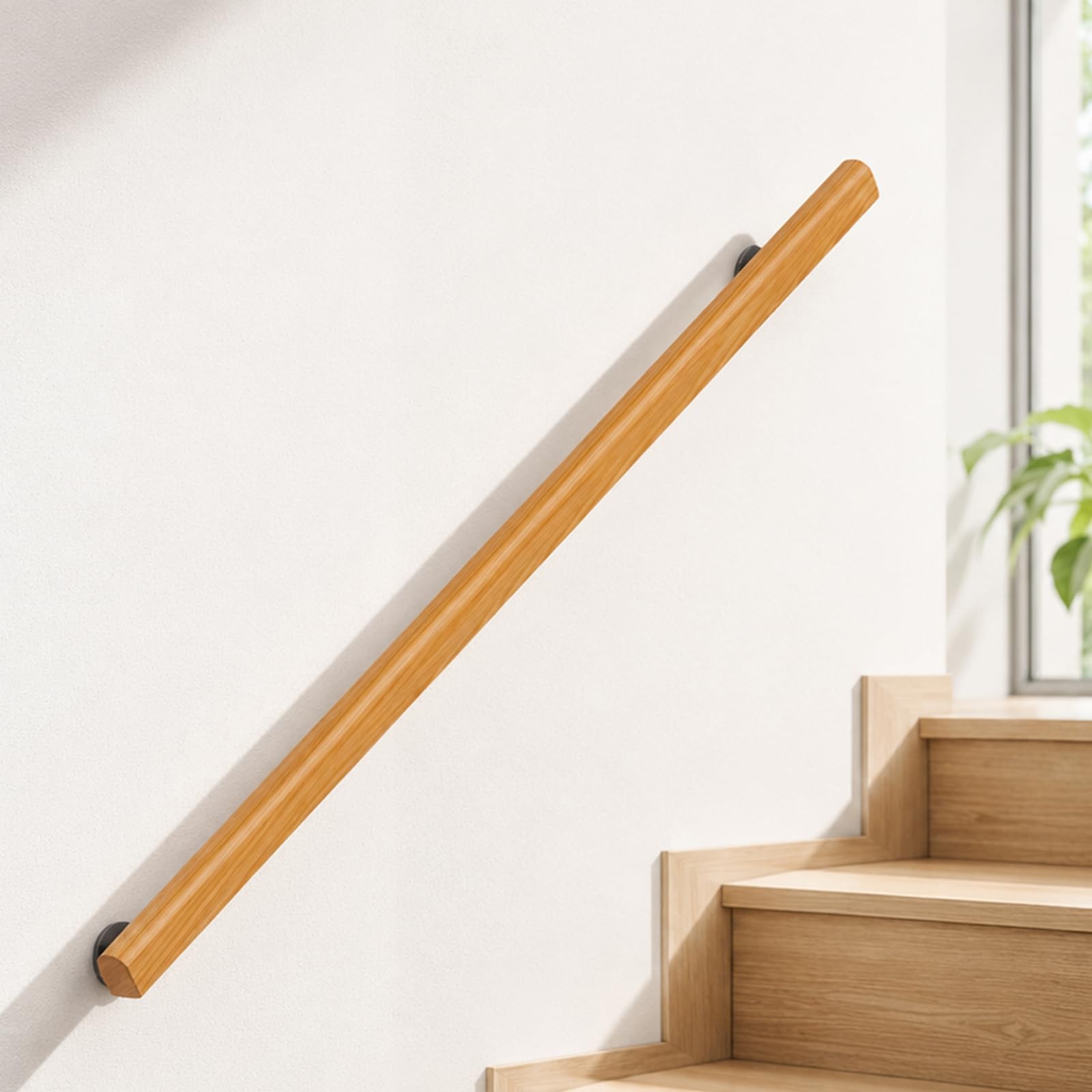
The rail rated to hold the most weight here — 550 pounds of pull on stainless brackets.
For maximum rated strength on a 4-foot span, this is the pick. The pine bar runs through rounded corners with a 1.9-inch diameter and sits 3.9 inches out from the wall, so your knuckles clear the drywall when you grab it in a hurry.
The stainless-steel bracket setup is the other reason this one earns its place. It is built to hold up in dry or wet environments, which makes it a genuine option for a bathroom or shower wall, not just a stairwell. And because the black stand can go at any position you choose, you can line the brackets up with your actual studs instead of trusting a pre-drilled pattern. The kit comes with all mounting hardware and supports 4-foot runs on two brackets, with more brackets added as lengths grow.
Buyers praise the build quality most, then the look once it is up — the polished pine finish reads warmer than painted metal, and staining it to match a room is straightforward. One fair warning: rail straightness is the one point of disagreement. A few buyers found their length arrived with a slight bow rather than dead flat. Lay it on the floor and sight down it before you drill, and you will know exactly what you are working with.
Why it stands out
- 550 lb pull rating — the highest rated capacity in this guide.
- Suits wet rooms like bathrooms and showers, not just stairwells.
- You place the brackets yourself, so you can match your own stud layout.
- 1.9-inch diameter with a 3.9-inch wall gap for comfortable hand clearance.
The honest limit
- Rail straightness varies — sight down the length before mounting.
- Wall-mount drilling is required, so a helper makes the job easier.
Pick this one if: you need the strongest rated rail for a wet room, shower wall, or a step where the brackets must land exactly on your studs.
Pass if: you want a rail with factory-drilled holes ready to go straight up.
5. Solid Red Oak Handrail Kit by G&T Wood Products
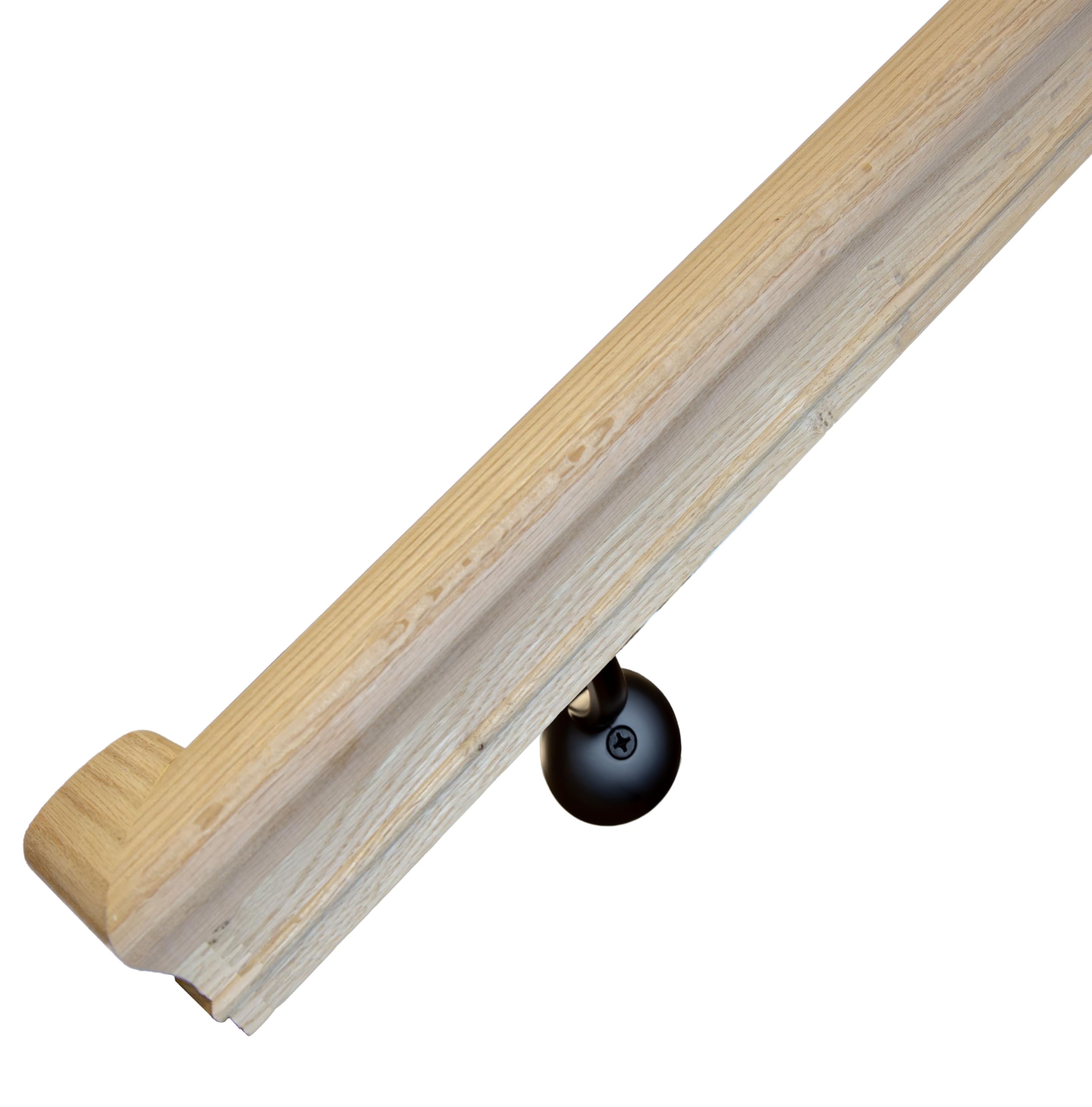
Real red oak with the returns already attached — bring your own stain, get a matched rail.
If your home already has oak trim, this is the rail that will disappear into it. It is cut from solid red oak in the 6010 profile — the flat-topped shape most handrails use — and it ships unfinished so you can stain or paint it to match. The wall returns come already attached to the rail, which saves you the fiddliest part of a handrail build: cutting and mating the return pieces yourself. You screw the brackets into the wood, then mount to the wall.
The build is dense and hefty in the hand, and the hardware is a thick, well-made brushed-nickel set. With two wall brackets and matching screws in the box, it mounts on a single screw per bracket rather than the traditional three-screw pattern, which keeps the install short. At 36 inches it is the shortest rail on this list — this is a turn-of-the-stair or short step rail, not a full-flight piece. Sand it, stain it to match your trim, then screw the brackets in.
Quality is the headline here, with appearance close behind — the oak grain shows beautifully under an oil or stain finish, and it reads as original woodwork rather than an add-on. Two honest notes. First, the 250-pound maximum rating is the lowest in this guide, so it is built for steadying, not for heavy leans. Second, sanding is the one part buyers disagree about: some found light high-grit work was all it needed, others hit a too-deep ding that could not be sanded out. Budget a little finishing time.
What earns it a place: genuine red oak, pre-attached returns, and a flat 6010 profile that blends into an existing staircase far better than a round dowel.
Suited to: anyone finishing a short turn rail or step rail who wants oak that stains to match the rest of the house.
Not for: you if you want a long continuous rail, a pre-finished surface, or a high weight rating.
6. Wooden Handrails for Indoor Stairs by CHSSIH

The one that looks like furniture — a lacquered walnut rail ready to mount.
Most rails here are pine you plan to paint or a raw oak you plan to stain. This one arrives finished in a deep walnut lacquer over a 94.5-inch length, so it goes up as-is and matches a darker, more polished interior. Solid wood runs the full span, joined by metal brackets for a clean, modern line that suits hallways, entryways, and stairways where the rail is visible from the front door.
The 2-inch diameter sits between the 1.38-inch Henka and the 3.35-inch JuneFanwei — chunky enough to fill your palm without feeling like a fence post. The four-to-seven-foot lengths ship as a single piece, while the eight-foot version comes in two four-foot sections, so measure your run before you order. Mounting hardware and printed instructions come in the box, and the whole rail weighs 4.5 pounds, which one person can handle.
Quality and appearance are what buyers love, and the praise gets specific: this rail draws compliments on the finish, and it has earned a place on front porches and interior entries alike. The thing to know is the included concrete anchors. Their sleeve-then-bolt design means you cannot easily back the rail out and re-mount it — so if you plan to paint or adjust, pick up different anchors first. Swapping in standard anchors costs a few dollars and keeps the rail re-mountable.
The finish is the draw: a lacquered walnut surface you can hang without sanding or staining, which in turn saves you a full weekend of prep work.
Choose it when: you want a finished, dark-wood rail that looks intentional from day one and you are happy with a single-piece span.
Consider the alternative: if you expect to re-mount the rail later, the anchors make that awkward.
7. 6FT Wood Stair Handrails by YEOOE

Six feet of polished pine with three brackets and a height you set yourself.
This rail splits the difference between the short step rails and the full-flight Purife at 84 inches — six feet of polished pine with a third bracket in the box. That extra bracket matters. Three mounting points on a six-foot run hold the rail flatter along the wall, which is the practical fix for the sag you get on longer spans. The bracket height adjusts freely, so you can dial the rail in at the height that suits the people who use those stairs.
The design details are built for daily use: an anti-skid polished pine surface, a waterproof coating, and a solid structure meant for the stairs, porch, patio, or loft step. The kit is thorough — three brackets, a drill bit, 18 screws, nine expansion bolts, and a manual. You should have everything you need to hang it without an extra hardware run.
What buyers rave about is the wood and the build, and a lot of the praise lands on how naturally the burlywood tone blends with existing hardwood floors. One thing to decide before ordering: size is the one mixed point. The length suits some staircases perfectly, while a few buyers found the profile wider in the hand than they pictured. If you prefer a thin round rail, the 1.38-inch Henka is the slimmer choice; if you want a fuller grip on a six-foot run, this is the one.
Standout details
- Three brackets across six feet keeps the rail flatter along the wall.
- Height-adjustable brackets let you set the rail for the people who use the stairs.
- Polished, waterproof pine grip that suits indoor steps and an outdoor patio alike.
- Full hardware kit in the box, including a drill bit and manual.
Before you commit
- Grip profile feels wider to some hands than expected — compare it to the 1.38-inch round rail.
- Like any wall-mount rail, you need studs or solid anchors to mount it.
It earns the spot if: you are covering a six-foot run and want the stability of three brackets plus a height you can set.
Better elsewhere if: a thin round profile is what your hand prefers.
Know the Specs
Weight capacity
This is the load the rail is rated to take, and it tells you how much lean it is built to handle. A higher number gives more margin — the 550-pound SPTZQURY sits at the top here, while the 250-pound red oak kit is built for steadying rather than heavy support. Match the rating to who uses the stairs: a firm hand from a senior or a child needs far less than a lean from a heavy adult carrying groceries.
Length and diameter
Length decides whether one piece spans your whole run or if you need to join two. Diameter decides how the rail feels in your hand: a round profile around 1.4 inches lets your fingers close fully around it, while a 2- to 3.35-inch profile gives a chunkier grip that some hands prefer. Always measure the run and compare it to the single-piece length before ordering.
Brackets and mounting
The brackets take the load into the wall, so their count and thickness matter as much as the wood. Two brackets suit a short rail; longer rails add a third or fourth to keep the span flat. Bracket hole spacing has to line up with your studs, so check whether the rail ships with factory-drilled holes or lets you place each bracket yourself.
Wood species and finish
Pine is the light, budget-friendly choice, often pre-finished and ready to mount. Oak is denser and heavier, and unfinished oak lets you stain it to match your floors. Walnut gives a darker, finished look right from the start. An unfinished rail needs light sanding and a finish coat; a polished or lacquered rail is ready to hang, which saves a weekend of prep.
Common Questions
Will a wood staircase railing hold my weight if I lean on it?
Can a wood handrail be used outdoors on a porch or deck?
Do I need to sand or finish the rail before I install it?
How do I match a new wood railing to my existing staircase?
What diameter handrail is easiest to grip?
Can a longer handrail come in sections?
Will the included mounting hardware fit my wall?
Is a round or flat handrail better for elderly or young users?
How much wall clearance does the rail need?
Can a wood handrail double as a grab bar in a bathroom?
The Bottom Line
The wood staircase railing that balances coverage, build, and grip best is the 7 FT Purife, with 84 inches of continuous solid wood on a 400-pound rating — the full-flight pick most stairs actually call for. If raw rated strength on a shorter run is your priority, the JuneFanwei rated to 501 pounds is the one to grab. And if you want oak that stains to match your existing trim, the red oak kit is the reach for a short turn rail. The Purife’s 4.5+ star rating across 200+ owners backs up its build quality.
How we choose
We do not accept paid placement. Every pick is matched to a real buyer and a real use-case; we do not hands-on test units.
Sources
Specifications: manufacturer listings and product documentation. Review insights: verified customer reviews, as of October 2026. Pricing: not shown on this page (it changes often); check the current price via the retailer link.
As an Amazon Associate, Home Digitized earns from qualifying purchases. This does not affect which products we feature.