
Specs are compiled from manufacturer listings and verified buyer reviews and can change over time — please confirm the key details on the product page before buying.
Stringy filament, a musty gun safe, or a dry-box hygrometer (a meter that reads humidity) that will not drop all point to the same fix: a proper 4A molecular sieve instead of general-purpose silica. A 4A sieve has a 0.4-nanometer pore — a microscopic opening that grabs water molecules and holds them. This shortlist covers three bulk options and spells out exactly which pore size each one delivers, so you can pick the right bag size and get on with your project.
This guide is built by comparing the manufacturers’ published specifications and the patterns across verified customer reviews, so you get each pick’s real strengths and trade-offs instead of marketing spin.
Bulk desiccant is a commodity, so your buying decision really depends on three things: bead size, bag volume, and if you want a hygrometer in the box. Here is what separates a genuinely useful jar of zeolite 4a beads from a bag you will regret pouring.
Top Picks

How To Choose The Best Zeolite 4A Beads
The first thing to check is the pore size printed on the label, because it decides what the beads will actually absorb. A 4A sieve has a 0.4nm pore and traps molecules up to that diameter, which is why it pulls water vapor out of filament spools and sealed containers so aggressively. A 13X sieve uses a 1nm pore and a different job description entirely, so the two are not interchangeable in a filament dry box.
Match the bead size to how you will portion it
Small granules around 1.5–2.5mm flow easily into mesh bags, tea filters, and stockings, so you can fill a dozen spool boxes without spilling half the scoop. Larger 3–5mm beads are easier to scoop by hand and less likely to slip through a loose mesh, which helps when you are pouring into a printed desiccant tray. Neither size is better — pick 1.5–2.5mm for bags and 3–5mm for a fixed container.
Decide if you want an indicator or a hygrometer
Color-change beads let you see at a glance when the desiccant is spent, but some blue indicating types rely on cobalt chloride. A non-indicating 4A formula paired with a digital hygrometer takes the guesswork out differently — you read the actual relative humidity number instead of watching a color shift. For filament storage, that number is the more useful signal.
Plan for recharging before you buy bulk
The bulk jars are sold as reusable, and reactivation means baking the granules at 550°C (1020°F) for 3 hours, then cooling them in a drying cylinder before reuse. That is a muffle-furnace job, not a kitchen-oven job for most households, so factor in whether you have access to that heat before you commit to a multi-pound container.
Side-by-Side Comparison
| Model | Best For | Pore Size | Bead Size | Net Weight | Amazon |
|---|---|---|---|---|---|
| Wisesorb 7.5 LBS 4A Molecular Sieve★ Best Overall | Filling many dry boxes at once | 0.4nm | 1.5–2.5mm | 7.5 LBS | Amazon |
| JEIZAW 4A Molecular Sieve Kit with Hygrometer | Filament storage, ready to use | 4A | 3–5mm | 2LB | Amazon |
| Wisesorb 13X Molecular Sieve Desiccant Beads | Compressor and PCP filters | 1nm | 1.5–2.5mm | 6 LBS | Amazon |
Detailed Reviews
1. Wisesorb 7.5 LBS 4A Molecular Sieve
Our pick — 4.5+★ from 60+ verified ratings; the strongest balance of quality and price.
The multi-pound tub that dries a whole shelf of spools without running dry halfway through.
This is the pick for anyone who has more than two or three filament spools and no interest in reordering every month. You get 7.5 LBS of 4A molecular sieve in granules sized 1.5–2.5mm — small enough to pour into mesh bags and tea filters, so you can portion out a dozen dry boxes from one container. Plan for that footprint before it arrives.
The pore geometry does the work. The 0.4nm opening traps molecules up to that width, and Wisesorb rates it to hold more than 17% of its own weight in water vapor at 77°F and 20% relative humidity. It keeps working down to -4°F, so the beads still pull moisture in a garage cabinet or an unheated shop. In a buyer test, a 30g sample soaked up water to 40.41g, then dropped back to 30.4g after an hour at 500°C in a convection oven — regenerable, and measurably so. In a sealed bag starting at 40% humidity, the beads pulled the reading to 10% overnight.
Filament duty is where this earns its reputation. Buyers report dry boxes holding steady — hygrometers showing no moisture creep after months, and no print failures traced to wet filament. Buyers also use the beads to knock down a damp, musty smell in a car. The honest catch hits first-time buyers hardest: the photos and unit description are loose about pellet size, so it is genuinely hard to judge the granule scale before it lands. Hold 1.5–2.5mm granules in your head as the spec. The other reality is that recharging 4A sieve calls for 550°C (1020°F) for 3 hours, so a big container makes sense only if you have furnace access or a long runway before a recharge.
Where this tub earns its keep
- 7.5 LBS of 0.4nm sieve means one order fills a whole set of spool boxes
- 1.5–2.5mm granules pour cleanly into mesh bags, tea filters, and stockings
- Holds more than 17% of its weight in water vapor at 77°F and 20% RH
- Works down to -4°F, so cold garages and shops are fine
The parts worth knowing up front
- Pellet size is hard to judge from the listing photos
- Reactivating 4A sieve calls for 550°C for 3 hours — not a kitchen-oven routine
- The 9.06 x 3.74 x 11.61 inch container needs real shelf space
Buy it if: you run several filament spools, a damp car, or a basement safe and want one bulk tub to cover all of it.
Think twice if: you only have one spool box, because a 7.5 LBS container is a lot of desiccant to keep dry while it waits.
2. JEIZAW 4A Molecular Sieve 2LB Kit
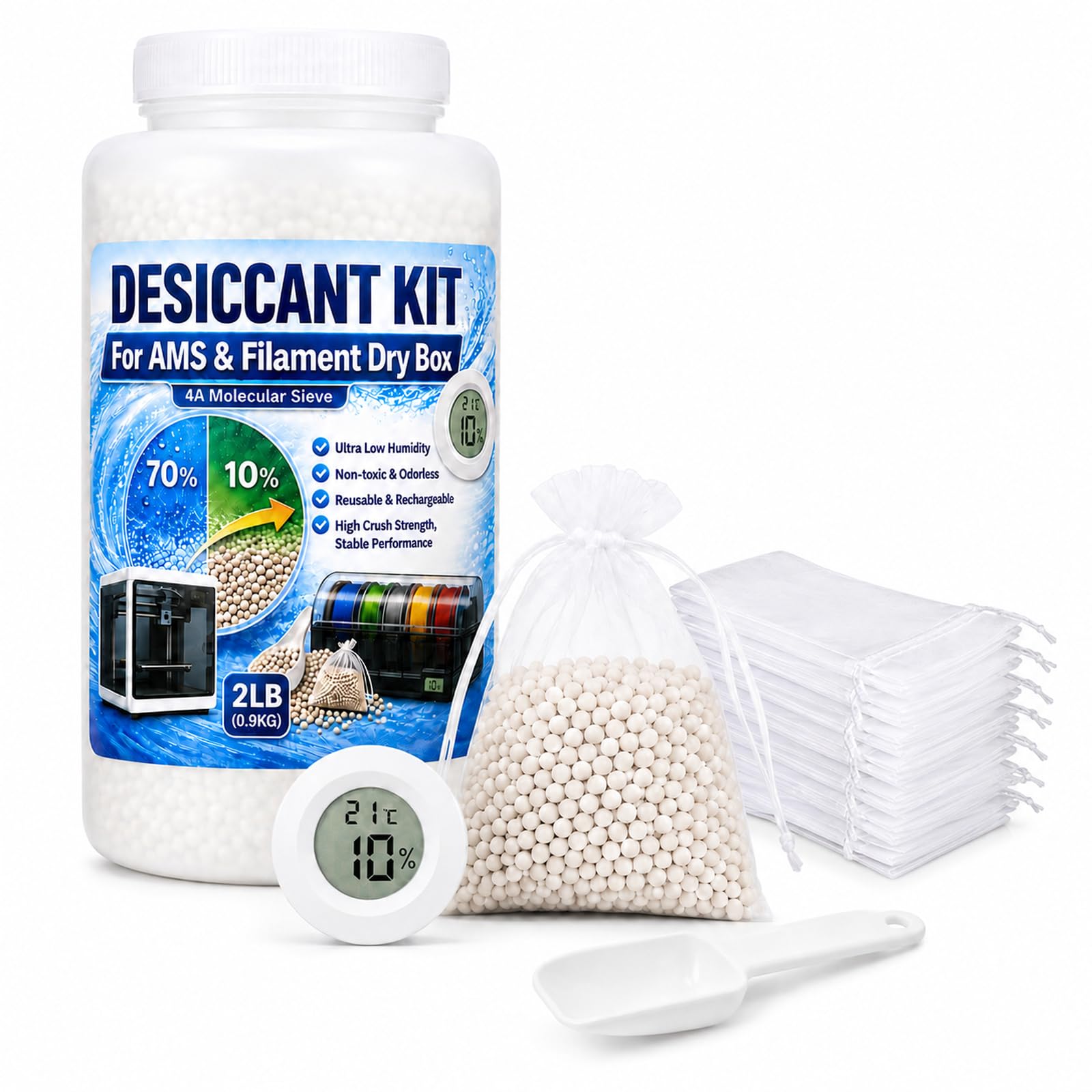
Everything you need to start drying filament tonight, in one box, with a humidity gauge to prove it worked.
Most bulk desiccant arrives as beads and nothing else, and you are left hunting for bags and a way to measure whether anything changed. This kit closes that gap. The 2LB jar of 4A molecular sieve ships with a digital hygrometer (a small screen that reads your storage space’s relative humidity), 10 reusable organza bags, and a measuring scoop. That is a complete moisture-control setup for one AMS unit or a stack of spool containers. Compare that to the Wisesorb 7.5 LBS tub, which outsizes it dramatically at 8.09 pounds versus 2.35 pounds but leaves you to source your own bags and reader.
The formula choice is the detail worth pausing on. JEIZAW runs a non-indicating 4A sieve with no cobalt chloride, so the beads do not shift color to tell you they are spent. Instead the hygrometer does the reporting — and it reports hard. Owners mention a CFS reading dropping from 45% to 10% after adding the beads, and another setup hitting 0% on a P2S screen with no recharge after several weeks. The practical upshot: you are not guessing at a blue-to-pink shift, you are reading a number. The beads are 3–5mm, noticeably chunkier than the 1.5–2.5mm granules in the Wisesorb tubs, which makes them easy to scoop but means they sit in a bag rather than sifting into a fine mesh.
Print quality is where this earns its place. Lower humidity in the storage space counters the usual wet-filament symptoms — stringing, popping, bubbling, and brittle filament that snaps mid-print. The kit shape also suits makers who print their own desiccant trays, since the beads pour into a DIY box or AMS tray as readily as into the included bags. The limitation is simply volume: 2LB goes fast if you are loading several large spool containers at once, and at 7.76 x 5.67 x 4.17 inches the box is compact but the supply is finite.
What you are really buying: a working humidity system, not just a bag of beads — sieve, bags, scoop, and a digital reader that tells you when to recharge.
The trade-off to accept: no color-change indicator. If you would rather watch beads turn color than trust a screen, this is the wrong format for you.
Reach for this if: you want to set up filament drying today without buying bags and a hygrometer separately.
Look elsewhere if: you are stocking a large workshop and need bulk volume more than a starter kit.
3. Wisesorb 13X Molecular Sieve Beads

A wider-pore sieve built for compressor filters — read the label before you pour it into a filament box.
Here is the one thing to understand before anything else: this is a 13X sieve, not a 4A. The pore measures 1nm instead of 0.4nm, which lets it adsorb larger molecules and co-adsorb water alongside carbon dioxide and hydrogen sulfide. That broader reach is exactly why it shows up in air and gas filtration rather than fine filament work. It still handles water well — rated to absorb more than 20% of its weight in vapor at 77°F and 20% relative humidity — and the 1.5–2.5mm granules match the size found in dedicated moisture filters. The container carries 6 LBS in the same 9.06 x 3.74 x 11.61 inch dual-handle can as its 4A sibling.
Where this builds its following is PCP airgun and compressor duty. The beads turn up as drop-in replacements in moisture filter housings — the same granule size the filter came with — and they work as designed there. That is a genuinely specific use case, and the 6 LBS volume means you can refill a filter several times over rather than buying small pre-packed cartridges. Baking at 550°C (1020°F) for 3 hours reactivates the granules, so the container keeps paying out as long as you have the heat to dry them.
The catch is compatibility, and it matters. If you came here for filament desiccant, the 4A picks above are the correct fit for a dry box; this 13X sieve is the wrong pore size for that job and better suited to filtration, where its wider opening does useful work. For a compressor moisture filter or a PCP (pre-charged pneumatic airgun) setup, though, the sizing and volume line up cleanly. At 6.5 pounds on the scale, it is a substantial can — lighter than the 8.09-pound 4A tub, heavier than the 2.35-pound kit — and its dual-handle design makes pouring controlled rather than scoop-and-hope.
The defining spec: a 1nm pore that pulls in larger molecules than a 4A sieve can, with water uptake above 20% of its own weight at 77°F and 20% RH.
The honest caveat: wrong tool for filament dry boxes. Match the sieve type to the job before buying.
Best matched to: compressor and PCP moisture filters that call for a 1.5–2.5mm granule and a wider-pore sieve.
Skip it for: 3D printer filament storage, where the 4A picks are the right pore size.
Know the Specs
Pore size (the 4A versus 13X question)
The number in the name is the pore diameter. A 4A sieve has a 0.4nm opening and traps molecules up to that size — mainly water, which is why it suits filament and sealed containers. A 13X sieve opens to 1nm and takes in larger molecules, which is why it appears in compressor and gas filtration. Buying the right one for your job matters more than any other spec on this page.
Water uptake capacity
Capacity is expressed as a percentage of the bead’s own weight in water vapor at a stated temperature and humidity. The 4A product here is rated above 17% at 77°F and 20% relative humidity; the 13X is rated above 20% under the same conditions. That figure tells you roughly how much moisture a given bag of beads can hold before it needs recharging.
Bead diameter and handling
Granules at 1.5–2.5mm pour into fine mesh, tea filters, and stockings, so they suit bag-based setups. Beads at 3–5mm are easier to scoop by hand and sit better in a printed tray. Pick the size that matches how you plan to portion and place the desiccant.
Reactivation temperature and time
Recharging means baking the granules at 550°C (1020°F) for 3 hours, then cooling them in a drying cylinder before reuse. That is furnace territory for most homes. If you cannot reach that heat, treat the beads as single-use and buy volume accordingly.
Common Questions
What does the 4A in Zeolite 4A Beads actually mean?
Can I use 13X beads instead of 4A for filament storage?
How do I know when the beads need recharging?
What temperature do I need to reactivate the desiccant?
Will the beads fit inside organza bags and tea filters?
How much desiccant do I need for a Bambu Lab AMS?
Can I use these beads in a car or a gun safe?
Are these beads safe to use around electronics and cameras?
Why do the beads get hot or fizz when they hit water?
Do the granules break down over repeated recharges?
The Bottom Line
For most buyers, the zeolite 4a beads winner is the Wisesorb 7.5 LBS 4A Molecular Sieve because it delivers the correct 0.4nm pore in a volume that fills a whole set of dry boxes without a reorder. Want a ready-to-run setup with a hygrometer and bags in the box? Grab the JEIZAW 2LB Kit. For compressor or PCP filter refills, reach for the Wisesorb 13X — just confirm the sieve type your filter calls for first, since the wider 1nm pore does a different job than a 4A sieve does in a filament box.
How we choose
We do not accept paid placement. Every pick is matched to a real buyer and a real use-case; we do not hands-on test units.
Sources
Specifications: manufacturer listings and product documentation. Review insights: verified customer reviews, as of October 2026. Pricing: not shown on this page (it changes often); check the current price via the retailer link.
As an Amazon Associate, Home Digitized earns from qualifying purchases. This does not affect which products we feature.