
Specs are compiled from manufacturer listings and verified buyer reviews and can change over time — please confirm the key details on the product page before buying.
Rotted wood is a lot less scary than it looks. If you can push a screwdriver into a sill, a post, or a window frame, a penetrating epoxy hardener can soak into the soft fibers, cure, and turn that mushy spot back into something solid you can paint and screw into again. The catch is that these products are not interchangeable: some are water-thin and need to be injected into holes, and some are pastes meant to fill a void after the liquid goes in. To keep things honest, this list uses flexible same-type matching — the nearest correct size or formula that does the same job as the exact product you might have searched for — so you never end up with a surface sealer or a paint when what you need is a consolidant.
This guide is built by comparing the manufacturers’ published specifications and the patterns across verified customer reviews, so you get each pick’s real strengths and trade-offs instead of marketing spin.
You will see the mix ratios, cure windows, and temperature limits that decide whether a repair actually sets, plus which kits come with the bottle or spreader you need on day one. Below you’ll find the best wood hardener for rotten wood picks, chosen by how they behave in real repairs.
Top Picks

How To Choose The Best Wood Hardener For Rotten Wood
Two products in the same aisle can behave completely differently. One pours like water and soaks straight into punky fibers, while another is a thick paste that sits on top and fills a hole. Start by deciding which job you actually have: stabilizing wood that is still physically there, or replacing wood that has gone hollow or crumbled away.
Match the fluid to the damage
A thin consolidant flows into the grain and hardens the fibers in place, which is what you want for a soft sill or a punky beam. A two-part epoxy paste is the follow-up step, filling gaps, knots, and missing chunks once the liquid has set. Many kits bundle both for exactly this reason, and it saves ordering twice.
Check the working window against your repair
Pot life is how long the mixed liquid stays workable before it starts to gel. A 30 to 60 minute window suits a small sill repair with a brush. If you are coating a whole deck or working alone on a big job, that same window can be tight, so plan the pour before you mix.
Read the temperature range, not just the label
Epoxy cures by chemical reaction, and cold slows it down. Some formulas are blended specifically for cooler conditions and should not be used above a stated ceiling, while warmer-weather formulas can stay tacky for days in a chilly garage. If your repair is outdoors in shoulder season, this one detail decides whether the job cures at all.
Dry wood is a hard rule
Penetrating epoxies bond to wood fibers, not to water. If the rot is soaking wet, the liquid will sit on the surface instead of soaking in. Dry the area first, and for severe rot remove any soft material that will not hold together before treating.
Side-by-Side Comparison
| Model | Best For | Kit Size | Form | Full Cure Time | Amazon |
|---|---|---|---|---|---|
| PC-Rot Terminator★ Best Overall | Deep-penetration sills and slabs | 24 oz (two bottles) | Low-viscosity liquid | 61 minutes | Amazon |
| PC-Woody + PC-Petrifier KitBest Two-Step Kit | Hardener plus gap filler in one order | 8 oz + 6 oz | Liquid + paste | — | Amazon |
| LiquidWood Epoxy ConsolidantBest for Vertical Repairs | Vertical frames and window sash | 6 oz + 6 oz | Liquid | — | Amazon |
| Boat Life Git-Rot Kit | Syringe injection into hidden rot | 4 fl oz | Liquid | — | Amazon |
| RTG Supply Rot Repair Epoxy | Decks and structural beams | Pint kit | Liquid (two-part) | 2 days | Amazon |
| TotalBoat Cold Weather Epoxy | Repairs in 40–65°F conditions | 1.5 pint kit | Liquid (two-part) | 4 days | Amazon |
| Abatron LiquidWood 2 Pint Kit | Permanent structural restorations | 2 pint kit | Liquid (two-part) | 24 hours | Amazon |
| System Three RotFix | Boat cores and large-volume pours | 24 oz kit | Liquid (two-part) | 72 hours | Amazon |
Detailed Reviews
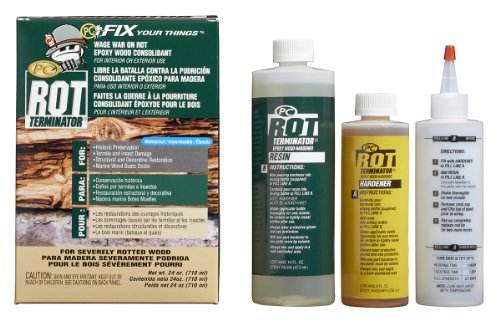
1. PC-Rot Terminator Epoxy Wood Hardener 24oz
Our pick — 4.5+★ from 350+ verified ratings; the strongest balance of quality and price.
Two bottles, one hour of work time, and a slab of Honey Locust that came back from the dead.
The number that decides your afternoon here is 60 minutes — that is how long the mixed epoxy stays workable, so you can saturate a big sill or a wide slab without the liquid gelling halfway through. It is a low-viscosity liquid, meaning it is thin enough to travel down into the grain and seal gaps deep inside the wood rather than sitting on the surface. The two-part kit ships as 24 ounces split across two bottles, which is a genuinely generous amount for a homeowner-level repair.
What wins people over is plainly the effectiveness of the thing — it is the quality that dominates owner feedback by a wide margin, with durability trailing behind it. The scene that keeps coming up is salvage: a deeply rotted slab that would otherwise go in the burn pile, treated and then turned into a finished tabletop, and the reviewer’s own words are that it “worked better than I hoped.” The service temperature range of -20 to +200 degrees F is another quiet advantage, because a repaired window frame or exterior post keeps its integrity through a hard freeze and a hot summer without re-softening.
Set your expectations on the schedule, because this is where opinions split. Full cure is listed at 61 minutes, yet owners routinely describe the surface taking far longer to harden right through — the customers-say read on this product literally describes the drying time as mixed, with decayed wood going hard like stone but a full two days passing before it feels completely done. On thick or dense wood, drilling small infiltration holes and adding gentle heat is the difference between a surface skin and a real, deep cure. Prime, paint, or stain once it has cured and the repair disappears under finish.
What earns the top spot
- 60 minutes of work time gives you room to saturate a large repair in one mix instead of rushing.
- Low-viscosity liquid reaches gaps deep in the grain, which is what actually stops rot spreading.
- Handles -20 to +200 degrees F in service, so exterior sills and posts stay solid through freeze and heat.
- Two 12-ounce bottles means enough volume for a real project, not just a test patch.
Where it asks for patience
- Full hardness can take far longer than the stated cure time on dense or thick wood.
- Dense species respond much better with drilled infiltration holes and a little heat.
- It is a stabilizer, not a filler — hollow voids still need an epoxy paste afterward.
Go for it when: you have soft, punky wood that still has body and you want to save the piece rather than replace it.
Plan around this: give the repair a couple of days before you sand or paint, especially in a cool garage.
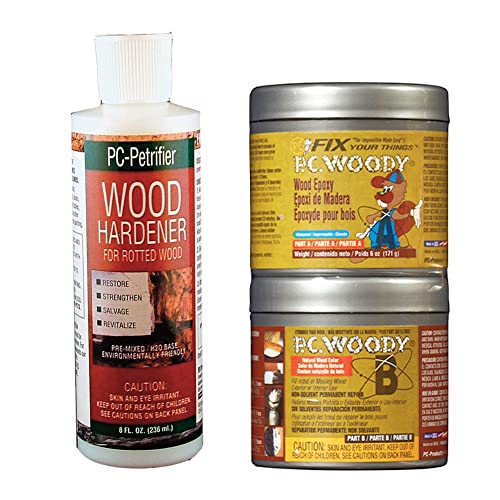
2. PC-Woody 6 oz and PC-Petrifier 8 oz
The one that solves the whole job: liquid to soak the rot, paste to rebuild what’s missing.
Most rot repairs are actually two problems wearing one coat of paint. First the fibers go soft, then a chunk goes missing entirely. This kit pairs an 8-ounce bottle of PC-Petrifier — a water-based wood hardener that soaks into rotted sills, frames, beams, columns, and trim — with a 6-ounce tub of PC-Woody, a two-part epoxy paste for replacing the wood that has already crumbled away. You treat with the liquid, let it set, then trowel in the paste and shape it.
The paste is the forgiving half. It mixes at a simple 1:1 ratio, holds its shape without sagging much, gives you 20 to 30 minutes of work time, sands easily, and takes paint. It handles like stiff play-dough straight from the tub, pressing into cracks and voids by hand — the spreaders in the box do the rest. Homeowners have used it on swollen, broken MDF cabinet frames and on a rotted eave corner, and in both cases the repair finished harder and sturdier than the surrounding material. An owner who used it on a kitchen counter frame described the result hardening “like cement.”
Here is the part the label will not tell you. The Petrifier protects and holds rotten fibers together, but it does not add structural support on its own, and on a genuinely soft spot it can be hard to tell whether the liquid did its work or the paste carried the repair. Mixing thick paste in a cold garage is also the most common frustration — the viscosity climbs and stirring gets stubborn. Warm the tub first and measure carefully before you start. Skip this one if you need a stain-grade clear finish, because the paste dries to a pale, near-whitish tone.
The value read: you are getting two different tools for one repair — the liquid goes deep where the paste cannot reach, and the paste rebuilds what the liquid cannot replace. Buying those separately is the usual path, and this bundle skips the second order. It also cleans up more kindly than solvent-based epoxies: the hardener washes out with water, the paste with acetone.
The honest caveat: keep it away from intense heat once cured — around 170 degrees F it softens and turns rubbery, so it is a poor choice under a dark-painted surface that bakes in direct sun.
Pick this if: the damage is a mix of soft wood and missing wood, like a window sill corner or a counter frame edge.
Look elsewhere if: you need a clear finish that accepts stain — the paste is not made for a stained look.
3. LiquidWood Epoxy Wood Consolidant
A water-thin consolidant that gravity can help you — pour from the top and let it sink into the grain.
Window sash, door frames, columns, posts, and antiques are all vertical surfaces, and vertical surfaces punish a thick product. LiquidWood is deliberately runny, so it streams down into damaged fibers rather than puddling at the top. It is sold as a 6-ounce Part A plus a 6-ounce Part B and cures to a solid that is shrink free, meaning the repair does not pull away from the surrounding wood later and leave a gap for water.
Owners on vertical jobs have found their own workarounds for the runniness: syringes and a cheap brush, worked in rather than squirted, so the liquid gets delivered exactly where the wood is punky. It also finishes invisibly — once cured it is smooth and hard, takes paint, and disappears into the surrounding board. What frustrates people is temperature. Curing slows sharply under 65 degrees F, and it may not cure at all below 50, so a cold-climate outdoor repair in winter is the wrong job for this bottle. Do that work in a warm shop or wait for spring.
Why it earns a place: for a rotted window sash or a porch column, the liquid’s thinness is the whole point — it reaches depth a brush-on paste never will. Buyers keep coming back to it, and one repeat customer’s note says as much: “This is a repeat order with two earlier orders.”
The trade-off to know: thin and slow in the cold. Give it real drying days in a cool space, and plan on a second application on really porous, spongy wood.
Reach for this if: your rot lives in a door frame, window sash, or post and you can pour from above.
Hold off if: your workspace will be below 50 degrees F for the next few days.
4. Boat Life Git-Rot Penetrating Epoxy Kit, 4-Ounce

Four ounces for the rot you can’t see — drill, inject, and let it chase the soft fibers down.
Some rot lives behind a fiberglass skin or under a floor you cannot lift. Git-Rot is built for that scenario: you drill small holes into the affected area, inject the liquid, and top off the holes repeatedly while it soaks in. The 4-ounce kit is small on purpose — you are treating pinpoint voids, not coating a deck. It works with loose fibers rather than demanding a clean, solid surface, which is rare among consolidants.
Owners describe filling drilled holes through a fiberglass layer and waiting ten to fifteen minutes between top-offs as the liquid disappeared into the wood, then finding the section solid the next day. Another used it on a rotted face board under a gutter and finished the job with body filler, sanding and painting until the patch vanished — the alternative was pulling the whole board. The one hard rule is dryness: this product will not displace water, so the wood has to be dry before you inject or the epoxy just floats.
Two gripes come up honestly. The kit does not include a mixing or injection container, so budget for a syringe or squeeze bottle before you start. And the price-per-ounce is the least generous of the liquids here — fine for a small, precise injection job, wasteful if you are treating a long run of trim. Git Rot’s own reviewers call it effective and worth the spend when the alternative is major demolition.
Where it shines: precision. A drill bit plus a syringe reaches rot that no brush ever touches, and the repair stays hidden under the existing surface.
What to add to the cart: a blunt-needle syringe set. Without one, this four-ounce bottle is awkward to place.
Suited to: floorboards, transoms, and structural corners where the rot is sealed behind another layer.
Not for: broad surface coating on a big deck — four ounces goes fast on open wood.
5. RTG Supply Co – Wood Rot Repair Epoxy (Pint)

A full pint of odor-free two-part epoxy built for the deck joists and posts you’d rather not replace.
This is the pick for structural wood — deck beams, joists, trusses, railings — where the repair has to hold a load and then survive the weather. RTG’s formula is 100% waterproof once cured, which matters on an exterior deck far more than on an indoor trim piece. It pours as a clear, low-viscosity liquid that soaks into soft fibers, and the maker states that cured wood can be sanded lightly and then primed, painted, or varnished. There are no VOCs and no odor, so a garage or basement repair does not gas out the house.
The pattern across owner experience is patience. Full cure is listed at 2 days, and decks are the recurring story: a cedar deck with rot at the joints, a 35-year-old redwood deck whose supporting trusses had gone mushy. Drilling holes to give the liquid somewhere to travel, then applying generously until the wood stops absorbing, is the technique that works — one owner described brushing it until “wood wouldn’t absorb more.” Painting over the cured repair, often a few days later, gets good adhesion and can spare you replacing whole boards.
Two honest notes before you buy. On badly delaminated or thick material it can stay tacky for a couple of days before it locks up solid, so do not panic on day one. And if you plan to stain rather than paint, the epoxy seals the grain it touches, so extra sanding around the repair is needed to avoid a color mismatch. The pint size suits a focused deck fix rather than a whole-deck refinish.
Why deck owners pick it
- 100% waterproof cure, which is the spec that actually matters on exterior lumber.
- No VOCs and no odor, comfortable for indoor trim work in a closed room.
- Low-viscosity liquid travels into joint rot rather than sitting on the surface.
- A full pint stretches across multiple boards and posts.
Keep in mind
- Staining afterward means sanding well past the repair to blend the color.
- Thick or delaminated wood can stay tacky for two days before it cures hard.
Made for: the homeowner staring at a soft deck joist who wants to stabilize it without a full rebuild.
One thing to budget: time — treat it, walk away, and paint a few days later.
6. TotalBoat Clear Penetrating Epoxy Wood Sealer 1.5 Pint
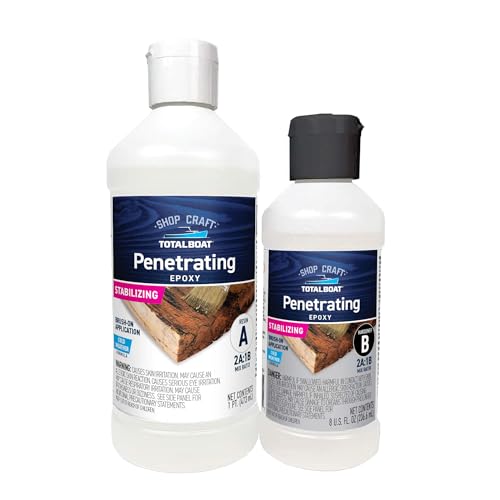
Formulated for the 40 to 65 degree range, so a cold garage no longer stalls your repair.
Most epoxies slow to a crawl in a chilly workshop, and that is exactly the problem this blend solves. TotalBoat sells two versions: a regular penetrating epoxy for 65 to 90 degrees F and this Cold Weather formula for 40 to 65 degrees F, with an explicit warning not to use the cold version above 65. If your repair window is a fall weekend or an unheated garage, that distinction is the whole reason to pick this bottle. The rest of the chemistry is a simple 2 parts resin to 1 part hardener, with soap-and-water cleanup.
It seals and hardens the wood and gives paint and varnish a better surface to grab onto, so the finish holds instead of peeling a year later. Softwoods, hardwoods, plywood, OSB, particle board, live-edge slabs — the maker lists them all as fair game. Owners have thinned it with denatured alcohol for deeper absorption into marine plywood and gotten visibly better penetration, then found it sanded and painted cleanly. A boat owner repairing a rotten engine hatch described the result as “not solid as a rock” but genuinely penetrating, since absorbing into the wood is the goal, not building a crust on top.
The patience tax is real. Full cure is listed at 4 days, and owners working in cold conditions report the repair still tacky well into the next day. Follow the mix ratio exactly — off-ratio batches in a cold shop are the usual no-cure culprit. Once cured, the film stays slightly flexible, which is a plus on a trailer deck or a spot that moves with temperature. If your repair has to be sanded and painted within 24 hours, this formula will hold you up.
What stands out: the temperature band. The 40–65°F band is the point: this formula cures in a cold garage where standard 65–90°F epoxies stall.
What it costs you: days. Plan the job for the start of a week, not the night before a party.
The right bottle if: your repair happens in a cold garage, a fall deck project, or an unheated shop.
Do not push it: above 65 degrees F this formula is the wrong choice — switch to the regular version.
7. Abatron LiquidWood 2 Pint Kit

Built for the repair that has to be permanent, with a 30 to 45 minute working window and 24-hour cure.
This is the consolidant you reach for when the wood is load-bearing and the fix needs to be structural, not cosmetic. It is a 2-pint kit — Part A resin plus Part B hardener — and the pot life runs 30 to 45 minutes, so a small repair can be mixed and brushed within one window without waste. Treated wood hardens a few hours after application, with a 24-hour full cure listed. It is Greenguard certified and formulated with almost no VOCs, so the smell stays mild in a closed room.
LiquidWood is popular on windows, doors, trim, columns, and posts, and it pairs with the brand’s WoodEpox compound for making permanent, shrink-free repairs. The story that sells it best is beam work: a century-old home where carpenter bees had hollowed out 6×6 gable beams into shells, drilled through the entry holes, plugged at the bottom, then filled from the top with LiquidWood, and the beam went from crushable to solid overnight. Another owner, a retired 45-year contractor, praised the slow set because it lets the epoxy absorb into the wood cells before it hardens, unlike fillers that crack out within a year. That slow set is deliberate: it lets the epoxy soak into the wood cells before hardening, unlike fillers that crack out within a year.
Its biggest limitation is thickness. On very punky, open-grained wood, the liquid can be too thick to absorb, and adding a second coat may not help — adding a thinner or choosing a low-viscosity formula is the better move. On a vertical face, thin and runny means drips, and the container is not pour-friendly, so a brush or syringe is a smarter applicator. At 24 hours the surface typically cures overnight even in high humidity and dries clear and glossy, ready for paint.
Where it justifies the premium: the slow, deep absorption is the point. It cures to a waterproof structure inside the wood rather than a film on top, built for structural repairs meant to outlast the original wood.
The honest limitation: it is not a thin, chasing liquid — on really porous soft wood, absorption is the weak link, not the cure.
For the patient restorer: antique furniture, structural beams, and window frames where a permanent repair beats replacement.
Not the first pick if: the wood is spongy and thirsty — a thinner formula covers that ground better.
8. System Three Resins Rotfix 24-Ounce
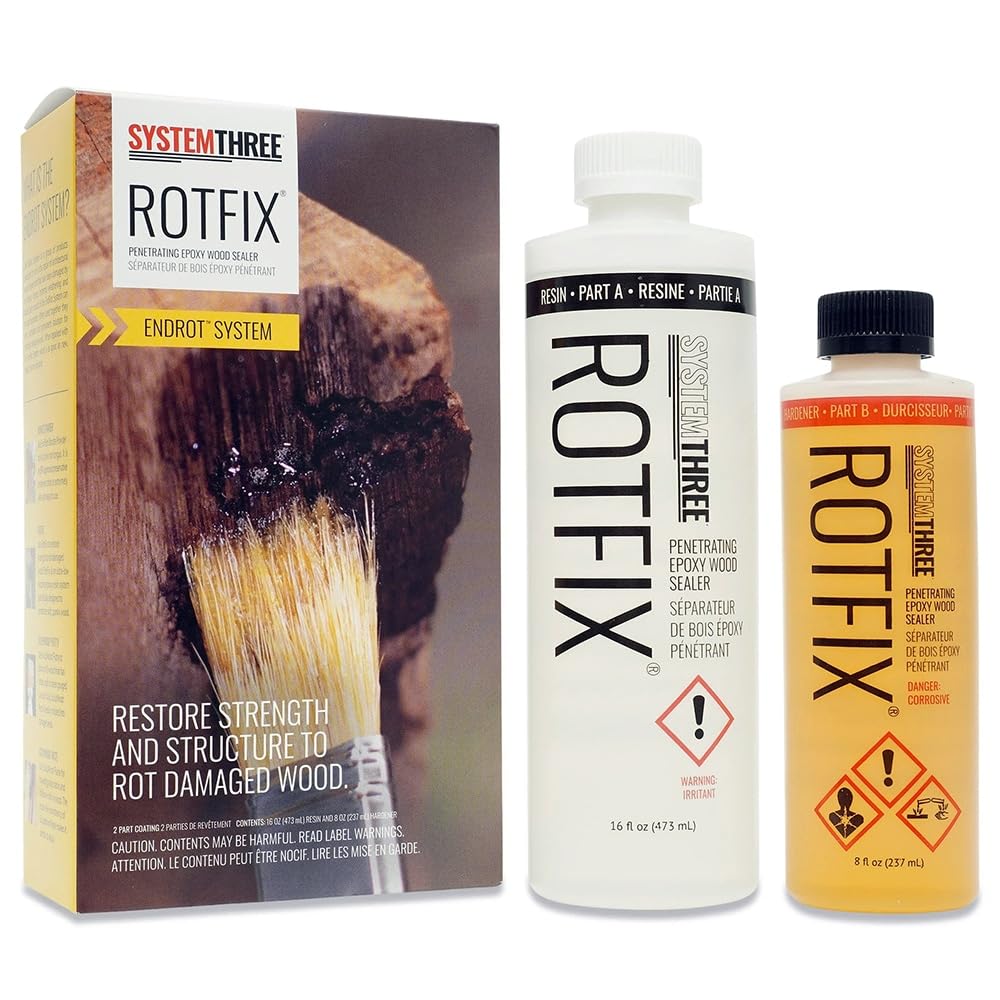
A 24-ounce pour for the big, water-thin job — decks, cores, and subfloors that soak up volume fast.
RotFix is a low-viscosity sealer, primer, and consolidant all in one bottle, and the 24-ounce kit includes a measuring and application bottle so you can pour precisely instead of guessing at the mix. That matters because the ratio is 1:2, and off-ratio batches are the most common reason an epoxy stays sticky. It is designed to flow into deteriorated and rotted wood, creating a sound, waterproof base for a filler putty to sit on afterward. Full cure is listed at 72 hours, the most patient schedule on this list.
The applications owners describe are big and awkward: a 1937 window frame, a water-damaged subfloor, a rotted balsa deck core on a 1973 Chris Craft, where two 24-ounce kits filled every drilled hole and turned the deck rigid again. None of that would have happened with a four-ounce bottle. The squeezable bottle forces epoxy into tight cavities, and the 24-ounce size means you are not mixing four separate batches under pressure.
Two things to plan around. This is a thin consolidant, not a filler, so deep holes need epoxy paste after the liquid cures — and on badly rotted spots, let the putty set for a day or two before treating, or the liquid will turn it into a sludgy mess. Temperature is the other variable: at around 70 degrees F it cures on schedule, but in a 50 to 60-degree shop it can take nearly two days to stop being tacky. A few buyers have reported missing mixing bottles in the box, so confirm the bottle is there when it arrives.
Where the 24 ounces pay off
- Included measuring bottle makes the 1:2 mix ratio easy to get right.
- Water-thin flow reaches deep crevices in cores, sills, and subfloors.
- Creates a waterproof base that filler putty and paint can bond to reliably.
- A single kit covers a job that would otherwise need three small bottles.
Worth knowing before you pour
- 72-hour listed full cure, and in a cold shop it can stay tacky for days.
- It is a sealer, not a void filler — plan on epoxy paste for missing wood.
- The measuring bottle has occasionally gone missing from the box.
The big-job pick: deck cores, subfloors, and the large pours where mixing one batch beats mixing six.
Better choices exist if: you need a repair paced to a single afternoon — this one wants 72 hours.
Know the Specs
Viscosity and Penetration
Viscosity is how thick or thin a liquid is — think of how honey creeps versus how water runs. A low-viscosity hardener flows into soft grain and down into tiny voids. A thick one stays near the surface and fills rather than soaks. If the rot is a soft spot in solid wood, choose thin. If a chunk is missing, you need a paste on top after the liquid sets.
Pot Life and Full Cure Time
Pot life is your working window once the resin and hardener are mixed — the time before the liquid gels and becomes useless. Full cure is how long until the wood is fully hard and safe to sand. Those are very different numbers, sometimes an hour apart and sometimes days. Plan a repair around the cure time, not the working time, because that’s what locks the schedule.
Application and Service Temperature
The application range tells you the temperature the room or work area needs to be in for the epoxy to cure correctly. The service range tells you what temperature the cured repair tolerates afterward. A repair that cures fine can then survive far hotter or colder conditions once set. Cold can stall the cure entirely, so check your workspace temperature before you mix, not after.
Kit Volume and Mix Ratio
Kit size tells you how far the bottle stretches — a four-ounce bottle treats pinpoint spots, while a pint handles a whole deck section. Mix ratio is the resin-to-hardener proportion, and getting it wrong is the top cause of a sticky, never-curing mess. A kit with an included measuring bottle makes this easy. If you need to fill voids, plan for a paste as well.
Common Questions
Can I use a wood hardener on wood that’s still wet?
What’s the difference between a consolidant and an epoxy paste?
Do I need to drill holes in the wood before applying a hardener?
Can I paint or stain over a cured wood hardener?
How long does it take before I can sand the repair?
Will a wood hardener stop rot from spreading?
Do I need a mask or ventilation for these epoxies?
Can I use a wood hardener on a boat or outdoor deck?
Will the hardener make the wood as strong as new?
What’s the difference between PC-Woody and PC-Petrifier?
The Bottom Line
For most rot repairs, the winner is the PC-Rot Terminator because it combines a 60-minute working window, a low-viscosity liquid that reaches deep into the grain, and enough volume in two bottles to finish a real project. The PC-Woody and PC-Petrifier kit is the one to grab if your damage includes a missing chunk, since it pairs the liquid hardener with a paste that rebuilds the void. And if the repair lives in a cold garage or a fall weekend, the TotalBoat Cold Weather formula is the bottle that will actually cure in those temperatures.
Two things decide how these jobs turn out, and neither is on the bottle label: the wood has to be dry before you pour, and you have to respect the cure time instead of sanding early. Match the formula to your repair’s shape and your workspace’s temperature, and the repair will outlast the board you saved.
How we choose
We do not accept paid placement. Every pick is matched to a real buyer and a real use-case; we do not hands-on test units.
Sources
Specifications: manufacturer listings and product documentation. Review insights: verified customer reviews, as of October 2026. Pricing: not shown on this page (it changes often); check the current price via the retailer link.
As an Amazon Associate, Home Digitized earns from qualifying purchases. This does not affect which products we feature.