
Specs are compiled from manufacturer listings and verified buyer reviews and can change over time — please confirm the key details on the product page before buying.
Buying zero gauge wire is really a question of what the wire is made of, because a thick jacket can hide a thin conductor. The right pick depends on whether you are feeding a starter, an amplifier, or a solar bank — and pure copper versus copper-clad aluminum (a cheaper aluminum core with a thin copper skin) changes everything about heat and voltage drop.
This guide is built by comparing the manufacturers’ published specifications and the patterns across verified customer reviews, so you get each pick’s real strengths and trade-offs instead of marketing spin.
What follows is a shortlist built on real buyer experience, from welders and RV owners to car audio installers. Here is what separates a genuine 1/0 AWG copper cable from a rebadged imposter, so you pick a zero gauge wire that carries current without cooking itself.
Top Picks
How To Choose The Best Zero Gauge Wire
Gauge is not a style choice — it is the physical thickness of the metal that has to swallow whatever current your starter, winch, or amplifier throws at it. Zero gauge (written 1/0 AWG) is the biggest cable most DIY electrical jobs ever call for, and that is exactly why sellers get creative about what is actually inside the jacket.
Copper versus copper-clad aluminum
Pure copper carries more current per strand and resists corrosion better at terminals. Copper-clad aluminum (CCA) wraps an aluminum core in a copper skin; it is lighter and cheaper, but it runs warmer and is a weaker choice for heavy continuous loads like a starter or a big inverter.
Verify the gauge before you buy
A true 1/0 AWG conductor should measure close to the published stranding and diameter for that size. If the listing never shows strand count, outer diameter, or copper thickness, treat the “0 gauge” label as unverified. Buyers who skip this step often end up with a cable that fits 2 AWG lugs instead of 1/0.
The right jacket for the job
Flexibility matters more than people expect. A welding-style rubber jacket bends around corners and tight runs; a stiff PVC jacket fights you on every turn. Look for solvent resistance and a wide temperature range if the run passes through an engine bay.
Side-by-Side Comparison
| Model | Best For | Conductor | Length | Max Current | Amazon |
|---|---|---|---|---|---|
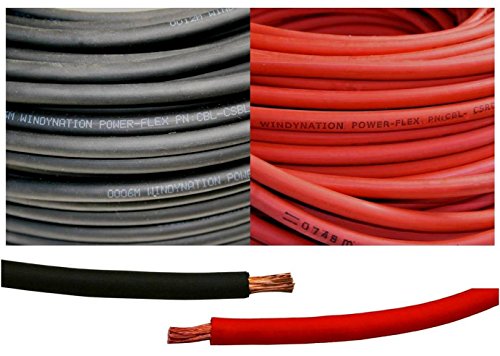
| WindyNation 1/0 AWG Welding Cable★ Best Overall | Best overall all-rounder | Pure annealed copper | 10 ft black + 10 ft red | — | Amazon |
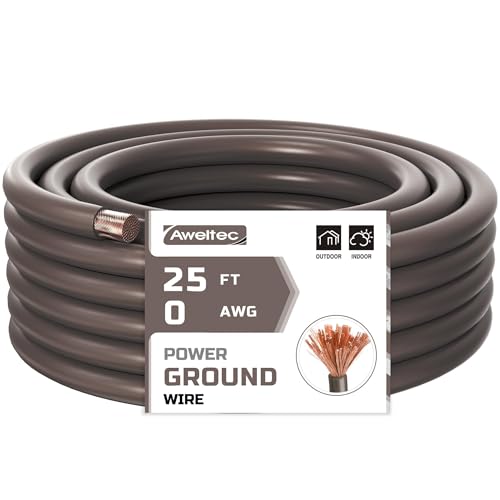
| AWELTEC 0 Gauge 25FT Power GroundBudget Champion | Budget audio & fuse box work | Copper-clad aluminum | 25 ft | — | Amazon |
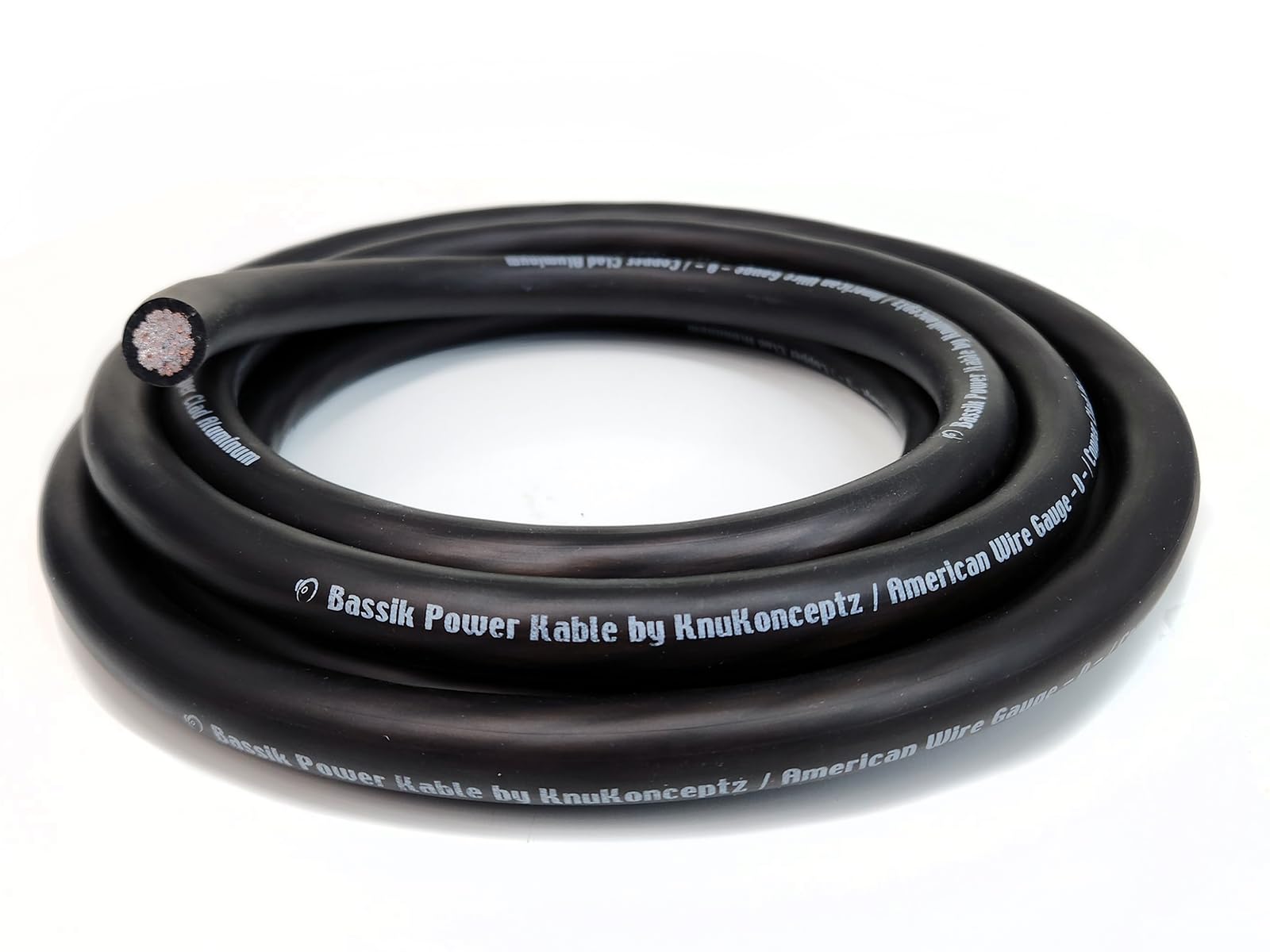
| KnuKonceptz Bassik 1/0 GaugeMost Flexible | Flexible amp runs | Copper-clad aluminum | 25 ft | 200 A | Amazon |
| Ruikarhop 40FT 1/0 Battery Cable Kit | Long battery relocation | CCA | 20 ft red + 20 ft black | 250 A | Amazon |
| Shirbly 1/0 Gauge Welding Cable | Pure copper on a budget | OFC (1703 strands) | 10 ft black + 10 ft red | — | Amazon |
| TEMCo Easy-Flex 1/0 AWG | High-amp audio & truck | OFC (975 strands) | 20 ft red | 285 A | Amazon |
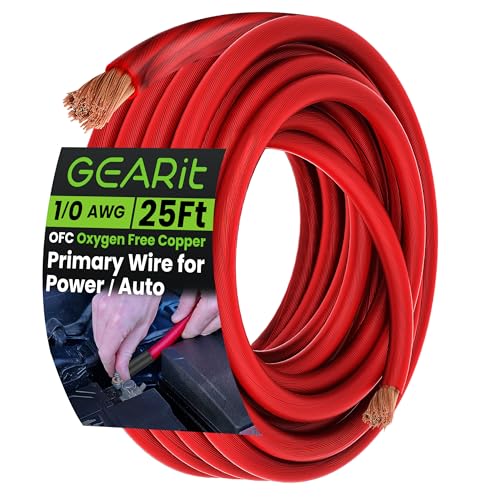
| GEARit 1/0 AWG OFC | Big 3 and battery relocation | Oxygen-free copper | 25 ft red | 300 A | Amazon |
| EWCS 1/0 Premium Welding Cable | Made-in-USA welding lead | Copper (988 strands) | 25 ft black | — | Amazon |
| KeyLine Chargers 1/0 AWG OFC | High-amp dual-alternator builds | OFC | 25 ft red | — | Amazon |
Detailed Reviews
1. WindyNation 1/0 AWG Welding Cable
Our pick — 4.5+★ from 700+ verified ratings; the strongest balance of quality and price.
Two matched ten-foot runs of genuinely annealed pure copper, ready to move heavy current.
You get ten feet of black and ten feet of red in one order — the combination most battery relocations, inverter installs, and solar bank builds actually need. The conductor is fully annealed pure copper and the jacket is solvent-resistant EPDM, a rubber compound that shrugs off oil and stays pliable in the cold.
That copper matters because pure metal carries current with less heat than a copper-clad aluminum alternative. Owners relocating a battery to an RX8 trunk found the 10-foot sections reached a trunk-mounted circuit breaker with length to spare, and the cable bent easily through the run instead of fighting the corners. One buyer who swapped out undersized solar wires that overheated at roughly 2000W reported the 1/0 cable running cool.
The one thing to plan around is length. Ten plus ten is generous for a compact car but short for a long truck or a full-size van run, and one buyer ended up adding a further 5-foot section to finish their job. Know your route distance before you order. Separately, the heavy rubber jacket carries a strong new-rubber smell that tends to air out overnight.
Where it earns its keep
- Pure annealed copper, matched 10 ft black and 10 ft red in one box.
- Very flexible EPDM jacket that bends into tight corners and direction changes.
- 600V rated and covers -50°C to +105°C for engine bay and outdoor solar work.
- Strips and crimps cleanly with standard ratcheting cutters and hydraulic crimpers.
What to plan for
- Twenty feet total falls short on long full-size truck and van runs.
- Fresh rubber smell on unboxing that clears within about a day.
Go with this if: your run is short-to-medium and you want proven pure copper for a battery move, solar bank, or inverter feed.
Measure twice on: long wheelbase vehicles need more than the twenty feet included here.
2. AWELTEC 0 Gauge 25FT Power Ground Cable
Twenty-five feet of copper-clad aluminum that gets a tired car fuse box back in business.
This is the connector for low-stakes electrical work where you want a full 25-foot roll without paying for pure copper. The core is copper-clad aluminum, meaning an aluminum center wrapped in a copper layer — lighter to run and the more economical route for power or ground duties. The translucent PVC jacket lets you see the conductor and color-match your runs, so you know which is positive at the terminal.
Owners replacing 40-year-old fuse-box wiring with it report the car starting and running better immediately. The wire is genuinely flexible rather than stiff, which helps when you are fishing it through a difficult-to-reach channel. Where it shines is feeding amps, subwoofers, and car radios — the lighter gauge and high strand count fit standard 1/0 ring terminals with no voltage loss in ordinary audio builds.
Be honest about the limits. This is not the cable for a starter that pulls a big surge on a lawn tractor, and the insulation is on the thinner side compared with heavy welding lead. Treat CCA as a solid economical choice for speakers and accessories, not for a high-current battery-to-starter run.
Value read: A 25-foot roll of CCA with a translucent jacket for differentiation, backed by a 2-year warranty.
Fit note: Pair it with the job — great for audio and accessories, thin-skinned for constant heavy loads.
Reach for this if: you are wiring amps, radios, or accessory circuits and want length over pure copper.
Look elsewhere if: your load is a starter or other surge-heavy draw that needs a thick copper run.
3. KnuKonceptz Bassik 1/0 Gauge AWG
The amp-run specialist that threads through tight curves without kinking.
KnuKonceptz builds this one for audio installs that snake through door sills and dash panels. It carries a 200A maximum current rating and 10 mm wire diameter, with large-gauge copper-clad aluminum strands that keep the cable light and bendable along the way. The jacketing is flexible enough that routing through a car’s interior becomes a one-person job.
Compared with the AWELTEC above, this is the step up in build consistency and flexibility for audio work, even though both use CCA. In a 2006 Honda Accord amp install, the supplied length covered the run, performance came close to a true 0-gauge benchmark cable, and power delivery beat the 4-gauge it replaced. The cable is available in several pre-cut lengths, so you can match the roll to your vehicle instead of trimming a long one.
The honest catch is the aluminum core. It works, but you should know what you bought — one buyer put it plainly: “It works, i just wish i paid attention and didn’t buy cca.” For amp power feed at this current rating that is fine; for a high-heat continuous load, pure copper still wins.
The wins
- 200A max current rating covers most car audio amplifier demands.
- Very flexible CCA strands ease tight runs and curves.
- Sold in multiple pre-cut lengths to match your run.
- Meets AWG standards for true 0 gauge thickness.
The trade-offs
- Copper-clad aluminum rather than pure copper, so expect more heat under constant load.
- Heavier-duty or high-heat builds should step up to OFC.
Pick it for: a flexible, properly sized 1/0 run feeding an amp or power-ground setup on a CCA budget.
Think twice if: the run will sit under constant high heat where pure copper pays off.
4. Ruikarhop 40FT 1/0 Battery Cable Kit

A complete long-run kit — red, black, lugs, and heat shrink in one box.
Forty feet total (20 feet red plus 20 feet black) is the kind of length battery relocation and long truck runs actually need, and this kit adds matching lug terminals plus 3:1 heat shrink tubes so you do not chase connectors separately. The cable is rated 250A and built from CCA with a rugged flexible PVC jacket and clear red/black polarity identification.
Buyers running RV battery relocations and golf cart lithium setups put the length and flexibility to work, and the routing stays manageable even on a long haul. The included lugs crimp down for a solid connection, though the lug metal is lighter grade — crimp carefully near the wire to keep them from splitting. The flexible jacket makes moving around corners and through panels straightforward.
The real conversation here is the conductor. It is CCA, and one buyer measured the labeled 1/0 as closer to 2 AWG with a copper-coated tin core, which means more heat and loss under very heavy sustained current. For a value-priced long kit that gets a winch or an RV wired, that trade is reasonable. For a high-amp solar bank carrying constant load, expect it to run warmer than pure copper.
What stands out: 40 total feet plus lugs and heat shrink is a genuinely complete relocation kit in one order.
The honest limit: CCA conductor and lighter-grade lugs mean you crimp with care and size it to the load.
Best match for: long battery relocations, winch feeds, and RV runs where you need length and hardware together.
Skip the shortcut if: you need true heavy continuous current through a pure copper conductor.
5. Shirbly 1/0 Gauge Welding Cable

1,703 strands of oxygen-free copper for the welder who is tired of cables that run hot.
The conductor is fully annealed pure copper built from 1,703 strands of 0.2mm wire, wrapped in a solvent-resistant EPDM rubber sheath. That strand count is why the cable bends into any shape you need. It is rated up to 600 volts and covers -58°F to +221°F, with resistance to most solvents and a fire-resistant polyolefin jacket.
Welders notice the difference in the heat. Welders upgrading from leads that got too hot to touch report a smoother arc and a cable they expect to outlast them. The pure copper setup suits DC applications with high-voltage batteries where the maker recommends pure copper over CCA, and it cuts and crimps cleanly for a solid connection.
Twenty feet total (10 feet black, 10 feet red) is the honest constraint — one user wanted more length for their application and stepped up to 15-foot cables instead. As long as your run fits the supplied length, this is one of the strongest pure-copper values in the group.
Why welders like it
- 1,703-strand oxygen-free copper conductor for strong current flow.
- EPDM jacket rated 600V and -58°F to +221°F.
- Very flexible, cuts cleanly, and crimps well for a solid join.
- Matched 10 ft black plus 10 ft red in the order.
Watch-outs
- Twenty feet total can fall short on long vehicle runs.
- You need to size the run before ordering to avoid a second length.
Worth grabbing for: pure-copper welding, inverter, or generator cables where twenty feet covers the run.
Double-check first: measure the distance — long runs need a bigger length than this order provides.
6. TEMCo Easy-Flex 1/0 AWG Welding Cable

A 285-amp oxygen-free copper lead that holds voltage when the bass drops.
This single 20-foot red run carries 285 max amps, a genuine step above the 200A CCA KnuKonceptz and the 250A Ruikarhop kit in this list. The conductor is annealed 30-gauge oxygen-free copper with 975 strands, and the rugged EPDM jacket resists cuts, tears, abrasion, water, oil, grease, and flame.
In a roughly 3500W RMS car audio build, owners saw voltage hold above 14V where the previous 4-gauge OFC sagged to 12V — the stability that keeps an amp fed through long bass runs. It is rated to 600 volts and -58°F to +221°F, and it also works for truck starter cables, winch leads, and RV DC systems. The conductor measures 13.36 mm nominal outer diameter for a tight fit on matching lugs.
It is one color, 20 feet, and single-cable, so you order twice if you need a black ground to match. And because it is high-strand OFC, you want a proper hydraulic crimper and cutoff tool for clean work rather than a cheap hand crimp.
Standout spec: 285 amps of pure OFC in a flame-resistant jacket, ideal for amp and truck-lead duty.
Kit reality: single red run only, so pair it with a second cable and the right crimping tools.
This is your pick if: high amp pull on audio, winch, or starter duty is the job and you want pure copper headroom.
Remember to add: a matching black ground length and a hydraulic crimper before you start.
7. GEARit 1/0 AWG OFC Wire
Big 3 upgrade territory: 300 amps of oxygen-free copper across a full 25 feet.
Here is the highest current rating in the group — 300 amps from stranded oxygen-free copper, not copper-clad aluminum. Twenty-five feet of soft-touch PVC jacket in red lets you route through interiors, trunks, and panels and cut the bulk down to fit. The red insulation marks the positive run for your alternator-to-battery work.
OFC is the reason serious installers reach for this over CCA. Pure copper runs cooler and drops less voltage on long runs, which is what you want for battery relocation, RV battery power, and 12V inverter positive connections. The ultra-fine copper strands also make it pliable enough to thread through a vehicle without kinking.
The price is the trade-off, and the buyers who went this route say it is worth it over the sound-shop markup. You are also ordering a single red 25-foot run, so factor in a separate ground cable and check terminal sizing for your specific project. Verify run length and overcurrent protection as you route — the capacity is there, but the installation still has to be right.
Why the upgrade pays
- 300A max current, the highest rating in this lineup.
- Oxygen-free copper stays cooler and drops less voltage than CCA.
- 25 ft of flexible soft-touch PVC, strips and routes easily.
- Suited to Big 3 upgrades, battery relocation, and inverter feeds.
Before you buy
- Premium OFC pricing runs higher than CCA rolls.
- Single red run — a ground cable and terminal sizing are on you.
Best for: Big 3 upgrades and pure-copper battery relocation where cooler current flow on a long run matters most.
Budget note: if pure copper is not essential, a CCA roll will cost less.
8. EWCS 1/0 Premium Extra Flexible Welding Cable

American-made copper with 988 strands, built to survive sun and water outdoors.
Sunlight resistant and water resistant, this 25-foot black cable is made in the USA with 988 strands of highly flexible 30-gauge copper stranding. It arrives as a coil, and the maker prints and packages it directly to lock in quality. Rated to 600 volts, it suits welding leads, tractor battery cables, and long outdoor runs.
Real copper is the selling point here — buyers run a gauge check and confirm true 1/0 AWG with no tin or impurities in the strands. Dense yet flexible, it bends and carries well, and crimped or soldered ends hold a solid connection over long runs with high amperage. One buyer rebuilt the battery cables on a John Deere diesel tractor with this wire and reported it ran well.
The trade-offs are simple: one 25-foot black run only, no red counterpart in the box, so ground-only or single-run jobs without color coding need a second roll. A few buyers noted their delivered length did not match expectations, so confirm the 25 feet on arrival.
The case for it: true 1/0 AWG US-made copper, sunlight and water resistant for outdoor and marine-adjacent setups.
The catch: one color, one length — plan a second cable if you need matching positive and negative.
Land on this if: you want verified US-made pure copper for a welding lead, tractor cable, or exposed outdoor run.
Order a second roll if: you need a red positive to complete the project.
9. KeyLine Chargers 1/0 AWG OFC Wire
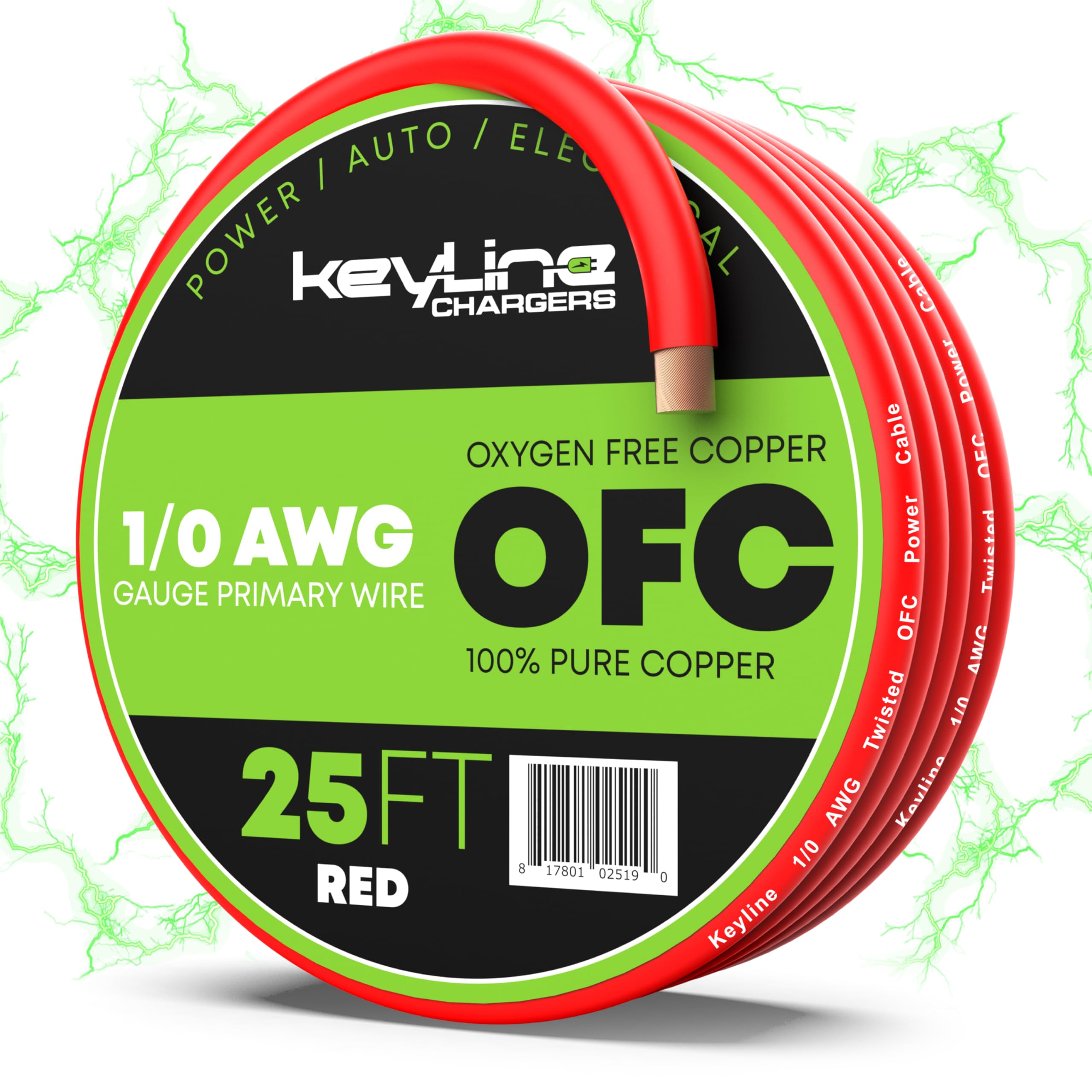
Twenty-five feet of oxygen-free copper that shrugs off 400 amps on a short run.
This is a 25-foot red oxygen-free copper cable for automotive, RV, trailer, and marine wiring — the build where conductivity and minimal voltage drop are the priority. It is designed to handle the strength of a 4/0 welding cable while staying flexible enough to install in tight battery and amplifier spots. The OFC core is what keeps power transfer reliable on long runs.
The heat-resistance claim gets tested hard in real builds. In one dual-alternator setup pushing 400A through a 6-foot run, the cable never overheated, and its jacket survived a 30-second lighter test. A 1/0 lug and AWG checker confirmed it is true 1/0 gauge. It bends more easily than expected, which makes routing and stripping go quickly.
Value is where buyers split. For premium OFC you pay accordingly, and if you compare it against cheaper CCA rolls the higher cost is real — the capacity and heat resistance are what justify it. It is one red 25-foot run, so match a ground cable and size your overcurrent protection before you build.
What it delivers
- Oxygen-free copper for minimal voltage drop and reliable power transfer.
- True 1/0 gauge confirmed when sized against 1/0 lugs and an AWG checker.
- Handled 400A on a 6-foot run with no overheating.
- Flexible and bends more easily than expected for stripping and routing.
Fair warnings
- Premium OFC sits at the higher end on cost versus CCA rolls.
- Single red 25-foot run — add a ground cable and fuse plan.
Made for: high-amp car audio and dual-alternator builds where true OFC and heat resistance carry the day.
Weigh the cost: a CCA roll covers lighter jobs for less if pure copper is not the priority.
Know the Specs
AWG Gauge and True Sizing
AWG (American Wire Gauge) is the numbered sizing system for wire thickness, and a lower number means a thicker conductor. Zero gauge, written 1/0 AWG, is one of the largest sizes most vehicle and solar jobs use. Sellers sometimes label a thinner cable as 0 gauge, so look for published strand count, outer diameter, or a stated AWG compliance before you buy.
Pure Copper versus CCA
Pure copper and oxygen-free copper (OFC) carry current with less heat and less voltage drop than copper-clad aluminum, which wraps an aluminum core in a copper skin. CCA is lighter and cheaper, and it works well for moderate loads like car audio. For heavy sustained current — a starter, a large inverter, or a long solar run — pure copper runs cooler across the whole length.
Common Questions
Is 1/0 gauge the same as 0 gauge wire?
Will zero gauge wire fit my 1/0 ring terminals and lugs?
Should I buy pure copper or copper-clad aluminum wire?
Can I use welding cable for a car battery cable?
How long can I run zero gauge wire before voltage drops?
What tools do I need to cut and crimp zero gauge wire?
Is a rubber welding jacket or a PVC jacket better for engine bays?
Does zero gauge wire work for solar battery banks and inverters?
Why does new zero gauge cable smell like rubber?
Can I mix copper and copper-clad aluminum in the same install?
The Bottom Line
For most buyers, the winning zero gauge wire is the WindyNation 1/0 AWG Welding Cable because it puts together proven pure annealed copper, matched ten-foot black and red runs, and a flexible EPDM jacket rated to 600 volts and -50°C to +105°C. If your job needs serious pure-copper headroom on a long run, the GEARit 1/0 AWG OFC Wire carries a 300A rating across 25 feet. And for a long battery relocation where you want the lugs and heat shrink in the same box, reach for the Ruikarhop 40FT kit. Measure your run, confirm the conductor type, and the right cable becomes an easy decision.
How we choose
We do not accept paid placement. Every pick is matched to a real buyer and a real use-case; we do not hands-on test units.
Sources
Specifications: manufacturer listings and product documentation. Review insights: verified customer reviews, as of October 2026. Pricing: not shown on this page (it changes often); check the current price via the retailer link.
As an Amazon Associate, Home Digitized earns from qualifying purchases. This does not affect which products we feature.