
Specs are compiled from manufacturer listings and verified buyer reviews and can change over time — please confirm the key details on the product page before buying.
If the power drops for three days, the only question that matters is whether your fridge, your well pump, and your heat still run. You do not need the loudest machine on the block. You need one that starts on the first press, has the outlets your house actually uses, and has a track record you can read before you buy. That is what this comparison covers, from a 12,500-watt dual-fuel workhorse to a 12kWh battery bank you can roll into the garage.
This guide is built by comparing the manufacturers’ published specifications and the patterns across verified customer reviews, so you get each pick’s real strengths and trade-offs instead of marketing spin.
What separates a wise purchase here is learning to read running watts versus peak watts, clean inverter power versus raw fuel power, and how much weight you are willing to move. This breakdown is built to help you match running watts, fuel type, and weight to your own outage plan.
Top Picks


How To Choose The Best Generator In The World
Start with the load, not the label. A generator has to cover the running watts of everything you want on at once, plus the surge your fridge or air conditioner draws in the first second. Add up what you actually need before you look at any model. Guessing leads to a machine that browns out your well pump mid-shower.
Running watts, peak watts, and the surge that trips you up
Running watts are the steady load you can pull all night. Peak watts are the short burst a motor needs to start. A compressor like a fridge or AC can draw several times its running load for a moment, so mind the gap. Make sure your peak number clears the total startup draw, not just the steady load.
Fuel choice decides how long you can stay powered
Gasoline is easy to find and burns quick. Propane stores for years without gumming a carburetor, and natural gas keeps running as long as the pipe feeds it. A dual-fuel or tri-fuel engine often buys you more outage hours than a slightly bigger gas tank. That flexibility matters most when a storm keeps you home for days.
Clean power, decibels, and where the machine will sit
An inverter generator conditions the electricity so sensitive electronics like laptops and medical devices are not at risk. Look for a low THD number (total harmonic distortion, the measure of how clean that power is) when you plan to plug in computers. Decibels decide whether your neighbor calls you at midnight, so check the rating at a stated distance. And know your weight limit before you buy, because a heavy unit will not move once it is parked.
Side-by-Side Comparison
| Model | Best For | Running / Peak Watts | Weight | Fuel & Start | Amazon |
|---|---|---|---|---|---|
| Westinghouse 12500 Peak Watt Dual Fuel★ Best Overall | Whole-home outage backup | 9,500 / 12,500 (gas) | 212.1 lb | Gas & propane · remote + electric start | Amazon |
| Champion 4000-Watt Dual Fuel RV ReadyRV Workhorse | RV trips and light home backup | 3,000 / 4,000 (gas) | — | Gas & propane · recoil start | Amazon |
| WEN DF680iX 6800-Watt Dual FuelRV & EV Ready | RV and EV-friendly backup | 5,100 / 6,800 (gas) | 99.2 lb | Gas & propane · electric start | Amazon |
| Jackery Explorer 2000 v2 | Quiet indoor essentials | 2,200W AC output · 2042Wh | 39.5 lb | Electric · solar optional | Amazon |
| EF ECOFLOW DELTA 3 Max | Fast-recharging home buffer | 2,400W AC · 3400W X-Boost · 2048Wh | — | Electric · solar optional | Amazon |
| BLUETTI Elite 300 | RV power in a small shell | 2,400W AC · 4800W surge · 3014Wh | 58 lb | Electric · solar optional | Amazon |
| GENMAX GM13500iETC | Whole-house with natural gas | 11,500 / 13,500 (gas) | 273.7 lb | Tri-fuel · electric + remote + ATS | Amazon |
| OSCAL PowerMax 6000 | 240V split-phase battery backup | 6,000W AC · 9000W surge · 3600Wh | — | Electric & solar · 120/240V | Amazon |
| Honda EM6500SX | Quiet overnight gas backup | 6,500W · 7,000W for 10 sec | 260.1 lb | Gas · electric start | Amazon |
| ERAYAK 4500W Inverter | Camping and small backup | 3,500 / 4,500 (gas) | 54 lb | Gas · manual start | Amazon |
| EF ECOFLOW DELTA Pro 3 (12kWh) | Whole-home battery backup | 4,000W AC · 6000W X-Boost · 4096Wh base | 260 lb | Electric & solar · 120/240V | Amazon |
Detailed Reviews
1. Westinghouse 12500 Peak Watt Dual Fuel Generator
Our pick — 4.5+★ from 800+ verified ratings; the strongest balance of quality and price.
Nine thousand five hundred running watts that can carry your whole house through an outage.
The number to anchor on is 9,500 running watts on gasoline, with a 12,500-watt peak to catch every motor start. That is enough overhead to run a 100-amp home panel and a central AC unit, as buyers report: “Ran whole 100-amp home incl. AC via 50-amp output (gas appliances).” On propane you still get 8,500 running and 11,200 peak, so a storm that outlasts your gas cans does not stop you.
Starting it is the other half of the story. A key fob and an electric start button mean you do not pull a cord in the rain, and the engine carries automatic low-oil and carbon monoxide shutdown. Performance is what wins people over here — it started right from the start and ran homes and 41-foot trailers in the reviews, and the auto shutoff is a quiet reason to trust it overnight. The catch is size: at 212.1 pounds and 27.2 inches long, this is a parked machine, not a carried one.
Fuel flexibility is where it earns its place. A 6.6-gallon tank gives up to 12 hours of run time with a fuel gauge on the panel, and a 457cc engine with a cast iron cylinder sleeve is built for repeat use. It is loud enough that you will want it away from a bedroom window, and the box arrives as a heavy freight delivery. Plan the shed or covered spot before it lands.
Where the Westinghouse wins
- The 12,500-watt peak clears an AC start without flinching.
- Dual fuel switching keeps you powered when gasoline runs out.
- The CO sensor shuts the engine off before fumes build.
What you accept for that power
- At 212.1 pounds, moving it needs a cart or two people.
- Noise arrives on the panel too, not just at the exhaust.
Reach for this if: you want one machine that can shoulder a whole-home panel on either gasoline or propane.
Look elsewhere if: you cannot dedicate a permanent spot to a 212-pound unit.
2. Champion 4000-Watt Dual Fuel Inverter Generator
A 4,000-watt inverter that runs a 15,000 BTU RV air conditioner without waking the campground.
This one gets its start in the reviews on performance and reliability, both of which come up most often for a machine that hides behind the work. It gives 3,000 running and 4,000 starting watts on gasoline, and drops to 2,700 running with up to 25 hours on propane. The 64 dBA rating at 23 feet is a normal conversation volume, which is why people boondocking with it stop worrying about the neighbors.
Clean power is where it turns into a house tool. The unit emits less than 3% THD, meaning it conditions the electricity enough to plug in a TV, a PC, or a router and a fridge at the same time. A 120V 25A TT-30R outlet and a 5-20R duplex port with a 12V automotive outlet cover most RV and home-camp needs. Run time lands around 8 to 10 hours under a regular load, so an overnight stretch usually means one refuel.
The honest trade-off is weight, and it shows up in reviews as a “barely portable” feeling. Some units need a second propane press before the fuel runs cleanly, and one 4,000-watt owner found it louder and heavier than smaller dual-fuel Champions in the same family. All of that is manageable for a weekend camper rather than a defect.
The case for it
- Up to 25 hours on propane stretches a single bottle into a full camping weekend.
- Clean inverter power keeps electronics safe while you run the AC.
The honest caveat
- Around 52 pounds means two hands for loading, not one.
Best for the camper van: anyone who needs a 30-amp RV plug and quiet AC running at a campsite.
Not for the whole-house plan: 3,000 running watts covers essentials, not a full panel.
3. WEN DF680iX 6800-Watt Dual Fuel Inverter Generator
A 240-volt inverter that can top up an electric vehicle and still run the trailer.
The bonded-neutral 240V setup is the defining feature here, giving low-power Level 2 charging for battery and hybrid vehicles. That makes it one of the few portable units that can serve as a travel charger without being tied to a wall. Gasoline delivers 6,800 surge and 5,100 rated watts, while propane gives 6,000 surge and 4,500 rated. A fuel shutoff runs the carburetor dry at the end of a session, which keeps maintenance down between outages.
Running it is a two-handed job at 99.2 pounds, but the wheels and telescoping handle do the work once it is on the ground. Owners mention electricity reaching two 15,000 BTU AC units through the 30-amp plug while on propane, and auto-start fires without a pull cord. The WEN Watchdog CO sensor is the safety backbone: it cuts the engine when carbon monoxide climbs. A 224cc dual-fuel engine powers all of it.
You should know it drinks fuel under load, and one owner reported a surging issue after an overnight RV run. The stabilizers on the base can catch a vinyl floor, and a few owners find the unit will not slide into a passthrough storage bay. Read the fault as a reminder to keep the oil and air filter clean and use a covered spot.
Why buyers rate it: the power bridge from gas to a 240-volt panel, plus the ability to charge an EV, is a combination most competitors in this class cannot offer.
What it costs you: 99.2 pounds and a fuel appetite mean you plan where it lives before you buy it.
The 240V pick: a strong match if you charge an EV on the road or power a split-phase panel.
Think twice if: you want a one-hand carry for quick campsite setup.
4. Jackery Explorer 2000 v2 Portable Power Station

2,042 watt-hours of battery power with no exhaust, no fuel, and 39.5 pounds to carry.
What wins people over with the Jackery 2000 v2 is quality and charging speed in equal measure. A 2,042Wh LiFePO4 battery feeds three AC ports rated for 2,200W total, and the USB-C PD port pushes 100W to a laptop or phone without an extra brick. Charge it from empty to 80% in 66 minutes on AC, or use the Emergency Super Charging mode through the app for a full charge in 102 minutes. Solar input tops out with 400W panels in as few as 6 hours.
If you have been eyeing a gas generator, the comparison matters: 39.5 pounds against a 212.1-pound Westinghouse is the difference between moving your backup into the kitchen by yourself and needing a second person. It runs silently at under 30dB in Silent Charging mode, so it sits inside the house without fumes or noise. The 20ms UPS switchover and a UL1778 certification mean electronics stay on during a flicker.
The trade-off is total energy, not a defect. It will not run central AC or a whole home. A heavy-load test turned up more drain than some buyers expect under a constant low-wattage draw, and 2,042Wh is a fixed ceiling with no battery expansion. For fridges, internet, lights, and devices, that is a solid day of coverage and the right tool.
Where it stands out: a 2,042Wh LiFePO4 pack that recharges in 66 minutes is faster than most buyers on gas can manage a refuel and restart.
The real ceiling: no expandability beyond 2,042Wh, and heavy loads drain faster than the spec suggests.
Pick it for: quiet indoor backup for essentials, and camping where a gas engine is not welcome.
Pass if: your plan hinges on running a central AC or a well pump.
5. EF ECOFLOW DELTA 3 Max Portable Power Station
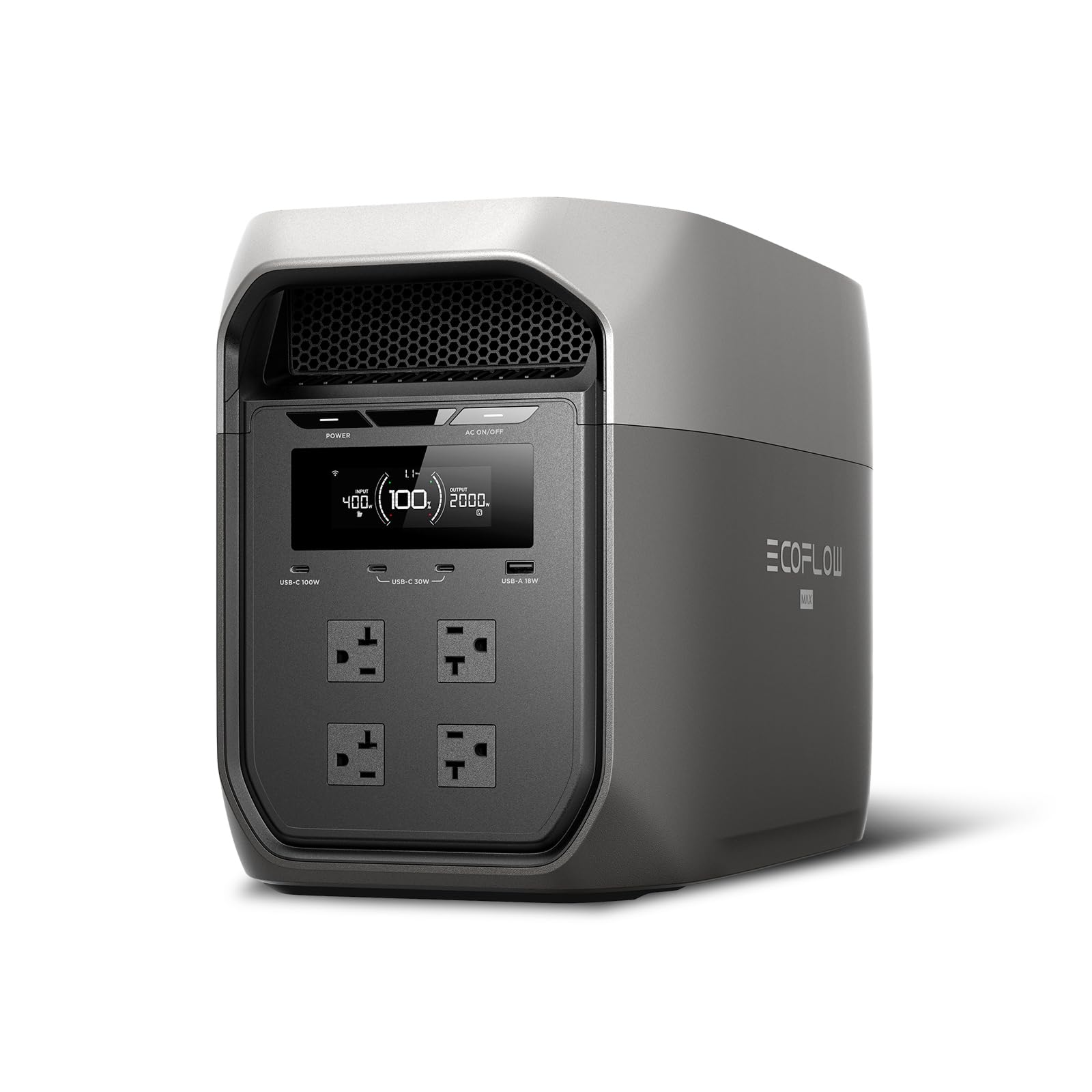
A 2,048Wh battery that refills to 80% in 1.13 hours and hides behind a 3400W surge.
Value and charging speed are the two things that draw the most praise to the DELTA 3 Max. A 2,048Wh LiFePO4 pack charges 0 to 80% in 1.13 hours on EcoFlow’s X-Stream system, which is a top-up that fits inside a lunch break. The X-Boost mode pushes 3,400W continuous to start appliances that would normally overload a 2,400W unit. A 10ms transfer switches to battery so fast that computers and routers do not blip.
Where it earns its keep is the dessert-business test: it runs a waffle iron and one or two freezers, with a surge lasting several seconds to start the compressor. Owners have run an Iceco VL45Pro fridge at 36°F for just over five days on a single charge. That quietness at night and a five-year service make it a daily-use tool, not a special-occasion one.
The honest note is weight — this is not a one-hand carry. And the 100W USB-C output is a step below what some buyers want for fast phone charging, though the 2400W continuous AC side handles nearly everything else. If you need to power a whole panel, this is a buffer, not a replacement for a large gas generator.
What it delivers
- 0 to 80% in 1.13 hours means less waiting on a storm night.
- 3,400W X-Boost starts tools and microwaves that trip smaller stations.
Where it stops short
- The 2,048Wh cap is fixed — there is no battery stacking on this one.
For the fast-paced household: it fits when you want a battery that refills almost as fast as a gas can.
For the whole-house plan: look at the larger DELTA Pro 3 below instead.
6. BLUETTI Elite 300 Portable Power Station
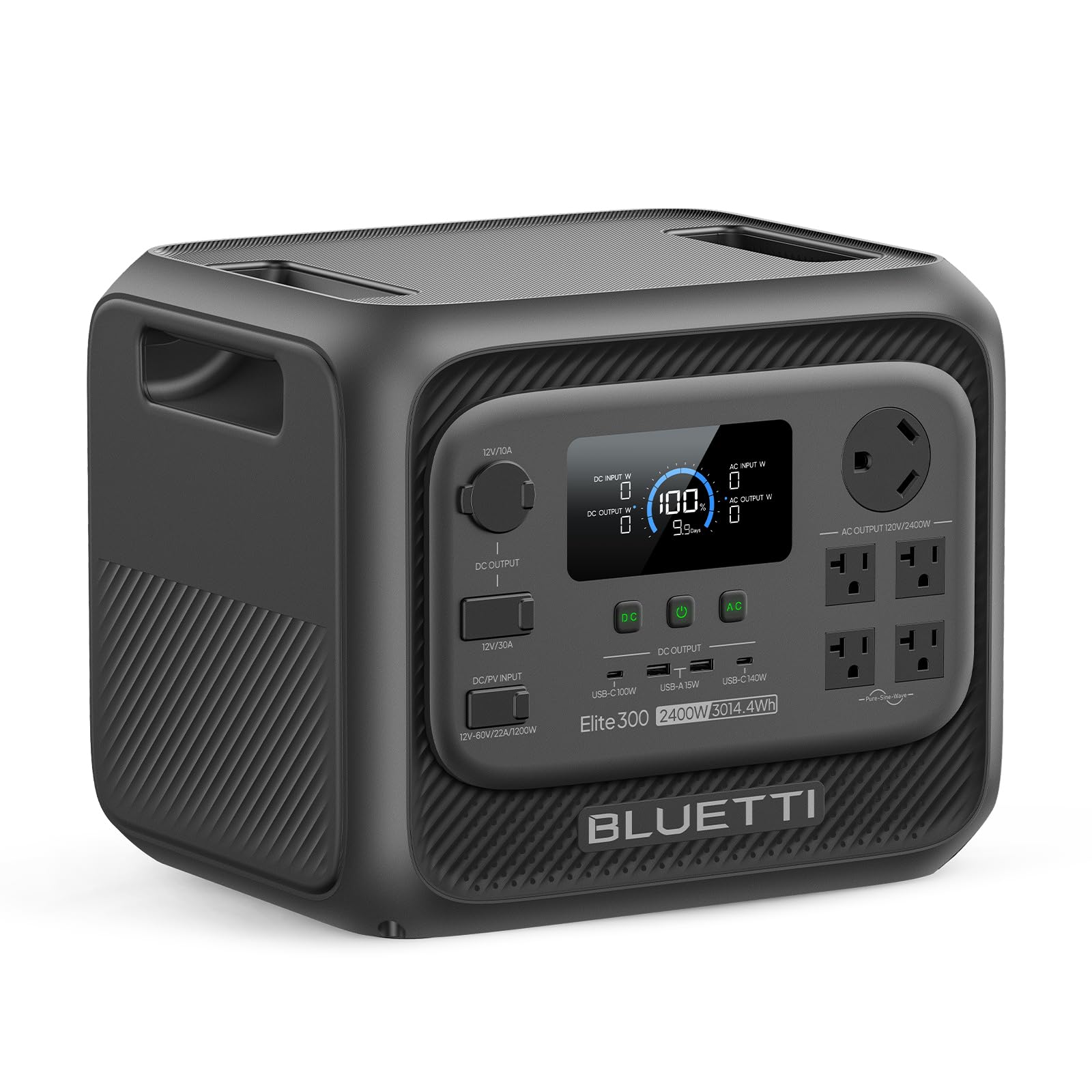
A 3,014Wh battery in a shell built for camper vans and RV shore power.
Charging speed and battery capacity are the twin draws here, and both live up to the numbers. A 3,014Wh LiFePO4 pack charges 0 to 80% in as fast as 78 minutes, so a lunch stop refills the bank. The 2,400W continuous output with a 4,800W surge starts kettles and resistive loads, and the 6000+ cycle rating on the cells is the reason people trust the brand on an RV wall.
The 30-amp TT-30 port and 12V/30A DC output are why this is an RV pick rather than a home pick. It runs RV air conditioners, 12V fridges, water pumps, and diesel heaters — the pieces that matter when boondocking for a weekend. A 10ms UPS switch keeps a home office or router on through a glitch.
The recurring trade-off is weight at 58 pounds and a solar input capped at 60 volts, which is tighter than some panels are built for. One buyer found an open-circuit panel voltage over the limit and had to configure a smaller array, and a soft-start compressor struggled on the surge. Read the panel specs before you buy them together.
The unique edge: a TT-30 RV outlet and 12V/30A DC output on a battery at 3,014Wh is a pair most competitors do not pair at this size.
The real limit: solar voltage is capped tight, so check your panel’s open-circuit voltage before buying.
Built for the RV: a tight fit for camper-van owners who want shore-style power without a gas engine.
Skip if: you need battery expansion — the 3,014Wh is fixed.
7. GENMAX 13500W Tri-Fuel Inverter Generator
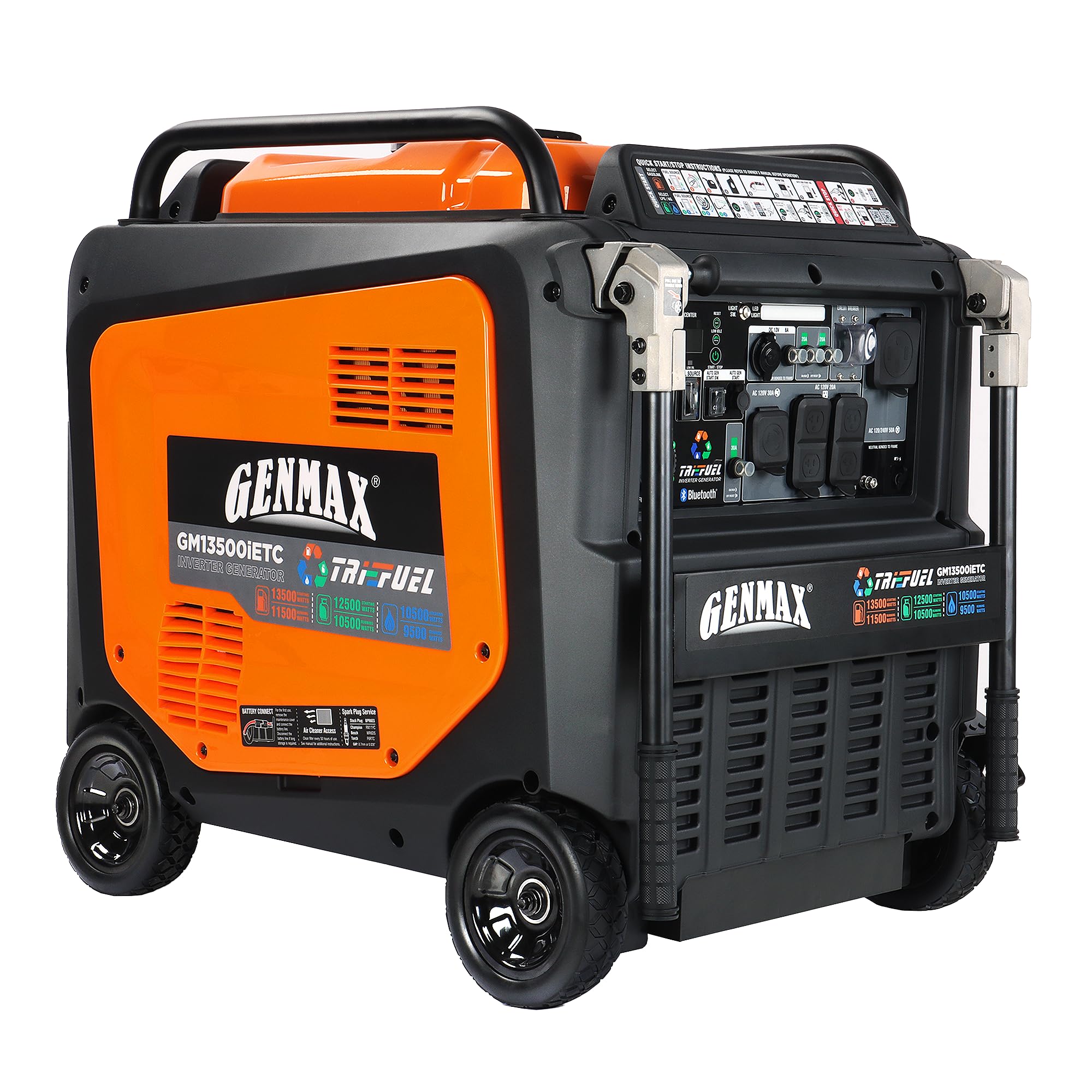
11,500 running watts on gas, 9,500 on natural gas, and five ways to start it.
Quality is the thing buyers keep returning to here, and it sits behind a 550cc engine with a clean sine-wave output at ≤3% THD. On gasoline you get 13,500 peak and 11,500 running watts; propane lands at 12,500 peak and 10,500 running; natural gas gives 10,500 peak and 9,500 running. That third fuel is the standout — a natural gas line can keep the unit running when the gasoline runs dry.
The 5-start lineup covers push-button electric, remote key fob, Bluetooth app, recoil backup, and ATS 2-wire auto-start for unattended home backup. An Eco-Mode throttles the engine down when the load drops, and the noise rating sits at 62 dB(A) at 25% load with up to 11.2 hours on a 6.9-gallon tank. A built-in LED light on the panel means you can see the outlets in the dark.
The honest trouble is service. A few units have shipped with voltage faults on the 240V circuit, and support responsiveness has been uneven on those cases. That is a fit note rather than a pattern — most customers note whole-house power through 4-ton heat pumps. At 273.7 pounds it is a parked machine, not a carried one.
Where it beats a gas-only unit
- Natural gas runs the unit as long as the line supplies it.
- ATS auto-start kicks in without you pulling anything.
- ≤3% THD keeps laptops and phones safe on inverter power.
What to plan around
- 273.7 pounds means it lives where it lands.
- Service response has been uneven on the few bad units.
The natural-gas pick: a strong choice if you have a gas line and want auto-start without a manual step.
Not the easy mover: 273.7 pounds rules out a quick campsite swap.
8. OSCAL PowerMax 6000 Solar Generator

A battery with true 120/240V split-phase output and a 6,000W surge to start a well pump.
The 3,600Wh LiFePO4 pack feeds four AC outlets at 6,000W continuous, with a 9,000W surge. The real feature is the 120/240V dual voltage output, which runs loads a single-voltage battery cannot push. If you have a 240V well pump or a 240V shop tool, this is one of the few battery stations that can actually start it.
A 2,200W bi-directional inverter refills the pack from 0 to 100% in about 1.96 hours on AC, or via 2,400W of solar input in 1.44 hours. The 5 to 8ms EPS switchover is faster than a blink, so network gear and a modem keep running. Up to 3,500 charge and discharge cycles on an eight-layer BMS is the longevity argument.
At 45.5 kg (about 100 pounds) it is heavy, though a handle and wheels make it movable. The honest fit note is the solar pairing: one buyer found the bundled panels a poor match, so buy panels matched to the 2,400W solar input. And 30+ ratings is thin, so read the spec sheet carefully if you need a proven track record.
Why the 240V matters: a well pump, an EV charger, or a 240V shop tool needs split-phase output that a standard battery cannot supply.
The fit note: panel quality is the swing factor — match your solar array to the input spec.
For the 240V load: a smart match if you have a split-phase appliance to keep running.
Skip if: you want a light, portable station for a camping weekend — this one is heavy.
9. Honda EM6500SX 6500 Watt Generator
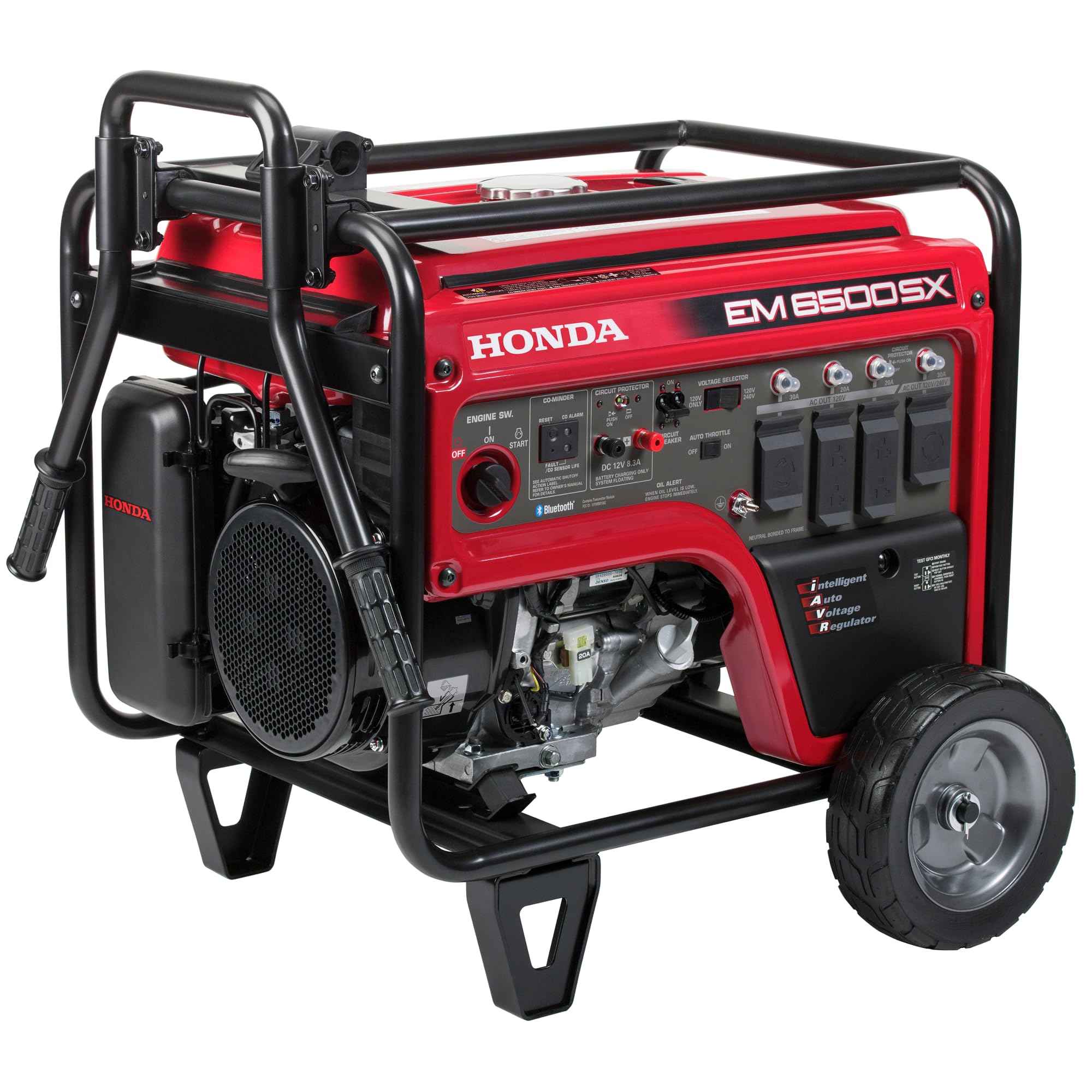
6,500 watts of Honda reliability with the app that tells you it is still running.
Performance and reliability carry this one, which makes sense for a 6,500-watt gas generator with electric start and a 7,000-watt burst for 10 seconds to start larger equipment. A 6.2-gallon tank runs 6.4 to 9.8 hours, and the iAVR voltage regulation holds a steady flow for sensitive gear. That is enough to run a whole house at idle in the owner reports, and that is a genuinely quiet claim for a 6,500-watt machine.
Honda’s My Generator app over Bluetooth is where it separates from a plain gas unit. Remote operation, monitoring, service reminders, and a wireless stop are all in the app, and the CO-MINDER system shuts the engine down if carbon monoxide climbs. A 3-year residential warranty covers it top to bottom. The unit runs at 64 to 66 dB(A).
The two things to know: it ships without oil, and it needs the handlebar, wheels, and battery assembled. One buyer measured the listed depth wrong for their shed, so check the real footprint before you commit. And one buyer ordered this instead of a smaller Honda by mistake — which is an expensive reminder to confirm the model number before checkout.
The case for Honda
- My Generator app gives remote start, stop, and monitoring over Bluetooth.
- CO-MINDER shuts down on carbon monoxide before it is dangerous.
Before you order
- Ships without oil and with parts to assemble.
- 260.1 pounds means a freight delivery and a permanent spot.
The overnight quiet pick: a strong fit for a household that wants a steady, known brand and an app on the phone.
Skip if: you want a lightweight carry or a unit that starts on propane.
10. ERAYAK 4500W Portable Inverter Generator

A 54-pound inverter that runs camping gear at 60.5 decibels and pairs up for more.
Two numbers define this one: 54 pounds and 60.5 dB(A). Against a 212.1-pound Westinghouse, that is a huge swing in portability, and the 60.5 dB rating is within the range of a normal conversation. It gives 4,500 peak and 3,500 running watts, with a 208cc engine and an inverter output rated 0.2% to 1.2% THD for sensitive electronics. That clean power is the reason laptops, TVs, and a CPAP can run from it.
Parallel-ready is where it scales. Connect two units with the sold-separately parallel kit and you get 7,000 rated and 9,000 peak watts with a 50A output — enough to run a bigger load without buying a bigger single machine. A 30A TT-30R outlet, two 120V AC outlets, a 12V 5A cigarette port, and USB-A plus USB-C ports cover the plugs. Fuel use is 0.561 gallons per hour at rated load or 0.21 gallons at 25% load in ECO Mode.
The catch is starting. There is no electric start, so it is a manual pull, and the review pages show a mixed result on first-pull reliability after storage. Add oil before first use or the low-oil sensor will block start-up. A buyer who ran one through six days of outage reported it powered two houses at or above capacity.
The carry-friendly pick: a 54-pound inverter with a 60.5 dB rating is a real contrast to the 212.1-pound gas workhorses above.
The one caveat: manual pull only, so a firm pull and fresh oil matter.
For the camper or small backup: a solid fit for tent camping, tailgating, and fridge backup.
Step up if: you want an electric start and dual-fuel options at the same time.
11. EF ECOFLOW DELTA Pro 3 with 2 Extra Batteries (12kWh)

Twelve kilowatt-hours of 120/240V battery power, with no refueling and no exhaust.
Performance is the aspect that carries this one, and the spec sheet backs it up. A 4,096Wh LiFePO4 base pack is loaded with two extra batteries for roughly 12kWh total, expandable to 48kWh with more batteries. Output is 4,000W continuous with 6,000W via X-Boost, and the 120/240V split-phase design can power a 1 HP water pump or a 3-ton central AC. That is a whole-home battery, not a camping gadget.
The 10ms switchover keeps NAS systems and servers alive, and X-Quiet operation hums as low as 30dB. You can charge it from AC, solar, a gas generator, or an EV charging pile, which is why owners treat it as a gas alternative. One report has it recharging from a 7,000W gas generator in about 2 hours and running a house on a 30A locking outlet. The 5-year warranty covers the automotive-grade LFP cells.
The trade-off is honest: it is 260 pounds, and the recurring note is that moving it needs wheels or two people. A few have hit an Error 71 BMS lockup and found the warranty shipping process slow. The fixed readout and outlet layout are also harder to reach in a tight garage corner. Plan for its real footprint before you assemble the stack.
The strongest case
- 12kWh totals out to days of whole-home backup with no fuel run.
- 240V split-phase runs a 3-ton central AC or a 1 HP water pump.
The unavoidable cost
- 260 pounds is a rolling unit, not a carrying one.
- Support response has been uneven on the rare bad unit.
The silent whole-home pick: it suits a household that wants backup without fuel or noise.
Not the budget plan: a pricey route compared with a gas workhorse, so only worth it if silence and no-fuel operation matter.
Know the Specs
Running Watts vs. Peak Watts
Running watts are the steady load a generator can hold all night. Peak watts are the short burst a motor needs to spin up. A refrigerator or air conditioner draws several times its running load for a split second, so check the peak number against your startup draw. A 3-ton central AC, for example, needs a surge a whole-home unit can supply — that is the difference between a unit that works and one that trips.
THD and Inverter Power
THD stands for total harmonic distortion, the measure of how clean the electricity is. An inverter generator converts the engine’s raw output into a steady sine wave. A lower THD number is safer for laptops, phones, and medical devices, and units rated at ≤3% or below land in that range. On raw open-frame power, sensitive electronics can see spikes that shorten their life. If you plan to plug in computers or a router, check the THD and inverter label.
Decibels (dB) at a Stated Distance
A decibel rating tells you how loud the unit is at a specific distance — commonly 23 or 25 feet. A 60.5 dB rating sits near a normal conversation, and a 64 dBA number is close behind. At 62 dB(A) at 25% load the sound is easy to live with. Sound climbs with load and distance shrinks the buffer, so place the unit near a wall or away from a bedroom window if you want a night without interruption.
Watt-Hours and LiFePO4 Capacity
A watt-hour is one watt of draw for one hour, so a 2,042Wh battery runs a 100-watt fridge for roughly a day before losses. LiFePO4 is the lithium chemistry in most quality battery stations, chosen for its cycle life. Check the continuous AC output too, because a 3,600Wh pack can still be limited to a set continuous watts. If you need a 240V load, look for split-phase output rather than a standard 120V battery.
Common Questions
Will a battery power station run my refrigerator overnight?
Can I run a central air conditioner on a portable generator?
Does a dual-fuel generator run better on propane or gasoline?
How long will a generator run on one tank of fuel?
Is inverter power safe for laptops and medical devices?
Can I connect two generators together for more power?
Do I need a transfer switch or an interlock for home backup?
Is a battery power station quieter than a gas generator?
Can I charge a power station from solar panels and how fast?
How heavy is too heavy for a portable generator?
The Bottom Line
If you want to keep a full home panel running in an outage, the generator in the world pick for most households is the Westinghouse 12500 Peak Watt Dual Fuel. It delivers 9,500 running watts and a 12,500-watt peak, and its dual-fuel engine runs on gasoline or propane, so a dry gas can does not end your outage. Shoppers say it can carry a full 100-amp home panel. If you would rather skip fuel and noise for the essentials, the EF ECOFLOW DELTA 3 Max is a battery unit that refills to 80% in 1.13 hours and runs silently, so it will not wake the house at night. For a whole-home battery that powers 240V loads (the higher voltage big appliances like dryers use) without a gas engine, reach for the EF ECOFLOW DELTA Pro 3 with two extra batteries.
One honest nudge: if your biggest worry is starting a central AC on the first press, put your money on the Westinghouse. Its 12,500-watt peak plus dual fuel gives it the best shot at that hard startup, and its high rating across hundreds of owner reviews backs that up.
How we choose
We do not accept paid placement. Every pick is matched to a real buyer and a real use-case; we do not hands-on test units.
Sources
Specifications: manufacturer listings and product documentation. Review insights: verified customer reviews, as of October 2026. Pricing: not shown on this page (it changes often); check the current price via the retailer link.
As an Amazon Associate, Home Digitized earns from qualifying purchases. This does not affect which products we feature.